The Syntax-Semantics Interface in Earlier Egyptian:
A Case Study in Verbs of Cognition
1JEAN WINAND
A. Foreword
WHAT WE KNOW ABOUT EARLIER EGYPTIAN essentially comes from studies in morphology and syntax.2 We
have so far witnessed different theoretical approaches: structuralism, the “Standard Theory” (and the “not-so-standard-theory,” see Collier 1990, 1994), generativism, etc. Questions that have been haunting (some) Egyptologists’ nights for decades (Vernus 1997; Winand 1997; Allen 2011a; Uljas 2011) remain largely the same:
• How can forms be mapped onto functions? Can one make a parallelism between the two? If so, should one adopt a strict isomorphic parallelism or looser, polymorphic (one-to-many) sets of relations?
• How far can we work with the principle of symmetry when reconstructing the verbal morphology? Should a variation that can be observed in a verbal class (e.g. the 3ae inf.) automatically be accepted for (all) other classes? If not, this raises a serious question about our ability to reconstruct paradigms in Egyptian (and probably also about the very purpose of making paradigms).
• What are the limits of use of the principle of analogy? To what extent are the emphatic forms of Later Egyptian that are morphologically marked (although there are significant differences between Late Egyptian, Demotic and Coptic) useful for understanding how the system worked in Earlier Egyptian?3 What can we infer about the verbal system in Earlier Egyptian from the
fact that the emphatic forms in Later Egyptian are distinct from the pragmatically/enunciatively “flat” forms (sḏm.f vs. j.jr.f sḏm, afswtM vs. ntafswtM)? To what extent does the existence of a form that is probably closest in Egyptian to a substantival form (mrr.f) have consequences for our analysis of the sḏm.n.f form? Is the parallel sufficient enough to accept that sḏm.n.f is a cover form at the graphic level for several morphologically distinct forms impossible to recognize because of the peculiarities of the hieroglyphic writing (Stauder 2014b)?4 To take
another viewpoint, what are the consequences, if any, of the existence of a Late Egyptian pattern specialized in sequentiality (jw=f ḥr (tm) sḏm) to how one should understand the morphology of the sḏm.n=f in Middle Egyptian?
• What use can be made of the negative (or passive) system when reconstructing the verbal paradigms of the positive (or active) forms? For instance, what can the opposition between passive sḏm.w=f vs. sḏm.n.tw=f tell us about the active sḏm.n=f?5 What can we gain in our 1 My thanks are due to Stéphane Polis for fruitful discussions on semantic maps and on critical issues related to lexical
semantics, and to Todd Gillen for his comments and for improving my English.
2 Curiously enough, the impact of pre-Coptic phonology, which apparently remains a German-speaking game field, seems to be limited to grammarians dealing with the predicative systems of Earlier Egyptian (but see recently Allen 2013).
3 Such a bottoms-up approach was instrumental in Polotsky’s seminal study (Polotsky 1944).
4 Once more, this was seen as pivotal in the Standard Theory: different unwritten vocalic schemes were once supposed to match different syntactic functions (see Depuydt 1986; Satzinger 1987, 1988).
analysis of the positive sḏm.n=f from the opposition between n sḏm.n=f vs. tm.n=f sḏm? Probably not that much, as both patterns do not strictly commute on a syntactic level. For the sake of comparison, should one accept in Late Egyptian that there are two morphologically distinct subjunctives because they can be used with two different negations (bn sḏm=f vs. tm=f
sḏm)? Most scholars would very likely disagree with such a view (Winand 1992 and 2006).
• How far is an isolated example (or some isolated examples) representative of something that is systemically significant?
One issue that will probably still be dealt with in decades to come is how temporality was expressed in Ancient Egyptian. Elaborating upon previous studies (Winand 2006a, 2006b), I here present a case study suggesting that the calculus of time and aspect is the result of a complex web of relations:
• actionality (argument structure, and modifications thereof), • the set of instructions given by the grammatical tenses, • the written genres and the repertoires within the genres, • some pragmatic considerations (to a certain extent),
• universally shared cognitive schemas in expressing causality or describing event structures (in the sense of Winand 2000 and 2006a).
Another, in my opinion, related issue for a more fine-grained understanding of Old and Middle Egyptian is lexicography in relation to grammar, something that is known in general literature as the semantic-syntactic interface (Levin and Rappaport Hovav 1997, Van Valin 2006). As is evident from the list given above, there is every reason to consider that the semantics of verbs constantly interact with grammatical tenses. This seems to be the case in any language, but it is crucially at the core of the functioning of languages that basically work within an aspectual system.
Thus, my answer to the general question raised by the organizers, which can be very broadly summed up as “how can we improve our understanding of Old Egyptian?,” is: by paying a closer attention to lexical semantics. This position was very recently advocated by James Allen (2011a, 5) in his reassessment of the
sḏm=f form(s?) in Old Egyptian. Lexical semantics was also the central topic of a conference held in Liège
in 2010 (see Grossman, Polis, and Winand 2012). Thus it seems that the idea is slowly making its way in Egyptology that lexemes are probably not some kind of flexible dough that can be freely used to flesh out some rigid syntactic skeleton.
I once again recently expressed my concern for the study of the relations between grammatical tenses and the verbal phasal aspect (also called Actionality, or, with a slightly different meaning Aktionsart) in a paper that was delivered in Leipzig in November 2012 at the conference Das “Altägyptische Wörterbuch”
und die Lexikographie der Ägyptisch-Koptischen Sprache (but see already Winand 1999, 2003). In this
paper, which was unequivocally entitled “A Dictionary, Please! The Leipzig Call,” I argued that: • a new dictionary is urgently needed in Egyptology;
• databases such as the TLA or Ramses (for Late Egyptian), no matter how useful they can be (and are, as a matter of fact), will never replace or be a credible substitute for a dictionary; • quite to the contrary, text corpuses, which, in a sense, are doomed to experience a never-ending
growth, will end up being out of control and beyond the reach of the majority of their potential users (Egyptologists who unfortunately turned out to be non-linguists, which seems to represent the majority of our community, and non-Egyptologists who take an interest in the study of language(s), which probably outnumber our small community).
A new dictionary — a very long-term project that cannot be realized outside the international cooperation of Egyptologists specializing in the study of texts and languages, joining forces with scholars who have an experience in dealing with lexicography, and of course with specialists in information technologies — should systematically provide, as regards the verbal lexemes, the argument structure(s) in relation to the grammatical tenses that verbs are actually used with. The study of verbs — but this is obviously also true for the other parts of speech — cannot be undertaken in isolation. The meaning of a verb, its capacity to enter a tensed paradigm, cannot be studied without considering the semantic web it belongs to. Taking the viewpoint of onomasiology is not something totally new in Egyptology (Spencer 1984, Vernus 1984a and 1984b, Cannuyer 1990, Gracia Zamacona 2008, etc.), but it remains largely underexploited (at least this has never been done systematically for any given stage of Egyptian), nor has it always be done within a sound theoretical framework.
The most promising avenues of research in this respect are of course lexical domains that do not belong to technical fields, where scientific terms or kinds of jargon are abundant.6 In this paper, I take some verbs
of cognition as a case study. Since my point is essentially epistemological (and methodological), I have not confined myself to Old Egyptian stricto sensu. The corpus considered here is Older Egyptian sensu latiore (Old Egyptian, Middle Egyptian and Classical Egyptian) with some occasional extensions towards later stages (18th-Dynasty Classical Egyptian and earlier phases of Late Egyptian). Such an extended corpus is probably necessary to secure a sufficient amount of data to make hypotheses; it also introduces a temporal dimension that is needed for any tentative dynamic reconstruction of the semantic web of relations that will be discussed in this paper.
The general theoretical principles that underlie my research have already been presented in Winand 2006a, admittedly a difficult piece of work to grasp.7 I thus take the present opportunity to briefly reassess
its fundamentals.
B. Aspect and Actionality
In languages where grammatical tenses in autonomous sentences express aspectual relations,8 the phasal
structure of verbs plays a decisive role. As native speakers of (mostly) Romance or Germanic languages, we are accustomed to a system where all verbs can theoretically accept all grammatical tenses (this is well illustrated in the neat, gapless grammatical tables that inevitably go with school textbooks; this of course provides all the material needed by teachers to put their pupils in the most terrible torments).9 Exceptions
precisely pop up when aspect is at stake. In this respect, the restrictions of use (or the semantic shifts) one can observe when a progressive is used are particularly significant. In French, for instance, there is no progressive tense strictly speaking, that is, a tense that belongs to a regular grammatical system of
6 See some already-published specialized Egyptian lexica on fauna, flora, architecture, medicine, etc.
7 In Egyptology, there have already been some (limited) signs of interest in verbal Aktionsart (but see, e.g., Loprieno 1984 or 1985, Hannig 1984, Vernus 1984 and 1990); after the publication of Winand 1998, 2003, 2006a and 2006b, see also Werning 2008 and 2011; for a practical application to some semantic classes of verbs, see Hafemann 2002.
8 In other syntactic environments (adjectival forms, nominal forms), there are cases of neutralisation, which should be considered only secondarily. As a matter of fact, specialization in meaning or in syntax (subordinate or relative tenses, passive tenses, emphatic forms, presence of a negation, etc.) must in a way be offset by a limited choice in the expression of aspect/time when compared to “flat (positive, active, enunciatively neutral, syntactically autonomous) sentences.”
9 My tender years in fundamental school were rhythmed by conjugating exciting verbs such as moudre in the imperfect subjunctive or in the passive simple past.
oppositions. The pattern “il est en train de faire X” (lit. “he is on his way to do X”) can be used in some pragmatically constrained circumstances.10 Among other instructions, it conveys the features [+DURATIVE]
[+DYNAMIC] and [+AGENCY]. This explains why a sentence such as
[1] Le livre est en train d’être sur la table “The book is being on the table”11
sounds rather strange because the stative verb être is of course [+DURATIVE], but does not select an agent
as its subject, and it is of course not dynamic. In this case, the use of être in the progressive is simply blocked in standard French. In some cases, a verb that does not exactly fit the instructions implied by a grammatical tense can nevertheless be used. In such cases, the price to be paid for or, if one prefers, the outcome of the negotiation between the two players (the verbal lexeme and the grammatical tense), is a modification of the aspectual selection made by the grammatical tense. For instance, in French, it is perfectly natural to have sentences such as
[2] Il est en train de mourir “He is dying.”
Although the verb mourir in French, as its counterpart in many languages, is perceptually conceived of as [-DURATIVE], the progressive can be used. As the process itself, being non-durative, cannot be under the scope of the progressive, the pre-phase of the process has in this case been selected. This contrasts with a verb such as courir, which belongs to a much more common semantic class of verbs [+DURATIVE] [+DYNAMIC] [+AGENTIVE] [-TELIC]:
[3] Il est en train de courir “He is running.”
Graphically, Ex. 3 can be represented like <~[~~~]~>, where the broken brackets < > represent the limit of the process and the square brackets [ ] the aspectual selection made by the grammatical tense, but Ex. 2 shows a different configuration (-[---]-<+>_____).12 As is clear from the graphs, while the aspectual selection
stands inside the limits of the process in Ex. 3, it is outside the process stricto sensu in Ex. 2. From these two simple examples, one cannot escape the conclusion that verbs have different phasal configurations.
Mourir has a pre- and a post-phase (the latter one can be accessed to by a stative tense, like the old perfective
in Egyptian), but courir has no pre- nor post-phase. If one intends to select the phase that immediately precedes the process of courir in French, one has to say something like
[4] Il est sur le point de courir “He is on the verge of running” and “He is about to / going to / ready to run” and the like.
Of course, languages do not always work in such a simple, straightforward way. The default phasal configuration of a verb can be modified when the argument structure is changed. For instance, it is possible to assign a goal to the process of courir by adding an adjunct like à la poste (to the post office).13 Such an 10 It is perfectly natural in French to use the simple tense to answer the question Que fais-tu ? “What are you doing?” The “progressif ” will be used rather to stress the activity the subject is engaged in, or to make the point clearer (Mais qu’est-tu
donc en train de faire ?).
11 Of course, a formulation like “the book is lying on the table” is perfectly acceptable in English, but a sentence such as le livre
est en train d’être couché sur la table fails the test in French, which shows that the two progressives do not exactly share the
same semantic traits.
12 For the graphs used to represent the selection made by an aspectual tense, see Winand 2006a.
extension recasts courir in another class, that of the telic verbs. The change of class (recategorisation) is made visible in these contrastive examples:
[5] a Il a couru pendant 20 minutes “He ran for 20 minutes”
b Il a couru à la poste en 20 minutes “He ran to the post office in 20 minutes” c? Il a couru à la poste pendant 20 minutes “He ran to the post office for 20 minutes” d Il a couru en 20 minutes “He ran in 20 minutes.”
In 5c, the presence of a temporal adjunct expressing a span of time is a bit awkward, though not impossible (there is hardly something that cannot be said with an appropriate context!) if one intends to say that the subject ran for twenty minutes but did not succeed, for whatever reason, in reaching the post office. Ex. 5d seems at first sight to be close to 5a. Actually, 5d cannot be understood without supplying a goal that has been omitted under pragmatic relevance. With courir, the implied goal can be a prepositional phrase (PrepP) such as à la poste, but another argument structure is also possible, such as a direct object, as in courir les
10 kilomètres (cf. to run the mile/marathon).
The preliminary conclusions that can be drawn are as follows: • some grammatical tenses give aspectual instructions; • these instructions consist of selecting a phase of the process; • all verbs have a phasal structure;
• there are different basic phasal structures that can be defined by a limited set of criteria (the most important and, as it seems, probably universally attested are durativity, telicity, dyna-micity, agency);14
• change(s) in the argument structure can modify the basic phasal structure of a verb;
• although there are some general, maybe universal, tendencies, the instructions given by grammatical tenses must be appreciated for any individual language: for instance, the English progressive and the French “progressive” do not share exactly the same semantic field (“The man is standing in the street” is perfectly acceptable in English, but the corresponding L’homme
est en train d’être debout dans la rue is definitely odd in French);15
• the same conclusions apply to the phasal structure of the verbs: there is no direct corres-pondence between a French verb and its “correspondent” in another language, as will be exemplified in the case study (as has been demonstrated, languages with an aspectual system often “compensate” for the relative numerical poverty of their verbal lexemes by being able to select phases that would be distributed to different lexemes in temporal systems;16 we will have
to come back to this in our case study);
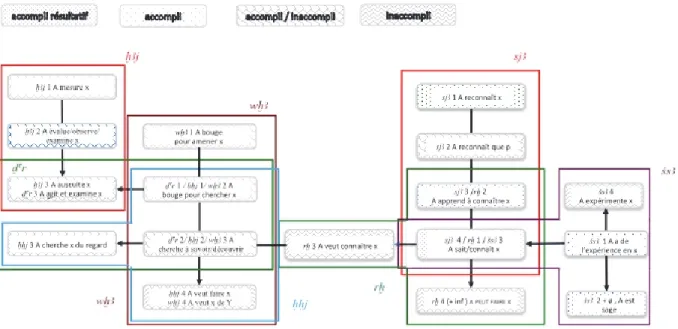
• as a consequence of the preceding statement, the way languages classify processes can vary. For instance, Egyptian gmj as a verb of cognition only means “find, discover” (see now Vernus 2012); it does not seem possible to access the phase preceding the process of finding, that of getting knowledge, as is possible for instance in French (il est en train de trouver la réponse). In Egyptian, this phase is expressed by other lexemes such as wḫƷ, ḥḥj, or ḏƸr (see below).
14 For a definition of these terms, and their relevance for the structure of Egyptian verbs, see Winand 2006a, 53–68.
15 The feature [+ DYNAMICITY] is part of the definition of the Egyptian progressive (Winand 2006a, 265–68, 286–88), which can have an influence on the selection of the subject. This property is of course not automatically shared by all languages that have a progressive in their tense system.
Classifying the verbal lexemes according to their phasal structure is admittedly a difficult, but not impossible, task. The main objection one is most faced with in the specialised literature is that it would be impossible to decide what the basic configuration is. For instance, for courir, it would be a matter of discussion to decide whether il court is more basic than il court vers X. In the first case, the second sentence must be analysed as an extension of the argument structure, but if one takes it the other way around, the basic structure is the bivalent one, and the first sentence, which must then be seen as a secondary development, is to be analysed as a case of valency reduction. I must confess that this kind of disputatio reminds me the Byzantine discussions on the gender of the angels. Actually, the whole argument can be circumvented. In my theoretical framework, I chose to select the best represented structure as the basic one on a statistical basis. Then one has only to determine to what extent the argument structure can be modified, and which effect(s) these changes can trigger. The most important point is to set a clear starting point whence it is possible to derive the other argument patterns. To put it another way, it does not really matter whether one decides that courir is primarily a telic bivalent verb that can be made atelic by the suppression of its second argument (courir vers la poste, courir le marathon > courir ø) or vice-versa. Thus, everything being equal, I opted for the configuration that is the most often, the most widely attested (as far as synchrony is concerned, diachrony can help to determine the historical extensions of an argument structure). This basic configuration can of course change over time. For instance, pḥ “reach” is transitive in Older Egyptian, but was treated like a verb of movement from Late Egyptian onwards, which prompted a change in the argument structure (pḥ noun phrase (NP) > pḥ r NP; see Winand 1999).
In defining the phasal structure of a verb, I consider the following features:
• the argument structure, that is the number of arguments (1, 2 or 3, more exceptionally 4), their form (definite/non-definite; singular/plural), their place on the scale of animacy, their semantic role (patient, experient, undergoer, etc.);
• the combination with the grammatical tenses that are aspectually marked;
• and the combination with temporal adjuncts that pass for diagnostic of an aspectual value, even if this must be interpreted with caution (Winand 2006a, 53–63).
To this, one must add, in a second step, the interaction of the verbal lexeme under consideration with the other verbs that belong to the same semantic web (onomasiological viewpoint). At the end of the process, one can expect two major results: (1) a classification of the verbal lexemes into semantic classes of actionality, (2) a better understanding of the verbal system.
For (1), the classes of actionality are defined according to a limited set of semantic features (Winand 2006a, 106–107):
• durativity • dynamicity • telicity • agentivity.
Any process has a limited number of aspectual phases. Prototypically, a process extends over a certain timespan [+ DURATIVE] and expresses an activity [+ DYNAMIC], which normally implies that its subject is
an agent that has full or some control of the process; this activity is ordinarily oriented towards the achievement of a goal [+ TELICITY], which means that the situation that prevails when the process ends is
my terminology, is generally perceived as static.17 In some cases, the phase that immediately precedes the
process is perceived by the linguistic community as having a cognitively significant adherence to the process. This pre-phase, to follow my terminology, can also be accessed via a grammatical tense marked for aspect (see Ex. 2). Graphically, a generic process can be represented as follows:
<~~~~~~+>_________
with < > setting the limits of the process
~~~~~ suggesting dynamicity, as opposed to _______, which expresses stativity
+ being the sign for telicity.
A process such as <~~~~~~+>_________ is usually called an accomplishment in the specialized literature.
In Egyptian, this category is well represented by very common verbs such as jrj “do,” or jwj “come.” It turns out that the classification of actionality does not necessarily match the syntactic distinction between transitive/intransitive. Both verbs are dynamic, durative and telic; but the change of situation is evaluated from the point of view of the second argument (the direct object) in the case of jrj (there was no X before the process started, and there is an X when the process is completed), and from the point of view of the subject in the case of jwj (A has moved in another place at the end of the process). This does not imply, of course, that diathesis is grammatically non-relevant in Egyptian, as it explains why jw jr.n=f sw is used in
the first case, and jw_j jj.kwj r X in the second case (see the difference in the selection of the auxiliary
[être/avoir] in French for the present past: il a fait X vs. il est venu à X, a distinction that was lost in English “he has done it” vs. “he has come to X”).18
Arranging classes of actionality according to the criteria that have been selected amounts to making a taxonomy. Although all taxonomies have a familiar look, it follows as a consequence of what has been said above about the irreducibility of the processes that lead to the formation of the lexicon across languages, that all possible classes of actionality are not equally relevant for every language. In Winand 2006, 106, I proposed a taxonomy that claims validity above all for Middle Egyptian. A class of actionality can be considered valid for a given language if it has some semantic properties that make it different from other classes and if it accordingly displays a distinctive grammatical behaviour. This claim is consistent with the semantic/syntactic hypothesis. If a semantic class meets only the first criterion, it probably will deserve an entry in a dictionary, but it clearly has nothing to do with actionality in the sense intended here. For instance, in the general class [verbs of movement], which — it should be noted — does not constitute a homogeneous class of actionality in Egyptian, one could set apart movements that require the help of a vehicle (drive, fly, surf) or movements that process along a horizontal line (run, walk) as opposed to vertical movements (jump, fall, ascend, etc.), etc. If these sub-classes do not behave grammatically in significant different ways, the inescapable conclusion is that they do not constitute classes of actionality in their own right.
For (2), grammatical tenses (or some constructions outside the grammatical system of oppositions) that are aspectually marked make a selection in the phasal structure of the verb. The following cases are such theoretically possible selections (once again taking as a starting point the class of accomplishments):
<~[~~~~]~+>_________ progressive imperfective (“he is/was/will be doing X”)
17 Processes with a dynamic postphase exist in many languages. This is the case in Egyptian for a well-known verb, šmj, which can take in the Old Perfective the meaning of walking (Winand 2006, 231–33).
18 The distinction was still retained into the 19th century in some literary texts. Compare Matthew 21:10: “when he was come into Jerusalem” (King James version) and “when he had entered Jerusalem” (New American Standard Bible).
<~~~~~~+>[______[___ resultative perfective (“he has/had/will have done X”)
[<~~~~~~+>]_________ global imperfective (“he does/used to do/will do X”)
<~~~~~[~+>]_________ momentaneous perfective (“he did X”)19
[ ]<~~~~~~+>_________ mellic (“he is/was/will be about to do X”).20
The ways individual languages can formally express such aspectual selections vary to a great extent. Some languages exclusively rely on auxiliaries or specialized expressions to do the job. In others, such as Classical Egyptian, the grammatical tenses are deeply involved. In between, there are languages (such as French or English) that combine grammatical tenses and other, more lexically oriented, means.
As has already been said, the instructions given by a grammatical tense do not blindly apply to any class of actionality. The “negotiations” can end up in only three possibilities:
• a complete harmony between the two protagonists: for instance, the use of a progressive with an accomplishment;
• a compromise between the grammatical aspect and the verbal phasal aspect: for instance, the use of resultative tense, such as the Old Perfective, with an atelic verb such as sḏm in Egyptian, which triggers a semantic shift (from “hearing” to “listening to, taking into account”; see Winand 2006, Ex. 275);
• the absence of a solution for combining the two (as in Ex. 1, where a stative verb normally resists a progressive in French), which is admittedly rare cross-linguistically, since languages usually display a wealth of inventiveness in this respect.21
In my opinion, it is as important to show which combinations are actually attested in our material (with the corresponding intended meanings) as to state what is not attested and for which reasons. As is well known, an absence can mean as much as a presence. As will be demonstrated in the case study below, the impossibility of combining a verb with a given tense marked for aspect can be attributed to two main reasons: first, there is no compatibility between the phasal aspect of a verbal class and the aspectual instructions of a grammatical tense (this is the third outcome listed above); second, this has to do with the structure of the lexicon in the language under consideration (two phasal aspects of what would have been considered a single process in another language have been distributed over two distinct verbal lexemes: cf. the wḫƷ – gmj distribution).
C. The Case Study
As a case study, I selected verbs of cognition that are closely related. They can be divided into two main groups: verbs of knowing (rḫ, sjƷ, šsƷ), and verbs of searching (wḫƷ, ḥḥj, ḏƸr, and, to a lesser extent, ḫƷj). The following points will be systematically considered:
• the argument structure in correlation with the grammatical tenses, • the system of classifiers,
• the onomasiological viewpoint: i.e., the synonyms and semantically related verbs that are found in the immediate context (i.e., in the same sentence or in the preceding/following sentence).
19 Pragmatically most often confined to past situations, but not obligatorily so.
20 For this term (which should not be confused with prospective, a term that is best avoided in discussions on aspect), see Winand 2006a, 175.
The following results are expected:
• defining, for each verb, all its attested meanings using semantic primitives,22
• discovering the correlations between meanings and argument structures/grammatical tenses, • discovering the semantic bridges between meanings,
• organizing the meanings of the verbs under consideration in a coherent semantic map.
As already noted in the Introduction, the corpus considered here is Earlier Egyptian (Old and Middle Egyptian), with occasional examples coming from the New Kingdom (mainly 18th Dynasty) “égyptien de tradition.”
1. Verbs of knowing
Three verbs are considered here: sjƷ, rḫ, and šsƷ. a. sjƷ
The verb sjƷ is attested from the Old Kingdom onward until the New Kingdom, where it became limited to religious texts. It usually takes as classifiers: nothing in Old Egyptian, in Middle Egyptian and during the New Kingdom, with occasional additions of or . It is consistently written with the sign (S 32), which depicts a piece of fringed cloth.
The Wb. suggests the following translations: “erkennen,” “Kenntnis haben von etwas”; when browsing
the data collected in the TLA, one can find the following translations: “(an)erkennen,” “kennen,” “zur Kenntnis nehmen,” “bewusst sein,” “verstehen,” “durchschauen,” “weise sein,” “erwählen,” “ertappt/ identifiziert sein,” “einen Eindruck von etwas gewinnen,” “nachdenken,” “beschreiben.”
Considering the available data for the period of time beginning with the Old Kingdom and ending with the 18th Dynasty, one can make the following observations.
The verb sjƷ can be roughly translated23 “reconnaître” (“recognize”).24 In Egyptian, one can distinguish
four main senses of “reconnaître.” I review them in what probably mirrors the diachronic evolution of this lexeme.
sjƷ 1: “reconnaître 1”: x EXISTS; A ALREADY KNOWS x; A IS ABLE TO RECOGNIZE x WHEN MEETING/ SEEING x AGAIN.25
In this sense, sjƷ is attested from the Old Kingdom onward. The argument structure is always A[ANIMATE] Vb X[(IN)ANIMATE]. This sense is very strongly connected with the domain of PERFECTIVITY;26 the following tenses are attested: perfectif sḏm=f, accompli sḏm.n=f with resultative 22 The system of semantic primitives used in this paper mainly relies upon Wierzbicka 1996 and Goddard 2002.
23 As will become clear in the following pages, I do not believe, in synchronic terms, in something like “the basic meaning,” from which all attested meanings could be ultimately derived. But for pedagogical uses (and also in dictionaries), one cannot minimize the interest of suggesting a global translation.
24 In this study, I will give French translations first, not so much for my personal comfort, but because as this is a semantic study, I expressly want to avoid any kind of misunderstanding coming from approximate translations in a language to which I do not belong as a native speaker. The purpose of the English equivalent given in parentheses is to supply some help for those who are not too well acquainted with French.
25 Here I take ‘recognize’ as a semantic primitive for the sake of brevity. Actually, ‘recognize’ can be analysed in more primitive traits like x EXISTS, A ALREADY KNOWS x, A SEES THAT x IS x.
26 To avoid ambiguities (Winand 2006), I use small caps for semantic designations (PERFECTIVE, IMPERFECTIVE, PROGRESSIVE, etc.) as opposed to lower-case letters for grammatical tenses (accompli, inaccompli, progressif, etc.). As regards grammatical tenses, I keep the French terminology as presented in Winand 2006a.
meaning, accompli momentané sḏm.n=f (with punctual meaning in narrative), relative form of accompli (sḏm.w.n=f) and the pattern n sḏm.n=f.
sjƷ 1 is used in collocation with verbs such as mƷƷ and rḫ, expressing acquisition of knowledge or
possession of knowledge. The following examples nicely show that the subject has a previous knowledge of what he is subsequently able to recognize:
[6] mƷ.n sw ḥnmm.t, sjƷ.n sw mskt.t (Pyr. 221–22)
“le peuple solaire l’a vu, la barque-msket l’a reconnu” (“the solar people have seen him, the
mskt.t-boat has recognized him”)
[7] n ḏd=j grg r kj, rḫ.kwj nṯr jmj rmṯ, sjƷ=j sw (Paheri, l. 9)
“je n’ai proféré de mensonge contre quiconque, connaissant le divin qui est en l’homme, je l’ai reconnu” (“I have not said a lie against anyone, knowing the god that is in men; I have recognized him”)
sjƷ 2: “reconnaître 2”: xEXISTS; ADOES NOT KNOW x; AIS ABLE TO RECOGNIZE THAT xBELONGS TO
X, or THAT x= x.
In other words, the subject, who did not have previous knowledge of x, is able to recognize that x is a member of the class X, or — but this is a specialization of the general case — that x is truly x (the class X being in this case reduced to one member).
In some cases, especially in the Old Kingdom, sjƷ 2 can take on the meaning of “tenir compte, prendre en consideration” (“take into account, take into consideration”): one recognizes that x, being what it pretends to be, deserves consideration:
[8] jw sjƷ md.t n.t mḏƷ.t tn jrj.t.n=k ḫr nswt r jz.t r rdj.t rḫ.t(j) wnt=k hƷ.t(j) m ḥtp … (letter from Pepi to Hirkhuf, col. 3)27
“on a tenu compte du texte de cette lettre que tu as faite par devant le roi pour le palais afin d’informer que tu es descendu en paix” (“one has taken account of the text of this letter you made under the king to the palace to let know that you have come down in peace”)
Very often, there is an adverbial extension indicating how the subject is able to recognize x.
The grammatical tenses aspectually marked that are attested with sjƷ 2 equally belong to the
PERFECTIVE (imperative, passive of accompli, accompli sḏm.n=f) and the IMPERFECTIVE domains
(inaccompli général sḏm=f, mrr=f, participle of inaccompli, infinitive): [9] … sjƷ.n nswt ḥr rs-tp=f (stela Cairo CG 20764, x+3)
“… que le roi a discerné (reconnu) en raison de sa vigilance” (“… whom the king has recognized because of his vigilance”)
[10] sjƷ=j sw [r-jḫ pƷj=j nḫt] (Kamose Stela I, 3)
“à quoi la reconnaîtrai-je ma victoire?” (“how shall I recognize my victory?”) [11] sjƷ ms.t(j).sj m jd.t n.t jwr.t (pKahun 3, 2)
“reconnaître celle qui doit enfanter dans la vulve de quelqu’une qui est enceinte” (“distinguishing who will give birth in the vulva from one who is pregnant”).
sjA 3: “reconnaître 3”: x EXISTS; A DOES NOT KNOW x; BY EXPERIENCING, A GETS TO KNOW x.
In this sense sjƷ is attested in the Middle Kingdom and the New Kingdom. It is of course very close to rḫ 2 “get to know” (cf. below). In this configuration, the argument structure shows a predilection for A[animate] Vb p; p can be grammatically expressed by an autonomous sentence, or by a sentence introduced by wnt or ntt. The grammatical tenses almost always belong to the domain of the PERFECTIVE:
[12] sjƷ.n ḥm=j wnt nn jr.tj=fj st nb ḥr-ḫw=k (stela of Ikhernofret, 9)
“car MM a acquis la conviction que personne à part toi ne pourrait faire cela” (“for My Majesty is now fully convinced that nobody but yourself could do this”)
[13] sjƷ=f pw N wrš ṯz r=f (CT VI, 246p)
“c’est qu’il se rend compte que N passe son temps à attacher” (“it means that he realises that N spends his time knotting”)
[14] rḫ.n{n}=sn jnk nb=sn, sjƷ.n<=sn> jnk wtṯ (ṯw) jmn-rƸ sƷ.t(=j) (Urk. IV, 346, 3–7)
“ils ont découvert que j’étais leur maître, ils ont reconnu que c’est moi, Amon Rê, qui t’avais enfantée, ma fille” {“they have learnt that I am their lord, they have realised that it was me, Amun-Ra, who created you, my daughter”).
sjƷ 4: “reconnaître 4”; x EXISTS; A ALREADY KNOWS x
In this sense, sjƷ is of course very close to rḫ 1 “to know” (cf. below). It is only attested as a participle in the accompli:
[15] jb sjƷ jmj ẖ.t, rḫ N pn, m ḫm sw (CT VI, 399u)
“ô cœur qui (re)connaît ce qu’il y a dans le corps, apprends à connaître ce N, ne le néglige pas !” (“O heart who recognises what is in the body, try to know this N, do not neglect him!”) [16] nb sjƷ sjƷ rḫy.t sjƷ=f m ḥm n stp-sƷ wnt bƷk-jm snḏ ḏd st (Sin. B 214–15)
“maître de science, qui connaît les sujets, il savait, dans la majesté du palais, que cet humble serviteur avait peur de le dire” (“lord of wisdom who knows his folk, he knew in the majesty of his palace that this humble servant was afraid of saying it”).
The following preliminary conclusions can be drawn:
• as regards the grammatical tense system, the tenses that belong to the sphere of the PERFECTIVE
largely prevail (30/36 in my corpus);
• sjƷ is never attested with a tense that expresses some kind of dynamic durativity (inaccompli
progressif); sjƷ can be contrasted with rḫ in this respect, which can be — albeit very rarely —
used in the progressive (cf. below);
• as the recognition of somebody or something is most often done by some kind of visual activity,
sjƷ is close to the semantic field of the verbs of seeing, such as gmḥ or mƷƷ;
• the classifiers suggest that sjƷ was first perceived as a mental activity ( ); the other classifiers ( or ) are attested later.
Thus sjƷ seems to express the instant recognition of something, a kind of flash memory. There is no process that leads to the state of knowing. The sḏm.n=f can focus on the resultative state of the process, which makes
sjƷ close to rḫ in this respect. In my system of graphic representation of actionality, the phasal structure of sjƷ can be captured as <+>_____.
b rḫ
The verb rḫ is well attested from the earliest records. If written with a classifier (the zero classifier is well attested), it usually takes the papyrus roll ( ).
The Wb. suggests the following translations: “wissen,” “kennen,” erkennen”; in the TLA, one can find
the following translations: “wissen,” “kennen,” erkennen,” “erfahren,” “bekannt sein,” “kennenlernen,” “lernen.”
Considering the available data the following observations can be made.
rḫ 1: “connaître”: x EXISTS, A KNOWS x.
The argument structure is most often A[animate] Vb X[(in)animate]; the second argument can also be a bare proposition or a proposition introduced by wnt or ntt (for the different types of comple-mentation, see Uljas 2007):
[17] jw ḥm ḥm(=j) rx mrr=k ḏd ḫ.t nb(.t) mrr.t ḥm(=j) (Letter of the King to Rashepses, col. 4)28
“Ma Majesté sait de fait combien tu aimes dire toutes choses que MM aime” (“My Majesty actually knows how much you like to say all that My Majesty likes”)
[18] jw=k rḫ.t(w) ntt ḏd.n PN r zƷ=f (Chicago Letter to the Dead OIM 13945, 1)29
“tu sais que PN a dit à son fils” (“you know that PN said to his son”).
The second argument can sometimes be omitted;30 in this case, rx expresses the mere situation of
knowing:
[19] jnk rḫ n nty n rḫ=f (stela of Antef, BM EA 581, B 11)31
“je suis quelqu’un qui sait pour celui qui ne sait pas” (“I am one who knows for him who does not know”).
In one example, the argument structure has a PrepP extension (r + NP), which triggers a different shade of meaning (A makes a distinction between X and Z: lit., A knows X rather than Y):
[20] ḥƷtj=j n ntf m ẖ.t=j rḫ=j Ƹnḫ r mwt (Sin. B 255–56)
“mon coeur, il n’était plus dans ma poitrine au point que je puisse (encore) distinguer la vie de la mort” (“my heart, it was not in my chest (anymore) so that I could know life from death”). As regards the grammatical tenses, tenses that belong to the PERFECTIVE largely prevail: (subject +) old
perfective, accompli participle in adjectival predicate, n sḏm=f, accompli relative form (sḏm.w.n=f), perfective sḏm-f (in the Pyramid Texts only, except in two cases, which could be explained as a participle as well)32, and subjunctive:
28 See Eichler 1991, 149–52. 29 See Gardiner 1930, 19–22.
30 The omission of an argument must not be confused with the omission under relevance, which does not affect the actionality of the process (see Winand 2004; 2006a, 125).
31 See photograph in Parkinson 1991, 62.
32 jnk Ʒḫ šps jqr, rx(=j)/rḫ(.w) ḫ.t “je suis un esprit vénérable et excellent, je connais les choses (ou “qui connaît les choses”)” (Tomb of Heri-Meru, front wall, 5). A similar situation can be observed in the Tomb of Ij-en-Hor (architrave): jnk jgr Ʒḫ [ ]
rḫ(=j)/rḫ(.w) ḥkƷ jw rmṯ rḫj jnk [ ] “je suis aussi un esprit [ ] je connais/connaissant la magie et les gens savent que je [ ].”
Cf. also stela Cairo CG 20543, A 10–11, where the sentence jḫr rḫ=s jqr s.t-Ƹ(=j) “as she knew the excellence of my action” could be segmented jḫr rḫ s(j) jqr s.t-Ƹ(=j), i.e., an adjectival predicate.
[21] j.rḫ=j sw rƷ pn n RƸ (Pyr. 771a P)
“je la connais cette formule de Rê” (“I know it, this spell of Ra”)
[22] j(w)=k rḫ.t(j) jj(=j) n=k ƸƷ ḥr wḏƸ-mdw ḥnƸ A B (Cairo Letter to the Dead, col. 10)
“tu sais que je suis venu ici à toi à cause du procès avec A et B” (“you know that I have come here about the case with A and B”)
[23] jw=j rḫ.kwj rn=j, n ḫm=j sw (CT VI, 176g)
“je connais mon nom, je ne l’ignore pas” (“I know my name, I am not ignorant of it”) [24] rḫ ṯw tr ḏd mrr.t ḥm(=j) r ḫ.t nb.t (Royal Letter to Rashepses, col. 3)
“tu sais par nature dire ce que MM préfère plus que tout” (“you know by nature how to express what My Majesty likes above all”) — This example should be contrasted with Ex. 17 from the same letter (adjectival predicate vs. subject + Old Perfective)33
[25] n rḫ pjpj pn mw.t=f tp.t rḫ.t.n=f (Pyr. 1428d P)
“Ce Pépi ne connaît plus sa première mère, qu’il connaissait” (“This Pepi does not know (anymore) his first mother that he knew”)
[26] sm.n=j ḫm.n(=j) mj rḫ.n(=j) n-mrw.t nfr rn(=j) m r(Ʒ) n tp(j).w-tƷ (stela Cairo CG 20543, A 15–16) “si j’ai nourri celui que je ne connaissais pas comme celui que je connaissais, c’est afin que mon nom soit excellent dans la bouche de ceux qui sont sur terre” (“I fed him whom I did not know like him whom I knew so that my name be perfect in the mouth of those who are upon earth”).
The semantic sphere of the IMPERFECTIVE is represented by the mrr=f, and probably once by the inaccompli général sḏm.f; in the former case, because of the syntactic environment (PrepP), the
aspectual opposition between PERFECTIVE and IMPERFECTIVE is neutralized:34
[27] n-zp jw.t ḫ.t nb.t jm(=j) n.t ḫsf n-ƸƷ.t-n rḫ(=j) ḫ.t (stela of Tjeti, 6)
“il ne s’est jamais produit quelque chose à cause de moi méritant punition, tant je savais les choses” (“nothing ever happened because of me that would deserve punishment as I knew so many things”)
[28] ḥs.tw=j ḥr rḫ=j m-ḫt rnp.wt jn nty.w r sn.t r jr.t.n=j (Urk. IV, 58, 2–3)
“je serai loué pour ma connaissance à travers les ans par ceux qui imiteront ce que j’ai fait” (“I shall be blessed for my knowledge through the years by those who will imitate what I did”). The same effect obtains when the mrr=f is used as complement of another verb, in this case the verb rḫ itself; one will note that the second argument has been omitted:
33 Cf. jn tr rḫ.w(j) ṯw jr.t mrr.t ḥzz.t nb=k “comme tu sais bien — n’est-ce pas? — faire ce que ton maître apprécie et loue?” (Letter of the King to Hirkhuf, col. 9).
34 See also: m ƸƷ jb=k ḥr rḫ=k “ne t’enfle pas la tête parce que tu sais” (Ptah. 52), which should be contrasted with Ptah. 178–79: jmj=k ƸƷ jb=k r.f ḥr rḫ.t.n=k jm.f ḫntw “tu ne dois pas être prétentieux contre lui à cause de ce que tu as appris à connaître de
lui précédemment,” where the presence of ḫntw shows that rḫ.t.n=k has the meaning of rḫ 2 “to get/obtain knowledge of” (cf. below).
[29] n tkk.n sw rḫ.w rḫ=f (Merikare E 33–34)
“ceux qui savent qu’il sait ne peuvent l’agresser” (“those who know that he knows cannot hurt him”).
In the final case, the inaccompli général sḏm=f is used adverbially, expressing a contrast between someone who is ignorant although he should know; once again, there is a neutralization of the aspectual opposition:
[30] nn km.n bw nfr n ḫm rḫ=f (Teaching of Amenemhet, Ve)35
“Le bienfait de/pour celui qui ignore alors qu’il devrait savoir ne saurait aboutir (se concré-tiser)” (“a good thing of/for him who ignores although he should know cannot be realised”). The contrast between rḫ 1 “savoir” and rḫ 2 “apprendre à connaître” is evident in examples such as the following one:
[31] r[ḫ.n=j ṯ]w[t šps] wrt [n=]j [m] jšs.t sk ḥm ḥm=j rḫ wnt P (Royal letter to Senedjemib, col. 7) “j’ai réalisé pourquoi tu étais quelqu’un de très utile pour moi étant donné que ma Majesté sait que P” (“I have come to know why you are so useful for me, as My Majesty knows that P”).
rḫ 2: “apprendre à connaître”: x EXISTS, A GETS KNOWLEDGE OF x BY EXPERIENCE.
The argument structure is most often A[animate] Vb X[(in)animate]; the second argument can also be a bare proposition or a proposition introduced by wnt or ntt, but this seems less common than it is for rḫ 1:
[32] j.rḫ šsp=k n=k ḥtp=k-nṯr pn (Py. 771a P)
“apprend que tu vas recevoir cette offrande divine” (“know that you will receive this divine offering of yours”)
[33] ḏd bƷk-jm dj(=j) rḫ PN wnt jqdw n spr.t=f r GN (T. Balat 3686)36
“je fais en sorte que PN sache que le maçon n’est pas encore arrivé à GN” (“I inform PN that the builder has not arrived yet at GN”).
The second argument is never omitted, which contrasts with rḫ 1, where this is far from exceptional. In syntactically autonomous sentences, the meaning “apprendre connaître” obtains with the
sḏm.n=f. This contrasts with the use of the perfective sḏm=f (Pyramid Texts) and Old Perfective (Old
Kingdom, except for Pyramid Texts), which has been observed for rḫ 1. When the sḏm.n=f is used with
jw, the difference can be very tiny when compared with jw + subject + Old Perfective:
[34] jw(=j) rḫ.n(=j) ḥkƷ nb štƷ n ẖn [ ] m ẖr.t-nṯr (Tomb of Ibj, offering chapel, East wall, main inscription, l. 5)37
“j’ai appris à connaître toutes les formules magiques secrètes de la Résidence [ ] dans la nécropole” (“I have learnt all the magic spells of the Residence … in the necropolis”)
35 The fact that the classifier has systematically been added after rḫ=f, and that rḫ=f never presents a feminine ending in the surviving manuscripts, casts some suspicion on the analysis of rḫ=f as a relative form.
36 See Pantalacci 1998.
[35] rḫ.n=f qd=j (Sin. B 32)38
“il avait appris à connaître mon caractère” (“he had got knowledge of my character”). In some examples, the reasons or means by which knowledge has been acquired are given:
[36] rḫ.n(=j) ḥm mrr w(j) RƸ ḥr rdj.t=f n(=j) ṯw ((Royal letter to Rashepses, col. 11)
“j’ai réalisé que Rê me chérissait parce qu’il t’a donné à moi” (“I have fully realised how Ra loves me because of his giving you to me”)
[37] r[ḫ.n=j ṯ]w[t šps] wrt [n=]j [m] jšs.t sk ḥm ḥm=j rḫ wnt P ((Royal letter to Senedjemib, col. 7)39
“j’ai réalisé que/pourquoi tu étais quelqu’un de très utile pour moi étant donné que ma Majesté sait que P” (“I have come to know that you are extremely useful for me, seeing that My Majesty knows that P”).
The same meaning also obtains with constructions that imply the reaching of a goal (r/n + sḏm.t=f, r + infinitive, imperative, exhortative construction):
[38] wḫd=k Ʒ wj r ḫpr.t zp=j r rḫ.t=k sḫr.w[=n] (Discourse of the Fowler = pBM EA 10274, 38–39)40
“puisses-tu me prendre en pitié jusqu’à ce que mon moment favorable survienne, jusqu’à ce que tu connaisses nos conditions” (“O may you pity me, until my good fortune exists, until you know [our (?)] state”)
[39] ƸḥƸ.n dwn.n=j rd.wj=j r rḫ dj.t=j m r(Ʒ)=j (ShS. 45–46)
“puis, j’étendis les jambes pour chercher à savoir ce que je pourrais me mettre en bouche” (“and then I stretched my legs to look for something to put in my mouth”)
[40] rḫ šw.t=k, wnn ḫ.t=k (Ptah. 489)
“apprend à connaître tes partisans, et tu auras du bien” (“get to know your partisans, you shall have goods”)
[41] m mḫ jb=k m sn, m rḫ ḫnms (Teaching of Amenemhet, IId)
“ne fais pas confiance à un frère, ne recherche (litt. ne cherche pas à connaître) pas d’ami” (“do not trust a brother, do not try to know a friend”)
[42] ḥƷ Ʒ rḫ=j ḫm.n kj.wj m tmm.t wḥm (Khakheperreseneb, ro. 7)41
“Ah si je savais, alors que les autres ne savent pas, précisément ce qui n’a pas été répété!” (“would that I knew — while the others do not know — what has not been repeated!”).
38 See also Stela of Tjeti, 6: ƸḥƸ.n rdj.n=f n(=j) nn rḫ.n=f jqr s.t-Ƹ=i “alors il me donna cela parce qu’il avait appris à connaître l’excellence de mon action”; Sin. B 107: mr.n=f wj rḫ.n=f qnn=j “il s’enticha de moi parce qu’il avait reconnu à quel point j’étais brave.”
39 See Eichler 1991, 142–45.
40 See Parkinson 2004. The English translation follows Parkinson’s.
41 I analyse rḫ as a mrr=f form, considering that m tmm.t wḥm is the second argument expressed obliquely to convey partitive
meaning (Winand forthcoming a), which also allows an emphatic force; I prefer to leave ḫm.n as it is (without correcting in
When rḫ is used with tenses that force the subject to do something (rdj + subjunctive) — that is, when the subject is invested with augmented agentivity — it becomes close to verbs that belong to the semantic domain of [LEARN]:42
[43] … nn rdj.t rḫ st mšƸ=f (Sin. R 22)
“… sans en informer son armée” (“… without informing his army of it”).
rḫ 3: “vouloir connaître”: x EXISTS, A WANTS TO GET KNOWLEDGE OF x.
Very exceptionally, rḫ is found with the progressive; in this case, the verb takes on a conative
meaning “to try to get knowledge of,” which can be only accounted for if the actionality of rḫ is <+>______, in which case the progressive focuses on the pre-phase immediately adjacent to the beginning of the process ([ ]<+>_____) (see below).
Thus, rḫ touches upon the semantic domain of [SEARCH], which can be seen as the logical pre-phase of [KNOW] (see Conclusions, below):
[44] Ʒ.t kt.t mjt.t rsw.t, jw pḥ.tw mwt ḥr rḫ st (Ptah. 287–88)43
“un court instant, à l’image d’un rêve, et on atteint la mort en essayant de les connaître” (“a short moment, like a dream, and one reaches death trying to know them”).
rḫ 4: “pouvoir” : A CAN Vb.
This meaning does not seem to be attested before the New Kingdom. This sharply contrasts with
ḫm “ignore” which can express the impossibility of doing something already in the Old Kingdom (with
a lexicalisation process probably on its way already in Earlier Egyptian). c. šsƷ
The verb šsƷ is well attested in the Old Kingdom. If written with a classifier (the absence of any classifier is far from exceptional), it usually takes the bubalis head and/or the papyrus roll.
The Wb. suggests the following translations: “erfahren sein,” “kennen,” verständig sein”; in the TLA,
one can find the following translations: “weise sein,” “erfahren sein,” “Kenntnis haben von,” “vertraut sein mit,” “kundig sein,” “sorgen für,” “geübt sein.”
The verb SsA originally means “avoir l’expérience de.” Considering the available data the following
observations can be made.
šsƷ 1 : “A a de l’expérience en qqch”: x EXISTS, A IS EXPERIENCED IN x.
In this sense, šsƷ is attested from the Old Kingdom onward. The argument structure is always A[animate] Vb m X[inanimate].
[45] dj=j zšƷ=f m ƸƷ=k (ShS, 139–40)44
“je ferai en sorte qu’il soit instruit de ta grandeur” (“I shall make him informed of your greatness”).
42 See Eloquent Peasant B2 47: nn ḫm rdj.n=k rḫ=f, nn wḫƷ sbƷ.n=k “il n’est pas d’ignorant que tu aies rendu savant; il n’est pas de fou que tu aies instruit,” where rdj rḫ and sbƷ are semantically close.
43 Another interpretation is, however, possible by giving to ḥr its full status as preposition (“because of knowing them”); cf. jnk
qb šw m ḫƷḫ ḥr rḫ prj “I was cool, free from haste because of knowing the outcome” (Stela BM 581, B2).
44 See also: nn wn rḫ tw wp-šr sƷ=k KN, dj=k šsƷ=f m sḫr.w=k m pḥtj=k “il n'y a personne qui te connaisse, si ce n'est ton fils, NR,
In some rare cases the argument introduced by the preposition is animate; the meaning then is “connaître par expérience”:
[46] sšm.t pw rn=k šsƷ nṯr m jrr n=f (Merikare, 130)
“ton nom est un guide de telle sorte que le dieu connaît par expérience celui qui agit pour lui” (“your name is a guide; thus the god knows by experience who acts for him”).
šsƷ 2 : “A est expérimenté”: A IS EXPERIENCED.
When the second argument is omitted, šsƷ takes on the meaning of being wise: [47] … šsƷ ḥr ḥr jrj.t jƷw.t=f (stela Cairo JE 46200, 5–6)45
“… au visage expert en remplissant son office” (“with an expert face while doing his office”) [48] … šsƷ, nn ḫmt.n=f (Urk. IV, 448)
“… sage (expérimenté), il n’est rien qu’il n’ignore” (“wise (experienced), there is nothing that he does not know”).
šsƷ 3 : “A sait x”: x EXISTS, A HAS GAINED EXPERIENCE IN x.
The meaning of šsƷ 1 obtains only with tenses that belong to the PERFECTIVE. When šsƷ is more precisely used with tenses belonging to the PERFECTIVE RESULTATIVE — that is, the participle of
accompli and the Old Perfective (which does not seem to be attested before the New Kingdom) — it
becomes very close to verbs such as rḫ or sbƷ, which express knowledge or teaching: [49] … wp-r ḫ.t wḏ.t(w)=s m šsƷ.t jm (Urk. I, 213, 7)46
“… si ce n’est les choses qui ont été ordonnées ou bien que l’on connaît” (“except for what has been decreed or what has been experienced”)
[50] … rḫ hp.w, šsƷ m jr.t (stela Cairo JE 38998, l. 2)47
“… qui connaît les lois, expert dans l’action” (“… who knows the laws, expert in action”) [51] … n ntt wj šsƷ.kwj wrt m pƷ qnt nḫt (Gebel Barkal stela of Thutmosis III, 38)48
“… car je suis très expérimenté dans l’action d’éclat” (… because I am much experienced in acts of bravery”).
šsƷ 4: “A fait l’expérience de qqch”: x EXISTS, A EXPERIENCES x.
In this sense, šsƷ is attested from the First Intermediate Period onwards. The argument structure is always A[animate] Vb m X[inanimate]. When the second argument is deleted, šsƷ takes on the meaning of showing his or her experience. The grammatical tenses always belong to the IMPERFECTIVE:49
[52] … rḫ.n tƷwj jqr sḫr.w=f, šsƷ rmṯ m ḥs.t=f, rdj.n nb tƷ.wj fƷw=f (tomb of Hapy-Djefa, 243) “… celui dont le Double Pays a appris l’excellence des conseils, dont les gens expérimentent la louange, dont le maître des Deux Terres a établi la réputation” (“…one whose excellence of counsels the Two Lands have learnt, whose blessing the people experience, whose reputation the lord of the Two Lands has set”).
45 See Kubisch 2008, 234–38, with fig. 20 and pl. 7c. 46 See Goedicke 1967, 56; Strudwick 2005, 104.
47 See Kubisch 2008, 194–95, with pl. 4a–b. Cf. Urk. IV, 97: rḫ tp-rd, šsƷ m rḫ.t.n=f “qui connaît les règlements, expérimenté dans ce qu'il a appris.”
48 See šsƷ.kwj m Ƹnḫ.t<.t>n jm.s “sachant par experience de quoi vous vivez” (tomb of Neb-wenenef).
To conclude, šsƷ seems to function as an adjective verb. It is associated with verbs such as rḫ, Ƹrq, and
more generally is associated with knowledge; the sentence rḫ tp-rd, šsƷ m rḫ.t.n=f is particularly interesting, as it shows that rḫ and šsƷ are not exactly synonymous, šsƷ expressing a quality that can be acquired by getting knowledge of something.
2. Verbs of searching
Four verbs are considered here: ḏƸr, ḥḥj, wḫƷ and ḫƷj. d. ḏƸr
The verb ḏƸr is attested from the MK onwards. It usually takes as classifiers: nothing, , , , in the Middle Kingdom; in the New Kingdom or are also attested.
The Wb. suggests the following translations: “suchen,” “untersuchen” “(besorgt auf etwas) blicken,”
“sich kümmern um”; in the TLA, one can find the following translations: “suchen,” “aufsuchen,” “unter-suchen,” “seek,” “seek favour with X,” “erforschen,” “herausfinden,” “durchkämmen,” “um etwas (sorgend) kümmern,” “beachten.”
Considering the available data the following observations can be made. The verb ḏƸr basically means “rechercher” (“look for, search).”
In Egyptian, one can distinguish five main senses of “rechercher.” I review them in what probably mirrors the evolution of this lexeme, but it should be noted here that the semantic chain suggested here is not supported (nor contradicted either) by the chronology, since all the semantic variants are attested for the first time in the Middle Kingdom.50
ḏƸr 1: “rechercher 1a”: XEXISTS; A MOVES TO SEEK X;A KNOWS WHERE X IS.“rechercher 1b”: X EXISTS; A MOVES TO SEEK X;A DOES NOT KNOW WHERE X IS.
As suggested by the classifier D54 ( ), ḏƸr expresses a movement to seek someone or something; when the subject knows where to look for, ḏƸr is not far from jnj “to bring,” an observation that can also be made for wḫƷ (see below):
[53] … r ḏƸr jḥ.w n nṯr=f (stela Cairo JE 20764, x+4)51
“… pour rechercher des boeufs pour son dieu” (“to look for some oxen for his god”) [54] … ḏƸr=s mƷƸ.t jmj.t jn.w jƷḫw (CT VI, 187c)
.”.. qu’elle aille chercher la Maât qui est avec ceux qui vont chercher la lumière du soleil” (“she can look for Maat that is with those who bring the solar light”).
If the subject does not know in advance where to look, the activity can end up in a state of knowledge, that is in a domain that is close to rḫ, as suggested by the collocations of ḏƸr and rḫ in many contexts:
[55] pḥ.n=j wḥƷ.t jmnt.t ḏƸr.n=j wƷ.wt.s nb.t (stela Berlin 22820, 4–5)52
“j’ai atteint l’oasis occidentale après en avoir exploré tous les chemins” (“I have reached the western oasis after exploring all its ways”)
50 For a diachronic reconstruction based on synchronic (a-chronic) evidence, see the case of Coptic, as exemplified, for instance, in some recent studies on grammaticalisation (Grossman forthcoming).
51 See Vernus 1986, 144–46.
[56] ƸḥƸ.n jr.n(=j) hrw 8 ḥr ḏƸr ḫƷs.t tn, n rḫ.n=j ... jm (Hammamat 199, col. 16)
“et alors je passai 8 jours à rechercher ce pays, sans parvenir à savoir où il était (?)” (“and then I spent 8 days looking for this land, without knowing where it was”).
As regards the grammatical tenses found with ḏƸr 1, tenses belonging to the PERFECTIVE and the IMPERFECTIVE are attested, which suggests that the actionality of ḏƸr can be represented as durative and dynamic.
ḏƸr 2: “rechercher 2”: A TRIES TO KNOW x BY SOME KIND OF INTELLECTUAL ACTIVITY.
ḏƸr 2a: x EXISTS.
In this sense, ḏƸr expresses the activity of searching to get knowledge of something or to discover something; no movement, no physical activity is involved in this case. It thus has potential cognitive extensions towards the domain of rḫ (more rarely sjƷ) and gmj.
The activity of searching is best expressed with tenses belonging to the IMPERFECTIVE; but the
result of the searching can also be expressed by a tense belonging to the PERFECTIVE (sḏm.n=f), which is different to merely stating the fact that one is now in the situation of knowing (rḫ) or of having discovered (gmj) something. Both are of course acceptable, but they nevertheless express two different viewpoints on almost identical states of affairs.
[57] jw jr.tj=fj ḏƸr=sn ẖ.t nb.t (Ens. loyaliste = CGC 20538, II, c, 11)53
“ses yeux scrutent tous les corps” (“his eyes scrutinise every body”) [58] nsw.t ḏs=f ḏƸr sḥ gm.n=f Ʒḫ.t n m-ḫt (Urk. IV, 861)
“c’est le roi lui-même qui a pris conseil, il a trouvé quelque chose d’utile pour le futur” (“it is the king himself who sought advice; he found something useful for the future”).
The way the search has been made can be made explicit; ḏƸr is thus close to verbs that express either a questioning or a means of getting information (hearing or seeing):
[59] jr ḏƸr=k qd n ḫnms, m šnn rk tkn jm=f (Ptah. 463)
“si tu enquêtes sur le caractère d’un commensal, n’interroge donc pas celui qui se trouve à côté” (“if you look into the character of a friend, do not question one who is near him”). Most often, the argument structure is A[animate] Vb X[(in)animate], but ḏƸr can also be used without an explicit second argument; in the following example, one will note the presence of a prepositional phrase that limitlessly extends the activity of searching:
[60] ḏƸr.n=f ḥr wƷ.t nb.t n gm=f zp ẖsj m-Ƹ=j (Urk. IV, 1425, 14–15)
“il a cherché partout, mais il n’a trouvé aucun acte répréhensible à ma charge” (“he looked everywhere, but he did not find any wrongdoing in my charge’).
The meaning of ḏƸr can have a slight variant, where the subject tries by some intellectual activity to find an X that belongs to a given class; in the next example, the nature of the direct object is made explicit by the extension m + NP:
53 See also Ipuwer, 11, 12–13: mṯn sw ḥr ḏƸ[r qd ] ḥr m “voyez, pourquoi enquête-t-il sur le caractère des hommes ?”; tomb of Neb-wenenef, 14–15: ḥr-nty jr jt=f jmn, nṯr wr, nn mjt.t=f ḏƸr n ẖ.t, wbƷ ḥƷty.w, sjƷ rḫ ẖnw ẖ.t “quant à Amon, c’est un grand dieu, qui n’a pas son pareil, qui scrute le corps, qui ouvre les coeurs, c’est Sia qui connait l’intérieur du corps.”
[61] rḥ.w mṯn rdj.n=j jƸš=tw n=tn r rdj.t ḏƸr=tn n=j sƷ=tn m sƷƷ (Neferti 6)
“camarades, voyez, je vous ai fait mander afin que vous fassiez chercher pour moi un fils de vous qui soit sage” (“Comrades, look, I summoned you so that you seek out for me a son of yours that is wise”).
From the NK onwards, ḏƸr can also express the interest one has in looking for something; the derived meaning is something close to “take an interest in” (“sich kümmern um”). In this sense, ḏƸr is phraseo-logically more frequently attested in negative patterns. One will note that ḏƸr is very close in this respect to nw r + NP in the Late Egyptian material. As this is outside my corpus of reference I only give here one example:
[62] n ḏƸr.n=f ḥḥ m ḫƷstj.w (Qadech Bulletin, § 93 = KRI II, 120, 14)
“il ne se préoccupe (recherche) pas des millers d’étrangers” (“he does not take an interest in thousands of foreigners”).
ḏƸr 2b: x DOES NOT EXIST.
In this sense, the subject tries to find something that does not exist; he tries to find a solution It is accordingly very close to ḥḥj, very often associated with the latter in the phraseology. In this respect,
ḏƸr can in some cases take the meaning of creating, imagining something new, which brings it close to
a verb like gmj, but also ḫmt or jb.
As regards the argument structure, one will note that ḏƸr is not infrequently used without a second argument — actually, it is the largest attested pattern in the documentation.
[63] n ḏƸr(=j) bw ḏw.wy n-mrw.t wƷḥ tp-tƷ, zb.t r jmƷḫ (tomb of Khety = Siut IV, 65)
“je n’ai rien conçu de mal afin de perdurer sur terre et d’atteindre l’état de bienheureux” (“I have not conceived of any wrong action, in order to stay on erath and reach the state of a revered one”) [64] Ʒḫ ḥƷty ḏƸr=f mnw r swƷḥ rn wr n nb=f (statue Cairo CG 583, 8)54
“au coeur utile quand il imagine des monuments pour établir le grand nom de son maître” (“useful of heart when he looks for monuments to make endure the great name of his lord”) [65] jnk sš (...) ḏƸr gm (stela Louvre E 3111 = C 167, 1)55
“je suis un scribe (...) quelqu’un qui cherche et trouve” (“I am a scribe … one who searches and finds”)
[66] ḏƸr ḫnw m ḥḥj n jb (Khakheperresseneb ro. 1)
“rechercher les phrases en se questionnant l’esprit” (“seeking sentences by searching the heart”) [67] … jb=j nṯr(j) ḥr ḏƸr n m-ḫt ḥƷty bj.t ḫmt.n=f nḥḥ ḥr tp.t-r(Ʒ) wp-jšd jmn nb mƷƸ.t (Urk. IV, 384) “… mon coeur divin en recherchant pour le futur; le coeur d’un roi a pensé l’éternité en fonction des déclarations de l’ouverture de l’arbre-ished, d’Amon maître de Maât” (“… my divine heart searching for the future; the king’s heart thought of eternity in accordance with the declarations of the opening of the ished-tree, of Amun, lord of Maat”)
54 Statue of Amenhotep, son of Hapu; see Varille 1968, pls. v–viii.
In one case, the argument structure has been changed: the second argument has been omitted and there is a third argument introduced by n for expressing the beneficiary of the process; the intended meaning is “to flatter someone,” a derived sense that is reminiscent of the case of sḏm n “to obey”:
[68] n qr(=j) z n ḥr(j)-tp=f, n ḏƸr=j n sḫm-jr=f (stela BM EA 562, x+6)56
“je n’ai pas noirci quelqu’un auprès de son supérieur, je n’ai pas flatté le puissant” (“I did not denigrate a man to his superior, I did not seek a favour of a mighty one”).
ḏƸr 3: “rechercher 3”: x EXISTS; A TRIES TO KNOW x BY SOME KIND OF INTELLECTUALANDPHYSICAL ACTIVITY.
In this meaning, ḏƸr moves closer to a more intellectual kind of searching, but it still requires some physical activity, as needed for instance in a medical diagnosis (exploring a wound); in this respect, ḏƸr is of course close to ḫƷj, a well-known verb in medical texts (see below), which also shows a semantic trail starting with a practical activity (measuring) and ending up with an intellectual one (evaluating, pondering).
In this sense, ḏƸr expresses an activity that is supposed to lead to the discovery of something, not to the acquisition of knowledge, a relation that can be activated in ḏƸr 2.
[69] ḏƸr.ḫr=k wbn=f gmm=k ḫ.t jm nḥƷ ẖr ḏbƸ.w=k (pSmith 2, 3)
“tu devras examiner sa blessure, tu y trouveras quelque chose d’irrégulier sous tes doigts” (“you should examine his wound, and you shall find something irregular under your fingers’). As regards the grammatical tenses, one will note that in this meaning ḏƸr is attested, but only once, with the Old Perfective. All examples come from 18th Dynasty medical texts, which might suggest that
ḏƸr 3 is a later development in the technical vocabulary:
[70] ƸƷ.t pw n.t ḥƸ.w, mr jry=j, ḏƸr.tj m ḫt (pEbers 5–6)
“c’est un gonflement de la chair, une maladie que je vais traiter, une fois qu’elle a été examinée au feu” (“it is a swelling of the flesh, a disease I will handle, once it has been examined with fire’).
To sum up, as regards the grammatical tenses, all aspectual tenses are attested, with the notable exception of the accompli ponctuel, which might suggest — if it is not a gap in our documentation — that
ḏƸr is not essentially a telic verb. The fact that an accompli résultatif (Old Perfective and sḏm.n=f, both as
a circumstancial or a autonomous sentence [jw sḏm.n=f]) can sometimes, although not frequently, be found is similar to other classes of verbs like sḏm or mƷƷ, which can also develop a post-phase when they take on the meaning of “listening to/taking into account” or “looking at,” respectively (Winand 2006, 230). e. ḥḥj
The verb ḥḥj is attested already in the Old Kingdom. It regularly takes the moving legs as classifier; in the Pyramid Texts, other classifiers involving the arms are sporadically found ( , , ).
The Wb. suggests the following translations: “suchen”; in the TLA, one can find the following
translations: “suchen,” “herumgehen,” “verloren gehen,” “überlegen.”
Considering the available data the following observations can be made. The verb ḥḥj basically means “(aller) chercher.” In Egyptian, one can distinguish four main senses of “(aller) chercher.”