HAL Id: hal-02868984
https://hal.inria.fr/hal-02868984
Submitted on 16 Jun 2020
HAL is a multi-disciplinary open access
archive for the deposit and dissemination of
sci-entific research documents, whether they are
pub-lished or not. The documents may come from
teaching and research institutions in France or
L’archive ouverte pluridisciplinaire HAL, est
destinée au dépôt et à la diffusion de documents
scientifiques de niveau recherche, publiés ou non,
émanant des établissements d’enseignement et de
recherche français ou étrangers, des laboratoires
Cloud-Edge Infrastructure: A Survey
David Espinel Sarmiento, Adrien Lebre, Lucas Nussbaum, Abdelhadi Chari
To cite this version:
David Espinel Sarmiento, Adrien Lebre, Lucas Nussbaum, Abdelhadi Chari. Decentralized SDN
Control Plane for a Distributed Cloud-Edge Infrastructure: A Survey. [Research Report] RR-9352,
INRIA. 2020, pp.40. �hal-02868984�
0249-6399 ISRN INRIA/RR--9352--FR+ENG
RESEARCH
REPORT
N° 9352
June 2020Control Plane for a
Distributed Cloud-Edge
Infrastructure: A Survey
RESEARCH CENTRE
RENNES – BRETAGNE ATLANTIQUE
Survey
David Espinel
∗†, Adrien Lebre
∗, Lucas Nussbaum
∗, Abdelhadi
Chari
†Project-Teams STACK
Research Report n° 9352 — June 2020 — 40 pages
Abstract: Today’s emerging needs (Internet of Things applications, Network Function
Virtual-ization services, Mobile Edge computing, etc.) are challenging the classic approach of deploying a few large data centers to provide cloud services. A massively distributed Cloud-Edge architecture could better fit the requirements and constraints of these new trends by deploying on-demand in-frastructure services in Point-of-Presences within backbone networks. A key feature in this context is the establishment of connectivity among several virtual infrastructure managers in charge of op-erating, each one, a subset of the infrastructure. After explaining the networking challenges related to distributed Cloud-Edge infrastructures, this article surveys and analyzes the characteristics and limitations of existing technologies in the field of Software Defined Network that could be used to provide the inter-site connectivity feature. This survey is concluded by discussing some research directions.
Key-words: IaaS, SDN, virtualization, distributed networking management, automation
∗INRIA
Résumé : Les besoins émergents d’aujourd’hui (des applications de l’internet des objets, des fonctions réseau virtualisées, le mobile edge computing, etc.) remettent en question l’approche classique consistant à déployer quelques grands centres de données pour fournir des services cloud. Une architecture cloud-edge massivement distribuée pourrait mieux répondre aux exigences et aux contraintes de ces nouvelles tendances en déployant des services d’infrastructure à la demande dans des points de présence au sein de réseaux backbone. Une caractéristique clé dans ce contexte est a mise en place de la connectivité entre plusieurs gestionnaires d’infrastructure virtuelle chargés d’exploiter, chacun, un sous-ensemble de l’infrastructure.
Après avoir expliqué les défis concernant la mise en place des services réseau dans les infras-tructures cloud-edge distribuées, cet article examine et analyse les caractéristiques et les limites des technologies existantes dans le domaine du réseau défini par logiciel qui pourraient être util-isées pour fournir la fonctionnalité de connectivité intersites. Ce survey est conclu en discutant de certaines pistes de recherche.
1
Introduction
Internet of Things (IoT) applications, Network Function Virtualization (NFV) services, and Mobile Edge Computing [1] require to deploy IaaS services closer to the end users in order to respect operational requirements. One way to deploy such a distributed cloud infrastructure (DCI) is to extend network points of presence (PoPs) with dedicated servers and to operate them through a cloud-like resource management system [2].
Since building such a DCI resource management system from scratch would be too expensive technically speaking, a few initiatives proposed to build solutions on top of the OpenStack and Kubernetes eco-systems (RedHat DCN [3], StarlingX [4], KubeEdge [5], and kubefed [6] to name a few). These proposals are based either on a centralized approach or a federation of independent
Virtual Infrastructure Managers (VIMs).1 The former lies in operating a DCI as a traditional
single data center environment, the key difference being the wide-area networking found between the control and compute nodes. The latter consists in deploying one VIM on each DCI site and federate them through a brokering approach to give the illusion of a single coherent system as promoted by ETSI [7].
Due to frequent isolation risks of one site from the rest of the infrastructure [8], the federated approach presents a significant advantage (each site can continue to operate locally). However, the downside relates to the fact that VIM code does not provide any mechanism to deliver inter-site services. In other words, VIMs have not been designed to peer with other instances to establish inter-site services but rather in a pretty stand-alone way in order to manage a single deployment. Several academic studies investigated how this global vision can be delivered either through a bottom-up or top-down approaches. A bottom-up collaboration aims at revising low-level VIM mechanisms to make them collaborative, using for instance a shared database between all VIM instances [1, 2, 9]. A top-down design implements the collaboration by interacting only with the VIMs’API leveraging for instance a P2P broker [10].
In addition to underlining the inter-site service challenges, these studies enables us to identify key elements a resource management for DCIs should take into account:
• Scalability: A DCI should not be restricted by design to a certain number of VIMs. • Resiliency: All parts of a DCI should be able to survive to network partitioning issues. In
other words, cloud service capabilities should be operational locally when a site is isolated from the rest of the infrastructure.
• Locality awareness: VIMs should have autonomy for local domain management. This implies that locally created data should remain local as much as possible, and only shared with other instances if needed, thus avoiding global knowledge.
• Abstraction and automation: Configuration and instantiation of inter-site services should be kept as simple as possible to allow the deployment and operation of complex scenarios. The management of the involved implementations must be fully automatic and transparent for the users.
In this article, we propose to extend these studies by focusing on the inter-site network service, i.e., the capacity to interconnect virtual networking constructions belonging to several independent VIMs. For instance, in an OpenStack-based DCI (i.e., one OpenStack instance by POP), the networking module, Neutron [11], should be extended to enable the control of both
1Unless specified, we used the term VIM in the rest of the article without any distinction between infrastructure
intra-PoP and inter-PoP connectivity taking into account the aforementioned key elements. We consider, in particular the following inter-site networking services [12]:
• Layer 2 network extension: being able to have a Layer 2 Virtual Network (VN) that spans several VIMs. This is the ability to plug into the same VN, VMs that are deployed in different VIMs.
• Routing function: being able to route traffic between a VN A on VIM 1 and a VN B on VIM 2.
• Traffic filtering, policy and QoS: being able to enforce traffic policies and QoS rules for traffic between several VIMs.
• Service Chaining: Service Function Chaining is the ability to specify a different path for traffic in replacement of the one provided by the shortest path first (SPF) routing decisions. A user needs to be able to deploy a service chaining spanning several VIMs, having the possibility to have parts of the service VMs placed in different VIMs.
Technologies such as Software Defined Networking (SDN), which proposes a decoupling among control and data plane [13], can be leveraged to provide such operations among VIMs [14]. This has been applied for instance to provide centralized control of lower infrastructure layers of WANs (e.g., physical links or fabric routers and switches) in several proposals [15–17], including the well-known Google B4 controller [18], and commonly referred nowadays as Software Defined WAN [19]. Similarly, VIMs specialized in the management of WANs, usually called WAN infras-tructure manager (WIM) [20], have been proposed as SDN stacks capable of controlling all the links and connectivity among multiple PoPs [21–23].
The approach in which this survey is interested is called SDN-based cloud computing [24]. Our objective is to study how such services can be delivered in a DCI context leveraging as much as possible existing solutions. To the best of our knowledge, this is the first study that addresses this question. Concretely, our contributions are (i) an analysis of the requirements and challenges raised by the connectivity management in a DCI operated by several VIMs, (ii) a survey of decentralized SDN solutions (analyzing their characteristics and limitations in the context of DCIs), and (iii) a discussion of the research directions in this field.
The rest of this paper is organized as follows. Section 2 defines SDN technologies in general and introduces two SDN-based cloud computing solutions, namely OpenStack and Kubernetes. A review on previous SDN surveys is provided in Section 3. Challenges related to DCI are presented and discussed in Section 4. Definitions of selected criteria used for the survey are explained in Section 5. Section 6 presents characteristics of the studied SDN solutions. The discussion and future work related to the distribution of the SDN control plane for DCIs are presented in Section 7 Finally, Section 8 concludes and discusses future works.
2
SDN and VIMs networking: Background
In this section, we present background elements for readers who are not familiar with the context. First, we remind the main concepts around Software-Defined-Network as they are strong basis for most solutions studied in this survey. Second, we give an overview of how the network is virtualized in OpenStack and Kubernetes, the two de facto open-source solutions to use cloud computing infrastructures.
2.1
Software-Defined-Network
The Software-Defined-Network paradigm offers the opportunity to program the control of the network and abstract the underlying infrastructure for applications and network services [13]. It relies on the control and the data plane abstractions. The former corresponds to the programming and managing of the network (i.e., it controls how the routing logic should work) The latter, corresponds to the virtual or physical network infrastructure composed by switches, routers, and other network equipment that are interconnected. These equipment use the rules that have been defined by the control plane to determine how a packet should be processed once it arrives at the device . The idea of the separation of the control plane was introduced by the IETF ForCES Working Group in 2004 [25]. However the SDN paradigm has not been adopted immediately. The work achieved in 2008 around OpenFlow [26] is considered as the first appearance of Software Defined Networks in modern literature. In this initial proposal, the control plane is managed through a centralized software entity called the SDN controller. To communicate with every forwarding device or lower-level components, the controller uses standardized application program interfaces (APIs) called southbound interfaces. In addition to OpenFlow, the most popular southbound APIs are the Cisco’s OpFlex ones [27].
Controllers also expose a northbound API, which allows communication among the controller and the higher-level components like management solutions for automation and orchestration. A generic SDN architecture with the aforementioned elements is presented in Figure 1. Overall, an SDN controller abstracts the low-level operations for controlling the hardware, allowing an easy interaction with the control plane, as developers and users can control and monitor the underlying network infrastructure [28].
Figure 1: SDN general architecture
One of the possible application domains of the SDN technology lies into the cloud computing paradigm, which exposes to end-users software, applications or virtualized infrastructures in a simple and easy-to-use way [29].
By delivering network programmability, SDN abstractions provide the control and manage-ment necessary to cloud computing solutions to expose network resources to end-users. Referred to as SDN-based cloud networking (SDN-clouds or SDN-enabled clouds), this approach enables the configuration and provisioning of virtualized network entities using programmable interfaces
in cloud computing infrastructures. It is used for instance to assure the multi-tenancy needs and the sharing of network resources among end-users [15, 24, 30, 31]. The Neutron OpenStack ser-vice described in the next section is a concrete example of such an SDN-based cloud networking service.
2.2
SDN-based Cloud networking services
To illustrate how the network resources are managed in a cloud computing infrastructure using SDN technologies, we discuss in this section the two de facto open-source solutions, namely OpenStack [32] and Kubernetes [33].
2.2.1 OpenStack Neutron
Challenge Key words Summary
Network information’s challenges Identifying how
informa-tion should be shared
information granularity Propose good informa-tion sharding strategies Sharing networking
information on-demand and in an efficient manner
information scope Avoid heavy synchro-nization by contacting only the relevant sites Facing network
discon-nections
information availability Continue to operate in cases of network parti-tioning and be able to re-cover
Technological challenges Standard automatized and distributed interface
automatized interfaces Well-defined and bridged vertical and horizontal interfaces Support and adaptation
of networking technolo-gies
networking technologies Capacity to configure different networking technologies
Table 1: DCI Challenges summary
Neutron is the OpenStack service in charge of delivering "Network connectivity as a Service". It provides on-demand, scalable, and technology-agnostic network services. Port, Network, and
Subnetwork are the basic object abstractions offered by Neutron. Those resources, referred to
as Core resources are managed by a Core in (the default one being the ML2 Core plug-in). Each abstraction has the same functionality as its physical counterpart: Network is an isolated L2 segment, Subnetwork is a block of IP version 4 or 6 addresses contained inside a Network, Port is a virtual switch connection point used to attach elements like VMs to a virtual network. More network objects can be defined and exposed extending the Neutron API, some examples are Router, floatingIPs, L2GWs [34], BGP-VPNs [35] or Virtual Private Network as a Service (VPNaaS) [36] which are known as resource extensions and controller by a Service plug-in.
Conceptually speaking, a single instance of the Neutron module could manage all network resources of a DCI. As long as it is possible to communicate at the IP level between all equip-ment, Neutron can configure the different network devices and deliver the expected network abstractions. Technically speaking, leveraging a single centralized module cannot satisfy DCI properties (Single Point of Failures, network bottleneck, intermittent connectivity between net-work equipment, etc.) and the deployment of several collaborative instances (in the worst case,
one per locations) is necessary. Unfortunately, the software architecture of Neutron does not al-low collaborations between multiple instances. For instance, the Neutron database belongs to a single Neutron instance, the resources created at one site can only be managed by that Neutron. It is not possible for a distant Neutron to have knowledge nor access to the objects present in a database of another instance. Because information of resources is not shared among Neutrons, the notion of a virtual network spanning different VIMs does not exist today in the Neutron database. Further, operations like identifiers assignation, IP and MAC addresses generation and allocations, DHCP services or security group management are also handled internally at each Neutron instance. Such kind of constraints takes out the possibility to manage Neutron resources in a distributed way.
2.2.2 Kubernetes networking
Kubernetes (a.k.a. k8s) is a container orchestration solution. In addition to container de-ployment mechanisms (i.e., using containerization platforms such as Docker [37] or Linux Con-tainers [38]), it offers scaling in/out, as well as load balancing capabilities. Kubernetes follows a client-server architecture, by default there is a single server that acts as a controlling node and API entry point. This master node manages several worker nodes where the containers are deployed. The main unit of scheduling in Kubernetes is the pod. A pod is a group of containers allocated on the same worker node to share a network stack and other resources.
To provide the networking capabilities for pods, Kubernetes allows end-users to use the default networking configuration or to use a third-party container network interface (CNI) plug-in. While the default k8s networking has a single default network, common to the entire cluster, several CNI plug-in implementations have been proposed to abstract the network within a Kubernetes cluster [39–45]. These plug-ins provide more functionalities than the default one such as firewalls or bandwidth control. Other solutions such as the Kuryr project [46], are wrappers to existing solutions (the Kuryr project exposes Neutron functionalities within Kubernetes). Since every plug-in creates the network in different manners, end-users have the ability to chose the most suitable plug-in depending on their use-cases.
2.2.3 Summary
Because VIMs such as OpenStack or Kubernetes have not been designed to peer with other in-stances, several projects have been investigating how it might be possible to deliver inter-site ser-vices. Among existing projects, we can mention Tricircle [47] in the OpenStack ecosystem or Ku-bernetes Cluster Federation [6]. Both projects aim at exposing multiple Openstack/KuKu-bernetes clusters as a single entity. Unfortunately, these solutions have been designed around a centralized architecture and face important limitations (scalability, network partitions, etc.).
Thus, how to decentralize the management of multiple clusters is an important question that our community must deal with. We propose to initiate the debate by focusing on the OpenStack Neutron service in the following. However, we underline that our study is valuable more generally since it provides an abstract enough analysis of the different challenges related to DCI management.
Before analysing in detail those challenges, we discuss previous works and surveys on SDN technologies. In addition to underlining major studies that might be relevant to better understand SDN concepts, it enables us to position our current work with respect to previous surveys.
3
Reviews on works & surveys on SDN and SDN-based
cloud computing
SDN Technology has been a hot topic for the last few years. In that sense several studies have been already published. In this section, we underline the major ones. First we discuss papers that discuss SDN technologies in general. Second, we review SDN-based cloud activities. By introducing these studies, we aim to underline that the use of multi-instance SDN technologies in the context of a DCI has not been analyzed in the literature yet.
In [48] the authors presented a general survey on SDN technologies presenting a taxonomy based on two classifications: physical classification and logical classification. For every one of the classifications, multiple subcategories were presented and explained and the surveyed SDN solutions were placed accordingly to their architectural analysis. The work finished by presenting a list of open questions such as scalability, reliability, consistency, interoperability, and other challenges such as statistics collection and monitoring.
In [49] and [50], the authors focus on the scalability criteria. More precisely, the work done by Karakus et al. [49] provided an analysis of the scalability issues of SDN control plane. the paper surveyed and summarized the characteristics and taxonomy of SDN control plane scalability through two different viewpoints: topology-related and mechanisms-related. The topology-related analysis presents the relation between topology of architectures and some scal-ability issues related to them. The mechanism-related viewpoint describes the relation between different mechanisms (e.g., parallelization optimization) and scalability issues. The limitation of this work is that the analysis is done by only considering the throughput measured in established flows per second and the flow setup latency.
In [50], Yang et al. provided a scalability comparison among several different types of SDN control plane architectures by doing simulations. To assign a degree of the scalability, the au-thors proposed to measure the flow setup capabilities and the statistics collection. Although comparisons among controller architectures are made in these two articles, there is no analysis nor mention to the DCI context and related challenges.
Among other available studies in traditional SDN technologies, the work presented in [51] and [52] are probably the most interesting ones with respect to DCI objectives. In their article [51], Blial et al. give an overview on SDN architectures composed by multiple controllers. The study is focused on the distribution methods and the communication systems used by several solutions in order to design and implement SDN solutions able to manage traditional networks. Similarly, the survey [52] discusses some design choices of distributed SDN control planes. it delivers an interesting analysis about the fundamental issues found when trying to decentralize an SDN control plane. These cornerstone problems are scalability, failure, consistency, and privacy. The paper analyses pros and cons of several design choices based on the aforementioned issues. While these two studies provide important information for our analysis, they do not address the cloud computing viewpoint as well as the DCI challenges.
In the field of SDN applied specifically to cloud computing, the works of Azodolmolky et al. [24, 30] provide information about the benefits and potential contributions of SDN technolo-gies applied for the management of cloud computing networking. While these works represent an interesting entry point to analyze the evolution of SDN-based cloud networking, they mostly analyzed the networking protocols and implementations (e.g., VLAN, VXLAN,...) that may be used in order to provide networking federation among a few data centers. More recently, Son et al. [31] presented a taxonomy of SDN-enabled cloud computing works as well as a classification based on their objective (e.g., energy efficiency, performance, virtualization, and security), the method scope (e.g., network-only, and joint network and host), the targeted architecture (e.g., Intra-datacenter network (DCN), and Inter-DCN), the application model (e.g., web application,
map-reduce, and batch processing), the resource configuration (e.g., homogeneous, and heteroge-neous), and the evaluation method (e.g., simulation, and empirical). Additional metrics such as data center power optimization, traffic engineering, network virtualization, and security are also used to distinguish the studied solutions. Finally, the paper provides a gap analysis of several aspects of SDN technologies in cloud computing that have not been investigated yet. Among them, one can cite the question related to the extension of cloud computing concepts to the edge of the network (i.e the DCI we envisioned).
To summarize, prior surveys and works neither analyze the challenges of decentralized vir-tualized networking management in the context of DCIs nor the characteristics (pros/cons) of SDN solutions that could be used to execute this management between multiple instances of the same VIM. The present survey aims to deliver such a contribution.
4
Distributed network control management Challenges
As discussed in Section 2, the control of the network elements of a DCI infrastructure should be performed in a distributed fashion (i.e., with multiple VIM network service that collaborate each other to deliver the same network capabilities across multiple sites). Obviously, decentralizing a controller such as Neutron brings forth new challenges and questions. We choose to divide them into two categories: the ones related to the organization of network information and the ones related to the implementation of the inter-site networking services. These challenges are summarized in Table 1. The key words column is used to introduce the name of the challenges that will be used in the rest of the document. Finally, the term VIM refers to the VIM network service in the following.
4.1
Network information’s challenges
Giving the illusion that multiple VIMs behave like a global SDN-based Cloud networking service requires an information exchange. However mitigating as much as possible data communications while being as robust as possible (w.r.t network disconnection or partitioning issues) requires to consider several dimensions as discussed in the following.
4.1.1 Identifying how information should be shared (information granularity)
The first dimension to consider is the organization of the information related to the network elements. As an example, the provisioning of an IP network between two VIMs will require to share information related to the IPs that have been allocated on each VIM. A first approach may consist in sharing the information between the two VIMs each time an IP is allocated to one resource. This way will prevent possible conflict but with an overhead in terms of communications (the global knowledge base is updated each time there is a modification). A second approach would be to split the range of IP addresses with the same Classless Inter Domain Routing (CIDR or network prefix) between the two VIMs at the creation of the network (i.e., each VIM has a subset of the IPs and can allocate them without communicating with other controllers). This way prevents facing IP conflicts even in case of network partitioning without exchanging information each time a new IP is allocated to a particular resource.
Understanding the different structures that are manipulated will enable the definition of different information sharding strategies between multiple VIMs and identify pros and cons for each of them.
Additionally, other elements related to local domain networking management that may be attached to a virtual network as local router gateways, external gateways, DHCP ports, DNS
servers, fixed host routes or floating IPs may not be likely to be shared with remote sites. In consequence, depending on the inter-site service, the granularity of the shared objects information needs to be well specified to avoid conflicts among the networking management entities. If in any case, the joint management of a networking construction is strictly required, the management entities should have the necessary mechanisms to do management coordination in order to provide some kind of data consistency.
4.1.2 Sharing networking information on-demand and in an efficient manner
(information scope)
The second dimension to consider is related to the scope of a request. Networking information should stay as local as possible. For instance, network information like MAC/IP addresses of ports and identifiers of a network related to one VIM does not need to be shared with the other VIMs that composed the DCI. Similarly, information related to a Layer 2 network shared between two VIMs as depicted in Figure 2 does not need to be shared with the 3rd VIM. The extension of this Layer 2 network could be done later. That is, only when it will be relevant to extend this network to VIM 3.
Figure 2: Layer 2 extension Request
Taking into account the scope for each request is critical since sharing information across all VIMs should be avoided due to the heavy synchronization and communication needs. In other words, contacting only the relevant sites for a request will mitigate the network communication overhead and the limitations regarding scalability as well as network disconnections.
Obviously, the information-sharing protocol needs to be fast and reliable to avoid performance penalties that could affect the deployment of the network service.
4.1.3 Facing network disconnections (information availability)
Each VIM should be able to deliver network services even in case of network partitioning issues. Two situations must be considered: (i) the inter-site network resource (for instance a Layer 2 network) has been deployed before the network disconnection and (ii) the provisioning of a new inter-site network resource. In the first case, the isolation of a VIM (for instance VIM 2 in Figure 3) should not impact the inter-site network elements: VIM 2 should still be able to assign IPs to VMs using the “local” part of the inter-site Layer 2 network. Meanwhile, VIM 1 and VIM
3 should continue to manage inter-site traffic from/to the VMs deployed on this same shared
In the second case, because the VIM cannot reach other VIMs due to the network partitioning issue, it is impossible to get information that are mandatory to finalize the provisioning process. The first way to address such an issue is to simply revoke such a request. In this case, the
information availability challenge is only partially addressed. The second approach is to provide
appropriate mechanisms in charge of finalizing the provisioning request only locally (e.g., creating temporary resources). However such an approach implies to integrate mechanisms to recover from a network disconnection.
Figure 3: Operate in a local any mode
Depending on the way the resource has been created during the partitioning, the complexity of the re-synchronization procedure may vary.
In the aforementioned scenario, the VIM may do the provisioning of a new VM in VIM 2 using an IP address already granted to a VM in VIM 1 or that belongs to another CIDR. Once the network failure is restored, VIM 1 will face issues to forward traffic to VIM 2 either because of the overlapping addresses or because there are two different CIDRs.
To satisfy the availability property, the inter-site connectivity management should be able to address such corner cases.
4.2
Technological challenges regarding inter-site networking services
Technological challenges are related to the technical issues that could be presented when trying to implement the DCI networking services.
4.2.1 Standard automatized and distributed interfaces (automatized interfaces)
A first challenge is related to the definition of the vertical and horizontal APIs to allow the provisioning of inter-site services from the end-users viewpoint but also to make the communi-cation/collaboration between the different VIMs possible. This means that the interface which faces the user (user-side or north-side as traffic flows in a vertical way) and the interface which faces other networking services (VIMs-side or east-west-side as traffic flows in a horizontal way) have to be smoothly bridged among them. This integration needs to be done in order to pro-vide the necessary user abstraction and the automation of the VIMs communication process. Consequently, this necessitates the specification and development of well-defined north- and east-west-bound interfaces presenting to the user and to remote instances an abstract enough API with the available networking services and constructions. Thus, how to design efficient APIs
for both north-bound and east-west-bound communication is another problem to address in the case of inter-site connectivity management tools.
Within the framework of OpenStack, Neutron (see Section 2.2) only presents a user oriented interface to provide local services due to its centralized nature.
The Tricircle project [47] partially address this interface automation leveraging a hierarchical architecture where an API gateway node is used as an entry point to a geo-distributed set of OpenStack deployments. Neutron deployments are not aware of the existence of other local Neutrons, but instead always communicate with the Neutron gateway which is also the only interface exposed to the user.
4.2.2 Support and adaptation of networking technologies (networking technologies)
Along with the initial networking information exchanges among VIMs to provide inter-site con-nectivity (MAC/IP addresses, network identifiers, etc.), the identification of the mechanism to actually do the implementation will be needed. Although there are many existing network-ing protocols to rely on to do the implementation (VLANs on an interconnection box, BGP-EVPN/IPVPN, VXLAN ids, GRE tunnels, etc.), they will need adaptation in the DCI case. Since the configuration of the networking mechanisms needs to be known by all the participant VIMs in a requested inter-site service, the exchange of additional implementation information will be required among the sites in an automatized way. This automation is required due to the fact that the user should not be aware of how these networking constructions are configured at the low-level implementation. Since a Cloud-Edge infrastructure could scale up to hundreds of sites, manual networking stitch techniques like [34] [35] will be simply not enough.
Depending on the implementation, the solution needs be able to do the reconfiguration of networking services at two different levels:
• At the overlay level which implies the ability to configure virtual forwarding elements like GoBGP instances [53], OpenvSwitch switches [54] or Linux bridges [55]
• At the underlay level which implies the ability to talk or communicate with some physical equipment like the Edge site gateway. As not all physical equipment is OpenFlow-enabled, the possibility to use other protocols may be an advantage when it is necessary to config-ure heterogeneous components or when internal routes should be exposed to allow traffic forwarding at data plane level.
Additionally, in the context of the challenge described in 4.1.3, the mechanisms used for the implementation need to be capable to reconfigure themselves in order to re-establish the inter-site traffic forwarding.
5
Multi-controller SDN Solutions: Characteristics
In addition to highlight the main challenges that should be addressed by a DCI network service management, our study aims at describing the state of the art of major SDN solutions and the analysis on how each controller may answer the different DCI proposed challenges. In this section, we present an overview of the major differences we identified between the solutions we have studied.
5.1
Architecture
The first point that distinguishes one solution to another is the way controllers are interconnected each other [48–52]. Figure 4 presents the connection topologies we identified during our analysis. We discuss in the following pros and cons of each approach.
Centralized: Architecture presenting a single centralized controller with a global view of the
system. It is the simplest and easiest architecture to manage, but at the same time, the less scalable/robust one due to the well-known problem of centralized architectures (SPOF, bottlenecks, network partitioning, etc.).
Hierarchical: Tree-type architecture composed by several layers of controllers. Most solutions
present a two-level tree consisting of local controllers and a "root" controller. As the names indicate, local controllers handle local operations such as intra-site routing. At the opposite the "root" controller deals with all inter-site operations. While local controllers only have its own local view and are not aware of the existence of other local controllers, the root controller should maintain a global knowledge of the infrastructure in order to communicate with local controllers each time it is mandatory. While this approach tackles the scalability challenge w.r.t. the centralized approach, it only increases the robustness partially as the root controller is still a centralized point.
Distributed but logically centralized: Architecture where there is one controller per site,
managing both intra and inter-site operations. Each time a controller creates or updates a network resource, it broadcasts the modifications to all other controllers. This way enables controllers to maintain an up-to-date copy of the global knowledge, thus acting as a single logical entity. This design stands close to the initial SDN proposition [13] as several controllers share global network information to present themselves as one single controller.
Fully distributed: Architecture similar to the previous one but without communicating all
creations/modifications to other controllers. In this approach, locally-created data remains in the instance where it has been created and shared with other instances only when needed. In such a case, explicit communications between controllers are instantiated in order to exchange technical information to establish for instance inter-site services. This way of interconnecting controllers increases the robustness w.r.t network disconnections as a network disconnections or a node failure only impact a subpart of the infrastructure.
Hybrid: Two-layer architecture mixing the distributed and the hierarchical architectures. The
control plane consists of several root controllers at the top layer. Each one of the roots manages multiple local controllers who are in charge of their respective site. These root con-trollers are organized in a distributed fashion, gathering global network state information among them.
5.2
Leader-based operations
When implementing a DCI network service, it is important to consider two kinds of operations:
leaderless vs. leader-based. Leaderless operations such as creating an only-local network and its
sub-networks are "simple" operations that should not lead to network information inconsisten-cies [52] and thus do not require leadership mechanisms. At the opposite, leader-based operations such as the assignment of an IP in an inter-site network, require a dedicated approach to avoid issues such as IP collisions. For those operations, there should be a leader to take consistent decisions among all controllers. Leaderships can be either given in two ways [56]: in a static
Figure 4: SDN topologies
manner to a controller (i.e., the root node in a hierarchical approach) or by using consensus protocols (i.e., leaderless and leader-based consensus) such as PAXOS [57] or RAFT [58].
Consensus protocols such as the aforementioned ones are used for several tasks such as leader election, group membership, cluster management, service discovery, resource/access manage-ment, consistent replication of the master nodes in services, among others [59]. Consensus typically involves multiple instances agreeing on values. Moreover, consensus can be reached when any majority of the instances is available; for instance, a cluster of 5 instances can continue to operate even if two nodes fail. However, applying consensus protocols to a distributed SDN controller may present some problems. In RAFT for instance, network failures can seriously impact the performance of the protocol: in the best case the partitioning may reduce the normal operation time of the protocol; in the worst case, they render RAFT unable to reach consensus by failing to elect a consistent leader [60].
5.3
Internal communication protocols
Depending on the selected topology, the communication between controllers occurs either verti-cally (centralized and hierarchical) or horizontally (distributed). Those communications can be handled through different manners like polling information from others controllers periodically, using a publish/subscribe approach to send notifications in an automatic manner or through explicit communication protocols between controllers.
5.4
Database management system
As largely discussed in Section 4, storing and sharing the state of the DCI network service would be an important challenge. Current solutions rely either on relational or noSQL databases. The former provides important properties to avoid consistency issues but cannot be distributed among geo-distributed resources in an efficient and scalable manner. The latter has been designed to cope with the horizontal scalability challenge but at the cost of losing the strong consistency property.
service as it could be used as the means to share information between controllers and thus, elim-inates the need for a dedicated communication protocol as discussed in the previous paragraph.
5.5
SDN interoperability and maturity
The studied SDN controllers should be capable of achieving a good performance in heterogeneous and dynamic network environments. For this reason, the capacity to configure different kind of equipment and the maturity of the solution will be explained in this section.
5.5.1 Network types targeted
The popularity of virtualization technologies leads to the abstraction of the physical network (a.k.a. the underlay network) into multiple virtual ones (a.k.a. overlay networks).
• Underlay network: Is a physical infrastructure that can be deployed in one or several geographical sites. It is composed by a series of active equipment like switches or routers connected among them using Ethernet switching, VLANs, routing functions, among other protocols. Due to the heterogeneity of equipment and protocols, the Underlay network becomes complex and hard to manage, thus affecting the different requirements that must be addressed like scalability, robustness, and high bandwidth.
• Overlay network: Virtual network built on top of another network, normally the underlying physical network, and connected by virtual or logical links. Overlay networks help admin-istrators tackle the scalability challenge of the underlay network. For instance, overlay networks leverage the use of encapsulation protocols like VXLAN because of its scalability e.g. VXLAN provides up to 16 million identifiers while VLAN provides 4096 tags.
Because of these two levels of complexity, SDN controllers could be designed to deal with both levels or just one. Obviously, the richer the operations, which are offered by controllers, the more difficult it would be to distribute the DCI network service.
5.5.2 Supported Southbound protocols
The reference SDN architecture exposes two kinds of interfaces: Northbound and Southbound. Northbound interfaces reference the protocol communication between the SDN controller and applications or higher layer control programs that may be automation or orchestration tools. Southbound interfaces are used to allow the SDN controller to communicate with the physi-cal/virtual equipment of the network. OpenFlow [61] is an industry standard considered as the de-facto southbound interface protocol. It allows entries to be added and removed to the internal flow-table of switches and potentially routers, so forwarding decisions are based on these flows. In addition to OpenFlow, SDN controllers may use other protocols to configure network components like NETCONF, LISP, XMPP, SNMP, OVSDB, BGP, among others [13]. BGP (Border Gate-way Protocol) for example, allows different Autonomous Systems (ASes) to exchange routing and reachability information between edge routers.
More generally, as not all physical equipment is OpenFlow-enabled, the possibility to use others protocols may be an advantage when it is necessary to configure heterogeneous components or when internal routes should be exposed to allow communication at data plane level.
5.5.3 Readiness Level
The Technological Readiness Level (TRL) scale is an indicator of the maturity level of particular technology. Due to the complexity of the mechanisms we are dealing with in this survey, it is important to consider the TRL of a technology in order to mitigate as much as possible development efforts. This measurement provides a common understanding of technology status and allows us to establish the status of the surveyed SDN solutions, as not all solutions have the same maturity degree. For this end, the TRL proposed by the European Commission presented in [62] has been used to classify the different solutions we studied.
5.5.4 Additional considerations: OpenStack compatibility
As we also propose to take the example of an OpenStack-based system to explain how SDN solutions could be used in a multi-VIM deployment, the capability to integrate with Neutron is introduced as illustrative example. Indeed, some SDN controllers may be able to integrate with Neutron to implement networking services or to add additional functionalities, consuming the Neutron core API or its extensions, and therefore, having a driver to pass network information to the controller.
6
Multi-controller SDN Solutions
Although it would be valuable, delivering a survey of all SDN controller solutions that have been proposed [63, 64] is beyond the scope of this article. We limited our study to the state of the art of major solutions and selected the best candidates that may fit the Distributed Cloud Infrastructure we are investigating. For the sake of clarity, we present the solutions we studied into two categories:
• Network-oriented SDN: solutions that have been designed to provide network programma-bility to traditional or virtualized network backbones. The controllers gathered in this category have not been designed to provide SDN capabilities for cloud computing network-ing environments.
• Cloud-oriented SDN: solutions that proposed an SDN way to manage the networking ser-vices of cloud computing infrastructures (as explained in Section 2.1). While some of the controllers gathered in this category have been initially designed to manage traditional networks, they propose extensions to provide SDN features within the cloud networking services.
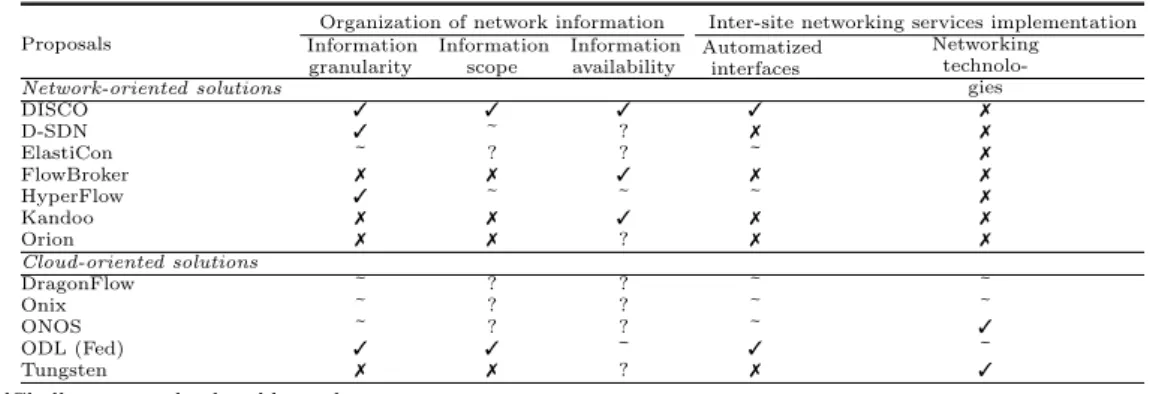
For each selected proposal, we present a qualitative analysis and summarize their character-istics and whether they address the DCI challenges, respectively in Table 2 and Table 3.
6.1
Network-oriented (controllers for SDN domains)
In this first part, we give an overview of the seven SDN solutions we investigated, namely DISCO [65], D-SDN [66], Elasticon [67], FlowBroker [68], HyperFlow [69], Kandoo [70], and Orion [71].
DISCO
DISCO (Distributed SDN Control Plane) relies on the segregation of the infrastructure into distinct groups of elements where each controller is in charge of one group using OpenFlow as
Table 2: SDN solutions characteristics Prop osals Mo del Implemen tation In terop erabilit y & maturit y Extra consideration Cen tralized (Single) Con troller Designs Distributed Designs Co ordination Strategy In ternal Comm unication Proto cols Database man-age- men t system Net w ork typ es targeted South b ound Proto cols Readiness Lev el Op enStac k compatibilit y (Flat) Logically cen tralized (Flat) Logically distributed Hierarc hical Hybrid Leader- based Leader-less Among lo cal no des With higher lay ers Among ro ot no des Underla y Ov erla y Network-oriente d solutions DISCO X X AMQP -? X Op enFlo w & RSVP-lik e P oC (TRL 3) 7 D-SDN X X SC-SC Proto col MC-SC Proto col -X Op enFlo w P oC (TRL 3) 7 ElastiCon X X DB-in/ TCP channel -NoSQL DB X Op enFlo w P oC (TRL 3) 7 Flo wBrok er X X -Flo wBrok er con trol c hannel ? ? X Op enFlo w P oC (TRL 3) 7 Hyp erFlo w X X WheelFS -WheelFS X Op enFlo w P oC (TRL 3) 7 Kando o X X
-Simple message channel
-X Op enFlo w P oC (TRL 3) 7 Orion X ? ? Not needed TCP c hannel Pub/Sub NoSQL DB X Op enFlo w P oC (TRL 3) 7 Cloud-oriente d solutions DragonFlo w X X X DB-in DB-in DB-in NoSQL DB/ others X Op enFlo w Demonstrated (TRL 6) Onix X X NoSQL DB ? -SQL DB NoSQL DB X X Op enFlo w & BGP System protot yp e (TRL 7) 7 ONOS X X DB-in -A tomix (NoSQL framew ork) X X Op enFlo w, NetConf& others Pro v en system (TRL 9) ODL (F ed) X X X AMQP -In-memory X X Op enFlo w, BGP & others Pro v e n system (TRL 9) T ungsten X X X BGP IFMAP DB-in NoSQL DB X X XMPP , BGP & others Pro v e n system (TRL 9)
Proposals
Organization of network information Inter-site networking services implementation Information granularity Information scope Information availability Automatized interfaces Networking technolo-gies Network-oriented solutions DISCO 3 3 3 3 7 D-SDN 3 ~ ? 7 7 ElastiCon ~ ? ? ~ 7 FlowBroker 7 7 3 7 7 HyperFlow 3 ~ ~ ~ 7 Kandoo 7 7 3 7 7 Orion 7 7 ? 7 7 Cloud-oriented solutions DragonFlow ~ ? ? ~ ~ Onix ~ ? ? ~ ~ ONOS ~ ? ? ~ 3 ODL (Fed) 3 3 ~ 3 ~ Tungsten 7 7 ? 7 3
13Challenge completely addressed. 2~ Challenge partially addressed. 37Challenge not addressed. 4? Undefined.
Table 3: SDN solutions challenges addressing
Control plane protocol. Each controller has an intra-domain (or intra-group) part that provides local operations like managing virtual switches, and an inter-domain (or inter-group) part that manages communication with other DISCO controllers to make reservations, topology state modifications or monitoring tasks. For the communication between controllers, DISCO relies on an Advanced Message Queuing Protocol (AMQP) message-oriented communication bus where every controller has at the same time an AMQP server and a client. The central component of every controller is the database where all intra- and inter-domain information is stored. We underline that there is not specific information on how the database actually works in the article that presents the DISCO solution.
DISCO can be considered to have a fully distributed design because every local controller stores information of its own SDN domain only, and, establish inter-domain communication with other controllers to provide end-to-end services only if needed. DISCO controllers do not act as a centralized entity and instead work as independent entities peering among them. It has a leader-less coordination because of its logically distributed condition (each controller is in charge of a subgroup so there is no possible conflict). DISCO’s evaluations have been performed on a proof of concept. For this reason, we assigned a TRL of 3 to DISCO.
Addressing the challenges
• Information granularity: Addressed - due to the segregation of the infrastructure into dis-tinct groups.
• Information scope: Addressed - thanks to its per-group segregation. When an inter-domain forwarding path is requested, DISCO controllers use the communication channel to only contact the relevant sites for the request. Thus, avoiding global information sharing. • Information availability: Addressed - in case of network disconnections, each controller
would be able to provide intra-domain forwarding. Besides, controllers that can contact each other could continue to deliver inter-site forwarding. Finally, a recovery mode is partially provided given that disconnected sites only need to contact the remote commu-nication channels to retake the inter-domain forwarding service when the connectivity is reestablished. As aforementioned, we underline that due to its implementation and the information that is manipulated, DISCO is conflict-less. This make the recovery process rather simple.
• Automatized interfaces: Addressed - thanks to the bridge presented among the northbound and east-west interfaces to do inter-controller communication.
• Networking technologies: Not addressed since it does not integrate other networking tech-nologies aside of OpenFlow.
D-SDN
D-SDN (Decentralized-SDN) distributes the SDN control into a hierarchy of controllers; i.e., Main Controllers (MCs) and Secondary Controllers (SCs), using OpenFlow as control plane protocol. Similarly to DISCO, SDN devices are organized by groups and assigned to one MC. One group is then divided into subgroups managed by one SC (each SC requests one MC to take the control over a subgroup of SDN devices). We underline that the current article does not give sufficient details regarding how states are stored within Main and Secondary Controllers. The paper mainly discusses two protocols. The first one is related to communications between SCs and MCs using D-SDN’s MC-SC protocol for control delegation. The second one, entitled
D-SDN’s SC-SC has been developed to deal with fail-over scenarios. The main idea is to have
replicas of SCs in order to cope with network or node failures.
As stated in the proposition, D-SDN has a hierarchical design: the MC could be seen as a root controller and SCs as local controllers. It has a leader-based coordination with MC being the natural leader in the hierarchy. As D-SDN is presented as a proof of concept, we defined a TRL of 3.
• Information granularity: Addressed - due to the segregation of the infrastructure elements into distinct groups.
• Information scope: Not addressed - the MC gathers global knowledge, and the communi-cation between SC appears just for fault tolerance aspects.
• Information availability: Undefined - in case of disconnection, SCs controllers can continue to provide forwarding within its local domain at the first sight. However, the article does not specify how the MC deals with such a disconnection. Besides, the controller does not provide any type of recovery method as D-SDN does not take into account network partitioning issues.
• Automatized interfaces: Not addressed - D-SDN proposes an interface for SC-SC com-munication only for fault tolerance issues. Moreover, there is not information regarding MC-MC communication patterns.
• Networking technologies: Not addressed - since it does not integrate any other networking technologies nor the capacity to provide inter-group service deployment.
ElastiCon
Elasticon (i.e., elastic controller) is an SDN controller composed by a pool of controllers. The pool can be expanded or shrunk according to the size of the infrastructure to operate. Each controller within the pool is in charge of a sub-set of the SDN domain using OpenFlow as control plane protocol. The elasticity of the pool varies according to a load window that evolves over time. Based on the computed value, a centralized module triggers reconfigurations of the pool like migrating switches among controllers or adding/removing a controller. While decisions are made centrally, it is noteworthy to mention that actions are performed by the controllers. To do so,
each controller maintains a TCP channel with every other one creating a full mesh. This protocol enables controllers to coordinate themselves if need be. The states of Elasticon are shared through the Hazelcast distributed data store [72], which can be accessed by all controllers. The use of a shared back-end by the pool gives as result a physically distributed but logically centralized design. As stated in Elasticon’s work, the solution has been implemented as a prototype, and thus a TRL of 3 has been assigned to it.
• Information granularity: Partially addressed - Elasticon has been designed to distribute the control of infrastructure over several controllers. If the Hazelcast data store can be deployed across several sites, it is possible to envision to distribute also the pool of controllers between the different sites. By accessing the same database, controllers will be able to add information to the database and fetch the others’ information to establish inter-site services. However, the consistency of the data store might be another issue to deal with. • Information scope: Undefined - it is linked to the database capabilities (in this case, to
the way the Hazelcast data store shards the information across the different sites of the infrastructure). However, it is noteworthy to mention that most advanced database systems such as CockroachDB only favor data-locality across several geo-distributed sites partially. • Information availability: Undefined - similarly to the previous challenge, it is linked to way the database services deals with network partitioning issues. In other words, intra/inter domain forwarding paths that have been previously established should go on theoretically (network equipment have been already configured). Only the recovery mechanism to the DB is unclear.
• Automatized interfaces: Partially addressed - because each controller already has a TCP channel to communicate with the other controllers. However, this communication channel is only used for coordination purposes.
• Networking technologies: Not addressed - since it only operates in OpenFlow-based sce-narios.
FlowBroker
FlowBroker is a two layers architecture using OpenFlow as control plane protocol. It is composed by a series of broker agents and semi-autonomous controllers. The broker agents are located at the higher layer. They are in charge of maintaining a global view of the network by collecting SDN domain-specific network state information from the semi-autonomous controllers, which are deployed at the bottom layer. Semi-autonomous controllers do not communicate among them, so they are not aware of the existence of other controllers in the network. These controllers are only aware of interfaces in the controlled switches, thus, providing local-domain forwarding. By maintaining a global view, the broker agents can define how semi-autonomous controllers should establish flows to enable inter-domain path forwarding.
FlowBroker presents a hierarchical design clearly with broker agents acting as root controllers and semi-autonomous domain controllers as local controllers. Although semi-autonomous con-trollers can establish forwarding paths inside their own domain, the communication with the broker agents is mandatory for inter-domain forwarding. Because of this reason, FlowBroker presents a leader-based coordination, where brokers act as leaders. We underline, however, that there is not any information describing how the information is shared between the different brokers.
Regarding the maturity, we assigned a TRL of 3 to FlowBroker because only a proof-of-concept has been implemented.
Addressing the challenges
• Information granularity: Not addressed - the segregation into semi-autonomous controllers enables the efficient sharding of the information per site. However, the global view of the information that is maintained by the brokers does not enable the validation of this property.
• Information scope: Not addressed - although the global view maintained by each broker allows them to contact only the semi-autonomous controllers that are involved into the inter-service creation, the result of each operation is forwarded to each broker in order to maintain the global view up-to-date.
• Information availability: Addressed - as aforementioned, semi-autonomous controllers can continue to provide local-domain forwarding without the need of the brokers. In the hypo-thetical case of a network disconnection and the subsequent reconnection, interconnected controllers can still forward the traffic among them. Actually, they only need to contact brokers in order to request inter-site forwarding configuration. Once the configuration of network equipment has been done, controllers do not need to communicate with brokers. Regarding the loss of connectivity with brokers, the recovery process is quite simple because the information shared between all brokers and semi-autonomous controllers is conflict-less. • Automatized interfaces: Not addressed - because semi-autonomous controllers do not have an east-west interface to communicate among them, but only communicate with brokers. Moreover, the way brokers exchange network knowledge to gather global network view is not discussed.
• Networking technologies: Not addressed - since its use is only intended with OpenFlow protocol.
HyperFlow
Hyperflow is an SDN NOX-based [73] multi-controllers using OpenFlow as control plane protocol. The publish/subscribe message paradigm is used to allow controllers to share global network state information, and is implemented using WheelFS [74]. Each controller subscribes to three channels: data channel, control channel, and its own channel. Events of local network domains that may be of general interest are published in the data channel. In this way, information propagates to all controllers allowing them to build the global view. Controller to controller communications are possible by publishing into the target’s channel. A heartbeat is published by every controller in the control channel to notify about its presence on the network.
As the global networking information is shared by all participant controllers, the controller topology presents a physically distributed but logically centralized design. Every controller manages its own domain. In case of network partitions, traffic forwarding can continue inside each controller domain and between the controllers that can contact each other. However, the dependency with respect to WheelFS is not discussed. In other words, the behavior of a controller that cannot contact WheelFS is undefined. More generally, the publish/subscribe paradigm enables Hyperflow to be leader-less. As this proposition has been implemented as a proof-of-concept, a TRL of 3 has been assigned to HyperFlow.
Addressing the challenges
• Information granularity: Addressed - thanks to WheelFS, it is possible to deploy one con-troller per site. Each one uses WheelsFS to share networking information in order to create
inter-domain forwarding paths.
• Information scope: Partially addressed - HyperFlow presents both a general information data channel and the possibility to communicate directly to specific controllers using their respective channel. Unfortunately, the paper does not clarify whether the establishment of inter-site forwarding is done by contacting the relevant controllers or if instead the general channel is used. In the former case, the exchange is efficient, in the latter, the information will be shared through all controllers.
• Information availability: Partially addressed - in case of network partitioning every con-troller can continue to serve their local forwarding requests. Regarding inter-forwarding, the dependency w.r.t. to WheelFS is unclear. Theoretically speaking, inter-forwarding channels should survive to disconnections (at least among the controllers that can inter-act). Moreover, WheelFS provides a recovery method to deal with network partitioning issues. Such a feature should enable controllers to requests new inter-forwarding paths af-ter disconnections without requiring to implement specific recovery mechanisms. Similarly to previous solutions, this is possible because the information shared through WheelFS is conflict-less.
• Automatized interfaces: Partially addressed - since WheelFS is used as both communi-cation and storage utility among controllers. Thus, it is used as the east-west interface. However, HyperFlow’s authors underlined that the main disadvantage of the solution is the use of WheelsFS: WheelsFS can only deal with a small number of events, leading to per-formance penalties in cases where it is used as a general communication publish/subscribe tool among controllers.
• Networking technologies: Not addressed - since it does not integrate other networking technologies besides OpenFlow.
Kandoo
Kandoo is a muti-controller SDN solution built around a hierarchy of controllers and using OpenFlow as control plane protocol. At the low level, local-domain controllers are in charge of managing a set of SDN switches and processing local traffic demands. At the high-level, the single root controller gathers network state information to deal with inter-domain traffic among the local domains. The authors of the Kandoo proposal claim that there are only a few inter-domain forwarding requests and that a single root controller is large enough to deal with. Regarding the local controllers, they do not know about the existence of the others, thus only communicate with the root controller using a simple message channel to request the establishment of inter-domain flows. Unfortunately, the authors did not give sufficient information to understand how this channel works and how the inter-domain flows are set up.
By its two level hierarchical design, Kandoo presents a leader-based coordination (the root controller being the natural leader of the architecture). As the solution had been implemented as a proof-of-concept, a TRL of 3 has been assigned to Kandoo.
Addressing the challenges
• Information granularity: Not addressed - the root controller is used to get information to do inter-domain traffic forwarding, thus gathering the global network view.
• Information scope: Not addressed - similarly to the previous challenge, there is no direct communication between controllers: the single root controller is aware about all inter-domain requests.
• Information availability: Addressed - similarly to FlowBroker solution, the root controller is only required to configure the inter-domain traffic. Once network equipment have been set up, there is no need to communicate with the root controller. The recovery process between local controllers and the root is simple: it consists in just recontacting the root once the network connectivity re-appears (similarly to FlowBroker is conflict-less). • Automatized interfaces: Not addressed - there is not an east-west interface to communicate
among local controllers.
• Networking technologies: Not addressed - since Kandoo does not implement other protocols besides OpenFlow.
Orion
Orion is presented as a hybrid SDN proposition using OpenFlow as control plane protocol. The infrastructure is divided into domains that are then divided into areas. Orion leverages area controllers and domain controllers. Area controllers are in charge of managing a sub-set of SDN switches and establish intra-area routing. Domain controllers, at the top layer, Tare in charge of synchronizing global abstracted network information among all domain controllers, and to establish inter-area routing paths for their managed area controllers. Synchronization of network states between domain controllers is done using a scalable NoSQL database. Moreover, a publish/subscribe mechanism is used to allow domain controllers to demand the establishment of inter-area flows among them. Finally, it is noteworthy to mention that area controllers are not aware about the existence of other area controllers and only communicate with its respective domain controller. This communication is done via a simple TCP channel.
Orion is the only solution that presents a hybrid design: each domain follows a two-level hierarchy and all domain controllers are arranged in a P2P way, using a NoSQL database to share information between each other. Unfortunately the paper does not give details regarding the NoSQL database nor the coordination protocol among the domain controllers. Hence, it is not clear whether Orion uses a leader-based coordination in its P2P model. As the solution had been implemented as a proof-of-concept, a TRL of 3 has been assigned to Orion.
Addressing the challenges
• Information granularity: Not addressed - although the infrastructure is divided into do-mains (each domain controller maintains its own view of the information), each area con-troller should notify its domain concon-troller about all changes that occur at the low level. • Information scope: Not addressed - first, area controllers cannot contact directly other
controllers to set up inter-site forwarding services and second, we do not know how infor-mation is shared between domain controllers (i.e., it is related to the database system, see Elasticon for instance).
• Information availability: Undefined - in case of network disconnections area controllers can continue to forward intra-domain traffic and inter-domain traffic on paths that have been previously established. In other words, domain controllers are used only for inter-domain path forwarding establishments. In case of a network disconnection, the area controller
only needs to reconnect to its domain controller when needed and when the connection reappears. There is no need for a specific recovery protocol because the information shared between area controllers and their respective domain controller is conflict-less. Only the recovery mechanism related to the DB that is used to share information among domain controllers is unclear.
• Automatized interfaces: Not addressed - due to the fact that local controllers do not present an east-west interfaces to communicate among them.
• Networking technologies: Not addressed - since it does not integrate other networking technologies aside of OpenFlow.
6.2
Cloud-Oriented
In this second part, we present the five solutions we selected from the cloud computing area, namely DragonFlow [75], Onix [76], ONOS [77], ODL [78], and Tungsten [79].
DragonFlow
DragonFlow is an SDN controller for the OpenStack ecosystem, i.e., it implements the Neutron API and thus can replace the default Neutron implementation (see Section 2.2). From the soft-ware architecture, DragonFlow relies on a centralized server (i.e., the Neutron server) and local controllers deployed on each compute node of the infrastructure. Each local controller manages a virtual switch providing switching, routing and DHCP capabilities using entirely OpenFlow. A DragonFlow ML2 mechanism driver and a DragonFlow service plug-in are activated in Neutron Server in order to provide system network information to all local controllers. Communication between the plug-ins at the Neutron server side and local controllers is done via a pluggable distributed database (currently supporting OVSDB [80], RAMCloud [81], Cassandra [82], and using ETCD [83] as default back-end).
Local controllers periodically fetch all information of network state through this database and update virtual switches, routes, etc. accordingly.
By maintaining a global knowledge of the network elements through its distributed database, DragonFlow can be considered as a distributed but logically centralized controller (see Sec-tion 5.1) at the first sight. However, the fact that there is a root controller (i.e., the Neutron server side) in charge of the management layer (i.e., updating configuration states in the dis-tributed database) and local controllers that implement the control plane makes DragonFlow more a hierarchical solution than a distributed one. In other words, for all leader-based op-erations, the Neutron plug-in deployed at the server side acts as the leader. In conclusion, although DragonFlow is presented as a distributed SDN controller, its design does not allow the management of a geo-distributed infrastructure (i.e. composed of multiple SDN controllers).
From the maturity view point and according to its activity, we believe DragonFlow has reached a TLR 6. Initially supported by Huawei, the project is rather inactive right now. Addressing the challenges
• Information granularity: Partially addressed - similarly to Elasticon, if the distributed database service can be deployed across several sites, we can envision an infrastructure composed of several DragonFlow Neutron plug-in. Each one will add information to the database and all local controllers will be capable to fetch the necessary information to provide end-to-end services.