HAL Id: hal-01116041
http://hal.univ-nantes.fr/hal-01116041
Submitted on 12 Feb 2015
HAL is a multi-disciplinary open access
archive for the deposit and dissemination of
sci-entific research documents, whether they are
pub-lished or not. The documents may come from
teaching and research institutions in France or
abroad, or from public or private research centers.
L’archive ouverte pluridisciplinaire HAL, est
destinée au dépôt et à la diffusion de documents
scientifiques de niveau recherche, publiés ou non,
émanant des établissements d’enseignement et de
recherche français ou étrangers, des laboratoires
publics ou privés.
Evolution of a Flexible Manufacturing System: From
Communicating to Autonomous Product
Francisco Gamboa Quintanilla, Olivier Cardin, Pierre Castagna
To cite this version:
Francisco Gamboa Quintanilla, Olivier Cardin, Pierre Castagna. Evolution of a Flexible
Manufactur-ing System: From CommunicatManufactur-ing to Autonomous Product. Service Orientation in Holonic and Multi
Agent Manufacturing and Robotics, 472, pp.167 - 180, 2013, Studies in Computational Intelligence,
�10.1007/978-3-642-35852-4_11�. �hal-01116041�
communicating to autonomous product
F. Gamboa Quintanilla, O. Cardin, P. CastagnaLUNAM Université, IUT de Nantes – Université de Nantes, IRCCyN UMR CNRS 6597 (Insti-tut de Recherche en Communications et Cybernétique de Nantes), 2 avenue du Pr Jean Rouxel
– 44475 Carquefou
(francisco.gamboa,olivier.cardin,[email protected]
Abstract. Production activity control of industrial systems is evolving in two separate directions for the past decade, double evolution which seems contra-dictory at first. First, a deeper integration of all the actors in/each actor of the industrial system, from the raw materials suppliersup to the customerservice department dealing with customers’rising demands. This is known as the con-cept of “supply chain”, generally international as the market is globalized. The second evolution is due to an increasing need for flexibility and reactivity, on one hand to answer to an increasingly varied demand, and on the other hand to have a better reaction to the disruptions appearing in the increasingly complex manufacturing systems. These evolutions imply a deep modification of the structure of these manufacturing systems, progressively mutating from an hie-rarchical organization – where the decisions are taken level by level, top to bot-tom, each level communicating its decisions to lower levels – to a networked organization, each node of this network being to some extent an/more or less an autonomous decision center. This control concept is very attractive, as it enables to significantly increase the control’s robustness by considering model-ing uncertainties and disruptions. However, very few academic papers deal with a detailed example of highly intelligent products in a context of product driven systems. This paper intends to show the evolution of a flexible manufacturing system, from a data oriented perspective to a product driven one.
Keywords:. Emergent Intelligence, Embedded Devices, Co-operative control / manufacturing, Self-organization
1
INTRODUCTION
Production activity control of industrial systems is evolving in two separate directions for the past decade, double evolution which seems contradictory at first. First, a dee-per integration of all the actors in/each actor of the industrial system, from the raw materials suppliers up to the customer service department dealing with customers’ rising demands. This is known as the concept of “supply chain”, generally
interna-for flexibility and reactivity, on one hand to answer to an increasingly varied demand, and on the other hand to have a better reaction to the disruptions appearing in the increasingly complex manufacturing systems. These evolutions imply a deep modifi-cation of the structure of these manufacturing systems, progressively mutating from an hierarchical organization – where the decisions are taken level by level, top to bottom, each level communicating its decisions to lower levels – to a networked or-ganization, each node of this network being to some extent an/more or less an auto-nomous decision center[12].
It is interesting to spot the fractal characteristic of this evolution. Indeed, the evolu-tion is present at the level of the supply chain, where the network is constituted of many managers and subcontractors. Furthermore, it is also possible to see this evolu-tion inside the manufacturing workshop, considered more and more as a network of manufacturing resources which negotiate to balance the work load. At the lowest level, the so called smart sensors and actuators become able to communicate with each other through field buses. This shift from a hierarchical toaheterarchical struc-ture is often carried out with a change in the way the production activity is controlled, which changes from predictive to reactive.
The predictive production activity control is based on the concept of scheduling. Scheduling which tries to forecast in time the date of execution of every task (trans-formation, transportation, preventive maintenance, etc.). This control is said to be predictive in the sense that decisions are made at a given time but are not applied until later on..The advantage of predictive scheduling is the ability to deal with the whole manufacturing system, so that by considering all the manufacturing resources, it can guarantee a relative optimization of the system’s behavior. This optimization is unfor-tunately relative because of two main issues. The first is the algorithmic complexity of most of the efficient scheduling methods, making their application difficult for industrial implementation. The use of meta-heuristics is generally chosen to solve this problem, but then appears the second issue, which is the lack of flexibility of the solu-tion given by the method. Indeed, the global approach carries a predicsolu-tion of decisions which are not longer valid at the moment of their application. Therefore, in an indus-trial context, the efficiency of the best scheduling methods is often altered by the nu-merous disruptions occurring on the system which question the initially planned dates.
The Reactive control, another approach, is based in the application of the decisions made up in real time during production according to set of specified rules. The aim here is not to suppress any prediction feature in the decision making process, but to always take the decisions as late as possible, i.e. at the time of their application. This approach implies giving a more important place to the product, passing from a simple raw material circulating in the system to a real actor of the control system, able to interact with other components within the system. The genesis of this control vision can be found in the holon paradigm[13][15].It was then was developed the concept of product-driven systems, which aims at giving the product an active and participative role in the decision making process and data flows created by the manufacturing sys-tem. All in order to fulfill theobjectives of transformation, transportation, mainten-ance, logistics, use and recycling[6][8].
This control concept is very attractive as it enables to significantly increase the ro-bustness of the controlby considering modeling uncertainties and disruptions[11]. Pinot et al. [9] compared a posteriori the solutions given by a predictive scheduler, a group scheduling algorithm (with two levels of flexibility) and by a product driven control, with respect to the transportation times which are modeled in scheduling algorithms.
This kind of control is very popular, as it marks the evolution of manufacturing systems towards a higher degree of flexibility. Technically, such evolution was made possible with the emergence of RFID technologies (Radio Frequency Identification) which give the product the ability to communicate and store data[4].However, very few academic papers deal with a detailed example of highly intelligent products in the context of product driven systems. This paper intends to show the evolution of a flex-ible manufacturing system (FMS), from data oriented to a product driven production.
In the next section, several concepts are introduced, some new, other from litera-ture, and most importantly a classification of products into two levels of intelligence within a flexible manufacturing system.These two levels will be the basis of the last two sections, which present the evolution of a manufacturing system from level 1 to level 2.
2
DECISION MAKING IN A PRODUCT DRIVEN SYSTEM
2.1 Physical structure of a product in a product driven system.
The first thing to define when talking about product driven systems is the notion of product. Indeed, in such control, the product becomes a real actor in the decisions that define its future, and thus can no longer be considered as a single piece of raw mate-rials. This implementation does not come without posing economic difficulties, espe-cially when considering high manufacturing rates, characterized of having very large flows of low value products. When the WIP (Work in Process) is relatively low, one solution consists in associating each product to a component which will give its intel-ligence. Thus, for both economic and interoperability reasons, the intelligent product in a manufacturing system is often the combination of several components (Fig.1). The simplest structure is made by the association of the product itself being manufac-tured and a transporter (base), for example a pallet carrying this product. It is the as-sociation product+transporterwhich has to be studied, as it can be potentially identi-fied as an intelligent product
Fig.1.Structureof an intelligent product
2.2 The production activity control function of a product driven system
In the context of product driven systems, [5]suggests a control architecture basedon the concept of Holonic Manufacturing System (HMS).
This is a distributed system (Fig.2), based on cooperation between:
Resource controllers, ensuring the correct execution of transformation andtrans-portation operations;
Product controllers, ensuring the completeness and the correct order of operations performed on the product.
[5] also suggeststhe use of the dynamic reconfiguration controlintroduced previously in literature. Other related works, such as [7], deal with the development of an envi-ronment (based on a distributed control through a multi-agent platform) designed to evaluate the control policies of product driven systems.On a general point of view, [10] defines manufacturing control as the set of functions necessary to start and track production, i.e. real-time control of planned fabrication orders containing, among others, the 3-tuple {task ; resource ; date).In the context of product driven systems, we suggest to add to this definition all the decisions which are induced by the flow of products, granting an acceptable behavior to the system according to one or several performance criterions. Indeed, what mainly seems to characterize a product driven system (are these/is this collection of) induced decisions. This definition implies the fact that two more tasks have to be performed: constant Tracking of production, im-plying a direct acquisition of data from the system itself, and a set of decisions, de-pending particularly on these data.
Fig.2.Product driven system architecture introduced by [5]
The decision is thus found at the centre of such control systems. As a matter of fact, this paragraph intends to identify all the elements involved in a decision.Each deci-sion could be split intofive main characteristics:
1. The Decision Trigger (D): event triggering the decision making process;
2. The Decision Center (C): smart entityof the system which evaluates the decision; 3. The Decision Parameters (P): Set of data (measured, evaluated or
planned)influencing the decision making process;
4. The System Directly impacted by the Decision (Sd): Subset of the systemon which the decision has a direct impact.
5. The System Influenced by the Decision (Si): Subset of the system on which the de-cision has an indirect influence.
To illustrate these concepts, we consider the example of the control used in a flow shop represented on Fig.3: after using machine 1, a decision has to be made on whether moving to machine 2 or 3. The decision trigger corresponds then to the avail-ability of the product at the exit of machine 1; the decision center is located within the control of machine 1. The parameters for the decision are the occupancy readingsof buffers 2 and 3, located in a database updated in real-time by the machines’ decision centers, and the data related to the product at the exit of machine 1 (priority, due date, processing time, etc.) carried by the product. As for the product, the selected machine and its buffer form a system directly impacted by the decision. Ad minima, the influ-enced system are the other machine, as it will not handle the product.
Fig.3.Flow shop with parallel machines
These definitions show that the product is, obviously, at the center of everything. The concept of intelligent products, as defined in[16] and developed in [6], is used here. The authors definethe product as an entity, both physical and informational, abletos-tore data, communicate, act and/ormake decisions. They have also defined five basic functions:
1. Possess a unique identification; 2. Communicatewith its environment; 3. Store and handledata about itself;
4. Master a dialog languageto communicateits state and data; 5. Participate in the decision making processes duringitsevolution.
From these basic functions, [6]defines two main levels of intelligence of the product. The following paragraph illustrates these levels on the example of Fig.3:
1. For level 1, the trigger is the event corresponding tothe arrival of a productat the exit of machine M1. Same as before,the product carries most or all of the deci-sion’s parameters (P). However, the decision centeris an entity of the manufactur-ing system, external to the product. This level can equally consider products pos-sessing a simple identification (barcode, etc.), products with sensing capabilities to sense its environment (instrumented products) or even those possessing a read/write data storage and communication capabilities (such as RFID for exam-ple). This level integrates functions 1 to 3 of the intelligent product as defined in [6], which then talks about data oriented product.
2. At level 2, the product isat the same time, both, the author of the triggering event and the decision center itself. It evaluates by itself the impact of the decision based on the data that it is able to store or retrieve directly from the environment. Its communication abilitiesmight enable it to communicate with other decision centers in order to make its decision. This level integratesthe products able to,
both,evaluate the efficiency of thepossible alternative solutionsand interact with the system to apply the decision. This level also integrates all the functions of an intel-ligent product as defined by[6].
The following sections introduce the control corresponding to a level 1 and to a level 2 for the same flexible manufacturing system.
3
LEVEL 1 MANUFACTURING SYSTEM
The flexible manufacturing system studied [3] is a job-shop with an automated transport system and six workstations (Fig.4). It is located in the workshop of the IUT de Nantes, France, and is integrated to a larger complex. The products presented in Fig.1 are assembled: workstation 1 enables to put or retrieve a product base on the transporter; workstations 2, 3 and 5 are able to assemble the product base with colored items to build the product; workstation 4 is an automated vision quality control workstation; workstation 6 is dedicated to the manual assembling and disassembling of poor quality products. Full and empty product bases (representing manufactured products and raw materials) are stored in the AS/RS (Automated Storage/Retrieval System), and are delivered on workstation 1 through the transfer workstation. Colored items are also stored in the AS/RS, and are delivered on each workstation via the AGV (Automated Guided Vehicles).
On the FMS, a transporters’ storehouse (made up by an accumulation conveyor) enables the storage of the idle/unassigned transporters. The 42 transporters are equipped with RFID tags. The production data of the transporter are written into the tag when it leaves the storehouse: number of products to transport (sequentially), recipe of each product in terms of operations, etc. At the same time, each workstation has a list of operations it is able to perform. Therefore, when the transporters move on to the main loop and arrive to the entrance of a workstation, a comparison between the next operation of the recipe and the list of operations the workstation is able to perform is made. According to the chosen rule, the transporters may enter the workstation or continue on the main loop. Once at the workstation, the data are read on the tag, and the workstation executes the operation needed by the product [1].
Fig.5 shows the topologic localization of the basic decisions that have to be taken all along the manufacturing process. Here are the questions that have to be answered at the corresponding decision points
DG1: At which date will the production begin?
DG2: How many transporters will be allocated to this order?
DG3: Which priority will be given to the order?
DG4: Should the transporter located at the entrance of the storehouse re-enter the storehouse or stay in the main loop?
DL1: Should the transporter located at the entrance of a workstation enter the workstation or stay on the main loop?
DL2: At the end of an operation, can the product pass on to the next operation indicated by the recipe or should an additional operation be applied for quality matters?
DL3: Should the transporter enter the workstation or should it continue in the buf-fer to be treated later on?
DL4: Should the transporter continue in the buffer or should it rejoin the main loop?
Fig.4.Integration of the job-shop in its environment
Obviously, numerous other decisions might be taken, considering the production objectives. However, it is clear that the decisions are explicitly made by the worksta-tions, based on the data carried by the product. This FMS is thus at level 1 of Wong’s/the classification in [6].
4
EVOLUTION TO A LEVEL 2 MANUFACTURING
SYSTEM
The evolution presented here is due to the desire of changing the way the production orders are placed on the system. Instead of going through the supervision (informa-tional flow), via the ERP, the will is to use the physical flow, and therefore the prod-ucts. The idea is to equip every product base and every colored item with an RFID tag. These tags are meant to become the trigger of actions when read by an appropri-ate reader.
Fig.5.Decision points in the assembly line.
The target architecture to implement is a holonic architecture, namely, PROSA[13][15]which presents a predictive/reactive behavior. The request for pro-duction is triggered by a resource holon located in the storehouse. When a propro-duction has to be started (for example, due date written on a product base is approaching), this holon retrieves a container of product bases, and transfers it to workstation 1. A re-quest for transporters is then sent to the holon handling the storehouse. When a trans-porter is said to be available, the storehouse sends it to workstation 1.
Once on the workstation, the empty transporter negotiates the deposit of a product base with the Cartesian robot of workstation 1. When the product base is mounted, the transporter reads the data of the product database stores these data in its internal memory and leaves the workstation. Once on the central loop, it negotiates with the workstations’ resource holons to reserve a time slot for treatment.
It is thus the transporter which can decide to enter or not to a workstation, and is thus able to act on its environment to turn off direction whenever needed. The issue here is for the transporter to be able to know its localization within the assembly line. This application will be made in a special fashion in order to save in costs and energy consumption: the transporter knows the exact configuration of the network; each time it senses it arrives to a turn, it is able to know the link it enters.
When a colored item is put on the product base, the transporter retrieves its asso-ciated data for traceability and quality control. These data are thus sent to the supervi-sion application, so that the progress of the production order can be visualized.
Fig.6 shows the developed hardware configuration of the transporter together with the product.
This evolution is extremely close to the notion of product-driven system. It is meant to form an experimental test bed for numerous fields of research to either:
Evaluate the pertinence of negotiation protocols;
Evaluate the performance of dynamic scheduling rules;
Evaluate the possibility of coupling predictive optimization techniques with reac-tive behavior;
Compare the performance of level 0 (classical control), 1 and 2 systems.
Fig.6.Hardwarecomponents of a level 2 intelligent product.
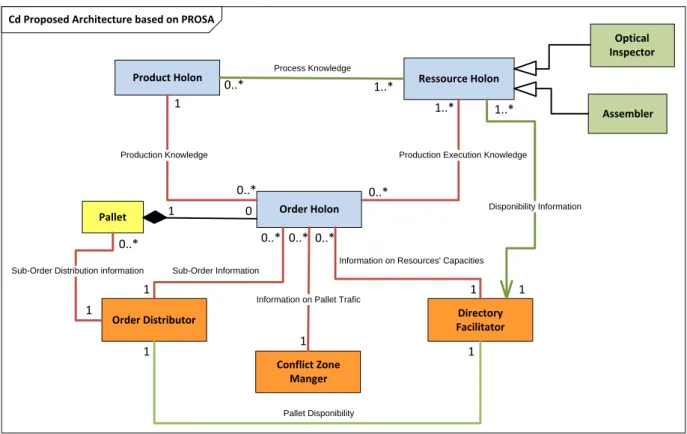
Fig.7 shows the class diagram of the architecture that was designed. This architec-ture is mainly based on the holonic reference architecarchitec-ture PROSA with its three basic holons being the product holon, resourceholon and order holon and the staff holons from which the “Directory Facilitator” is directly inspired on HCBA and on the Mul-ti-Agent System’s platform, JADE. The three basic holons are each in charge one aspect on the processes of exploration, negotiation and association that lead to the production of the product in question. The staff holons, in this architecture, where designed to give coordination between the interactions of the three main basic holons. More importantly, they provide data about the state of the system that indirectly in-creases the vision of the negotiating holons on the system’s state. This augmentation in vision increases the possibilities of system while trying to approach optimality[14].
Product Holon Ressource Holon Order Holon Pallet Order Distributor Conflict Zone Manger Directory Facilitator Optical Inspector Assembler
Production Knowledge Production Execution Knowledge Process Knowledge
Sub-Order Information
Information on Resources' Capacities
Pallet Disponibility Information on Pallet Trafic
Disponibility Information 1 0..* 0..* 0..* 1..* 1..* 1..* 1 1 0..* 0..* 0..* 1 1 Sub-Order Distribution information
1 1
1
0..*
1 0
Cd Proposed Architecture based on PROSA
Fig.7.Architecture Class Diagram.
Fig. 8 shows the investigated interactions between holons during the launch of an order coming directly from a client. The main character in this interaction scenario is the “Order Distributor”. Its essential role is to split the client’s main order into small-er, more manageable sub-orders that can be individually handled by a single transpor-ter. The partition and allocation of sub-orders can be made with simplistic rules, for example, considering only the energy autonomy of each of the transporters and a defined weight between parallelism and the number of transporters used. Alternative-ly, it can be applied more complex and centralized algorithms with augmented vision of the system as in [2] to choose the distribution that will result in a greater efficiency. The negotiation process of the transporters with a sub-order assigned is detailed on Fig. 9.
Directory Facilitator
Order Holon Conflict Zone Manager
Create OH
Loop
[Marquage != Terminal State] Initialisation of RdP and Variables
What are the Ressources? List of Alternative Ressources
ref Calculate sequence of actions
to get to next Ressource Get alternative Operations
Drive (Sequence) Start Operation Product Holon : Associated PH Ressource Holon : Next Associated RH
Request Operation Parameters
ref Drive (Sequence)
Parameters
Message indicating Conclusion
Execute Operation
Evolve RdP (Marquage)
Sd Order Holon Life Cycle ( )
5
CONCLUSION AND FUTURE WORK
This paper presents the evolution of a manufacturing system from data oriented to product-driven. This evolution is made by reconsidering the concept of product, giv-ing it embedded abilities to decide and communicate. Such evolution offers numerous perspectives, as it is sufficiently open for implementing different roles and behavior rules.
Furthermore, the control of a product-driven systembeing characterized by a distri-buted control architecture, each resource is controlled by a decision center. In is be-comes obvious how the decisions taken by the system are distributed among the deci-sion centers, and are thus not centralized. This repartition of intelligence throughout the system is an advantage in the way it eases the control of the system. However, the decision making process in such system is generally simplistic, as the parameters the decision centers have at their disposal generally represent just a subset of the data available about the whole system (generally the neighborhood of Sd), when the im-pact on Si, might be very important. The evaluation of the best decisionoften needs for the decision center to have:
1. An increased vision of the systemto dispose of a wider P set;
2. A prevision abilityenabling it to anticipate the impact of the decision on Si. As shown in[14], the efficiency of a holonic architectureis the abilityof holons to forecast the future behavior of the system. This is especially true in the case of prod-uct driven systems. It would thus be very interesting to apply at real scale the work developed in [2], dealing with the application of online simulation (or other similar tools) as a decision support system. If atomic automated decision centers could have these tools at their disposal, atomic decision making could be not simplistic any more, and therefore the global behavior could get closer to a hypothetic optimal behavior.
These developments would emphasize the impact of a coupling between heterar-chical and hierarheterar-chical architectures, generally referred as “semi-heterarheterar-chical”. This coupling would mainly rely on the abilities of the Staff holon, central element of the prevision capacity.
6
REFERENCES
1. CardinO.. Contribution of online simulation to production activity control decision support - application to a flexible manufacture system. PhdThesis, Université de Nantes, Nantes, 2007.
2. Cardin O.,CastagnaP..Using online simulation in Holonic manufacturing sys-tems.Engineering Applications of Artificial Intelligence, 22 (7),pp.1025-1033, 2009. 3. Cardin O., Castagna P., « Handling uncertainty in production activity control »,
Proceed-ings of the 12th IFAC Symposium on Information Control Problems in Manufacturing, INCOM 2006 ,Saint-Etienne, France, p. 579-584, 2006.
4. Cea A., Bajic E., « Ambient Services for Smart Objects in the Supply Chain Based on RFID and UPnP Technology », Proceedings of theThird Conference on Management and Control of Production and LogisticsMCPL'04. Santiago de Chile, 2004.
5. Gouyon D., Pétin J.-F., Morel G., « A product driven reconfigurable control for shop floor systems », Studies in Informatics and Control, vol. 16, 2007.
6. McFarlane D., Sarma S., Chirn J. L., Wong C.Y., Ashton K., « Auto ID systems and intel-ligent manufacturing control »,Engineering Applications of Artificial Intelligence,vol.16, p.365–376, 2003.
7. Pannequin R., Proposition d’un environnement de modélisation et de test d’architectures de pilotage par le produit de systèmes de production, Thèse de doctorat, Université Henri Poincaré de Nancy, 2007
8. Pétin J.-F., Gouyon D., Morel G., « Supervisory synthesis for product-driven automation and its application to a flexible assembly cell », Control Engineering Practice, vol. 15, n°5, 2007, p. 595-614.
9. Pinot G., Cardin O., Mebarki N., « A study on the group sequencing method in regards with transportation in an industrial FMS », IEEE International Conference on Systems, Man and Cybernetics, Montréal, Québec, 2007.
10. Pujo P., Kieffer J.P., « Chapitre 1: Concepts fondamentaux du pilotage des systèmes de production », dans Pujo P., Kieffer J.P. Fondements du pilotage des systèmes de produc-tion, Traité IC2 Productique, Edition Hermès, 2002.
11. Roy B., « Main sources of inaccurate determination, uncertainty and imprecision in deci-sion models », Mathematical Computer Modeling, vol. 12, n° 10/11, p. 1245-1254, 1989. 12. Trentesaux D., Pilotage hétérarchique des systèmes de production, Habilitation à Diriger
des Recherches, Université de Valenciennes et du Hainaut-Cambresis, 2002.
13. Valckenaers, P., Van Brussel, H., Wyns, J., Bongaerts, L., Peeters, P., « Designing Holon-ic manufacturing systems », RobotHolon-ics and Computer-Integrated Manufacturing, vol. 14, p. 455-464, 1998.
14. Valckenaers, P., Karuna, H., Saint Germain, B., Verstraete, P., Van Brussel, H.. « Emer-gent short-term forecasting through ant colony engineering in coordination and control systems », Advanced Engineering Informatics, vol.20, n°3, p.261-278, 2006.
15. Van Brussel, H., Wyns, J., Valckenaers, P., Bongaerts, L., Peeters, P., « Reference archi-tecture for holonic manufacturing systems: PROSA », Computers in Industry, vol. 37, p. 255-274, 1998.
16. Wong, C. Y., McFarlane D., Zaharudin A. A., Agarwal V., « The Intelligent Product Dri-ven Supply Chain », IEEE Systems Man and Cybernetics, Hammammet,Tunisie, 2002.