HAL Id: hal-01170285
https://hal.archives-ouvertes.fr/hal-01170285
Submitted on 2 Jul 2015
HAL is a multi-disciplinary open access
archive for the deposit and dissemination of
sci-entific research documents, whether they are
pub-lished or not. The documents may come from
teaching and research institutions in France or
abroad, or from public or private research centers.
L’archive ouverte pluridisciplinaire HAL, est
destinée au dépôt et à la diffusion de documents
scientifiques de niveau recherche, publiés ou non,
émanant des établissements d’enseignement et de
recherche français ou étrangers, des laboratoires
publics ou privés.
Introducing complexity into project management
through multi-stakeholder interactions
Myriam Le Goff-Pronost, Matthieu Arzel, Antoine Beugnard, Jean-Philippe
Coupez, François Gallée, Claire Lassudrie, Michel Morvan, Bruno Vinouze,
Richard Naël, Didier Baux
To cite this version:
Myriam Le Goff-Pronost, Matthieu Arzel, Antoine Beugnard, Jean-Philippe Coupez, François GallÉe,
et al.. Introducing complexity into project management through multi-stakeholder interactions. SEFI
2014 : 42th annual conference, Sep 2014, Birmingham, United Kingdom. pp.135 - 135. �hal-01170285�
Introducing complexity into project management through multi-stakeholders
interactions
M. Le Goff, M. Arzel, A. Beugnard, J.-P. Coupez, F. Gallée, C. Lassudrie, M. Morvan, B. Vinouze
Assistant Professor, Télécom Bretagne, Brest, France
E-mail:
[email protected]
R. Naël
Professor, Lycée Vauban, Brest, France
D. Baux
Advisor in Corporate Communication, 1 rue du Chanoine Moreau, Quimper, France
Conference Topic: Active learning
INTRODUCTION
Telecom Bretagne is a French graduate engineering school in Information and Communication Technology. One of our ambitions is to train competitive managers able to cope with complex projects. We have therefore introduced a project based learning technique where students are in a practical situation close to their future life as engineer [1]. In this paper, we describe the organisation and focus on the interactions among many stakeholders.
At the end of their last year of training, students have to perform a technical and economic study with a large degree of autonomy in their team organisation. Many stakeholders are involved in the project: Customer, Steering Committee, Technical Experts and Communications Coach. The students must discover by themselves the specific role of each stakeholder and must adjust the communication level suitable for each interlocutor. This project organisation with many stakeholders and large students’ groups brings opportunities to illustrate complex situations.
In terms of the research process, we used quantitative and qualitative methods to analyse the students’ progress in stakeholders’ interactions. The main hypothesis is that a real project leads to a better involvement with understanding of project management and interactions’ process and improves the students’ skills in this area. Qualitatively, we collected the stakeholders’ feelings through interviews (Customer, Steering Committee) and reports on their personal experience in the project. Quantitatively, we constructed a self assessment questionnaire for students to position their skill level in project management. Questions are based on the acquired knowledge in project management for their past and current studies. Questions concerned technical aspects (communication, risk management and delays, for example) and human behaviour aspects (adaptation to change, ability to chair a meeting, stress management, conflict management ...).
In the first chapter, we describe the key items which are the foundations of this course. In chapter 2, we analyse the interactions between the different stakeholders and highlight their evolutions according to the progress of the project. In chapter 3, we quantitatively and qualitatively analyse the students’ skills evolution thanks to the course. In the conclusion, we summarise the main elements of this course and propose some perspective to improve the students’ feedback analysis.
1. COURSE UNIT DESCRIPTION
The course unit aims to train students in projects with complexity. From [2], “Complexity is also a new
way of seeing the world. To get over the feeling of confusion and enable for them to see in the complexity not only a source of complexity but an opportunity for progress, the managers must renew their traditional way of addressing the problems and find the means for thinking their actions with and not against the complexity”. So we introduce a project management through a case study where
students attempt to fulfil the real need of a real Customer [3]. The course addresses the following items of the CDIO syllabus: 2.4 (Attitudes, thought and learning), 3.1 (Teamwork), 3.2 (Communication) as well as 4.3 (Design and management of system engineering) [4]. The unit is coordinated by a Steering Committee (SC) composed of teachers in various specialties (economics; physics, computer science, etc.) “tutoring of interdisciplinary projects changes the role of the teacher
from the traditional lecturer towards a coach or a trainer” [5]. The role of the Steering Committee (SC)
is to ensure that students use an efficient process to advance their project properly. SC also coordinates the whole stakeholders’ team and periodically meets the student groups. Furthermore, the SC may modify the project scenario depending on pedagogical requirements and circumstances. The Customer's request deals with a technical and economic study outside the students traditional technical skills in telecommunication / networking / IT. As an example, the subject can be related to electricity production on the campus based on renewable energy in response to the requirements of the school's director. In addition to purely technical problems, the project also includes economic and sustainable development dimensions. These various skills will be acquired along the project duration thanks to Experts in engineering, project management, communication, economics or sustainable development.
The class is split into two large groups (named A and B) of about 17 students which will both prepare separate responses to the same customer’s demand. Each group plays the role of a company. It is worth noting that the SC does not put the groups in competition, even if this may occur spontaneously. At the beginning of project, the groups have to organize themselves very quickly due to group size, nature and wide scope project. For this purpose, students are encouraged to get help and advice from the Communication Coach (CC) and the SC. On one side, the CC helps the groups separately by discussions within the team, negotiation and dispute resolution techniques. We emphasis the communication in this course because it is a key point of success: "55 percent of project managers
agree that effective communications to all stakeholders is the most critical success factor in project management" [6]. On the other side, the SC is mainly focused on questioning the group internal
organization and operating mode. In order to observe the interactions among students and their evolution, one Methodological Tutor (MT) per group attends the scheduled periods of work. Moreover, the SC has almost weekly meetings with the project leaders. These observations help to analyse the difficulties encountered and to compare the target organizations with real ones.
After the first meeting with the Customer where students discover the project, both groups have to deliver an initial quotation for the study as well as a technical specification document. The groups and the Customer have to agree on these deliverables and hence the first milestone is the "contract" signature. Then, the actual study can start under the SC’s supervision concerning the methodology. The SC demands weekly dashboard reports as well as updated management charts. During the project, the SC may introduce hazards such as changes in the customer’s request, audit and human resources modifications. On their side, students can rely at any moment on the above mentioned Experts. Furthermore, a junior and a senior Expert Managers (EM) testify on their own project management experiences. A second milestone is positioned at the middle of the project in the form of a progress meeting with the Customer. This meeting may lead to modifications. Finally, the last milestone is the defence by each group of their proposed technical and economic solution and the project management methodology in front of Customer, Experts and SC. The final project deliverable corresponds to both technical and methodological reports.
2. INTERACTION DYNAMIC BETWEEN STAKEHOLDERS
2.1 Interactions in the project initial phase
In the initial phase, students have to organize themselves and to provide first deliverables. This requires many interactions with different stakeholders. These interactions are managed in different manners, depending on the students’ experience and autonomy.
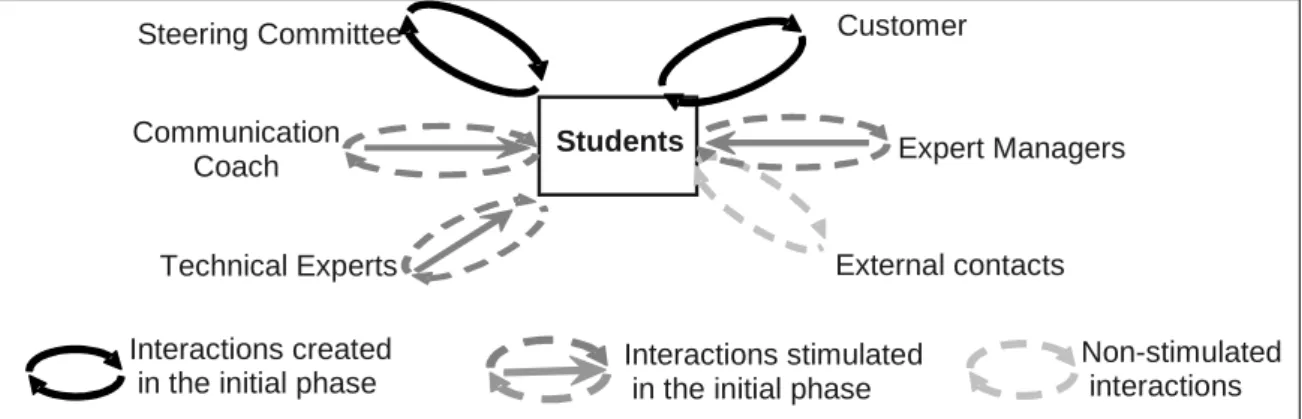
A first level of interaction is directly created by students at the beginning of the project with the Steering Committee (SC) and the Customer (black lines in Figure 1).
Fig. 1. Initial interactions (initial point of view by the students and stimulated interactions)
The students–SC interaction is initiated by the SC with the definition of the expected deliverables (project management plan, dashboard). This is followed by an immediate students’ reaction. They have to define their internal organization in complete autonomy by choosing a project manager, people in charge of external communication with the customer and the SC and the work-package leaders. As the project starts, the students-SC interaction is very similar to a conventional student-teacher relationship. The student-teachers require some reports or actions and the students obey. Every week, the SC meets for half an hour several members of each team (generally the project manager and 3 to 5 students including work-package leaders or tasks managers). Students have to present a dashboard report, difficulties encountered and planned actions. No technique is discussed there. The students-Customer interaction is initiated by the Customer with an invitation for proposals and the definition of the deliverables (quotation, specifications, milestones and final report). The Customer's wish was to bring strong credibility and reality to his request, including the status of the expected study, the budget and its representation by the entire executive committee of the school. This interaction is active from start as it requires immediate work on deliverables. Even if the students have already encountered such situations in school and also at work since they follow an apprenticeship based curriculum, the Customer felt that students had difficulties in understanding his requirements and expectations. This is rather usual to see students not familiar with hazy boundaries project. There is a second level of interaction (dark-grey lines on Figure 1) which concerns all the interactions that have to be fully managed by the students. The productivity of the interactions depends only on the students’ involvement. However, stimulation is required to make these interactions active as soon as possible so that the project speeds up early. Different lectures are proposed to both stimulate these interactions and give initial technical background information. First, the students meet a Communications Coach (CC) who presents the fundamentals of teamwork and conflict management. This helps students to organize their teams by defining the team structure, the roles, the internal and external communications (contacts with the SC and the Customer). These lectures also allow the CC to be introduced as a possible counsellor who may help the students to solve organizational problems and/or internal/external conflicts. This interaction is of prime interest for the life of this complex project, where stress, conflicts and organisation issues cannot be avoided and are often beyond the students’ initial skills. Second, the students attend a debate with junior and senior Expert Managers (EMs) who share their professional experience. These EMs describe real situations and explain how they personally discovered and solved management issues. They explain how they benefited from their experience to improve their skills. Since the students have repeated training periods in companies, they are integrated into team works and thus motivated to share their own experiences (lived or
Customer Expert Managers Steering Committee Students Communication Coach
Technical Experts External contacts
Interactions created
in the initial phase Interactions stimulated in the initial phase
Non-stimulated interactions
observed) and to actively debate with the EM. Finally, students attend conferences with Technical Experts who give lectures on the technical background related to the technical proposal. These lectures are also used to initiate the interactions and promote continuous exchanges between student teams and Experts all along the project. These experts are of prime importance because the field of the project is outside the students skills.
Some interactions are never stimulated and never supervised by the SC (light-grey lines in Fig 1). In order to deepen and broaden their technical knowledge, students create interactions with external contacts which were not originally defined. Students are free to prospect by themselves and have full freedom to manage these interactions. For instance, over the last few years, they have contacted regulation authorities, equipment providers and consulting companies.
2.2 Factors impacting the evolution of interactions and organization
During the project, we observed several evolutions both in the interactions between each group and its environment but also in the internal structure and management of each group. Several factors influenced or directly caused these changes: (1) the SC through weekly meetings with each group; (2) the Customer who requests more details before the formal agreement (signature); (3) an audit which was conducted by a virtual consulting company composed of SC members named “Auditas” and (4) the support provided by the CC.
In this part, we analyse the difficulties experienced by each group when interacting with the different stakeholders, and the role of the SC, the CC and the audit in helping the students to overcome these difficulties.
Intervention of the Communication Coach: the CC was informed of the groups’ difficulties by the SC and the Methodological Tutors which allowed him to act as a real coach and to play a central role in the course. Different dysfunctions and difficulties were analysed and treated during the project. At the beginning of the project, the students tended to confuse the respective roles of the SC and the Customer. The SC role was discussed with students because they perceived it at first as a “spoilsport” and not as a methodological guide.
Written interactions between student groups and the Customer or the SC were sometimes too abrupt, and the students’ mails were the subject of different clarifications dealing with the impact of poorly prepared communication, necessary distance with the recipients (difference between informal communications with friends and official communication with a Customer) or various aspects of positive communication. The CC participated in several separate meetings with the group A project manager to help him to strengthen his role towards his group, to improve the team motivation, the group structure or his own communication. This mirror effect, free from any evaluation or judgment helped this project manager to putt things into perspective and become more objective and lucid. Internal tensions arising in group A became an opportunity to focus on the importance of prioritizing tasks, revising the initial breakdown structure and repartition of roles.
Intervention of Auditas: the audit performed by the fictitious consulting company Auditas, was introduced as an unexpected event after the first third of the project. The goal is to make the students conscious of potential weaknesses in their organization. In fact, students’ reaction went beyond our expectations and this audit was a real shock for them, especially for team A. At first, remarks and recommendations from Auditas appeared to them very negative and they complained about it to the SC. After sharp discussions with the SC and advice or clarifications from the CC, they better understood Auditas’ recommendations and radically changed their team internal structure and the role definitions. The responsibilities related to project management, including communication, planning and risk management were clearly detailed according to Auditas recommendations. Finally, this audit which was at first perceived by team A as a threat to the team future, turned out to be a strong factor of cohesion and re-motivation. In fact, group A simply experienced Tuckman’s standard project phases [7]. Auditas’ recommendations were perceived more positively by team B who took these recommendations into account to more precisely define the communication process and the role of communication leader.
Analysis of students’ identification stakeholders’ interactions: at the end of the project, students wrote their final report in which they explained the structure and the evolution of their organization and the interactions they had with the different stakeholders. Both groups identified the main interactions with the Customer, the Technical Experts, and the SC. Group B identified two more interactions with Auditas and various External Contacts. It is worth noting that they did not identify, and consequently
did not define any responsibilities for the communication with other stakeholders such as the CC and Expert Managers. The group communications with the Customer and the SC were easily activated, but not with the Technical Experts. If it is essential to define Technical Experts dissociated from the SC for this type of project, it is important to make sure the students establish rapidly a direct relationship with Technical Experts (for example, by means of a workshop, mail or forum) so that groups make the step to use experts services.
As a conclusion of this analysis, we observe that the earlier the students identify the stakeholders, the better the communication flows and the more efficient the team organisation is.
3. ANALYSIS OF STUDENTS’ SKILLS REGARDING THE INTERACTIONS
BETWEEN STAKEHOLDERS
We use qualitative and quantitative methods for the interactions analysis between the different stakeholders of the project from the students’ point of view. The first part shows the evolution of such skills based on the results of a self management questionnaire. The second part analyses the students’ feedback at the end of project.
3.1 Quantitative analysis of the students skills evolutions
The questionnaire was completed by the students before the project and also in the same way, at the end of the project. The questionnaire consists of 20 identically constructed questions. For each question, students had to individually rate their capacity on a 5-level scale: from no knowledge to mastery. In this article, according to the topic of this publication, we have only selected the questions related to human interactions competencies, i.e. 14 questions. In this section, we focus on 3 points to analyse the students’ skill progression: the change in perceived skills for the class as a whole, for the two teams individually and separately for the team leaders and the other team members.
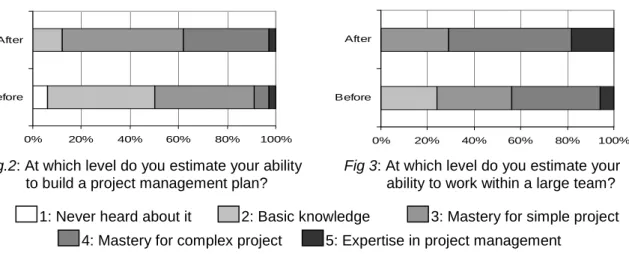
We first studied an overview on the class progress by analysing the individual answers addressing the deliverable writing skill (Fig 2) and also their skill of working in a large group of students(Fig 3).
0% 20% 40% 60% 80% 100% Before After 0% 20% 40% 60% 80% 100% Before After
Fig.2: At which level do you estimate your ability
to build a project management plan?
Fig 3: At which level do you estimate your
ability to work within a large team?
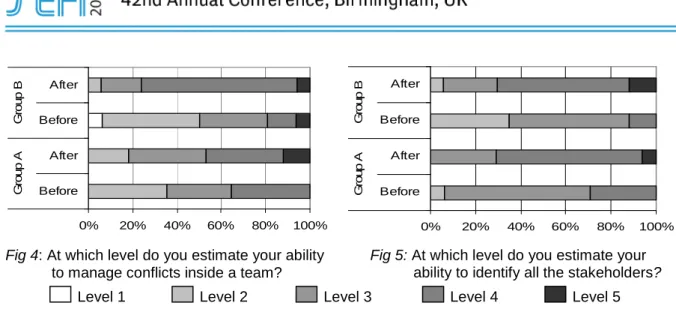
Figure 2 shows that initially 50 % of students position themselves on a level equal or superior to level 3 to establish a project management plan document. At the end of the course, 90 % of the students estimate a level 3 or better. Concerning the capacity to work in a large team (Fig 3), the course enables 70% of the students to assess a level of 4 or better, compared to the 45 % of students having this level initially. Moreover, the expertise level 5 is reached by 20 % of students after the course. Second, we compare the behaviours of the 2 groups because they had different methods of working. Group B had a strong leadership with a masterful way of working. On the contrary, group A started in almost chaos mode to finally reach a smart delegation way of managing. So, the answers about the management of conflicts (Fig 4) and identification of stakeholders (Fig 5) are clarifying their respective way of management.
1: Never heard about it 2: Basic knowledge 3: Mastery for simple project
0% 20% 40% 60% 80% 100% Before After Before After G ro u p A G ro u p B 0% 20% 40% 60% 80% 100% Before After Before After G ro u p A G ro u p B
Fig 4: At which level do you estimate your ability
to manage conflicts inside a team?
Fig 5: At which level do you estimate your
ability to identify all the stakeholders?
Figure 4 about conflict management shows that the initial level of group B is lower than that of group A. And, inside the 20% of group B, almost half of the members estimate having an expert level 5 compared to 0 expert in group A. In contrast, group B improves his skills much more than group A thanks to the course. In group B, expert number stays constant at 5 % contrary to group A which declares 12% experts after the course. This result is correlated with the group B methods of working which had a consensual leadership. For group B, the project had roll out without hitch and the management of few conflicts was almost without problem. On the contrary, at the beginning of project, group A suffered from a lack of leadership creating a big stress inside the group and with the SC. The audit allowed this group to make aware of their weakness and the conflicts calmed down, but in pain. The leaders have learned a lot, sometimes at their expense, but conflict management is still an art feared by half of the students. Figure 5 shows rather similar skills in the 2 teams for identifying the project stakeholders (70 % of students with level 4 or 5).
Finally, we compare the evolution of leaders and contributors’ skills for the 2 groups. We select a question about oral communication (Fig 6) and another about responsibility of a task (Fig 7).
0% 20% 40% 60% 80% 100% Before After Before After L e a d e rs C o n tr ib u to rs 0% 20% 40% 60% 80% 100% Before After Before After L e a d e rs C o n tr ib u to rs
Fig 6: At which level do you estimate
your ability to communicate orally?
Fig 7: At which level do you estimate your ability to be responsible of a task?
Figure 6 shows that after the course, 85 % of leaders get a level 4 or 5 for oral communication compared to only 65 % of contributors. Moreover, about 15% of the level 4 people, leaders or contributors, reach the level 5. Finally, 50 % of leaders reach an expert level compared to only 10 % of contributors. This confirms that leaders have more skills than simple contributors. Concerning the head of task skill, figure 7 shows that before the course, 70 % of leaders and only 30 % of contributors had a level of 4 or better. After the course, the number of contributors at level 4 doubled but none of them reached an expertise level 5. Strangely, the number of expert leaders is almost divided by two after the course. This means that leaders had no longer estimated themselves to be at an expert level, they scaled down their level after experiencing the real difficulties of this difficult role.
3.2 Students personal experience analysis
The qualitative assessments of students point of view were studied by considering only their reflexion about their interactions with other actors. There is a possible bias concerning their feedback because
Level 1 Level 2 Level 3 Level 4 Level 5
all the team members could read it and it was a part of the final report which has been evaluated. However, five major themes emerge from their feedback. For each citation, we have indicated the group to which the student belongs to.
Importance of the project manager: the project manager is the reference person in each group. He had to motivate his team, to support, defend and represent it. He was assisted by the heads of work-package and thus had an overall vision of the project. This position which is held by only two persons in each class was seen as important and was considered to be a key success of the project: "In a
complex project like this, I emphasize the importance of the project manager and all the task leaders. Indeed, these representatives were determinant in tracking targets, deadlines and maintaining the team motivation"(Group B).
Different stakeholders understanding: one of the students main difficulty was to understand the Steering Committee positioning. At first, it was seen as a set of teachers, so rather critical and penalizing. After many discussions, students were able to see this SC as a support for guidance and recommendations. “I think this project is relatively close to what we will encounter in business, if we
can find a balance between the role of teachers and the role of SC” (Group A). Students realized that
they were dealing with real stakeholders who had multiple constraints. Indeed, this directly impacted their project “It helped me to realize that delays had an important impact on the final decisions and that
the team could be dependent on external stakeholders” (Group B). The company Auditas was
aggressive during its audit. The negative points of each group were put forward. After stepping back, students realized that this approach was positive for reorientation and accomplishment of the project. "Even if the conclusions made by Auditas are not easy to take onboard, they allowed us to mobilize
ourselves once again and especially to question ourselves” (Group A).
Human complexity relationship: this project highlighted the complexity of human relationships, both within a group but also with external stakeholders. "I also found that the complexity of the project was
not at the technical level but at the human level" (Group B). This is in complete agreement with [8]
where we see: “Out of the respondents, 69% indicate that failing to realise the intended benefits can
be attributed for more than 50% to human factors and the process of change in an organisation. Complexity and risks of projects are continuously underrated, benefits are inflated and timelines are too tight. Combined with the overestimation of one’s own abilities and limited risk controls, the result is delayed and budget is exceeded”. "The first component of a project is human" (Group A). Human
relationships were particularly difficult as the group size is large (17 students). It was necessary to manage that and to motivate everyone involved. Students also highlighted the need to communicate [9]. "It was also important to know how to communicate in our project within the team and with the
outside so that it is understood and accepted by everyone" (Group A).
An efficient learning process: the technical project with a real request and a real Customer was seen as a relevant learning process. Students felt they were living a human experience and had acquired human relationships skills, aspects that they could not have noticed via a traditional course. "Discovering ourselves, learning about our team and its members in order to be able to speak with
every one in the best way is something you cannot teach, but which is learned by doing it yourself"
(Group B). Some awkwardness arose but will remain in memory and shouldn’t be reproduced.
Team pride: at the end, students showed satisfaction concerning the realised work. They were proud that their team produced a good deliverable for the Customer. Some students even had the feeling of belonging to a company, "Internally, it was like being in a real company, with conflicts, delays, lack of
motivation and re-motivation" (group A). Others noticed how the team knitted together "a true team cohesion emerged in this project, all of us turned towards the same goal: giving the best of ourselves to complete the course" (Group B).
In conclusion for the students "the factors on which we made the most progress are human factors" (group A).
CONCLUSION
After such a project, the students assessment shows a significant evolution of their management skills and their perception of complexity. The students clearly understood that they had to get through a sometimes painful but necessary process of team work organisation to be able to properly respond to the customer’s request. They also showed pride in getting through this challenging project as a stronger team. Students’ perceptions of the various roles were not identical to those of the Steering
Committee or those of the Stakeholders, as they focused on responding to the technical problem. As an example, students did not mention the role of the Communications Coach although he played a key role. The Steering Committee considered the course unit as a learning by doing experiment where errors remain acceptable as they are part of the learning process. After standing back, student accept it as a difficult but normal phase in the learning process.
In the future, we want to improve the experiment and analyse feedback over a longer period. Finer project monitoring is also envisaged to make the work of the Steering Committee more efficient and responsive.
ACKNOWLEDGMENTS
The authors would like to thank the Executive Committee of Telecom Bretagne. Many thanks to P.Friedel for valuable discussions and strong involvement in this training. A special thanks to K. Heggarty for his help in the paper translation.
REFERENCES
[1] Vinouze B. et al. (2013), How to train engineering students to cope with complexity in project management? 41ème SEFI Conference, Published by SEFI aisbl, ISSN: 1024-7920, September, Leuven.
[2] Genelot, D. (2011), Manager dans la complexité, INSEP CONSULTING Edition, ISBN
978-2-914006-958, p. 21.
[3] Abernethy, K., Piegari, G. and Reichgelt H. (2007) Teaching project management: an experiential approach, Journal of Computing Sciences in Colleges, vol. 22, no. 3, pp. 198– 205.
[4] CDIO
http://www.cdio.org/
,
consulted on 04/11/2014.[5] Kiviluoma P. and al. (2013), Experiences and insights into tutoring and assessment on itnerdeisciplinary project-based learning, 41ème SEFI Conference, September, Leuven. [6] Project Management Institute Inc, (May 2013), The high cost of low performance, the
essential role of communications, pp 1-10.
[7] Tuckman B. (1965), Developmental sequence in small groups, Psychological Bulletin, 63, pp 384-399.
[8] T. Broekhuizen, J. de Gier, S. van der Meijs, R. Oudega, H. Wilbrink, (2012), KPMG Advisor Institute, Project and programme management survey, pp 43-49.
[9] Lievens J. (2013), Are communication skills important for engineers? A relevant research question for engineering students and curriculum designers, 41ème SEFI Conference, September, Leuven