HAL Id: hal-02133948
https://hal.insa-toulouse.fr/hal-02133948
Submitted on 20 May 2019
HAL is a multi-disciplinary open access
archive for the deposit and dissemination of sci-entific research documents, whether they are pub-lished or not. The documents may come from teaching and research institutions in France or abroad, or from public or private research centers.
L’archive ouverte pluridisciplinaire HAL, est destinée au dépôt et à la diffusion de documents scientifiques de niveau recherche, publiés ou non, émanant des établissements d’enseignement et de recherche français ou étrangers, des laboratoires publics ou privés.
John Susainathan, Florent Eyma, Emmanuel de Luycker, Arthur Cantarel,
Bruno Castanié
To cite this version:
John Susainathan, Florent Eyma, Emmanuel de Luycker, Arthur Cantarel, Bruno Castanié. WOOD-BASED COMPOSITE SANDWICH STRUCTURES. ECCM18 - 18th European Conference on Com-posite Materials, Jun 2018, Athènes, Greece. pp.24 - 28. �hal-02133948�
WOOD-BASED COMPOSITE SANDWICH STRUCTURES
John Susainathan
1, Florent Eyma
1, Emmanuel De Luycker
1, Arthur Cantarel
1, Bruno
Castanié
11
Institut Clément Ader (ICA), Université de Toulouse, CNRS UMR 5312-INSA-ISAE-Mines Albi-UPS, 3 Rue Caroline Aigle, 31400 Toulouse
Email: [email protected]
Keywords: sandwich, plywood, keyword 3, keyword 4, keyword 5
Abstract
Low carbon impact is a shared goal of all transportation industry. One way to match this expectation consists in the introduction of lightweight materials with high specific properties such as composites materials. A sandwich structure with a plywood as a core material combined with metallic or composite skins appear as good candidate at a very low cost. Some recent and old applications of wood in transportation will be recalled first and then the sandwich manufacturing issues will be be detailed. Some results on static and impact responses are also presented.
1. INTRODUCTION
Properties of wood such as fire resistance or thermal and acoustic insulation are also essential for many applications and could lead to a new interest for this material. Wood is also a totally renewable material which guarantees sustainability with much lower costs compared to honeycomb or foam cores. Balsa wood is currently used for the design of naval sandwich structures. Some results highlight its advantages for impact applications [1, 2]. Very few applications of wood based sandwich structures were found in automotive and naval structures. Nevertheless, in the sixties a “Le Mans” race car designed by the famous English engineer Frank Costin was all plywood made for the structure with a total mass of only 450 kg (see Fig. 1). More recently a repair was made on a Mudry acrobatic airplane CAP 10 by replacing wood spar by carbon spars [1]. So the authors wishes to demonstrate the interest in merging these old material with new materials.
2. DESIGN AND MANUFACTURING OF SANDWICHES WITH PLYWOOD CORES 2.1. Sandwiches description
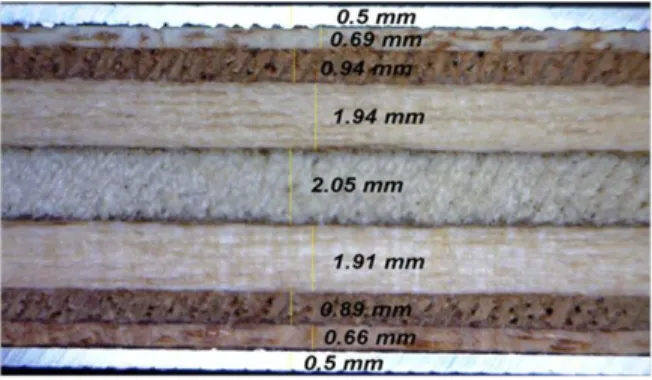
Two type of plywood were used named “Plywood-A” and “Plywood-B” and showed Fig. 2. Theses plywood are obtained after stacking of Okoume and polar layers oriented at 0° or 90°
a)
b)
Figure 2. Plywood –A (a) and –B (b) stackings
The skins were made from aluminum or composite materials. GFRP (Glass Fiber Reinforced Polymer), CFRP (Carbon Fiber Reinforced Polymer) and FFRP (Flax Fiber Reinforced Polymer) were chosen respectively for their high strength, low cost and their renewable aspect. A typical sandwich structure obtained is showed fig. 3 (see also [2] and [3]).
Figure 3. Wood-based sandwich structure with aluminum skins 2.2. Manufacturing issues
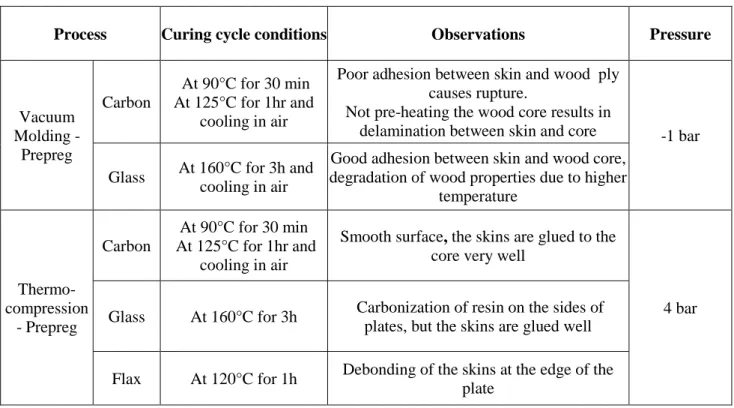
Suitable and inexpensive techniques were used to make sandwich plates with plywood core. The manufacturing processes and some remarks are reported in Table 1 [2, 3]. Two types of processes were tested : vaccum bag molding and thermo-compression molding.
With the first process, two types of wood core sandwiches were made: one with glass and one with carbon skins. The sandwich was constructed by positioning all the materials on the mold as follows. Three plies of prepreg were peeled and stacked, one by one, at the bottom, the wood core (heated at 90 °C for 1 hour to reduce moisture) was placed in position and three plies of prepreg were stacked on top of it. Finally one ply of drainage fabric was stacked to absorb excess resin. The mold was closed with a sealed covering and the air was evacuated to compact all this together in a vacuum of about 1 bar in order to minimize porosity and have a better fiber ratio. The depression was maintained while the samples were cured in an oven.
For thermo-compression, pre-heated wood that had been cured at 90 °C for 1 hour in order to remove a large proportion of its moisture content was used. For the curing cycle development, the initial focus was to develop a reliable set of cure process parameters, such as temperature, pressure and cycle duration, that satisfied the cure, porosity, fiber volume fraction, and dimensional requirements. The
pressure and temperature of the curing cycle was calibrated starting from 1 bar and 90°C. Once the tests had been validated, Panels 500 x 500 mm2 were made under the same conditions but with an equivalent pressure of 4 bars. The time of the curing cycle was chosen according to the prepreg specifications.
For the technique of vacuum bag molding with prepreg used for making sandwiches with carbon epoxy skin, there was poor adhesion between the two components (wood core and CFRP skin), which resulted in peeling, caused by insufficient pressure being exerted by depression. This was overcome with the thermo-compression process, which gave good bonding between the plywood core and the skin and, finally, good sandwich panels for this work.
Table 1. Manufacturing methods and main observations.
Process Curing cycle conditions Observations Pressure
Vacuum Molding - Prepreg Carbon At 90°C for 30 min At 125°C for 1hr and cooling in air
Poor adhesion between skin and wood ply causes rupture.
Not pre-heating the wood core results in
delamination between skin and core -1 bar Glass At 160°C for 3h and
cooling in air
Good adhesion between skin and wood core, degradation of wood properties due to higher
temperature Thermo-compression - Prepreg Carbon At 90°C for 30 min At 125°C for 1hr and cooling in air
Smooth surface, the skins are glued to the core very well
4 bar Glass At 160°C for 3h Carbonization of resin on the sides of
plates, but the skins are glued well
Flax At 120°C for 1h Debonding of the skins at the edge of the plate
3. THREE POINTS BENDING OF SANDWICHES WITH PLYWOOD CORES
Quasi-static bending tests were conducted using a 100 kN load cell on an MTS universal testing machine. Three bending tests were conducted according to ASTM standard on longitudinal and transverse specimens. In this study, at least three specimens of each type of material were tested. The distance between the roller supports (L) was 220 mm. Load and machine displacements were recorded. The deflection was measured with a LVDT sensor located under the sample at the middle. The tests were filmed in order to identify the different failure mechanisms. The bending tests were continued until fracture occurred. For each material, two measurement configurations were used (longitudinal and transverse) in order to take the influence of the plywood stacking sequences into account. In this paper the whole results will not be showed and only the bending stiffness behavior of sandwiches with composite skins will be presented (for comprehensive results see [2, 3]).
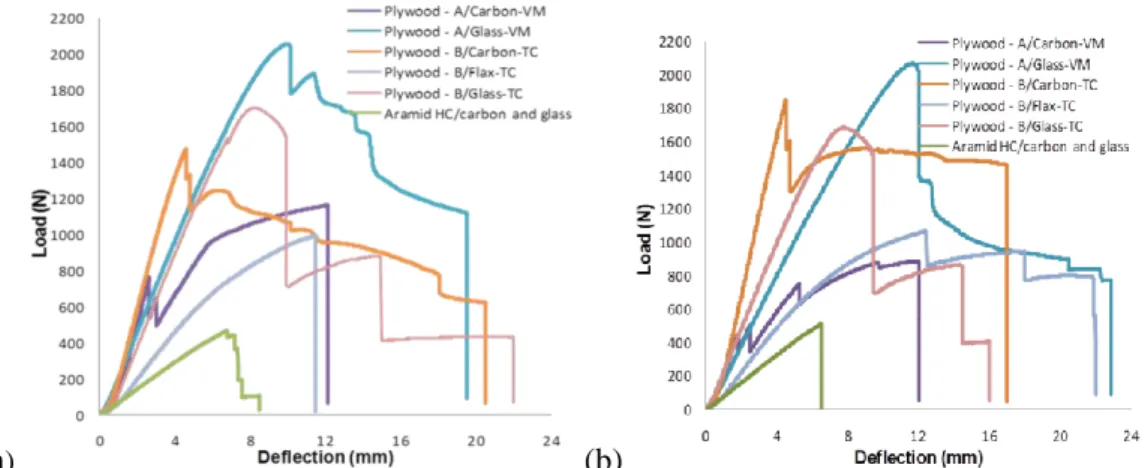
The load/displacement curves are given Fig.4. Regardless of the manufacturing process considered, the results show that plywood with carbon skin has a higher bending stiffness than all other materials in the case of longitudinal samples, due to the greater stiffness of the carbon skins, and also has specific stiffness and bending stress comparable to those of the reference sandwich. However, the vacuum molding process gave it poor adhesion between the skin and core as compared to the adhesion obtained with the thermo-compression process. In general, plywood with composite skin, such as carbon, glass or flax skin also has stiffness that is two to three times better than that of the reference
sandwich, the specific stiffness and specific shear modulus being comparable to the reference. However, these structures exhibit weak results in terms of shear modulus when compared to the reference material. The results indicate that the reference material seems to yield more stiffness and stress for a very low value of peak load. This difference may be explained by the difference in cross sectional area, which is half that of the other wood based sandwich structures tested. It is interesting to observe, in particular, that plywood with flax skin exhibits specific stiffness that is comparable to that of aramid honeycomb/carbon thanks to the low density of the flax skin. Concerning stress results, plywood with glass skin gives higher bending stress than all other materials in the case of a longitudinal sample, due to the higher strength of its glass skin and the better adhesion between skin and core that comes from the vacuum molding process. Its results in terms of strength and stiffness are comparable with those of the other cases. Specific stresses are clearly still in favor of the reference sandwich but these preliminary results are nevertheless encouraging and optimizations are possible for plywood based sandwich structures. The best compromise solution between stiffness and strength in the flexural response of wood based sandwich panels with these different skins is the plywood (A or B) with glass skin. Its strength is higher and its adhesion better in both kinds of process when compared to carbon skin manufactured by the vacuum molding process.
(a) (b)
Figure 4. Load – displacement curves of three point bending for plywood structures with composite
skin, a) Longitudinal, b) Transverse.
4. LOW-VELOCITY/LOW ENERGY IMPACTS OF SANDWICHES WITH PLYWOOD CORES
Impact tests were performed using a drop weight apparatus already presented in previous paper of the authors (for example [5]) followed by tomography analysis. The principle of the falling weight is to drop an instrumented mass, guided in a tube, onto a sample plate held by a clamping window. In our test, the main components were:
• A mass of 2.08 kg. This value was set so as to achieve the desired impact energy with speeds of up to 5 m/s;
• A load sensor located under the mass, to measure the force between the impactor and the specimen during the impact;
• A hemispherical impactor 16 mm in diameter;
• A support window, of internal dimensions 125 x 75 mm², on which the specimen was positioned (standard specimen dimensions: 100 × 150 mm²). These dimensions were determined based on Airbus standards AITM 1-0010.
• A clamping window having inner dimensions identical to those of the lower window (125 x 75 mm²) to hold the specimen during the impact.
• A kickback system to prevent multiple shocks on the specimen.
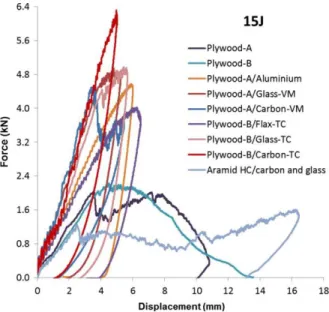
Figure 5. Force-displacement plot for the different wood based sandwich structures at 15 J.
The impact response of the eight different wood based sandwich structures and our reference materials are presented in Fig. 5 in terms of a force-displacement plot for the 15 J case only (for comprehensive results see [3, 4]). In general, the initial slope of force-displacement varies with the skin materials, thus indicating variation in stiffness of the different wood based sandwich structures. As expected, the skin properties influence the impact behavior of these sandwich structures even at lower displacement values. Concerning plywood structures, plywood A is found to yield slightly better results than plywood B in terms of absorbed energy and indentation, due to its longer plateau. Its higher number of interfaces causes better transverse behavior, which leads to smaller permanent indentation than in plywood B In terms of specific energy absorption, despite the good results of the materials under test, the reference material yields the highest results due to its low density. However, at 15 J, all these materials undergo perforation with heavy loss of structural integrity, which are incompatible with most applications. The plywood also gives good results regarding specific energy absorption because of its low density.
For plywood structures with aluminum skins, compared to plywood structures alone, there is an absence of plateau and peak force oscillation occurs due to the high strength and stiffness of the skin. This structure has comparable energy absorption and better resistance to indentation than the reference material but is not as good in terms of specific energy absorption, because of the high density of aluminum skin. Moreover, this structure results in a deeper indentation than in any of the other structures with composite skin, which can be undesirable in some applications.
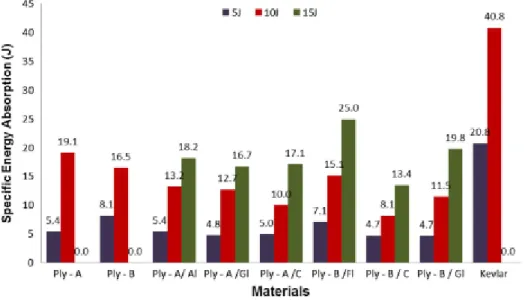
The specific energy absorptions at three energy levels for different sandwich structures are shown in Fig. 6. Two different processes, thermo-compression and vacuum molding with prepreg, were used to manufacture our panels of plywood structure with carbon/epoxy and glass/epoxy composite skins. In general, we found that the plywood with glass skin fabricated by the thermo-compression process had minimum defects, and better adhesion and structural integrity than that obtained by vacuum molding,
as a result of the high operating temperature, the absence of trapped air, and the pressure used in the thermo-compression process.
Figure 6. Specific energy absorption for the 8 configurations tested plus the reference one.
In terms of energy absorption, carbon fiber reinforced composite shows somewhat weak results but with small indentation due to the greater stiffness of the skins. It also resists the highest impact load of all the plywood structures. However, it suffers from higher delamination in the skin and extreme crushing of the plywood core due to its elastic spring back effect and poor adhesion between skin and core, which results from the insufficient pressure used in the case of vacuum molding or the presence of trapped air in the case of thermo-compression.
With glass fiber reinforced composite skins, the behavior is quite different. The perfect adhesion and the spring back effect of the skin prevents delamination but decohesion occurs in the first ply of the plywood core. This results in an absorbed energy comparable to that observed with flax fibers, and smaller indentation than with carbon fibers because of the higher strength of the skins. Whatever the impact energy, this material is the best compromise between absorbed energy and indentation.
When flax fiber reinforcement is used in the skins, the composite behaves similarly to plywood with aluminum skins in terms of absorbed energy and specific energy absorption but shows smaller indentation as the plastic deformation is less than for aluminum. There is minimum delamination and debonding between skin and core due to the moderate elastic spring back effect and the better adhesion obtained through the thermo-compression process as compared to plywood with carbon skin fabricated by either the vacuum molding or the thermo-compression process.
Finally, regarding specific energy absorption (see Fig. 6), the reference material, aramid honeycomb with carbon and glass composite skins, yields the highest results because of its low density but undergoes perforation and loses its structural integrity for high energy impacts (15 J). In comparison, in the case of plywood with aluminum skin, crushing is transformed into indentation without perforation. Regarding newly developed wood based sandwich structures; a very interesting compromise can be obtained for flax skin structures thanks to their low weight and their high energy absorption.
6. CONCLUSIONS
The manufacturing methods and bending static response of innovative sandwich structures with plywood cores have been studied. It has been shown that the quality of the adhesion between skins and plywood can vary with the manufacturing method (vacuum molding or thermo-compression). Moreover, wood is sensitive to high temperatures and its mechanical properties can be degraded during the manufacturing process. However, bending tests showed that the mechanical characteristics
were very high compared to those of a reference sandwich that is currently used for civil aircraft floors. In particular:
- The plywood/carbon composite skins solution is the best in terms of stiffness (almost three times better than the reference aramid honeycomb / carbon and glass material).
- The plywood/glass composite skin solution is the best in terms of resistance (almost twice as good as the reference material).
Following the plywood with glass skin, the plywood with flax skin, which is bio-based, offers a good compromise between energy absorption and specific energy absorption due to its lower density. In conclusion, the development of these structures with plywood cores seems to be a good solution regarding impact concerns. These materials, which are more resistant, more functional and more environmentally friendly, could replace the ones currently used for cargo-bay floors in the aeronautics industry, for example. The only limitation remains the weight of these structures which is 2.5 times that of currently used materials. Nevertheless, for a floor intended for assembly on a final assembly line (i.e. outside a flying structure), this combination of properties associated with a 20 times lower cost (about 7€ /m2) seems to be a promising solution for certain potential applications. Prospects are also being considered for the development of new materials and their use in crash box applications in the automotive industry.
References
[1] http://www.air-menuiserie.com/Cap-10-BK.acsimodulo,IA,18.
[2] J.P. Susainathan, F. Eyma, E. De Luycker, A. Cantarel and B. Castanié. Manufacturing and quasi-static bending behavior of wood-based sandwich structures. Composite Structures. 182, 487-504. 2017
[3] John Prakash Susainathan Development and characterization of Wood Based Ecostructure. PhD University of Toulouse 2017.
[4] J.P. Susainathan, F. Eyma, E. De Luycker, A. Cantarel and B. Castanié. Experimental investigation of impact behavior of wood-based sandwich structures. Composite Part A. 109, 10-19. 2018 [5] Mezeix L., Dols S., Bouvet C., Castanié B., Giavarini JP, Hongkarnjanakul N. Experimental
analysis of impact and post-impact behaviour of inserts in Carbon sandwich structures. J. Sand Struct Mat, on line, https://doi.org/10.1177/1099636216687582