HAL Id: dumas-03172099
https://dumas.ccsd.cnrs.fr/dumas-03172099
Submitted on 17 Mar 2021HAL is a multi-disciplinary open access archive for the deposit and dissemination of sci-entific research documents, whether they are pub-lished or not. The documents may come from teaching and research institutions in France or abroad, or from public or private research centers.
L’archive ouverte pluridisciplinaire HAL, est destinée au dépôt et à la diffusion de documents scientifiques de niveau recherche, publiés ou non, émanant des établissements d’enseignement et de recherche français ou étrangers, des laboratoires publics ou privés.
Medical affairs: its role and added value within
pharmaceutical industry
Célia Picard
To cite this version:
Célia Picard. Medical affairs: its role and added value within pharmaceutical industry. Pharmaceutical sciences. 2021. �dumas-03172099�
AVERTISSEMENT
Ce document est le fruit d'un long travail approuvé par le
jury de soutenance.
La propriété intellectuelle du document reste entièrement
celle du ou des auteurs. Les utilisateurs doivent respecter le
droit d’auteur selon la législation en vigueur, et sont soumis
aux règles habituelles du bon usage, comme pour les
publications sur papier : respect des travaux originaux,
citation, interdiction du pillage intellectuel, etc.
Il est mis à disposition de toute personne intéressée par
l’intermédiaire de
l’archive ouverte DUMAS
(Dépôt
Universitaire de Mémoires Après Soutenance).
Si vous désirez contacter son ou ses auteurs, nous vous
invitons à consulter la page de DUMAS présentant le
document. Si l’auteur l’a autorisé, son adresse mail
apparaîtra lorsque vous cliquerez sur le bouton « Détails »
(à droite du nom).
Dans le cas contraire, vous pouvez consulter en ligne les
annuaires de l’ordre des médecins, des pharmaciens et des
sages-femmes.
Contact à la Bibliothèque universitaire de Médecine
Pharmacie de Grenoble :
UNIVERSITÉ GRENOBLE ALPES UFR DE PHARMACIE DE GRENOBLE
Année : 2021
LES AFFAIRES MEDICALES : LEUR RÔLE ET LEUR VALEUR AJOUTÉE AU SEIN DE L’INDUSTRIE PHARMACEUTIQUE
THÈSE
PRÉSENTÉE POUR L’OBTENTION DU TITRE DE DOCTEUR EN PHARMACIE
DIPLÔME D’ÉTAT
Célia PICARD
THÈSE SOUTENUE PUBLIQUEMENT À LA FACULTÉ DE PHARMACIE DE GRENOBLE
Le : 11/03/2021
DEVANT LE JURY COMPOSÉ DE Président du jury :
Mme Annabelle GEZE Membres :
M Redha BOUROUINA (directeur de thèse) M Denis WOUESSIDJEWE
M Maxime DETAVERNIER
L’UFR de Pharmacie de Grenoble n’entend donner aucune approbation ni improbation aux opinions émises dans les thèses ; ces opinions sont considérées comme propres à leurs auteurs.
DÉDICACES
À Matthieu,
De Kuopio à Paris en passant par Lyon et bien sûr Grenoble, tu as toujours été d’un soutien sans faille. Je ne pouvais tout simplement pas rêver mieux. Je te remercie d’être tout simplement toi. Je t’aime.
À mes parents,
A vous qui m’avez toujours soutenue, conseillée et encouragée dans mes choix. Votre écoute, votre bienveillance et votre amour sont inestimables. Sans vous rien de tout cela n’aurait été possible. Merci pour tout, je vous aime.
À mes frères,
Discrets mais présents, je sais que vous êtes fiers. Merci d’avoir toujours été là.
À mes grands-parents,
Vous avoir comme exemples a été le meilleur des cadeaux et des enseignements. Je ne vous remercierais jamais assez de m’avoir montré le chemin.
À Marion,
Malgré la distance, je sais que tu es et que tu seras toujours là et pour cela, merci ! À tous nos voyages, à toutes ces années passées à tes côtés et aux prochaines.
À ma Pharmille : Julie, Salomé et Léa,
À vos côtés, j’ai passé les plus belles années de ma vie. Citer nos bons moments serait en omettre d’autres tellement ils sont nombreux. Merci d’avoir toujours été là.
À Camille,
Le binôme infernal. Un regard aura suffi pour que l’on ne se quitte plus, probablement le destin. Tout nous oppose et tout nous rapproche. Merci pour ton soutien inconditionnel !
À tous mes amis,
Séverin, Victor, Alexandre, Maud, Mathilde, Anissa, Marie et tous les autres, merci pour tous nos moments d’amitié. J’ai beaucoup de chance de vous avoir comme amis !
REMERCIEMENTS
Aux membres du jury,
À la Présidente du Jury,
Mme Anabelle Gèze,
Je vous remercie de me faire l’honneur de présider mon jury de thèse. Soyez assurée de ma sincère reconnaissance et de mon grand respect.
À mon Directeur de thèse,
M. Redha Bourouina,
Je tiens à te remercier pour ton encadrement tout au long de cette thèse. Je suis ravie d’avoir travaillé à tes côtés. Merci pour ta gentillesse, ta disponibilité et surtout pour tes précieux conseils d’une pertinence sans faille.
À mon Tuteur universitaire,
M. Denis Wouessidjewe,
Je vous adresse tous mes remerciements pour m’avoir accompagnée tout au long de mon cursus universitaire jusqu’à la rédaction de cette thèse. Merci pour vos conseils, votre soutien et votre bienveillance.
Au membre du jury,
M. Maxime Detavernier,
Je te remercie sincèrement d’avoir accepté de faire partie de ce jury de thèse. Travailler avec toi lors de mon externat a été très enrichissant. Je suis heureuse que tu sois présent pour ce dernier travail universitaire.
Aux Chefs de Produit, Médecins Produit et Référents Médicaux Régionaux
ayant pris de leur temps pour participer aux entretiens,
Un grand merci pour la richesse de nos échanges et pour toute cette matière partagée qui m’a permis de rédiger cette thèse.
Aux professionnels de santé ayant répondu à l’enquête en ligne, Je vous remercie pour l’intérêt que vous avez porté à ce travail.
TABLE DES MATIERES
DÉDICACES ... 3
REMERCIEMENTS ... 6
TABLE DES MATIERES ... 8
LISTE DES TABLEAUX... 11
LISTE DES FIGURES ... 12
LISTE DES ABREVIATIONS ... 14
INTRODUCTION ... 15
1. Développement en français ... 16
2. Literature Review ... 23
2.1. Medical Affairs: structure and roles ... 23
2.1.1. Medical Advisor ... 25
2.1.2. Medical Science Liaison ... 31
2.1.3. Medical information ... 34
2.1.4. Medical Education ... 35
2.2. Managing talents ... 35
2.3. Evolution of Medical Affairs since 1999 ... 37
2.4. Focus on compliance ... 42
2.5. Medical Affairs impact measure ... 45
3. Research methodology ... 47
3.1.1. Internal value measurement through links with Marketing department 48
3.1.2. External value with healthcare providers ... 50
3.2. Quantitative metrics ... 52
3.3. Limitations ... 53
3.4. Data analyzing ... 54
4. Méthodologie de recherche ... 54
4.1. Mesures qualitatives ... 54
4.1.1. Mesure de la valeur interne au travers des liens avec le département Marketing ... 55
4.1.2. Valeur externe avec les professionnels de santé ... 57
4.2. Mesures quantitatives ... 58
4.3. Limites ... 59
4.4. Analyse des données ... 60
5. Results ... 61
5.1. Qualitative value: Internal and external links and perception of MA ... 61
5.1.1. Internal links between MA and Marketing departments ... 61
5.1.2. External links with medical Key Opinion Leaders ... 78
5.2. Quantitative value: Value of MA through the practical case study of prostate cancer ... 94
5.2.1. Head office teams ... 94
5.2.2. Field teams (MSLs) in France ... 96
6. Discussion ... 98
6.1.1. A unique expertise essential into a pharmaceutical company ... 98
6.1.2. A rapid evolution of MA situation forming part of external and internal environment... 104
6.1.3. Value estimation of Medical Affairs: the added value is difficult to quantify ... 109
6.2. Recommendations ... 110
6.2.1. Links between Medical Affairs and Marketing... 110
6.2.2. Estimation of Medical Affairs value ... 111
6.2.3. Links between HCPs and Medical Affairs and more generally with the pharmaceutical industry ... 112
6.2.4. Global recommendations for the future growth of Medical Affairs ... 112
6.3. Limitations ... 113
CONCLUSION ... 115
RÉFÉRENCES BIBLIOGRAPHIQUES ... 115
LISTE DES TABLEAUX
Table I : MSL versus Sales rep ... 33
Table II : Example of different kinds of qualitative and quantitative metrics in MA (Arbet-Engels et al., 2018) (23) ... 46
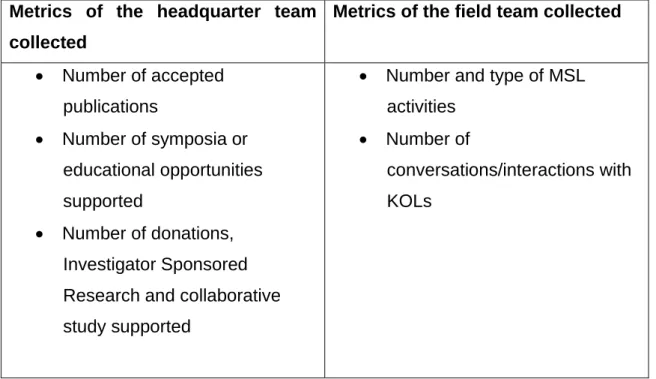
Table III : Different metrics collected during the quantitative analysis ... 52
Table IV : Différents paramètres collectés lors de l’analyse quantitative ... 59
Table V : Interview respondents characteristics ... 62
Table VI : Description of Marketing department role according to Marketing and medical respondents* ... 63
Table VII : Description of Medical Affairs department role according to marketing and medical respondents* ... 66
Table VIII : Medical Affairs role: support versus support and strategic ... 71
Table IX : Differences between MSL and sales rep on the KOL perception ... 84
Table X : Subgroup analysis according to the degree of influence ... 88
Table XI : Number of approved Medical Affairs publications at a global and local level between 2017 and 2019 concerning prostate cancer products ... 95
Table XII : Number of approved Medical Affairs supports for research in France between 2017 and 2019 concerning prostate cancer products ... 95
Table XIII : Number of approved Medical Affairs operations in France between 2017 and 2019 concerning prostate cancer products ... 96
Table XIV : Collaboration opportunities between Medical Affairs and Marketing: strategic role versus supporting role ... 100
LISTE DES FIGURES
Figure n°1 : Medical Affairs main functions ... 24 Figure n° 2 : Medical Affairs’ activities for both external and internal audiences adapted from Jain, S. (2017) (4) ... 25 Figure n° 3 : Interactions between Global and Local Medical Teams ... 28 Figure n° 4 : Medical Advisor role: internal and external interactions ... 30 Figure n° 5 : Core Medical Affairs competencies (extracted from Bedenkov et al. 2020) (13) ... 36 Figure n°6 : Number of Orphan Drug Designation Requests by Year (extracted from Geete and al. 2017) (16) ... 41 Figure n° 7 : Example of goal- and outcome-oriented metrics aligned with strategic objectives (extracted from Arbet-Engels et al., 2018) (23) ... 47 Figure n° 8 : Semi-structured interview guideline for Marketing and Medical Affairs departments ... 50 Figure n° 9 : Comparison of Medical Affairs and Marketing point of view on the
collaboration's opportunities ... 70 Figure n° 10 : Medical specialty distribution for survey respondents (n=67) ... 79 Figure n° 11 : At what frequency do you interact with Medical Affairs department? (n=63) ... 80 Figure n° 12 : In your perception, what are the three proposals that best represent the Medical Affairs department? (n=65) ... 81 Figure n° 13 : What have been your collaborations with the headquarters teams of the Medical Affairs department of a pharmaceutical company? (n=61) ... 82 Figure n° 14 : Do you think that the Medical Affairs of a pharmaceutical company bring you more than what you bring to it or vice versa? (n=63) ... 83 Figure n° 15 : Do you appreciate MSL’s intervention in your hospital department? (n=62) ... 86
Figure n° 16 : What would be the global rate of the Medical Affairs service, utility, and support? (n=62) ... 87 Figure n° 17 : Number of MSL’s interventions for a pharmaceutical company by year 97 Figure n° 18 : Medical Affairs scientific expertise: a real competitive advantage ... 104
LISTE DES ABRÉVIATIONS
AI : Artificial Intelligence
CSP : Code de la Santé Publique (Public Health Code)
DMOS : Diverses Mesures d’Ordre Social (Various Social Measures) EMA : European Medicines Agency
FDA : Food and Drug Administration
HCP : HealthCare Providers or HealthCare Professional KOL : Key Opinion Leader
KPI : Key Performance Indicator MA : Medical Affairs
MKT : Marketing
MSL : Medical Science Liaison QoL : Quality of Life
RWD : Real-World-Data RWE : Real-World Evidence R&D : Research & Development
SmPC : Summary of Product Characteristics TUA : Temporary Use Authorization
INTRODUCTION
Le rôle des Affaires Médicales dans les entreprises pharmaceutiques ne cesse de croître depuis ces dernières décennies. L'environnement en constante évolution est l'un des éléments clés expliquant la nécessité d'une telle fonction. Tout d’abord, l'apparition de produits innovants complexes et de médicaments orphelins ainsi que l'augmentation des coûts de santé conduisent les professionnels de santé à demander des messages scientifiques précis et de qualité avec des résultats cliniques avérés. Ajouté à cela, le besoin de transparence des sociétés pharmaceutiques envers toutes les parties prenantes impliquées dans le circuit du médicament (professionnel de santé, patients et autorités) augmente et participe au développement des Affaires Médicales. Pour finir, l'évolution de la définition de la valeur qui se fonde toujours davantage sur des preuves et demande donc des données de vraie vie qui sont collectées et analysées par les Affaires Médicales explique également l’essor de ce département.
Ce projet vise à décrire le rôle actuel du département des Affaires Médicales ainsi que ses différents liens avec les acteurs externes et internes afin de mettre en évidence sa place au sein de l'industrie pharmaceutique. L'objectif est également de qualifier et de quantifier la valeur des apports du département des Affaires Médicales.
Pour cela, une revue détaillée de la littérature expliquera le rôle de ce département puis décrira son évolution de l'année 2001 à nos jours.
La valeur qualitative des Affaires Médicales sera ensuite analysée au travers d’entretiens avec les départements des Affaires Médicales et du Marketing pour qualifier leur rôle en interne puis grâce à une enquête en ligne réalisée auprès de médecins afin de caractériser leur implication externe.
Un cas pratique sur le cancer de la prostate tentera d'expliquer comment ce département apporte de la valeur quantitativement pour le laboratoire pharmaceutique.
1. Développement en français
Les Affaires Médicales (AM) ont su s’adapter et répondre à un besoin résultant des divers changements environnementaux dans lesquels évolue l’industrie pharmaceutique. Cependant, leur évolution rapide et continue fait que ce département demeure méconnu et sa valeur reste complexe à estimer. Ce projet a donc pour objectifs de décrire précisément l’implication et les différentes fonctions des Affaires Médicales puis d’évaluer sa valeur ajoutée au sein de l’industrie pharmaceutique. Pour cela, une revue de la littérature, des entretiens, une enquête en ligne ainsi qu’un cas pratique viseront à répondre aux questions suivantes :
- Quels sont les rôles des Affaires Médicales pour les laboratoires pharmaceutiques ?
- Comment estimer la valeur des Affaires Médicales au sein de l’industrie pharmaceutique ?
La revue de la littérature a montré que les Affaires Médicales ont pris un rôle central au sein des entreprises pharmaceutiques avec de nombreux interlocuteurs internes et externes. Ce département doit continuer de s’adapter aux nouveaux changements environnementaux et doit notamment évoluer avec la digitalisation, l’adoption de l’orientation patient, le besoin de génération de données de vie réelle tout en démultipliant le nombre d’interlocuteurs. Bien qu'elles aient désormais un rôle stratégique clair, l'évaluation de leur valeur ajoutée reste un défi. Une partie de ce problème pourrait être résolue par
l'intelligence artificielle (IA), la technologie devenant un moyen de quantifier la valeur de données qualitatives.
La méthodologie de recherche de cette étude est séparée en deux parties distinctes correspondant aux deux différentes mesures permettant d'évaluer la valeur des Affaires Médicales : les paramètres qualitatifs et les paramètres quantitatifs.
Tout d’abord, la valeur qualitative des AM sera explorée à la fois en interne et en externe. La collecte de mesures qualitatives est essentielle pour rendre compte des relations que les AM entretiennent avec leurs différents interlocuteurs :
- Dans une première partie, la réalisation d’entretiens semi-structurés avec des collaborateurs des départements des Affaires Médicales et du Marketing de différents laboratoires pharmaceutiques permettront de confirmer le rôle pivot des Affaires Médicales en interne. L’objectif sera de recueillir la perception des deux départements (AM et Marketing) sur le rôle des Affaires Médicales et de repérer d’éventuelles incohérences par rapport à ce qui a été décrit dans la littérature et/ou de décrire la compréhension que ces départements se font l’un de l’autre. Le guide pour l'entretien semi-structuré se décompose en quatre parties principales décrites dans la Figure n°9. - La deuxième partie de l’analyse qualitative portera sur la
caractérisation des liens entre les Affaires Médicales et les professionnels de santé et plus particulièrement avec des leaders d’opinion via le recueil de leur perception de ce département grâce à
une enquête en ligne. Les leaders d’opinion sont identifiés selon leur fréquence d’apparition en tant qu’auteurs de publications scientifiques ou en tant qu’intervenants lors de congrès. Cette étude s’oriente spécifiquement vers des leaders d’opinion dans le domaine de l’oncologie. L’enquête porte sur les interactions qu’entretiennent les médecins avec les Affaires Médicales, leur perception de cette relation mais aussi leur compréhension du rôle de ce département par rapport aux autres départements de l’industrie pharmaceutique qui interagissent avec les professionnels de santé.
Pour compléter cette étude, la valeur quantitative des Affaires Médicales sera abordée par l’évaluation numérique des actions de ce département dans le cadre d’un cas pratique de la prise en charge du cancer de la prostate dans une entreprise pharmaceutique. L’extraction de ces mesures quantitatives concernent à la fois les activités de l’équipe siège et de l’équipe de terrain.
Cette analyse comporte néanmoins quelques limites : la valeur qualitative externe n'a été étudiée qu’auprès des professionnels de santé leaders d’opinion en omettant les autres interlocuteurs externes des Affaires Médicales (professionnels de santé non-leaders d’opinion, associations de patients, autorités sanitaires…). Seul le domaine thérapeutique de l’oncologie a été a ciblé. La valeur des sous-départements de l’Information Médicale, des Opération Cliniques ou de la Formation Médicale n’a pas été analysée. Enfin, cette étude se focalise sur la pratique des Affaires Médicales telle qu’elle est exercée en France.
Les principaux résultats des différentes parties décrites dans la méthodologie sont résumés ci-après.
Les entretiens réalisés en interne auprès des départements des Affaires Médicales et Marketing montrent un alignement global entre ces deux entités avec, néanmoins, quelques incohérences majeures. Si l'on considère la perception du département Marketing, les points de vue des personnes interrogées (départements Marketing et Affaires Médicales) sont globalement alignés. Les différences constatées lors de ces entretiens concernent principalement le rôle stratégique du département Marketing où les réponses montrent un manque d'information sur certaines de ses activités (prévisions de ventes ou gestion du KOL) et à l'opposé une surestimation de son activité de communication qui ne semble pas correspondre à son rôle. En ce qui concerne la perception du département médical, les résultats révèlent une réelle incompréhension des caractéristiques fondamentales de ce département et de ses rôles en interne. En effet, le département Marketing semble ne pas citer le rôle de garant scientifique qui est le fondement même de leur fonction, et sous-estime le nombre d'acteurs internes avec lesquels les Affaires Médicales interagissent. Les résultats montrent un bon alignement concernant les opportunités de collaborations entre ces deux départements, comme la co-construction de plans stratégiques de marque ou la collaboration sur des symposiums / opérations marketing. Les personnes interrogées des Affaires Médicales et du Marketing s'accordent à dire que les Affaires Médicales sont un département ayant à la fois des fonctions de soutien et des fonctions stratégiques.
Les principaux résultats de l’enquête en ligne auprès des professionnels de santé leaders d’opinion montrent qu’une majorité des personnes interrogées ont déjà été en contact avec les AM. Cependant, ces collaborations profiteraient en premier lieu aux entreprises pharmaceutiques (cas où le leader d’opinion apportent son expertise lors de conseils consultatifs ou en tant qu'intervenant lors de réunions scientifiques) et bénéficieraient ensuite aux professionnels de santé par le biais de soutien aux programmes de recherche (collaboration sur des études cliniques). Toutefois, le panel interrogé estime que cette collaboration est équilibrée. Le panel différencie bien l'activité des MSL (Medical
Science Liaison) de celle des délégués hospitaliers ainsi que de l’activité des
équipes des AM du siège. Dans l'ensemble, les médecins interrogés estiment le service, l'utilité et le soutien des AM à 3,65 sur 5. L'analyse en sous-groupes selon le degré d’influence des leaders d’opinion montre des résultats généralement semblables entre les sous-groupes. Néanmoins, ces résultats soulignent que les sous-groupes ont des besoins différents de la part des AM en fonction de leur degré d'influence : les leaders d’opinion majeurs demandent de l’information sur les données récentes tandis que les leaders d’opinion mineurs expriment davantage un besoin de soutien.
Les résultats quantitatifs portant sur l’étude du cas pratique de l’implication des Affaires Médicales dans une entreprise pharmaceutique dans l’aire thérapeutique du cancer de la prostate confirment que la quantification de la valeur des Affaires Médicales est complexe. Ces résultats ayant été obtenus au sein d’une seule et même entreprise pharmaceutique, d'autres analyses portant sur davantage d’entreprises et sur d’autres aires thérapeutiques
devraient être réalisées pour conclure définitivement sur la valeur quantitative des AM.
Cette étude a confirmé le rôle pivot des Affaires Médicales en mettant en avant les avantages que ce département apporte au sein de l’industrie pharmaceutique. Les différentes analyses ont en effet montré que la place centrale des AM est tout d’abord liée à la caractéristique même de ce département : son expertise scientifique. Ce haut niveau de connaissances médicales permet à la fois de devenir l’interlocuteur privilégié auprès des professionnels de santé leaders d’opinion qui ont montré une opinion positive envers les Affaires Médicales au travers de l’enquête en ligne, mais aussi de devenir un acteur non substituable en interne auprès des autres départements et notamment du département Marketing. Au sein des entreprises pharmaceutiques, les Affaires Médicales semblent néanmoins manquer d’une définition claire auprès des autres départements qui permettrait à la fois une meilleure délimitation des activités mais aussi une meilleure performance par amélioration de la synergie. Les leaders d’opinion semblent conscients de leur relation interdépendante avec les AM mais ils ont davantage mis en avant la dépendance de l’industrie pharmaceutique à leur égard que le contraire. Les Affaires Médicales doivent veiller à ce que cette relation reste équilibrée. Les entreprises pharmaceutiques doivent trouver la bonne place pour les Affaires Médicales tout en intégrant les changements environnementaux afin d'optimiser leur efficacité et de développer leur rôle stratégique.
Cette analyse a également mis en avant la difficulté à évaluer la valeur quantitative de ce département puisque la plupart de ses activités concerne des
données qualitatives et que le peu de données quantitatives disponibles ne reflètent pas correctement l’activité des Affaires Médicales. La constante amélioration technologique contribuera sans doute à pallier, dans les prochaines années, à cette difficulté grâce, notamment, à l’utilisation de l’Intelligence Artificielle comme outil de quantification d’activités qualitatives.
2. Literature Review
As a background, the following literature brings the key concepts describing the role of Medical Affairs department with a description of its organization and the talent management of people working into this area. This literature review also focuses on a state of the art of the evolution of the Medical Affairs role from the past twenty years until today while sensitizing on the main concerns through the years that Medical Affairs department have been facing.
2.1.
Medical Affairs: structure and roles
Medical Affairs’ activity differs a lot depending on the life cycle of the product (pre-launch, launch or mature product), on the product itself (therapeutic area involved, innovative product, diagnostic associated product) but also on the pharmaceutical company. Nevertheless, more generally, “Medical Affairs” is described as the department within pharma companies dedicated to interact with healthcare practitioners, included physicians, who are implicated into clinical studies on the companies’ products or care providers who just use it (1). Therefore, Medical Affairs department is dedicated to be the guarantor of the scientific and clinical information diffused for both internal collaborators and external stakeholders. Consequently, Medical Affairs interact with several departments internally (Clinical Operations, Commercial, Market Access, Pharmaceutical Affairs…) not forgetting the strong external relationships they built with healthcare professionals and patient organizations. Two main activities drive the Medical Affairs department: collection and management of data, and knowledge diffusion (2).
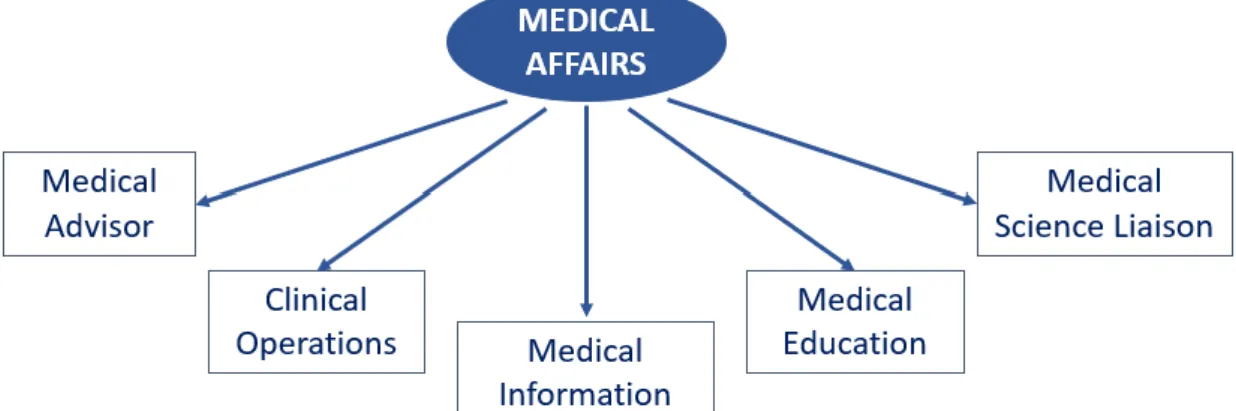
MA play a pivot role into pharmaceutical companies from integrate, generate, and disseminate data coming from Global Research & Development teams or local clinical operational team to support Health Care Professionals (HCP) needs through the product life cycle. Medical Affairs department create a real link between Global R&D and commercial departments that were completely separated before. The main core functions of Medical Affairs are the following (3) (Figure n°1):
- Medical Advisor
- Medical Science Liaisons (MSLs) - Medical information
- Clinical operation - Medical Education
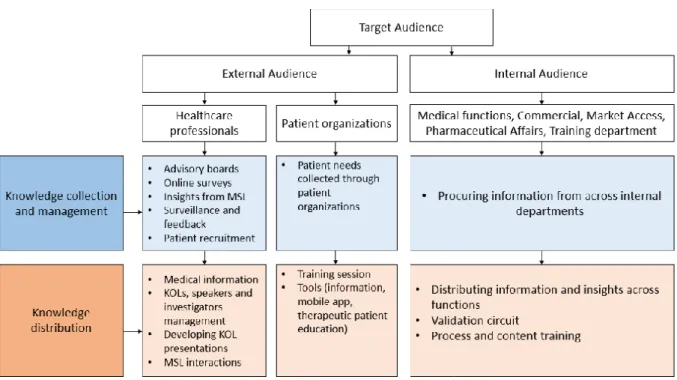
Figure n° 2 : Medical Affairs’ activities for both external and internal audiences adapted from Jain, S. (2017) (4)
As shown in Figure n°2, activities depend on the target that could be external or internal. For both audiences, Medical Affairs’ activities are driven by two main objectives: collect and manage data followed by the diffusion of these data. This is the key infinite process leading this department.
2.1.1. Medical Advisor
The Medical Advisor of a therapeutic unit has a key role into the pharmaceutical industry and occupies a central place at the heart of the Medical Affairs department. Indeed, by definition, the Medical Advisor is the expert of a pathology, its environment and products related to this disease. By being the scientific expert of the disease inside a pharmaceutical company, he is, hence, the guarantor of the quality and the accuracy of the scientific message. He shall
ensure that every data used is correct and well interpreted. To do so, the cross-functionality is inevitable (Figure n°4):
- With other internal functions:
➢ Marketing/commercial department: the Medical Advisor is responsible for the validation of every promotional document concerning the scientific content. More generally, every document diffused externally and internally is validated by the Medical Advisor including market research study. For instance, promotional documents provided to sales rep and made by the marketing department or any internal education document need a Medical Advisor scientific validation.
➢ Market Access department: since the market authorization of new drugs or label extension is highly regulated, the need of clinical data is essential. The Medical Advisor has a role to identify and highlight data that could be useful for market access team into every of their application dossiers. Newly, a new trend of Real-World Data (5) (RWD) appear and again, Medical Advisor plays a critical role for the generation of this kind of data upstream of the register application. RWD are complementary data in addition to classical randomized clinical studies that confirm in a real-world setting what was found in clinical settings. The Food and Drug Administration (FDA) and the European Medicines Agency (EMA) even described the increasing role of this data on their regulatory decision making (6,7). Therefore, the collaboration between
Market Access and the medical department lasts during all the medication life cycle management.
➢ Clinical operation: the Medical Advisor is locally the source of creation of new non interventional studies. By identifying a need with healthcare professional or for the company, he establishes the study concept. Once the concept is defined and endorsed internally, clinical study department will ensure the realization of this study after confirmation of the feasibility and the relevance of this study.
➢ Pharmacovigilance department: for the resolution of pharmacovigilance cases, often, it requires the expertise of Medical Advisors either for pathology or product questions but also for bibliography references. On the opposite, if the Medical Advisor hears about a pharmacovigilance case, for instance during their discussions with healthcare professionals, he must declare it.
➢ Medical Information: sometimes, when the question is too specific, Medical Information does not have the answer and asks for the Medical Advisor expertise. Medical Advisor’s service could also be necessary for bibliography demands from HCPs.
➢ Education department: the Medical Advisor is the source of every training documents for the attention of every collaborators concerning the pathology, its environment and treatments associated. Medical Advisors are also in charge of training each new collaborator and of the continuing education.
➢ Regulatory Affairs: validation the update of Summary of Product Characteristics (SmPC) made by the Regulatory Affairs department.
- With other internal MA subdepartments:
- Global Medical Affairs team with bilateral interactions (Figure n°3): downward adaptation of the global strategy at a national scale but also Medical Advisors bringing local insights to the global team. Global and local medical teams collaborate on the follow-up of clinical studies and the dissemination of publications. - MSL team: Medical Advisor has a supportive role for the MSL
team including training, presentations content creation (slide decks for HCP presentations) or national strategy sharing for the regional declination.
Figure n° 3 : Interactions between Global and Local Medical Teams
● With external stakeholders:
➢ Healthcare professionals: Medical Advisors have several occasions to interact with HCPs. Firstly, and mainly, Medical
Advisors have a role of service towards HCPs. They collaborate for support research projects through donations, Investigator Sponsored Research (ISR) or collaborative study depending on the type of research the physician is planning to do. Those research projects can then lead to publications for which Medical Advisors is in close link with HCP implicated. HCPs and Medical Advisors also interact for company’s symposia in a congress or for events on behalf of the company where the HCPs is chosen as an orator. On the other hand, interactions with HCPs also allow the collection of insights, needs and potential opportunities.
➢ Health authorities: in the context of the market authorization of a new product: scientific positioning with selection of data to demonstrate the place of the product in the therapeutic strategy given the efficacy and tolerance compared to other products. ➢ Patient organizations: those organizations interact increasingly
with HCPs, health authorities and patients and hence, have an important place. Medical Advisors have a pivotal role in gathering the patient organization needs to set up projects responding those needs. As pharmaceutical industry, there is no direct interaction with patients. Medical Affairs are often the only department interacting with patient organization.
Figure n° 4 : Medical Advisor role: internal and external interactions
In addition to these external and internal collaborations, the Medical Advisor is also in charge of its own medical lead tactics. It could be a medical symposium, medical events on behalf of the company or advisory board that consists to understand better the environment of the disease management and answering questions by asking them to pundits in this domain.
To ensure his expertise, the Medical Advisor is constantly updating his knowledge by reading literature or going to congress.
2.1.2. Medical Science Liaison (MSL)
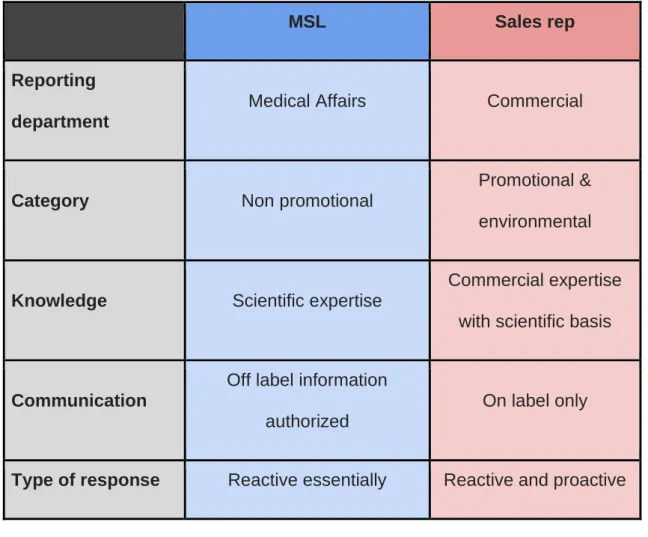
As the regulatory framework and compliance requirement are more and more restrictive for the commercial sales force, the MSL function emerged to respond to new requirements, collect local insights and satisfy the growing demand of HCPs asking for complex scientific data. To do so, pharmaceutical companies created a new role allowed to talk of off-label information (clinical data without marketing authorization indication) but with the constraint to respond mostly reactively to demands (Table I summarizing MSL versus Sales rep characteristics). That is how MSL became the first non-promotional field function. Hence, MSLs are scientific experts trained to communicate complex scientific and medical information to HCPs. In addition of this scientific communication role, MSLs main activities are:
- Meetings with healthcare professionals and Key Opinion Leader (KOL) Management: in a reactively and non-promotional way, MSLs can be asked by HCPs to communicate about new clinical results (could be off label information), management of a disease or to talk about support for research projects. MSLs also ensure study follow-up with local investigators.
- KOL Mapping: the first identification and the update of main KOL are essentials during the pre-marketing authorization but also during the entire product lifecycle. KOL mapping will be used by medical colleagues but also by sales department.
- Sales rep education: MSLs oversee the training continuity by communicating most important information coming from the latest
congresses or publications and that could be useful for the sales rep activity.
- Regional medical strategy: MSL oversees the declination of the global medical strategy on a regional scale. Guided by their knowledge of the specific environment and actors of a region, MSLs build their strategic plan summarizing the main medical activities responding the needs of local external stakeholders. - Regional medical project management: often, headquarters events
on behalf of the company can be disseminated regionally. It also concerns events directly on the initiative of the MSL and specifically adapted to a region.
- Scientific literature monitoring: MSLs must be always aware of the evolution of the disease management, disease environment and all the treatments associated so that they stay scientific experts and they can anticipate their positioning concerning competitors. - Support on headquarters operations (symposia, events on behalf
of the company)
- Insight collection and reporting: since MSLs are the link between HCPs and headquarter’s teams, the insights reporting is an important activity. It allows the company to adapt its medical strategy regarding information they got.
Table I : MSL versus Sales rep
MSL Sales rep
Reporting department
Medical Affairs Commercial
Category Non promotional
Promotional & environmental
Knowledge Scientific expertise
Commercial expertise with scientific basis
Communication
Off label information authorized
On label only
Type of response Reactive essentially Reactive and proactive
Rutherford and Smith (2016) described MSL major functions depending on the product lifecycle phases (8):
- During early stages of development, the role of MSL is to develop the interest of external HCPs for the molecule and make the molecule widely known. He also has a major role of follow-up with clinical trial center (recruitment, study progress…)
- On pre-launch phase, the role is the same as it is in early stage but added to this, MSLs will help to build the market access plan and if needed begin to fill the data gaps by initiating new studies through HCPs.
- When the medication is available on the market, MSLs keep the previous roles but now have the responsibility to educate HCPs for its use.
- On the post launch, at this stage, MSLs start their role of responding to KOLs requests on the clinical development or more generally on prescription questions. It also states the emerging need of Real-World Data and therefore the beginning of establishment of observational studies.
Finally, MSLs main functions are to allow the optimal disease management for patient and to optimize the medication use by ensuring the medication to be taken at right stage of the disease by the right patient profile (9).
2.1.3. Medical information
Medical Information was heavily involved into the creation of Medical Affairs department. Indeed, Medical Information was the foundation of this department when at that time a real need of medical expertise about pharmaceutical company’s product portfolio emerged. This need was for both internal collaborators but also for external stakeholders asking for greater transparency associated with an increasing need for more detailed knowledge about treatments prescribed, received (patients/patient’s organizations) and authorized on the market and reimbursed (for health authorities). Added to this, the increased number and complexity of new drugs, Medical Information has grown out.
According to Tiwari (2006), Medical Information could be defined as “the
about medicines”. Main Medical Information activities are answering medical
queries, providing information proactively, reporting adverse drug reaction they become aware, providing an online medicine information service for public, training and education, keeping databases of published and unpublished information updated (10). In France, Medical Information to HCPs is a regulatory obligation for pharmaceutical industry. It is optional for patients.
2.1.4. Medical Education
The medical education are project managers setting up medical education projects for HCPs and working in close collaboration with the Medical Advisor (who makes the content). It bridges the gap between Medical Advisors, service providers and support functions such as legal (for the contractual part) and purchasing departments. It is a growing department: since marketed products are more innovative and complex, it is a priority to improve HCPs knowledge and skill in order to disseminate the good practices in the use of this new products (11).
2.2.
Managing talents
Historically, Medical Affairs department was considering as a support function and it is now clearly moving from this previous support role to a complete strategic role. This fact that Medical Affairs became a real advantage is a real challenge for pharmaceutical industry and more specifically to find the right talent facing these new requirements (12). Indeed, even if ten years ago, the classical Medical Affairs profile was physician with clinical background, it is now insufficient to have only a scientific knowledge. Medical Affairs department
now needs real leaders able to interact with several stakeholders internally and externally. Consequently, business acumen is now inevitable for Medical Affairs profiles.
Requirements for Medical Affairs described by Bedenkov et al. (2020) are particularly high (13):
- Science knowledge and understanding associated with a R&D collaboration
- High understanding in regulations surrounding pharmaceutical activities and compliance/legal departments requirements
- Strategic capabilities of their Marketing colleagues associated with customer interaction skills
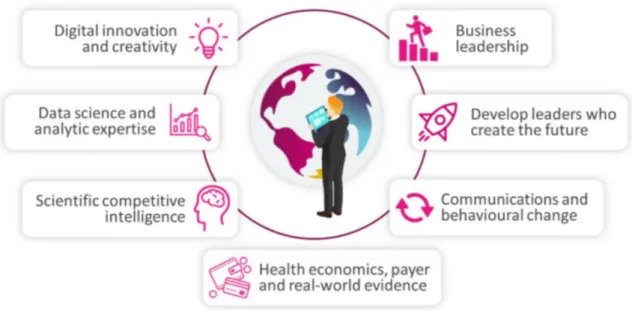
To meet all these expectations, Bedenkov et al. (2020) established the six core competencies needed for Medical Affairs talents (Figure n°5)
Figure n° 5 : Core Medical Affairs competencies (extracted from Bedenkov et al. 2020) (13)
This evolution of Medical Affairs position explains the shift of profiles that were entirely physicians ten years ago and that are now opened to other scientific profiles such as PhD or pharmacists always with the aim to find people with both scientific expertise and business acumen. Nevertheless, there is almost no educational program in France allowing working in the Medical Affairs department. Main MA profiles are mostly coming from other departments such as pharmacovigilance or marketing. The reason is probably the too rapid evolution of Medical Affairs and, hence, the implementation of a new training that could not follow.
2.3.
Evolution of Medical Affairs since 1999
In 1999, the MA department was at its beginning and numerous big pharma companies didn’t have yet a real department as known today. One core task that MA was already doing is the drug information through medical queries. At that time, the MA department was then almost entirely dedicated to this task and the department was besides called “Medical Affairs/drug information department” (14). A benchmarking survey on this department was carried out on twenty-four major pharma and biotech companies at that moment in order to provide information on how measure their performance and it showed that MA at that time employed 7 to 53 people to respond to 27 to 196 queries per healthcare professional per week on average (14). It should be noted that in the 90s pharma companies had not the current technology allowing the staff to be more efficient and all queries were answered without the help of internet but most of the time it was already written responses. In this paper, Hopkins et al. also described the transformation that MA department will soon go through
even if it was not official tasks, responders of the survey affirm that apart from the medical queries activity they also have early stages activities of the current MA department such as: training sales force, adverse event reporting, supporting internal teams on Food and Drug Administration (FDA) submission and FDA approval.
In 2001, the importance of the MA department started to be a fact and Wolin et al. wrote an entire paper on how MA is becoming to be a real need for the future of pharma companies (15). It is one of the first time that a real description of this department was made. Two functions where MA has a role to play are described. First, MA has a role to fill the gap of post approval clinical studies conduct and follow-up. Secondly, the arrival of new indications with small markets require a specific expertise that only MA can satisfy. Those two tasks are primordial and explain how MA place falls between the clinical development team and the Marketing/sales department. The balance between collaborating Marketing and participate to clinical trial completion at the same time is a key success factor of MA department success. Again, activities such as training, adverse event reporting are described as full part MA’ task.
Later, in the 2010s, papers concerning MA had multiplied with a broader view that allowed a more accurate description and a view of the possible evolutions MA could encounter. Indeed, in 2012 came the first papers that suggest what MA will become in the next years. One paper first described the main changes that pharmaceutical industry is facing that will cause in the
meantime a radical change into MA department. At that time, three main forces that MA needs to take into consideration for its transformation emerged (2):
- Value definition - The need of a broader definition of value due to healthcare costs which constantly increase will deeply transform the healthcare landscape. Since costs are rising, authorities and more globally healthcare systems from all around the world are trying to adapt by increasing control. To do so, to make decisions, payers are more and more asking for Real-World Data with the aim to clearly define the effectiveness of a product and be able to compare it to alternative solution.
- Cost pressures causing the emergence of new decision-maker stakeholders and need of transparency - This paper anticipated the
future increase consumerism of patients and hence of healthcare expenditures that will cause a rise in costs pressure obligating firstly, physicians to shift their decisions making power to other stakeholders that are closer to control costs and secondly, pharmaceutical companies for transparency towards public for financial disclosures.
- Data proliferation - In this era of data production, MA cannot escape from seeing the number and the types of data increasing with notably the apparition of Real-World Data and patient-generated data used not only separately but also in an integrated manner in the whole data sets. With the need of transparency which leads to data over-diffusion, MA will have then a crucial role to control the use of data by avoiding misuse of the data and will have to handle the rising compliance pressure regarding this issue.
Those forces need to be considered and Evers et al., 2012, propose solutions for MA to both deal with these changes while creating value. Firstly, MA should demonstrate value while improving patient access and maintaining the best use of medications. The key point of value demonstration is to understand what value definition is done according to the different stakeholders: “while patients focus on out-of-pocket costs, physicians focus on reimbursement, and payors/governments focus on cost to the health system”. The second point is to expand their relationships with broader stakeholders to follow the patient-centric trend. The third lever is to diffuse from complex and numerous data, a clear, transparent, and unbiased message that allows MA to gain credibility and recognition from the external stakeholders. Finally, MA will need, to face this evolving healthcare landscape, a strong organization with broader personnel profiles allowing to get a multidisciplinary team to respond to the wider role of MA.
In 2017, it was already a fact that MA, that was once defined with a narrow activity with only support responsibilities, is now a department with strategic decisions to take (16). It is recalled that drug development pipeline is shifting from chronic diseases to orphan diseases (Figure n°6) which needs high scientific expertise that MA can bring. Again, technology improvement is described as a key challenge. MA department needs to follow this trend not to lose their customers since both physician and consumers are using new technologies to find information.
Figure n°6 : Number of Orphan Drug Designation Requests by Year (extracted from Geete and al. 2017) (16)
More recently, in 2020, technology challenge is not anymore a challenge but a reality. MA is now facing a new shift following technologic advances and digitalization catalyzed by the recent COVID-19 pandemic (13). Healthcare systems are currently adapting to new technology and MA is no exception in that regard. Even if pharmaceutical industry was already trying to adapt to digital evolutions, it was lagging behind compared to other industry. COVID-19 crisis urges pharmaceutical companies to digitize quickly and MA was one of the most concerned department regarding this accelerated shift. Indeed, MA that has a lot of external links has a decreased access to HCPs and also institutions but in the same time, HCPs rise their virtual engagements (17). Those two trends lead to a deep change in the way of interacting on a digital way (email, videoconference or phone exchange). In addition to diversify communication channels, the COVID-19 crisis also reinforces the need of RWE
data generation. It will be their responsibilities to fill the gap between data found on Randomized Clinical Trial (RCT) and data fall within real-world settings.
To resume, since 1999, MA went from a department almost entirely dedicated to medical information to one of the most complex department pharmaceutical industry ever knew dealing with R&D and science, regulations and compliance, strategy through interactions with both Marketing and sales and all of that keeping in mind that the heart of this department is the patient care. Medical Affairs should therefore find the right balance between supporting commercial interests while keeping the right external link to gain public trust with the help of new innovative ways of communication (2). The first involvement of Medical Affairs that was at the beginning the Medical Information is besides more and more outsourced, which clearly indicates the deep evolution of this department which was created for a basic supporting activity and became a critical transversal group. MA evolved from a support role to strategic collaborator at several degrees. It is constantly reinventing itself and the recent worldwide COVID-19 pandemic has already accelerated the new shift of digitalization.
2.4.
Focus on compliance
In 2011, Werling, Carnell and McCormick, laid foundation of a real description of how Medical Affairs departments should focus on compliance and described the best practices linked with this notion. At that time, MA was not led by clear regulatory requirements. Hence, issues that MA could face about compliance are listed and best practices to confront those challenges have been searched. First of all, the increase of MSLs activity lead to a growth of
compliance issues linked with this practice and pharma companies have to remember the separation between sales rep who not insure an off-label promotion and MSLs function which is devoted to do this off-label information. Moreover, grant funding must be independent and not initiated by the commercial department so that results will not become suspicious. Another important point concerns the diffusion of off-label literature which means the diffusion of scientific papers about unapproved uses of a medication. It must be rigorously managed, and in the US, the FDA proposes a guidance to handle this type of publication that could be diffused and how. Lastly, the globalization of Medical Affairs should not be an impediment to standardized procedures between countries. Many solutions are proposed to answer these issues concerning the respect of compliance (Werling, K., Carnell, H. and McCormick, D. 2011):
- Medical Affairs should be an independent entity within the company from commercial department. This allows medical team, including MSLs, to have a clearer separation and facilitate management. Hence, the reporting must be done to other department than commercial like R&D or Compliance.
- Funding of MA should not be dependent of commercial objectives or in other words sales driven. Grant review board should besides be composed of members from MA or R&D
- Clear framework for off-label literature dissemination through the establishment of process detailing how the literature could be diffuse (proactively without any request or reactively after a written explicit demand) and which kind of material could be sent.
- Clear guidance for MSLs activities.
- Transparency on every payment or transfer value made by a pharmaceutical company towards a healthcare professional.
In France, in 2011, the “Anti-Gift” and transparency law has been reinforced. This law described two main areas (18):
- Transparency of the links between the pharmaceutical industry and health actors (going to healthcare professionals to every stakeholder working with pharma companies such as students, healthcare institutions or software companies). It requires companies commercializing products covered by the Social Security system to publish advantages granted, conventions and amounts.
- ‘’Anti-gift’’ law which is a part of the “Diverses Mesures d’Ordre Social” (DMOS) law (n° 93-121) adopted in 1993 and reviewed in 2016 with the “Santé” law (19). This law ensures a control of advantage granted to healthcare professionals.
More recently, in October 2020, the “Anti-Gift” law has been updated with even stricter conditions guiding interactions between pharmaceutical industry and healthcare professional (20):
- Students, healthcare associations or public officials implicated in public health policies are now also concerned by the scope of application
- “Benefits” thresholds, that could be research studies funding, remuneration of an expertise or hospitality during professional meetings, have been updated downward.
2.5.
Medical Affairs impact measure
Demonstrating Medical Affairs value could be difficult since this department cannot directly quantify their impact on revenue because of the very essence of their activity of guarantor of the diffusion of information. Indeed, most of MA activities are intangible and hence difficult to measure (21). Moreover, finding effective Key Performance Indicator (KPI) is not natural for MA since strict regulatory guidelines that are governing them and could lead to a too consistent separation between them and commercial activities (2,16). Nevertheless, Dietlin et al (2013) (21) and Dias (2014) (22), mentioned the demonstration of value as a key lever of optimization of impact of Medical Affairs (among others: clear defined role of Medical Affairs functions, alignment between MA and brand message and optimization of MSLs utilization). The difficulty is then to establish which metrics Medical Affairs value could be both quantified and qualified. To characterize the measurement of Medical Affairs value, two types of metrics can be defined (23):
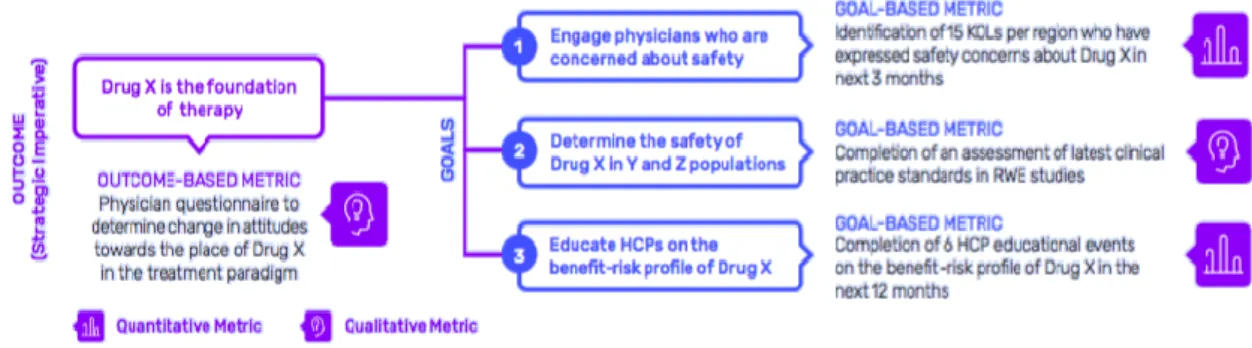
- Outcome-based metrics: metrics that measures the capacity to achieve a strategic objective. It follows broad metrics that not only consider MA department but could also include external actors. A typical example of this type of metrics could be the change of position of a healthcare professional concerning a practice or a product.
- Goal-based metrics: those metrics are the one which evaluate all the intermediary goals that allow to reach the outcome. They are much more precise but need to be aligned with the much broader outcome.
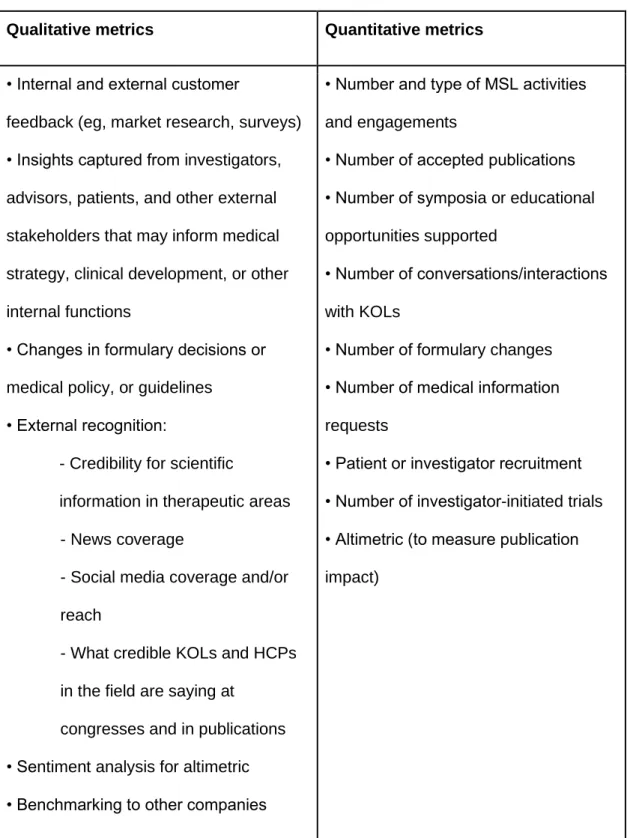
Added to this, a distinction between qualitative and quantitative metrics must be done. Most of the time outcome-based metrics are qualitative in opposition of goal-based metrics that are mostly quantitative (Table II).
Table II : Example of different kinds of qualitative and quantitative metrics in MA (Arbet-Engels et al., 2018) (23)
Qualitative metrics Quantitative metrics • Internal and external customer
feedback (eg, market research, surveys) • Insights captured from investigators, advisors, patients, and other external stakeholders that may inform medical strategy, clinical development, or other internal functions
• Changes in formulary decisions or medical policy, or guidelines
• External recognition:
- Credibility for scientific
information in therapeutic areas - News coverage
- Social media coverage and/or reach
- What credible KOLs and HCPs in the field are saying at
congresses and in publications • Sentiment analysis for altimetric • Benchmarking to other companies
• Number and type of MSL activities and engagements
• Number of accepted publications • Number of symposia or educational opportunities supported
• Number of conversations/interactions with KOLs
• Number of formulary changes • Number of medical information requests
• Patient or investigator recruitment • Number of investigator-initiated trials • Altimetric (to measure publication impact)
Both outcome and goal-based metrics are closely interlinked. The establishment of those metrics should be anticipating prior to the execution of technical tactics to set-up a clear logic between metrics and medical plan to find an alignment. (Figure n°7).
Figure n° 7 : Example of goal- and outcome-oriented metrics aligned with strategic objectives (extracted from Arbet-Engels et al., 2018) (23)
In conclusion, MA has taken a central role into the pharmaceutical companies with many internal and external interlocutors and must manage permanent environmental changes. MA is influenced by those transformations and will have to handle digitalization, embracing patient-centric healthcare, RWE data generation while managing the increase of partnership. Despite having now a clear strategic role, evaluating its added value is still challenging. A part of this issue could be solved by the Artificial Intelligence (AI) with technology becoming a way of quantifying the value of qualitative data (24).
3. Research methodology
The intent of this research part is to demonstrate how and to which extent Medical Affairs can bring benefit within the pharmaceutical industry.
Indeed, even if Medical Affairs Department seems to have a central role, since its activities are about giving a scientific and clinical support, it is complicated to both qualify and quantify the contribution that Medical Affairs bring to the industry. Both quantitative and qualitative value will be explored in the below methodology. The aim is to have a real overview of each lever on which Medical Affairs have an impact. To do so, the methodology is separated in two distinct parts corresponding to the two different metrics allowing evaluating the MA value: qualitative and quantitative metrics. The timeline description of different stages of this study is available in the Appendices part (Appendix 1).
3.1.
Qualitative metrics
Firstly, qualitative metrics will allow showing input made by MA that are not numerically measurable. Collecting qualitative measures is essential to show the consideration behind all MA activities and getting more in details of the links MA developed internally. Moreover, the understanding of relationships they support with HealthCare Professionals (HCPs) is as much important as quantitative indicators. For that reason, both internal and external to the pharmaceutical company links will be studied to determine the MA’ role and to which extent this role could be considered as a pivot role.
3.1.1. Internal value measurement through links with Marketing department
Demonstrate the internal value is important to highlight if MA got a central role or not. To do so, this project focused on one main department that interacts daily with MA: Marketing department.
Semi-structured interviews are conducted and in order to be as
accurate as possible, several French pharmaceutical companies (headquarters or subsidiaries) are interrogated (Astellas Pharma, MSD, Pfizer, Ipsen & one unreported). This type of interview has been chosen for its capacity to lead to a real discussion allowing a more complete content. The aim of the interview is to firstly see the perception Marketing has of the Medical Affairs department; secondly to detail interactions between them and thirdly to understand how Medical Affairs department is collaborating with the Marketing department and in which environment those relationships integrate. Interviews in both Medical Affairs and Marketing departments are planned to spotlight potential inconsistencies on activities, potential strategic role, collaborations opportunities and point of view on the evolution of MA within the pharmaceutical industry between:
- what was described in the literature review and the view both medical and Marketing departments gave of Medical Affairs
- the description Marketing department did about Medical Affairs and the description Medical Affairs did about themselves
In the end, both medical and Marketing departments are interrogated allowing a deep analysis of the comprehension that those departments have from each other’s. The duration of each interview varies from 30 minutes to one hour.
The guideline for semi-structured interview consists of four main parts (Figure n°8):
1) The interviewee answers questions about his current position (either Marketing or Medical Affairs functions)
2) The interviewee is then asked about his point of view of the other part (either Marketing or Medical Affairs functions)
3) The interviewee describes their inter-relationships between them and the other part (either Marketing or Medical Affairs functions) listing needs of both departments and what each of the departments brings to each other 4) Finally, the fourth part consists on providing perspective describing what
are the main challenges, how will this interaction evolve and why?
Figure n° 8 : Semi-structured interview guideline for Marketing and Medical Affairs departments
The set of questions asked during the interviews are available in the
Appendix 2.
3.1.2. External value with healthcare providers
The second step to get an exhaustive overview of Medical Affairs was to have the point of view of external actors. Here, this project focused only on one external stakeholder which was assessed as the most important to study
healthcare providers. Indeed, they have the higher frequency of interactions with MA.
To get the higher rate of response, only key opinion leaders (KOLs) were targeted because of their closest and greater number interactions with Medical Affairs. An online survey format has been chosen since it is one of the less time-consuming method for this type of medical function that does not have much time to spend. For practical reasons, only KOLs from the oncology area have been targeted (oncologist but also each specialty with an oncology specialization). It allowed facilitating the identification of KOLs while keeping a great diversity of therapeutic area since oncology can concern every organ of the human body. In France, the estimated KOLs in the oncology area is around 1200 (oncologists and other specialties with an oncology specialization). With a 10% margin of error and a confidence level of 90%, the expected number of responses was 65. The online survey is sent by email to KOLs selected according to their name’s apparition on publications in famous scientific journals and on congress presentations. Indeed, the influence of a HCP is often linked with the frequency of their appearance in scientific publications (and therefore his implication in major clinical trials) and correlated with the number of times this same HCP is involved in international congresses. In this project, frequency of publication and congresses’ implication are both required to describe a specific HCP as a KOL.
The survey was oriented specifically on interactions they have with Medical Affairs (MSLs team and headquarter team) and the perception they have about it (the detailed online survey is available in the Appendix 3).