DETECTION OF DEFECTS ON FRUITS BY MACHINE VISION
AND UNSUPERVISED SEGMENTATION
O. Kleynen and M.-F. Destain
Gembloux Agricultural University, UMC, Passage des Déportés 2, 5030 Gembloux, Belgium. Email: [email protected]; Internet: www.fsagx.ac.be/me.
INTRODUCTION
Defect detection on fruits by machine vision is a complex task. Indeed, the sound tissue colour is not uniform and the defects present a wide variability in colour, shape and texture. Mostly often, images are acquired by conventional RGB cameras and defect segmentation is performed by algorithms based on Bayes’ rules. The efficiency of these methods can be improved firstly by acquiring images with a dedicated vision system and secondly by implementing unsupervised segmentation methods. The present study concerns the results obtained on ‘Jonagold’ apples.
APPROACH
In a previous study (Kleynen etal., 2003), the selection of the most efficient bandpass filters for detecting a wide range of defects on ‘Jonagold’ apples was performed using a spectrometric method. The chosen filters were centred around 450, 500, 750 and 800 nm. On the basis of these results, a multi-spectral image acquisition device was set up. It was made of a MultiSpec Agro-Imager (Optical Insignts Inc.) including the four selected bandpass filters and coupled to a high resolution monochrome digital camera (CV-M4CL JAI). With this system, four images of the same fruit corresponding to four different spectral components were obtained on the CCD area. The system was mounted in a lighting tunnel especially designed to provide sufficient light in each of the four spectral bands
.
Images of fruits including a wide range of defects (scald, haildamage, russet, scar tissue, frost damage, recent bruises, …) were acquired.
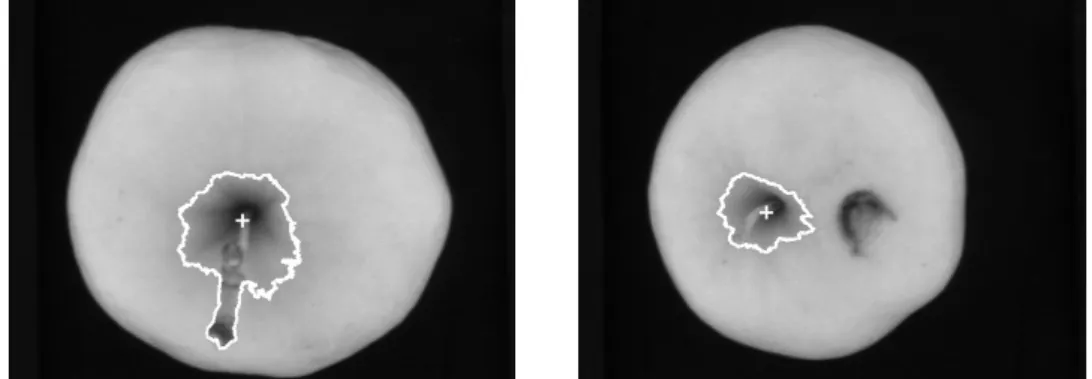
Image processing consisted in two main steps. First, the calyx/stem-end regions were detected by a correlation pattern matching algorithm and segmented by a flood filling procedure (fig. 1). Then, the fruit tissue was segmented into two classes according to an unsupervised method based on the analysis of the probability density distribution of the spectral components. The modes and the valleys of the distribution were detected by a hill climbing method using a density gradient estimate derived from the ‘mean shift’ procedure (Comaniciu and Meer, 2002). This procedure lead to a variable number of clusters. In order to obtain only two tissue classes, the Bhattacharyya distance was used to identify the two most distant clusters of the distribution. Starting from the modes of these clusters, the probability density distribution was then divided into two main clusters according to the nearest neighbour method.
At last, fruit classification into sound and defective classes was done by a hierarchical linear discriminant analysis on the basis of spectral and shape attributes computed on the segmented regions. A first linear discriminant function was determined to separate sound and defective fruits and a second function was then used to retrieve the calyxes and stem ends classified into the defective fruits.
RESULTS
The results (cross validation) indicated that more than 90 % of sound fruits, including views of calyx and stem end, were correctly classified. More than 85 % of fruits presenting important defects (implying rejection of the fruits) and recent bruises (between one and two hours old) were also correctly classified. Classification errors
came mainly from a confusion between round dark defects and calyxes or stem ends. Less serious defects were correctly classified at rate of 70 %. Nevertheless, a large number of classification errors could be solved by taking multiple views of the fruit. Figure 2 shows an example of fruit presenting a defect that is difficult to detect with standard RGB cameras but that was well classified with the new method.
CONCLUSION
Dedicated acquisition systems are more efficient than conventional systems to detect defects on fruits. However, they require the selection of interference filters, which is a task that has to be done specifically for each product (apples, pears, etc.).
In comparison to supervised methods, unsupervised segmentation offers the possibility of dividing the image data into clusters without any intervention of an operator. It does not require any assumption relative to the statistical distribution of the spectral components of the sound and defective apples. The classification precision is good and somewhat better than that obtained with supervised methods.
Fig. 1. Examples of calyx/stem end segmentation (800 nm spectral band).
Fig. 2. Examples of a fruit presenting sunburns (surrounded in white) well segmented
and correctly classified (500 and 800 nm spectral bands). ACKNOWLEDGEMENTS
This research is funded by the General Direction of Technology, Research and Energy of the Walloon Region (Belgium). Convention No 9813783.
REFERENCES
[1] Comaniciu D. and Meer P. (2002). Mean shift : a robust approach toward feature space analysis. IEEE Trans. Pattern Analysis and Machine Intelligence, vol. 24, n° 5, pp. 1-18.
[2] Kleynen O., Leemans V., Destain M.-F. (2003). Selection of the most efficient wavelength bands for Jonagold apple sorting. Post-harvest Biol. Technol. Vol 30/3 pp 221-232.