HAL Id: hal-01303109
https://hal.archives-ouvertes.fr/hal-01303109
Submitted on 22 Jul 2020
HAL is a multi-disciplinary open access archive for the deposit and dissemination of sci-entific research documents, whether they are pub-lished or not. The documents may come from teaching and research institutions in France or abroad, or from public or private research centers.
L’archive ouverte pluridisciplinaire HAL, est destinée au dépôt et à la diffusion de documents scientifiques de niveau recherche, publiés ou non, émanant des établissements d’enseignement et de recherche français ou étrangers, des laboratoires publics ou privés.
Denis Bourguet, Thomas Guillemaud
To cite this version:
Denis Bourguet, Thomas Guillemaud. The hidden and external costs of pesticide use. Sustainable Agriculture Reviews, 19, Springer International Publishing, pp.35-120, 2016, Sustainable Agriculture Reviews, 978-3-319-26776-0. �10.1007/978-3-319-26777-7_2�. �hal-01303109�
35
The Hidden and External Costs of Pesticide
Use
Denis Bourguet and Thomas Guillemaud
Abstract A fair evaluation of the net benefi ts provided by pesticides is essential to
feed the current debate on their benefi ts and adverse consequences. Pesticides pro-vide many benefi ts by killing agricultural and human pests. However, they also entail several types of costs, including internal costs due to the purchase and appli-cation of pesticides, and various other costs due to the impact of treatments on human health and the environment. Here, we provide a comprehensive review of these costs and their evaluation. We defi ne four categories of costs: regulatory costs, human health costs, environmental costs and defensive expenditures. Those costs are either internal to the market, but hidden to the users, or external to the market and most often paid by a third party. We analysed 61 papers published between 1980 and 2014, and 30 independent dataset. Regulatory costs reached very large values, e.g. US$4 billion yearly in the United States in the 2000s. However, if all regula-tions were respected, these costs would have jumped to US$22 billion in this coun-try. Health costs studies generally did not take into account fatal cases due to chronic exposure such as fatal outcomes of cancers. Doing so would have increased esti-mates of health costs by up to tenfold, e.g. from US$1.5 billion to US$15 billion in the United States in 2005.
Most environmental impacts have never been quantifi ed in the literature. Environmental costs were nevertheless estimated to up to US$8 billion in the United States in 1992. Although defensive expenditures have rarely been considered in the literature, they include at least the extra cost of the part of organic food consumption due to aversive behavior linked to pesticide use. This cost reached more than US$6.4 billion worldwide in 2012. Our review thus revealed that the economic costs of pesticide use have been seldom considered in the literature and have undoubtedly
D. Bourguet (*)
INRA, UMR 1062 Centre de Biologie pour la Gestion des Populations (CBGP) INRA-IRD- CIRAD-Montpellier SupAgro , 755 avenue du Campus
Agropolis, CS 30016 , 34988 Montferrier/Lez cedex , France e-mail: [email protected]
T. Guillemaud
INRA, Université Nice Sophia Antipolis, CNRS, UMR 1355-7254 Institut Sophia Agrobiotech , 06903 Sophia Antipolis , France
been strongly underestimated in the past. Despite this underestimation, we found that overall hidden and external costs ranged from US$5.4 million in Niger in 1996 to US$13.6 billion in the United States in 1992. We perform an updated and more complete retrospective evaluation of these costs in the United States and show that they probably reached the value of US$39.5 billion per year at the end of the 1980s-start of the 1990s. We also re-evaluate past benefi t-cost ratio of pesticide use in various countries and reveal that the cost of pesticide use might have outreached its benefi ts, e.g. in the United States at the start of the 1990s. We fi nally advocate that the key impact to be evaluated is the cost of illnesses and deaths triggered and favored by chronic exposure to pesticides. The benefi t-cost ratio of pesticide use may have easily fallen below 1 if this cost had been taken into account. The quanti-fi cation of this key cost is therefore urgently required for a more accurate evaluation of pesticide use and for regulatory purposes.
Keywords Insecticides • Fungicides • Herbicides • Environmental impact • Cost-
of- illness • Defensive expenditures • External costs • Benefi t-cost ratio analysis
2.1 Introduction
High levels of agricultural productivity will be required to sustain the world popula-tion, given current population growth rates. Between 1960 and 2000, the Green Revolution increased global food production by a factor of two to three (Evenson and Gollin 2003 ). However, the approaches used to increase production damaged many ecosystems, rendering them more vulnerable to pests. The control of these pests is essential if we are to maintain the high levels of productivity required to meet demand. The growth of the world population has also been accompanied by a desire to improve the length and quality of human life. With people living longer and in better health, food demands have increased, also necessitating the effective control of pests.
Organisms harmful to humans, their environment and production can be con-trolled in many different ways. Pesticides are one of the most widely used and effec-tive tools for this purpose. Almost two billion people work in agriculture, and most use pesticides to protect their crops or livestock. Pesticides are also widely used in gardens and around the home, in the framework of public health programs. Pesticide sales increased by a factor of 20–30 between the 1960s and 1990s (Oerke 2006 ). Pesticide use has continued to increase over the last two decades in most developing countries, e.g. Thailand during the 1990s and 2000s (Praneetvatakul et al. 2013 ) and Pakistan during the 1990s (Khan et al. 2002 ). Moreover, contrary to what is com-monly believed, pesticide use has remained stable in several developed countries, e.g. the United States (Osteen and Fernandez‐Cornejo 2013 ), mostly due to an increase in herbicide use (Schreinemachers and Tipraqsa 2012 ). Overall pesticide
consumption is currently close to two to three million tons per year (United States Environment Protection Agency 2011 ), 45 % of all pesticides being used in Europe, 25 % in the United States, 4 % in India and 26 % in the rest of the world (De et al.
2014 ). Total expenditure on pesticides is about US$40 billion per year (Popp et al.
2013 ).
Despite the high cost of their purchase, the widespread application of pesticides has been favored by the benefi ts they provide. In particular, they have increased crop and livestock yields and, in some circumstances, have improved human health, e.g. by killing vectors of human pathogens, and quality of life, e.g. by killing trouble-some organisms (Cooper and Dobson 2007 ).
However, the purchase costs are only one of the types of cost associated with pesticide use. Indeed, the spraying of these chemicals has an impact on the environ-ment and health, with potentially serious fi nancial consequences (Fig. 2.1 ). For instance, in a report published in 1990, the World Health Organization ( WHO )
Fig. 2.1 Vietnamese farmer spraying pesticide on rice without protections in Hội An, Quảng Nam, Vietnam. A fair evaluation of the net benefi ts provided by pesticides requires a thorough estimation of their costs, including those associated with their impact on health and the environment. The purchase costs are only one of the types of cost associated with pesticide use. Indeed, the spraying of these chemicals has an impact on the environment and health, with potentially serious fi nancial consequences. For instance, farmers take safety measures when handling and applying pesticides to their crops, to decrease or prevent direct exposure to these chemicals. The defensive expendi-tures taken into account include costs associated with precautions taken to reduce direct exposure to pesticides, such as masks, caps, shoes/boots, handkerchiefs, long-sleeved shirts/pants. Spraying is sometimes carried out without protection and even those farmers who do try to protect them-selves generally limit this protection to the wearing of long-sleeved shirts and long pants. Low levels of income, awareness and education, the hot and humid climate, cultural taboos, fashion and discomfort are signifi cant factors accounting for the lack of personal protection (Unmodifi ed pho-tography by Garycycles, under Creative Common License CC BY ( https://creativecommons.org/ licenses/by/2.0/ ))
indicated that there may be as many as one million unintentional severe acute poisoning incidents annually, resulting in 20,000 deaths (WHO 1990 ). These serious cases of poisoning account for a minute fraction of the overall impact of pesticides on health. On the basis of a survey of self-reported minor poisoning events in Asia, Jeyaratnam ( 1990 ) estimated that as many as 25 million agricultural workers in the developing world annually may suffer a poisoning incident.
A fair evaluation of the net benefi ts provided by pesticides requires a thorough estimation of their costs, including those associated with their impact on health and the environment. Donald J Epp and coworkers ( 1977 ) were probably the fi rst to espouse this idea, with the description of a complete taxonomy of the negative impacts of pesticide use to be taken into account. However, they concluded that the state-of-the-art at the time at which they wrote their report was insuffi ciently advanced for a monetary evaluation of environmental impacts. David Pimentel per-formed such an evaluation few years later, providing the fi rst overall estimate of the externalities induced by pesticide use. The articles he published from the late 1970s (Pimentel et al. 1979 ) onwards (most recently, Pimentel and Burgess 2014 ) focused on the United States. They inspired a few studies in other countries, but there has never been a synthetic analysis of these studies, their shortcomings, limitations and conclusions. Such a synthesis is essential for the current debate on the benefi ts and consequences of the use of these chemicals.
This review aims to (i) identify and categorize the various costs triggered by the use of chemical pesticides, (ii) provide a comprehensive overview of the articles estimating – in economic terms – these costs, whether at local, regional or national scale, for a single pesticide or for total pesticide use, (iii) report the costs estimated in these articles. These costs, in US$, have been updated to 2013 values, using annual infl ation factors and the 2013 purchasing power parity (PPP) conversion fac-tors obtained from the development indicafac-tors of the World Bank ( http://data.world-bank.org/indicator/PA.NUS.PPP ), (iv) identify the consequences for benefi t-cost ratio analyses on pesticide use and (v) provide perspectives concerning the evalua-tion of these costs.
2.2 Types of Costs Generated by the Deleterious
Consequences of Pesticide Use
Pesticides are designed to kill, repel, attract, regulate or stop the growth of living organisms considered to be pests (United States Environmental Protection Agency
2007 ). A pest is any type of living organism, e.g. mammals, birds, reptiles, fi sh, amphibians, mollusks, insects, nematodes, weeds and microbes (bacteria and viruses), that competes with our food crops or space, spreads disease or acts as a vector for disease and/or causes us discomfort.
Pesticides include chemicals, biopesticides and biological agents (United States Environmental Protection Agency 2007 ). We have decided to focus this review on
chemical pesticides, for several reasons. First, chemical pesticides account for the vast majority of pesticides used worldwide, e.g. more than 80 % in the United States (United States Environmental Protection Agency 2008 ). Second, chemical pesti-cides are probably the most harmful pestipesti-cides for the environment and human health. For instance, according to the Stockholm Convention on Persistent Organic Pollutants, nine of the 12 most dangerous and persistent organic pollutants are chemical pesticides (United Nations Environment Programme 2001 ).
We will also focus mostly on chemicals protecting plants from the damage caused by weeds, plant diseases or animals, notably insects. In fact, the term ‘
pesti-cide ’ is often exclusively used to refer to plant protection products, although pesti-cides are also used for non-agricultural purposes. Chemical pestipesti-cides are of three main types – herbicides, insecticides and fungicides – but several other types of biocides, such as nematicides and rodenticides, are also used.
Pesticide use has been shown to have a marked positive effect on agriculture (Cooper and Dobson 2007 ; Gianessi 2009 ; Gianessi and Reigner 2005 , 2007 ) and human health (Cooper and Dobson 2007 ). However, pesticides may also have del-eterious effects on the environment and human health, generating several types of costs.
For the purposes of this review, we have defi ned four broad categories of costs (Table 2.1 ): regulatory costs, human health costs, environmental costs and defensive expenditures. Regulatory costs are all the costs entailed as part of private or public mandatory measures to remove pesticides, to protect the environment or human health from the potential damage caused by pesticides and/or to repair damage already infl icted. For instance, the monitoring and decontamination of tap water can be considered a regulatory cost. Human health costs, often referred to as cost-of- illness, are the expenses associated with acute or chronic pesticide poisoning. These costs are mostly incurred by the farmers applying pesticides, although all citizens can be exposed to pesticides and may, therefore, suffer chronic health effects, in particular. Environmental costs are the costs of both pesticide damage to animals, plants, algae and microorganisms and pest resistance to pesticides. These costs may be incurred by farmers or by society as a whole. Finally, defensive expenditures cover all expenses by farmers and society to prevent pesticide exposure, such as the purchase of organic food or bottled water consumption. These four broad categories of costs include both internal and external costs (Table 2.1 ).
The internal costs of pesticide use are the costs, to the farmer, of pesticide use within the agricultural production process. These costs are described as “internal” because they determine the price of the fi nal product, i.e. they are internal to the market. We do not review here the “usual” internal costs of pesticide use such as market prices of pesticides, taxes on these products, costs of the application, trans-port and storage of pesticides, accounting costs, etc., but these costs are taken into account in the re-evaluation of overall costs and of the benefi t-cost ratio of pesticide use (see Sect. 2.9 ). We were particularly interested in the “hidden” costs associated with the impact of pesticides on the environment and human health, regulatory mea-sures and defensive behavior. These additional costs are “hidden” in the sense that farmers are not necessarily aware of them. This is the case for environmental
Table 2.1 Types and categories of costs generated by environmental and health impacts, regulatory
actions and defensive behavior
Category of
cost Pesticide impact
Hidden costs External costs
Decrease in benefi ts a Increase in “usual” internal costs b Generation of other internal costs Private external costs External costs sensu stricto Regulatory costs Public research, communication, expertise on pesticides X Regulations, decrees and laws X Mandatory pesticide handling and disposal X Human health costs Preventive medicine, annual check-ups X X
Health issues for farmers
X X X
Health issues for the public X Environmental costs Pesticide resistance X X X Soil degradation X X Pollination decrease X X Decrease in natural enemies X X X Lower plant production due to herbicide application X Bee renting X Degradation of the farm environment X Livestock health issues X Degradation of the environment X Domestic animal health issues X Defensive expenditure Purchase of protective clothing, glasses and masks
X
Purchase of organic food and bottled water
X
a Due to lower yields
impacts increasing pesticide requirements for the production process. These hidden costs increase the “usual” internal costs (Table 2.1 ). The environmental impact of pesticide use may also decrease production levels. Such “hidden” costs are paid through the achievement of a smaller benefi t than would have been achieved by farmers in the absence of a deleterious impact of pesticide use (Table 2.1 ). Finally, pesticide use generates other internal costs, concerning the purchase of protective equipment, e.g. gloves and masks, the renting of bees for pollination, specifi c man-datory requirements for pesticide handling and disposal, preventive medicine and annual check-ups for farmers. In addition to the usual internal costs, farmers incur this third class of hidden costs directly (Table 2.1 ).
Environmental and human health impacts, regulatory actions and defensive behavior triggered by pesticide use also generate external costs (Table 2.1 ). These costs are described as “external” because they are not included in the farmers’ pro-duction costs, i.e. they are external to the market. They are mostly paid by a third party, but some, such as those concerning the health of the farmer or degradation of the farm environment, may have a direct impact on farmers. Hence, external costs may be incurred by the farmers themselves (“external private costs”, Table 2.1 ) or by other parties, e.g. consumers, public authorities, people living close to the farm (“external costs sensu stricto”, Table 2.1 ).
Health issues for farmers generate both hidden internal costs and external private costs. The impairment of the farmer’s health due to the use of pesticides for a spe-cifi c type of production, such as crop production, may increase crop production costs, e.g. loss of working hours devoted to crop production, lower yields or the need to pay workers for a larger number of hours of work. Some of the costs of pesticide use relating to health are therefore internal. However, the impairment of farmers’ health due to pesticide use may also have economic consequences relating to other types of production, such as livestock production, or lower levels of non- market goods, such as childcare or leisure time. Thus, some pesticide costs relating to health issues are external (Table 2.1 ). However, it is diffi cult to determine the proportions of health costs that should be considered internal and external. We will therefore consider all these costs as externalities in this review.
Here, we defi ned four categories of costs – regulatory costs, human health costs, environmental costs and defensive expenditures – that are commonly not included in the economic evaluation of pesticide use. These costs are either internal to the market, but hidden to the users, or external to the market and most often paid by a third party.
2.3 Literature Surveyed
We carried out a literature review as comprehensive as possible, using Google Scholar and the Web of Science, and screening the references cited by the articles identifi ed relating to this topic. We excluded papers based on contingent valuation methods (see below), resulting in the identifi cation of 61 relevant articles in total
(Table 2.2 ). These articles were published in peer-reviewed scientifi c journals (23), scientifi c journals without peer review (11), books (1), book chapters (10), confer-ence proceedings (2), PhD theses (2) and reports (12) (Table 2.2 ). These 61 papers are based on only 30 independent datasets, because several papers were based on the same dataset (Table 2.2 ). These publications have differed in terms of their sci-entifi c impact. The 12 articles written by Pimentel and coworkers obtained more than 1500 citations in Google Scholar, the other 49 papers having about 2500 cita-tions between them (Table 2.2 ). The costs estimated for the United States by David Pimentel et al. are the most widely known, and the corresponding dataset is often considered to be the key dataset when referring to the overall cost of pesticide use. Two other datasets have been widely cited: one relating to the externalities of pesti-cide use in the United Kingdom (Pretty et al. 2000 , 2001 , cited about 750 times in total) and the other concerning these externalities in the Philippines (Pingali et al.
1994 , 1995 ; Rola and Pingali 1993 , cited about 500 times in total).
The studies identifi ed used different methodologies to estimate costs and these methodological differences partly refl ect the heterogeneity of the types of cost con-sidered. Some of the impacts of pesticide use have a value that can be directly esti-mated from market prices. For instance, mandatory governmental regulations concerning pesticide use may require particular activities, e.g. water monitoring (Pretty et al. 2000 , 2001 ; Waibel et al. 1999 ), and equipment, e.g. water fi lters (Pimentel et al. 1992 , 1993a , b ; Pimentel and Greiner 1997 ; Pimentel and Hart
2001 ). Their costs can be determined from market values. Other effects, such as food contamination (e.g. Jungbluth 1996 ) or the loss of working days if the farmer is ill, have costs based on market price (e.g. Pimentel et al. 1980a , b ) that can be evaluated by productivity function methods (Bowles and Webster 1995 ). The same is true for losses of agricultural production (see the series of papers by Pimentel et al.) due to lower pollination rates, livestock health issues, soil degradation or increases in pesticide use due to the selection of pesticide resistance (e.g. Tegtmeier and Duffy 2004 ). However, some of the goods affected by pesticide use are non- market goods. For instance, the increase in health risk associated with pesticide use has no directly observable price. In such cases, economists must use non-market evaluation techniques to monetize individual preferences. The monetary values obtained with these techniques refl ect the individuals’ willingness to pay for a reduction of the risk (Travisi et al. 2006 ). Revealed willingness to pay is an approach in which the monetary value of a change in risk is derived from individuals’ pur-chasing decisions in existing markets. This approach is often used to estimate the costs of aversive behavior, e.g. wearing protection clothes, drinking bottled or puri-fi ed water, eating organic food, designed to decrease the risk of human health impairment. Revealed willingness to pay can also be used to estimate the cost of wildlife loss. For instance, the cost linked to human activities, such as bird watch-ing, can be used to estimate bird losses due to pesticides (Pimentel 2005 ). The contingent valuation method – also referred to as stated willingness to pay – is also often used for the market valuation of non-market goods (Venkatachalam 2004 ). This method is based on stated preferences in hypothetical market settings. We decided not to use estimates based on stated willingness to pay because the answers
Table 2.2
Characteristics
of the papers pro
viding at least one estimate of the e
xternal cost of pesticide use
Reference Source Language Peer Revie wed? Dataset Cate
gory of cost considered
a
Country of the study No. of citations in Google Scholar
Re g. COI En v. DE Ajayi ( 2000 ) Report English No 1 X Iv ory Coast 50 Ajayi et al. ( 2002 ) Report English No 2 X X X X Mali 23 Athuk orala et al. ( 2012 ) Sci Journal English Y es 3 X X Sri Lanka 3 Atre ya ( 2005 ) Sci Journal English Y es 4 X X Nepal 17 Atre ya ( 2007 ) Report English No 5 X X Nepal 8 Atre ya ( 2008 ) Sci Journal English Y es 5 X X Nepal 33 Atre ya et al. ( 2012 ) Sci Journal English Y es 6 X X Nepal 6 Atre ya et al. ( 2013 ) Sci Journal English Y es 6 X X Nepal 0 Brenna ( 2001 ) Sci Journal Italian Y es 7 X Italy 0 Choi et al. ( 2012 ) Sci Journal English Y es 8 X South K orea 0
Cole and Mera-Orcés ( 2003
) Chapter book Spanish No 9 X Ecuador 6 Cole et al. ( 2000 ) Sci Journal English Y es 9 X Ecuador 60 Corriols et al. ( 2008 ) Sci Journal English Y es 10 X Nicaragua 18 Crissman et al. ( 1994 ) Sci Journal English Y es 9 X Ecuador 129 De vi ( 2007 ) Report English No 11 X India 16 Dung ( 2007 ) PhD thesis English No 12 X V ietnam 2
Dung and Dung (
1999 ) Report English No 12 X V ietnam 71 Fleischer ( 1999 ) Conf Proc English No 13 X X X German y 5 (continued)
Table 2.2 (continued) Houndek on and De Groote ( 1998 ) Conf Proc English No 14 X X Niger 11 Houndek on et al. ( 2006 ) Sci Journal English No 14 X X X Niger 5 Huang et al. ( 2000 ) Report English No 15 X China 49 James ( 1995 ) Sci Journal English Y es 16 X Canada 11 Jansen et al. ( 1998 ) Report English No 17 X Costa Rica 4 Jungbluth ( 1996 ) Report English No 18 X X X Thailand 63 Khan et al. ( 2002 ) Sci Journal English Y es 19 X X X Pakistan 25
Maumbe and Swinton ( 2003
) Sci Journal English Y es 20 X Zimbabwe 103 Ngo wi et al. ( 2007 ) Sci Journal English Y es 21 X Tanzania 64 Pimentel ( 2005 ) Sci Journal English Y es 22 X X X United States 272 Pimentel ( 2009 ) Book chapter English No 22 X X X United States b
Pimentel and Bur
gess ( 2014 ) Book chapter English No 22 X X X United States 1
Pimentel and Greiner ( 1997
) Book chapter English No 22 X X X United States 6
Pimentel and Hart ( 2001
) Book chapter English No 22 X X X United States 11
Pimentel et al. ( 1980a
) Sci Journal English Y es 22 X X X United States 181 Pimentel et al. ( 1980b ) Book chapter English No 22 X X X United States 11 Reference Source Language Peer Revie wed? Dataset Cate
gory of cost considered
a
Country of the study No. of citations in Google Scholar
Re g. COI En v. DE
Pimentel et al. ( 1991a ) Book chapter English No 22 X X X United States a Pimentel et al. ( 1991b ) Sci Journal English Y es 22 X X X United States 136 Pimentel et al. ( 1992 ) Sci Journal English Y es 22 X X X United States 632
Pimentel et al. ( 1993a
) Book chapter English No 22 X X X United States 133 Pimentel et al. ( 1993b ) Sci Journal English Y es 22 X X X United States 93 Pi ng al i e t a l. ( 1994 ) Sci Journal English Y es 23 X Philippines 154 Pi ng al i e t a l. ( 1995 ) Book chapter English No 23 X Philippines 31 Praneetv atakul et al. ( 2013 ) Sci Journal English Y es 24 X X X Thailand 7 Pretty et al. ( 2000 ) Sci Journal English Y es 25 X X X United Kingdom 537 Pretty et al. ( 2001 ) Sci Journal English Y es 25 X X X United Kingdom 225 R ol a a nd P in ga li ( 1993 ) Book English No 23 X Philippines 322
Soares and Porto ( 2009
) Sci Journal English Y es 26 X Brazil 36
Soares and Porto ( 2012
) Sci Journal English Y es 26 X Brazil 3 Soares et al. ( 2002 ) Sci Journal English Y es 27 X Brazil 14 Steiner et al. ( 1995 ) Book chapter English No 28 X X X United States 49 Te
gtmeier and Duf
fy ( 2004 ) Sci Journal English Y es 29 X X X United States 179 (continued)
Table
2.2
(continued)
W
aibel and Fleischer
( 1998 ) Report German No 13 X X X German y a W aibel et al. ( 1999 ) Sci Journal English Y es 13 X X X German y 27 W ilson ( 1999a ) PhD thesis English No 30 X X Sri Lanka 25 W ilson ( 1999b ) Report English No 30 X Sri Lanka 0 W ilson ( 2000a ) Sci Journal English Y es 30 X Sri Lanka 33 W ilson ( 2000b ) Report English No 30 X X Sri Lanka 2 W ilson ( 2002a ) Sci Journal English Y es 30 X Sri Lanka 8 W ilson ( 2002b ) Book chapter English No 30 X Sri Lanka 15 W ilson ( 2003 ) Sci Journal English Y es 30 X X Sri Lanka 11 W ilson ( 2005 ) Sci Journal English Y es 30 X Sri Lanka 5 Y anggen et al. ( 2003 ) Report English No 9 X Ecuador 8 a Re g., En
v ., COI and DE correspond to re
gulatory costs, en
vironmental costs, cost-of-illness and defensi
ve e
xpenditures, respecti
vely
b Does not appear in Google Scholar
Reference Source Language Peer Revie wed? Dataset Cate
gory of cost considered
a
Country of the study No. of citations in Google Scholar
Re g. COI En v. DE
given by respondents may be highly dependent on the way in which contextual information is presented (see Florax et al. 2005 ).
The literature on hidden internal and external costs of pesticide use thus consists of 61 papers published between 1980 and 2014, these papers being based on 30 independent datasets. The costs were evaluated using both market and non-market methods. Among these latter we chose to exclude studies based on stated willing-ness to pay.
2.4 Regulatory Costs
Regulations concerning pesticide use are laid down by government bodies and con-cern (i) mandatory actions that must be undertaken by users and consumers, (ii) governmental actions to organize and check compliance with mandatory actions, and (iii) the activity of governmental agencies associated with pesticide use, such as research agencies. These regulations entail monetary costs. In general, these costs are not included in the market price of the pesticides. They must therefore be paid subsequently, as externalities, by public authorities (hence by consumers and citi-zens), producers or users.
2.4.1 A Small Number of Studies
Regulatory costs were taken into account in 24 articles (Table 2.2 ): eight book chap-ters (7 written by Pimentel and coworkers), four reports (2 from the Hannover Pesticide Policy project), one non-reviewed journal article and 11 articles published in peer-review scientifi c journals. However, the estimates given in several articles were partly or fully based on the same dataset. This was the case of all papers written by Pimentel and coworkers. It was also the case for Praneetvatakul et al. ( 2013 ), who actualized some of the costs originally estimated by Jungbluth ( 1996 ). We identifi ed 15 different estimates, but only nine fully independent datasets (Table 2.3 ).
2.4.2 A High Diversity of Costs
Both external and internal costs are associated with the testing and registration, production, distribution – including importation, transport and sales – use and dis-posal of pesticides. The external costs are the economic burden to the public author-ities responsible for organizing controls and checks on the compliance of stakeholders, e.g. public authorities, consumers, sellers and producers, with the regulations. The internal costs are the monetary subsidiaries paid by pesticide
handlers, e.g. users, sellers and producers, when they have to comply with manda-tory regulations (Ajayi et al. 2002 ).
The various types of regulatory costs considered in the 24 articles investigating those costs are given in Table 2.4 . The sources of these costs were highly diverse, including campaigns to raise public awareness of the impact of pesticides, monitor-ing and control, and public research on pesticides. The considerable diversity of these items may go some way to explaining why none of the studies considered the entire set of costs and heterogeneity in the costs considered by the various studies. Several articles listed a large number of qualitatively different regulatory costs, but estimates were frequently lacking. For instance, Ajayi et al. ( 2002 ) mentioned extension services as one of the externalities of pesticide use, but they provided no estimate of the costs involved. Waibel et al. ( 1999 ) also considered several costs, including the costs of removing contaminated products from the market and the cost of administrative activities, e.g. laws and decrees, and researches, but these Table 2.3 Economic costs due to regulations governing pesticide use
Reference Country Year
Fully independent dataset a Overall costs (million US$ 2013 per year) Houndekon and De Groote ( 1998 );
Houndekon et al. ( 2006 )
Niger 1996 A 0.15
Ajayi et al. ( 2002 ) Mali 1999 B 1.58
Khan et al. ( 2002 ) Pakistan 2002 C 9.71
Fleischer ( 1999 ); Waibel and Fleischer ( 1998 ); Waibel et al. ( 1999 )
Germany 1996 D 168.26
Pretty et al. ( 2000 , 2001 ) United Kingdom
1996 E 318.51
Praneetvatakul et al. ( 2013 ) Thailand 2010 F 357.28 Pimentel et al. ( 1980a , b ) United Sates 1980 G 491.96
Jungbluth ( 1996 ) Thailand 1995 F 558.33
Pimentel et al. ( 1991a , b ) United States 1991 G 2372.34 Steiner et al. ( 1995 ) United States 1991 H 3203.00 Pimentel and Hart ( 2001 ) United States 2001 G 3451.19 Pimentel and Greiner ( 1997 ) United States 1997 G 3751.06 Pimentel ( 2005 , 2009 ); Pimentel and
Burgess ( 2014 )
United States 2005 G 4229.13 Pimentel et al. ( 1992 , 1993a , b ) United States 1992 G 4319.01 Tegtmeier and Duffy ( 2004 ) United States 2002 I 4988.69
Table 2.4 Types of regulatory costs for pesticide use
Type of cost Ajayi et al. (
2002 ) Houndek on et al. ( 2006 ) Jungbluth ( 1996 ) Praneetv atakul et al. ( 2013 ) Khan et al. ( 2002 ) Steiner et al. ( 1995 ) Te gtmeie r and Duf fy ( 2004 ) Pimentel et al. ( 1980a , b ) Pimentel et al. ( 1991a , b ) Pimentel et al. ( 1992 , 1993a , b )
Pimentel and Greiner (
1997
)
Pimentel and Hart (
2001 ) Pimentel ( 2005 ); Pimentel and Bur gess ( 2014 ) Pretty et al. ( 2000 , 2001 ) Fleischer ( 1999 ); W
aibel and Fleischer
( 1998 ); W aibel et al. ( 1999 ) Pesticide registration, regulat ion and market monitoring X X X X X Public awareness cam paigns on pesticide impact X X X Disposal of obsolete and leftover pesticides X X X
Farm work safety X
Control & monitoring Crop and/or food X X X X X X Water (surface, underground and/or wells) X X X X X X X X X Livestock X Wildlife X X Undefi ned X X X X X X X X Water decontamination X X X X X X X Public research on pesticides X X Extension services X X Economic shortfall Crop X X X X X X X X X Water X X Livestock X X Milk X X Fishing X X
costs were not quantifi ed. Differences in public regulations between countries also underlie the considerable differences in the items considered between papers. For instance, Khan et al. ( 2002 ) pointed out that there was no monitoring program in Pakistan in 2002.
Most papers took into account the economic shortfall of crops exceeding the maximum residue limit or the costs of controls and monitoring (Table 2.4 ). Water decontamination, the regulation of pesticide registration and market monitoring costs were estimated in a small number of papers (Table 2.4 ) (Fig. 2.2 ). Other costs, such as those associated with governmental public information campaigns, eco-nomic shortfalls for water exceeding the maximum residue limit and public research on pesticides, were considered and estimated even less frequently (Table 2.4 ). However, these costs may account for a large proportion of the external costs of pesticides. For instance, public information campaigns accounted for about 10 % of the total external costs estimated by Khan et al. ( 2002 ) in the Pakistan, and public research costs were estimated at about 10 % of the total external costs by Praneetvatakul et al. ( 2013 ) in Thailand.
Finally, some costs, such as the time and money spent establishing regulations, have never been estimated. This is unfortunate, because it has been acknowledged that such costs may be high, due to the need for research and development, expert advice and a number of offi cial tests (Ajayi et al. 2002 ; Waibel et al. 1999 ).
2.4.3 Estimated Costs
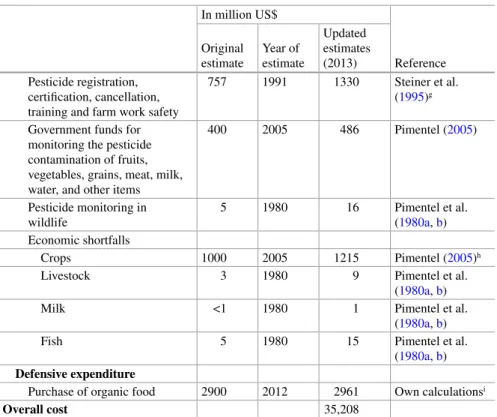
Estimates of total annual r egulatory costs vary considerably, from US$150,000 (2013) in Niger (Houndekon and De Groote 1998 ; Houndekon et al. 2006 ) to US$5 billion (2013) in the United States (Tegtmeier and Duffy 2004 ) (Table 2.3 ). We did not carry out a meta-analysis to fi nd the cause of this variation. However, as a fi rst approximation, we can consider this variation to be due to the differences in the cat-egories of costs considered, the detailed composition of each category and the geo-graphic scale of the study. The costs of commonly considered categories were particularly variable and depended strongly on the subcategories included. For instance, monitoring and control costs were frequently considered, but different aspects of these costs were covered. The estimates obtained thus differed consider-ably between papers, depending, in particular, on whether or not they considered the control of underground water. For instance, Pimentel and coworkers began to con-sider the costs of monitoring underground water and wells in their papers published in 1991. The consideration of these costs led to an immediate increase in their esti-mates of the overall cost of pesticide regulations of more than 300 %, with these costs accounting for 90 % of total regulatory costs for pesticide use (Pimentel et al. 1991a ,
been taken into account by Pimentel et al. since 1992. These costs accounted for about 40 % of the externalities associated with pesticide use.
2.4.4 Actual Versus Theoretical Costs
Most estimates of r egulatory costs were based on the actual expenditure of various stakeholders, including public authorities, manufacturers, distributors, sellers and farmers. No attempt was made to estimate non-monetary values. Due to the ‘
regula-tory ’ nature of these costs, estimates were generally based on the offi cial budget reports of public agencies.
Fig. 2.2 Peace River Manasota Regional Water Supply Authority Water Treatment Plant facility.
Water decontamination corresponds to one of the several regulatory costs induced by pesticide use. Estimates of regulatory costs differed considerably between studies, depending, in particular, on whether or not they considered the control of underground water. For instance, in the United States, Pimentel and coworkers began to consider the costs of monitoring underground water and wells in their papers published in 1991. The consideration of these costs led to an immediate increase in their estimates of the overall cost of pesticide regulations of more than 300 %, with these costs accounting for 90 % of total regulatory costs for pesticide use (Pimentel et al. 1991a , b ). Moreover Pimentel ( 2005 , 2009 ) and Pimentel and Burgess ( 2014 ) estimated that the current monitoring of wells in the United States (about US$2 billion per year) would have reached US$17 billion per year if all the wells in the United States were monitored (Unmodifi ed photography by Florida Water Daily, under Creative Common License CC BY ( https://creativecommons.org/licenses/ by/2.0/ ))
However, current costs may be much lower than the theoretical value. For instance, Pimentel ( 2005 , 2009 ) and Pimentel and Burgess ( 2014 ) estimated the current monitoring of wells in the United States at about US$2 billion per year, but indicated that this cost would have reached US$17 billion per year if all the wells in the United States were monitored. Including these theoretical costs made a large difference, increasing the overall regulatory costs estimated by Pimentel ( 2005 ,
2009 ) and Pimentel and Burgess ( 2014 ) from US$4.2 billion to almost US$22 bil-lion. Similarly, Jungbluth ( 1996 ) noted that costs related to pesticide residues in food in Thailand were diffi cult to estimate and were based on hypothetical scenarios rather than on real situations. In the absence of pesticide residue control for most food products, Jungbluth ( 1996 ) had to extrapolate the proportion of products exceeding the maximum residue limit from scarce data. Assuming that 10 % of all fruits and vegetables were above the maximum residue limit and assuming that these products would be unsaleable according to regulations, Jungbluth ( 1996 ) obtained a cost of about fi ve billion Baht in 1996. He considered this value – cor-responding to almost 90 % of the regulatory costs – as an upper limit for the costs truly paid by the corresponding stakeholders. Conversely, Jungbluth ( 1996 ) noted that if the maximum residue limit was not reached, then only the cost of control and monitoring should be taken into account, corresponding to 48.5 million Baht in 1996. This value should be taken as the lower limit of estimates. Along the same lines, Khan et al. ( 2002 ) distinguished between actual and potential costs. The potential costs they considered included the cost of establishing laboratories for pesticide residue analyses, residue monitoring programs, and training programs on the safe use of pesticides. These costs were largely theoretical, because there were no such activities in the region covered by their study in 2002, like in many develop-ing countries (Ecobichon 1999 ). They reported the existence of regulations, but a lack of enforcement. They pointed out, in particular, that there was no comprehen-sive national monitoring system, and this may remain the case.
2.4.5 Conclusions
Regulatory costs, in particular, have been underestimated. We will see that this is also true for the other categories of “hidden” and external costs, but this underesti-mation may be particularly marked for regulatory costs. First, only 24 of the 61 articles assessing the external cost of pesticides included regulatory costs, and these 24 articles were actually based on only nine fully independent datasets. Second, each of these articles considered only a small number of regulatory costs. Finally, current costs are probably much lower than the costs that would have to be paid if the complete control, monitoring and decontamination of pesticide residues were to be undertaken and if all products exceeding the legal maximum residue limit had to be withdrawn from the market.
Although underestimated, regulatory costs could reach very large values such as US$4 billion (2013) yearly in the United States in the 2000s. Our analysis shows
that if all regulations were respected, these costs would have jumped to US$22 bil-lion (2013).
2.5 Human Health Costs
Despite strict regulations on the registration and use of pesticides, there are major concerns about their direct impact on human health following occupational expo-sure and the indirect expoexpo-sure of non-occupationally exposed populations. Agricultural workers in fi elds and greenhouses are often occupationally exposed to pesticides, as they are responsible for preparing, mixing and loading pesticide prep-arations, spraying pesticides, sowing pesticide-treated seeds, harvesting sprayed crops, and cleaning and disposing of pesticide containers. Similarly, workers in the pesticide industry are also likely to experience occupational exposure. The families of farmers and other people living in rural areas in which pesticides are intensively used may also be indirectly exposed to these chemicals, through off-target pesticide drift from agricultural applications in particular (Lee et al. 2011 ) (Fig. 2.3 ). Finally, the overall population is also indirectly exposed to pesticides, through the consump-tion of food and drinking water contaminated with pesticide residues. Many pesti-cides can damage human health (Damalas and Eleftherohorinos 2011 ) and, for this reason, high doses over short periods (acute poisoning) and lower doses over longer periods of time (chronic exposure) may have an impact on human health. Karabelas et al. ( 2009 ) found that 84 of the 276 active substances authorized as plant protec-tion products in Europe at the end of 2008 – 32 of the 76 fungicides, 25 of the 87 herbicides and 24 of the 66 insecticides – had at least one deleterious effect on health following acute and/or chronic exposure. These effects included acute toxic-ity, carcinogenictoxic-ity, reproductive and neurodevelopmental disorders and endocrine disruption. Worldwide, pesticide use has resulted in thousands of cases of acute and chronic poisoning, with effects of varying severity on human health, from mild effects to death. In this section, we review the studies providing estimates of the economic consequences of human health impairment, from benign health damage to death, due to pesticide use.
2.5.1 Several Studies Based on a Limited Number of Datasets
We identifi ed 57 articles providing monetary costs of the impact on health of pesti-cide exposure. These studies were published in diverse forms, including articles in scientifi c peer-reviewed journals (e.g. Choi et al. 2012 ), book chapters (e.g. Cole and Mera-Orcés 2003 ), PhD dissertations (e.g. Dung 2007 ), conference proceed-ings (e.g. Yanggen et al. 2003 ) and specifi c reports (e.g. Devi 2007 ). Some datasets were used as the basis of several publications. For instance, the dataset from the pioneering study by David Pimentel in the United States has been used in several
publications reporting either the same estimates (Pimentel and Greiner 1997 ; Pimentel and Hart 2001 ) or providing new estimates (Pimentel et al. 1992 ; Pimentel and Greiner 1997 ; Pimentel 2005 , 2009 ) but describing the same types of cost. Similarly, the original dataset of Clevo Wilson ( 1999a ) has been used in several articles in scientifi c journals and in several book chapters (e.g. Wilson 1999b , 2000a ,
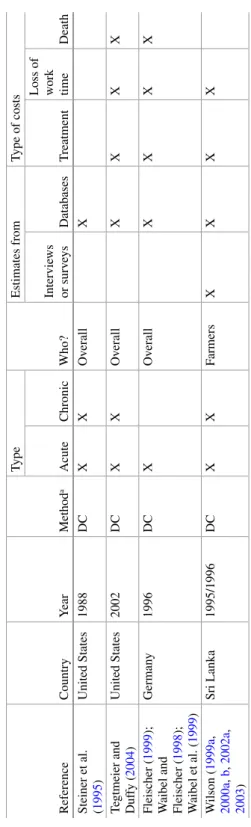
b , 2002a , b , 2003 , 2005 ). These 57 articles thus actually correspond to 29 indepen-dent cost-of-illness studies, starting with two papers by Pimentel et al. published in 1980 and ending with a book chapter written by Pimentel and Burgess and pub-lished in 2014 (Table 2.5 ). All 29 datasets involved cost-of-illness analyses, but they were produced by different methodologies (Table 2.5 ). Some focused on occupa-tional exposures, notably those of the individuals spraying pesticides, whereas oth-ers focused on the pesticide exposure of the whole population. Some authors Fig. 2.3 Pesticides are s prayed in crop fi elds to protect them against agricultural pests. During
these spray applications, these chemicals may disperse by drifting. They may therefore reach non- target crops in neighbouring fi elds, weakening these plants and reducing yields. Such crop injuries have been reported, in particular, for aerial applications of glyphosate (e.g. Ding et al. 2011 ; Reddy et al. 2010 ). Families of farmers and other people living in rural areas in which pesticides are intensively used may also be indirectly exposed to these pesticides, through this off-target pesti-cide drift from agricultural applications. After spraying, pestipesti-cides can also seep into the soil (Gil and Sinfort 2005 ; Pimentel 1995 ). Once in the soil, some soluble pesticides may be washed out in runoff water and during soil erosion, resulting in leaching into rivers and lakes (Chopra et al. 2011 ) (Unmodifi ed photography by Santiago Nicolau, under Creative Common License CC BY-SA ( https://creativecommons.org/licenses/by-sa/2.0/ ))
provided direct estimates of the various health costs, whereas other inferred health costs indirectly, by complex statistical modeling (Table 2.5 ).
2.5.2 Estimated Costs
The economic impact on human health has been evaluated per case, per farmer (or household), per rural establishment and at regional or national levels. The detailed costs reported in the 29 independent studies are shown in Table 2.6 .
The costs of pesticide poisoning were evaluated at between about US$30 in Thailand and US$600 in Costa Rica (2013) per case, with each farmer/household using pesticides incurring annual costs of US$3 in China to US$187 in Sri-Lanka (2013) per year. In Central America, several authors have reported annual costs of US$32 to US$100 (2013) (see Vaughan (1993) and Villagrán (1976) cited by García ( 1998 ) and Castillo and Appel (1990) and Alvarado et al. (1998) cited by Cole et al. ( 2000 )). These costs may be as high as US$850 (2013) per year for a rural establish-ment. At national level, health costs due to pesticide exposure have been estimated at US$1.1 million in Italy to about US$1.5 billion in the United States (2013) (Table
2.6 ).
These costs cannot be considered comparable, because they are infl uenced by several parameters, e.g. the type of pesticide used, the number of treatments applied, the degree to which farm staff spraying pesticides are protected etc., that may differ considerably between countries, with particularly marked differences between developed and developing countries. Moreover, in any given country, these costs have probably decreased over time, for two reasons. First, farmers have certainly become more aware of the effects of pesticide use on health and, therefore, probably protect themselves better against pesticide drifts. Second, some of the most danger-ous pesticides have been withdrawn in many countries. Hence, on the one hand, costs actualized to 2013 values in US$ could easily be considered overestimates of current costs. On the other hand, human health costs were probably greatly under-estimated at the time at which these reports were published, for three reasons. First, the frequencies of illness and death triggered by chronic exposure to pesticides have rarely been evaluated (see Sect. 2.5.5 ). Second, acute poisoning events generate various types of costs, and none of the studies performed to date has taken all these costs fully into account (see Sect. 2.5.3 ). Third, not all pesticide-poisoning events are recorded in databases or reported by farmers, particularly in developing coun-tries (e.g. Lekei et al. 2014 ; Shetty et al. 2011 ). Indeed, some of the individuals carrying out pesticide spraying consider the symptoms of poisoning to be ‘ normal ’ and do not, therefore, pay much attention to them.
Table 2.5 Cost-of-illness studies on pesticide e xposure Reference Country Y ear Method a Type Who? Estimates from Type of costs Acute Chronic Intervie ws or surv eys Databases T reatment
Loss of work time
Death Ajayi ( 2000 ) Iv ory Coast 1996/1997 DC X Farmers X X X Ajayi et al. ( 2002 ) Mali 2000 DC X Ov erall X X X X X
All Pimentel and Pimentel et al. papers
United States 1980–2014 DC X X Ov erall X X X X Athuk orala et al. ( 2012 ) Sri Lanka 2007/2008 DC X Farmers X X X Atre ya ( 2005 ) Nepal 2004 DC X Farmers X X X Atre ya ( 2007 , 2008 ) Nepal 2005 SI X Farmers X X X Atre ya et al. ( 2012 , 2013 ) Nepal 2008 SI X Farmers X X X Brenna ( 2001 ) Italy 1999 DC X Ov erall X X Choi et al. ( 2012 ) South K orea 2009 DC X Ov erall X X X X Crissman et al. ( 1994 ); Cole et al. ( 2000 ); Cole and Mera-Orcés ( 2003 ); Y anggen et al. ( 2003 ) Ecuador 1991/1992 DC X Ov erall X X X X Corriols et al. ( 2008 ) Nicaragua 2001 DC X Ov erall X X
(continued) De vi ( 2007 ) India 2004/2005 SI X Farmers X X X
Dung and Dung ( 1999
); Dung ( 2007 ) V ietnam 1996/1997 SI X Farmers X X X Houndek on and De Groote ( 1998 ); Houndek on et al. ( 2006 ) Niger 1996 SI X X Farmers X X X Huang et al. ( 2000 ) China 2000 SI X Farmers X X Jansen et al. ( 1998 ) Costa Rica 1993 DC X Farmers X X X Jungbluth ( 1996 ) Thailand 1995/1996 DC X Farmers X X X Khan et al. ( 2002 ) Pakistan 2002 DC X
Farmers and industrial work
ers
X
X
X
X
Maumbe and Swinton (
2003 ) Zimbabwe 1998/1999 DC X Farmers X X X Ngo wi et al. ( 2007 ) Tanzania 2005 DC X Farmers X X X Pi ng al i e t a l. ( 1994 , 1995 ); Rola and Pi ng al i ( 1993 ) Philippines 1989–1991 SI X X Farmers X X X Praneetv atakul et al. ( 2013 ) Thailand 2010 DC X Ov erall X X X Pretty et al. ( 2000 , 2001 ) United Kingdom 1996 DC X Farmers X X X Soares et al. ( 2002 ) Brazil 1991–2000 Si X Rural work ers X X X
Soares and Porto ( 2009
, 2012 ) Brazil 1998/1999 SI X Farmers X X X
Steiner et al. ( 1995 ) United States 1988 DC X X Ov erall X Te gtmeier and Duf fy ( 2004 ) United States 2002 DC X X Ov erall X X X X Fleischer ( 1999 ); W aibel and Fleischer ( 1998 ); W aibel et al. ( 1999 ) German y 1996 DC X Ov erall X X X X W ilson ( 1999a , 2000a , b , 2002a , 2003 ) Sri Lanka 1995/1996 DC X X Farmers X X X X a DC
direct cost and
SI statistically inferred Table 2.5 (continued) Reference Country Y ear Method a Type Who? Estimates from Type of costs Acute Chronic Intervie ws or surv eys Databases T reatment
Loss of work time
Table 2.6
Estimated costs
of the impact of pesticide e
xposure on health Estimate Country Y ear
US$ 2013 (per year)
Reference Per case Ecuador 1992 44.71 Crissman et al. ( 1994 ); Cole et al. ( 2000
); Cole and Mera-Orcés (
2003 ); Y anggen et al. ( 2003 ) Thailand 1995 32.30 Jungbluth ( 1996 ) Nicaragua 2001 134.93 Corriols et al. ( 2008 ) Tanzania 2005 <1 to 400 Ngo wi et al. ( 2007 ) Costa Rica 1993 591.18 Jansen et al. ( 1998 ) Per f armer/household per year China 2000 2.63 Huang et al. ( 2000 ) Nepal 2005 3.10 Atre ya ( 2007 , 2008 ) Iv ory Coast 1996 11.88 Ajayi ( 2000 ) Nepal 2008 16.24 Atre ya et al. ( 2012 , 2013 ) V ietnam 1996 25.53
Dung and Dung (
1999 ); Dung ( 2007 ) Sri Lanka 2007 15.66 Athuk orala et al. ( 2012 ) Nepal 2004 35.06 Atre ya ( 2005 ) Ph ili pp in es 19 89 82 .3 7 Pi ng al i e t a l. ( 1994 , 1995 ); R ol a a nd P in ga li ( 1993 ) India 2004 104.52 De vi ( 2007 ) Brazil 2000 168.37 Soares et al. ( 2002 ) Sri Lanka 1995 187.36 W ilson ( 1999a , 2000a , b , 2002a , 2003 ) Zimbabwe 1998 9.42
Maumbe and Swinton (
2003
)
Per rural establishment per year
Brazil
1998
5.05–1072.09
Soares and Porto (
2009
,
2012
)
Table 2.6 (continued) Estimate Country Y ear
US$ 2013 (per year)
Reference At national le vel per year Italy 1999 1,100,000 Brenna ( 2001 ) Thailand 1995 1,260,000 Jungbluth ( 1996 ) United Kingdom 1996 2,297,000 Pretty et al. ( 2000 , 2001 ) Mali 1999 3,714,000 Ajayi et al. ( 2002 ) Thailand 2010 2,990,000 Praneetv atakul et al. ( 2013 ) Niger 1996 4,397,000 Houndek on and De Groote ( 1998 ); Houndek on et al. ( 2006 ) Nicaragua 2001 4,058,000 Corriols et al. ( 2008 ) South K orea 2009 7,792,000 Choi et al. ( 2012 ) German y 1996 17,986,000 Fleischer ( 1999 ); W
aibel and Fleischer (
1998 ); W aibel et al. ( 1999 ) Sri Lanka 2007 35,885,000 Athuk orala et al. ( 2012 ) Pakistan 2002 78,064,000 Khan et al. ( 2002 ) Sri Lanka 1995 21,636,000–130,044,000 W ilson ( 1999a , 2000a , b , 2002a , 2003 ) United States 1988 246,290,000–486,510,000 Steiner et al. ( 1995 ) United States 1991 439,320,000 Pimentel et al. ( 1991a , b ) United States 1980 581,180,000 Pimentel et al. ( 1980a , b ) United States 2002 1,308,890,000 Te
gtmeier and Duf
fy ( 2004 ) United States 1992 1,326,450,000 Pimentel et al. ( 1992 , 1993a , b ) United States 1997 1,367,040,000
Pimentel and Greiner (
1997
); Pimentel and Hart (
2001 ) United States 2005 1,492,960, 000 Pimentel ( 2005 , 2009
); Pimentel and Bur
gess (
2014
2.5.3 Non-fatal Cases of Acute Poisoning
Acute poisoning, leading to respiratory, gastrointestinal, allergic, and neurologic disorders, is commonly reported by farmers, and particularly by those carrying out pesticide applications (e.g. Hudson et al. 2014 ; Kishi et al. 1995 ). For instance, in a broad survey performed in 2010, Lee et al. ( 2012 ) found that 25 % of South Korean male farmers had suffered acute occupational pesticide poisoning, suggesting that there may be more than 200,000 cases per year across South Korea. About 12 % of these pesticide-poisoning cases led to the consultation of a medical doctor or hospi-talization (Lee et al. 2012 ). In the United States, the incidence of pesticide poison-ing events requirpoison-ing medical care among the 3,380,000 agricultural workers is thought to be between 10 and 600/100,000 (Calvert et al. 2008 and references therein), corresponding to about 300–20,000 cases annually.
All the cost-of-illness studies took acute poisoning events into account, but they considered very different types of costs associated with such poisoning events. Both indirect and direct costs were incurred. Direct costs are paid either by the farmers themselves or by the society, if, for example, hospital admission is free of charge. Indirect costs correspond to the working time lost by poisoned individuals and their families during and after the poisoning event. This time, which many farmers may not have considered – 90 % in the study by Athukorala et al. ( 2012 ) –, can be con-verted into wage loss and, therefore, into a monetary cost. All cost-of-illness studies took the cost of hospitalization and/or doctor fees into account (Table 2.7 ). By con-trast, the costs of medication and of transport to and from hospital visits and medical consultation were explicitly included in only two thirds and one third, respectively, of the studies (Table 2.7 ). The economic burden due to the number of days taken off work to recover from poisoning events is the indirect cost classically identifi ed in cost-of-illness studies. Almost all studies included this cost, paid by farmers, and some found that it outweighed, by far, the direct cost of acute poisoning (e.g. Wilson
1999a , 2000a , b , 2003 )
However, absence from work to recover from illness is only one of the various indirect costs associated with pesticide poisoning. Indeed, Wilson ( 1999a , 2000a , b ,
2002a , 2003 ), who generated what is probably the most comprehensive and com-plete list of indirect costs to date, also identifi ed (i) a decrease in productivity for farmers not taking time off from work to recover and just after their return to work, (ii) impaired decision-making and (iii) a loss of leisure time (Table 2.7 ). However, he recognized that it would be diffi cult to estimate the number of leisure hours lost and the decrease in working effi ciency. Leisure hours were defi ned as ‘ any time
spent at home after work, such as time spent reading a newspaper, watching televi-sion, listening to the radio, playing a game or practicing a hobby, or time spent with
the family ’. As suggested by Becker ( 1965 ), Wilson evaluated leisure time costs on
the basis of the hourly wage, given that any loss of leisure time would be likely to affect productivity at work.
Decreases in productivity at work and in decision-making abilities were esti-mated in a few other cost-of-illness studies (Table 2.7 ). However, none of these
Table 2.7
Types of
costs
tak
en into account for acute pesticide poisoning in cost-of-illness studies
Type of costs Atre ya ( 2005 ) Atre ya ( 2007 , 2008 ) Atre ya et al. ( 2012 , 2013 ) W ilson ( 1999a , 2000a , b , 2002a , 2003 ) Ajayi ( 2000 ) Crissman et al. ( 1994 ); Cole et al. ( 2000 ); Cole and Mera-Orcés ( 2003 ); Y anggen et al. ( 2003 ) Choi et al. ( 2012 ) De vi ( 2007 ) Ngo wi et al. ( 2007 ) Ajayi et al. ( 2002 )
Dung and Dung (
1999 ); Dung ( 2007 ) Fleischer ( 1999 ); W aibel and Fleischer (
1998 ); Waibel et al. ( 1999 ) Houndek on and De Groote ( 1998 ); Houndek on et al. ( 2006 ) Jansen et al. ( 1998 ) Athuk orala et al. ( 2012 ) Pi nga li e t a l. ( 1994 , 1995 ); R ola and Pin gal i ( 1993 )
Maumbe and Swinton (
2003
)
Khan et al. (
2002
)
All Pimentel and Pimentel et al. articles Te gtmeier and Duffy (
2004 ) Jungbluth ( 1996 ) Praneetv atakul et al. ( 2013 ) Pretty et al. ( 2000 , 2001 ) Soares et al. ( 2002 )
Soares and Porto (
2009 , 2012 ) Brenna ( 2001 ) Corriols et al. ( 2008 ) Dir ect costs
Hospitalization and/or doctors’
fees X X X X X X X X X X X X X X X X X X X X X X X X X X c d T
reatment (drugs, local healing, local cure)
X X X X X X X X X X X X X X X X X T
ransport to and from hospital/doctor
X X X X X X X X X X Indir ect costs Loss of w orking days whilst reco vering X X X X X X X X X X X X X X X X a X X X X X X X X
Lo wer producti vity if remaining at w ork and on return to w ork X X X X X X X
Impairment of decision-making abilities
X X X X T ime tak en by f amily
members to nurse the victim of illness
X X X X Childcare X
Loss of leisure time
X
Cost of fatal poisoning incidents
Loss of w ork time/ producti vity X X Cost of life X b X X
a These costs were estimated in terms of the number of days lost, b
ut the corresponding economic v
alue w as not estimated b These authors took the cost of deaths into account. Ho we ver , the y did not specify which costs the y took into account. The y mer ely wrote ‘ Substantial amounts of 24 million in terms of tr
eatment, 18 million for work loss during ailments and 224 million rupees for accidental deaths ar
e estimated as t he e xternality costs ’ c These authors pro vide the mean out-of-pock et costs (without details) for a single acute pesticide poisoning episode – the y als o indicate that poisoned farmers loss about days of producti ve w
orking time, without quantifying this cost
d No details are gi ven, except that the y took into account only the treatment costs for visible impairments (e xcluding chronic poisoning). Ho we ver , it is not clear whether
costs include the loss of w
ork. Ho
we
ver
, the
y clearly do not include the cost of life
e Unkno
wn, because no details are pro
vided about the dif
other studies evaluated the loss of leisure time as in the study by Wilson. However, Wilson did not estimate all the indirect costs due to pesticide poisoning and recog-nized that ‘ the costs to the family were not taken into account ’ . These costs, includ-ing the time taken by family members to nurse the victim of illness, were investigated in cost-of-illness studies performed in Nepal (Atreya 2005 , 2007 , 2008 ; Atreya et al.
2012 , 2013 ) and Ecuador (Cole et al. 2000 ; Cole and Mera-Orcés 2003 ; Crissman et al. 1994 ; Yanggen et al. 2003 ). The cost of childcare, which was estimated by Fleischer and coworkers (Table 2.7 ), is another indirect cost that was not considered by Wilson. Finally, an additional indirect cost, identifi ed but not estimated by Devi ( 2007 ), is the time spent traveling to seek medical help. Thus, none of the cost-of-illness studies performed to date fully took into account all the various costs associ-ated with acute pesticide poisoning.
2.5.4 Fatal Cases of Acute Poisoning
Suicide accounts for most of the fatal cases of acute poisoning. Gunnell et al. ( 2007 ) estimated that 250,000 people die from voluntary pesticide ingestion each year, accounting for 30 % of all suicides. The costs associated with such deaths cannot be considered an externality of pesticide use. Nevertheless, accidental pesticide poi-soning, mostly in the occupational setting, may be fatal in some cases and the costs associated with such deaths can be treated as external costs. Fatal accidents due to occupational pesticide poisoning are very rare in some countries, such as the United States (1 case recorded from 1998 to 2005, Calvert et al. 2008 ), but may concern several tens or hundreds of workers per year in other countries with higher levels of pesticide use or in which workers are less well equipped with personal protection equipment (Fig. 2.1 ). For instance, Santana et al. ( 2013 ) reported that 2052 deaths, excluding homicides and suicides, were recorded as due to pesticide poisoning in Brazil, between 2000 and 2009. Half of these deaths concerned agricultural workers and most of them were caused by poisoning with organophosphate and carbamate pesticides.
The cost of fatal cases of accidental poisoning was estimated in only six sets of cost-of-illness studies: Ajayi et al. ( 2002 ), Choi et al. ( 2012 ), Khan et al. ( 2002 ), Tegtmeier and Duffy ( 2004 ), Pimentel and coworkers and Fleischer and coworkers (Table 2.7 ). Fatal cases have generally been ignored, mostly due to the type of cost- of- illness studies performed. Indeed, several of these studies involved interviews with a sample of farmers about the costs they incurred during pesticide poisoning incidents (Table 2.5 ). By defi nition, studies of this type cannot take deaths into account and, therefore, did not assess the cost of fatal poisoning events.
Two studies estimated the cost of these deaths, by evaluating the corresponding loss of work time. Ajayi et al. ( 2002 ) economically quantifi ed the loss of life as the decrease in agricultural gross domestic product per habitant during the mean dura-tion of an economically active life in agriculture set, in their study, at 50 % of 30 years. Similarly, Choi et al. ( 2012 ) estimated the loss of productivity loss due to