LETTER
doi:10.1038/nature11597Albedo and atmospheric constraints of dwarf planet
Makemake from a stellar occultation
J. L. Ortiz1, B. Sicardy2,3,4, F. Braga-Ribas2,5, A. Alvarez-Candal6,1, E. Lellouch2, R. Duffard1, N. Pinilla-Alonso1,7, V. D. Ivanov6, S. P. Littlefair8, J. I. B. Camargo5, M. Assafin9, E. Unda-Sanzana10, E. Jehin11, N. Morales1, G. Tancredi12, R. Gil-Hutton13, I. de la Cueva14, J. P. Colque10, D. N. Da Silva Neto5, J. Manfroid11, A. Thirouin1, P. J. Gutie´rrez1, J. Lecacheux2, M. Gillon11, A. Maury15, F. Colas16, J. Licandro17, T. Mueller18, C. Jacques19, D. Weaver20, A. Milone21, R. Salvo12, S. Bruzzone12, F. Organero22, R. Behrend23, S. Roland12, R. Vieira-Martins9,5,16, T. Widemann2, F. Roques2, P. Santos-Sanz1,2, D. Hestroffer16, V. S. Dhillon8, T. R. Marsh24, C. Harlingten25, A. Campo Bagatin26, M. L. Alonso27, M. Ortiz28, C. Colazo29, H. J. F. Lima30, A. S. Oliveira30, L. O. Kerber31, R. Smiljanic32, E. Pimentel19, B. Giacchini19, P. Cacella33& M. Emilio34
Pluto and Eris are icy dwarf planets with nearly identical sizes, comparable densities and similar surface compositions as revealed by spectroscopic studies1,2. Pluto possesses an atmosphere whereas Eris does not; the difference probably arises from their differing distances from the Sun, and explains their different albedos3. Makemake is another icy dwarf planet with a spectrum similar to Eris and Pluto4, and is currently at a distance to the Sun interme-diate between the two. Although Makemake’s size (1,420 6 60 km) and albedo are roughly known5,6, there has been no constraint on its density and there were expectations that it could have a Pluto-like atmosphere4,7,8. Here we report the results from a stellar occult-ation by Makemake on 2011 April 23. Our preferred solution that fits the occultation chords corresponds to a body with projected axes of 1,430 6 9 km (1s) and 1,502 6 45 km, implying a V-band geometric albedopV5 0.77 6 0.03. This albedo is larger than that
of Pluto, but smaller than that of Eris. The disappearances and reappearances of the star were abrupt, showing that Makemake has no global Pluto-like atmosphere at an upper limit of 4–12 nano-bar (1s) for the surface pressure, although a localized atmosphere is possible. A density of 1.7 6 0.3 g cm23is inferred from the data.
Stellar occultations allow detection of very tenuous atmospheres and can provide accurate sizes and albedos9,10,11,3,12, so we embarked on a programme of predicting and observing occultations by (136472) Makemake, also known as 2005 FY9. The occultation of the faint
star NOMAD 1181-0235723 (with magnitude mR518.22, where
NOMAD is the Naval Observatory Merged Astronomic Dataset) was predicted in 2010 by methods similar to those used to predict occultations by several large bodies13, but refined as shown in Supplementary Information section 1. We arranged a campaign in-volving 16 telescopes, listed in Supplementary Table 1. The occultation was successfully recorded from seven telescopes, listed in Table 1, at
five sites. From the images obtained, we made photometric measure-ments as a function of time (light curves).
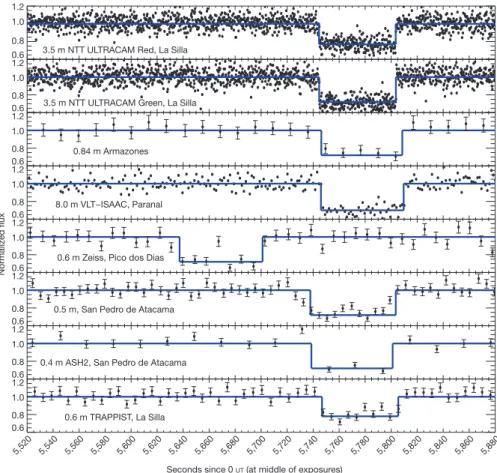
The light curves of the occultation are shown in Fig. 1. Fitting synthetic square-well models to the light curves yielded the disappear-ance and reappeardisappear-ance times of the star (Table 1), from which we calculate one chord in the plane of the sky for each site (see Sup-plementary Information section 3). On the basis of analyses of the light curves, taking into account the cycle time between the images and the dispersion of the data, we deduce that there were no secondary occultations, so we can reject the existence of a satellite larger than about 200 km in diameter in the areas sampled by the chords. The result is consistent with a deep-image survey that did not find any satellites16. The chords can be fitted with two shape models (Fig. 2). Our preferred shape, which is compatible with our own and other observations (see Supplementary Information section 8), corresponds to an elliptical object with projected axes of 1,430 6 9 km and 1,502 6 45 km. By combining this result with visible photometry at various phase angles17, we calculated that Makemake has a V-band geometric albedo of pV50.77 6 0.03 (see Supplementary Information
section 4). This is considerably high compared to albedos of other trans-Neptunian objects (TNOs)5, and is larger than that of Pluto (pV50.52)18but smaller than that of Eris (pV50.96)3.
The object is large enough to be in hydrostatic equilibrium, so it is possible to use the figures of equilibrium formalism, as done for Haumea19, to analyse the shape of a body that rotates with Make-make’s period of 7.77 h (refs 20, 21). The object could only be a tri-axial Jacobi ellipsoid for densities in the range 0.66–0.86 g cm23(for example, ref. 22). Such low densities are unrealistic for a body as large as Makemake (see Supplementary Fig. 7). Thus, Makemake must be an oblate Maclaurin spheroid for plausible densities between 1.4 and 2.0 g cm23(see discussion in Supplementary Information section 8).
1Instituto de Astrofı´sica de Andalucı´a, CSIC, Apartado 3004, 18080 Granada, Spain.2LESIA–Observatoire de Paris, CNRS, UPMC Univ. Paris 6, Univ. Paris-Diderot, 5 Place J. Janssen, 92195 Meudon Cedex, France.3Universite´ Pierre et Marie Curie, 4 Place Jussieu, 75252 Paris Cedex 5, France.4Institut Universitaire de France, 103 Boulevard Saint Michel, 75005 Paris, France.5Observato´rio Nacional/MCTI, Rua General Jose´ Cristino 77, CEP20921-400 Rio de Janeiro, Brazil.6European Southern Observatory, Alonso de Co´rdova 3107, Vitacura, Casilla 19001, Santiago 19, Chile.7SETI Institute, 189 Bernardo Ave., Mountain View, California 94043, USA.8Department of Physics and Astronomy, University of Sheffield, Sheffield S3 7RH, UK.9Observato´rio do Valongo, Universidade Federal do Rio de Janeiro, Ladeira Pedro Antonio 43, CEP 20.080-090 Rio de Janeiro, Brazil.10Unidad de Astronomı´a, Facultad de Ciencias Ba´sicas, Universidad de Antofagasta, Avenida Angamos 601, Antofagasta, Chile.11Institut d’Astrophysique de I’Universite´ de Lie`ge, Alle´e du 6 Aouˆt 17, B-4000 Lie`ge, Belgium.12Observatorio Astrono´mico Los Molinos DICYT-MEC Cno. de los Molinos 5769, 12400 Montevideo, Uruguay. 13Complejo Astrono´mico El Leoncito (CASLEO) and San Juan National University, Avenida Espan˜a 1512 sur, J5402DSP, San Juan, Argentina.14Astroimagen, Abad y Sierra 58Bis, 07800 Ibiza, Spain.15San Pedro de Atacama Celestial Explorations, Casilla 21, San Pedro de Atacama, Chile.16IMCCE, Observatoire de Paris, UPMC, Univ. Lille 1, CNRS, 77 Av. Denfert-Rochereau, 75014 Paris, France.17Instituto de Astrofı´sica de Canarias, Vı´a La´ctea s/n 38250 La Laguna, Tenerife, Spain.18Max-Planck-Institut fu¨r Extraterrestrische Physik, Giessenbachstraße, 85748 Garching, Germany.19Observato´rio CEAMIG-REA, Rua Radialista Joao Sposito 183, Belo Horizonte, Minas Gerais, CEP31545-120, Brazil.20Observato´rio Astronoˆmico Christus, Universidade de Fortaleza. Rua Joa˜o Carvalho, 630, Aldeota, Fortaleza, Brazil. 21Instituto Nacional de Pesquisas Espaciais/MCTI, Divisa˜o de Astrofisica, Av. dos Astronautas 1758, Sa˜o Jose´ dos Campos-SP, 12227-010, Brazil.22Observatorio astrono´mico de La Hita, 45840 La Puebla de Almoradiel, Toledo, Spain.23Observatoire de Gene`ve, CH-1290 Sauverny, Switzerland.24Department of Physics, University of Warwick, Coventry CV4 7AL, UK.25Caisey Harlingten Observatory, The Grange, Scarrow Beck Road, Erpingham, Norfolk NR11 7QX, UK.26Departamento de Fı´sica, Ingenierı´a de Sistemas y teorı´a de la Sen˜al and Instituto de Fı´sica Aplicada a las Ciencias y la Tecnologı´a, Universidad de Alicante P.O. Box 99, 03080 Alicante, Spain.27Instituut voor Sterrenkunde, K. U. Leuven, Celestijnenlaan 200B, B-3001 Leuven, Belgium.28Pontificia Universidad Cato´lica de Chile Vicuna Mackenna 4860 7820436 Macul, Santiago, Chile.29Observatorio Astronomico el Gato Gris, S. Luis 145, Tanti, Co´rdoba, Argentina.30IP&D, Universidade do Vale do Paraı´ba, Av. Shishima Hifumi, 2911, CEP 12244-000, Sa˜o Jose´ dos Campos, Brazil.31Laborato´rio de Astrofı´sica Teo´rica e Observacional, Departamento de Cieˆncias Exatas e Tecnolo´gicas, Universidade Estadual de Santa Cruz, 45662-00 Rodovia Ilhe´us-Itabuna, km 16, Brazil.32European Southern Observatory, Karl-Schwarzschild-Str. 2, 85748 Garching bei Mu¨nchen, Germany.33Rede de Astronomia Observacional, Brasilia, SMPW Q25 CJ1-10B, 71745-501, Brazil.34Universidade Estadual de Ponta Grossa, O.A. — DEGEO, Avenida Carlos Cavalcanti 4748, Ponta Grossa 84030-900, Brazil.
5 6 6 | N A T U R E | V O L 4 9 1 | 2 2 N O V E M B E R 2 0 1 2
Macmillan Publishers Limited. All rights reserved
Thermal measurements indicate that Makemake must have two ter-rains with very different albedos5,6,23, and a diameter of 1,420 6 60 km (ref. 6) if assumed to be spherical. This value is in agreement with, but
considerably less precise than, the value of 1,430 6 9 km determined here under the assumption of spherical shape. One of the terrains in the thermal models must be very dark to explain Makemake’s thermal
0.6 0.8 1.0
3.5 m NTT ULTRACAM Red, La Silla
0.6 0.8 1.0 1.2
3.5 m NTT ULTRACAM Green, La Silla
0.6 0.8 1.0 1.2 0.84 m Armazones 0.6 0.8 1.0 1.2 Normalized flux 8.0 m VLT−ISAAC, Paranal 0.6 0.8 1.0 1.2
0.6 m Zeiss, Pico dos Dias
0.6 0.8 1.0 1.2
0.5 m, San Pedro de Atacama
0.6 0.8 1.0 1.2
0.4 m ASH2, San Pedro de Atacama
5,520 5,540 5,560 5,580 5,600 5,620 5,640 5,660 5,680 5,700 5,720 5,740 5,760 5,780 5,800 5,820 5,840 5,860 5,880
Seconds since 0 UT (at middle of exposures) 0.6 0.8 1.0 1.2 0.6 m TRAPPIST, La Silla 1.2
Figure 1|Light curves of the Makemake event observed from seven telescopes on 2011 April 23.Note that the brightness drop in the Pico dos Dias light curve happens earlier than the rest because the observatory is at a very different longitude (see map in Supplementary Fig. 1). Also note that the ULTRACAM camera provided two channels of useful data (one in the red and the other in the green part of the spectrum). The light curves show the sum of the star and Makemake fluxes, arbitrarily normalized to unity outside the occultation. The R-band star magnitude is about 18.22 according to the
NOMAD catalogue, compared with roughly 17.2 for Makemake. Therefore, the expected brightness drop was around 0.35 in normalized flux, as observed. The error bars are 1s. The NTT and Very Large Telescope Infrared Spectrometer and Array Camera (VLT-ISAAC) light curves are shown without error bars. The blue lines show square-well models that fit the observations, from which the occultation chords of Fig. 2 are obtained. Possible features in the centre of the occultation light curves are analysed in the Supplementary Information. TRAPPIST, Transiting Planets and Planetesimals Small Telescope.
Table 1|Details of the successful observations on 2011 April 23
Site and telescope Pixel scale (0)
Integration time (s)
Filter name Dead time (s)
Instrument name/ detector
Immersion time (UT) Emersion time (UT) Longitude/Latitude/Height
La Silla, 3.5 m NTT 0.35 0.272 r9 0.0036 ULTRACAM channel r9 1:35:44.59 6 0.07 1:36:43.51 6 0.08 289u 159 58.50 E/ 29u 159 31.80 S/2,345.4 m La Silla, 3.5 m NTT 0.35 0.272 g9 0.0036 ULTRACAM channel g9 1:35:44.64 6 0.04 1:36:43.66 6 0.07 289u 159 58.50 E/ 29u 159 31.80 S/2,345.4 m La Silla, 0.6 m TRAPPIST
0.64 5 Clear 1.435 FLI- PL3041BB 1:35:46.82 6 1.6 1:36:45.47 6 1.6 289u 159 38.20 E/
29u159 16.60 S/2,317.7 m
Paranal, 8 m VLT 0.148 1.521 J 0 ISAAC 1:35:46.00 6 0.35 1:36:49.60 6 0.35 289u 359 50.10 E/
24u 379 30.30 S/2,635 m
Armazones, 0.84 m 0.57 10 Clear 3.5 SBIG-STL6303E 1:35:46.30 6 1.1 1:36:48.52 6 3 289u 489 13.60 E/
24u 359 51.90 S/2,705.7 m San Pedro de Atacama,
0.5 m Harlingten
1.61 5 Clear 1.048 Apogee U42 1:35:37.86 6 2.7 1:36:43.56 6 3.1 291u 499 13.00 E/
22u 579 12.20 S/2,305 m San Pedro de Atacama,
0.4 m ASH2
1.21 15 Clear 5.966 SBIG-STL11000 1:35:38.66 6 4 1:36:41.16 6 2 291u 499 13.00 E/
22u 579 12.20 S/2,305 m Pico Dos Dias, 0.6 m
Zeiss
1.98 5 Clear 3.851 SITe SI003AB 1:33:57.27 6 1.6 1:35:01.08 6 2.2 314u 259 02.50 E/
22u 329 07.80 S/1,810 m Image sequences were obtained with all the telescopes at different image rates and with different dead times, as shown. All the observations were made in the visible, except for the Paranal light curve, which was obtained with ISAAC, a near-infrared instrument14. The sequences were started typically 20 min before the nominal occultation time, and finished around 20 min later. The images were bias subtracted and flat-field corrected using calibration frames taken before or after the occultation. From the image sequences, fluxes of the combined light source formed by Makemake and the blended star were obtained. The fluxes were obtained by means of synthetic circular-aperture photometry techniques, and the fluxes of other stars in the field of view were extracted using the DAOPHOT package15. The fluxes as a function of time constitute what we call light curves. These were divided by the fluxes of other stars to compensate for transparency fluctuations in the terrestrial atmosphere. The resulting light curves were divided by the average value of the unocculted part of the light curve to obtain a normalized flux. The uncertainties in the fluxes were obtained from the standard deviation of the data outside the occultation drop. The computers that controlled the cameras were all periodically synchronized withUTtime servers, except for ULTRACAM at the 3.5-m NTT, the timing of which was directly synchronized by means of a global positioning system that provided a time accuracy better than 1 ms. We tested the accuracy of the timing of the Internet-synchronized computers by checking the error logs. The maximum deviations of the computer clocks were all less than 10 ms. Thus we adopt this value as a conservative estimate of the error in the times of the images.
LETTER
RESEARCH
2 2 N O V E M B E R 2 0 1 2 | V O L 4 9 1 | N A T U R E | 5 6 7 Macmillan Publishers Limited. All rights reserved
output at 24 mm (ref. 6), which requires a warm terrain on the order of 50 K (see Supplementary Information section 5). The two terrains and Makemake’s low rotational variability20,21,24can be reconciled if the
object is rotating nearly pole-on, if the dark terrain is spread uniformly in longitude (a banded configuration) or by a combination of both conditions.
Makemake is, a priori, a good candidate to have a fully developed atmosphere4,7,8. Its albedo and distance from the Sun lie between those of Pluto (which has a global atmosphere) and Eris (which does not, at least currently). Makemake may also have a similar surface composi-tion to Pluto and Eris, on the basis of spectroscopic observacomposi-tions4. At the warm temperatures of about 50 K expected from two-terrain ther-mal models, methane vapour pressure is on the order of a few microbars, whereas nitrogen vapour pressure is around two orders of magnitude higher (as illustrated in Fig. 32 of a work on vapour pressures25).
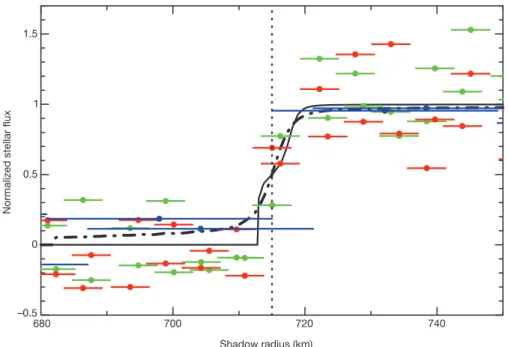
However, a global Pluto-like atmosphere is ruled out by our occulta-tion light curves, which have abrupt ingress and egress profiles (Fig. 1). To get an upper limit on a global atmosphere, it is possible to model its effects on occultation profiles and compare them with observations. The profiles from the New Technology Telescope (NTT) imply an upper limit to the surface pressure of a putative methane atmosphere of only 4–12 nbar at a 1s confidence level, and 20–100 nbar at the 3s level (see Fig. 3 and Supplementary Information section 6 for a description of the models, which also consider nitrogen).
One possibility that might explain the lack of a global atmosphere is that Makemake has little or no N2ice, because N2vapour pressure is
well above the microbar level even on the cooler terrain. From an update of the results of the models on retention of volatiles8, consi-dering new empirical determinations of the vapour pressures of N2and
CH4(ref. 25), Makemake would not have retained N2if it were smaller
than 1,370 km, which we rule out. With a diameter of 1,430 km, Makemake would have to have a density of less than 1.7 g cm23,
smal-ler than the adopted nominal value of 1.8 g cm23(ref. 8), to result in
complete N2loss. Considering now that CH4is abundant on the
sur-face of Makemake, again from the volatile-retention arguments, its density would have to be greater than 1.4 g cm23. Other constraints
on the density based on the observed shape and the figures of equilib-rium are discussed in Supplementary Information section 8. Another
800 810 820 830 840 850 860 f (mas) 430 440 450 460 470 g (mas) W N S. Pedro
Pico dos Dias
Paranal Armazones
La Silla
Figure 2|Occultation chords obtained at five different sites plotted in the projected plane of the sky. The axis marked g indicates the north–south direction in the projected plane of the sky; f indicates the east–west direction. Units are milliarcseconds (mas). Note that the Paranal and Armazones chords almost overlap. The Paranal, Armazones, Pico dos Dias and San Pedro chords sampled the central part of Makemake. The star disappearance takes place on the left. The chord extremities can be fitted by two different models. The first (pictured in brown) is a circle of diameter 38.28 6 0.22 mas (1s level), equivalent to 1,430 6 9 km, with a reduced x2of 1.032. The second (pictured in black) is an ellipse with a minor axis of 1,428 6 17 km and an axial ratio of 1.15 6 0.17, with the long axis tilted by 9 6 24u (1s level) with respect to the local celestial north. The reduced x2of the fit is 1.027. The dashed line shows the
axes of the best-fitting ellipse. As discussed in the Supplementary Information, the best shape is between the two models. Makemake was 51.5AUfrom Earth and 52.21AUfrom the Sun at the time of the occultation.
Shadow radius (km)
680 700 720 740
Normalized stellar flux
1.5
1
0.5
0
–0.5
Figure 3|Observed and synthetic light curves. A comparison of two CH4
pure atmosphere models with data (ingress and egress profiles: green, NTT g9 points; red, NTT r9 points; blue, VLT J-band) plotted against the distance to Makemake’s shadow centre, assuming a circular limb for simplicity. Bars are the radius intervals corresponding to each integration bin. For better reading, and in contrast to Fig. 1, the fluxes have been normalized between zero (average value of the flux during the occultation) and unity (full stellar flux). The models
correspond to a CH4atmosphere with a surface temperature of 30 K, a
near-surface temperature gradient of 17 K km21followed by an isothermal profile with T 5 100 K for higher altitudes. Solid line: surface pressure of
Psurf58 nanobar, compatible with the data at 1s. Dash-dotted line: model with
Psurf5100 nanobar (compatible with the data at 3s). See Supplementary
Information for a full description of the models.
RESEARCH
LETTER
5 6 8 | N A T U R E | V O L 4 9 1 | 2 2 N O V E M B E R 2 0 1 2
Macmillan Publishers Limited. All rights reserved
possibility to explain the lack of a global atmosphere is a nearly pole-on orientation. From a theoretical study7, TNOs with high obliquity are less likely to have globally distributed atmospheres.
The remarkably high albedo of Eris (pV50.96) is thought to be the
result of a collapsed atmosphere, which coated Eris with bright, fresh ices3,26. A fully condensed atmosphere on Makemake might have resulted in an albedo similar to that of Eris, which is not the case. However, if Makemake had a local rather than a global atmosphere, some parts of the surface could be fully covered with fresh ice from the collapsed part of the atmosphere and be very bright, and others could remain dark. The overall albedo of Makemake could thus be smaller than that of Eris, but larger than that of Pluto. A local atmosphere would also provide a reason for the two-terrain models needed to explain Makemake’s thermal data.
Local atmospheres on TNOs are theoretically plausible7; they can be confined to a subsolar region or a band at the subsolar latitude. It should be noted that a small drop of only 10 K in surface temperature implies a decrease of three orders of magnitude in the vapour pressure of CH4and N2at low temperatures.
We can investigate whether the presence of a local atmosphere is consistent with our data. The bottom of the occultation light curves should be flat in an airless body. Flashes in occultations are known to be caused by the focusing effect of an atmosphere when the observer passes near the centre of the shadow27. Thus, the noise level of the light curves at their bottoms can put limits on the local atmosphere that can extend to the limbs. Modelling of central flashes for plausible local atmospheres shows that an atmosphere with surface pressure on the order of several microbars can exist and still be consistent with the data, provided that the atmosphere is confined to specific parts of the limb (see Supplementary Information section 7).
From the information gathered on Pluto, Eris and now Makemake using stellar occultations, we hypothesize that the albedos and other surface properties of the largest TNOs are determined by sublimation and condensation processes. In our picture, the largest albedos would result from atmospheres that have fully condensed (collapsed onto the surface), whereas medium-albedo objects would have local atmo-spheres and the lower-albedo objects would have global atmoatmo-spheres from sublimation of the volatiles. Future studies will shed light on this possibility and whether sublimation is fully solar driven or is also driven by other mechanisms. The airborne Stratospheric Observatory For Infrared Astronomy, in combination with large aperture telescopes on the ground, would be an excellent tool for this kind of study. Received 1 June; accepted 17 September 2012.
1. Licandro, J. et al. Visible spectroscopy of 2003 UB313: evidence for N2ice on the surface of the largest TNO? Astron. Astrophys.458, L5–L8 (2006).
2. Tegler, S. C. et al. Ice mineralogy across and into the surfaces of Pluto, Triton, and Eris. Astrophys. J.751, 76 (2012).
3. Sicardy, B. et al. A Pluto-like radius and a high albedo for the dwarf planet Eris from an occultation. Nature478, 493–496 (2011).
4. Licandro, J. et al. The methane ice rich surface of large TNO 2005 FY9: a Pluto-twin in the trans-Neptunian belt? Astron. Astrophys.445, L35–L38 (2006).
5. Stansberry, J. A. et al. in The Solar System Beyond Neptune. 161–179 (eds Barucci, M. A., Boehnhardt, H., Cruikshank, D. P., Morbidelli, A. & Dotson, R.) (Univ. Arizona Press, 2008).
6. Lim, T. et al. ‘‘TNOs are Cool’’: A survey of the trans-Neptunian region. III. Thermophysical properties of (90482) Orcus and (136472) Makemake. Astron. Astrophys.518, L148 (2010).
7. Stern, S. A. & Trafton, L. M. in The Solar System Beyond Neptune (eds Barucci, M. A., Boehnhardt, H., Cruikshank, D. P., Morbidelli, A. & Dotson, R.) 365–380 (Univ. Arizona Press, 2008).
8. Schaller, E. L. & Brown, M. E. Volatile loss and retention on Kuiper belt objects. Astron. J.659, L61–L64 (2007).
9. Hubbard, W. B., Hunten, D. M., Dieters, S. W., Hill, K. M. & Watson, R. D. Occultation evidence for an atmosphere on Pluto. Nature336, 452–454 (1988).
10. Young, E. F. et al. Vertical structure in Pluto’s atmosphere from the 2006 June 12 stellar occultation. Astron. J.136, 1757–1769 (2008).
11. Sicardy, B. et al. Charon’s size and an upper limit on its atmosphere from a stellar occultation. Nature439, 52–54 (2006).
12. Elliot, J. L. et al. Size and albedo of Kuiper belt object 55636 from a stellar occultation. Nature465, 897–900 (2010).
13. Assafin, M. et al. Candidate stellar occultations by large trans-Neptunian objects up to 2015. Astron. Astrophys.541, A142 (2012).
14. Moorwood, A. et al. ISAAC at the VLT. Messenger95, 1–5 (1999). 15. Stetson, P. B. DAOPHOT — a computer program for crowded-field stellar
photometry. Publ. Astron. Soc. Pacif.99, 191–222 (1987).
16. Brown, M. E. et al. Satellites of the largest Kuiper belt objects. Astrophys. J.639, L43–L46 (2006).
17. Rabinowitz, D. L., Schaefer, B. E. & Tourtellotte, S. W. The diverse solar phase curves of distant icy bodies. I. Photometric observations of 18 trans-Neptunian objects, 7 centaurs, and Nereid. Astron. J.133, 26–43 (2007).
18. Buratti, B. et al. Photometry of Pluto in the last decade and before: evidence for volatile transport? Icarus162, 171–182 (2003).
19. Rabinowitz, D. et al. Photometric observations constraining the size, shape, and albedo of 2003 EL61, a rapidly rotating, Pluto-sized object in the Kuiper belt. Astrophys. J.639, 1238–1251 (2006).
20. Heinze, A. N. & de Lahunta, D. The rotation period and light-curve amplitude of Kuiper belt dwarf planet 136472 Makemake (2005 FY9). Astron. J.138, 428–438 (2009).
21. Thirouin, A. et al. Short-term variability of a sample of 29 trans-Neptunian objects and centaurs. Astron. Astrophys.522, A93 (2010).
22. Tancredi, G. & Favre, S. Which are the dwarfs in the Solar System? Icarus195, 851–862 (2008).
23. Mu¨ller, T. et al. Makemake: A truly exotic TNO! EPSC-DPS Joint Meeting, Nantes, France 1416 (2011).
24. Ortiz, J. et al. Short-term rotational variability in the large TNO 2005 FY9. Astron. Astrophys.468, L13–L16 (2007).
25. Fray, N. & Schmitt, B. Sublimation of ices of astrophysical interest: a bibliographic review. Planet. Space Sci.57, 2053–2080 (2009).
26. Alvarez-Candal, A. et al. The spectrum of (136199) Eris between 350 and 2350 nm: results with X-Shooter. Astron. Astrophys.532, A130 (2011).
27. Elliot, J. L. et al. Occultation of Epsilon Geminorum by Mars. II — The structure and extinction of the Martian upper atmosphere. Astrophys. J.217, 661–679 (1977). Supplementary Information is available in the online version of the paper. Acknowledgements These results were based partially on observations made with European Southern Observatory Telescopes at the La Silla and Paranal Observatories under programme 287C-5013. J.L.O. acknowledges funding from Spanish and Andalusian grants and the European Regional Development Fund (FEDER). B.S. acknowledges support from French National Research Agency (ANR) grant ‘Beyond Neptune’, and from the Institut Universitaire de France. E.U.-S. acknowledges the support from the Chilean National Commission for Scientific and Technical Research (Gemini-CONICYT funds), and from the North Catholic University of Chile Vicerectorate of Research and Technology Development (UCN-VRIDT). TRAPPIST is a project funded by the Belgian Fund for Scientific Research (FRS-FNRS) with the participation of the Swiss National Science Foundation (SNF). J.I.B.C. acknowledges grants by the Brazilian National Council for the Development of Science and Technology (CNPq), and the Foundation for Research Support of the State of Rio de Janeiro (FAPERJ). P.S.-S. acknowledges financial support by the Centre National de la Recherche Scientifique (CNRS). R.G.-H. acknowledges partial financial support by the Argentinian National Scientific and Technical Research Council (CONICET). F.B.-R. acknowledges the support of the French-Brazilian Doctoral College Coordination of Improvement of Graduated Personnel programme (CDFB/CAPES). A.A.-C. acknowledges support from the Marie Curie Actions of the European Commission (FP7-COFUND). S.P.L., V.S.D. and T.R.M. acknowledge funding for ULTRACAM from the UK Science and Technology Facilities Council. R.D. acknowledges support from Spanish Ministry of Economics and Competitiveness through a Ramo´n y Cajal contract.
Author Contributions J.L.O. helped to plan the campaign, analysed data for the prediction, made the prediction, participated in the observations, obtained and analysed data, interpreted data and wrote part of the paper. B.S. helped to plan the campaign, participated in the observations, analysed data, interpreted data, wrote and ran the diffraction and ray-tracing codes and wrote part of the paper. F.B.-R. and A.A.-C. helped to plan the campaign, participated in the observations and analysed and interpreted data. E.L. analysed the implications of the results for Makemake’s thermal model and putative atmospheric structure and wrote part of the paper. R.D. and V.D.I. helped to plan the observations and analysed data. J.I.B.C., S.P.L., E.U.-S., J.P.C., E.J. and J.M. participated in the observations and analysed data. M.A., F.B.-R., J.I.B.C., R.V.-M., D.N.d.S.N. and R.B. discovered the star candidate and analysed data. P.J.G. and T.M. made thermal models and participated in the interpretation. All other authors participated in the planning of the campaign and/or the observations and/or the interpretations. All authors were given the opportunity to review the results and comment on the manuscript.
Author Information Reprints and permissions information is available at www.nature.com/reprints. The authors declare no competing financial interests. Readers are welcome to comment on the online version of the paper. Correspondence and requests for materials should be addressed to J.L.O. ([email protected]).
LETTER
RESEARCH
2 2 N O V E M B E R 2 0 1 2 | V O L 4 9 1 | N A T U R E | 5 6 9 Macmillan Publishers Limited. All rights reserved