Published in: European heart journal (2004), vol. 25, iss. 23, pp. 2167-21678 Status : Postprint (Author’s version)
Drug-eluting stents: meta-analysis in diabetic patients
Andre J. Scheen, Fabian Warzée, Victor M.G. LegrandDivision of Diabetes Nutrition and Metabolic Disorders and the Division of Cardiology Department of Medicine CHU Sart Titman (B35) B-4000 Liège, Belgium
Dear Editor,
We read with interest the systematic review on drug-eluting stents (DES) by Hill et al.1 The early data available
indicate that DES reduce in-stent restenosis and major adverse cardiac events (MACE), mainly
revascularizations. Although diabetes mellitus represents a major risk factor for coronary heart disease, no specific attention has been devoted to this particular population in this remarkable review. In the ARTS study, diabetic patients undergoing coronary stenting had a poorer prognosis than non-diabetic patients and diabetic patients treated with bypass surgery.2 A recent meta-analysis of six trials in patients receiving coronary
angioplasty with bare-metal stents (BMS) reported that the odds ratio (OR) of restenosis associated with diabetes was 1.61 (95% CI 1.21-2.14, p = 0.004).3 As DES significantly reduce restenosis rates,4 especially in small
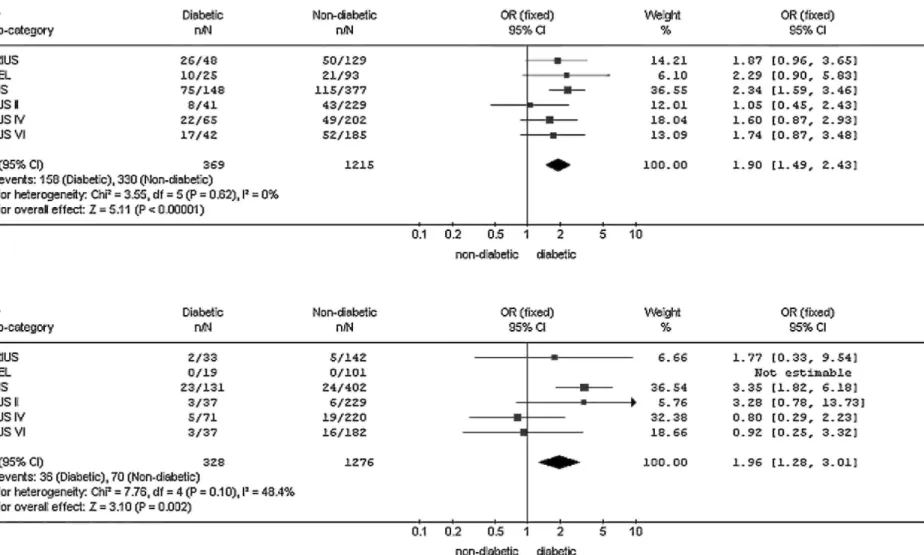
vessels, it would be interesting to specifically analyse the potential impact of DES in diabetic patients. We performed a meta-analysis of the results from six recent trials comparing DES and BMS, using sirolimus (RAVEL, SIRIUS and E-SIRIUS) or paclitaxel (TAXUS II, TAXUS IV and TAXUS VI). These trials provided adequate figures which allowed us to recalculate the rate of in-stent restenosis (defined as a stenosis ≥ 50%) after a follow-up of 6-12 months in both diabetic (around 20% of the population) and non-diabetic patients (Fig. 1 ). OR of restenosis was markedly lower when comparing DES with BMS and similar in both non-diabetic (OR: 0.16; 0.12-0.20; p <0.00001) and diabetic (OR: 0.16; 0.11-0.24; p <0.00001) patients. However, as compared to non-diabetic individuals, the OR of in-stent restenosis associated with diabetes still averaged 1.96 (1.28-3.01) in the groups receiving DES (p = 0.002), a figure quite similar (although less consistent between studies) to that observed with BMS (OR = 1.90; 1.49-2.43; p <0.00001). Interestingly, in the SIRIUS substudy specifically devoted to diabetes,5 in-lesion restenosis was significantly reduced with DES compared to BMS in the
non-insulin-requiring patients (7.7% vs. 49.3%, p < 0.001 ), but not in the non-insulin-requiring patients (35% vs. 50%, p = 0.38). MACE incidence after 9 months was reduced from 25% with BMS to 9.2% with DES (p < 0.001 ) in diabetic patients and from 16.5% to 6.5% (p < 0.001) in non-diabetic patients, respectively. Finally, in the RESEARCH registry of DES use in the real world,6 diabetes was a significant predictor of MACE (OR =1.62;
1.09-2.43; p = 0.02), especially clinically driven target vessel revascularization (OR =1.81; 1.10-2.99; p = 0.02). In conclusion, DES are associated with a 80% remarkable relative risk reduction of restenosis during the first year of follow-up in diabetic patients as compared to BMS, similar to that observed in non-diabetic subjects. However, despite the use of DES, diabetes mellitus still remains an independent risk factor of restenosis, need for revascularization and MACE. Further specific prospective studies with highly effective DES should be performed in this high risk diabetic population.
Published in: European heart journal (2004), vol. 25, iss. 23, pp. 2167-21678 Status : Postprint (Author’s version)
Fig. 1: Meta-analysis of six trials comparing the effects of bare-metal stents (BMS) (a) vs. drug-eluting stents (DES) (b) on restenosis in diabetic (d) vs. non-diabetic patients.
Published in: European heart journal (2004), vol. 25, iss. 23, pp. 2167-21678 Status : Postprint (Author’s version)
Published in: European heart journal (2004), vol. 25, iss. 23, pp. 2167-21678 Status : Postprint (Author’s version)
References
1. Hill RA, Dundar Y, Bakhai A et al. Drug-eluting stents: an early systematic review to inform policy. Eur
Heart J 2004;25:902-19.
2. Legrand VMG, Serruys PW, Unger F et al. on behalf of the Arterial Revascularization Therapy Study (ARTS) Investigators. Three-year outcome after coronary stenting versus bypass surgery for the treatment of multives-sel disease. Circulation 2004;109:1114-20.
3. Gilbert J, Raboud J, Zinman B. Meta-analysis of the effect of diabetes on restenosis rates among patients receiving coronary angioplasty stenting. Diabetes Care 2004;27:990-4.
4. Sousa JE, Serruys PW, Costa AAA. New frontiers in cardiology. Drug-eluting stents (part I εt part II).
Circulation 2003;107:2274-9. 2383-2389.
5. Moussa I, Leon MB, Bairn DS et al. Impact of sirolimus eluting stents on outcome in diabetic patients. A SIRIUS (SIRollmUS-coated Bx Velocity balloon-expandable stent in the treatment of patients with de novo coronary artery lesions) substudy. Circulation 2004;109:2273-8.
6. Lemos PA, Serruys PW, van Domburg RT et al. Unrestricted utilization of sirolimus-eluting stents compared with conventional bare stent implantation in the "Real World". The Rapamycin Eluting Stent Evaluated at Rotterdam Cardiology Hospital (RESEARCH) Registry. Circulation 2004; 109: 190-5.