HAL Id: tel-01712306
https://tel.archives-ouvertes.fr/tel-01712306
Submitted on 19 Feb 2018
HAL is a multi-disciplinary open access
archive for the deposit and dissemination of sci-entific research documents, whether they are pub-lished or not. The documents may come from teaching and research institutions in France or
L’archive ouverte pluridisciplinaire HAL, est destinée au dépôt et à la diffusion de documents scientifiques de niveau recherche, publiés ou non, émanant des établissements d’enseignement et de recherche français ou étrangers, des laboratoires
software-defined networking
Rishikesh Sahay
To cite this version:
Rishikesh Sahay. Policy-driven autonomic cyberdefense using software-defined networking. Cryp-tography and Security [cs.CR]. Institut National des Télécommunications, 2017. English. �NNT : 2017TELE0022�. �tel-01712306�
THÈSE DE DOCTORAT CONJOINT TELECOM SUDPARIS et L’UNIVERSITE PIERRE ET MARIE CURIE
Spécialité :Informatique et Réseaux
École doctorale : Informatique, Télécommunications et Électronique de Paris
Présentée par
Rishikesh Sahay
Pour obtenir le grade de
DOCTEUR DE TELECOM SUDPARIS
Policy-Driven Autonomic Cyberdefense
using Software-Defined Networking
Soutenue le 14 Novembre devant le jury composé de : Guillaume URVOY-KELLER
Professeur – Université Nice Sophia Antipolis / Rapporteur Michaël HAUSPIE
Maître de conférences, HDR – Université de Lille / Rapporteur Isabelle CHRISMENT
Professeure – TELECOM Nancy, Université de Lorraine / Examinateur Houda LABIOD
Professeure – Télécom ParisTech / Examinateur Guillaume DOYEN
Maître de conférences – Université de Technologie de Troyes / Examinateur Hervé DEBAR
Professeur – Télécom SudParis / Directeur de thèse Zonghua ZHANG
HDR – IMT Lille Douai / Co-Encadrant de thèse Gregory BLANC
Acknowledgements
There are quite a few people that have contributed one way or another to the accomplishment of this work. Some of these people even come unexpectedly to our lives to give us a word of courage or just to listen to us when we are down, or when we do not find an answer to our multiple questions. I would like to thank all of you from very deep inside.
Foremost, I would like to express my gratitude to Prof. Hervé Debar my thesis director for the continuous support of my Ph.D study and research, for his comments, motivation, enthusiasm, and immense knowledge. It is absolutely difficult to succeed in the process of finding and developing an idea without the help of a specialist in the domain. I found in my director not only the source of wonderful ideas to develop, but also the support that a PhD student needs.
I would like to thank Zonghua Zhang and Gregory Blanc my thesis co-supervisors for their continuous guidance and support during my thesis. Thanks a lot to both of you for your time, dedication, your remarks -always appropriate and direct to the point. Thanks for your advices at the different stages of my thesis which helped me to complete my work.
Thanks to the European project ’NECOMA’ (Nippon-European Cyberdefense-Oriented Multi-layer threat Analysis) and ’SUPERCLOUD’ and all the partners with whom we worked together. Thanks to Vladimir Dombrovski for his implementation of my framework in the platform. Thanks as well to Mohammed El Barbori for his help during the implementation of the framework in mininet.
I would also like to thank Prof. Guillaume Urvoy-Keller and Dr. Michael Hauspie who, as reporters and members of the jury, had the hard task of reading my thesis and giving their advice in order to improve its content. Thanks a lot to Prof. Isabelle Chrisment, Dr. Guillaume Doyen, Prof. Houda Labiod for their interest, involvement and for being part of the jury of my thesis.
I would also like to thank Khalifa Toumi to help me during my last contribution of my thesis. Your suggestions have been very helpful in completing my work.
Thanks to my colleagues Jose, Nesrine, Fabien, Ibrahim, Yasir for all the time spent together. It has been a great experience having you all around.
I am eternally indebted to my loving parents who supported me at every stage of my life, my wife Saumya, brother, my brother’s wife and my mother-in-law. Thanks for always showing the pride in their faces while referring to me and my achievements. A special thanks to my lovely wife Saumya who supported me during the last stage of my thesis. You deserve a special thanks, there are 1001 reasons for it.
I can not conclude this acknowledgement without thanking Francoise ABAD for her love and her effort in making sure that our missions were treated properly, and for always helping us in finding a solution to our flights and hotel problems.
Thanks a lot, Merci beaucoup to everybody that contributed directly and indirectly to the realiza-tion of this dissertarealiza-tion. Enjoy your reading ! ! !
Abstract
Cyber attacks cause significant loss not only to end-users, but also Internet Service Providers (ISP). Recently, customers of the ISP have been the number one target of the cyber attacks such as Distributed Denial of Service attacks (DDoS). These attacks are encouraged by the widespread availability of tools to launch the attacks. So, there is a crucial need to counter these attacks (DDoS, botnet attacks, etc.) by effective defense mechanisms.
Researchers have devoted huge efforts on protecting the network from cyber attacks. Defense methodologies first contains a detection process, completed by mitigation. Lack of automation in the whole cycle of detection to mitigation increase the damage caused by cyber attacks. It requires manual configurations of devices by the administrator to mitigate the attacks which cause the network downtime. Therefore, it is necessary to close the security loop with an efficient mechanism to automate the mitigation process.
In this thesis, we propose an autonomic mitigation framework to mitigate attacks that target the network resources. Our framework provides a collaborative mitigation strategy between the ISP and its customers. The implementation relies on Software-Defined Networking (SDN) technology to deploy the mitigation framework. The contribution of our framework can be summarized as follows: first the customers detect the attacks and share the threat information with its ISP to perform the on-demand mitigation. We further develop the system to improve the management aspect of the framework at the ISP side. This system performs the alert extraction, adaptation and device configurations. We develop a policy language to define the high level policy which is translated into OpenFlow rules.
Finally, we show the applicability of the framework through simulation as well as testbed validation. We evaluate different QoS and QoE (quality of user experience) metrics in SDN networks. The application of the framework demonstrates its effectiveness in not only mitigating attacks for the victim, but also reducing the damage caused to traffic of other customers of the ISP.
Résumé
Les attaques cybernétiques causent une perte importante non seulement pour les utilisateurs finaux, mais aussi pour les fournisseurs de services Internet (FAI). Récemment, les clients des FAI ont été la cible numéro un de cyber-attaques telles que les attaques par déni de service distribué (DDoS). Ces attaques sont favorisées par la disponibilité généralisée outils pour lancer les attaques. Il y a donc un besoin crucial de contrer ces attaques par des mécanismes de défense efficaces.
Les chercheurs ont consacré d’énormes efforts à la protection du réseau contre les cyber-attaques. Les méthodes de défense contiennent d’abord un processus de détection, complété par l’atté-nuation. Le manque d’automatisation dans tout le cycle de détection à l’atténuation augmente les dégâts causés par les cyber-attaques. Cela provoque des configurations manuelles de péri-phériques l’administrateur pour atténuer les attaques affectent la disponibilité du réseau. Par conséquent, il est nécessaire de compléter la boucle de sécurité avec un mécanisme efficace pour automatiser l’atténuation.
Dans cette thèse, nous proposons un cadre d’atténuation autonome pour atténuer les attaques réseau qui visent les ressources du réseau, comme par les attaques exemple DDoS. Notre cadre fournit une atténuation collaborative entre le FAI et ses clients. Nous utilisons la technologie SDN (Software-Defined Networking) pour déployer le cadre d’atténuation. Le but de notre cadre peut se résumer comme suit : d’abord, les clients détectent les attaques et partagent les informations sur les menaces avec son fournisseur de services Internet pour effectuer l’atténuation à la demande. Nous développons davantage le système pour améliorer l’aspect gestion du cadre au niveau l’ISP. Ce système effectue l’extraction d’alertes, l’adaptation et les configurations d’appareils. Nous développons un langage de politique pour définir la politique de haut niveau qui se traduit par des règles OpenFlow.
Enfin, nous montrons l’applicabilité du cadre par la simulation ainsi que la validation des tests. Nous avons évalué différentes métriques QoS et QoE (qualité de l’expérience utilisateur) dans les réseaux SDN. L’application du cadre démontre son efficacité non seulement en atténuant les attaques pour la victime, mais aussi en réduisant les dommages causés au trafic autres clients du FAI.
Contents
Acknowledgements i
Abstract (English/Français) iii
List of figures ix
List of tables xi
1 Introduction 1
1.1 Background and Challenges . . . 2
1.2 Contributions . . . 3
1.3 Outline of Dissertation . . . 4
2 State of The Art 7 2.1 Autonomic Cyberdefense . . . 7
2.2 Software Defined Networking Architecture . . . 9
2.3 Genesis of Software Defined Networking . . . 13
2.4 Improving Network Security with Software Defined Networking (SDN) . . . . 15
2.5 Attack Models and Taxonomy . . . 30
2.6 Distributed Denial of Services (DDoS) Attacks and Mechanisms . . . 32
2.7 Concluding Remarks . . . 34
3 An SDN based Autonomic DDoS Defense Framework 37 3.1 Limitations of Existing Solutions and Motivations . . . 37
3.2 Proposed Autonomic Cyberdefense Framework . . . 39
3.3 Use Case . . . 48
3.4 Simulation based Experiments . . . 50
3.5 Testbed based Experiments . . . 55
3.6 Discussion . . . 59
3.7 Related work . . . 61
3.8 Conclusion . . . 62
4 SDN-Oriented Policy Representation and Translation 65 4.1 Policy Representation and Translation:Configuration . . . 67
4.2 Policy Grammar for High-level Policy . . . 70
4.3 OpenFlow Rule Templates . . . 73
4.4 Scenario 1: On-demand QoS Provisioning . . . 76
4.5 Scenario 2: On-demand DDoS attack mitigation . . . 84
4.6 Features and Comparison with Existing Policy Language . . . 91
4.7 Related Work . . . 96
4.8 Conclusion . . . 97
5 A New SDN based Security Policy Management and Enforcement Framework 99 5.1 Requirements for the Policy Management and Enforcement Framework . . . . 100
5.2 Design Components . . . 101
5.3 Path Computation and Network Service Header . . . 103
5.4 Workflow of the Framework . . . 105
5.5 Experiments . . . 106
5.6 Discussions . . . 113
5.7 Conclusion . . . 114
6 Conclusion and Future Work 117 A French Summary 119 A.1 Introduction . . . 119
A.2 Un Cadre de Mitigation de DDoS Autonome basé sur SDN . . . 122
A.3 Représentation et Traduction des Politiques de Haut Niveau . . . 129
A.4 Cadre de Gestion et de Mise en Œuvre des Politiques de Sécurité SDN . . . 137
A.5 Conclusion . . . 143
List of Figures
1.1 Reference model of autonomic defense framework . . . 2
2.1 State of Automation in Security. . . 8
2.2 SDN Architecture . . . 10
2.3 Current trend in the DDoS Attack . . . 31
3.1 SDN-enabled DDoS mitigation framework . . . 41
3.2 Use case illustrating the application of ArOMA. . . 49
3.3 Network topology used for the simulations . . . 52
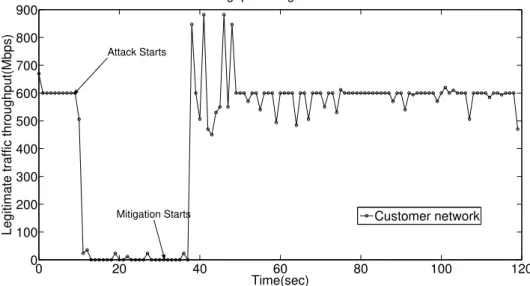
3.4 Response of ArOMA and throughput of legitimate traffic . . . 53
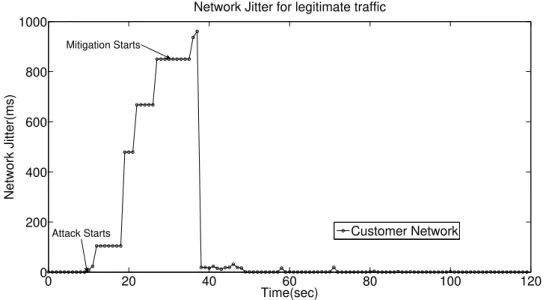
3.5 Network Jitter of legitimate traffic going towards customer network . . . 54
3.6 Throughput of suspicious traffic with different impact severity . . . 55
3.7 Time to rebuffer . . . 57
3.8 Average buffer length of legitimate and attack traffic . . . 58
3.9 Duration of the player in paused mode . . . 59
3.10 Average goodput of legitimate and attack traffic . . . 60
4.1 High-level view of the policy translation process . . . 66
4.2 Policy management and enforcement framework . . . 67
4.3 Deployment of Policies in the Network . . . 77
4.4 Different QoS scenarios for policy deployment . . . 81
4.5 Gold QoS policy implementation time with different scenarios . . . 83
4.6 Silver QoS policy implementation time with different scenarios . . . 84
4.7 Bronze QoS policy implementation time with different scenarios . . . 85
4.8 Packet loss in the deployment of policy on the ingress and egress switch at last . 85 4.9 Implementation time of mitigation policies . . . 91
4.10 Independent of the traffic rate time required to implement the mitigation policy for high impact severity flows . . . 92
4.11 Number of Packets that bypass during the implementation of block action at the ingress switch . . . 93
5.1 Workflow of the Policy Management Framework . . . 101
5.2 An Example of Policy Aware Shortest Path . . . 103
5.4 Throughput of legitimate traffic going towards customer network after redirection 111
5.5 Throughput of legitimate traffic in the case traffic going towards C1is redirected
through low suspicious path . . . 111
5.6 Throughput of legitimate and suspicious traffic going towards customer network after redirection. . . 112
5.7 Network jitter of legitimate traffic . . . 113
A.1 Cadre d’atténuation d’attaques DDoS basé sur SDN . . . 124
A.2 Taille moyenne du buffer en fonction des scénarios d’attaque . . . 127
A.3 Débit applicatif moyen en fonction des scénarios d’attaque . . . 128
A.4 Cadre de gestion et d’application des politiques . . . 130
A.5 Déploiement de politiques dans le réseau . . . 133
A.6 Flux opérationnel du cadre de gestion de politiques . . . 138
A.7 Scénario expérimental pour trois réseaux clients avec un réseau FAI. . . 141
List of Tables
2.1 SDN Controllers . . . 12
2.2 History of programmable networks . . . 14
2.3 DDoS Detection Applications over SDN . . . 18
2.4 Traffic Monitoring Applications over SDN . . . 20
2.5 DDoS Mitigation Applications over SDN . . . 24
2.6 Service Chaining . . . 28
2.7 SDN-based Policy Management . . . 30
3.1 Comparison between existing DDoS mitigation schemes . . . 38
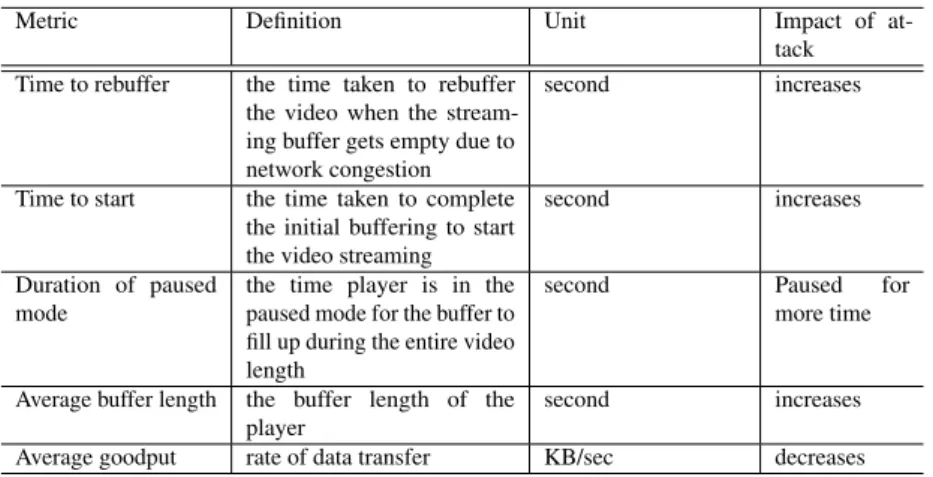
3.2 Security API overview . . . 44
3.3 Mapping between security class, impact severity, policy, bandwidth and associ-ated label . . . 52
3.4 Platform specifications . . . 55
3.5 Defined metrics to measure the impact of DDoS attacks . . . 56
4.1 Syntax to Specify Policies . . . 73
4.2 A Mapping Table between High QoS Bandwidth and the Network Path . . . 79
4.3 QoS Policies in different scenarios . . . 82
4.4 A Mapping Table between Bandwidths, Customer Network and the Path . . . . 87
4.5 Mitigation policies in different scenarios . . . 89
4.6 Comparison with Procera, OpenSec and Merlin . . . 95
5.1 Traffic its flow class and Destination Network . . . 107
5.2 Traffic paths in terms of bandwidth and link loss probability . . . 108
A.1 Table de correspondance entre largeurs de bande passante et chemins réseau . . 135
A.2 Bande passante et probabilité de perte de liaison pour les chemins réseau. . . . 141
1
Introduction
Cyber attacks are defended by two mechanisms: detection and mitigation. The attack diagnosis relies on the detection mechanism. Mitigation is the response mechanism that tries to reduce the impact of ongoing attacks on the network. Research on mitigation approaches have received less attention compared to detection, due to the complexity involved in the deployment of automated mitigation mechanisms. Moreover, existing mitigation mechanisms require the deployment of special hardware or software devices, which makes it complex and expensive for the deployment. Furthermore, network or cyber attacks do not only cause problems to enterprise networks or end users, but also for Internet Service Providers (ISPs). Generally, enterprise networks and end users get the Internet services from ISPs, as they subscribe to the ISP to get network connectivity. If the attackers target end users then it also causes collateral damage to ISPs as the traffic traverses through their network before reaching to end users. Therefore, the ISPs have become important players in cyber security and their intervention is key in mitigating the cyber attacks and their impacts. However, it is difficult for the ISP to detect the attacks going towards end users or enterprise networks. Specifically because, ISPs have a large customer base, and if they do the detection on behalf of their customers then it causes huge processing overhead. Therefore, it is important to design a mitigation technique that can coexist between ISPs and end users. So, it is crucial for the end-users to share the adequate information to service provider for mitigating cyber attacks.
Therefore, there is a need for cooperative and large scale defense mechanism among different partners involved [51]. Such cooperative mechanisms have scalability concern at the technical and business level. These cooperative mechanisms should overcome the both technical and business challenges, and should benefit all the partners involved.
The management of such cooperative defense mechanism is a difficult task, as it has various challenges: (1) the timely and automated sharing of alert informations between different managed domains, (2) the deployment of network and security policies depend on the Service Level Agree-ments (SLAs) with different network domain without any policy violation, (3) the configuration of low-level device specific rules on the heterogeneous network devices should not depend on the
manual work of network administrators, (4) the deployment of such defense mechanism should not rely on the specific hardware or software installation. Therefore, it is necessary to have an automated defense mechanism, which respond to network changes and security alerts without intervention from network administrators.
Automated defense framework should have a closed loop between different components of the defense mechanisms from monitoring, analysis to response. As shown in Fig. 1.1, the framework essentially contains a loop which consists of monitor, analysis, countermeasures and reaction. The network status is managed by controller or a centralized manager which uses the analysis results provided by the Analysis module, on the collected network traffic by the Monitor module, from the data plane devices. The analysis results assist the controller in selecting the countermeasure, and execute the reaction policies in the data plane devices. The network administrator can specify the high level network and security policies to manage the different modules.
Monitor Analysis Counter-measures Reaction Network status Network status Network status Network infrastructure, Data plane Network infrastructure, Data plane Policy
Figure 1.1 – Reference model of autonomic defense framework
1.1
Background and Challenges
Despite the tremendous efforts from both industry and academia, Cyber attacks continue emerging with unprecedented amount and varieties. A clear gap between the detection of security events and incident response still remains. For security professionals, it’s desirable to have a system which can automatically detect and defend against cyber attacks in real time, which is, however, mission impossible in practice today. According to the Forbes magazine report [84], three years ago the cost of cyber crime in the U.S. was 100 billion dollars. Many attacks goes undetected because of dependency of security systems on human intervention. IT personnel are no match to the intensive and sustained cyber attacks in the network. According to ABI research [96], in the future enterprises would not act manually to mitigate the cyber attacks after they happen. Specially, Distributed Denial of Service (DDoS) attacks are the most prevalent attack in the
1.2. Contributions
Internet today, which causes huge damage to the enterprise as well as to the ISPs [11]. The existing mechanisms require the presence of network administrators to mitigate the DDoS attacks which impacts the services in the network. Security automation would help the enterprises to mitigate the attacks without any human intervention. Automation provides speed in responding to the high-volume attacks in the network. Therefore, in this thesis we focus on mitigating the DDoS attack with automation of security mechanism.
However, there are some challenges in providing the needed automation for cyber defense. There is clear gap among the different components from monitoring and analysis to response. Automation should provide the control of the network according to different conditions. Different components in an automated defense should communicate effectively with each other for overall defense of the system. It should not increase the deployment cost for the enterprise network in terms special software and hardware. Since, if it requires some special devices or software which requires a lot of modification in the network, then enterprises would be reluctant to deploy these kind of automated mechanisms. Currently, the automated defense mechanisms are hardwired with the hardware devices which makes there deployment and management a complex and daunting task. Furthermore, the automated defense system should be robust and immune to new forms of attacks on the system. So, these challenges still need to be addressed to make the defense system in the network automated and operational.
1.2
Contributions
The objective of this thesis is to study the feasibility and effectiveness of building autonomic cyberdefense mechanism using Software-Defined Networking (SDN) technology. We leverage the unique features of SDN mainly programmability and global visibility over the entire network, and centralized controllability to design autonomic defense mechanism. In another word, thesis is intended to study how and to what extent the autonomic cyberdefense can be achieved. More specifically, the following objectives are identified,
1. Design a collaborative and autonomic defense mechanism which integrates the security functions ranging from anomaly detection in the customer network to the analysis and adoption of countermeasures in the ISP together into a pipeline.
2. A gap between high-level policies and low level rules always remain, motivating us to design such a policy representation and translation mechanism, which can effectively translate high-level security and network policies into the actual actions enforced on networking and security devices.
3. Considering the fact that attack on one customer can potentially affect many customer. So, a dynamic path computation is important for effective traffic engineering. This motivates us to design a policy management and enforcement framework for the ISP network which considers multiple factors such as congestion level in the path for policy enforcement.
The proposed framework relies on managing legitimate, suspicious and malicious flows between the ISP and its customers using SDN technology. SDN is a new networking paradigm in which control plane is decoupled from the data plane. Control plane is a centralized intelligence point and it provides a global visibility of the network. We propose to use SDN for providing security and QoS services to the customers of ISPs. Mitigation and QoS services are achieved by sharing the security alerts and flow information with its ISP by the customers. The information shared by the customer allows the ISP to establish different paths to process the flows.
To achieve the above objectives, we need to develop a framework, as well as designing effi-cient algorithms, methods, and approaches. The contributions delivered in this dissertation are summarized as follows.
1. Proposing an autonomic defense framework by leveraging SDN paradigm which can systematically integrate key security functions together: anomaly detection, policy specifi-cation & countermeasures selection, and response.
2. Designing a SDN based policy representation and translation technique that automatically translate the high-level security and network policy into low-level OpenFlow rules for enforcement in the network and security devices.
3. Providing a dynamic and adaptive policy management and enforcement framework for the ISP network. It handles attack mitigation and QoS requests of different customers and enforce appropriate security policies according to particular demands customers and overall network status of the ISP. A prototype of the framework has also been developed and evaluated via simulation to show the effectiveness of our proposal.
1.3
Outline of Dissertation
This dissertation is organized as follows:
Chapter 2 - State of the Art. This chapter firstly surveys the research efforts on building autonomic cyberdefense mechanisms. Then SDN based security architecture and mechanisms are extensively discussed, including network monitoring, anomaly detection, traffic engineering, attack mitigation, as well as security policy management in SDN. The final part is focused on DDoS attacks, one of the largest Internet threat that has been studied for more than two decades. Chapter 3 - an SDN based Autonomic Cyberdefense Framework. This chapter presents an autonomic cyberdefense framework which leverages the characteristics of SDN to systematically integrate several essential security functions together, ranging from network monitoring and anomaly detection to the adoption of countermeasures and incident response. A use case about DDoS attack mitigation is developed for testing the feasibility and effectiveness of the proposed framework.
1.3. Outline of Dissertation
Chapter 4 - SDN-Oriented Policy Representation and Refinement. This chapter presents a technique to represent and translates the network and security policies. It allows the network administrator to define the global network and security policies without knowing how these policies are enforced in the data plane. Upon receiving the security alerts these high-level policies are instantiated and translated into low-level OpenFlow rules for deployment in the OpenFlow switches.
Chapter 5 - a Novel SDN based Policy Management System. This chapter deals with the policy management framework in the ISP network. It enables the ISP to express the high-level security and network policies. These high-level policies in the ISP network are triggered upon receiving the security alert or QoS request from the customers. The framework extracts data from alerts and computes the path and deploy the corresponding low level rules in the OpenFlow switches in an automated way. This policy management and enforcement framework is validated by experimental simulations with an ISP and multiple customers scenario.
Chapter - Conclusion and Future Work This chapter concludes the dissertation with a sum-mary of contributions and presents the perspective for future work.
2
State of The Art
Today, Internet offers a wide variety of services in the cloud such as video streaming, online banking, VoIP services, etc. These services demands protection from malicious users and attacks. This is yet a very difficult task; thus protecting these services in the network is known as cyber defense. This term refers to the mechanisms devised for protecting the network and its resources from cyber attacks (Malware spreading, distributed denial of service attacks, etc.) performed by the attackers. However, protecting the network and services from the cyber attacks is very difficult task because of the non trivial manual work involved by the network administrator (e.g. configuring the devices, deployment of the rules, etc.).
The survey report of AlgoSec [7] as shown in Fig. 2.1 shows, that due to the lack of automation 20 percent of organizations experienced security threats. 42 percent of organizations had network outage because of the network mis-configurations caused by the security related tasks. According the the survey many organizations experienced security breach because of the manual security configurations. Report says that for 19 percent of organizations it takes one full working day or more to resolve the security breach because of the manual work involved by the network administrators.
However, with the increased cyber threats, it is required to automate the defense mechanisms. Attackers use automated tools to target the network resources so automated defense is required to tackle these attacks. Next, we present a survey and state of the art on the autonomic defense mechanisms. Then, we discuss security mechanisms proposed using Software-Defined Network-ing (SDN) technology to which can enables us to create an architecture for automated defense. Then, we present the current trends in the cyber attacks and some proposals to tackle the cyber attacks with SDN technology and then we conclude.
2.1
Autonomic Cyberdefense
There have been efforts to automate the security mechanisms due to large number of cyber attacks that have been occurred in the past. When cyber attacks have been successful they have
Figure 2.1 – State of Automation in Security.
caused huge financial loss to organizations. Therefore, to make the networks more secure and independent of human intervention, it is necessary to make them automated like Autonomic Computing (AC) system. AC systems are able to dynamically adapt to changes in accordance with the high-level defined policies. AC systems have mechanisms to monitor, analyse, plan and execute themselves based-on the changing environment according to the defined policies. A rule based automated anomaly detection framework is proposed in [91] to protect the Building Automation and Control (BAC) networks. Intrusion Detection System (IDS) is developed by training the system with the data flows collected by the FireAlarm system testbed using the monitoring module. Rules are collected from the offline data mining techniques to detect the attacks. Cognitive Cyber Defense (CCD) [1] solution proposed by IBM contains a set of cyber security applications which output threat indicators based on analysis of different data. It builds real-time and long-term profiles of different entities (hosts, external users, etc.) by analyzing different data sources which enables to classify and detect anomalous activities. These mechanisms perform offline analysis and then the rules are updated by the network administrators. ISDS [117] was developed as a framework for automated security based on autonomic computing. The aim of this software is to provide intelligence to its components to dynamically adapt according to the security conditions of the network. The main idea of the framework is to analyse the informations received from the network and adjust dynamically.
2.2. Software Defined Networking Architecture
AUTONOMIA [29] framework uses the self-configuration approach to control and manage the security systems in the network. It configures the system and modifies the policies dynamically to protect the network. The framework has two modules: Component Management Interface (CMI) and Component Runtime Manager (CRM). The CMI is used to define the high-level policies for each component in the network whether it is software or hardware. The CRM manages the components using the policies defined in the CMI.
The work reported in [94] classifies the traffic as normal, abnormal, and uncertain to prioritize the traffic to provide the quality of service. A tool reported in [116] update the firewall rules based on the information of traffic to a honeynet. It contains a module that analyzes the traffic logs generated by the honeynet and uses data mining mechanisms to generate the new firewall rules for the deployment.
These frameworks require special software or hardware for their deployment. It makes these systems difficult for the deployment. Moreover, these system are limited to offline analysis of data and making a long term profiles for decision making such as in [91], [1], [117], [116] and [94]. They do not focus on the deployment of policies to dynamically adapt the mechanism to provide security. AUTONOMIA [29] framework proposes to modify the policies to protect the network. However, it requires different software and hardware components to be deployed to realize the framework. Thanks to the emergence of Software-Defined Networking (SDN) [88] enables us to revisit the defense mechanism to make them automated. Next, we present about SDN and the security mechanisms proposed using SDN technology.
2.2
Software Defined Networking Architecture
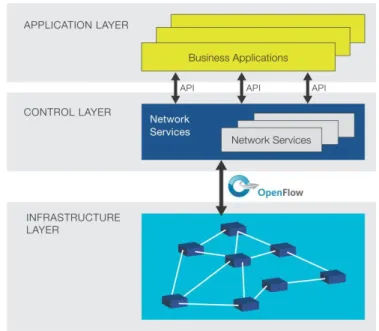
Software-Defined Networking (SDN) is a new networking paradigm which separates the control and data planes as shown in Fig. 2.2 [88]. The separation of control from the data plane enables to easily add new network functions based on the current network requirements. The term SDN was coined at Stanford University to represent the work on OpenFlow [80]. Since then, it has attracted a lot of attention from both academia and industry. Many novel ideas based-on SDN have been proposed [41, 66, 73, 82, 101]. In industry, SDN is considered as a technology which can reduce the operational cost and strengthen their network.
Due to the strong coupling between control and forwarding plane in traditional networks, it becomes difficult to develop and deploy new network applications, since it would require modifi-cation in the control plane of all network devices through some hardware upgrades. Therefore, new network features are provided in the network through the introduction of middleboxes such as Intrusion Detection Systems, firewalls, load balancer, etc. These middleboxes need to be placed statically at some key locations in the network which makes it difficult to dynamically reconfigure them at runtime depending on the requirements. The main reason, for researchers to have interests in SDN is mainly because it provides centralized controller where policies can be defined for changing network environment and these policies can be enforced in the data plane
Figure 2.2 – SDN Architecture
through southbound API.
The Software-Defined Networking architecture consists of three distinct layers as follows: • The application layer consists of the end-user business applications that consume the SDN
communications services. The control layer is accessed through the application layer by the northbound API.
• The control layer provides the functionality that supervises the network forwarding behavior through an open interface.
• The infrastructure layer consists of the network elements (NE) and devices that provide packet switching and forwarding.
According to this model, an SDN architecture is characterized by the following key attributes: • Logically centralized controller and Network-Wide Visibility: In SDN, all data plane
devices are connected to a centralized controller. The controller can send control messages to data plane devices. The controller can also send queries to data plane devices to get the statistics to infer the network status. With a centralized controller and the knowledge of global network status, decision making is facilitated, as opposed to legacy networks where nodes are unaware of the overall state of the network.
• Programmability: SDN networks are controlled by software, which may be provided by the vendors or network operators themselves. Data plane devices can be controlled by
2.2. Software Defined Networking Architecture
the applications deployed at the controller. It provides the approach to introduce new network functions. Several programming languages have been proposed to enable this feature [46, 114, 115].
• Abstraction: The business applications that use SDN services are abstracted from the underlying network technologies. Network devices are also abstracted from SDN control layer to ensure portability. Data plane has very simple logic to forward and drop the flow based on the installed rules. The simplified data plane provides the flexibility to add new features, like DevoFlow [32], NetFPGA [86], [6].
• Flow-based Management: Forwarding decisions in the switches are taken per flow. Rules in the switches are installed on per-flow basis. The basic characteristics of SDN is to forward the flow to the controller, when the network devices do not have the rules to handle these flows. This feature allows to deploy the rules as and when it is required. Moreover, it enables the network operator to handle the flow dynamically based on the varying conditions in the network [6].
• Dynamicity SDN provides flexibility to accommodate changes for more dynamicity. De-vices in the network can be reconfigured easily depending on the varying conditions in the network. It enables to deploy the applications for bandwidth on-demand services in the data centers and service provider network.
SDN Controller
The controller is the core component of the SDN network since all the intelligence is centralized at the controller which generates the network configuration based on the policies defined the network operator. It abstracts the low level implementation details of the data plane configuration. There are various SDN controllers proposed. In Table 2.1, we have clustered some features of different SDN controllers. Features include architecture, northbound API, programming language, and OpenFlow version they support. Architecture of the SDN controllers are either centralized or distributed. A centralized SDN controller is the single entity which manages and configures all the data plane devices in the network based on the policies defined by the administrator. It also becomes a single point of failure. Moreover, a centralized controller may not be a good choice to manage the large networks. Northbound API enables the developers to deploy the application above and abstract the low-level details of the devices. SDN controllers support different types of programming languages to write the applications. Moreover, SDN controllers have also been grouped based on the OpenFlow versions they support.
As we can see in Table 2.1, most of the controllers are centralized and multi-threaded. A centralized SDN controller is the single entity which manages and configures all the data plane devices in the network based on the policies defined by the administrator. Centralized multi-threaded controllers leverage the parallelism of multicore computer architecture. Centralized controllers such as RYU, NOX-MT, Trema, POX have been designed for data centers, and carrier
Table 2.1 – SDN Controllers
SDN Controller Architecture Northbound
API
Programming Language
OF Version
NOX Centralized Ad-hoc API C++ v1.0
NOX-MT Centralized
multi-threaded
Ad-hoc API C++ v1.0
OpenDaylight Distributed REST,
RESTCONF
Java v(1.0,1.3)
Floodlight Centralized
multi-threaded
REST API Java v1.1
POX Centralized Ad-hoc API Python v1.0
Trema Centralized
multi-threaded
Ad-hoc API C, Ruby v1.0
ONOS Distributed REST API Java v1.0
RYU Centralized
multi-threaded
REST API Python v(1.0,1.2,1.3,1.4,1.5)
grade networks. Distributed controllers such as ONOS, OpenDaylight can be scaled to manage the needs of small to large networks. The advantage of distributed controller is that it provides fault-tolerance. When one node fails, then another node can take the duties of the failed node. Currently, SDN controllers support a wide variety of northbound APIs such as REST APIs and ad-hoc APIs. As shown in Table 2.1, RYU, floodlight, OpenDaylight, and ONOS support the RESTful API for communication through northbound interface. However, NOX, POX, and Trema have their own ad-hoc APIs. Currently, only RYU SDN controller supports all the five OpenFlow versions.
Communication with SDN Controller:
The core modules of the SDN controller includes the Network Operating System (NOS) and the network device drivers. Switches, network applications like firewalls, Network Address Translator (NAT) are external applications to SDN controller. The SDN controller communicates with the external applications in the network with three different APIs.
1. Southbound API: This API enables the communication between the controller and Open-Flow switches. OpenOpen-Flow is a standard protocol used for communication between the controller and the switches. It is a vendor-independent protocol which provides flexibility to network operators to program the controller and data plane according to their requirements. 2. Northbound API: Network applications which want to communicate with the controller and underlying network infrastructure communicate through this API. For instance, firewall, Deep Packet Inspection (DPI) and other network applications deployed at the application
2.3. Genesis of Software Defined Networking
layer of the controller uses this API to communicate with the network devices through the SDN controller. Generally, these applications use a REST API for the communication with the controller.
3. East-West API: Generally, this API is used to communicate between distributed SDN controllers. For instance, in a network, if the control is distributed between two controllers, then it may require to pass information to another controller. It can also be the case that two controllers reside in different domains, and they share informations related to their domains with each other through east-west bound API. In other scenarios, different controllers in the network may perform different tasks allocated to them. For example, one controller may be allocated to perform network related tasks such as routing, load balancing. While an other controller is allocated to perform security related tasks.
There are different types of flow messages in SDN which uses the APIs described above for communication in SDN network.
1. Packet-in messages: The packet-in messages are used for communication between switches and controller. When a flow arrives at the switches for which it does not have a rule, then this flow is forwarded to the controller to decide the action to be enforced. Depending on the high-level policy controller enforce the rule in the switches to take the action on the flow.
2. Controller-to-Switch Messages These messages are initiated by the controller for asking the switch features or sending the rules in the switches for forwarding or dropping flows. 3. Flow Statistics: These messages are triggered by the controller to collect the flow statistics
from the OpenFlow switches.
The salient features of SDN technology enable us to enhance the security of the network. Next in Section 2.4.1, we present how SDN features can provide benefits to security mechanisms.
2.3
Genesis of Software Defined Networking
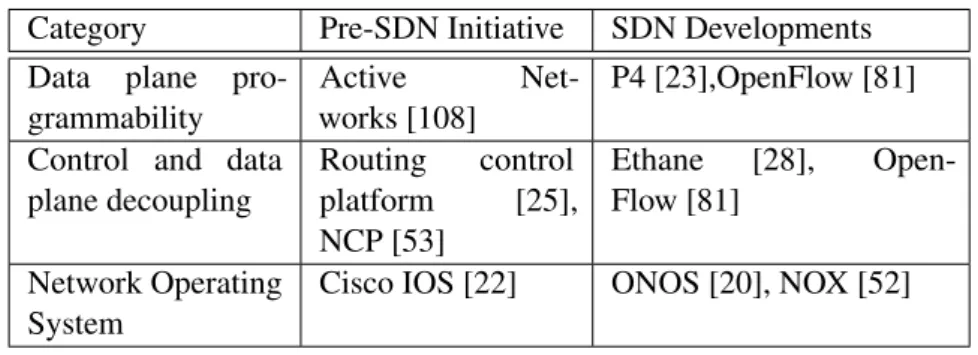
Though SDN is a recent concept, it builds on the history of ideas on networking. Specifically, it has been developed on the work of programmable networks such as active networks [108], programmable ATM networks [71] and on the idea of control and data plane separation such as routing control platform [25].
We summarize the historical perspective of pre-SDN related works in Table 2.2 into three different categories. Along with the categories, we specified in the second and third column of the table which mentions past initiatives and more recent SDN deployments.
Table 2.2 – History of programmable networks
Category Pre-SDN Initiative SDN Developments
Data plane
pro-grammability
Active
Net-works [108]
P4 [23],OpenFlow [81] Control and data
plane decoupling Routing control platform [25], NCP [53] Ethane [28], Open-Flow [81] Network Operating System
Cisco IOS [22] ONOS [20], NOX [52]
Active networks [108] is one of the early works on building networks on the concept of data plane programmability. It assumes that the switching devices can download the programs with specific instructions for processing of the packets. The second way proposed is to replace the packets with the tiny programs, which are encapsulated in transmission frames and processed at each node in the path.
P4 [23],OpenFlow [81] represent the recent approach of data plane programmability. Open-Flow [81] is one of the early works on the SDN deployment. It relies on configuring the forwarding devices to support flow tables which can be dynamically modified using central-ized controller. P4 [23] is a high level language for programming protocol independent packet processors.
The works on separating the data and control plane dates back to 1980s. NCP [53] is one of the early works done on decoupling the control and data plane. It was developed by AT&T to manage its telephone network. Similarly, routing control platform proposed to improve the management in BGP networks.
Recently, Ethane [28] and OpenFlow [81] proposed the decoupling of the control and data planes for Ethernet networks. These mechanisms do not require modifications on forwarding devices. It makes these solutions very attractive for the networking community.
Network operating system abstract the underlying hardware to the network administrator which makes it easier to manage the network resources as well as the deployment of network applications. The work on Network Operating System was restarted with the introduction of OpenFlow based NOSs such as NOX [52], ONOS [20]. CISCO IOS [22] has been the most widely used NOS since 1990s.
2.4. Improving Network Security with Software Defined Networking (SDN)
2.4
Improving Network Security with Software Defined
Network-ing (SDN)
2.4.1 SDN Enabled Security Mechanisms
We believe that SDN can significantly improve the security research and it can also be integrated with the existing security mechanisms. Decoupling of control and data plane allow to define the global network and security policy at the control plane which can be enforced in the data plane through programmability provided by the SDN. Moreover, global visibility of SDN makes it possible to effectively handle the traffic in the network. In the recent years, there have been some proposals for providing security using SDN technology. In this section, we discuss the SDN enabled security mechanisms.
Attack Detection mechanism in SDN
In [50], authors proposes an anomaly based detection and mitigation mechanism using OpenFlow and sFlow statistics collection mechanism. The framework uses entropy based anomaly detection technique over SDN and compare it with the OpenFlow and sFlow flow statistics collection mechanisms. Flow statistics collection with the native OF (OpenFlow) approach is performed when the SDN controller request for the flow statistics from the OpenFlow switches. In SDN, the controller is informed of the first packet for each flow. This first packet is matched to the network policy at the controller, and then the subsequent packets are collected from the switch and forwarded to the anomaly detection module running at the controller. The disadvantage of OF collection method is that there is no sampling involved in the collection process, so it collects the overall network traffic passing through the switch.
The framework also proposes a sFlow based statistics collection mechanism. In this method, sampling process is involved which enables to construct the flow definition and collects the flow statistics. This results in a significant reduction in the required number of flow entries. The proposed system compares the number of flow entries required for detection and CPU usage, with entropy based detection and Threshold random walk with credit based connection rate limiting(TRW-CB) algorithms. Results show that the average number of flows required under sFlow collection mechanism with entropy based method is 217 flows. However, with the OF based approach the required number of flows are 5184 flows. The same is the case with TRW-CB algorithm. Average number of flows required are 217 with sFlow mechanism;however, with the OF based approach the number of flows required are above 2000. The CPU usage under sFlow and TRW-CB algorithm is 32 percent. However, under OF based flow collection mechanism the CPU usages for entropy based and TRW-CB algorithm is 47 and 42 percent respectively. Therefore, authors shows that the sFlow traffic collection mechanism is better than the native OF (OpenFlow) traffic collection mechanism.
Organizing Maps (SOM) to detect the attacks. SOM is an unsupervised artificial neural network method. Authors used SOM method to classify the network traffic as normal or abnormal. In this technique, NOX controller periodically interacts with the switches and collects the traffic samples from the switches. It extracts the features of interest such as average of packet per flow, average of bytes per flow etc. from flow entries from all switches, and then the extracted features are forwarded to the classifier module for further processing. The classifier module analyzes whether traffic is DDoS flooding attack or legitimate traffic.
In [82, 83],multiple anomaly detection algorithms are used in the experimentation in order to validate their usability in small environments. Authors propose the idea that the anomaly detection algorithm can run at the border router of the home network. Four anomaly detection algorithms were implemented over the NOX SDN controller. These algorithms are Threshold Random Walk with Credit based Rate Limiting (TRW-CB), Rate Limiting, Maximum Entropy Detector, and NETAD. In the experimentation, they have used low network traffic rates ranging from 60 to 12, 000 packets per second as they have considered the home network. Results indicate that the algorithms perform well in the small enterprise network environment. However, when it was tested at the ISP level algorithms were unable to perform well. It also shows that the detection is far more accurate and efficient in the home network in comparison to the ISP network because of the high volume of traffic in the ISP network.
In NetFuse [118], a proxy device is deployed between the switches and the controller. The proxy monitors the network load, and instructs switches to reroute any overloading flows to NetFuse devices. This technique requires multiple SDN controllers in hierarchy. The proxy device is deployed in between the SDN controller and the data plane. It monitors the network and also communicates with the centralized controller. It uses passively collected data to monitor active flows in the network.
Industrial solutions have also been proposed to detect the attacks. Radware [103] has developed DefenseFlow a solution to detect the Distributed Denial of Service (DDoS) attacks. Radware’s anti-DDoS application instructs OpenFlow controller to program OpenFlow switches to behave as OpenFlow counters, which collects the flow statistics. It makes a baseline profile of the network traffic and then monitors for the anomalies related to DDoS attacks. If the attack is detected then, it notifies the controller to reroute the attack traffic to specialized devices deployed in the network to process the attack traffic. Radware has also developed an open source version defense4all of its commercial product DefenseFlow. It has been developed on the OpenDaylight controller. In [126] a two-stage rate based detection mechanism is used to detect the DDoS attacks. Threshold is defined by the network administrator, and once the traffic exceed the threshold then second stage detection is activated. For instance, authors in their experimentation set 3000 packets for every 5 seconds as a first stage detection. Once the traffic exceed this threshold then second stage threshold of 800 Packets Per Second (PPS) is activated. If the traffic continues at the 800 PPS for 5 times, then DDoS defender application starts dropping the traffic.
2.4. Improving Network Security with Software Defined Networking (SDN)
An anomaly-based detection and mitigation mechanism based on SDN is introduced in [49]. It uses a bidirectional count sketch algorithm to detect the attacks. Furthermore, it uses packet count on sFlow samples based on destination IP for attack detection. It identifies the destination IP addresses with high asymmetric communication pattern. It uses a threshold value to detect the asymmetry in communication. It removes the IP addresses which do not cross the threshold value. Once the controller identifies the malicious flows, it instructs the switch to drop the malicious flows. Legitimate traffic is still forwarded to victim as compared to Remote Triggered Black Hole (RTBH) in which victim becomes unreachable for benign traffic. The authors in the paper proposed a modular approach for data collection, anomaly detection and victim identification and attack mitigation. The proposed mechanism is deployed at the ingress point of the network so that once the malicious flow is identified, then it can be blocked at the entry point in the network which saves the network resources inside the network from collateral damage.
Table 2.3 shows the DDoS detection application deployed using SDN technology, their methodol-ogy, deployment location and the SDN controllers they have used for the application deployment. Detection methodology specifies the algorithm or mechanism used to detect the attack. Deploy-ment location provides the switch or router location from where data is collected to detect the attacks. For instance,mechanisms such as [50], [83], [118], and [49] are deployed at the border routers in the network. Mechanisms [24] and [103] collect information from all the switches in the network to detect the attacks. Moreover, in Table 2.3 columns containing controller tells the SDN controller used to deploy the mechanism. For example, detection mechanisms [50], [83], and [24] are implemented using NOX controller. POX controller is used to deploy Remote Triggered Black Hole [49] mechanism, while Radware’s solution [103] is deployed using OpenDaylight controller. NetFuse [118] has not given the controller used to deploy its mechanism.
Traffic Monitoring in SDN Environment
In the legacy network the traffic monitoring tool requires a separate hardware or special software configuration making it tedious and expensive task for deployment and management. Moreover, precise measurement of traffic matrix in the large IP network is difficult due to high number of switches and other networking components. However, traffic matrix estimation problem can be minimized in the SDN environment. By leveraging the global visibility of SDN controller and streamlined flow operations in the SDN switches which allows to query for flow statistics, OpenTM provides a traffic estimator mechanism. OpenTM [109], provides a traffic estimator mechanism for origin-destination (OD) pairs in the network. It keeps account of the active flows in the switches and gets the routing information from the OpenFlow controller’s routing application and periodically polls the switches for the packet count counters to get the statistics. By using the informations available to the SDN controller, OpenTM create different types of TM for sources and destinations. In this mechanism the flow statistics is collected from the ingress and egress switches in the network because they are close to the source and destination.
Table 2.3 – DDoS Detection Applications over SDN Detection
Applica-tion
Detection Method Deployment
Loca-tion
Controller Combining
OpenFlow and
sFlow [50]
Compares the OF flow statistics collection with sFlow based collection ap-proach on entropy based method
Egress port of the egress switch
NOX
Lightweight DDoS Detection [24]
Self-organizing map with traffic features is used to detect the attack
All OF switches in the network NOX Traffic Anomaly Detection using SDN [83] Threshold Random Walk,Rate limit-ing,Maximum entropy
detector and NETAD
algorithms were tested
Border routers of the home network is the deployment location
NOX
Remote
Trig-gered Black Hole (RTBH) [49]
Uses bidirectional count sketch algorithm to detect the attacks and asymmet-ric communication pattern to detect the attacks based on threshold
Detect DDoS at-tacks at the ingress point of the net-work
POX
NetFuse [118] Uses multi dimensional
flow aggregation to com-bine the flow for detection and safeguard the network from traffic overloading
Ingress switch Not given
Radware [103] Makes a baseline profile
of network traffic and then monitors the network for anomalies
Distributed
detec-tion probes
OpenDaylight
Authors in the paper pointed out that currently, ISP over-provision network resources to meet the QoS requirements of their customers. It polls edge switches at an adaptive rate which increases when flow rate differ between samples and decreases when flows stabilize. It minimizes the number of queries between switch and controller. It continuously monitors all the flows between pre defined link on throughput, packet loss, and delay. The monitoring of end-to-end QoS parameters helps traffic engineering mechanisms to compute the appropriate paths for routing the traffic.
The OpenSAFE [14] framework suggest to distribute the traffic to monitoring applications. It leverages the fact that every first packet of a flow needs to be forwarded to the controller. Then SDN controller forwards the new flows to the traffic monitoring applications which analyzes it
2.4. Improving Network Security with Software Defined Networking (SDN)
with IDS. However, OpenSAFE requires expensive hardware to perform the monitoring. OpenSketch [124] proposed an SDN-based monitoring mechanism. It separates the measurement data plane from the control plane. It provides a three stage pipeline (hashing, filtering, counting) which can be implemented with the switches and they can support different measurement tasks. The control plane of OpenSketch provides the measurement library which automatically configures the pipeline and assigned resources to varied measurement task. However, the new protocol proposed by OpenSketch somehow requires the upgrade in the network devices. Moreover, it also requires the standardization of the new protocol. Therefore, it makes ISP reluctant to deploy this mechanism.
The Passive Flow Monitoring (PaFloMon) [12] aims at providing the slice based monitoring in the OpenFlow networks. in this mechanism network is segmented into different slices. It is motivated by the OFELIA [2], which is the OpenFlow testbed in the Europe. PaFloMon aims to enrich the OFELIA framework with slice aware monitoring. The sFlow monitoring tool is integrated with the OFELIA. The aim of the OFELIA is to safeguard the experiments from the intrusive traffic that active measurements causes during experimentation.
Traffic monitoring applications are grouped in Table 2.4 according to the methodology, deploy-ment location and SDN controller used to deploy these applications. OpenTM [109] collects the flow statistics from the switches closer to destination; OpenNetMon [112] uses edge switches in the network to collect the flow statistics; while OpenSAFE [14] collects the flow statistics from middleboxes deployed in the network path to monitor the traffic. OpenTM [109] and OpenSAFE [14] use the NOX controller while OpenNetMon [112] uses POX controller to deploy the mechanism.
Traffic Engineering (TE) using SDN
In traditional networks, possible ways to perform traffic engineering is to manually modify the rules or pre-deploy the rules in network devices. It is a very intensive and daunting task for the network operators. Furthermore, in traditional network the traffic engineering mainly contains IP-based TE and MPLS-based TE. IP-based TE solves the problem of load balancing in multi path environment by optimizing the IP routing algorithm. But, IP-based routing has some drawbacks. For example, if OSPF link weights are used to control the routing of traffic, then it is difficult to split the traffic randomly. Additionally, if the link fails or topology changes then it takes time to converge. Likewise, MPLS-based TE causes performance overhead in the network. In summary, the tight-coupling between the control and forwarding planes, in addition to distributed network control, makes the traffic management a difficult task in traditional networks. The separation of control and data planes in SDN allows network operators to define a global network policy at the centralized controller which can be dynamically enforced. Moreover, the global visibility of SDN enables network operators to deploy the monitoring tool which can monitor and collect the network status information in the real time.
Table 2.4 – Traffic Monitoring Applications over SDN Traffic Monitoring
Applications
Methodology Deployment
loca-tion
Controller
OpenTM [109] provides the traffic estimation for
source and destination pair in a network
Switches closer to destination is used for querying the flow statistics
NOX
OpenNetMon [112] It provides monitoring to
deter-mine whether end-to-end QoS pa-rameters are achieved and for-ward the input to TE to compute the paths
Edge switches in
the network are
used to collect the statistics
POX
OpenSAFE [14] Forwards the first packet of flow
to the monitoring application to get the information about the flow
Middleboxes are de-ployed in the path to monitor the traf-fic
NOX
OpenSketch [124] Provides 3-stage pipeline
(hash-ing, filter(hash-ing, counting) and mea-surement library to configure re-sources for varied measurement tasks
No details given No details
given
PaFloMon [12] Provides a slice based
monitor-ing in the SDN network
No details given No details
given
Shu et.al [102] proposed a framework for traffic engineering in an SDN environment. The framework consists of two parts: (i) traffic measurement and (ii) traffic management. Traffic measurement mainly includes monitoring the network and collecting the network status in real time for managing the traffic. The network status information includes end-to-end network latency, topology connection status, bandwidth utilization, etc. Depending on these informations, the current network status is validated whether it is correct or not. Depending on the traffic measurement information, traffic in the network is scheduled to satisfy the user needs in terms of QoS.
Cao et.al [26] proposed mechanism for planing and online routing of traffic based on SDN. The SDN controller in the mechanism performs the policy lookup, flow steering, and route installation. The policy table at the controller determines the logical sequence of middleboxes the packets need to traverse. The Controller maps the logical sequence of middleboxes to the physical topology. Once the logical to physical path is mapped, then the SDN controller installs the rules in the flow table of the switches to forward the flow. The authors proposed an optimization algorithm to optimize the resources such as the middlebox capacity to handle the projected traffic. They also provided an optimization technique for online traffic steering. The aim of this algorithm is to determine the optimal allocation of resources for the flow upon arrival.
2.4. Improving Network Security with Software Defined Networking (SDN)
Agarwal et.al [3] proposed a traffic engineering technique in an SDN environment. It believes that the SDN can be helpful in better network resource utilization and it can improve the network performance metrics like packet loss and delay. The objective of this traffic engineering mechanism is to adaptively and dynamically manage the network traffic according to network operators requirement. It uses the Fully Polynomial Time Approximation Scheme (FPTAS) to compute the route at the centralized controller. It considers the partial deployment of SDN forwarding element (OpenFlow switches) to route the traffic in the network.
2.4.2 SDN based Security Architecture and Services
In this section, we discuss the security architecture and framework based on SDN to provide the mitigation, middlebox deployment and middlebox chaining to process the traffic through middleboxes in an SDN environment.
Attack Mitigation
In Drawbridge [73], the customers can subscribe to traffic engineering services provided by ISPs. It is based on the assumption that the customer’s controller can communicate with the ISP’s controller for the deployment of the mitigation rules. The objective of this proposal is to avoid the unwanted dropping of customers’ traffic by their ISP. Since, in case of congestion ISP may drop legitimate traffic traversing to the customer network. In the architecture, authors assumed that the end-hosts perform the detection and send the rules to the ISP controller for mitigation. ISP controller checks the validity of the rules and enforce the rules in its switches or send the rules to the upstream ISP for the enforcement. This framework, provides the flexibility for the customers to be adaptive in dealing with the traffic based on its dynamics. The customer can decide at runtime rules to be established at the controller. However, in this mechanism ISP needs to share its Policy Enforcement Points (PEP) with their customers.
The system presented by SENSS [125] provides an interface to request for attack traffic mitigation. Once the attack is detected by the victim network, then it sends a message to the ISP requesting the concerned traffic details and its route. The victim network can also requests the ISP to filter or modify routes for the traffic coming to its network. SENSS system enables the customer to ask the ISPs during no attack period, about the amount of traffic that it receives from their neighbors and route to the network which is sending heavy traffic towards it. During DDoS attacks, the customer compares the traffic distribution before the attack and during attack and identifies the upstream ISP that is sending a lot of traffic. It assumes that these ISPs may be sending attack traffic, then the customer network issues a filtering message to these ISPs to mitigate the attack traffic. The important features of SENSS are:(1) Victim oriented: The victim has the incentive to do the attack detection and mitigation. SENSS proposes a system to enable the victim to directly request for the security services from remote ISPs. Victim can request the ISP for mitigating the traffic which belongs to the victim’s address space; (2) It provides a simple interface for victims to request for the mitigation services from ISPs. Victim can request services like traffic
filtering, rerouting and quality of service guarantees; (3) Through the interface provided by the ISPs victims can request multiple ISPs to traceback the attack and then it can issue the commands for the ISPs to take the action to mitigate the attack. This framework requires multiple ISPs to collaborate with each others.
The Bohatei [41] leverages SDN and network function virtualization (NFV) capability to provide elastic DDoS defense. In this technique, authors leverages the NFV approach to instantiate the defense VM (Virtual Machine) at the required location in the network. Bohatei leverages the SDN paradigm to steer traffic towards instantiated VMs in the network. It provides an ISP centric deployment model, where an ISP offers DDoS-defense-as-a-service to its customers. The ISP can monetize these services. It assumes that the ISP uses some anomaly detection system to detect whether a customer is under DDoS attack. Then attack estimation is done for the suspicious traffic. The Resource manager in Bohatei uses the estimates to determine the type, number and location of VMs needed to be instantiated. The Resource manager tries to optimize the network resources using two algorithms: (1) Data center selection problem; (2) Server selection problem in the data center (SSP). DSP is a greedy algorithm to select the data center for steering of suspicious traffic. The algorithm provides two outputs. Firstly, it provides the what fraction of suspicious traffic should be forwarded to each data center. Secondly, it provides a physical graph corresponding to attack type defense to be deployed by the data center. SSP algorithm greedily tries to assign the servers with the higher capacities to process the suspicious traffic. Then, forwarding rule is set up to forward the traffic to defense VM. Evaluation showed that the Bohatei system is able to handle attacks of hundreds of Gbps. It also enables the response for DDoS traffic in less than 1 minutes. However, this framework requires the ISP to perform the detection on behalf of their customer which can cause processing overhead on the ISP. Since, ISPs have hundreds and thousands of customers to manage.
The DBA [74] proposes SDN-based DDoS blocking mechanism to mitigate botnet based attacks in the network. It uses the standard OpenFlow APIs to deploy the mechanism in the SDN environment. In this mechanism, authors propose to protect a server from botnets. Protected server inside the network establishes a secure communication channel with the DDoS Blocking Application (DBA). When an attack is detected by the server, it notifies the DBA about the attack. Then, the DBA provides a redirected address to server. The DBA maintains a pool of public IP addresses which can be used for redirection. Upon receiving the new IP address, the server notifies the legitimate clients to use the new address to access the service. The new address needs not to be physically replicated, but may be in the same subnet. Redirection address information provided to the clients require some computation cost to protect these services from bots. In their scheme, authors used CAPTCHA [4] to protect the services running at the server from bots. However, in this mechanism, bots are poorly programmed as it may not be the case in the practical scenario. Moreover, it has been assumed that the bots are not using IP spoofing. Additionally, in this technique of redirection, the server needs to cooperate with the DBA for redirection.