Science Arts & Métiers (SAM)
is an open access repository that collects the work of Arts et Métiers Institute of
Technology researchers and makes it freely available over the web where possible.
This is an author-deposited version published in: https://sam.ensam.eu
Handle ID: .http://hdl.handle.net/10985/15135
To cite this version :
Julien DEPARDAY, Patrick BOT, Frédéric HAUVILLE, Benoit AUGIER, Marc RABAUD, Dario MOTTA, David LE PELLEY - Modal Analysis of Pressures on a Full-Scale Spinnaker - In: The 22th CHESAPEAKE SAILING YACHT SYMPOSIUM, Etats-Unis, 2016-04 - The 22th
THE 22nd CHESAPEAKE SAILING YACHT SYMPOSIUM
ANNAPOLIS, MARYLAND, MARCH 2016
Modal Analysis of Pressures on a Full-Scale Spinnaker
Julien Deparday
1, Naval Academy Research Institute, Brest, France
Patrick Bot, Naval Academy Research Institute, Brest, France
Fréderic Hauville, Naval Academy Research Institute, Brest, France
Benoit Augier, Naval Academy Research Institute, Brest, France
Marc Rabaud, Laboratoire FAST, Univ.Paris-Sud, CNRS, Université Paris-Saclay, F-91405, Orsay,
France
Dario Motta, University of Auckland, New-Zealand
David Le Pelley, University of Auckland, New-Zealand
ABSTRACT
While sailing offwind, the trimmer typically adjusts the downwind sail "on the verge of luffing", letting occasion-ally the luff of the sail flapping. Due to the unsteadiness of the spinnaker itself, maintaining the luff on the verge of luffing needs continual adjustments. The propulsive force generated by the offwind sail depends on this trimming and is highly fluctuating. During a flapping sequence, the aero-dynamic load can fluctuate by 50% of the average load. On a J/80 class yacht, we simultaneously measured time-resolved pressures on the spinnaker, aerodynamic loads, boat and wind data. Significant spatio-temporal patterns are detected in the pressure distribution. In this paper we present averages and main fluctuations of pressure distribu-tions and of load coefficients for different apparent wind an-gles as well as a refined analysis of pressure fluctuations, us-ing the Proper Orthogonal Decomposition (POD) method. POD shows that pressure fluctuations due to luffing of the spinnaker can be well represented by only one proper mode related to a unique spatial pressure pattern and a dynamic behavior evolving with the Apparent Wind Angles. The time evolution of this proper mode is highly correlated with load fluctuations.
Moreover, POD can be employed to filter the measured pres-sures more efficiently than basic filters. The reconstruction using the first few modes allows to restrict to the most en-ergetic part of the signal and remove insignificant variations and noises. This might be helpful for comparison with other measurements and numerical simulations.
NOTATION
AWA Apparent Wind Angle AWS Apparent Wind Speed IQR Inter Quartile Range (Q3-Q1) Q1 First Quartile
Q3 Third Quartile
POD Proper Orthogonal Decomposition CF Load Coefficient (1 Load
2ρS(AWS)2)
∆CP Differential pressure coefficient (Pleeward1 −Pwindward 2ρ(AWS)2
) ρ Density of air (1.25 kg/m3)
S Sail Area of the asymmetrical Spinnaker (65 m2)
INTRODUCTION
In research and development in sail aerodynamics, full-scale testing, wind tunnel testing and numerical simulation have always been complementary. Numerical simulation allows to efficiently investigate different designs without the cost of creating sails (Chapin et al., 2011, Durand et al., 2014, Ranzenbach et al., 2013, Viola et al., 2015). Nowadays, advanced computational resources have enhanced numeri-cal simulation and have allowed to couple fluid and struc-tural solvers to create Fluid-Structure Interaction simula-tions (Chapin et al., 2011, Durand et al., 2014, Ranzenbach et al., 2013, Augier et al., 2014, Lombardi et al., 2012, Ren-zsch and Graf, 2010, Trimarchi et al., 2013). However wind tunnel testing and full-scale testing are required for compar-ison and validation (Hansen et al., 2002, Renzsch and Graf, 2013, Viola and Flay, 2011). Wind tunnel testing has the advantage to be in a controlled environment where a bal-ance can be used to measure the forces created by the sails on the boat frame (Campbell, 2014a, Flay, 1996, Graf and Müller, 2009, Zasso et al., 2005). Those results can easily be used to create a Velocity Prediction Program (Campbell, 2014b, Le Pelley and Richards, 2011). Nevertheless with wind tunnel testing, some rules of similitude are violated as the Reynolds number, or the ratio of fabric weight to wind
pressure or the ratio of membrane stress to wind pressure. Full-Scale testing does not have those issues, and permits to determine yacht performance in real sailing conditions. Those experiments need complex set-up in a harsh envi-ronment but actual aerodynamic loads can be assessed in a variety of ways. Sail boat dynamometers (Herman, 1989, Hochkirch and Brandt, 1999, Masuyama, 2014) measured forces from upwind sails transmitted to the boat frame. Fos-sati et al. (2015) created a sail boat dynamometer with the possibility of measuring aerodynamic forces of downwind sails. Augier et al. (2012) carried out experiments where loads on the rigging lines and sails were measured. They contributed to a better comprehension on interaction be-tween the wind, the rigging and the sails. Le Pelley et al. (2015) measured the forces and the directions on the three corners of spinnakers. Le Pelley et al. (2012), Lozej et al. (2012), Motta et al. (2014), Viola and Flay (2010) measured pressures on sails for upwind and downwind sails.
However downwind sails are more complex to study than upwind sails mainly due to their non-developable 3D shape with highly cambered sections and massively detached flow around a thin and very flexible membrane. Due to the dynamic behavior of this unsteady fluid-structure interac-tion, the pressures on the sail vary quickly. Even in sta-ble conditions, offwind sails have an inherent unsteadi-ness. One key feature of spinnaker unsteadiness comes from the flapping at the leading edge, also called luffing. We have previously investigated pressure evolution during luff-ing (Deparday et al., 2014, Motta et al., 2015). In Depar-day et al. (2014), we showed an example where flapping of spinnaker creates pressure peaks at the leading edge in-creasing the aerodynamic force dynamically by 50%. Due to the non-stationarity of the environment while sailing, spatio-temporal pressure data are complex to analyze and therefore to simulate. However significant and different spatio-temporal patterns can be spotted (Motta et al., 2015) and might be produced by different physical causes (Fluid-Structure Interaction, wind variations, boat motions, etc.). In this paper we present an approach to decompose complex pressure evolutions into simpler modes. It would then allow easier analysis and comparison with simulations.
This paper presents results of full-scale experiments of an instrumented J/80 class yacht in offwind conditions were loads, pressures on the spinnaker, boat and wind data were measured. After presenting the experimental apparatus, av-erage and fluctuations of pressures and loads are presented. The next section is the use of the Proper Orthogonal De-composition (POD) method on pressures to create a simpler model of the complex variations of pressure distribution in time. We show then that the method also helps to highlight the correlation between the main evolution of pressures and the variations of loads.
EXPERIMENTAL SETUP
An instrumented J/80 class sailing yacht, an 8 meter one-design cruiser racer was used during those experiments. A tri-radial asymmetrical spinnaker with a surface of about 65 m2with a 12 meter long rounded luff was hoisted as well
as a mainsail of 17 m2. Boat and wind data, loads on the
standing rigging and on the sails were recorded. Moreover pressure taps, developed by the Yacht Research Unit from the University of Auckland were stuck on the spinnaker to acquire the dynamic pressure distribution. They were syn-chronized with the other data thanks to an acquisition soft-ware, RTMaps developed by Intempora which received ev-ery signal at their own rate and timestamped them “on the flow”. A resampling was applied during the post process-ing to obtain synchronous data for easier analysis. Figure 1 shows the arrangement of all the sensors set onboard. This setup for downwind navigation is a further develop-ment of the experidevelop-mental system described in Augier et al. (2012) which was used for measurements in upwind navi-gation.
z x paddlewheel speed log motion sensor Load sensors 3D anemometer GPS Compass Pressure sensors
Figure 1: General arrangement of the experimental set-up on the J/80. 16 load sensors (green discs), 44 pressure taps (red circles), and wind and boat sensors (blue squares).
Loads
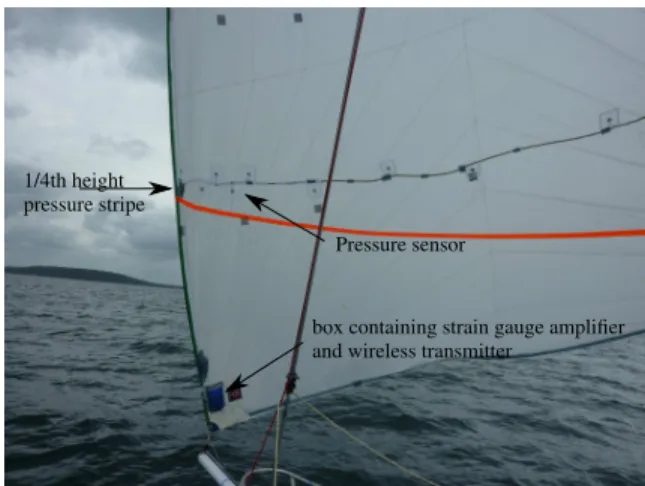
The standing rigging (shrouds, forestay and backstay) is fit-ted with custom-made turnbuckles and shackles equipped with strain gages. The running rigging (the corners of the mainsail and of the spinnaker -head, tack and clew-) is equipped with instrumented shackles too. For the stand-ing riggstand-ing and the mainsail the sensors are connected to a load acquisition system Spider8 from HBM. Voltages are received from all strain gages and amplified. They are then converted in digital data at a rate of 25 Hz. Thereafter they are transferred to the real-time acquisition software, RTMaps. Due to the high displacements of the spinnaker -in the order of magnitude of 1 to 5 meters for the spinnaker used in those experiments-, the instrumented shackles on the three corners of the spinnaker communicate wirelessly to the acquisition system. The clew sensor is connected via a wire running along the foot of the sail to a small box located near the tack point of the spinnaker (see Figure 2). This box con-tains two strain gage amplifiers, one for the tack sensor and one for the clew. A microcontroller receives and transmits data at a sampling frequency of 25 Hz to the receiver inside the boat via a wireless and low consumption ZigBee net-work. Another box is located at the head position for the head instrumented shackle. The delay between the emission and reception of data is insignificant compared to dynamics in sailing.
The errors of measurement are less than 2% of the mea-surement range (10 000 N for the shrouds, forestay and for the mainsail sheet, 5000 N for the backstay and other instru-mented shackles on the mainsail and spinnaker).
Pressure sensor 1/4th height
pressure stripe
box containing strain gauge amplifier and wireless transmitter
Figure 2: Photograph of the tack of the spinnaker used.
Pressures on spinnaker
On the spinnaker, 44 low range differential pressure sensors (Honeywell XSCL04DC) are located on the surface along 4 horizontal stripes: at 1/4, 1/2, 3/4 and 7/8th height of the spinnaker (see Figures 1 and 2). 12 transducers are used on each of the first 3 stripes and 8 for the top one. There is a
higher concentration of pressure taps near the leading edge to be able to record potential leading edge suction peaks. Those sensors measure a difference of pressure between the suction side and the pressure side using the piezoresistive ef-fect. There is no need for a measure of a reference pressure, a complicated task in full-scale experiments. Those sen-sors are stuck on one side -at the pressure side when sailing on portside tack- and are positioned facing 2mm-diameter holes on the sail to measure the pressure jump across the sail without significant air leak. Punctured light sail cloth patches are applied on the pressure taps to profile the sen-sors. This custom built pressure system was designed by the Yacht Research Unit at the University of Auckland. These pressure transducers are connected by wires to the receiver inside the boat and thus are synchronized with the other data.
The pressure sensors have a sampling frequency of approxi-matively 10 Hz with a maximum range of ±1 kPa and a res-olution of 0.5 Pa. The pressure acquisition system is more described in Motta et al. (2014).
Procedure
Sea trials were performed in the bay of Brest, France, off-shore Ecole Navale. During those experiments the weather conditions were stable:
• average true wind speed: 6 m/s (12 kn) • gust: 8 m/s (16 kn)
• wind direction: 270◦(westerly wind). Stable. Flat
wa-ter.
Even in conditions considered as "stable" (with no gust, no wind shift, on flat water and fixed trimming), offwind sails have an inherent unsteadiness, like luffing (flapping at the leading edge). To keep “stable” conditions, a standard pro-cedure must be followed. During those experiments, the controlled inputs were the apparent wind angle and the trim of the spinnaker. Trimmer and helmsman were kept the same for the whole test. The trimmer adjusted the spinnaker at the optimum trim (i.e. on the verge of luffing at the lead-ing edge). The helmsman kept the apparent wind angle as constant as possible.
During the post-processing routine, periods of 5 seconds minimum were labelled “stable” when the standard devia-tion of the apparent wind angle (AWA) was below 4◦ and
the standard deviation of the apparent wind speed (AWS) was below 10% of the average. Those periods were ex-tended in time as long as those criteria were met. A large range of AWA (between 55◦and 140◦) is swept by the
“sta-ble” periods found, with a certain redundancy for most of the AWA. Each stable period is processed individually.
AVERAGES AND FLUCTUATIONS Pressures
The average pressure distribution and loads are compared according to the apparent wind angle. A large range of ap-parent wind angles (AWA) has been met in a rather constant true wind speed (TWS) between 5.8 m/s and 7.1 m/s thus be-tween 11.2 kn to 13.8 kn. The apparent wind angle is mea-sured at the mast head. One should be aware this measure is affected by the twist of the wind, the upwash effect from the sails and the heel.
To display the pressure distribution on the whole sail from discrete measurement points, a linear Radial Basis Function interpolation has been used. On following figures where the pressure distribution is displayed on the spinnaker, blue crosses show where the pressure measurement sensors were located on the sail. Thus pressures at those blue crosses are actual measured values, when the pressure distribution is interpolated between the stripes and pressure taps. With no information on the sail boundaries, values at the top (above 7/8th) and at the bottom (below 1/4th) are extrap-olated. The shapes used to display the pressure distribu-tions come from other experiments with the same spinnaker where photogrammetric measurements were carried out to acquire the flying shapes.
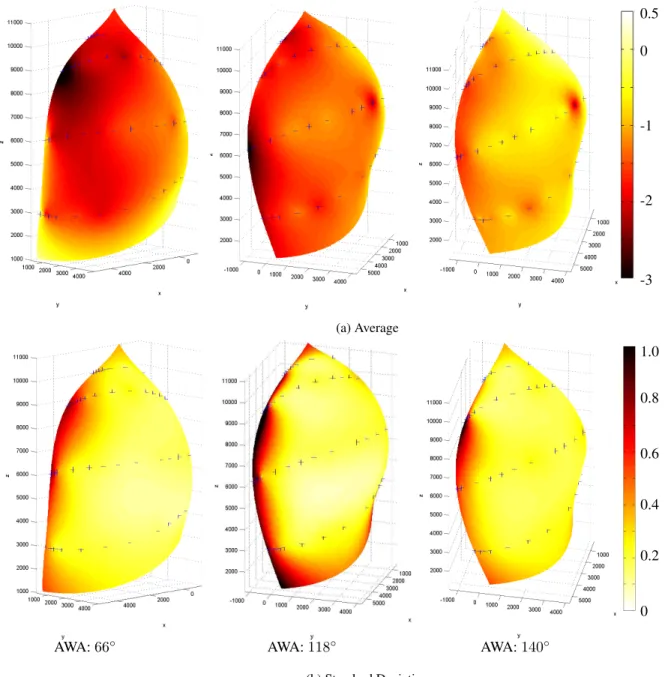
Time-Averaged pressure distributions for similar apparent wind angles have good repeatability. Moreover the pres-sure distribution evolves clearly with the AWA. Figure 3a presents 3 characteristic pressure spatial distributions at 66◦,
118◦and 140◦. It shows the coefficient of the difference of
pressure as commonly defined in aerodynamics: ∆CP =
Pleeward− Pwindward 1
2ρ(AWS)2
.
At tight angles as AWA 66◦, a bulb of high suction is
found at the leading edge in the top half of the spinnaker (∆CP ≈ −3) which produces high aerodynamic force.
∆CPon the rest of the sail is around -2 increasing to -1/-0.5
at the trailing edge.
At AWA around 110◦-120◦, the area where the peak of
suction occurs is smaller around half of the spinnaker height and the absolute value lower. On the rest of the spinnaker, the pressure coefficient on the spinnaker is rather constant around -1.2 and increasing to -0.5 at the trailing edge. At AWA 140◦, the decrease of suction is even more visible
on the whole sail with almost no suction peak at the leading edge and with a reduction of |∆CP| along the flow up
to a positive ∆CP at the trailing edge even on the actual
measured points. Positive pressure coefficient means a collapse of the sail at the trailing edge and thus an unstable flying shape. It is consistent with what the authors have noticed during experiments: at large AWA, the spinnaker starts collapsing first at the leech and not at the luff. While the AWA is increased, not only is a clear decrease of absolute differential pressure coefficient (from -3 down
to 0 about), but also the AWS decreases (from 7 m/s to 3.5 m/s about). So the absolute values of ∆P decrease even more dramatically: At tight AWA, around 65◦, the order
of magnitude of differential pressure is −40 Pa, and only −4 Pa at large AWA –around 140◦-.
Figure 3b shows the standard deviation for the corre-sponding AWA. Standard deviation on the whole sail is in-terpolated from the standard deviations calculated on the pressure taps only. Higher standard deviations mean big-ger variations of pressure during a “stable” period. Despite a clear difference for the pressure distribution on the whole spinnaker depending on the AWA, pressure variations dur-ing the “stable” periods have similar spatial patterns. Strong variations are found at the leading edge, around 1, on the whole height for 66◦ and 118◦ while the rest of the
spin-naker has a standard deviation of about 0.2. However, while the order of magnitude of standard deviation of ∆CP is
similar for every AWA, the relative variation of pressures compared with the average pressure coefficient varies. Vari-ations are more significant for large AWA (around 120◦
-140◦) than for tight AWA. For tight AWA, the standard
de-viation is around 30 Pa thus 75% of the average pressure. For large AWA, the standard deviation is around 8 Pa thus 2 times bigger than the average pressure.
Loads
Figure 4 displays the load coefficients on the three corners of the spinnaker according to the apparent wind angle:
CF =
Load
1
2ρ S(AWS)2
with S the sail area of the spinnaker.
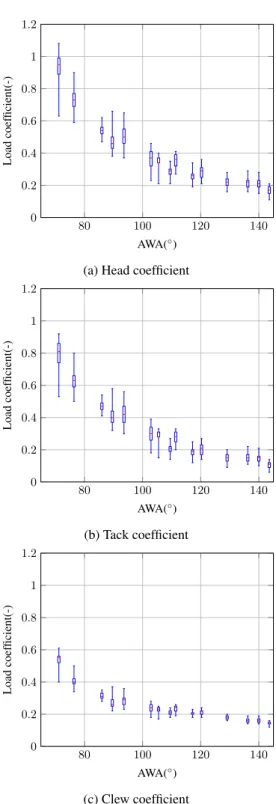
In Figure 4, only “stable” periods of 10 seconds minimum are taken. Even though the periods chosen are “stable”, loads can vary significantly. Therefore each period for a specific average apparent wind angle is displayed as a box plot. The central red mark is the median, and the edges of the box are the lower and upper quartile. The lower quartile (Q1) splits off the lowest 25% of data from the highest 75%. The upper quartile (Q3) splits off the highest 25% of loads from the lowest 75%. The box represents the interquartile range (IQR = Q3 –Q1). It contains 50% of the loads recorded during one “stable” period. The whiskers show the maximum and minimum loads recorded.
Figure 4 shows also the general trend of the load coeffi-cients on the three corners according to the apparent wind angle. Head and tack have similar evolution with a decrease especially between 110◦and 140◦respectively from 0.8 to
0.5 and from 0.7 to 0.3. Whereas clew load coefficient is approximatively constant around 0.4.
As explained previously, when the AWA is increased, the AWS decreases. While at clew point, the absolute loads mostly decrease only due to the decrease of the AWS, at
-3 0.5 0 -1 -2 (a) Average 0.2 1.0 0.8 0.6 0.4 0
AWA: 66◦ AWA: 118◦ AWA: 140◦
(b) Standard Deviation
Figure 3: Pressure distributions, time average pressure coefficient ∆CP (a) and the fluctuations (b) for 3 typical AWA (66◦,
118◦, 140◦). Blue crosses show the positions of the pressure taps.
tack and head points the absolute loads decrease even more significantly. To confirm this, Figure 5 displays the evolu-tion of load coefficient using the True Wind Speed (TWS) for the non-dimensional coefficient:
CF =
Load
1
2ρ S(TWS)2
for Figure 5 only. with the TWS formula from Fossati (2009):
T W S = q
(AWS cos(AWA) − BS)2+ (AWS sin(AWA)cos(heel))2
TWS is rather constant for every AWA (around 12 kn). A higher decrease is noticed when the AWA is increased for the head and tack loads than for the clew load which varies only a little.
To analyze variations of load coefficients from an aerodynamic point of view the AWS is used for the non dimensional coefficient CF. Q3 can be seen as an arbitrary
separation between the small variations of loads around the median (inside the IQR) and the peaks of loads (in the top quarter). In Figure 4, the IQR has the same relative range for every AWA, between –10% and +10% of the median for the most loaded corners (head and tack) and between
80 100 120 140 0.2 0.4 0.6 0.8 1 AWA(◦) Load coef ficient(-)
(a) Head coefficient
80 100 120 140 0.2 0.4 0.6 0.8 1 AWA(◦) Load coef ficient(-) (b) Tack coefficient 80 100 120 140 0.2 0.4 0.6 0.8 1 AWA(◦) Load coef ficient(-) (c) Clew coefficient
Figure 4: Boxplot for load coefficients CF at the three
cor-ners of the spinnaker for different AWA. Central red mark is the median, the box represent the interquartile range be-tween the lower and upper quartiles. It contains 50% of the loads. The upper and lower whiskers indicate the minimum and maximum values.
-5% and +5% for the clew. Since the IQR is relatively constant and small, one can conclude that for every AWA,
80 100 120 140 0 0.2 0.4 0.6 0.8 1 1.2 AWA(◦) Load coef ficient(-)
(a) Head coefficient
80 100 120 140 0 0.2 0.4 0.6 0.8 1 1.2 AWA(◦) Load coef ficient(-) (b) Tack coefficient 80 100 120 140 0 0.2 0.4 0.6 0.8 1 1.2 AWA(◦) Load coef ficient(-) (c) Clew coefficient
Figure 5: Boxplot for load coefficients CFwith the TWS as
reference at the three corners of the spinnaker for different AWA. Central red mark is the median, the box represent the interquartile range between the lower and upper quartiles. It contains 50% of the loads. The upper and lower whiskers indicate the minimum and maximum values.
without taking into account peaks of loads, the averaged load coefficient is rather stable and varies slightly.
For the most loaded corners (head and tack) the upper whisker (maximum load) is about 20% higher than the median for tight angles (AWA < 100◦) and 30% for large
angles (AWA > 120◦). For the clew point the upper
whisker is always about 15% higher than the median for all AWA. Relative variations of loads seem fairly constant for every AWA, and slightly bigger for large AWA at the head and tack points.
It is interesting to note that most variations of loads are present at the head and tack points, the closest points of the leading edge where the highest variations of pressure occur. While at clew point, the relative variation of loads is smaller. Those variations of loads and pressures are unsteady even during “stable” periods. However specific patterns might be spotted and might be linked to different causes. The yacht motion and its influence on the apparent wind (pitching and rolling of the boat), gusts (pure aerodynamic cause), vortex shedding, or a change of the spinnaker shape as luffing (un-steady fluid-structure interaction) could make the spinnaker forces vary.
Therefore, we would like to extract patterns in order to de-compose complex pressure evolutions into simpler modes. Those pressure modes could help to describe a temporal global behavior in a better way than analyzing each pressure sensor signal, and could be correlated with other recorded data. We decided to use the Proper Orthogonal Decompo-sition method to characterize the spatial pattern of pressure variations.
DECOMPOSITION INTO MODES Proper Orthogonal Decomposition method
The Proper Orthogonal Decomposition (POD), is based on the Karhunen-Loeve expansion and also called Principal Component Analysis, PCA. It was first introduced in the context of Fluid Mechanics by (Lumley, 1967). The input data (in our case ∆CP(x, t) ) can be expanded into
orthog-onal basis functions φi(x) with time coefficient an(t):
U (x, t) =X
n
an(t) · φn(x).
As proper modes are derived from the data itself (data driven decomposition), there is no need of a-priori knowl-edge or education scheme. Moreover, each basis function has its own amount of fluctuation energy different from each other. These functions are statistically optimal in the least mean-square sense. As a result, fluctuation energy drops down quickly which means a low number of modes is needed in the expansion to reproduce the main variations of the field. POD is a powerful tool for generating lower dimensional models of dynamical systems. Most of the time, POD is used on the fluctuations of
the input data only. After subtracting the average compo-nent (seen as the zeroth mode) from the data, a matrix U is created as a set of N observations (commonly called snap-shots) of M records. Each column contains all fluctuating input data (M values) from a specific snapshot and each row contains all snapshots (N snapshots) from a specific measurement point. U= u11 u12 · · · u1N u21 u22 · · · u2N .. . . .. ... ... uM1 uM2 · · · uM N
Then the auto covariance matrix C (MxM) is calculated as: C= U ∗ UT
because M >> N. We have M= 44 measurement points and N ≈ 20000. However in fluid mechanics, it is com-mon to have N >> M when using PIV or CFD results for example. For those cases the so-called “Snapshot POD” introduced first by (Sirovich, 1987) is used. For our ex-periments, the “Direct POD” has been applied. The corre-sponding eigenvalue problem of the auto covariance matrix is solved:
C∗ Φ = λ ∗ Φ
The eigenvectors Φ(i) are the POD modes. POD modes are sorted in descending order according to their correspond-ing eigenvalue λ(i) which represent their energy. The POD mode with the highest corresponding eigenvalue is mode 1. The expansion coefficient (or mode time coefficient) is cal-culated as follows:
a= UT ∗ Φ POD results
Following results presented here are for a “stable” period with an average AWA of 69◦, but is representative to what
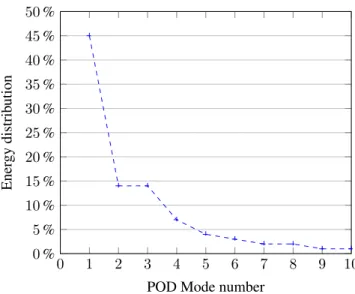
we have observed for different periods at different AWA. This point will be discussed further in the article. Figure 6 shows the energy distribution for each POD mode. The first mode contains almost 45% of the fluctuation energy. Mode 2 and 3 represent only 15% each. And most of the time other modes have less than 5% of the fluctuation energy. It is clear that the first mode is dominant compared to the others.
The pressure distribution evolution can be simplified by taking only the first terms of the expansion. The reconstruc-tion using the first modes allows to only keeping the most energetic part of the signal and removing insignificant vari-ations and noises. The precision of the reconstruction has been calculated according to the number of modes. With mode 0 (the average) and mode 1, 85% of the signal is al-ready reconstructed. With 3 modes, the error of reconstruc-tion of the pressure signals is 10%. About 10 modes are
0 1 2 3 4 5 6 7 8 9 10 0 % 5 % 10 % 15 % 20 % 25 % 30 % 35 % 40 % 45 % 50 %
POD Mode number
Ener
gy
distrib
ution
Figure 6: Energy distribution of the fluctuations for the first 10 modes for AWA 69◦.
required to achieve a reconstruction with less than 5% of difference.
Figure 7 presents the first 3 modes. The scale value is ar-bitrary. To represent a fluctuation of Cp, they must be multi-plied by the corresponding mode time coefficient depending on the time - which can be positive or negative - (presented in Figure 9). Mode 1 has a bulb of pressure on the top half of the spinnaker at the leading edge and a smaller bulb of oppo-site sign on the bottom half height of the spinnaker. Mode 2 is similar with the standard deviation pattern presented be-fore. Mode 3 and further modes display smaller coherent patterns and may change with the period used.
Table 1: Energy distribution of the fluctuations for the first 10 modes for different AWA.
Modes 66 deg 98 deg 120 deg 140 deg
1 43% 46% 45% 45% 2 21% 16% 19% 15% 3 8% 9% 10% 11% 4 7% 6% 6% 7% 5 4% 5% 3% 5% 6 3% 4% 3% 3% 7 2% 3% 2% 2% 8 2% 2% 2% 2% 9 2% 2% 2% 2% 10 1% 1% 1% 1%
Table 1 shows the energy distribution for different “stable” periods at different AWA. The ratio of energy of each mode number is rather constant for every AWA. Moreover each mode number has a similar pattern of pressure distribution, even though it happens that mode 2 and mode 3 are inverted in a few cases.
To compare modes, the maximum value of time
coef--0.25 -0.1 0 0.1 0.25 (a) Mode 1 -0.25 -0.1 0 0.1 0.25 (b) Mode 2 -0.25 -0.1 0 0.1 0.25 (c) Mode 3
Figure 7: First 3 spatial orthogonal modes from POD method for AWA 69◦. Mode 1 is the most energetic mode.
ficient is taken to be multiplied by the spatial mode: max(a1(t)) · φ1(x). Maximum value of time coefficient is
used since we want to analyze and compare dominant varia-tions. Moreover, by mathematical definition: ∀n, an(t) = 0
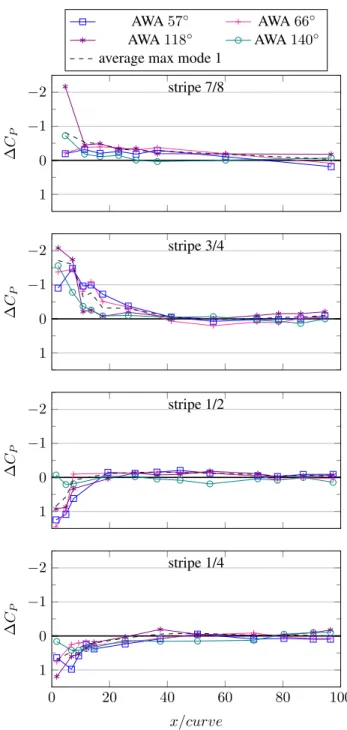
and thus is irrelevant to be used for comparison. Maximum values of mode 1 for different AWA are presented in Figure 8 at 4 different stripes where the pressures are measured (1/4, 1/2, 3/4, 7/8th height of the spinnaker). Differential pressure coefficients have comparable shapes for every AWA, except that |∆CP| on the bottom half is
slightly smaller for deeper AWA. The bulb of suction at the leading edge at 7/8 and 3/4 of the spinnaker height is always present and a smaller bulb of positive ∆CP at 1/2
and 1/4 height is also spotted. Even if the POD method is a data driven decomposition (i.e. modes are derived from the data itself), there is a good repeatability of POD modes for “stable” periods when the spinnaker has a fixed trim. Moreover mode 1, which plays an important role in the fluctuation of pressures, could be defined as a unique mode whatever the AWA.
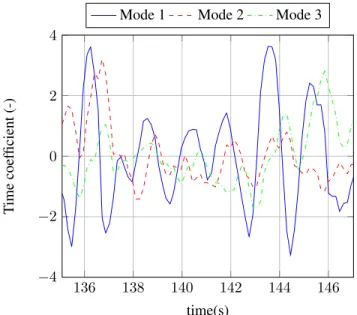
POD modes evolve in time. When the time coefficient of a corresponding mode is at an extremum, the corre-sponding mode is then preponderant. Analyzing time co-efficients would then help to link pressure variations with other recorded data.
Figure 9 shows the evolution of the time coefficient for the first 3 modes. Amplitudes of mode 1 are bigger than the other modes as expected due to the larger energy it pos-sesses. Mode 1 and mode 2 are slightly correlated; mode 2 is shifted of a quarter of a pseudo-period. It means when mode 1 is maximal, mode 2 is null. A typical pseudo pe-riod for mode 1 stands out for this AWA 69◦. Furthermore,
for different “stable” periods, at different AWA -not dis-played here-, similar variations of the temporal coefficient of mode 1 are detected. However the dynamics change with the AWA. The pseudo-period is measured, and the sponding frequency is displayed in Table 2 with the corre-sponding average AWS of the “stable” period. The reduced frequency is calculated as follows:
fr=
fs·
√ S AW S with S the sail area, thus√S = 8.3 m.
When the AWA is increased, the typical pseudo frequency of the time coefficient of mode 1 is reduced by a factor of 2.5. The AWS decreases at a similar rate. A ratio of 2.1 is found between AWA 57◦ and 140◦. Therefore the
reduced frequency is nearly constant with a small decrease. Figure 10 displays the pseudo-frequency of the time coeffi-cient of mode 1 as a function of the AWS. There is a linear dependence of the pseudo-frequencies with the AWS. It demonstrates that mode 1 is mostly driven by aerodynamic phenomena as expected, and not by mechanical resonance of the rigging or of the membrane of the sail.
−2 −1 0 1 ∆ CP stripe 7/8 AWA 57◦ AWA 66◦ AWA 118◦ AWA 140◦
average max mode 1
−2 −1 0 1 ∆ CP stripe 3/4 −2 −1 0 1 ∆ CP stripe 1/2 0 20 40 60 80 100 −2 −1 0 1 x/curve ∆ CP stripe 1/4
Figure 8: Mode 1 for maximum time coefficient max(a1(t)·
136 138 140 142 144 146 −4 −2 0 2 4 time(s) T ime coef ficient (-)
Mode 1 Mode 2 Mode 3
Figure 9: Time coefficient an(t) for the first three modes for
AWA 69◦.
In conclusion, the spatial pattern of mode 1 does not change with the AWA, but only the temporal dynamics with an increase of the pseudo-period when the AWA increases. Table 2: Pseudo-frequency and reduced frequency for dif-ferent AWA. AWA(◦) f s(Hz) AWS(m/s) fr(-) 57 1.5 7.0 1.78 66 1.3 6.4 1.69 69 1.3 6.2 1.73 98 1 5.4 1.53 118 0.7 3.7 1.57 140 0.6 3.3 1.52
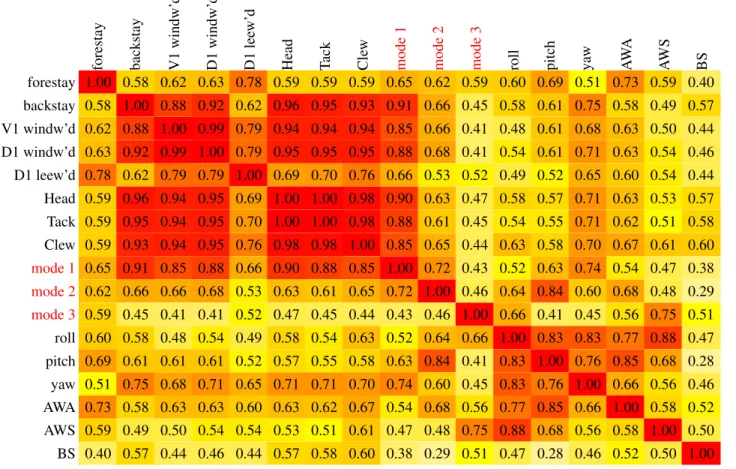
Table 3 presents the cross-correlation of all data measured for the specific period presented in (Deparday et al., 2014) where loads and flapping were strongly correlated. The nor-malized cross-correlation is calculated with the time coef-ficients of the first three modes. Cross correlation between two signals X and Y is defined as follow:
Cxy(τ ) = E[(X(t2) − µX(t2)) − (Y (t1) − µY(t1))] where E[·] is the expected value operator, τ = t2− t1 is
the shift applied between two signals. µX and µU Y are the
mean functions.
The cross correlation matrix is calculated to determine the correlations of every signal with each other. The values are between 0 when not correlated at all -in white in the table- and 1 when signals have the same dynamics -in red in the table. Colors in Table 3 highlight the correlations between experimental data. The diagonal represents the auto-correlation of every signal.
3 4 5 6 7 0 0.5 1 1.5 2 AWS (m/s) Pseudo frequenc y (Hz)
Figure 10: Pseudo-frequency of the time coefficient of the first POD mode (red dots) for different AWA as a function of the AWS. A linear interpolations fits the experimental data.
A very strong correlation is present between the loads except with the forestay and the shroud D1 leeward as they are not loaded and slack. Loads are also slightly correlated with the yaw. The shift between the two signals is about 1 second in advance for the loads. A peak of aerodynamic loads might modify the aerodynamic center of effort and thus change the equilibrium of the sailing yacht and make the course vary.
The time coefficient of mode 1 is also well correlated with the loads (around 0.9). There is no delay between mode 1 and the spinnaker aerodynamic loads. Spinnaker aero-dynamic loads are 0.1 s in advance of the standing rigging loads. In this case the pressure evolution is instantaneously transmitted to the corners of the spinnaker which then transmit this increase of loads to the shrouds and backstay. Mode 1 is a good parameter to define peaks of loads due to flapping of the spinnaker.
Here mode 2 is reasonably correlated with mode 1 with a coefficient of 0.72. The shift between the two modes is 0.4 s. As explained previously with Figure 9, mode 2 is shifted of a quarter of a pseudo-period. Thus the pseudo-frequency for this specific period should be around T = 4 · 0.4 s = 1.6 s. This pseudo-period corresponds to what was presented in Deparday et al. (2014).
In conclusion, mode 1 describes well the flapping of the luff. It can be represented as a unique spatial pattern for every AWA and thus is a good indicator of the dynamics of the spinnaker. Its temporal pseudo-period slows down as the AWS decreases when the AWA is increased.
Table 3: Cross-correlation between different signals recorded during experiments, and first 3 modes of the POD. Correlation values (and their corresponding colors) vary between 0 (in white) meaning no correlation and 1 (in red), same dynamics.
forestay backstay V1 windw’ d D1 windw’ d D1 lee w’ d
Head Tack Cle
w mode 1 mode 2 mode 3 roll pitch yaw AW A A WS BS forestay 1.00 0.58 0.62 0.63 0.78 0.59 0.59 0.59 0.65 0.62 0.59 0.60 0.69 0.51 0.73 0.59 0.40 backstay 0.58 1.00 0.88 0.92 0.62 0.96 0.95 0.93 0.91 0.66 0.45 0.58 0.61 0.75 0.58 0.49 0.57 V1 windw’d 0.62 0.88 1.00 0.99 0.79 0.94 0.94 0.94 0.85 0.66 0.41 0.48 0.61 0.68 0.63 0.50 0.44 D1 windw’d 0.63 0.92 0.99 1.00 0.79 0.95 0.95 0.95 0.88 0.68 0.41 0.54 0.61 0.71 0.63 0.54 0.46 D1 leew’d 0.78 0.62 0.79 0.79 1.00 0.69 0.70 0.76 0.66 0.53 0.52 0.49 0.52 0.65 0.60 0.54 0.44 Head 0.59 0.96 0.94 0.95 0.69 1.00 1.00 0.98 0.90 0.63 0.47 0.58 0.57 0.71 0.63 0.53 0.57 Tack 0.59 0.95 0.94 0.95 0.70 1.00 1.00 0.98 0.88 0.61 0.45 0.54 0.55 0.71 0.62 0.51 0.58 Clew 0.59 0.93 0.94 0.95 0.76 0.98 0.98 1.00 0.85 0.65 0.44 0.63 0.58 0.70 0.67 0.61 0.60 mode 1 0.65 0.91 0.85 0.88 0.66 0.90 0.88 0.85 1.00 0.72 0.43 0.52 0.63 0.74 0.54 0.47 0.38 mode 2 0.62 0.66 0.66 0.68 0.53 0.63 0.61 0.65 0.72 1.00 0.46 0.64 0.84 0.60 0.68 0.48 0.29 mode 3 0.59 0.45 0.41 0.41 0.52 0.47 0.45 0.44 0.43 0.46 1.00 0.66 0.41 0.45 0.56 0.75 0.51 roll 0.60 0.58 0.48 0.54 0.49 0.58 0.54 0.63 0.52 0.64 0.66 1.00 0.83 0.83 0.77 0.88 0.47 pitch 0.69 0.61 0.61 0.61 0.52 0.57 0.55 0.58 0.63 0.84 0.41 0.83 1.00 0.76 0.85 0.68 0.28 yaw 0.51 0.75 0.68 0.71 0.65 0.71 0.71 0.70 0.74 0.60 0.45 0.83 0.76 1.00 0.66 0.56 0.46 AWA 0.73 0.58 0.63 0.63 0.60 0.63 0.62 0.67 0.54 0.68 0.56 0.77 0.85 0.66 1.00 0.58 0.52 AWS 0.59 0.49 0.50 0.54 0.54 0.53 0.51 0.61 0.47 0.48 0.75 0.88 0.68 0.56 0.58 1.00 0.50 BS 0.40 0.57 0.44 0.46 0.44 0.57 0.58 0.60 0.38 0.29 0.51 0.47 0.28 0.46 0.52 0.50 1.00 CONCLUSIONS
Full-Scale experiments were carried out on an instrumented J/80 sailing yacht where loads, pressure distribution on the spinnaker boat and wind data were measured at different downwind angles.
We show pressure coefficients and load coefficients decrease when the AWA is increased, whereas variations of load and pressure coefficients are mainly constant. Therefore varia-tions relative to the average loads or pressures are bigger for larger AWA. Moreover we found that most of the pressure and load variations are mainly at the luff for every AWA. A POD analysis has been used on pressure signals in order to identify the most energetic patterns. The first mode of the POD method is uniquely identified for every AWA, and is well associated with the flapping of the luff producing cor-related variations of loads on the 3 corners of the spinnaker. It has a unique spatial mode of pressure fluctuations for all AWA. Only the temporal behavior differs with the AWA. An identified typical pseudo-period of flapping has been calcu-lated thanks to this first mode. It shows a linear decrease of the pseudo-frequency with the AWS. Flapping of the luff might be the result of an aerodynamic phenomenon. Moreover POD enables to characterize a global unsteady be-havior instead of analyzing all local pressure time series
This paper presented a way to characterize the pressure evo-lution due to flapping. It permits to show to sail designers where the highest variations of pressure occur when flap-ping. Moreover thanks to the POD method, the first modes allow to reconstruct a signal with the main variations (i.e. with the most energetic part) and remove noises. Therefore comparison with other measurements or numerical simula-tions is simplified.
ACKNOWLEDGEMENTS
This project has received funding from the European Union’s Seventh Programme for research, technological de-velopment and demonstration under grant agreement No PIRSES-GA-2012-318924, and from the Royal Society of New Zealand for the UK-France-NZ collaboration project SAILING FLUIDS.
References
CHAPIN, V.G.,DECARLAN, N. and HEPPEL, P., A
Multi-disciplinary Computational Framework for Sailing Yacht Rig Design & Optimization through Viscous FSI, 20th
Chesapeake Sailing Yacht Symposium, March, (1–17), Annapolis (2011).
DURAND, M., LEROYER, A., LOTHODÉ, C., HAUVILLE,
F., VISONNEAU, M., FLOCH, R. and GUILLAUME, L., FSI investigation on stability of downwind sails with an automatic dynamic trimming, Ocean Engineering, 90, (2014), 129–139.
RANZENBACH, R., ARMITAGE, D. and CARRAU, A.,
Mainsail Planform Optimization for IRC 52 Using Fluid Structure Interaction, 21st Chesapeake Sailing Yacht Symposium, March, (50–58), Annapolis (2013).
VIOLA, I.M., BIANCOLINI, M.E., SACHER, M. and CELLA, U., A CFD-based wing sail optimisation method coupled to a VPP, 5th High Performance Yacht Design Conference, (1–7), Auckland (2015).
AUGIER, B., HAUVILLE, F., BOT, P., AUBIN, N. and DU
-RAND, M., Numerical study of a flexible sail plan submit-ted to pitching: Hysteresis phenomenon and effect of rig adjustments, Ocean Engineering, 90, (2014), 119–128.
LOMBARDI, M., CREMONESI, M., GIAMPIERI, A. and
PAROLINI, N., A strongly coupled fluid-structure
inter-action model for wind-sail simulation, 4th High Perfor-mance Yacht Design Conference, (212–221), Auckland (2012).
RENZSCH, H. and GRAF, K., Fluid Structure Interaction
Simulation of Spinnakers–Towards Simulation Driven Sail Design, 21st HISWA Symposium on Yacht Design and Yacht Construction (2010).
TRIMARCHI, D., VIDRASCU, M., TAUNTON, D.,
TURNOCK, S. and CHAPELLE, D., Wrinkle development
analysis in thin sail-like structures using MITC shell fi-nite elements, Finite Elements in Analysis and Design, 64, (2013), 48–64.
HANSEN, H., JACKSON, P. and HOCHKIRCH, K.,
Com-parison of Wind Tunnel and Full-Scale Aerodynamic Sail Force measurements, High Performance Yacht Design Conference, Auckland (2002).
RENZSCH, H. and GRAF, K., An experimental validation
case for fluid-structure-interaction simulations of down-wind sails, 21st Chesapeake Sailing Yacht Symposium, March, (59–66), Annapolis (2013).
VIOLA, I.M. and FLAY, R.G., Sail pressures from full-scale, wind-tunnel and numerical investigations, Ocean Engineering, 38(16), (2011), 1733–1743.
CAMPBELL, I.M.C., A comparison of downwind sail
coef-ficients from tests in different wind tunnels, Ocean Engi-neering, 90, (2014a), 62–71.
FLAY, R.G., A twisted flow wind tunnel for testing yacht sails, Journal of Wind Engineering and Industrial Aero-dynamics, 63(1-3), (1996), 171–182.
GRAF, K. and MÜLLER, O., Photogrammetric Investiga-tion of the Flying Shape of Spinnakers in a Twisted Flow Wind Tunnel, 19th Cheasapeake Sailing yacht Sympo-sium, March, Annapolis (2009).
ZASSO, A., FOSSATI, F. and VIOLA, I.M., Twisted Flow Wind Tunnel Design for Yacht Aerodynamic Studies, EACWE4 - The 4th European & African Conference on Wind Engineering, (1–14), Prague (2005).
CAMPBELL, I.M.C., Comparison of downwind sailing
per-formance predicted from wind tunnel tests with full-scale trials from America’s Cup class yachts, 23rd HISWA Symposium on Yacht Design and Yacht Construction (2014b).
LE PELLEY, D. and RICHARDS, P., Effective Wind Tunnel
Tesing of Yacht Sails Using a Real-Time Velocity Predic-tion Program, 20th Cheasapeake Sailing Yacht Sympo-sium, Annapolis (2011).
HERMAN, J.S., A sail force dynamometer: design,
imple-mentation and data handling, Ph.D. thesis, Massachus-sets Institute of Technology (1989).
HOCHKIRCH, K. and BRANDT, H., Fullscale
hydronamic force measurement on the Berlin sailing dy-namometer, 14th Chesapeake Sailing Yacht Symposium, (33–44), Annapolis (1999).
MASUYAMA, Y., The work achieved with the sail
dy-namometer boat “Fujin”, and the role of full scale tests as the bridge between model tests and CFD, Ocean Engi-neering, 90, (2014), 72–83.
FOSSATI, F., BAYATI, I., ORLANDINI, F., MUG
-GIASCA, S., VANDONE, A., MAINETTI, G., SALA, R.,
BERTORELLO, C. and BEGOVIC, E., A novel full scale
laboratory for yacht engineering research, Ocean Engi-neering, 104, (2015), 219–237.
AUGIER, B., BOT, P., HAUVILLE, F. and DURAND, M.,
Experimental validation of unsteady models for fluid structure interaction: Application to yacht sails and rigs, Journal of Wind Engineering and Industrial Aerodynam-ics, 101, (2012), 53–66.
LEPELLEY, D.J., RICHARDS, P.J. and BERTHIER, A.,
De-velopment of a directional load cell to measure flying sail aerodynamic loads, 5th High Performance Yacht Design Conference, (66–75), Auckland (2015).
LE PELLEY, D., MORRIS, D. and RICHARDS, P.,
Aerody-namic force deduction on yacht sails using pressure and shape measurements in real time, 4th High Performance Yacht Design Conference, (28–37), Auckland (2012).
LOZEJ, M., GOLOB, D. and BOKAL, D., Pressure dis-tribution on sail surfaces in real sailing conditions, 4th High Performance Yacht Design Conference, (242–251), Auckland (2012).
MOTTA, D., FLAY, R.G., RICHARDS, P.J., LE PELLEY, D.J., DEPARDAY, J. and BOT, P., Experimental investi-gation of asymmetric spinnaker aerodynamics using pres-sure and sail shape meapres-surements, Ocean Engineering, 90, (2014), 104–118.
VIOLA, I.M. and FLAY, R.G., On-water pressure measure-ments on a modern asymmetric spinnaker, 21st HISWA Symposium on Yacht Design and Yacht Construction, November, Amsterdam (2010).
DEPARDAY, J., BOT, P., HAUVILLE, F., MOTTA, D., LE
PELLEY, D.J. and FLAY, R.G.J., Dynamic
measure-ments of pressures, sail shape and forces on a full-scale spinnaker, 23rd HISWA Symposium on Yacht Design and Yacht Construction, Amsterdam (2014).
MOTTA, D., FLAY, R., RICHARDS, P., PELLEY, D.L., BOT, P. and DEPARDAY, J., An investigation of the dy-namic behaviour of asymmetric spinnakers at full-scale, 5th High Performance Yacht Design Conference, (76– 85), Auckland (2015).
FOSSATI, F., Aero-hydrodynamics and the performance
of sailing yachts, International Marine / Mc Graw Hill (2009).
LUMLEY, J., The structure of inhomogeneous turbulence,
A. Yaglom and V. Tatarski, eds., Atmospheric Turbu-lence and Wave Propagation, (166–178), Nauka, Moscow (1967).
SIROVICH, L., Turbulence and the dynamics of coherent
structures part i: coherent structures, Quarterly of Ap-plied Mathematics, XLV(3), (1987), 561–571.