HAL Id: inria-00609613
https://hal.inria.fr/inria-00609613
Submitted on 25 Jun 2012
HAL is a multi-disciplinary open access
archive for the deposit and dissemination of
sci-entific research documents, whether they are
pub-lished or not. The documents may come from
teaching and research institutions in France or
abroad, or from public or private research centers.
L’archive ouverte pluridisciplinaire HAL, est
destinée au dépôt et à la diffusion de documents
scientifiques de niveau recherche, publiés ou non,
émanant des établissements d’enseignement et de
recherche français ou étrangers, des laboratoires
publics ou privés.
VirtualEMF: a Model Virtualization Tool
Cauê Clasen, Frédéric Jouault, Jordi Cabot
To cite this version:
Cauê Clasen, Frédéric Jouault, Jordi Cabot. VirtualEMF: a Model Virtualization Tool. Workshops of
the 30th International Conference on Conceptual Modeling (ER 2011), Oct 2011, Brussels, Belgium.
�inria-00609613�
VirtualEMF: a Model Virtualization Tool
Cauˆe Clasen, Fr´ed´eric Jouault, and Jordi Cabot
AtlanMod Team (INRIA, ´Ecole des Mines de Nantes, LINA) – France {caue.avila clasen, frederic.jouault, jordi.cabot}@inria.fr
Abstract. Specification of complex systems involves several heteroge-neous and interrelated models. Model composition is a crucial (and com-plex) modeling activity that allows combining different system perspec-tives into a single cross-domain view. Current composition solutions fail to fully address the problem, presenting important limitations concerning efficiency, interoperability, and/or synchronization. To cope with these issues, in this demo we introduce VirtualEMF: a model composition tool based on the concept of a virtual model, i.e., a model that do not hold concrete data, but that redirects all its model manipulation operations to the set of base models from which it was generated.
1
Introduction
Complex systems are usually described by means of a large number of interre-lated models, each representing a given aspect of the system at a certain ab-straction level. Often, the system view a user needs does not correspond to a single model, but is a cross-domain view in which the necessary information is scattered in several models. This integrated view is provided by the means of model composition which is, in its simplest form, a modeling process that com-bines two or more input (contributing) models into a single output (composed) model. Model composition can be very challenging, due to the heterogeneous nature of models and the complex relationships that can exist between them.
Composition has been extensively studied from various perspectives: its for-mal semantics [2], composition languages [3], or also targeting different families of models (UML [1], Statecharts [4], database models [5], . . . ). A commonal-ity of the vast majorcommonal-ity of approaches is the fact that the composed model is generated by copying/cloning information from its contributing models, what poses some important limitations in terms of synchronization (updates in the composed model are not propagated to the base ones, or the other way round), creation time (copying many elements is time consuming, and composition must be re-executed every time contributing models are modified), and memory usage (data duplication can be a serious bottleneck when composing large models).
In this demo we present VirtualEMF: a model composition tool that allows overcoming these limitations by applying the concept of virtual models, i.e., models that do not hold concrete data (as opposed to concrete models), but that access and manipulate the original contributing data contained in other models. The tool was built on top of Eclipse/EMF1
.
1
2
Virtual (Composed) Models
In short, a virtual model is a model whose (virtual) elements are proxies to elements contained in other models. It provides to tools/users the illusion of working with a regular model while, in fact, all access and manipulation requests are transparently redirected to the set of models from which it was generated (completely integrating contributing model elements into the composed model). Model virtualization brings the following properties to model composition:
– Interoperability: virtual models are handled as normal models and there-fore they can be exchanged between standard modeling tools;
– Synchronization: virtual and contributing models share the same element instances. Thus, updates are automatically propagated in both directions; – Faster creation time: no information cloning is required, and as elements
are synchronized, generation is executed only once;
– Less memory usage: as virtual models do not contain concrete data, no extra memory is used.
Virtual Composed Model VMab
Contributing Model Mb Modeling Tool A read/write Contributing Model Ma Correspondence Model Modeling Tool B Virtual Composition Composition Metamodel conforms to composition input/output inter-model relationships
Fig. 1.Model virtualization artefacts.
Fig. 1 introduces the main idea of model virtualization and the involved arte-facts. Tools (editors, analysis and transformation tools,. . . ) see and use the vir-tual model as a normal model. The virvir-tual model delegates modeling operations to its set of contributing models, locating referenced element(s), and translating them into virtual elements to be used by the tool. Contributing elements are composed at runtime, on an on-demand basis.
Contributing elements (and their properties) can be composed/translated into virtual elements in different manners. Some may be filtered; others, simply reproduced. Another possibility is when contributing elements are related to each other and the virtual element is a combination of them (e.g. as in merge or override relationships). A correspondence model links contributing elements and identifies which translation rule should be used for composing each element.
A virtual composed model conforms to the same composition metamodel a concrete composed model would. This composition metamodel states the core concepts that can populate the composed model.
3
The VirtualEMF Tool
The VirtualEMF tool is an Eclipse plug-in built on top of EMF in order to support the transparent usage of virtual models by EMF-based tools. Here we provide a brief explanation on how to create and use virtual models.
To create a virtual model, users must provide, besides the contributing mod-els to be virtualized (and their metamodmod-els), three elements:
1. A composition metamodel that specifies the virtual model concepts. It can be manually defined or be the result of a separate composition process; 2. A correspondence model (defined with the AMW2
tool) containing vir-tual links that relate contributing elements and specify how they should be composed (i.e. which translation rule is to be applied to them);
3. A .virtualmodel file specifying the physical location of the resources in-volved in the virtual composition process (see Fig. 2).
compositionMetamodel = {\MMab.ecore}
contributingMetamodels = {\MMa.ecore, \MMb.ecore} contributingModels = {\Ma.xmi, \Mb.xmi}
correspondenceModel = {\MatoMb.amw}
VMab.virtualmodel
Fig. 2.A sample virtual model file.
The .virtualmodel file extension is automatically associated in Eclipse with our specific virtual model handler. Therefore, the loading of a virtual model involves only providing this file as input to any EMF-based tool (e.g., double-clicking a .virtualmodel file will automatically trigger VirtualEMF, that loads the virtual model in the standard model viewer). No extra information is re-quired, as the actual data used by the virtual model is retrieved from contribut-ing models and the correspondence model defines how to combine them.
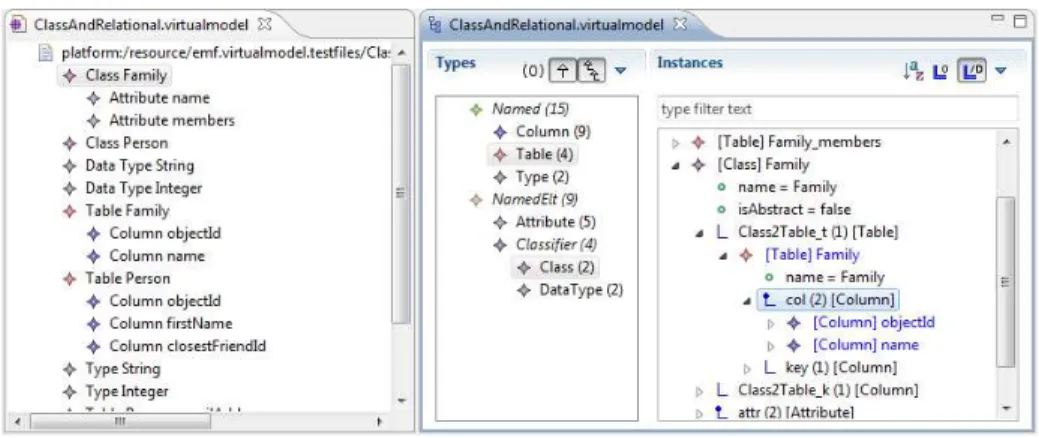
VirtualEMF refines the full set of operations available for a regular model. Thus, usage is also completely transparent (as in Fig. 3). When virtual ele-ments are accessed, VirtualEMF checks which are the referenced contributing element(s), if they are virtually linked, and then translates it(them) accordingly (e.g. with f ilter, merge, override, inherit, or associate rules). If no virtual link is specified for a contributing element, it is simply reproduced.
During the demo it will be presented how virtual models are created and used with VirtualEMF, which are its main elements, and how users can define them. This will be shown through several step-by-step examples, with different types of models and specifying different kinds of relationships between them. Finally we will present a set of experiments used to prove that our approach fulfils the desired properties mentioned in section 2.
2
Fig. 3.A virtual model (composition of a UML class model with a relational database model, where the latter derives from the former and virtual associations are used to display traceability links between them) handled in two different EMF tools: Sample Ecore Editor (left) and MoDisco Model Browser (right).
4
Conclusion
Model virtualization is a powerful mechanism that provides a more efficient model composition process, while maintaining perfect synchronization between composition resources. This demo presents VirtualEMF3
, our model virtualiza-tion tool. The tool is extensible and supports different types of virtual links and new semantics for them. As further work we intend to explore new types of inter-model relationships, and to use state-of-the-art matching techniques to automatically identify relationships and generate the correspondence model. Sev-eral experiments have been conducted to prove the scalability of our solution.
References
1. Anwar, A., Ebersold, S., Coulette, B., Nassar, M., Kriouile, A.: A Rule-Driven Approach for composing Viewpoint-oriented Models. Journal of Object Technology 9(2), 89–114 (2010)
2. Herrmann, C., Krahn, H., Rumpe, B., Schindler, M., V¨olkel, S.: An Algebraic View on the Semantics of Model Composition. In: ECMDA-FA 2007, LNCS, vol. 4530, pp. 99–113. Springer, Heidelberg (2007)
3. Kolovos, D., Paige, R., Polack, F.: Merging Models with the Epsilon Merging Lan-guage (EML). In: MoDELS 2006, LNCS, vol. 4199, pp. 215–229. Springer, Heidel-berg (2006)
4. Nejati, S., Sabetzadeh, M., Chechik, M., Easterbrook, S., Zave, P.: Matching and Merging of Statecharts Specifications. In: ICSE 2007. pp. 54–64. IEEE Computer Society (2007)
5. Rahm, E., Bernstein, P.A.: A survey of approaches to automatic schema matching. The VLDB Journal 10, 334–350 (2001)
3