HAL Id: hal-00916615
https://hal.inria.fr/hal-00916615
Submitted on 10 Dec 2013
HAL is a multi-disciplinary open access
archive for the deposit and dissemination of
sci-entific research documents, whether they are
pub-lished or not. The documents may come from
L’archive ouverte pluridisciplinaire HAL, est
destinée au dépôt et à la diffusion de documents
scientifiques de niveau recherche, publiés ou non,
émanant des établissements d’enseignement et de
Asynchronous Games over Tree Architectures
Blaise Genest, Hugo Gimbert, Anca Muscholl, Igor Walukiewicz
To cite this version:
Blaise Genest, Hugo Gimbert, Anca Muscholl, Igor Walukiewicz. Asynchronous Games over Tree
Architectures. ICALP - 40th International Colloquium on Automata, Languages, and
Programming-2013, Jul Programming-2013, RIGA, Latvia. pp.275-286, �10.1007/978-3-642-39212-2_26�. �hal-00916615�
Asynchronous Games over Tree Architectures
Blaise Genest1, Hugo Gimbert2, Anca Muscholl2, Igor Walukiewicz2
1
IRISA, CNRS, Rennes, France
2
LaBRI, CNRS/Universit´e Bordeaux, France
Abstract. We consider the distributed control problem in the setting of Zielonka asynchronous automata. Such automata are compositions of finite processes communicating via shared actions and evolving asyn-chronously. Most importantly, processes participating in a shared action can exchange complete information about their causal past. This gives more power to controllers, and avoids simple pathological undecidable cases as in the setting of Pnueli and Rosner. We show the decidability of the control problem for Zielonka automata over acyclic communication architectures. We provide also a matching lower bound, which is l-fold exponential, l being the height of the architecture tree.
1
Introduction
Synthesis is by now well understood in the case of sequential systems. It is useful for constructing small, yet safe, critical modules. Initially, the synthesis problem was stated by Church, who asked for an algorithm to construct devices trans-forming sequences of input bits into sequences of output bits in a way required by a specification [2]. Later Ramadge and Wonham proposed the supervisory control formulation, where a plant and a specification are given, and a controller should be designed such that its product with the plant satisfies the specifica-tion [18]. So control means restricting the behavior of the plant. Synthesis is the particular case of control where the plant allows for every possible behavior.
For synthesis of distributed systems, a common belief is that the problem is in general undecidable, referring to work by Pnueli and Rosner [17]. They extended Church’s formulation to an architecture of synchronously communicat-ing processes, that exchange messages through one slot communication channels. Undecidability in this setting comes mainly from partial information: specifica-tions permit to control the flow of information about the global state of the system. The only decidable type of architectures is that of pipelines.
The setting we consider here is based on a by now well-established model of distributed computation using shared actions: Zielonka’s asynchronous au-tomata [20]. Such a device is an asynchronous product of finite-state processes synchronizing on common actions. Asynchronicity means that processes can progress at different speed. Similarly to [6,12] we consider the control problem for such automata. Given a Zielonka automaton (plant), find another Zielonka automaton (controller) such that the product of the two satisfies a given spec-ification. In particular, the controller does not restrict the parallelism of the
system. Moreover, during synchronization the individual processes of the con-troller can exchange all their information about the global state of the system. This gives more power to the controller than in the Pnueli and Rosner model, thus avoiding simple pathological scenarios leading to undecidability. It is still open whether the control problem for Zielonka automata is decidable.
In this paper we prove decidability of the control problem for reachability objectives on tree architectures. In such architectures every process can com-municate with its parent, its children, and with the environment. If a controller exists, our algorithm yields a controller that is a finite state Zielonka automa-ton exchanging information of bounded size. We also provide the first non-trivial lower bound for asynchronous distributed control. It matches the l-fold expo-nential complexity of our algorithm (l being the height of the architecture tree). As an example, our decidability result covers client-server architectures where a server communicates with clients, and server and clients have their own interac-tions with the environment (cf. Figure 1). Our algorithm providing a controller for this architecture runs in exponential time. Moreover, each controller adds polynomially many bits to the state space of the process. Note also that this architecture is undecidable for [17] (each process has inputs), and is neither cov-ered by [6] (the action alphabet is not a co-graph), nor by [12] (there is no bound on the number of actions performed concurrently).
Related work. The setting proposed by Pnueli and Rosner [17] has been thor-oughly investigated in past years. By now we understand that, suitably using the interplay between specifications and an architecture, one can get undecid-ability results for most architectures rather easily. While specifications leading to undecidability are very artificial, no elegant solution to eliminate them exists at present.
The paper [10] gives an automata-theoretic approach to solving pipeline ar-chitectures and at the same time extends the decidability results to CTL∗ spec-ifications and variations of the pipeline architecture, like one-way ring architec-tures. The synthesis setting is investigated in [11] for local specifications, meaning that each process has its own, linear-time specification. For such specifications, it is shown that an architecture has a decidable synthesis problem if and only if it is a sub-architecture of a pipeline with inputs at both endpoints. The paper [5] proposes information forks as an uniform notion explaining the (un)decidability results in distributed synthesis. In [15] the authors consider distributed synthesis for knowledge-based specifications. The paper [7] studies an interesting case of external specifications and well-connected architectures.
environment
. . .
environmentenvironment
Synthesis for asynchronous systems has been strongly advocated by Pnueli and Rosner in [16]. Their notion of asynchronicity is not exactly the same as ours: it means roughly that system/environment interaction is not turn-based, and processes observe the system only when scheduled. This notion of asynchronicity appears in several subsequent works, such as [19,9] for distributed synthesis.
As mentioned above, we do not know whether the control problem in our setting is decidable in general. Two related decidability results are known, both of different flavor than ours. The first one [6] restricts the alphabet of actions: control with reachability condition is decidable for co-graph alphabets. This re-striction excludes among others client-server architectures. The second result [12] shows decidability by restricting the plant: roughly speaking, the restriction says that every process can have only bounded missing knowledge about the other processes (unless they diverge). The proof of [12] goes beyond the controller synthesis problem, by coding it into monadic second-order theory of event struc-tures and showing that this theory is decidable when the criterion on the plant holds. Unfortunately, very simple plants have a decidable control problem but undecidable MSO-theory of the associated event structure. Melli`es [14] relates game semantics and asynchronous games, played on event structures. More re-cent work [3] considers finite games on event structures and shows a determinacy result for such games under some restrictions.
Organization of the paper. The next section presents basic definitions. The two consecutive sections present the algorithm and the matching lower bound. The full version of the paper is available at http://hal.archives-ouvertes.fr/ hal-00684223.
2
Basic definitions and observations
We start by introducing Zielonka automata and state the control problem for such automata. We also give a game-based formulation of the problem.
2.1 Zielonka automata
Zielonka automata are simple parallel finite-state devices. Such an automaton is a parallel composition of several finite automata, called processes, synchronizing on shared actions. There is no global clock, so between two synchronizations, two processes can do a different number of actions. Because of this Zielonka automata are also called asynchronous automata.
A distributed action alphabet on a finite set P of processes is a pair (Σ, dom), where Σ is a finite set of actions and dom : Σ → (2P\ ∅) is a location function. The location dom(a) of action a ∈ Σ comprises all processes that need to syn-chronize in order to perform this action. A (deterministic) Zielonka automaton A = h{Sp}p∈P, sin, {δa}a∈Σi is given by:
– for every process p a finite set Sp of (local) states, – the initial state sin∈Q
– for every action a ∈ Σ a partial transition function δa : Qp∈dom(a)Sp · → Q
p∈dom(a)Sp on tuples of states of processes in dom(a).
For convenience, we abbreviate a tuple (sp)p∈P of local states by sP, where P ⊆ P. We also talk about Sp as the set of p-states and ofQ
p∈PSp as global states. Actions from Σp = {a ∈ Σ | p ∈ dom(a)} are called p-actions. For p, q ∈ P, let Σp,q = {a ∈ Σ | dom(a) = {p, q}} be the set of synchronization actions between p and q. We write Σloc
p instead of Σp,pfor the set of local actions of p, and Σcom
p = Σp\ Σploc for the synchronization actions of p.
A Zielonka automaton can be seen as a sequential automaton with the state set S = Q
p∈PSp and transitions s a
−→ s0 if (s
dom(a), s0dom(a)) ∈ δa, and sP\dom (a)= s0
P\dom (a). By L(A) we denote the set of words labeling runs of this sequential automaton that start from the initial state. Notice that L(A) is closed under the congruence ∼ generated by {ab = ba | dom(a) ∩ dom(b) = ∅}, in other words, it is a trace-closed language. A (Mazurkiewicz) trace is an equivalence class [w]∼ for some w ∈ Σ∗. The notion of trace and the idea of describing concurrency by a fixed independence relation on actions goes back to the late seventies, to Mazurkiewicz [13] (see also [4]).
Consider a Zielonka automaton A with two processes: P, P . The local actions of process P are {u0, u1, c0, c1} and those of process P are {u0, u1, c0, c1}. In addition, there is a shared ac-tion $ with dom($) = {P, P }. From the initial state, P can reach state (i, j) by executing uicj, same for P with ukcl and state (k, l). Action $ is enabled in every pair ((i, j), (k, l)) satisfying i = l or k = j, it leads to the final state. So L(A) = {[uicjukcl$] | i = l or k = j}.
As the notion of a trace can be formulated without a reference to an accept-ing device, one can ask if the model of Zielonka automata is powerful enough. Zielonka’s theorem says that this is indeed the case, hence these automata are a right model for the simple view of concurrency captured by Mazurkiewicz traces.
Theorem 1. [20] Let dom : Σ → (2P \ {∅}) be a distribution of letters. If a language L ⊆ Σ∗ is regular and trace-closed then there is a deterministic Zielonka automaton accepting L (of size exponential in the number of processes and polynomial in the size of the minimal automaton for L, see [8]).
2.2 The control problem
In Ramadge and Wonham’s control setting [18] we are given an alphabet Σ of actions partitioned into system and environment actions: Σsys∪ Σenv = Σ. Given a plant P we are asked to find a controller C over Σ such that the product P × C satisfies a given specification (the product being the standard product of the two automata). Both the plant and the controller are finite, deterministic automata over the same alphabet Σ. Additionally, the controller is required not
to block environment actions, which in technical terms means that from every state of the controller there should be a transition on every action from Σenv.
The definition of our problem is the same with the difference that we take Zielonka automata instead of finite automata. Given a distributed alphabet (Σ, dom) as above, and a Zielonka automaton P , find a Zielonka automaton C over the same distributed alphabet such that P × C satisfies a given specifica-tion. Additionally it is required that from every state of C there is a transition for every action from Σenv. The important point here is that the controller has the same distributed structure as the plant. Hence concurrency in the controlled system is the same as in the plant. Observe that in the controlled system P × C the states carry the additional information computed by the controller.
Example: Reconsider the automaton on page 4, and assume that ui, uk ∈ Σenv are the uncontrollable actions (i, k ∈ {0, 1}). So the controller needs to propose controllable actions cj and ck, resp., in such a way that both P and P reach their final states f, f by executing the shared action $. At first sight this may seem impossible to guarantee, as it looks like process P needs to know what uk process P has received, or vice-versa. Nevertheless, such a controller exists. It consists of P allowing after ui only action ci, and P allowing after uk only action c1−k. Regardless if the environment chooses i = j or i 6= j, the action $ is enabled in state ((i, i), (j, 1 − j)), so both P, P can reach their final states.
It will be more convenient to work with a game formulation of this problem, as in [6,12]. Instead of talking about controllers we will talk about distributed strategies in a game between system and environment. A plant defines a game arena, with plays corresponding to initial runs of A. Since A is deterministic, we can view a play as a word from L(A) – or a trace, since L(A) is trace-closed. Let Plays(A) denote the set of traces associated with words from L(A).
A strategy for the system will be a collection of individual strategies for each process. The important notion here is the view each process has about the global state of the system. Intuitively this is the part of the current play that the process could see or learn about from other processes during a communication with them. Formally, the p-view of a play u, denoted viewp(u), is the smallest trace [v] such that u ∼ vy and y contains no action from Σp. We write Playsp(A) for the set of plays that are p-views: Playsp(A) = {viewp(u) | u ∈ Plays(A)}.
A strategy for a process p is a function σp: Playsp(A) → 2Σpsys, where Σsys
p = {a ∈ Σsys| p ∈ dom(a)}. We require in addition, for every u ∈ Plays
p(A), that σp(u) is a subset of the actions that are possible in the p-state reached on u. A strategy is a family of strategies {σp}p∈P, one for each process.
The set of plays respecting a strategy σ = {σp}p∈P, denoted Plays(A, σ), is the smallest set containing the empty play ε, and such that for every u ∈ Plays(A, σ):
1. if a ∈ Σenv and ua ∈ Plays(A) then ua is in Plays(A, σ);
2. if a ∈ Σsys and ua ∈ Plays(A) then ua ∈ Plays(A, σ) provided that a ∈ σp(viewp(u)) for all p ∈ dom(a).
Plays from Plays(A, σ) are called σ-plays and we write Playsp(A, σ) for the set Plays(A, σ) ∩ Playsp(A). The above definition says that actions of the
environ-ment are always possible, whereas actions of the system are possible only if they are allowed by the strategies of all involved processes.
Our winning conditions in this paper are local reachability conditions: ev-ery process has a set of target states Fp ⊆ Sp. We also assume that states in Fp are blocking, that is, they have no outgoing transitions. This means that if (sdom(a), s0dom(a)) ∈ δa then sp ∈ Fp/ for all p ∈ dom(a). For defining winning strategies, we need to consider also infinite σ-plays. By Plays∞(A, σ) we denote the set of finite or infinite σ-plays in A. Such plays are defined as finite ones, replacing u in the definition of Plays(A, σ) by a possibly infinite, initial run of A. A play u ∈ Plays∞(A, σ) is maximal, if there is no action c such that the trace uc is a σ-play (note that uc is defined only if no process in dom(c) is scheduled infinitely often in u).
Definition 1. The control problem for a plant A and a local reachability con-dition (Fp)p∈P is to determine if there is a strategy σ = (σp)p∈Psuch that every maximal trace u ∈ Plays∞(A, σ) is finite and ends inQ
p∈PFp. Such traces and strategies are called winning.
3
The upper bound for acyclic communication graphs
We impose two simplifying assumptions on the distributed alphabet (Σ, dom). The first one is that all actions are at most binary: |dom(a)| ≤ 2, for every a ∈ Σ. The second requires that all uncontrollable actions are local: |dom(a)| = 1, for every a ∈ Σenv. The first restriction makes the technical reasoning much simpler. The second restriction reflects the fact that each process is modeled with its own, local environment.
Since actions are at most binary, we can define an undirected graph CG with node set P and edges {p, q} if there exists a ∈ Σ with dom(a) = {p, q}, p 6= q. Such a graph is called communication graph. We assume throughout this section that CG is acyclic and has at least one edge. This allows us to choose a leaf ` ∈ P in CG, with {r, `} an edge in CG. So, in this section ` denotes this fixed leaf process and r its parent process. Starting from a control problem with input A, (Fp)p∈P we will reduce it to a control problem over the smaller (acyclic) graph CG0= CG
P\{`}. The reduction will work in exponential-time. If we represent CG as a tree of depth l then applying this construction iteratively we will get an l-fold exponential algorithm to solve the control problem for the CG architecture. The main idea is that process r can simulate the behavior of process `. Indeed, after each synchronization between r and `, the views of both processes are identical, and until the next synchronization (or termination) ` evolves locally. The way r simulates ` is by “guessing” the future local evolution of ` until the next synchronizations (or termination) in a summarized form. Correctness is ensured by letting the environment challenge the guesses.
In order to proceed this way, we first show that winning control strategies can be assumed to satisfy a “separation” property concerning the synchronizations of process r (cf. 2nd item of Lemma 1):
Lemma 1. If there exists a winning strategy for controlling A, then there is one, say σ, such that for every u ∈ Plays(A, σ) the following holds:
1. For every process p and A = σp(viewp(u)), we have either A ⊆ Σpcom or A = {a} for some a ∈ Σloc
p .
2. Let A = σr(viewr(u)) with A ⊆ Σcom
r . Then either A ⊆ Σr,` or A ⊆ Σrcom\ Σr,` holds.
It is important to note that the 2nd item of Lemma 1 only holds when final states are blocking. To see this, consider the client-server example in Fig. 1 and assume that environment can either put a client directly to a final state, or oblige him to synchronize with the server before going to the final state. Suppose that all states of the server are final. In this case, the server’s strategy must propose synchronization with all clients at the same time in order to guarantee that all clients can reach their final states.
Lemma 1 implies that the behavior of process ` can be divided in phases consisting of a local game ending in states where the strategy proposes commu-nications with r and no local actions. This allows to define summaries of results of local plays of the leaf process `. We denote by state`(v) the `-component of the state reached on v ∈ Σ∗from the initial state. Given a strategy σ = (σp)p∈P and a play u ∈ Plays`(A, σ), we define:
Syncσ`(u) = {(t`, A) | ∃x ∈ (Σ`loc)∗. ux is a σ-play, state`(ux) = t`, σ`(ux) = A ⊆ Σr,`, and A = ∅ iff t` is final}.
Since our winning conditions are local reachability conditions, we can show that it suffices to consider memoryless local strategies for process ` until the next synchronization with r (or until termination). Moreover, since final states are blocking, either all possible local plays from a given `-state ultimately require synchronization with r, or they all terminate in a final state of ` (mixing the two situations would result in a process blocked on communication).
Lemma 2. If there exists a winning strategy for controlling A, then there is one, say σ = (σp)p∈P, such that for all plays u ∈ Plays`(A, σ) the following hold:
1. Either Syncσ`(u) ⊆ (S`\ F`) × (2Σr,`\ {∅}) or Sync σ
`(u) ⊆ F`× {∅}. 2. If uy is a σ-play with y ∈ (Σ \ Σ`)∗, σr(viewr(uy)) = B ⊆ Σr,`and B 6= ∅,
then for every (t`, A) ∈ Syncσ`(u) some action from A ∩ B is enabled in (stater(uy), t`).
3. There is a memoryless local strategy τ : S` → (Σ`sys∩ Σloc
` ) to reach from state`(u) the set of local states {t`| (t`, A) ∈ Syncσ`(u) for some A}. The second item of the lemma says that every evolution of r should be compatible with every evolution of `. The memoryless strategy from the third item proposes local actions of ` based only on the current state of ` and not on the history of the play. This strategy is used in a game on the transition graph of process `. The third item of the lemma follows from the fact that 2-player games with reachability objectives admit memoryless winning strategies.
Definition 2. An admissible plan T from s` ∈ S` for process ` is either a subset of (S`\ F`) × (2Σr,`\ {∅}) or a subset of F`× {∅}, such that there exists a memoryless local strategy τ : S` → (Σ
sys ` ∩ Σ
loc
` ) to reach from s` the set {t`| (t`, A) ∈ T for some A}. An admissible plan T is final if T ⊆ F`× {∅}. So Lemma 2 states that if there exists a winning strategy then there is one, say σ such that Syncσ`(u) is an admissible plan for every σ-play u. Note also that we can check in polynomial time whether T as above is an admissible plan.
We are now ready to define informally the reduced plant A0 on the process set P0 = P \ {`}, that is the result of eliminating process `. The only part that changes in A concerns process r, who now simulates former processes r and `. The new process r starts in state hsin,r, sin,`i. It will get into a state from Sr×S` every time it simulates a synchronization between the former r and `. Between these synchronizations its behaviour is as follows.
– From a state of the form hsr, s`i, process r can do a controllable action ch(T ), for every admissible plan T from s`, and go to state hsr, T i.
– From a state of the form hsr, T i process r can behave as the former r: it can either do a local action (controllable or not) or a shared action with some p 6= `, that updates the Sr-component to some hs0r, T i.
– From a state hsr, T i process r can also do a controllable action ch(B) for some B ⊆ Σr,` and go to state hsr, T, Bi; from hsr, T, Bi there are new, uncontrollable actions of the form (a, t`) where (t`, A) ∈ T and a ∈ A ∩ B such that (sr, t`)−→ (sa 0
r, t0`) in A. This case simulates r choosing a set of synchronization actions with `, and the synchronization itself. For correctness of this step it is important that B is chosen such that for every (t`, A) ∈ T there is some a ∈ A ∩ B enabled in (sr, t`).
Finally, accepting states of r in A0 are Fr× F`, and hsr, T i for sr ∈ Fr and T a final plan. The proof showing that this construction is correct provides a reduction from the control game on A to the control game on A0.
Theorem 2. Let ` be the fixed leaf process with P0 = P \ {`} and r its par-ent. Then the system has a winning strategy for A, (Fp)p∈P iff it has one for A0, (F0
p)p∈P0. The size of A0 is |A| + O(Mr2M`|Σr`|), where M
r and M` are the sizes of processes r and ` in A, respectively.
Remark 1. Note that the bound on |A0| is better than |A| + O(Mr2M`2|Σr`|)
obtained by simply counting all possible states in the description above. The reason is that we can restrict admissible plans to be (partial) functions from S` into 2Σr,`. That is, we do not need to consider different sets of communication
actions for the same state in S`.
Let us reconsider the example from Figure 1 of a server with k clients. Ap-plying our reduction k times we reduce out all the clients and obtain the single process plant whose size is Ms2(M1+···+Mk)c where Ms is the size of the server, Miis the size of client i, and c is the maximal number of communication actions between a client and the server. Our first main result also follows by applying the above reduction iteratively.
Theorem 3. The control problem for distributed plants with acyclic communi-cation graph is decidable. There is an algorithm for solving the problem (and computing a finite-state controller, if it exists) whose running time is bounded by a tower of exponentials of height equal to half of the diameter of the graph.
4
The lower bound
Our main objective now is to show how using a communication architecture of diameter l one can code a counter able to represent numbers of size Tower (2, l) (with Tower (n, l) = 2Tower (n,l−1) and Tower (n, 1) = n). Then an easy adapta-tion of the construcadapta-tion will allow to encode computaadapta-tions of Turing machines with the same space bound as the capabilities of the counters.
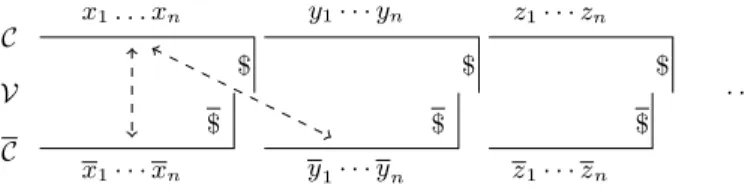
x1. . . xn x1· · · xn y1· · · yn y1· · · yn z1· · · zn z1· · · zn $ $ $ $ $ $ C C V . . .
Fig. 2. Shape of a trace with 3 processes. Dashed lines show two types of tests.
Let us first explain the mechanism we will use. Consider a trace of the shape presented in Figure 2. There are three processes C,C and V. Process C repeatedly generates a sequence of n local actions and then synchronizes on action $ with the verifier process V. ProcessC does the same. The alphabets of C and C are of course disjoint. The verifier process V always synchronizes first with C and then with C. Observe that the actions y1· · · yn are concurrent to both x1· · · xn and y1· · · yn, but they are before z1. Suppose that we allow the environment to stop this generation process at any moment. Say it stops C at some xi, and C at xi. We can then set the processes in such a way that they are forced to communicate xi and xi to V; who can verify if they are correct. The other possibility is that the environment stops C at xi and C at yi forcing the comparison of xi with yi. This way we obtain a mechanism allowing to compare position by position the sequence x1· · · xn both with x1· · · xn and with y1· · · yn. Observe that V knows which of the two cases he deals with, since the comparison with the latter sequence happens after some $ and before the next $. Now, we can use sequences of n letters to encode numbers from 0 to 2n− 1. Then this mechanism permits us to verify if x1· · · xn represents the same number as x1· · · xn and the predecessor of y1· · · yn. Applying the same reasoning to y1· · · yn we can test that it represents the same number as y1· · · yn and the predecessor of z1· · · zn. If some test fails, the environment wins. If the environment does not stop C and C at the same position, or stops only one of them, the system wins. So this way we force the processes C and C to cycle through representations of numbers from 0 to
2n− 1. Building on this idea we can encode alternating polynomial space Turing machines, and show that the control problem for this three process architecture (with diameter 2) is Exptime-hard. The algorithm from the previous section provides the matching upper bound.
After this explanation let us introduce general counters. We start with their alphabets. Let Σi = {ai, bi} for i = 1, . . . , n. We will think of ai as 0 and bi as 1, mnemonically: 0 is round and 1 is tall. Let Σi#= Σi∪ {#i} be the alphabet extended with an end marker.
A 1-counter is just a letter from Σ1followed by #1. The value of a1is 0, and the one of b1is 1. An (l + 1)-counter is a word x0u0x1u1· · · xk−1uk−1#l+1where k = Tower (2, l), and for every i < k we have: xi ∈ Σl+1 and ui is an l-counter with value i. The value of the above (l + 1)-counter is P
i=0,...,kxi2
i. The end marker #l+1is there for convenience. An iterated (l + 1)-counter is a nonempty sequence of (l + 1)-counters (we do not require that the values of consecutive (l + 1)-counters are consecutive).
Suppose that we have already constructed a plant Cl with root process rl, such that every winning strategy in Cl needs to produce an iterated l-counter on rl. We now define Cl+1, a plant where every winning strategy needs to
... ...
...
produce an iterated (l + 1)-counter on its root process rl+1. Recall that such a counter is a se-quence of l-counters with values 0, 1, . . . , (Tower (2, l)−1), 0, 1, . . . The plant Cl+1 is made of two copies of
Cl, that we name Dl and Dl. We add three processes: rl+1, rl+1, Vl+1. The root rl+1 of Cl+1 communicates with Vl+1 and with the root rl of Dl, while rl+1 communicates with Vl+1 and with the root of Dl.
In order to force Cl+1 to generate an (l + 1)-counter, we allow the environ-ment to compare using Vl+1 the sequence generated by rl+1 and the sequence generated by rl+1. The mechanism is similar to the example above. After each letter of Σl, we add an uncontrollable action that triggers the comparison be-tween the current letters of Σlon rl+1 and on rl+1. This may correspond to two types of tests: equality or successor. For equality, Vl+1 enters a losing state if (1) the symbols from rl+1 and from rl+1 are different; and (2) the number of remaining letters of Σlbefore #lis the same on both rl+1 and rl+1. The latter test ensures that the environment has put the challenge at the same positions of the two counters. The case for successor is similar, accounting for a possible carry. In any other case (for instance, if the test was issued on one process only instead of both rl+1and rl+1), the test leads to a winning configuration.
The challenge with this schema is to keep rl+1 and rl+1 synchronized in a sense that either (i) the two should be generating the same l-counter, or (ii) rl+1 should be generating the consecutive counter with respect to the one generated by rl+1. For this, a similar communication mechanism based on $ symbols as in the example above is used. An action $lshared by rl+1and Vl+1is executed after each l-counter, that is after each #l shared between rl+1 and rl. Similarly with
action $l shared by rl+1 and Vl+1. Process Vl+1 switches between state eq and state succ when receiving $l, and back when receiving $l so it knows whether rl+1 is generating the same l-counter as rl+1, or the next one. As rl+1 does not synchronize (unless there is a challenge) with Vl+1 between two $l, it does not know whether rl+1has already started producing the same l-counter or whether it is still producing the previous one. Another important point about the flow of knowledge is that while rl is informed when rl+1 is being challenged (as it synchronizes frequently with rl+1, and could thus be willing to cheat to produce a different l-counter), rl does not know that rl+1 is being challenged, and thus cheating on rl would be caught by verifier Vl.
Proposition 1. For every l, the system has a winning strategy in Cl. For every such winning strategy σ, if we consider the unique σ-play without challenges then its projection on S
i=1,...,lΣ #
i is an iterated l-counter.
Proposition 1 is the basis for encoding Turing machines, with Cl ensuring that the space bound is equal to Tower (n, l).
Theorem 4. Let l > 0. There is an acyclic architecture of diameter (4l − 2) and with 3(2l− 1) processes such that the space complexity of the control problem for it is Ω(Tower (n, l))-complete.
5
Conclusions
Distributed synthesis is a difficult and at the same time promising problem, since distributed systems are intrinsically complex to construct. We have considered here an asynchronous, shared-memory model. Already Pnueli and Rosner in [16] strongly argue in favour of asynchronous distributed synthesis. The choice of transmitting additional information while synchronizing is a consequence of the model we have adopted. We think that it is interesting from a practical point of view, since it is already used in multithreaded computing (e.g., CAS primitive) and it offers more decidable settings (e.g., client-server architecture).
Under some restrictions we have shown that the resulting control problem is decidable. The assumption about uncontrollable actions being local represents the most common situation where each process comes with its own environment (e.g., a client). The assumption on binary synchronizations simplifies the defini-tion of architecture graph and is common in distributed algorithms. The most important restriction is that on architectures being a tree. Tree architectures are quite rich and allow to model hierarchical situations, like server/clients (recall that such cases are undecidable in the setting of Pnueli and Rosner). Neverthe-less, it would be very interesting to know whether the problem is still decidable e.g. for ring architectures. Such an extension would require new proof ideas. A more immediate task is to consider more general winning conditions. A fur-ther interesting research direction is the synthesis of open, concurrent recursive programs, as considered e.g. in [1].
Our non-elementary lower bound result is somehow surprising. Since we have full information sharing, all the complexity is hidden in the uncertainty about actions performed in parallel by other processes.
References
1. B. Bollig, M.-L. Grindei, and P. Habermehl. Realizability of concurrent recursive programs. In FOSSACS, volume 5504 of LNCS, pages 410–424, 2009.
2. A. Church. Logic, arithmetics, and automata. In Proceedings of the International Congress of Mathematicians, pages 23–35, 1962.
3. P. Clairambault, J. Gutierrez, and G. Winskel. The winning ways of concurrent games. In LICS, pages 235–244. IEEE, 2012.
4. V. Diekert and G. Rozenberg, editors. The Book of Traces. World Scientific, 1995. 5. B. Finkbeiner and S. Schewe. Uniform distributed synthesis. In LICS, pages 321–
330. IEEE, 2005.
6. P. Gastin, B. Lerman, and M. Zeitoun. Distributed games with causal memory are decidable for series-parallel systems. In FSTTCS, volume 3328 of LNCS, pages 275–286, 2004.
7. P. Gastin, N. Sznajder, and M. Zeitoun. Distributed synthesis for well-connected architectures. Formal Methods in System Design, 34(3):215–237, 2009.
8. B. Genest, H. Gimbert, A. Muscholl, and I. Walukiewicz. Optimal Zielonka-type construction of deterministic asynchronous automata. In ICALP, volume 6199 of LNCS, 2010.
9. G. Katz, D. Peled, and S. Schewe. Synthesis of distributed control through knowl-edge accumulation. In CAV, volume 6806 of LNCS, pages 510–525. 2011.
10. O. Kupferman and M. Vardi. Synthesizing distributed systems. In LICS, 2001. 11. P. Madhusudan and P. Thiagarajan. Distributed control and synthesis for local
specifications. In ICALP, volume 2076 of LNCS, pages 396–407, 2001.
12. P. Madhusudan, P. S. Thiagarajan, and S. Yang. The MSO theory of connectedly communicating processes. In FSTTCS, volume 3821 of LNCS, 2005.
13. A. Mazurkiewicz. Concurrent program schemes and their interpretations. DAIMI Rep. PB 78, Aarhus University, Aarhus, 1977.
14. P.-A. Melli`es. Asynchronous games 2: The true concurrency of innocence. TCS, 358(2-3):200–228, 2006.
15. R. V. D. Meyden and T. Wilke. Synthesis of distributed systems from knowledge-based specifications. In CONCUR, volume 3653 of LNCS, pages 562–576, 2005. 16. A. Pnueli and R. Rosner. On the synthesis of an asynchronous reactive module.
In ICALP, volume 372, pages 652–671, 1989.
17. A. Pnueli and R. Rosner. Distributed reactive systems are hard to synthesize. In FOCS, pages 746–757, 1990.
18. P. J. G. Ramadge and W. M. Wonham. The control of discrete event systems. Proceedings of the IEEE, 77(2):81–98, 1989.
19. S. Schewe and B. Finkbeiner. Synthesis of asynchronous systems. In LOPSTR, number 4407 in LNCS, pages 127–142. 2006.
20. W. Zielonka. Notes on finite asynchronous automata. RAIRO–Theoretical Infor-matics and Applications, 21:99–135, 1987.