HAL Id: hal-01738235
https://hal-mines-paristech.archives-ouvertes.fr/hal-01738235
Submitted on 20 Mar 2018HAL is a multi-disciplinary open access
archive for the deposit and dissemination of sci-entific research documents, whether they are pub-lished or not. The documents may come from teaching and research institutions in France or abroad, or from public or private research centers.
L’archive ouverte pluridisciplinaire HAL, est destinée au dépôt et à la diffusion de documents scientifiques de niveau recherche, publiés ou non, émanant des établissements d’enseignement et de recherche français ou étrangers, des laboratoires publics ou privés.
to 3D Stokes Flows
F. Alouges, M. Aussal, A. Lefebvre-Lepot, Franck Pigeonneau, Antoine Sellier
To cite this version:
F. Alouges, M. Aussal, A. Lefebvre-Lepot, Franck Pigeonneau, Antoine Sellier. Application of the Sparse Cardinal Sine Decomposition to 3D Stokes Flows. International Journal of Computational Methods and Experimental Measurements, WIT Press, 2017, 5 (3), pp.387 - 394. �10.2495/CMEM-V5-N3-387-394�. �hal-01738235�
© 2017 WIT Press, www.witpress.com
ISSN: 2046-0546 (paper format), ISSN: 2046-0554 (online), http://www.witpress.com/journals DOI: 10.2495/CMEM-V5-N3-387-394
APPLICATION OF THE SPARSE CARDINAL SINE
DECOMPOSITION TO 3D STOKES FLOWS
F. ALOUGES1, M. AUSSAL1, A. LEFEBVRE-LEPOT1, F. PIGEONNEAU2 & A. SELLIER31Centre de Mathématiques Appliquées, Ecole polytechnique, France 2Surface du Verre et Interfaces, Saint-Gobain, France
3LadHyX, Ecole polytechnique, France
ABSTRACT
In boundary element method (BEM), one encounters linear system with a dense and non-symmetric square matrix which might be so large that inverting the linear system is too prohibitive in terms of cpu time and/or memory. Each usual powerful treatment (Fast Multipole Method, H-matrices) developed to deal with this issue is optimized to efficiently perform matrix vector products. This work presents a new technique to adequately and quickly handle such products: the Sparse Cardinal Sine Decomposition. This approach, recently pioneered for the Laplace and Helmholtz equations, rests on the decomposition of each encountered kernel as series of radial Cardinal Sine functions. Here, we achieve this decompo-sition for the Stokes problem and implement it in MyBEM, a new fast solver for multi-physical BEM. The reported computational examples permit us to compare the advocated method against a usual BEM in terms of both accuracy and convergence.
Keywords: boundary element method, fast convolution, Stokes equations.
1 INTRODUCTION
We consider a flow around a body Ω of a Newtonian and unbounded liquid with uniform viscosity μ. Adopting henceforth the usual tensor summation notation, the Newtonian liquid has pressure p, velocity u = uiei and stress tensor σ = σijeiƒ ejsuch that, in the entire liquid
domain D = 3 \ Ω, σij ij i j j i p u x u x = − + ∂ ∂ + ∂ ∂ d m (1)
with δ the usual Kronecker delta. Neglecting inertial effects, the creeping flow (u, p) satisfies the following Stokes equations and far-field behavior
m∆ = ∇u p and div( )u =0in D, (2) ( , )u p →( , )00 far from Ω (3) One has to supplement eqns (2) and (3) with conditions on the smooth surface ∂Ω having unit normal n directed into the liquid. Those conditions depend on the nature of ∂Ω: no-slip or slipping solid surface, flexible surface,...
Each component uj = u.ej admits [1] in D a key integral representation involving the
Oseen velocity tensor G = Gij(X)eiƒ ej and stress tensor T = Tijk(X)eiƒ ejƒ ek defined, for X = Xiei ≠ 0, as
Noting dS = dS(y), a possible regularized form of this representation is u n G dS u u n T j ik k ij i i k i ( ) [ ]( ) ( ) [ ( ) ( )] ( ) x y y x y x y = − − + − ∂Ω
∫
1 8 1 8 pm s p∫
∂Ω jjk(y x− ) ,dS x∈ ∪ ∂ΩD . (5)Inspecting eqn (5) shows that when looking at u in the entire liquid domain D it is sufficient to gain on the body boundary ∂Ω the velocity u and the surface traction σ.n. In practice, those
two key surface quantities are obtained by injecting the boundary conditions prescribed on ∂Ω either in eqn (5) for x on ∂Ω or in the following equivalent relation
8pu u n T dS u n T j i k PV ijk i k PV ijk ( ) ( ) ( ) ( ) [ ]( ) ( x x y y x y y x = − − + − ∂Ω ∂Ω
∫
∫
))dS ik kn ( )G( ) ,dS ij − − ∈∂Ω ∂Ω∫
sm y y x x (6)where the superscript PV indicates the principal value of the integral.
In practice, the discretization of eqn (5) on ∂Ω or eqn (6) is done by a collocation or Galerkin BEM (boundary element method) which approximates ∂Ω with boundary elements. On those elements one locates N nodal points at which three Cartesian components amongst
ui and ei.s.n are unknown. Denoting by Nd = 3N, the number of degrees of freedom, one arrives at a linear system A.v = b with Nd–unknown vector v and dense and non-symmetric square Nd × Nd matrix A. For Nd typically less than 10000 one can use a LU factorization. For Nd larger one resorts to a generalized minimal iterative residual method (such as GMRS), which reduces the task to the evaluation of products A.q for many vectors q. This can be efficiently done by storing only a relevant approximation of A by so-called Fast Multipole Method [2, 3] or H-matrices approach [4, 5]. Employing those methods each matrix-vector product A.q is approximated in only O(Ndlog Nd) operations.
Recently, a new accelerating technique has been proposed in Alouges and Aussal [6] for the boundary-integral equations encountered in potential and Helmholtz problems. This method appeals to a suitable sparse integration grid in the Fourier space, and a back and forth non-uniform Fast Fourier transform [7, 8]. This work extends the procedure to the boundary- integral eqn (6) obtained for the Stokes problem and investigates its abilities in terms of both error and cpu time.
2 THE SPARSE CARDINAL SINE DECOMPOSITION (SCSD) 2.1 Principle for a radial kernel
For the cardinal sine function sinc defined by sinc(t) = sin(t)/t, we look at evaluating the con-volution operator g with radial kernel sinc defined as
g( )x = sin ( ) ( ) ,r f ydS r= −|y x| ∂Ω
∫
c (7)This can be done calculating the usual three-dimensional Fourier transform F(g) of g and then operating the inverse Fourier transform with
g( ) e F ( ) (g)( ) . x = x⋅
∫
1 2p3 3 ixx xx xxd (8)Actually, noticing that F(sinc) = 2π2δ
S2, with δS2 the Dirac mass on the unit sphere S2 of 3,
it turns out that F(g) is a radial function given by F(g)(ξ) = 2π2F(f)(ξ)δ
S2(x) where ξ = |ξ|.
Accordingly, eqn (8) becomes
g i f d d ei e i f ( ) exp( ( ) ) ( ) ( x x y y y y x y = − ⋅ = ∈∂Ω ∈ ⋅ − ⋅
∫
∫
1 4 1 4 2 p p xx xx xx xx xx y S ))d dy . y∈∂Ω ∈∫
∫
xx S2(
)
xx (9)In eqn (9), the integration over S2 (or ∂Ω) is evaluated by a numerical quadrature with Nξ (or Ny) points ξl (or ym) with associated weight wl
xx (or w
m
y). Thus, at point x
k on ∂Ω one finally
gets the approximation
g k l i k l i m l mf m m N l N ( )x ∼ xxwxxexp(x ⋅xx) exp(−y ⋅xx)wy (y ) = =
∑
∑
1 1 y .. (10)Once f has been computed at points (ym)m of ∂Ω, we then successively calculate the following discrete Fourier and inverse Fourier transforms
(11) a task which is efficiently achieved using the non-uniform FFT of type 3 [8]. Accordingly, the algorithm global complexity to evaluate g(xk)isO((Nξ + Ny) log(Nξ + Ny)).
As shown in Alouges and Aussal [6], it is possible to extend the procedure to the approxi-mation of the convolution integral
gK( )x = K(|X|) ( ) d ,f y S X y x= − ∂Ω
∫
(12)when the kernel K admits a sparse cardinal sine decomposition of the form
K r p pr r
p P
( ) ~ b sin (c λ ) for large enough. =
∑
1
(13) The selected accuracy level of the approximation (9) dictates the values of P and coefficients βp and λp. In addition, it is also possible to get
sin (c λp|X|) ~ Wplexp(iX pl) for |X| large enough
l Npl ⋅ =
∑
xx 1 (14) with points ξpl on S2 and relevant weights Wpl. More precisely, using eqns (13) and (14) one
can actually obtain |K(|X|) — Ka(|X|)| ≤ ε with ε a prescribed small tolerance and |X| in the
range [Rmin, Rmax]. The approximating kernel Kais readily defined as
Ka pWpl i l N pl p P pl (|X|)= exp(X⋅ ). = =
∑
∑
b 1 1 xx (15)The trick then consists in using the decomposition
In getting the operator gK, the first integral in eqn (16) is calculated by only keeping into account the part of ∂Ω for which |X| ≤ Rmin(local interactions which then add to the discre-tized operator gKa sparse matrix contribution), whereas the second integral is calculated over the entire surface ∂Ω using eqn (15) and the definition X = y – x. Consequently, the convo-lution operator gKobeys the same algorithm as the previous one for K = sinc except for the Fourier grid on S2 which resorts to more points ξpl.
For a given tolerance ε the associated values of P, λp, βp, Wpl, ξpl and (Rmin, Rmax) have been obtained in Alouges and Aussal [6] for the Laplace kernel K(r) = 1/(4πr) and the Helmholtz kernel K(r) = exp(ikr)/(4πr).
2.2 Application to Stokes kernels
Unfortunately, the Stokes kernels G and T, with Cartesian components defined by eqns (4), are clearly not radial ones. In a first attempt recently proposed in Alouges et al. [9] to gene-ralize the approach to those kernels too many computations are still needed and this results in a pretty slow algorithm. Therefore, we propose and test in this paper another formulation which was found to improve the performances of the underlying algorithm.
Denoting by Id = ej⊗ ej the identity tensor, we write G = G1 + G2 with the following definitions G x x G x x x x Id x 1( )=| |, 2( )= | | | | ⊗ − 2 3 . (17)
Actually, the above decomposition presents two basic merits:
(i) First, G1 is a radial kernel for which we apply the technique described in Alouges and Aussal [6]. This provides us with a set of integration weights and points
(
w
xxj,,
xx
j)
j Nxx1 1
1≤ ≤ 1
and the formula
2 1 1 1 1 | |~ exp( ) , x wj x j N j i xx xx xx =
∑
⋅ (18)which is valid1 for all x such that |x| is in the range [R
min, Rmax].
(ii) Second, the kernel G2 is the Hessian matrix of the radial function g2: X→ − | |X . Achieving the SCSD of g2 leads to a new quadrature (wxxj,,xxj) j Nxx
2 2 1≤ ≤ 2 such that g j i j N j 2 2 1 2 2 ( )x = −| |~x , exp(x⋅ ) =
∑
xx wxx xx . (19)Differentiating eqn (19) twice immediately yields the approximation x x x Id x x ⊗ − − ⊗ ⋅ =
∑
| | | |~ exp( ). , 3 2 2 2 1 2 2 xx xx xx xx xx j j j j N j i w (20)The eqns (18) and (20) finally permit us to apply the method.
In a similar fashion, for the Cartesian components of the Green stress tensor T we use this time the identity
x x x x x x x x x i j k i j k ij k i j j i | |x 5 | |x | |x k| |x k| |x . 3 3 3 3 1 3 = ∂ ∂ ∂ ∂ +d +d +d (21) 1 The choice of R
At that stage, the third derivative of |x| is computed as before (see how to deduce eqn (20) for eqn (19)) while the other terms are essentially coordinates of the gradient of |x|-1 (use this
time eqn (18)). As before, all those terms are computed using the SCSD. 3 NUMERICAL VALIDATION
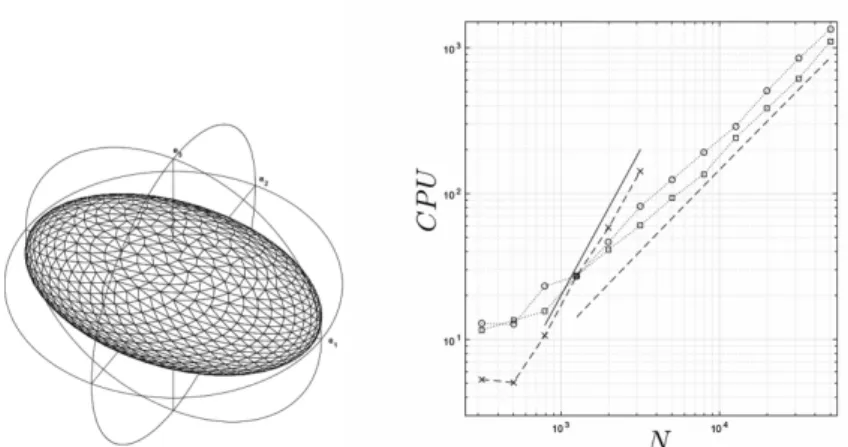
Henceforth, we benchmark the proposed strategy for a solid ellipsoid with surface ∂Ω defined by x a x a x a a a a 1 2 1 2 2 2 2 2 3 2 3 2 1 1 2 3 5 3 2 + + = for on x ∂Ω; ( , , ) ( , , ). (22)= As illustrated in Fig. 1, the surface ∂Ω is approximated as ∂Ωhusing flat P1triangular bound-ary elements with typical size h which is the average length of the sides of the boundbound-ary elements. The normal to ∂Ωh is approximated by the normal to the surface ∂Ωh on which we put N nodes (recall that Nd = 3N). The computations are run for a Galerkin approach using a GMRS iterative solver and a parallel Matlab code. For each test, the SCSD method
con-vergence error (versus h) and CPU time (versus N) are compared against the ones obtained by a full BEM method and termed BEM. Computations are run for N between 200 and 5000 for BEM and for N between 200 and 50000 for SCSD. Moreover, different accuracy level (tolerance) ε for the SCSD are taken while the prescribed residual for the GMRS solver is taken to be in getting the operator ε.
3.1 The stresslet
We first test the stresslet contribution, i.e. the second integral appearing in eqn (6). This is done taking on ∂Ω a rotation with velocity w = e1˄ x = wiei. Hence, we introduce on ∂Ω the vector field Q = Qjej by
Qj( )x = 1
∫
∂ΩPV[ i kn ]( )yTijk(y x− ) .dS8p w (23)
From Pozrikidis [1] one has the analytical result
Q x( )= −w x( )/2 for on x ∂Ω (24) and we accordingly define the error Err as the following quantity
Err=[
∫
∂Ω| ( )Q x +w x /( ) |2 2 dS] .1 2/ (25) The computations give Err = O(ε) for SCSD and Err ∼ 10–14 for BEM. Moreover, as shownin Fig. 1, the cpu time CPU behaves as N2 for BEM and as N log (N) for SCSD.
3.2 The Stokeslet
We now test a term similar to the last integral occurring in eqn (6). To do so, we this time define on ∂Ω the vector field Q by
As it is well known [1], one has in theory Q(x) = 0 whatever x located on the boundary ∂Ω. Thus, we now define the error Err as
Err=[
∫
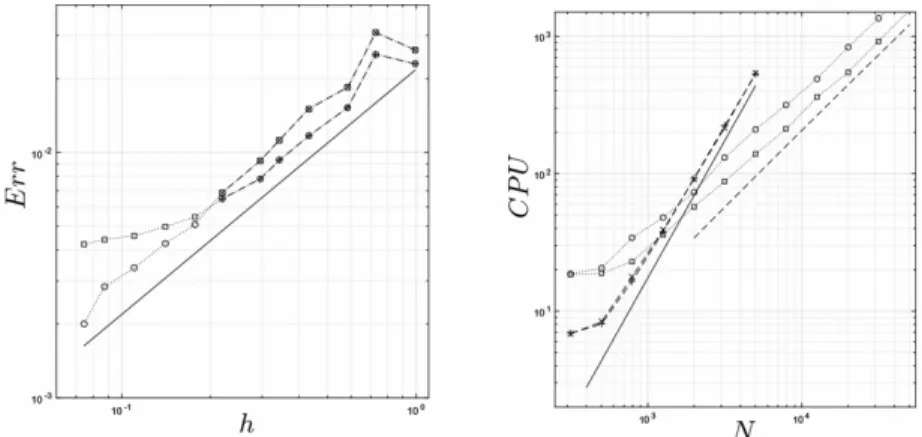
∂Ω| ( ) |Q x 2 dS] .1 2/ (27) Both Err and the CPU time are plotted in Fig. 2. Note that Err = O(h2) for BEM while, notsurprisingly, Err = O(ε) for SCSD. As ε decreases from ε = 10–2 to ε = 10–4 the SCSD
con-verges to BEM. As regard the CPU time, is appears that BEM and SCSD behave as N2and N log(N), respectively.
Figure 1: Surface mesh ∂Ωh for the ellipsoid. CPU time versus N for the Stresslet test: BEM
(×) and SCSD for ε = 10–3() or ε = 10–4(o). Functions N log(N) (dashed line) and N2 (solid line) are also plotted.
Figure 2: Error and CPU for the Stokeslet test. BEM (+) and SCSD for ε = 10–2(◊), ε = 10–3()
and ε = 10–4(o). Functions N log(N) (dashed line) and either h2 or N2 (solid lines)
3.3 Integral representation
We test the whole relation (6) for the Stokes flow (u0, p0), obeying eqns (2) and (3) and thus also eqn (6), produced by a force point with unit strength e1 located inside the ellipsoid at
point x0 = (1, 2, 0.5). Clearly, for this flow and associated stress tensor σ0 we have
u j G T n j j jk k 0 0 1 0 0 1 0 8 8 , ( ) ( ) , [ ] ( ) ( ) ( ). x =u e⋅ =j x xp−m ss ⋅n x = x x−p x (28) The error Err is the L2(∂Ω) norm between u
0 and its integral representation given by eqn
(6). Both the computed error Err and cpu time CPU are plotted in Fig. 3. It appears that
Err = O(h) for BEM and SCSD with tolerance ε = 10–4. In addition, the cpu time is order N2
or N log(N) for BEM or SCSD, respectively.
Figure 3: Error and CPU for the integral representation. BEM (+) and SCSD for ε = 10–2(◊),
ε = 10–3() and ε = 10–4(ο). Functions N log(N) (dashed line) and N (solid line for
error) or N2 (solid line for CPU) are also plotted.
Figure 4: Error and CPU for the Dirichlet to Neumann problem. BEM with ε = 10–3(+) or
ε = 10–4(×) and SCSD for ε = 10–3(D) and ε = 10-4(o). Functions N log(N) (dashed
3.4 The Dirichlet to Neumann problem
Finally, this last test concerns the Dirichlet to Neumann problem, i.e. we provide the velocity
u0 on the ellipsoid boundary ∂Ω and compute the resulting traction (s0⋅ n)num there from the boundary-integral eqn (6). This traction [1] is defined up to a constant multiple of n. Denot-ing by (s0⋅ n)num the computed traction, we first calculate the constant λ which minimizes the L2(∂Ω) norm of s
0⋅n – (s0 ⋅ n)num – λn. Then, the numerical error Err is defined as
Err=
{
∫
∂Ω| (ss0⋅ −) (ss0⋅ )num− |dS}
.2 1 2
n n ln / (29)
The resulting Err and cpu time CPU, given in Fig. 4, exhibit the same trends as the ones observed for the previous integral representation test.
4 CONCLUSION
A new sparse cardinal sine decomposition for 3D Stokes flow has been proposed, imple-mented and also compared, both in terms of accuracy and cpu time, against a classical BEM solver. It is different from and more efficient than the one recently proposed and tested in Alouges et al. [9]. We aim in future at implementing this technique also to the regularized boundary-integral eqn (5).
REFERENCES
[1] Pozrikidis, C., Boundary Integral and Singularity Methods for Linearized Viscous Flow, Cambridge University Press: Cambridge, 1992.
[2] Greengard, L. & Rokhlin, V., The Rapid Evaluation of Potential Fields in Three
Dimen-sions, In Vortex Methods, Springer Verlag, pp. 121–141, 1988.
[3] Greengard, L., The Rapid Evaluation of Potential Fields in Particle Systems, MIT Press, 1988.
[4] Hackbusch, W., A Sparse Matrix Arithmetic Based on H-Matrices. Part I. Introduction
to H-matrices, Computing, 62(2), pp. 89–108, 1999. [5] Hackbusch, W., Hierarchische Matrizen, Springer, 2009.
[6] Alouges, F. & Aussal, M., The sparse cardinal sine decomposition and its application for fast numerical convolution. Numerical Algorithms, 70(2), pp. 427–448, 2015.
http://dx.doi.org/10.1007/s11075-014-9953-6
[7] Dutt, A. & Rokhlin, V., Fast fourier transforms for nonequispaced data. SIAM Journal
on Scientific Computing, 14(6), pp. 1368–1393, 1993.
http://dx.doi.org/10.1137/0914081
[8] Lee, J.-Y. & Greengard, L., The type 3 nonuniform FFT and its application. Journal of
Computational Physics, 206(1), pp. 1–5, 2005.
http://dx.doi.org/10.1016/j.jcp.2004.12.004
[9] Alouges, F., Aussal, M., Lefebvre-Lepot, A., Pigeonneau, F. & Sellier, A. The sparse cardinal sine decomposition applied to Stokes integral equations. Proceedings of the