HAL Id: hal-00301807
https://hal.archives-ouvertes.fr/hal-00301807
Submitted on 12 Jul 2006HAL is a multi-disciplinary open access
archive for the deposit and dissemination of sci-entific research documents, whether they are pub-lished or not. The documents may come from teaching and research institutions in France or abroad, or from public or private research centers.
L’archive ouverte pluridisciplinaire HAL, est destinée au dépôt et à la diffusion de documents scientifiques de niveau recherche, publiés ou non, émanant des établissements d’enseignement et de recherche français ou étrangers, des laboratoires publics ou privés.
Investigating the composition of organic aerosol
resulting from cyclohexene ozonolysis: low molecular
weight and heterogeneous reaction products
J. F. Hamilton, A. C. Lewis, J. Reynolds, L. J. Carpenter, A. Lubben
To cite this version:
J. F. Hamilton, A. C. Lewis, J. Reynolds, L. J. Carpenter, A. Lubben. Investigating the composition of organic aerosol resulting from cyclohexene ozonolysis: low molecular weight and heterogeneous reaction products. Atmospheric Chemistry and Physics Discussions, European Geosciences Union, 2006, 6 (4), pp.6369-6399. �hal-00301807�
ACPD
6, 6369–6399, 2006Composition of organic aerosol from
cyclohexene ozonolysis J. F. Hamilton et al. Title Page Abstract Introduction Conclusions References Tables Figures J I J I Back Close Full Screen / Esc
Printer-friendly Version Interactive Discussion Atmos. Chem. Phys. Discuss., 6, 6369–6399, 2006
www.atmos-chem-phys-discuss.net/6/6369/2006/ © Author(s) 2006. This work is licensed
under a Creative Commons License.
Atmospheric Chemistry and Physics Discussions
Investigating the composition of organic
aerosol resulting from cyclohexene
ozonolysis: low molecular weight and
heterogeneous reaction products
J. F. Hamilton1, A. C. Lewis1, J. Reynolds1, L. J. Carpenter1, and A. Lubben2
1
Department of Chemistry, University of York, Heslington, York, YO10 5DD, UK
2
Bruker Daltonics, Banner Lane, Coventry, CV4 9GH, UK
Received: 26 April 2006 – Accepted: 16 May 2006 – Published: 12 July 2006 Correspondence to: J. F. Hamilton ([email protected])
ACPD
6, 6369–6399, 2006Composition of organic aerosol from
cyclohexene ozonolysis J. F. Hamilton et al. Title Page Abstract Introduction Conclusions References Tables Figures J I J I Back Close Full Screen / Esc
Printer-friendly Version Interactive Discussion
Abstract
The composition of organic aerosol formed from the gas phase ozonolysis of cyclohex-ene has been investigated in a smog chamber experiment. Comprehensive gas chro-matography with time of flight mass spectrometric detection was used to determine that dicarboxylic acids and corresponding cyclic anhydrides dominated the small gas phase
5
reaction products found in aerosol sampled during the first hour after initial aerosol formation. Structural analysis of larger more polar molecules was performed using liquid chromatography with ion trap tandem mass spectrometry. This indicated that the majority of identified organic mass was in dimer form, built up from combinations of the most abundant small acid molecules, with frequent indication of the inclusion
10
of adipic acid. Trimers and tetramers potentially formed via similar acid combinations were also observed in lower abundances. Tandem mass spectral data indicated dimers with either acid anhydride or ester functionalities as the linkage between monomers. High-resolution mass spectrometry identified the molecular formulae of the most abun-dant dimer species to be C10H16O6, C11H18O6, C10H14O8and C11H16O8and could be
15
used in some cases to reduce uncertainty in exact chemical structure determination by tandem MS.
1 Introduction
It has recently been established that significant amounts of particulate matter are or-ganic in nature deriving from both primary and secondary sources, where oror-ganic
ma-20
terial can contribute 20–50% of the total fine (sub-micron) aerosol mass in continental mid-latitudes (Putaud et al., 2004; Saxena et al., 1996) and up to 90% in tropical highly forested areas (Andreae et al., 1997; Artaxo et al., 1988; Talbot et al., 1988). Volatile organic compounds (VOCs) are emitted to the atmosphere from both biogenic and anthropogenic sources, which within the boundary layer of the troposphere have the
25
ability to react rapidly with NOxin the presence of OH radicals (formed from sunlight) to 6370
ACPD
6, 6369–6399, 2006Composition of organic aerosol from
cyclohexene ozonolysis J. F. Hamilton et al. Title Page Abstract Introduction Conclusions References Tables Figures J I J I Back Close Full Screen / Esc
Printer-friendly Version Interactive Discussion form ozone and other photochemical by-products. Secondary organic aerosol (SOA)
can form in the atmosphere following the photo-oxidation of these gas phase organic species which often result in the formation of lower vapour pressure products. In order to understand and predict the growth and ageing of SOA, and its subsequent radia-tive and hygroscopicity characteristics, it is necessary to understand both the chemical
5
nature of SOA precursors, and the end products and mechanisms by which SOA is formed.
Partitioning of organic compounds to the aerosol phase and subsequent reactions both on the aerosol surface and within the bulk particle are currently poorly understood. In previous studies of speciation of organics in SOA, the observation of compounds
10
whose vapour pressure should prohibit their incorporation into the aerosol could not be explained (Forstner et al., 1997; Jang et al., 2001). More recently however, high molec-ular weight and hence low volatility, organic species have been found in aerosol formed during smog chamber studies from a range of precursors (Kalberer et al., 2004). It has been suggested that heterogeneous reactions, both on the surface and within the bulk,
15
may aid the incorporation of volatile compounds, producing stable macromolecules or polymers within the aerosol. The nature of this low volatility fraction and its formation reactions are still highly uncertain however.
High molecular weight reaction products have been identified in aged SOA from a wide range of compounds, including 1,3,5-trimethyl-benzene, cyclo-alkenes, α-pinene
20
and glyoxal (Bahreini et al., 2005; Gao et al., 2004a; Hastings et al., 2005; Kalberer et al., 2004, 2005). Initial evidence provided a size distribution using Laser Desorption Ionisation Mass Spectrometry (LDI-MS) (Kalberer et al., 2004), but this approach was unable to provide detailed structural information. Tolocka et al. (2004) applied liquid chromatography combined with matrix laser desorption ionisation (MALDI),
electro-25
spray ionisation (ESI) and chemical ionisation (CI) mass spectrometry. CI was found to cause decomposition of the parent oligomer, but MALDI and ESI provided similar oligomer distributions. Tandem mass spectrometry using a quadrupole time of flight (Q-TOF) allowed structural identification of individual compounds including dimers, trimers
ACPD
6, 6369–6399, 2006Composition of organic aerosol from
cyclohexene ozonolysis J. F. Hamilton et al. Title Page Abstract Introduction Conclusions References Tables Figures J I J I Back Close Full Screen / Esc
Printer-friendly Version Interactive Discussion and tetramers of known gas phase reaction products from the ozonolysis of α-pinene.
Currently however only a very limited number of VOCs have been tested as precursors and little information on exact oligomers structures and hence formation mechanisms are available.
Cyclohexene is emitted to the atmosphere from both anthropogenic and natural
5
sources. Reaction of cyclohexene with ozone can occur in dark conditions and is a known night time source of OH radicals. Although of relatively low individual abun-dance in the atmosphere it has been studied in the laboratory extensively, since it acts as a simple surrogate for the behaviour of more complex terpenoid species. Limited information is available on the composition of SOA produced from this reaction but
10
a number of recent studies have shown the occurrence of oligomers in aged aerosol (4–6 h after start of reaction) (Bahreini et al., 2005; Gao et al., 2004a, b).
This paper describes a detailed analysis of chemicals found within SOA formed dur-ing a cyclohexene ozonolysis reaction in the European Photo-reactor (EUPHORE) chamber. Three complimentary state of the art analytical techniques were used to
15
identify the composition of cyclohexene SOA including both early generation gas phase reaction products (i.e. the monomer building blocks) and higher molecular weight prod-ucts, formed from heterogeneous reactions either on the surface or within the bulk of the aerosol. Thermal desorption coupled to comprehensive gas chromatography with time-of-flight mass spectrometry (GCXGC-TOF/MS) has previously been used to
20
identify small molecules in toluene photo-oxidation SOA and has been used in this study (Hamilton et al., 2005). A technique to identify oligomers in SOA using reverse phase liquid chromatography with electrospray ionisation and ion-trap mass spectrom-etry (LC-ESI-MS/MS) was developed and the results are presented. Empirical formulae were subsequently determined for the major components identified in LC-ESI-MS/MS
25
using liquid chromatography coupled to high mass accuracy Time-of-Flight MS (LC-ESI-TOF)
ACPD
6, 6369–6399, 2006Composition of organic aerosol from
cyclohexene ozonolysis J. F. Hamilton et al. Title Page Abstract Introduction Conclusions References Tables Figures J I J I Back Close Full Screen / Esc
Printer-friendly Version Interactive Discussion
2 Experimental
Experiments were carried out at the European Photo-Reactor (EUPHORE) in Valencia, Spain, which consists of two FEP-Teflon hemispheres, each with a volume of approx-imately 200 m3. The floor is water-cooled to minimise solar heating and an air purifi-cation and drying system provides NOy-NMHC-free and dry air while two fans ensure
5
homogenous mixing of the chamber air. The initial concentrations of cyclohexene and ozone were 120 ppb and 420 ppb, respectively. Excess i -propanol (8 ml) was used as an OH scavenger. Samples were collected on 47 mm diameter quartz-fibre filters us-ing a high volume sample pump. Filters were pre-fired at 500oC for 12 hours prior to sample collection, and were stored in a sealed vial below 4oC until analysis. Samples
10
were collected at approximately 74.4 L min−1 for 60 min, with a total sample volume of 4.21 m3and the total mass of aerosol collected onto the filter was 794 µg.
An area of approximately 3 mm×9 mm was removed from the filter and cut into three equal sized pieces for analysis by GCXGC. The small section of filter paper was in-troduced into a cooled glass GC injection liner (50◦C), purged with helium and then
15
heated at 20◦C min−1in a flow of helium to a maximum of 300◦C, where it was held for 10 min. The organics released in this heating regime were collected in a silica capillary liquid nitrogen cold trap inside the GC oven. Following desorption from the aerosol ma-trix, the silica capillary trap was removed from the liquid nitrogen and rapidly heated to the oven temperature. Further details can be found elsewhere (Hamilton et al., 2004).
20
GCXGC-TOF/MS was carried out using a cryo-jet Pegasus 4D (Leco, St. Joseph, MI, USA) incorporating an Agilent 6890N Gas Chromatograph and a Pegasus III reflectron time-of-flight mass spectrometer. A liquid nitrogen cooled gas jet midpoint modulator, at approximately –160◦C, was used to enable comprehensive two-dimensional sepa-rations. A secondary oven housed within the GC oven allowed independent column
25
temperature controls. The columns set used in experiments provides a primary volatil-ity based separation followed by a secondary polarvolatil-ity based separation. The first di-mension was a 5% phenyl-95% methyl-polysiloxane 30 m×320 µm×1.0 µm HP-5 (J&W
ACPD
6, 6369–6399, 2006Composition of organic aerosol from
cyclohexene ozonolysis J. F. Hamilton et al. Title Page Abstract Introduction Conclusions References Tables Figures J I J I Back Close Full Screen / Esc
Printer-friendly Version Interactive Discussion Scientific, Wilmington, DE, USA). The second column was a 14%
cyanopropylphenyl-polysiloxane 2 m×100 µm×0.1 µm BP10 (SGE, Melbourne, Australia). The GC was held at 70◦C for two minutes and then raised at 2.5◦C min−1 to 250◦C and held at this temperature for a further sixteen minutes. The carrier gas was helium (99.9999%, BOC Gases, Guilford, UK) supplied at 1.5 ml min−1. The modulator and secondary
5
oven were operated at+30◦C and+15oC above GC oven temperature, respectively. The remainder of the filter was placed into 5 ml of HPLC grade methanol (Fisher Scientific, Hampton, NH, USA), the sample vial wrapped in foil to avoid photolysis and left for two hours. This was sonicated for one hour and the methanol extraction filtered using a 0.45 mm PVDF syringe filter (Whatman). The extract was blown to dryness
10
under a gentle stream of nitrogen and the residue re-dissolved in 1 ml of 0.1% formic acid in HPMS grade water (Riedel-de Ha ¨en, Germany) 50% methanol solution. LC-MS/MS analysis was performed using a HCT Plus ion trap mass spectrometer (Bruker Daltonics GmbH, Bremen, Germany) equipped with an Eclipse ODS-C18 column with 5 µm particle size (Agilent, 4.6 mm×150 mm). Samples (40 µl) were injected via an
15
autosampler (Agilent 1100 series) and a gradient elution was performed using 0.1% formic acid in HPLC-MS grade water (75% to 40% over fifteen minutes, hold for ten minutes, return to starting conditions) and pure methanol at 0.6 ml min−1. Electrospray ionisation was carried out at 300◦C, with a nebuliser pressure of 50 psi and nitrogen dry gas flow rate of 12 L min−1. The mass spectrometer was used in alternating positive
20
and negative ion mode, scanning from 50 to 1000 Daltons (Da).
High resolution TOF measurements were performed using an electrospray mi-crOTOF (Bruker Daltonics GmbH, Germany). Chromatographic conditions were iden-tical to those used previously. 10 µl aliquots of the samples were injected via an au-tosampler (Agilent 1100 series). Negative ion electrospray ionisation was carried out
25
at a source temperature of 200◦C, nebuliser pressure of 14 psi and a nitrogen dry gas flow rate of 7 l min−1. The scan range used was 50 to 800 Da. The data was externally calibrated using an average spectrum of sodium formate clusters automatically injected at the start of the chromatographic run.
ACPD
6, 6369–6399, 2006Composition of organic aerosol from
cyclohexene ozonolysis J. F. Hamilton et al. Title Page Abstract Introduction Conclusions References Tables Figures J I J I Back Close Full Screen / Esc
Printer-friendly Version Interactive Discussion
3 Results
3.1 GCXGC analysis
Initial analysis of the cyclohexene SOA was carried out using thermal desorption cou-pled to GCXGC-TOF/MS and an example chromatogram is shown in Fig. 1. The chro-matogram is presented as a contour plot with the retention times on columns 1 and 2
5
on the X- and Y-axis and the response as a coloured contour. Each spot on the chro-matograms represents an individual compound with a full mass spectrum. Increasing retention times on columns one and two indicate increasing volatility and polarity, re-spectively. A total of 45 analytes were identified and structures are given in Table 1.
The chromatogram is dominated by di-carboxylic acids (glutaric C5 and adipic C6)
10
and their corresponding cyclic anhydrides. The majority of the identified mass is ac-counted for by a small number of compounds, unlike previous studies of toluene SOA where no one compound or functionality dominated (Hamilton et al., 2005). In addi-tion, a number of ring-retained compounds were identified, including cyclohexanone, cyclohexanol, 1,2-cyclohexandiol, 1,2-cyclohexandione and 2-hydroxy-cyclohexanone,
15
which can be mechanistically linked directly to the starting reactant. Large numbers of cyclic products, formed via a ring cleavage process, were also found including both 5 and 6 membered rings such as cyclopentanones, cyclopentenones, lactones, pyra-nones and bicyclic species. Dihydro-2(3H)-furanone and tetrahydro-2H-pyran-2-one are most likely the result of dehydration and internal cyclisation of the corresponding
20
terminal hydroxy-acid (4-hydroxy-butanoic acid and 5-hydroxy-pentanoic acid) which is known to occur rapidly on formation (Kimura et al., 2003).
Many previous studies of SOA composition use derivatization to convert polar groups to less polar functionalities to make them more suitable for GC analysis. Popular deriva-tization agents used include PFBHA (O-(2,3,4,5,6-pentafluorobenzyl)-hydroxamine)
25
and BSTFA (N,O-bis(trimethylsilyl)-trifluoroacetamide), which convert carbonyl groups and carboxyl/hydroxyl groups, respectively. The derivatized analytes are well suited to GC and produce good peak characteristics although cyclic compounds, such as those
ACPD
6, 6369–6399, 2006Composition of organic aerosol from
cyclohexene ozonolysis J. F. Hamilton et al. Title Page Abstract Introduction Conclusions References Tables Figures J I J I Back Close Full Screen / Esc
Printer-friendly Version Interactive Discussion identified in this study, do not react with these derivatization compounds and would
potentially not be resolved. In this work the use of thermal desorption to release semi-polar compounds from the aerosol removes the use of semi-polar solvents which can cause solvent effects (such as peak tailing, broadening or splitting) and hence the loss or re-action of compounds during GC analysis (Fowlis, 1995). Thermal desorption and GC
5
in general has a limited polarity range, obvious in the tailing peak shape of glutaric and adipic acid in Fig. 1. More volatile di-acids, such as oxalic and malonic acid cannot be identified using this technique as they are lost to surfaces within the liner and degrade on column.
A number of unidentified peaks were found with this technique and interpretation of
10
their mass spectra proved inconclusive. However, fragmentation patterns with losses of 14 (CH2), 16 (O) and 28 (CO) mass units suggest an oxidised hydrocarbon backbone. Compounds with fragments as large as 166 Da were seen, and cannot be accounted for without “mass adding” heterogeneous reactions.
3.2 LC-ESI MS/MS analysis
15
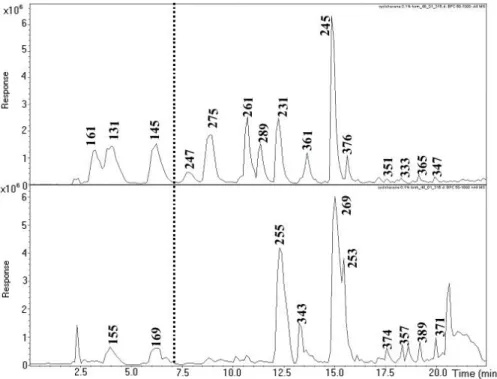
The methanol extracts of cyclohexene SOA were analysed using LC-MS/MS in both the negative and positive ionisation modes and the base peak chromatograms are shown in Fig. 2. The base peak chromatogram is a representation of the most intense single ion at each scan point and this ion mass is shown for each peak. A blank filter was also extracted but the chromatogram showed no significant peaks above the noise. Positive
20
ionisation mode had the highest sensitivity but the majority of ions had formed adducts with Na+ and K+, which provided poor fragmentation patterns and was not used further in this study.
Analytes with molecular masses below 200 Da dominate the early part of the chro-matogram. Structural analysis of fragmentation patterns and comparison with standard
25
solutions resulted in the detection of 7 low molecular weight acids. Peak identifica-tions are shown in Table 2 and correspond to the following products: glutaric acid, adipic acid, 6-oxohexanoic acid, 3,6-dihydroxy-5-oxohexanoic acid, di-oxohexanoic
ACPD
6, 6369–6399, 2006Composition of organic aerosol from
cyclohexene ozonolysis J. F. Hamilton et al. Title Page Abstract Introduction Conclusions References Tables Figures J I J I Back Close Full Screen / Esc
Printer-friendly Version Interactive Discussion acid, hydroxy-glutaric acid and hydroxy-adipic acid. The position of the hydroxyl or
carbonyl group on the final three analytes cannot be determined using this technique. The most abundant molecules found during the GCXGC analysis, i.e. the di-acids and their derivatives, also account for the majority of small molecules identified in the LC analysis, highlighting the complimentary nature of the two techniques.
5
These acids have previously been identified as some of the major components of SOA formed during cyclohexene ozonolysis and can be mechanistically linked to the parent hydrocarbon, via a number of reaction pathways. A total of 16 di-carboxylic acids, hydroxy-acids, oxo-acids, di-aldehydes and pentanal were quantified in Kalberer et al. (2000) and were found to account for almost all of the aerosol volume, based
10
on an aerosol density of 1.4 g cm−3. Gao et al. (2004a) identified a total of 20 low molecular weight species in cyclohexene-O3 SOA, which were calculated to account for 42% of the total SOA mass. A further 3% was attributed to oligomeric structures. This discrepancy was attributed partly to the use of different OH scavengers (CO versus cyclohexane) producing different HO2to RO2ratios in the reaction system. This study
15
uses i -propanol as the OH scavenger, so is different from either study. Other factors that may produce artifacts include the use of denuders, different filters and sampling preparation techniques.
Although no direct quantification was carried out in this study (since for many species no standard or authentic compound exists), it is clear from Fig. 2 that these early
gen-20
eration ozonolysis products account for perhaps less than half of the overall aerosol composition. The intensity of the base peak chromatograms suggests that the majority of compounds identified have a molecular mass greater than 200 Da and are likely the result of combination reactions either heterogeneously with the aerosol or in the gas phase. The dotted line on the chromatograms indicates the shift from small monomer
25
type compounds to dimers, formed using the monomer building blocks. Using a tan-dem MS approach with an ion-trap, the two most abundant ions at each survey scan at any point on the chromatogram are isolated and undergo one stage of collision induced fragmentation (MS2). Using the product ion mass spectra (i.e. MS2), a detailed
ACPD
6, 6369–6399, 2006Composition of organic aerosol from
cyclohexene ozonolysis J. F. Hamilton et al. Title Page Abstract Introduction Conclusions References Tables Figures J I J I Back Close Full Screen / Esc
Printer-friendly Version Interactive Discussion tural analysis of each peak was carried out and confirmed the most abundant peaks as
dimers.
The four most abundant dimers found correspond to precursor ion masses of 231, 245, 261 and 275 m/z and the MS and product ion mass spectra are shown in the top half of Figs. 3–6. Due to the limited number of fragment ions produced for these
5
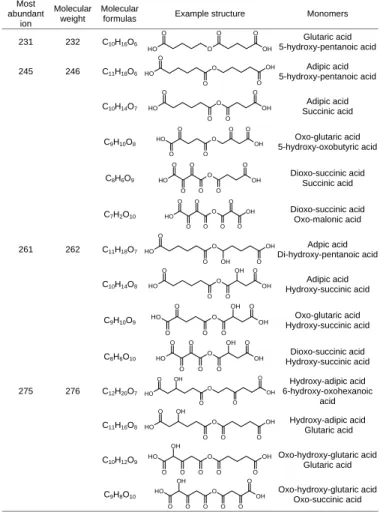
species an exact structural identification could not be obtained, only a reduction in possible chemical structure possibilities. Sufficient data was available to determine the possible molecular formulas for each peak, shown in Table 3. Each molecular formula is accompanied by one of the most likely dimer structures, assuming they are composed of the most abundant low molecular weight compounds identified in the SOA using
10
GCXGC and LC-MS. The monomer pair that would form the example structures are also shown in Table 3. In some cases, such as the C7H2O10 molecular formula for M=246 Da, the chemical structure given is the only possible isomer.
The largest peak in the chromatogram corresponds to a [M-H]− of 245 Da and the mass spectrum and product ion mass spectrum are shown in the top half of Fig. 3.
15
The 245 ion dissociates to the fragment ions of 145, 127, 117, 101, 83 Da and two structures, with different molecular formulas, that fit the required fragments are shown in the lower half of Fig. 3. In the case of all the possible molecular formulae, the linkage between the monomer units is either ester or anhydride functionality. Although the end groups may have differing combinations of C, H and O, to match the mass spectrum,
20
the linkage can only be via one of these two functional groups. In practice the spectra could well be composed of both functional types as a mixture.
The mass resolution of the ion-trap mass spectrometer is insufficient to differenti-ate between the five proposed molecular formulae for [M-H]−=245 Da. However, due to the different atomic combinations, they have slightly different accurate mass values
25
e.g. C11H18O6=246.261726 and C7H2O10=246.087894 Da. The cyclohexene extract was analysed on a micrOTOF, a time-of-flight mass spectrometer with a resolution of 10 000. This allows the measurement of accurate mass to 1 mDa, and to differentiate between two ions of very similar mass. As the isobaric compounds were separated in
ACPD
6, 6369–6399, 2006Composition of organic aerosol from
cyclohexene ozonolysis J. F. Hamilton et al. Title Page Abstract Introduction Conclusions References Tables Figures J I J I Back Close Full Screen / Esc
Printer-friendly Version Interactive Discussion time by chromatography, the resolution aspect was less important than the accurate
mass. The spectra contained information not only on the accurate mass, but also iso-tope ratios. The combinations of these two pieces of information were used to narrow down a theoretical list of potential formula to give a confident compound identification.
Using accurate mass measurements, the molecular formula of the most abundant
5
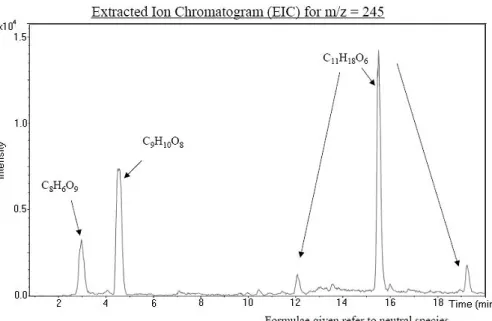
compound with M=246 Da was confirmed as C11H18O6. With this information and the MS2 fragmentation data in both the negative and positive ionisation modes, the only possible linkage of the two reactants is an ester, with the most likely structure being a dimer of adipic acid and 5-hydroxy-pentanoic acid. The extracted ion chro-matogram obtained on the micrOTOF for [M-H]−=245 Da is shown in Fig. 7. Although
10
the C11H18O6 peak is the largest in the chromatogram, more oxidised compounds are also present, and their possible structures are given in Table 3. MS2spectra are not available for these compounds due co-elution with more abundant ions.
Accurate mass measurement and the product ion mass spectrum for [M-H]=231 Da, indicate that this compound is an analogue of the previous dimer, with one less CH2
15
group i.e. C10H16O6. Combining accurate mass and tandem MS data again gives the most likely structure as the ester of glutaric acid and 5-hydroxy-pentanoic acid, shown in Fig. 4.
The next most abundant peaks correspond to 261 and 275 Da ions. Accurate mass measurements indicate these compounds are more oxidised both containing 8
oxy-20
gen atoms (C10H14O8 and C11H16O8, respectively). The linkage between monomers units can be either an ester or an acid anhydride depending on the position of the car-bonyl groups and example structures are shown in Figs. 5 and 6. The combination of MS techniques in this case is unable to determine exactly the linkage only refine to two possibilities or a combination thereof. It is clear that the composition of
hetero-25
geneous reaction products is reasonably complex, with single ion masses being most likely made up of a mixture of different molecular formulas. The power of LC is certainly required to isolate individual compounds with the same nominal mass but varying de-grees of oxidation, which are not possible using techniques based on ionisation alone.
ACPD
6, 6369–6399, 2006Composition of organic aerosol from
cyclohexene ozonolysis J. F. Hamilton et al. Title Page Abstract Introduction Conclusions References Tables Figures J I J I Back Close Full Screen / Esc
Printer-friendly Version Interactive Discussion Although the main peaks identified from tandem MS correspond generally to the least
oxidised structures in Table 3, high resolution mass spectrometry indicates that the majority of molecular formulas proposed in Table 3 are present in this SOA.
The smaller peaks at the end of the separation are difficult to see above the noise, with many low concentration species eluting together to give an elevated baseline.
5
Plotting single ion chromatograms allows individual peaks to be extracted from this baseline. The region of the chromatogram between 15 and 24 min has been expanded and individual ion chromatograms for 4 masses are shown in Fig. 8. These later peaks correspond to molecules with a molecular mass greater than 300 Da. The product ion mass spectra for the four peaks are shown in the lower region of Fig. 8. The product ion
10
mass spectra have a common set of product ions – 145, 217 and 245 Da – indicating that they have related structures. Indeed the 145 fragment corresponds to an ionised [M-H] adipic acid group and is seen in many of the dimers also. Structural analysis of the product ion mass spectra is inconclusive but suggests that these peaks are mixtures of trimers and tetramers, which cannot be individually separated by the LC
15
system used here.
In order to obtain a profile of the total molecular mass distribution of SOA compo-nents, the average mass spectra across the entire chromatogram can be combined. This approach provides a “view” of chemical composition similar to that obtained us-ing techniques such as MALDI. A comparison of the mass distribution profiles
(nega-20
tive ion mode) from the extracted blank filter and the cyclohexene SOA are shown in Fig. 9. This average mass spectra is very similar to that obtained by directly infusing the sample into the ESI-ion trap without any LC separation. The blank filter provides a background mass spectrum, where there is no obvious structure, the maximum in-tensity is 600 counts and most masses are below 400 counts. The cyclohexene SOA
25
mass spectrum shows the expected major larger ion peaks 14 (CH2) and 16 (O) Da apart. The high intensity 131, 145 and 161 Da ions correspond to glutaric acid, adipic acid and hydroxy-adipic acid identified earlier. The monomer and dimers dominate the mass spectrum (in the same way they dominate when viewed as individual
ACPD
6, 6369–6399, 2006Composition of organic aerosol from
cyclohexene ozonolysis J. F. Hamilton et al. Title Page Abstract Introduction Conclusions References Tables Figures J I J I Back Close Full Screen / Esc
Printer-friendly Version Interactive Discussion graphic peaks) but it is clear that a significant amount of aerosol mass resides in an
oligomeric form, with ion fragments above the background up to at least 600 Da. These oligomeric compounds are found in low concentrations and do not undergo MS2 frag-mentation, due to overlapping with more abundant analytes during the LC separation and insufficient sensitivity of the ion-trap during syringe infusion. The SOA resolved in
5
this paper was produced during the first hour after initial aerosol was detected and indi-cates that heterogeneous reactions do begin to occur early in the formation and aging process. Although the monomer and dimers dominate the SOA composition, within an hour molecules up to 600 Da have already formed.
The total chromatogram mass spectra shown in Fig. 9 can also be plotted for
10
the product ion mass spectra to give an indication of the most common frag-ments/monomers. The PMS2 was plotted for the monomer-dimer (Rt 2.0-Rt 16.0) and trimer-tetramer (Rt 16-Rt 32.8) regions of the chromatogram and are shown in Fig. 10. The monomer-dimer product ion mass spectrum is dominated by fragment 145 Da (adipic acid) and other low molecular weight species. The trimers-tetramers
15
spectrum shows both monomer and dimer groups, and is again dominated by 145 Da (and its fragmentation products – loss of –OH2=127 Da, loss of –CO=101 Da and loss –OH2+CO=83 Da). It is clear that although the SOA composition formed from this precursor ion is time consuming to resolve, only a limited number of key chemical frag-ments are needed to describe much of the composition. This demonstrates that only a
20
small subset of possible early stage small molecule SOA products found in the GCXGC and LC analysis take part in the heterogeneous reactions in the early stages of aerosol processing, – in this case of cyclohexene it is adipic acid that is commonly incorpo-rated to larger molecules. This would suggest that in the future it may prove feasible to construct a detailed precursor specific chemical SOA formation scheme in the manner
25
used in master chemical mechanisms for the gas phase.
ACPD
6, 6369–6399, 2006Composition of organic aerosol from
cyclohexene ozonolysis J. F. Hamilton et al. Title Page Abstract Introduction Conclusions References Tables Figures J I J I Back Close Full Screen / Esc
Printer-friendly Version Interactive Discussion
4 Conclusions
The composition of the secondary organic aerosol formed during the ozonolysis of cy-clohexene has been investigated and it was determined that the majority of the organic mass was composed of di-carboxylic acids, cyclic anhydrides and dimer molecules, formed through reactions of the most abundant small acids. Tandem mass
spectrom-5
etry indicated the predominate linkage between monomer units as either esters or acid anhydrides. Trimers and tetramers were identified but could not be structurally as-signed. High resolution mass spectrometry allowed the exact molecular formulas of the most abundant dimers to be determined, structures which can only be accounted for by mass adding heterogeneous reactions. Although the aerosol analysed was collected
10
relatively early in the aging process, molecules up to 600 Da were found. Fragmenta-tion of larger molecules produced a limited number of product ions, indicating that only a subset of gas phase reaction products undergo heterogeneous reactions.
Acknowledgements. Thanks go to K. Wirtz and the team at the Fundaci ´on Centro de Estudios
Ambientales del Mediterr ´aneo (CEAM) in Valencia, Spain. Thanks to Bruker Daltonics for
15
high-resolution mass spectrometric analysis. This research was funded by the NERC grant (NE/B50582X/1).
References
Andreae, M. O. and Crutzen, P. J.: Atmospheric aerosols: Biogeochemical sources and role in atmospheric chemistry, Science, 276, 1052–1058, 1997.
20
Artaxo, P., Storms, H., Bruynseels, F., Vangrieken, R., and Maenhaut, W.: Composition and Sources of Aerosols from the Amazon Basin, J. Geophys. Res., 93, 1605–1615, 1988. Bahreini, R., Keywood, M. D., Ng, N. L., Varutbangkul, V., Gao, S., Flagan, R. C., Seinfeld,
J. H., Worsnop, D. R., and Jimenez, J. L.: Measurements of secondary organic aerosol from oxidation of cycloalkenes, terpenes, and m-xylene using an Aerodyne aerosol mass
25
spectrometer, Env. Sci. Techol., 39, 5674–5688, 2005.
ACPD
6, 6369–6399, 2006Composition of organic aerosol from
cyclohexene ozonolysis J. F. Hamilton et al. Title Page Abstract Introduction Conclusions References Tables Figures J I J I Back Close Full Screen / Esc
Printer-friendly Version Interactive Discussion
Forstner, H. J. L., Flagan, R. C., and Seinfeld, J. H.: Secondary organic aerosol from the pho-tooxidation of aromatic hydrocarbons: Molecular composition, Env. Sci. Techol., 31, 1345– 1358, 1997.
Fowlis, I. A.: Gas Chromatography, in: “Analytical Chemistry by Open Learning”, John Wiley and Sons, 1995.
5
Gao, S., Keywood, M., Ng, N. L., Surratt, J., Varutbangkul, V., Bahreini, R., Flagan, R. C., and Seinfeld, J. H.: Low-molecular-weight and oligomeric components in secondary or-ganic aerosol from the ozonolysis of cycloalkenes and alpha-pinene, J. Phys. Chem. A., 108, 10 147–10 164, 2004a.
Gao, S., Ng, N. L., Keywood, M., Varutbangkul, V., Bahreini, R., Nenes, A., He, J. W., Yoo, K.
10
Y., Beauchamp, J. L., Hodyss, R. P., Flagan, R. C., and Seinfeld, J. H.: Particle phase acidity and oligomer formation in secondary organic aerosol, Env. Sci. Techol., 38, 6582–6589, 2004b.
Hamilton, J. F., Webb, P. J., Lewis, A. C., Hopkins, J. R., Smith, S., and Davy, P.: Partially oxidised organic components in urban aerosol using GCXGC-TOF/MS, Atmos. Chem. Phys.,
15
4, 1279–1290, 2004.
Hamilton, J. F., Webb, P. J., Lewis, A. C., and Reviejo, M. M.: Quantifying small molecules in secondary organic aerosol formed during the photo-oxidation of toluene with hydroxyl radicals, Atmos. Env., 39, 7263–7275, 2005.
Hastings, W. P., Koehler, C. A., Bailey, E. L., and De Haan, D. O.: Secondary organic aerosol
20
formation by glyoxal hydration and oligomer formation: Humidity effects and equilibrium shifts during analysis, Env. Sci. Techol., 39, 8728–8735, 2005.
Jang, M. S. and Kamens, R. M.: Characterization of secondary aerosol from the photooxidation of toluene in the presence of NOx and 1-propene, Env. Sci. Techol., 35, 3626–3639, 2001. Kalberer, M., Paulsen, D., Sax, M., Steinbacher, M., Dommen, J., Prevot, A. S. H., Fisseha, R.,
25
Weingartner, E., Frankevich, V., Zenobi, R., and Baltensperger, U.: Identification of polymers as major components of atmospheric organic aerosols, Science, 303, 1659–1662, 2004. Kalberer, M., Sax, M., and Samburova, V.: Characterization of polymers in nanometer sized
atmospheric aerosol particles, Chimia, 59, 43–43, 2005.
Kalberer, M., Yu, J., Cocker, D. R., Flagan, R. C., and Seinfeld, J. H.: Aerosol formation in the
30
cyclohexene-ozone system, Env. Sci. Techol., 34, 4894–4901, 2000.
Kimura, M., Hasegawa, Y., Nakagawa, K., Kajita, M., Watanabe, K., and Yamaguchi, S.: A sensitive method for 4-hydroxybutyric acid in urine using gas chromatography-mass
ACPD
6, 6369–6399, 2006Composition of organic aerosol from
cyclohexene ozonolysis J. F. Hamilton et al. Title Page Abstract Introduction Conclusions References Tables Figures J I J I Back Close Full Screen / Esc
Printer-friendly Version Interactive Discussion
trometry, J. Chromatogr., B: Anal. Technol. Biomed. Life Sci., 792, 141–144, 2003.
Putaud, J. P., Raes, F., Van Dingenen, R., Bruggemann, E., Facchini, M. C., Decesari, S., Fuzzi, S., Gehrig, R., Huglin, C., Laj, P., Lorbeer, G., Maenhaut, W., Mihalopoulos, N., Mulller, K., Querol, X., Rodriguez, S., Schneider, J., Spindler, G., ten Brink, H., Torseth, K., and Wieden-sohler, A.: European aerosol phenomenology-2: chemical characteristics of particulate
mat-5
ter at kerbside, urban, rural and background sites in Europe, Atmos. Env., 38, 2579–2595, 2004.
Saxena, P. and Hildemann, L. M.: Water-soluble organics in atmospheric particles: A critical review of the literature and application of thermodynamics to identify candidate compounds, J. Atmos. Chem., 24, 57–109, 1996.
10
Talbot, R. W., Andreae, M. O., Andreae, T. W., and Harriss, R. C.: Regional Aerosol Chemistry of the Amazon Basin During the Dry Season, J. Geophys. Res., 93, 1499–1508, 1988. Tolocka, M. P., Jang, M., Ginter, J. M., Cox, F. J., Kamens, R. M., and Johnston, M. V.:
Forma-tion of oligomers in secondary organic aerosol, Env. Sci. Techol., 38, 1428–1434, 2004.
ACPD
6, 6369–6399, 2006Composition of organic aerosol from
cyclohexene ozonolysis J. F. Hamilton et al. Title Page Abstract Introduction Conclusions References Tables Figures J I J I Back Close Full Screen / Esc
Printer-friendly Version Interactive Discussion
Table 1. Low molecular weight reaction products identified in cyclohexene ozonolysis SOA
using GCXGC-TOF/MS.
Identified analyte Mass Peak on
GCXGC Structure
LINEAR ALDEHYDES and KETONES
butanal 72 1 O pentanal 86 3 O hexanal 100 4 O 2-propenal 56 O 2-butenal 70 O 2-hexenal 98 O 3-hydroxy-butenal 86 O OH butanedial 86 O O hexanedial 114 12 O O 2-hexanone 100 O ACIDS propanoic acid 74 OH O butanoic acid 88 6 OH O pentanoic acid 102 8 OH O hexanoic acid 116 OH O
butandioc acid (succinic acid) 118 OH
O O H
O
pentandioc acid (glutaric acid) 132 17
OH O O O H
hexandioc acid (adipic acid) 146 18 OH
O O
H O 6385
ACPD
6, 6369–6399, 2006Composition of organic aerosol from
cyclohexene ozonolysis J. F. Hamilton et al. Title Page Abstract Introduction Conclusions References Tables Figures J I J I Back Close Full Screen / Esc
Printer-friendly Version Interactive Discussion Table 1. Continued. OTHERS butanol 74 2 OH 2-butene-1,4-diol 88 HO OH 2-butoxyethanol 118 O OH
hexanoic acid anhydride 214 20
O O O CYCLICS Cyclohexanone 98 9 O 1,2-cyclohexandione 112 O O 2-hydroxy-cyclohexanone 114 11 O OH cyclohexanol 100 7 OH 1,2-cyclohexandiol 116 15 OH OH
formic acid cyclohexyl ester 128 O
O cyclohexen-2-one 96 O 1-4-cyclohexen-2-dione 110 O O cyclopentanone 84 5 O cyclopentane carboxaldehyde 98 O 2-methyl-cyclopentanone 98 O cyclopentenone 82 O cyclopentendione 96 O O 6386
ACPD
6, 6369–6399, 2006Composition of organic aerosol from
cyclohexene ozonolysis J. F. Hamilton et al. Title Page Abstract Introduction Conclusions References Tables Figures J I J I Back Close Full Screen / Esc
Printer-friendly Version Interactive Discussion Table 1. Continued. dihydro-2(3H)-furanone 86 10 O O 2(5H)-furanone 84 O O dihydro-5-methyl-2(3H)-furanone 100 O O 2,5-furandione 98 O O O 2,5-dihydro-furandione (succinic anhydride) 100 13 O O O 5-oxotetrahydro-furan-2-carboxylic acid 128 19 O O O tetrahydro-2H-pyran-2-one 100 14 O O dihydro-2H-pyran-2,6-(3H)-dione 114 16 O O O 2-oxepanone 114 O O 6-oxo-bicyclo[3.1.0]hexan-3-one 98 O O 7-oxobicyclo[4.1.0]heptane 98 O 6,8-dioxabicyclo[3.2.1]octane 114 O O 6387
ACPD
6, 6369–6399, 2006Composition of organic aerosol from
cyclohexene ozonolysis J. F. Hamilton et al. Title Page Abstract Introduction Conclusions References Tables Figures J I J I Back Close Full Screen / Esc
Printer-friendly Version Interactive Discussion
Table 2. Low molecular weight reaction products in cyclohexene ozonolysis SOA extract
iden-tified using LC-MS/MS.
Identified analyte [M-H]
m/z ratio Mass Structure
6-Oxo-hexanoic acid 129 130 H OH O O Dioxo-hexanoic acid 145 146 H OH O O O
Pentanedioc acid (Glutaric) 131 132
OH O O
H O
Hexanedioc acid (Adipic) 145 146 HO OH
O O Hydroxy-glutaric acid 147 148 OH O O H O OH Hydroxy-adipic acid 161 162 HO OH O O OH 3,6-dihydroxy-5-oxohexanoic acid 161 162 HO OH O OH O 6388
ACPD
6, 6369–6399, 2006Composition of organic aerosol from
cyclohexene ozonolysis J. F. Hamilton et al. Title Page Abstract Introduction Conclusions References Tables Figures J I J I Back Close Full Screen / Esc
Printer-friendly Version Interactive Discussion
Table 3. Proposed dimer structures of peaks identified in LC-MS/MS chromatogram. Possible
molecular formulas and corresponding dimer-monomer pairs are shown for each mass.
Most abundant ion Molecular weight Molecular
formulas Example structure Monomers
231 232 C10H16O6 O H O O O OH O Glutaric acid 5-hydroxy-pentanoic acid 245 246 C11H18O6 HO O OH O O O Adipic acid 5-hydroxy-pentanoic acid C10H14O7 HO O O O O OH O Adipic acid Succinic acid C9H10O8 O O OH O O H O O O Oxo-glutaric acid 5-hydroxy-oxobutyric acid C8H6O9 O O O OH O O O H O O Dioxo-succinic acid Succinic acid C7H2O10 O O O O O H O O O OH O Dioxo-succinic acid Oxo-malonic acid 261 262 C11H18O7 HO O O OH O OH O Adpic acid Di-hydroxy-pentanoic acid C10H14O8 HO O OH O O O OH O Adipic acid Hydroxy-succinic acid C9H10O9 O OH O O OH O O H O O Oxo-glutaric acid Hydroxy-succinic acid C8H6O10 O OH O O OH O O O H O O Dioxo-succinic acid Hydroxy-succinic acid 275 276 C12H20O7 HO O O O OH OH O O Hydroxy-adipic acid 6-hydroxy-oxohexanoic acid C11H16O8 HO O O OH O O O OH Hydroxy-adipic acid Glutaric acid C10H12O9 O OH O O O OH O H O O Oxo-hydroxy-glutaric acid Glutaric acid C9H8O10 O OH O O O H O O OH O O Oxo-hydroxy-glutaric acid Oxo-succinic acid 6389
ACPD
6, 6369–6399, 2006Composition of organic aerosol from
cyclohexene ozonolysis J. F. Hamilton et al. Title Page Abstract Introduction Conclusions References Tables Figures J I J I Back Close Full Screen / Esc
Printer-friendly Version Interactive Discussion 12 11 10 9 7 6 8 5 4 3 2 1 18 17 16 15 14 13 20 19
Fig. 1. TIC chromatogram obtained by TD-GCXGC-TOF/MS of a cyclohexene ozonolysis
aerosol sample. Peak identifications are given in Table 1.
ACPD
6, 6369–6399, 2006Composition of organic aerosol from
cyclohexene ozonolysis J. F. Hamilton et al. Title Page Abstract Introduction Conclusions References Tables Figures J I J I Back Close Full Screen / Esc
Printer-friendly Version Interactive Discussion
Fig. 2. Electrospray LC-ion-trap MS chromatograms of the cyclohexene SOA methanol extract.
Upper: Negative ionisation mode. Lower: Positive ionisation mode. Labels correspond to the most abundant ion for each peak.
ACPD
6, 6369–6399, 2006Composition of organic aerosol from
cyclohexene ozonolysis J. F. Hamilton et al. Title Page Abstract Introduction Conclusions References Tables Figures J I J I Back Close Full Screen / Esc
Printer-friendly Version Interactive Discussion
Fig. 3. Mass spectral data and structural analysis of peak with [M-H]− of 245 Da. Top: MS spectrum at peak apex. Middle: Collision induced dissociation product ion spectrum. Bottom: Two possible structures that explain the MS2fragmentation. High mass resolution spectrometry indicates that the upper structure has the correct molecular formula and is most likely.
ACPD
6, 6369–6399, 2006Composition of organic aerosol from
cyclohexene ozonolysis J. F. Hamilton et al. Title Page Abstract Introduction Conclusions References Tables Figures J I J I Back Close Full Screen / Esc
Printer-friendly Version Interactive Discussion
Fig. 4. Mass spectral data and structural analysis of peak with [M-H]− of 231 Da. Top: MS spectrum at chromatographic peak apex. Middle: Collision induced dissociation product ion spectrum. Bottom: Proposed structure, fragments that explain MS2spectrum are shown.
ACPD
6, 6369–6399, 2006Composition of organic aerosol from
cyclohexene ozonolysis J. F. Hamilton et al. Title Page Abstract Introduction Conclusions References Tables Figures J I J I Back Close Full Screen / Esc
Printer-friendly Version Interactive Discussion
Fig. 5. Mass spectral data and structural analysis of peak with [M-H]− of 261 Da. Top: MS spectrum at peak apex. Middle: Collision induced dissociation product ion spectrum. Bottom: Proposed structures with ester (upper) and acid anhydride (lower) linkages. Both structures can explain MS2spectrum and have correct molecular formula.
ACPD
6, 6369–6399, 2006Composition of organic aerosol from
cyclohexene ozonolysis J. F. Hamilton et al. Title Page Abstract Introduction Conclusions References Tables Figures J I J I Back Close Full Screen / Esc
Printer-friendly Version Interactive Discussion
Fig. 6. Mass spectral data and structural analysis of peak with [M-H]− of 275 Da. Top: MS spectrum at peak apex. Middle: Collision induced dissociation product ion. Bottom: Proposed structures with ester (upper) and acid anhydride (lower) linkages. Both structures can explain MS2spectrum and have correct molecular formula.
ACPD
6, 6369–6399, 2006Composition of organic aerosol from
cyclohexene ozonolysis J. F. Hamilton et al. Title Page Abstract Introduction Conclusions References Tables Figures J I J I Back Close Full Screen / Esc
Printer-friendly Version Interactive Discussion
Fig. 7. Extracted ion chromatogram for m/z 245, obtained using high resolution micrOTOF
detector. Peaks are labelled with the associated molecular formula.
ACPD
6, 6369–6399, 2006Composition of organic aerosol from
cyclohexene ozonolysis J. F. Hamilton et al. Title Page Abstract Introduction Conclusions References Tables Figures J I J I Back Close Full Screen / Esc
Printer-friendly Version Interactive Discussion
Fig. 8. Upper: Extracted ion chromatograms for m/z 332.8 (black), 264.5 (red), 346.3 (green),
and 351.6 Da (blue). Lower: Product ion mass spectrum for each peak.
ACPD
6, 6369–6399, 2006Composition of organic aerosol from
cyclohexene ozonolysis J. F. Hamilton et al. Title Page Abstract Introduction Conclusions References Tables Figures J I J I Back Close Full Screen / Esc
Printer-friendly Version Interactive Discussion
Fig. 9. Averaged mass spectrum across the entire LC chromatogram. Upper: Blank filter.
Lower: Cyclohexene ozonolysis aerosol.
ACPD
6, 6369–6399, 2006Composition of organic aerosol from
cyclohexene ozonolysis J. F. Hamilton et al. Title Page Abstract Introduction Conclusions References Tables Figures J I J I Back Close Full Screen / Esc
Printer-friendly Version Interactive Discussion
Fig. 10. Average product ion mass spectrum across the entire LC chromatogram. Upper:
Monomer and dimer region. Lower: Trimer and tetramers region.



![Fig. 3. Mass spectral data and structural analysis of peak with [M-H] − of 245 Da. Top: MS spectrum at peak apex](https://thumb-eu.123doks.com/thumbv2/123doknet/14777382.594548/25.918.122.591.52.523/fig-mass-spectral-data-structural-analysis-peak-spectrum.webp)
![Fig. 4. Mass spectral data and structural analysis of peak with [M-H] − of 231 Da. Top: MS spectrum at chromatographic peak apex](https://thumb-eu.123doks.com/thumbv2/123doknet/14777382.594548/26.918.120.585.112.476/fig-mass-spectral-data-structural-analysis-spectrum-chromatographic.webp)
![Fig. 5. Mass spectral data and structural analysis of peak with [M-H] − of 261 Da. Top: MS spectrum at peak apex](https://thumb-eu.123doks.com/thumbv2/123doknet/14777382.594548/27.918.125.590.38.529/fig-mass-spectral-data-structural-analysis-peak-spectrum.webp)
![Fig. 6. Mass spectral data and structural analysis of peak with [M-H] − of 275 Da. Top: MS spectrum at peak apex](https://thumb-eu.123doks.com/thumbv2/123doknet/14777382.594548/28.918.124.590.36.538/fig-mass-spectral-data-structural-analysis-peak-spectrum.webp)