O
pen
A
rchive
T
oulouse
A
rchive
O
uverte (
OATAO
)
OATAO is an open access repository that collects the work of Toulouse researchers and
makes it freely available over the web where possible.
This is an author-deposited version published in:
http://oatao.univ-toulouse.fr/
Eprints ID: 6222
To link to this book section :
https://www.novapublishers.com/catalog/product_info.php?products_id=8624
To cite this version : Costa-Dias, Sérgia and Sousa, Ronaldo and
Lobón-Cerviá, Javier and Laffaille, Pascal The decline of diadromous fish in
Western Europe inland waters: mains causes and consequence. (2009) In:
Fisheries : Management, economics and perspectives. Nova Science
Publishers, pp. 67-92. ISBN 978-1-60692-303-0
Any correspondence concerning this service should be sent to the repository
administrator:
[email protected]
T
HE
D
ECLINE OF
D
IADROMOUS
F
ISH IN
W
ESTERN
E
UROPEAN
I
NLAND
W
ATERS
:
M
AIN
C
AUSES
AND
C
ONSEQUENCES
Sérgia Costa-Dias
1, 2, 3, Ronaldo Sousa
1, 2, Javier Lobón-Cerviá
3&
Pascal Laffaille
41 CIMAR/CIIMAR – Centro Interdisciplinar de Investigação Marinha e Ambiental -
Universidade do Porto, Rua dos Bragas 289, 4050-123 Porto, Portugal
2 ICBAS - Instituto de Ciências Biomédicas de Abel Salazar - Universidade do Porto, Lg.
Prof. Abel Salazar 2, 4099-003 Porto, Portugal
3 Museo Nacional de Ciencias Naturales - Dep. Ecología Evolutiva, C/ José Gutiérrez
Abascal 2, 28006 – Madrid, Spain
4 Equipe Biodiversité et Gestion des Territoires, Université de Rennes 1, Campus
Beaulieu, 35043 Rennes, France
A
BSTRACTRelative to the overwhelming information available on marine fisheries, inland systems have received less attention within the global fisheries crisis. The present situation however, raises serious concerns and this chapter is an attempt to summarize the status of Western European inland fisheries focused on some of the most valuable species targeted in Western Europe: diadromous fishes, including shads, salmonids and the European eel. These species have been reported to be declining over the last decades and the underlying causes appear to be related with human impact on habitat, water quality deterioration, river regularizations, introduction of invasive species, and overexploitation whereas the effects of climate change are still under debate.
Overall, these species not only have economic importance but also play fundamental ecological roles in inland aquatic habitats including nutrient cycling, trophic dynamics and overall productivity. Consequently, a decline of migratory fish populations may have important direct and future consequences on the economy. Nevertheless, it also means that fewer species are present to perform critical functions and the consequences may be severe when species with disproportionately influence on biogeochemical cycles, energy fluxes and trophic dynamics are lost. In view of this, the sustainable future of inland
fisheries will certainly include a compromise with biodiversity maintenance. Since for different species and types of habitat the major impacts differ, some case studies are examined and management proposals are discussed.
1. I
NTRODUCTIONDuring the last decades inland aquatic systems have been severely damaged or altered at a greater rate than at any other period in human history (Dudgeon et al. 2006). Such changes have resulted in an increased interest to develop conservation strategies for such important habitats (Ricciardi & Rasmussen 1999; Dudgeon 2000; Bergerot et al. 2008). Areas near aquatic ecosystems were always favored sites for human settlement and activities, and were heavily exploited for water supply, irrigation, electricity generation, industrial and private use, waste disposal, food resources, as routes for navigation, and more recently further exploited for tourism and leisure activities (see for example Szöllosi-Nagy et al. 1998). Therefore, it should be expected that increases in human demographics and resource exploitation resulted in a greater ecological impact and the consideration of these systems as the most impacted areas of the planet (Malmqvist & Rundle 2002; Dudgeon et al. 2006).
Of the great diversity of animals that colonized inland aquatic ecosystems, fishes are one of the most threatened taxonomic groups (Darwall & Vié 2005) due to their high sensitivity to alterations of aquatic habitats (Laffaille et al. 2005; Oberdorff et al. 2002). Some diadromous species (i.e. species with life cycle stages in both fresh and marine waters, for which they migrate between those types of habitat) are now classified as rare or endangered largely due to adverse effects of human activities. By their migratory life style, diadromous fishes may be at a higher risk of extinction (e.g. exploitation of various and different habitats for reproduction and growth, and long distance of migration). In addition, general reasons have been pointed out for the decline of migratory fish species in Western European waters namely habitat loss (e.g. Moriarty & Dekker 1997), estuarine or freshwater habitat deterioration (e.g. Lepage et al. 2000; Laffaille et al. 2004), introduction of invasive species (e.g. Lefebvre et al. 2004), severe pollution (e.g. Maes et al. 2007), flow regularization (e.g. Gowans et al. 1999; Domingos et al. 2006), climate change (e.g. Knights 2003) and overexploitation (e.g. Masters et al. 2006).
Based on a set of 41 river drainages, Béguer et al. (2007) and Lassalle et al. (2008) analyzed the distribution of 14 diadromous fish (including the ones focused on in this chapter) at the beginning of the 20th century in Western Europe. Although some species have
disappeared from some of those water basins, their study allowed the evaluation of the importance of several environmental variables and the use of predictive models for species absence/presence data. Although there was no proportionality between the number of diadromous species and the surface area of the basin, they have found that Western European basins contain a large majority of anadromous species (i.e. reproduction occurs in fresh water, growth period in marine water) and that the proportion of these species increases with latitude. Furthermore, their analysis and model predictions suggested that the distribution of diadromous species richness results from the interaction between four main factors: temperature, surface area, stream flow power and catchment productivity. Guégan et al. (1998) also showed that energy availability and habitat heterogeneity predict global riverine fish diversity and consequently migratory fish. Generally, each species presents habitat
preferences for individual or combinations of factors (see for example Bardonnet & Baglinière 2000, for Atlantic salmon) and as a consequence each species displays different distribution patterns.
The present chapter reports on the temporal variations in numbers either collected from fishery data or wild population surveys during the last decades including the severe decline of migratory species in Western Europe namely on Atlantic salmon Salmo salar Linnaeus, 1758, allis shad Alosa alosa Linnaeus, 1758, European sturgeon Acipenser sturio L., 1758, and European eel Anguilla anguilla Linnaeus, 1758. Although not so emblematic, there are other migratory fish with considerable importance that are also worth mentioning such as sea trout
Salmo trutta trutta Linnaeus, 1758, brown trout Salmo trutta fario Linnaeus, 1758, twaite
shad Alosa fallax Lacepède, 1803, and sea lamprey Petromyzon marinus Linnaeus, 1758. All these species except eel have anadromous behaviors, thus adults enter inland waters to reproduce in rivers and streams’ clear and well oxygenated waters. The offspring spend a variable (depending on the species) growth period within the natal river before migrating to the ocean (McDowall 1988). The European eel is catadromous (i.e. reproduction occurs at sea, growth period mainly in inland waters), usually living in continental waters during its main growth period, but reproduction is carried out in the Sargasso Sea (Atlantic Ocean). After spawning the offspring are carried by the Gulf Stream towards the Western coast of Europe and North Africa as “leptocephali”, the larval stage. At the continental shelf they metamorphose into glass eels and enter continental waters (recruitment), where they become yellow eel and remain until they start the opposite migration for spawning, as silver eels (Tesch 2003).
Undoubtedly, it seems critical to thoroughly identify the causes of diadromous fish declines within the global fisheries crisis. In this chapter we have tried to summarize the most relevant economic and ecological aspects related with the above mentioned species and the principal effects provoked by decreases in diversity and density of migratory fish species in Western European running waters. In addition, special attention will be devoted to future perspectives of these fisheries and possible management proposals. Although focusing mainly on Western European waters, some parallels will be established with other worldwide areas, and to the same extent the framework provided by this chapter could be useful in other ecosystems where this problem follows a similar pattern.
2. THE
DECLINE:
P
OTENTIALC
AUSESThe causes of the decline in abundance or local extinction of diadromous species are varied (rarely due to one factor alone) and probably the result of cumulative and/or an interplay of anthropogenic effects (Rochard et al. 1990; Jonsson et al. 1999; Feunteun 2002). Consequently hierarchical evidence has been rarely demonstrated (Baisez & Laffaille 2005).
It was not our intention to fully review all the reasons behind these declines in this section but instead to consider the most relevant ones. Examples of studies pointing out the most emphasized causes for the decline of some of the species’ populations referred in this chapter are presented on Table 1. Nevertheless, what we can discuss are the most probable causes, since defining cause-effect links generally carries a high degree of uncertainty and lack of data is often responsible for inconclusive results.
Table 1. Examples of studies were authors identified main causes of population disturbance. Causes in columns, in accordance with the text
Habitat IS Contam F.regul. C.Change Overexp. Study
Atlantic x Ackefors, et al. 2001
Salmon xx Boet, et al. 1999
x Fausch, 2007
x Hesthhagen & Hansen 1991
x Johnsen & Jensen 1991
Brown x Blanchet, et al. 1991
Trout x Fausch, 2007
Lobon-Cervia 2007
European x x x x x Acou, et al. 2008
Eel x x x x x Bonhommeau, et al. 2008
x x x x x Friedland, et al. 2007
xx Kirk 2003
xx Knights 2003
xx Lobon-Cervia 2007
xx Moriarty & Dekker 1997
xx Nicola, et al. 1996
European xx Boet, et al. 1999
Sturgeon xx xx xx Lenhardt, et al. 2006
xx Nicola, et al. 1996
Sea xx Boet, et al. 1999
Lamprey xx Nicola, et al. 1996
Shads xx Boet, et al. 1999
xx Nicola, et al. 1996
xx x x Taverny, et al. 2000
x – referred as influencing the species population
2.1. Habitat Loss
Habitat loss has been pointed out as the most common threat to biodiversity (Rodrigues et al. 2006) and in the case of aquatic ecosystems it may be a consequence of an alteration of land usage such as conversion to agricultural areas or construction on the margins, interventions on the riverbed such as channelization, or inaccessibility caused by physical barriers like ditches and dams. Probably the most significant anthropogenic influence on the decrease of diadromous fishes has been alteration, degradation and destruction of habitat (Jonsson et al. 1999). Effects are very difficult to estimate because they range from small (modification of micro-habitat characteristics) to large spatial scales (alteration of ecosystem processes) (Gregory & Bisson 1997).
In the case of ditches, weirs and dams, migration to suitable areas for reproduction (especially for anadromous fish) or feeding (especially for eel) may be prevented. In addition, water impoundments interfere with both longitudinal and lateral connectivity, that is, with upstream-downstream and lateral movements, respectively. A decrease in longitudinal and lateral connectivity may result in fragmentation of the systems and alter the natural flooding patterns (Jones & Stuart 2008).
Lateral connectivity with the main channel is likely to lead to seasonal habitat accessibility. For instance, in an Amazonian floodplain, Granado-Lorencio et al. (2005) showed that the connectivity level influences the distribution patterns of migratory fishes. Similar results were observed in the Loire floodplain (France), where the lateral eel population characteristics (size, density, growth rate) are likely to be heterogeneous (Lasne et al. in press). Surprisingly, migratory fish researchers still continue to largely ignore the ecological and conservational importance of lateral river connectivity.
Effects of longitudinal connectivity in human altered systems are more recognized (Rodriguez 2002; Domingos et al. 2006). For instance, Allis shad in River Minho (Northwestern of Iberian Peninsula) is an example of the declined catches caused by a dam-impacted population. Following the first of a series of dams construction during the 1950’s and 60’s, the number of shads captured per year by traditional fisheries drop from around 62 000 to 36 000 individuals, with a subsequent decline to less than 1000 individuals per year when all dams were working (Taverny et al. 2000). Moreover, by the 1990’s the blockage of fish movements caused by dams built in large rivers of the Iberian Peninsula, and the absence or inefficacy of transposable mechanisms, were identified as the main cause for the extinction of species such as lamprey, sturgeon, shads and eel from central Spain (Nicola et al. 1996). Similar results were obtained in the River Guadalquivir (Spain) after the Alcalá del Rio dam construction in 1931 (Granado-Lorencio 1991). Habitat loss due to the blockage or drying of interconnecting ditches resulted in the loss of foraging places for eel in the Yser basin (Flandrian part) (Denayer & Belpaire 1996). The construction of weirs and dams along the Seine (France) was held responsible for the local extinction of sturgeon, salmon, marine lamprey and shads, due to the definite closure of passages to spawning grounds (Boët et al. 1999). Similarly, the blockage of free access to spawning grounds is considered to be one of the main reasons for the decline of sturgeons (Lenhardt et al. 2006).
In the case of large physical obstacles such as dams, further than preventing access to upstream areas, they may also prevent downstream migrations or lead to high mortality rates caused by individuals fall or turbines’ injuries in the case of hydroelectric facilities (Taverny et al. 2000).
Gosset et al. (2006) assessed the impact of anthropogenic fragmentation on migratory behavior of brown trout in the River Bidasoa (Spain). The presence of obstacles isolated upstream areas from the main stem, generating an asymmetrical gene flow and creating partially or fully isolated reproductive units at the watershed scale. These authors hypothesize that the extra time and energy consumed by migrating individuals downstream of weirs, waiting for an increase in discharge that allows migration, would compromise their reproductive success and survival probability.
Loss of habitat, and especially that lost above barrages and dams (through the disconnection of available habitat from the stream), seems to be responsible for the European eel decline, or even local extinction (Moriarty & Dekker 1997). Nowadays, migration of eels in many European rivers is obstructed by dams, and it was estimated that 33% of the habitat within its natural range was not accessible for natural or artificial reasons more than one decade ago (Moriarty & Dekker 1997). Although the situation varies between countries, over 90% of habitat was lost in Spain, and eel disappeared in more than 80% of river catchments across the Iberian Peninsula, remaining abundant in only a few coastal streams whose waters flow unimpeded into the sea (Lobón-Cerviá 1999).
Even though some situations are reversible, in the Gironde Estuary (France), destruction of essential habitat for the Atlantic sturgeon due to gravel extraction has totally condemned restoration possibilities (Lepage et al. 2000).
Nevertheless, the effects of dam construction may be hardly apparent on fisheries decrease over the years since a specific pressure may be acting synergistically in combination with other disturbances. Therefore, it may not be straightforward to link population declines with single factors. For example, random catastrophes (e.g. local epidemics or abrupt abiotic changes) and habitat losses induced by human interventions may increase the extinction risks of populations living in fragmented habitats (Casagrandi & Gatto 2002).
2.2. Invasive Species (IS)
Man has a long history of exploiting natural resources but not an equivalent one for their management. Several species have been deliberately or accidentally introduced into areas outside their natural range for nutritional needs, health control or simply commercial or recreational purposes. By aquatic IS (see Copp et al. 2005) we may be referring to a wide range of organism types, including plants and animals such as crustaceans, molluscs, fishes, mammals and parasites of any of those organisms. Although human activities have been determinant in IS introductions and dispersion (Leprieur et al. 2008), the potential interactions between native and introduced fish species in Europe have been little investigated (Blanchet et al. 2007).
IS may impact aquatic ecosystems at the individual (e.g. altering the behavior of native species, influencing habitat use and foraging), population (e.g. changing abundance, biomass and distribution of other species), community (e.g. altering interactions among populations and potentially inducing trophic cascades) and ecosystem (e.g. changing pathways and magnitude of movement of energy and nutrients) levels (Simon & Townsend 2003). From the potential impacts of introduced fish on the native fishes of the English Lake District, Winfield and Durie (2004) pointed out the most relevant ones as being competition, predation and habitat modifications. Competition for food resources may be disastrous even when the
species for which they compete are initially abundant since a sustained and rapid increase of the introduced species population may lead to consequent limitation in resources. Blanchet et al. (2007) investigated the strength of competition between the native brown trout and the exotic brook trout (Salvelinus fontinalis (Mitchill, 1814)) and rainbow trout (Oncorhynchus
mykiss (Walbaum, 1792), using both laboratorial and field experiments in Southwest France.
Since the juvenile period is a critical stage in the fish life, they have used young-of-the-year individuals, and considered both intra- and inter-specific competition. These authors concluded that brook trout may represent a minor risk for native brown trout, but that the rainbow trout may negatively affect the native trout in European streams. Apart from the direct effects of invading salmonids due to biotic interactions, they may also have indirect effects on native species by fragmenting their habitat and isolating native populations (Fausch 2007).
The proportion of native freshwater species has been falling with the increasing number of IS incorporated into freshwater communities. Consequently, alterations in the abundance or type of available preys and predators, or in the bottom morphology, among other potential changes caused by introduced species, may occur. Theoretically, generalist feeders may overcome major changes in their diet, but species with specialized feeding tactics may be marginalized by rearrangements in the food web due to introduced species (Oberdorff et al. 2002).
According to Baxter et al. (2004) IS may also change subsidies and affect distant food webs. These authors, working in a large scale field experiment performed in northern Japan, were able to demonstrate that the IS rainbow trout interrupted reciprocal flows of invertebrate prey that were essential to the maintenance of the stream and adjacent riparian forest food webs. In detail, rainbow trout consumed terrestrial prey that fell into the stream, changing the foraging habits of the native Dolly Varden charr (Salvelinus malma) that was forced to consume insects that graze algae from the stream bottom. This situation indirectly increased algal biomass and decline the biomass of adult aquatic insects emerging from the stream to the forest. All these changes provoked by the introduction of a IS ultimately led to a 65% reduction in the density of riparian-specialist spiders in the forest.
There are also examples of catastrophic impacts of parasites introduced along with their natural hosts such as the nematode Anguillicola crassus, a swimbladder parasite of the Japanese eel introduced at the beginning of the 1980s (Blanc 1989; Kirk 2003) that seriously affected European eel populations (Lefèbvre et al. 2004; Eel Rep. 2005). Another example concerns the monogenous parasite Gyrodactylus salaries, introduced into Norwegian rivers in the mid of 1970s, that was responsible for a 50% reduction in the natural production of salmon in Norway (Johnsen & Jensen 1991). A more subtle impact of IS is the possible genetic introgression with native fish species. Introgression can increase the likelihood of local extinction by reducing fitness and the ability of populations to adapt to changing conditions (Allendorf & Leary 1988). Although the data dealing with this issue in fish species is still limited, some studies have already shown hybridization between the invasive rainbow trout (Onchorhynchus mykiss) and cutthroat trout (Salmo clarki (Girard)), Apache trout (O.
apache (Miller)) and Gila trout (O. gilae (Miller)) (Simon & Townsend 2003 and references
therein). In addition, stocking of conspecifics can also result in introgression and reduced genetic variability and for example hybridization between hatchery and wild populations of salmonids, including brown trout (Hansen et al. 2001) and brook trout (Salvelinus fontinalis) (Hayes et al. 1996) have been documented.
2.3. Contamination
Due to human extensive presence, aquatic systems have been broadly used as generalized waste recipients. Fishes, and the European eel in particular, have been widely investigated as biomonitors of the system’s health and demonstrated to accumulate contaminants in accordance with concentrations in water or sediments (e.g. Batty et al. 1996; Bordajandi et al. 2003; Linde et al. 1999; Usero et al. 2003; Belpaire & Goemans 2007). Nevertheless, except for eels (e.g. see Belpaire & Goemans 2007), studies on the behavioral impacts of such contamination, or on the long term survival of individual migratory fish or of their offspring are lacking. Specific characteristics of the eel like size, life span, fat content, benthic feeding, habitat ecology, distribution, euryhyalinity and semelparity (one reproductive cycle) may be considered as unfavorable according to chemical contamination. Their important effects concern the decrease of the reproductive and/or migratory and/or resistance capacities (Bruslé 1994; Couillard et al. 1997; Eel Rep. 2005; Hodson et al. 1994). For instance, pollution might severely lower individual fitness by reducing the fecundity or the probability of reaching the Sargasso Sea for reproduction (Acou et al. 2008). In the Yser basin, eutrophication has led to the impoverishment of the fish population and the habitat quality, with consequent decrease on the available food for eels (Denayer & Belpaire 1996).
Water contamination in the Caspian and Black Seas and adjacent areas, has affected sturgeon both direct and indirectly (Lenhardt et al. 2006). These authors refer to effects of contamination such as lowering of juveniles’ survival and decrease of zoobenthos and macroalgae stocks, which can seriously affect both juvenile and adult sturgeons.
The Atlantic salmon populations in southern Norway have been lost due to acidification of the freshwater habitats (Hesthagen & Hansen 1991).
Additionally, even low but long-sustained levels of contamination may affect individuals and lead to physiological alterations or even increase their susceptibility to disease (e.g. see Feunteun 2002 and references therein, for eel).
2.4. Flow Regularization
The increased concern about the impacts caused by flow regularizations on the biotic communities led to the development of the scientific field of the so-called ‘‘environmental flows’’ which produced dozens of methods trying to give answers to this problem (Dyson et al. 2003; Tharme 2003).
Migratory fish species are especially vulnerable to some of the abnormalities caused by flow regularizations such as a decrease in freshwater outflow that otherwise would function as a strong river signature, as happens with the riverine recruitment of the early stage of the European eel juveniles (Briand et al. 2002). Glass eels enter estuaries mainly in autumn and winter, when high flow and floods naturally occur, and the flow may quantitatively predict the fluvial recruitment (Acou 2006). Entering rivers mainly during summer and autumn, Atlantic salmon specimens experience natural variation in flow during the entrance period into rivers. Although there is some evidence of the influence of river flow on fish communities within estuaries (Costa et al. 2007) or freshwater catchments (Lasne et al. 2007a), upstream effects demand far more attention since lower estuarine areas function mainly as corridors for the migratory species considered here, with uppstream areas being
more relevant for their vital life cycle requirements. Nevertheless, the impact of flow regularization, and particularly its decrease, goes well beyond fish entrance in freshwaters. Trout juveniles’ survival is largely dependent on freshwater discharge during early spring since a higher discharge increases the spatial habitat availability (Lobón-Cerviá 2007).
Native species life cycle evolution occurred according to natural patterns of river flow and flow anomalies resulting from discharge regulation may decouple the natural cycle between water temperature and flooding, affecting both fish spawning and movement (Lasne et al. 2007b; Jones & Stuart 2008). More than 90% of the Baltic salmon populations have been lost due to river regulation for hydropower purposes (Ackefors et al. 1991). Alteration of the morphological or hydrological characteristics of any given ecosystem should therefore be carefully examined when analyzing fish population trends.
Finally, and in the context of the future climate change scenario (see below), the variability in the rivers’ flow presents great ecological and management challenges and there is a potential leading to increased engineering responses to these possible changes with potential pay offs in the ecosystem stress (Malmqvist & Rundle 2002).
2.5. Climate Change
Historical events such as glaciations constrained the continental distribution of diadromous species, but the consequences of recent and predicted climatic trends on species ecology are still unclear.
According to most of the predictions, the number of extreme events such as floods and droughts will increase in Europe in the near future, and the temperature range will expand (IPCC 2007). Those are some of the consequences of climate change most affecting inland waters, but alterations on winds and water circulation are predicted for oceans (IPCC 2007). Since diadromous species take advantage of both inland and oceanic waters, it is expectable that at some point in their life cycle they will be influenced by environment changes due to climate alterations (Lassalle et al. 2008).
Salmonids are sensitive species on their preference for a river or stream area for reproduction and survival of their offspring. In general, the distribution range of migratory fishes may change and earlier migrations may occur (IPCC 2007). Potential impacts may result from long series of dry years and rising water temperatures.
Contrary to salmonids, the European eel is not so selective, occupying a variety of habitats in inland waters. Knights (2003) described the continental phase of this species as tolerant of a wide range of environmental conditions and with a broad choice of prey, which along with the fact that they do not spawn in fresh water, makes them less vulnerable to change. Being so, from all the factors reported as leading to a decline in the European eel population, ocean-climate changes interfering with larval (leptocephali) transport may be key influences leading to recruitment failure (Castonguay et al. 1994; Friedland et al. 2007; Knights 2003). Larval survival is possibly affected by starvation and/or unfavorable currents that prevent or prolong the duration of the oceanic migration (Friedland et al. 2007; Knights 2003).
Bonhommeau et al. (2008) also focused on the oceanic phase and particularly on the potential effect of oceanographic and trophic conditions encountered by eel larvae on the patterns of variability and the decline in glass eel recruitment over several decades. They have
investigated the relation between temperature and primary production, thus exploring that relation by using temperature as an inverse proxy for primary production over time. A negative correlation was found between glass eel recruitment and sea temperature, thus sustaining the hypothesis that variability in glass eel recruitment may be linked to food availability and/or composition for the early larval stage. Additionally, changes in the winds and temperature structure of the Sargasso Sea may affect the spawning location and consequently the efficiency of the leptocephali transport to continental habitats (Friedland et al. 2007).
2.6. Overexploitation
Although we are not aware of any case in which overfishing has led directly to species extinction, harvest is a contributing factor to extinction risk for many populations of diadromous fishes (Jonsson et al. 1999).
To test hypothesis of overexploitation is extremely difficult, especially if stock structure, biomass and productivity data are absent and quantitative data are only originating from fisheries. Such data may be regarded as reflecting the stock status but are not a proof of overexploitation themselves and must me carefully analyzed since even a steep decline in catches does not provide information on the stock other than the corresponding catch per unit of effort along time.
Along with overfishing, Lenhardt et al. (2006) points out water pollution and habitat destruction as major causes of negative pressure for sturgeons. The same three causes of impact are referred to as the main contributing factors for a continuous and long-endured anthropogenic pressure resulting in the depletion of the Wadden Sea, although with the effects of fishing not completely clear (Holm 2005).
In some species fishing the larger individuals will lead to an increased opportunity for reproduction of the smaller/younger individuals, potentially less fitted. In other species, like eel, fishing the larger (immature) yellow eels and (maturing) silver eels may put an increased pressure on one of the genus, females in this case, since they generally grow into larger sizes than males. Regarding eel, the fact that all continental stages are targeted by fisheries must be considered. Nevertheless, the impact of fisheries on eel populations seems to be site dependent, since overfishing tends to affect more seriously easily exploitable areas with limited recruitment (Knights 2003), that is, where recruitment does not exceed the carrying capacity of a certain ecosystem.
3. C
ONSEQUENCES OF THED
ECLINEDiadromous fishes have been considerably appreciated for human consumption and some are regarded as real delicacies, increasing their market value and economic interest. The decline on their catches is deemed responsible for economic and social losses and for considerable alteration in the ecosystem structure, processes and functions (Baisez & Laffaille 2005). Furthermore, inexistent or failed management plans allowed for intensive fisheries and economic structures depending on those resources were ruined when they collapsed.
Diadromous fish are important from an ecological and/or conservational point of view, because they constitute an original component of biodiversity (Béguer et al. 2007), in a few cases are recognized as umbrella species (Feunteun 2002; Baisez & Laffaille 2005), keystone species (Willson & Halupka 1995), or participate in organic matter exchanges (Laffaille et al. 2000). However, the ecological research focused on potential effects on ecosystem functioning derived from declines in migratory fish species still is in infancy. The number of studies addressing these and other related issues are considerably less than those on coastal areas and as a consequence, there is an urgent need to increase our knowledge with potential pay offs in future management and conservation action plans.
3.1. Economic Consequences
Commercial and recreational fisheries of diadromous fish have been of economic and social importance for centuries (Dekker 2003; Elie et al. 2000; Marta et al. 2001). Despite the fact that the economic importance of inland fisheries is generally declining in Europe, at least in Western countries (Moriarty & Dekker 1997), some fisheries still have commercial and social importance (Baisez & Laffaille 2005). Furthermore, fish provides 15% of the total animal protein in human diets (Casal 2006). Although a single diadromous fish species may not be critical for most European local economies, they may still represent an important source of additional income.
Salmon has generally received broad attention and has tremendous economic importance. Nevertheless, the development of aquaculture as an alternative to fisheries has satisfied consumers demand and to some extent compensated the wild stocks decline.
In the south of Europe, the exploitation of eel is one of the major components of the small-scale coastal and inshore fisheries. Juvenile eel are the third species in economic rank value, from the Loire (France) to the south of Portugal. Its economic importance is thus large and has a heavy social impact within the framework of small-scale coastal, estuarine and inland fisheries. These fishing activities have a structuring effect on regional economies in the Atlantic Space, with around 25 000 people in Europe drawing an income from fishing eel (IFREMER–www.ifremer.fr; Moriarty & Dekker 1997). Furthermore, the total production amounts to 180 million Euro, plus 380 million Euro in added value (Feunteun 2002).
Contrary to the salmon case for which aquaculture is well developed, up to now aquaculture is not an effective alternative to eel fisheries. Despite all the actual scientific knowledge and advances on eel reproduction and development, it is not yet viable to complete the eel life cycle for aquaculture purposes. Thus, eel aquaculture may only be used for growing individuals originating from wild populations.
The evolution of the activities related with allis and twaite shads fisheries have been intimately connected with shads’ stock evolution (Elie et al. 2000). In western European areas such species have been exploited for several centuries and possess high local socio-economic importance.
Nonetheless, direct income from fisheries is not the only benefit from migratory species since they may perform important functions in any given system and so contribute to the overall sustainability.
3.2. Ecological Consequences
The debate about loss of biodiversity and its consequences for the ecosystem functioning has been focused on the possibility that declines in assemblage diversity will be critical for the performance of important functions, and consequences will be greatest when species with disproportionately strong influences on nutrient, habitat, or assemblage dynamics are lost (Allan et al. 2005). In relation to migratory fish species, declines in abundances and diversity will be critical not only for the aquatic ecosystems colonized but also for adjacent terrestrial areas with possible consequences for a diverse assemblage of terrestrial and semiaquatic animals, and terrestrial plant assemblages (Allan et al. 2005). A reduction in the density of these animals entering European rivers can have ecological consequences at least in i) food webs; ii) nutrient cycling; iii) abiotic properties of the ecosystem and iv) relationships with other organisms (predation, facilitation processes, parasitism).
In relation to the food webs the results from the loss of these species may depend on the complexity and diversity of each assemblage. Even so, a decrease or disappearance of a certain species may divert the flux of energy to their competitors and from their predators. Omnivorous fishes such as eel, consume variable amounts of organic matter not digestible for other species, which may be absorbed by the eel or expelled in a (partially) digested form becoming then available for other organisms. Diadromous species are considered as biotic vector of nutrients traveling in different directions, from rivers to ocean and vice-versa (Laffaille et al. 1998; Lefeuvre et al. 1999).
Nutrient and organic matter fluxes have generally only been estimated by measurements of quantities transferred by water. Nevertheless, the involvement of fish in these fluxes has rarely been studied. Though, Krokhin (1975), Durbin et al. (1979), Northcote (1988) and Elliott et al. (1997) have shown that amphihaline species, e.g. salmonids, are responsible for major organic inputs in oligotrophic riverine systems. Many anadromous salmonid breeders die after spawning. Then, they introduce organic matter as body weight which is decayed and finally mineralized. Nutrients resulting from decaying fish that are transported into terrestrial habitats by subsurface flow, flooding, and consumers fertilize terrestrial ecosystems and enhance the growth and diversity of plants and soil microbes (Gende et al. 2002). Indeed, mass migrations of fishes within fluvial basins are responsible for active transport of nutrients and energy at the landscape scale and declines in these migrations will result in the loss of an important flux of resources into terrestrial systems. Elliott et al. (1997) estimated that in a catchment in Northeast England, adults import 26 to 40 metric tons y-1 of organic carbon and,
simultaneously, smolts export 2 to 4.5 ton y-1. Moreover, Krokhin (1975) showed that corpses
of dead salmon spawners may be responsible for up to 40% of phosphorus input in Lake Dalnee (Russia). In the same way, the European eel export organic matter as body weight from continental waters (brackish and fresh) where they grow, to the Sargasso sea where they spawn and die (Laffaille et al. 2000). Therefore, because spawning, nursery and growth areas are located in different systems, important amounts of nutrients and organic matter are transferred during the migrations.
These species can also have great influence in the abiotic characteristics of the colonized habitats with potential changes in the biotic community. In recent years, although not particularly well explored in migratory fish species, the functional importance of ecosystem engineers (i.e. organisms that directly or indirectly control the availability of resources to other organisms through the physical modification, maintenance, or creation of habitats;
Jones et al. 1994, 1997) has gained momentum in all ecological theory. In relation to freshwater migratory species a few works have already shown that some species can be responsible for important ecosystem engineering activities (e.g. nest digging, foraging, and movement). Several migratory fish species dig nests that produce patches of disturbed substrates (Moore 2006). Depending on the species, size, density and characteristics of the habitat (potentially, the largest impacts will be in habitats with intermediate to low hydrologic energy), the resulting disturbance may be high and potentially produce significant impacts on benthic habitats and communities. Changes such as coarsening of sediments by displacing fine sediments (Moore et al. 2004), increasing concentration of suspended particulate matter (Moore 2006), decreasing periphyton biomass (Moore et al. 2004) and increasing mortality of benthic invertebrates (Minakawa & Gara 2003) have been described. In addition, according to Montgomery et al. (1996) bioturbation resulting from nest digging (or other activities) may also decrease the susceptibility of streams to erosion from floods due to sorting of sediments into size classes since digging may increase critical shear stress of stream bottoms. Foraging activities by migratory fish species also bioturbate the sediments which may result in increases in the movement of fine sediments, reductions in local sediment accumulations and release of nutrients (Power 1990; Flecker 1996; Statzner et al. 2003). Finally, the movement of migratory fish species may also change the abiotic and biotic characteristics of the habitat by increasing bioturbation that ultimately cause changes in the sediments characteristics, release nutrient and damage submerged vegetation.
These species can also have disproportional importance in other biotic relationships since they are important food resources to other species. For example, spawning salmon and their fry have been shown to be important to a wide variety of mammals, from mink to North American brown bears, as well as to piscivorous birds; furthermore, salmon influence the densities of insectivorous passerine birds in the riparian areas of salmon streams as a result of the indirect effects of salmon on insect prey (Willson & Halupka 1995).
4. P
ERSPECTIVESSome of the sources of impact on diadromous fishes are unlikely to loosen up to a point of full species recovery in the short term, even if they are human generated and actions are taken. Reasons for that are varied and include intrinsic characteristics of the species (e.g. according to Lenhardt et al. (2006), sturgeon recovery, as well as their extinction, is a multi-decadal affair) and the severity of the measures taken (e.g. reductions in the fisheries may not be sufficient and a complete stop may be needed).
Eel status was specified by the International Council for the Exploration of the Sea (ICES): species in the process of regression and presenting critical situations, mainly in the North of its distribution area. The Precautionary Approach (as defined by FAO Technical Guidelines in 1996) requires that any fishing action be justified within the framework of a global management of the fisheries and be periodically called into question according to observed population trends. In this context, the Advisory Committee for Fisheries Management of ICES proposed a recovery plan which requires a reduction in the exploitation of eel and must include a habitat-restoration plan (INDICANG 2004).
Atlantic salmon and sturgeon has also been the object of several European projects and measures (e.g. Bloesch et al. 2006; Klemetsen et al. 2003; Rochard 2002) in an attempt to slow down or stop their accelerated decline.
In Asturias (Northwestern Spain) angling for salmon and trout is a major social, economic and recreational activity. Valuable records of catch data over the last few decades (data made available by Consejeria de Medio Ambiente, Principado de Asturias) and parallel studies on wild populations (Lobón-Cerviá 2005, 2007; unpublished data) permits an analysis of temporal trends. Fishing data include records of angling for Atlantic salmon on Rivers Deva, Narcea, Sella, Esva and Eo (Figure 1). Catch values for the last two decades do not follow a uniform trend, with sequences of high and low values succeeding one another. Nevertheless, values of salmon catches among the five rivers do seem to follow the same patterns, with comparatively high values for the most recent years.
0 500 1000 1500 2000 2500 3000 1985 1986 1987 1988 1989 1990 1991 1992 1993 1994 1995 1996 1997 1998 1999 2000 2001 2002 2003 2004 2005 2006 2007 N u m b e r o f in d iv id u a ls
deva narcea sella esva eo
Figure 1. Number of Atlantic salmon caught in five Asturian rivers from 1985 through 2007.
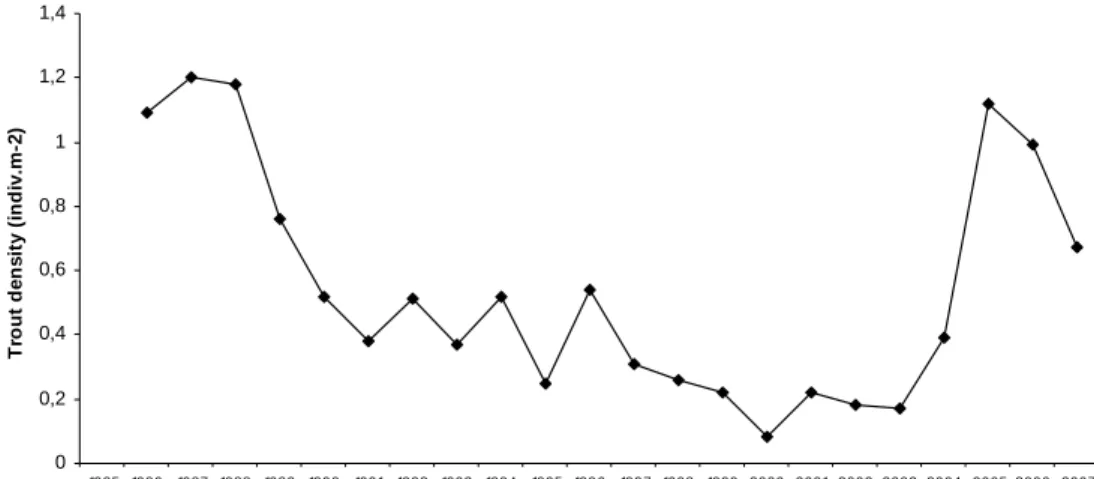
In parallel, brown trout density in River Chaballos (River Esva water basin) was assessed every year in September, since 1986, based on 4 predetermined sampling sites (Lobón-Cerviá 2005). Average density declined from over 1 ind.m-2 by the mid 80’s, to a minimum of 0.08
ind.m-2 in the year 2000. Yet, in recent years trout density in the Chaballos reached values
comparable to those of two decades ago, enabling us to propose a population recovery (Figure 2).
0 0,2 0,4 0,6 0,8 1 1,2 1,4 1985 1986 1987 1988 1989 1990 1991 1992 1993 1994 1995 1996 1997 1998 1999 2000 2001 2002 2003 2004 2005 2006 2007 T ro u t d e n s it y ( in d iv .m -2 )
Figure 2. Density of brown trout in River Chaballos (Esva water basin) from 1985 to 2007.
Lobón-Cerviá & Iglesias (2008) also found a surprising trend for the eel using a similar temporal data set (1986-2006) for River Esva. In-stream density of yellow eels declined from high values over 2000 ind.ha-1 during the mid 80’s to a minimum value of about 400 ind.ha-1
by the end of the 90’s, which then increased to reach values around the 2000 ind.ha-1 during
the last sampled years. Nevertheless, recruitment (of glass eels) to the water basin and estuarine density of the youngest juveniles in the River Esva kept declining along the entire period of study. These results suggest the occurrence of in-stream density-dependence influence towards the stabilization of the population.
Yet, Lobón-Cerviá & Iglesias’ (2008) results regarding a population of eel that has never been exploited. Furthermore, the water basin of the River Esva, for which data for both eel and salmonids were analyzed, remains in a natural state, with no physical barriers or any other highly negative impact on the river or it streams. To the same extent, no interventions were taken that could explain the increased values for catch or density of those fishes.
Furthermore, due to recent work on basin water quality improvement and with the perspective of many more interventions to fulfill the European Union Water Framework Directive objectives, diadromous fish now absent in some basins, may recover if gene pool is still available (Béguer et al 2007, and references therein).
Xenopoulos et al. (2005) modelled river discharge for over 200 rivers located between latitudes 42ºN and 42ºS trying to predict potential freshwater fish extinctions from climate change and water withdrawal by 2070. They used two scenarios assuming economic and population trends consistent with a regionalized world, one economically oriented (with particular emphasis on greenhouse gas emission), and another with a strong environmental focus. Total water use was computed according to each scenario for population, irrigation, number of livestock and estimates of domestic and industrial use. Owing to a higher degree of uncertainty of the consequences of increased discharge for riverine biodiversity, these authors concentrated on the consequences of a decrease in discharge and the rivers they used for the model construction are located in the latitudinal band for which reduced discharge (>10% reduction) is predicted to occur under the chosen scenarios. In general, Xenopoulos et al. (2005) statistical approach linking river discharge and fish biodiversity implied that fish
species limited to high-discharge river reaches would be among those species most at risk to extinction. They have considered that fish adapted to particular combinations of discharge and other habitat features such as floodplains, stream gradient, substrate or riparian vegetation, would face an increased risk of extinction.
Although vast European areas are out of the latitudinal band considered by Xenopoulos et al. (2005), and diadromous fish species may face decrease but perhaps not extinction, their work emphasizes the inevitability of climate changes and the vulnerability of some species with particular habitat combination needs. On the other hand, recent increases in some species density both in un- and intervened areas may be considered as recovery signs encouraging further studies and management actions.
5. M
ANAGEMENTP
ROPOSALSAlthough some of the above mentioned species face extreme situations, some of them possibly irreversible, in several areas of their distribution range management is the only achievable way of positive intervention.
At a conference on “Fisheries in the Future” Senior (1996) referred over-capacity as the disease in fisheries all over the world, and he stresses that the recurrent answer of first limiting catches, then adopting technical measures and finally limiting entry simply does not work. According to his words, limiting catches is a symptom of the disease rather than a cure itself. It seems that lowering the rate of exploitation of a fishery or even deciding for its complete stop still continues to be an immediate measure. Nevertheless, little or no recovery has followed several cases of large reductions in exploitation (Klemetsen et al. 2003).
General measures that we do believe should be incorporated in a management plan and may effectively contribute to a real control of the problem regards 1) the human component, e.g. by increasing communication and education across disciplines, especially among engineers, hydrologists, economists, local fishermen and ecologists; and passing the information to the local populations; 2) the ecosystem, e.g. by increasing restoration efforts, using already tested ecological principles as guidelines; and also maintaining and protecting the freshwater ecosystems that have high integrity and if possible increase the connectivity; and 3) particular species in need of a more detailed plan, e.g. by restocking depleted populations such as the cases of salmon and sturgeon in Spain. For the European eel, for which a wide area of suitable habitat is not available due to physical obstacles, passes are important to conserve and/or to recover eel stocks (Laffaille et al. 2005).
For the particular case of invasive species, existing introductions must be controlled and further introductions prevented. For example, live-bait should be banned since the wide spread of some species may result from escapement of those specimens, but specially promote information dissemination on why the use of live-bait should be controlled.
Considering measures already implemented like flow management, modern methods recognized that arbitrary minimum flows are now completely inadequate because the structure and function of a riverine ecosystem and many adaptations of its biota are connected to temporal variation in river flows (Arthington et al. 2006; Poff et al. 2007). Therefore, in order to protect freshwater biodiversity and maintain the goods and services that rivers provide, we need to mimic components of natural flow variability. This perspective should
receive further attention and is fundamental to take into consideration the magnitude, frequency, timing, duration, rate of change and predictability of flow events (e.g. floods and droughts), and the sequencing of such conditions (Baron et al. 2002; Arthington et al. 2006).
Most restoration programs are based on stock enhancement through improvement of natural recruitment or restocking or restoring habitats (Feunteun 2002). For restocking juveniles or adults raised in captivity may be used, as the example with Atlantic salmon in Lake Ontario (Canada) where breeding adults were able to efficiently construct a nest in a natural stream (Scott et al. 2005).
When habitat has been lost due to physical inaccessibility, an obvious action should be to implement transposable mechanisms such as fish ladders. Indeed, that has happened (Feunteun 2002) but two questions must be carefully considered: the adequacy of the ladders installed to the fish species that they are intended for; and, in the case of eel, the possibility of downstream migration trough adequate passes. Laffaille et al. (2005) report an example from the river Frémur (France) from which they have concluded on the positive influence of eel passes for the recovery of the eel population in upstream areas previously inaccessible for eels.
Climate change is largely beyond the control of individual nations or regions but regional changes in the management of water and other stressors on freshwater ecosystems could prevent some of the predicted scenarios, with the reduction of water consumption probably as the most viable conservation strategy to prevent the forecast loss of fishes (Xenopoulos et al. 2005).
Moreover, the development of descriptive and predictive models may enlighten some aspects of diadromous fish ecology and has been referred to as a valuable management tool (e.g. Ibbotson et al. 2002; Lambert & Rochard 2007).
Marine reserves are still under evaluation as a management instrument, but they are indeed a promising tool (Hilborn et al. 2004). Although only a few protected freshwater areas have been created within the broad view of protected areas, they are a partial solution for habitat degradation (Saunders et al. 2002). Protected areas in open habitats like estuaries and coastal areas may not be significant for eel or other migratory fish species conservation, but their existence in more confined sections such as freshwater areas may be part of an effective local solution if they are integrated into a wider management plan (Cucherousset et al. 2007).
Nevertheless, to successfully achieve river and freshwater fisheries rehabilitation a strategic approach must be followed, complemented with post-intervention monitoring and a wide dissemination of the results (Cowx & van Zyll de Jong 2004).
6. C
ONCLUSIONThe severe decline in some diadromous fish populations and the consequent decline in fisheries catches have been answered with a vast production of studies allowing for the recognition of the major potential causes of such population declines. At the same time, tools have been created to assist an adequate management at both the populations and the ecosystem levels.
Nevertheless, the orchestration of scientific knowledge acquisition, management and monitoring has only recently started to be effective and the measures that have to be taken are
most of the time controversial. To detain the thoroughly mentioned declining trends and to aspire to any level of populations’ recovery, scrupulous policies have to be implemented, even with uncertain out coming potential of positive results.
7. A
CKNOWLEDGMENTSS. Costa Dias acknowledges the Portuguese Foundation for Science and Technology - FCT - for financial support trough a PhD grant (SFRH/BD/16922/2004).
8. R
EFERENCESAckefors, H., Johansson, N. & Wahlberg, B. 1991. The Swedish compensatory programme for salmon in the Baltic: an action plan with biological and economic implications. ICES
Marine Science Symposia, 192: 109-119.
Acou, A. 2006. Bases biologiques d’un modéle pour estimer la biomasse féconde de l’anguille européenne en fonction des recrues fluviales et du contexte de croissance: approche comparative a` l’échelle de petits bassins versants. PhD. thesis. Rennes: University of Rennes 1. 316pp. URL http:// www.diadfish.org/francais/documents_f.htm. Acou, A., Robinet, T., Lance, E., Gerard, C., Mounaix, B., Brient, L., Le Rouzic, B., &
Feunteun, E. 2008. Evidence of silver eels contamination by microcystin-LR at the onset of their seaward migration: what consequences for breeding potential? Journal of Fish
Biology, 72: 753–762.
Allan, J.D., Abell, R., Hogan, Z., Revenga, C., Taylor, B.W., Welcomme, R.L., & Winemiller, K. 2005. Overfishing of Inland Waters. BioScience, 55: 1041-1051.
Allendorf, F.W. & Leary, R.F. 1988. Conservation and distribution of genetic variation in a polytypic species, the cutthroat trout. Conservation Biology, 2: 170-184.
Arthington, A.H., Bunn, S.E., Poff, N.L.R., & Naiman, R.J. 2006. The challenge of providing environmental flow rules to sustain river ecosystems. Ecological Applications, 16: 1311– 1318.
Baisez, A. & Laffaille, P. 2005. Un outil d’aide à la gestion de l’anguille: le tableau de bords anguille du bassin Loire. Bulletin Français de Pêche Piscicole, 378-379: 115-130. Bardonnet, A. & Baglinière, J.L. 2000. Freshwater habitat of Atlantic salmon (Salmon salar).
Canadian Journal of Fisheries and Aquatic Sciences, 57: 497-506.
Baron, J.S., Poff, N.L., Angermeier, P.L., Dahm, C.N., Gleick, P.H., Hairston, N.G., Jackson, R.B., Jr., Johnston, C.A., Richter, B.G., & Steinman, A.D. 2002. Meeting ecological and societal needs for freshwater. Ecological Applications, 12:1247-1260.
Batty, J., Pain, D. & Caurant, F. 1996. Metal concentrations in eels Anguilla anguilla from the Camargue region of France. Biological Conservation, 76: 17-23.
Baxter, C.V., Fausch, K.D., Murakami, M., & Chapman, P.L. 2004. Fish invasion restructures stream and forest food webs by interrupting reciprocal prey subsidies. Ecology, 85: 2656-2663.
Béguer, M., Beaulaton, L. & Rochard, E. 2007. distribution and richness of diadromous fish assemblages in Western Europe: large-scale explanatory factors. Ecology of Freshwater
Fish, 16: 221-237.
Belpaire, C. & Goemans, G. 2007. Eels: contaminant cocktails pinpointing environmental contamination. ICES Journal of Marine Science, 64: 1423-1436.
Bergerot, B., Lasne, E., Vigneron, T., & Laffaille, P. 2008. Prioritization of fish assemblages with a view to conservation and restoration on a large scale European basin, the Loire.
Biodiversity and Conservation, 17:2247-2262.
Blanc, G. 1989. L'anguillicolose. Répartition géographique. Mise au point d'une méthode de diagnostic par échotomographie. Moyens de lutte. Thèse vétérinaire ENV Nantes. Blanchet, S., Loot, G., Grenouillet, G., & Brosse, S. 2007. Competitive interactions between
native and exotic salmonids: a combined field and laboratory demonstration. Ecology of
Freshwater Fish, 16: 133-143.
Bloesch, J., Jones, T., Reinartz, R., Striebel, B., Holcik, J., Kynard, B., Siciu, R., & Williot, P. 2006. Action Plan for the conservation of sturgeons (Acipenseridae) in the Danube River Basin. Nature and Environment, No. 144.
Boët, P., Belliard, J., Berrebi-dit-Thomas, R., & Tales, E. 1999. Multiple human impacts by the City of Paris on fish communities in the Seine river basin, France. Hydrobiologia, 410: 59-68.
Bonhommeau, S., Chassot, E. & Rivot, E. 2008. Fluctuations in European eel (Anguilla
anguilla) recruitment from environmental changes in the Sargasso Sea. Fisheries Oceanography, 17: 32-44.
Bordajandi, L.R., Gómez, G., Fernández, M.A., Abad, E., Rivera, J., & González, M.J. 2003. Study on PCBs, PCDD/Fs, organochlorine pesticides, heavy metals and arsenic content in freswater fish species from the River Turia (Spain). Chemosphere, 53: 163-171.
Briand, C., Fatin, D. & Legault, A. 2002. Role of Eel Odour on the Efficiency of an eel,
Anguilla anguilla, Ladder and Trap. Environmental Biology of Fishes, 65: 473-477.
Brusati, E.D. & Grosholz, E.D. 2006. Native and introduced ecosystem engineers produce contrasting effects on estuarine infaunal communities. Biological Invasions, 8: 683-695. Bruslé, J. 1994. L'anguille européenne Anguilla anguilla, un poisson sensible aux stress
environnementaux et vulnérable à diverses atteintes pathogènes. Bulletin Français de
Pêche Piscicole. 335: 237-262.
Casagrandi. R. & Gatto. M. 2002. Habitat Destruction, Environmental Catastrophes, and Metapopulation Extinction. Theoretical Population Biology, 61: 127-140.
Carlton, J.T. & Geller, J.B. 1993. Ecological roulette: the global transport of non-indigenous marine organisms. Science, 261: 78-83.
Casal, C.M.V. 2006. Global documentation of fish introductions: the growing crisis and recommendations for action. Biological Conservation, 8: 3-11.
Castonguay, M., Hodson, P.V., Moriarty, C., Drinkwater, K.F., & Jessop, B. M. 1994. Is there a role of ocean environment in American and European eel decline? Fisheries
Oceanography, 3: 197-203.
Cohen, A.N. & Carlton, J.T. 1998. Accelerating invasion rate in a highly invaded estuary.
Science, 279: 555-558.
Collares-Pereira, M.J., Cowx, I.G., Ribeiro, F., Rodrigues, J.A., & Rogado, L. 2000. Threats imposed by water resource development schemes on the conservation of endangered fish
species in the Guadiana River Basin in Portugal. Fisheries Management and Ecology, 7: 167-178.
Copp, G., Bianco, P.G., Bogutskaya, N. G., Eros, T., Falka, I., Ferreira, M.T., Fox, M.G., Freyhof, J., Gozlan, R.E., Grabowska, J., Kovac, V., Moreno-Amich, R., Naseka, A.M., Penaz, M., Povz, M., Przybylski, M., Robillard, M., Russel, I.C., Stakenas, S., Sumer, S., Vila-Gispert, A. & Wiesner, C. 2005. To be, or not to be, a non-native freshwater fish.
Journal of Applied Ichthyology, 21:242-262.
Costa, M.J., Vasconcelos, R., Costa, J.L., & Cabral, H.N. 2007. River flow influence on the fish community of the Tagus estuary (Portugal). Hydrobiologia, 587: 113-123.
Couillard, C.M., Hodson, P.V. & Castonguay, M. 1997. Correlations between pathological changes and chemical contamination in American Eels, A. rostrata, from the St Lawrence River. Canadian Journal of Fisheries and Aquatic Sciences, 54(8): 1916-1927.
Cowx, I.G.& van Zyll de Jong, M. 2004. Rehabilitation of freshwater fisheries: tales of the unexpected? Fisheries Management and Ecology, 11: 243-249.
Cucherousset, J., Paillisson, J.M., Carpentier A., Thoby, V., Damien, JP., Eybert, M.C., Feunteun, E., & Robinet, T. 2007. Freshwater protected areas: an effective measure to reconcile conservation and exploitation of the threatened European eels (Anguilla
anguilla)? Ecology of Freshwater Fish, 16: 528-538.
Darwall, W.R.T. & Vié, J.C. 2005. Identifying important sites for conservation of freshwater biodiversity: extending the species-based approach. Fisheries Management and Ecology, 12: 287-293.
Denayer, B. & Belpaire, C. 1996. Bottle-necks for restoration of the eel population, Anguilla anguilla (L.) of the river Yser basin (Flanders). Archives of Polish Fisheries, 4: 175-186. Dekker, W. 2003. Status of the European eel stock and fisheries. In: Aida K., Tsukamoto K.
& Yamauchi, K. (Eds). Eel biology. Springer-Verlag, Tokyo.
Domingos, I., Costa, J.L. & Costa, M.J. 2006. Factors determining length distribution and abundance of the European eel, Anguilla anguilla, in the River Mondego (Portugal).
Freshwater Biology, 51: 2265-2281.
Dudgeon, D. 2000. The ecology of tropical Asian rivers and streams in relation to biodiversity conservation. Annual Review of Ecology and Systematics, 31: 239-63. Dudgeon, D., Arthington, A.H., Gessner, M.O., Kawabata, Z., Knowler, D.J., Lévêque C.,
Naiman, R.J., Prieur-Richard, A., Soto, D., Stiassny, M.L.J., & Sullivan, C.A. 2006. Freshwater biodiversity: importance, threats, status and conservation challenges. Biological Reviews of the Cambridge Philosophical Society, 81: 163-338.
Durbin, A.G., Nixon, S.W. & Oviatt, C.A. 1979. Effects of the spawning migration of the alewife, Alosa pseudoharengus, on freshwater ecosystems. Ecology, 60: 8-17.
Dyson, M., Bergkamp, G. & Scanlon, J. (Eds.) 2003. Flow: essentials of environmental flows. IUCN, Gland, Switzerland and Cambridge, UK.
EELREP 2005. Estimation of the reproduction capacity of European eel. Final report. http://www.fishbiology.net/eelrepsum.html
Elie, P., Taverny, C., Mennesson-Boisneau, C., & Sabatié, M.R. 2000. L’exploitation halieutique. In: Baglinière J.L. & Elie P. (eds.), Les Aloses (Alosa alosa et Alosa fallax spp.). INRA, Paris, pp. 199-226.
Elliott, J.M., Lyle, A.A. & Campbell, R.N.B. 1997. A preliminary evaluation of migratory salmonids as vectors of organic carbon between marine and freshwater environments.
FAO 1996. Technical guidelines for responsible fisheries / Food and Agricultural Organization of the United Nations, Rome.
Fausch, K.D. 2007. Introduction, establishment and effects of non-native salmonids: considering the risk of rainbow trout invasion in the United Kingdom. Journal of Fish
Biology, 71 (Supl D): 1-32.
Feunteun, E. 2002. Management and restoration of European eel population (Anguilla
anguilla): An impossible bargain. Ecological Engineering, 18: 575-591.
Flecker, A.S. 1996. Ecosystem engineering by a dominant detritivore in a diverse tropical stream. Ecology, 77: 1845-1854.
Friedland, K.D., Miller, M.J. & Knights, B. 2007. Oceanic changes in the Sargasso Sea and declines in recruitment of the European eel. ICES Journal of Marine Science, 64: 519-530.
Gende, S.M., Edwards, R.T., Willson, M.F., & Wipfli, M.S. 2002. Pacific salmon in aquatic and terrestrial ecosystems. BioScience, 52: 917-928.
Godinho, F.N. and Ferreira, M.T. 1998. The relative influences of exotic species and environmental factors on an Iberian native fish community. Environmental Biology of
Fishes, 51: 41-51.
Gosset, C., Rives, J. & Labonne, J. 2006. Effect of habitat fragmentation on spawning migration of brown trout (Salmo trutta L.). Ecology of Freshwater Fish, 15: 247-254. Gowans, A.R.D., Armstrong, J.D. & Priede, I.G. 1999. Movements of adult Atlantic salmon
in relation to a hydroelectric dam and fish ladder. Journal of Fish Biology, 54: 713–726. Granado-Lorencio, C. 1991. The effect of man on the fish fauna of the River Guadalquivir,
Spain. Fisheries Research, 12: 91-100.
Granado-Lorencio, C., Araujo-Lima, C.R.M. & Lobón-Cerviá, J., 2005. Abundance– distribution relationships in fish assembly of the Amazonas floodplain lakes. Ecography, 28: 515–520.
Gregory, S.V. & Bisson, P.A. 1997. Degradation and loss of anadromous salmonid habitat in the pacific Northwest. In: Stouder D.D.J., Bisson P.A. & Naiman R.J. (Eds.) Pacific salmon and their ecosystems: status and future options. Chapman & Hall, New York, pp 277-314.
Guégan, J., Lek, S. & Oberdorff, T. 1998. Heterogeneity predict global riverine fish diversity.
Nature, 391:382-284.
Hansen, M.M., Ruzzante, D.E., Nielsen, E.E., & Mensberg, K.L.D. 2001. Brown trout (Salmo trutta) stocking impact assessment using microsatellite DNA markers. Ecological
Applications, 11: 148–160.
Hayes, J.P., Guffey, S.Z., Kriegler, F.J., McCracken, G.F., & Rarker, C.R. 1996. The genetic diversity of native, stocked and hybrid populations of brook trout in the southern Appalachians. Conservation Biology, 10: 1403-1412.
Hesthagen, T. & Hansen, L.P. 1991. Estimates of the annual loss of Atlantic salmon, Salmo
salar L., in Norway due to acidification. Aquaculture Research, 22: 85-92.
Hilborn, R., Stokes, K., Maguire, J.J., Smith, T., Botsford, L.W., Mangel, M., Orensanz, J., Parma, A., Rice, J., Bell, J., Cochrane, K.L., Garcia S., Hall S.J., Kirkwood G.P., Sainsbury, K., Stefansson, G., & Walters, C. 2004. When can marine reserves improve fisheries management? Ocean & Coastal Management, 47: 197-205.
Hodson, P.V., Castonguay, M., Couillard, C.M., Desjardins, C., Pelletier, E., & McLeaod, R. 1994. Spatial and temporal variations in chemical contamination of American eels,