Submitted to the 1st International Conference on Energy, Environment And Climate Changes
Refl ex: development of a decision help tool for residential renovation
J.-M. HAUGLUSTAINE S. MONFILS
Energy and Sustainable Development
Dept. of Sciences and Management of the Environment University of Liege (ULg)
Liege, Belgium
e-mails: [email protected] stephane.monfi [email protected]
Abstract—Earth’s energy issues and its survival have been,
for a few years, in the centre of the preoccupations of dif-ferent countries and in everybody’s mind. A big part (around 40 % for Europe) of the energy consumption and CO2 emis-sions come from buildings and use of them. In Belgium, like in many European countries, the existing buildings represent the main part of the building stock. These buildings are rela-tively old, and most of the dwellings are not at all or not well thermally insulated; their airtightness is weak and their hea-ting installations are old.
We can fi nd there real potential improvement and high possi-bilities of renovation. It seems essential, nowadays, to improve the performances of the existing building stock, in a sustai-nable development and energy saving way, from the econo-mic, ecological and social points of view. To do that, the owner, the contractor and the architect are confronted with many renovation options, and choosing the best intervention scena-rios is never easy. It’s in this context that the software RE-FLEX (for Rénovation EFfi cace d’un Logement EXistant, in English: EFfi cient Renovation of an EXisting dweLling) has been developed. This project concerns residential buildings, but could also be extrapolated for other building types [1]. The paper fi rst describes the basis and the hypotheses of the software, then the way to use it, and fi nally the results we get with such a tool. The parameters taken into account in the software are relative to: the building envelope (geometrical characteristics, walls composition, thermal insulation, win-dows), orientation and building environment for solar gains, internal gains, building inertia, technical installations (of heating, domestic hot water and ventilation systems), as well as the urgent interventions, those accepted and whished by the user and the other ones not allowed due to town planning regulations, or budget limit, or those which resulting perfor-mances are lower than expected.
After that, the software tests all the possible combinations, while integrating the constraints defi ned both by the user and by the technical feasibility. It shows different solutions in a graphical way, with two by two inputs, corresponding to the performances chosen by the user, in order to select the most suitable solutions and to restrain the number of renovation possibilities.
Finally, the software proposes four multicriteria analyses, which can be distinguished from each other by the importance
given to each criterion. The results are shown in a graphical form, and sorted in a decreasing order. The solutions are dif-ferently ranked according to the user’s point of view. The fi gu-red performances of the different solutions can also be shown. Future development of the tool will focus on the user’s long term strategy, allowing him to schedule interventions with successive money supplies.
Keywords-component: dwelling energy renovation, improvement of energy performance of existing dwellings, multicriteria optimized choice of renovation scenarios.
I. INTRODUCTION
From 30 to 40% of the energy consumption and CO2 emissions come from buildings in Europe, and especially the way we use them. In Wallonia [2], like in many Euro-pean countries, the existing buildings represent the main part of the building stock. These buildings are relatively old, and most of the dwellings are, if not at all, not well protected from the heat losses by thermal insulation; in addition, their airtightness is weak and their heating instal-lations are old.
We can fi nd there a real potential for improvement and possibilities of renovation. It seems essential, nowadays, to improve the performances of the existing building stock, in a sustainable development and energy saving way, from the economic, ecological and social points of view. In order to achieve that goal, owners, contractors and architects have to face with many renovation options and solutions, so choosing the best intervention scenario is not always easy. The software REFLEX (for Rénovation EFfi cace d’un Logement EXistant; in English: EFfi cient Renovation of an EXisting dweLling) has been developed in this context, and will evolve with the awareness and knowledge. This project concerns residential buildings, but could also be extrapolated to other building types.
II. THE SOFTWARE
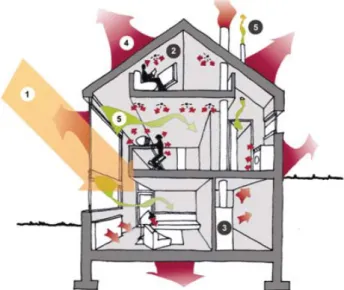
As the energy balance of a building (Figure 1) must take into account every gains and losses of it [3], the software will consider several parameters in its calculations, rela-tive to the building envelope (its thermal insulation, vapour
permeability, windows), solar gains (windows orientation and tilt), internal gains (occupation, household appliances), building inertia (materials and their heat absorption acces-sible capacity), heating and ventilation systems (auxiliary consumption, effi ciency of the possible heat exchanger), domestic hot water and possible air conditioning systems and electrical household equipments.
Figure 1. Energy balance of a building 1: solar gains
2: internal gains
3: heating emissions from heating system 4: heat losses through building envelope 5: heat losses due to air change
The software mechanism can be split in 6 steps: • Data input
• Solutions generation • Valuation of performances
• Preselection according to the performances • Multicriteria analysis
• Best solutions
A. Data Input
In order to effi ciently associate the owner to the deci-sion process [4], the software can be both used by owners and architects. So the software is divided in two parts: a simplifi ed one (which has to be easily used), and an expert one. Of course, the fi rst (and simplifi ed) part has also to be fi lled by the “experts”, using the most detailed interface, because the few questions asked there, related to the buil-ding in general, are needed in all calculation cases. These issues include the age of the building, some typology para-meters [5], the heated fl oor area, the number of occupants, the orientation, the heating energy vector, the domestic hot water systems, the ventilation, etc.
Of course, these few pieces of information are hardly enough to estimate the total energy consumption of a dwel-ling for heating, coodwel-ling, ventilation and domestic hot wa-ter. If the user stays in the simplifi ed mode, the calculation will consider default values for the other required ones.
The fi rst questionnaire also refers to possible constraints
which could help making decisions between interventions. For instance, it is asked from the user the minimal percen-tage of energy savings sought or the maximal available bud-get he is prepared to unlock (with or without loan). Some renovation options should also be abandoned because of some urban constraints (e.g. a facade of the building could not be covered because of its historical value, or a back facade of a row house is hardly reachable...).
The user could also have a pretty good idea of the materials or installations he does not want (for example: for personal reasons, only natural cellulosic insulation is acceptable), or cannot consider because it is not fi tted to the building (example: the natural gas network is not existing on the site), so he can (or has to) limit the number of pos-sible combinations.
The database of renovation work items is included in the software, with cost per unit and attributes, like work easiness, user’s discomfort during works, etc.
The expert’s part of the software is more accurate, and cells are pre-fi lled in with default values ‒ determined on common buildings ‒ which can be accepted or changed.
In parallel with the description of building and systems, one can specify the habits of the owners and the use of the building, for example:
• Heating period;
• Comfort temperatures (day, night, unoccupied periods)
• Hourly occupation of the dwelling
• Type of clothing and activities in the building (in order to evaluate the internal gains).
The user has the possibility to encode some more detai-led parameters, as far as the envelope and the systems are concerned : • Roofs (fl at or tilted) • External walls • Windows • Floors • Heating system
• Domestic hot water system • Ventilation system
• Cooling system (if existing)
B. Solutions Generation
Going through the questionnaire, the user specifi es the insulation level of each external wall, and whether some part of it needs to be renewed or changed.
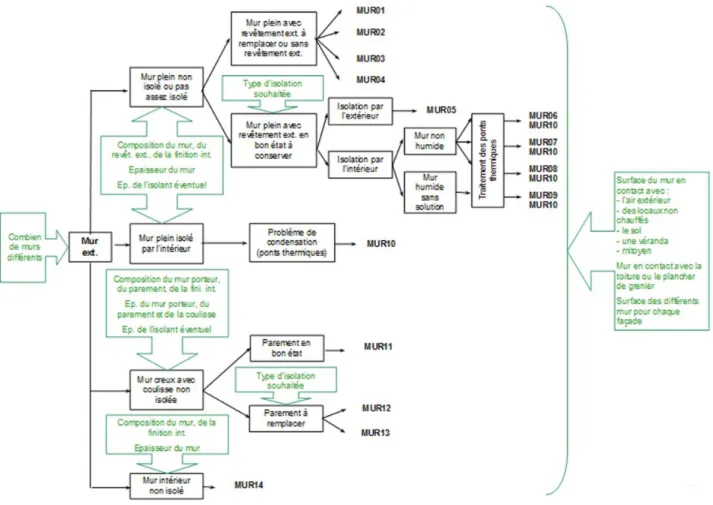
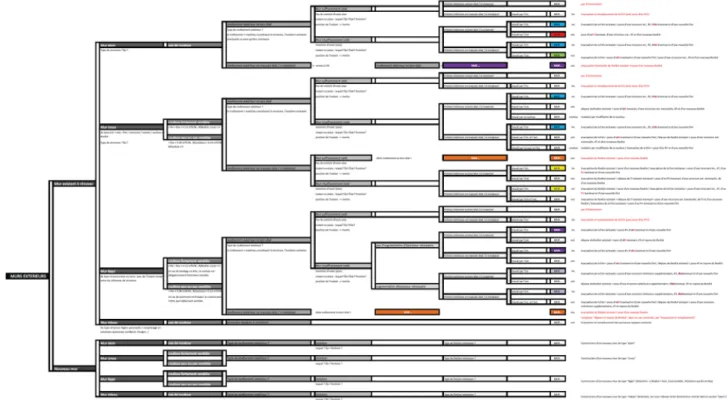
The fi rst step was therefore to build fl owcharts in order to describe the components, following a logic string of suitable questioning, step by step in a “decision tree”. For example, the description of a wall goes through the tree hereafter (Figure 2).
At the end of the description, only stay the solutions that can actually be applied to the wall; it is up to the user to choose between them.
These fl owcharts were helpful to build input data ques-tionnaires, in order to target required information to fi nd valuable solutions and to evaluate their performances. Then, the attributes (an attribute is a characteristic of an
intervention) for each intervention (an intervention is a technical action on a component) were determined.
The main problem for the generation of solutions was to avoid the huge proliferation of possibilities. This is the reason why a few constraints were intro-duced. The fi rst one is the cost. It’s purely an economic fi ltration constraint, eliminating the combinations of solutions not compatible with the available budget. The second one is the percentage of energy savings asked by the owner. The aim is to estimate the energy consumption in initial and in renovated situations. The cal-culation takes into account the losses through the envelope, the losses through air change, the effi ciency of the heating system, and a simplifi ed calculation of the domestic hot water needs.
Some interventions are automatically brought together, and rules were created to deal with compatibilities/in-compatibilities between some interventions and/or some materials. For example: the replacement of windows will increase the airtightness of the dwelling, so that air change rate without any ventilation system would not satisfy the indoor air quality requirements. This is the reason why the installation of a ventilation system ‒ when not already exis-ting ‒ is automatically coupled with the windows replace-ment.
All the data used in the module of generation of solu-tions are described in XML language, which is particularly adapted to describe and control structured information.
The different intervention scenarios applied to the buil-ding are defi ned by the software and each one of them must be:
• technically feasible; • with an acceptable cost;
• respecting the energy saving target.
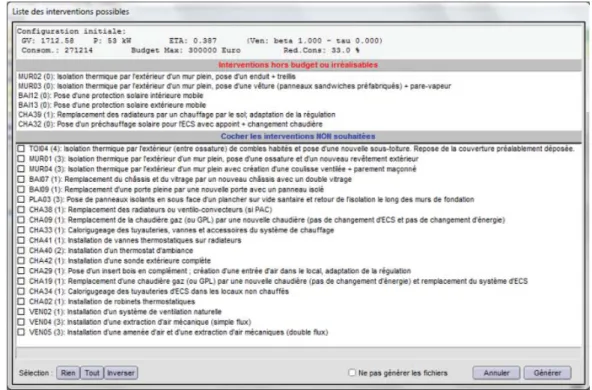
All these interventions are listed, and the user can select those he doesn’t want, as he once did for facing materials, to reduce the number of possible combinations (Figure 3). It’s also possible to know the number of solutions before beginning the calculation. It’s useful to adapt the choices to converge to a minimum of valuable combinations.
Finally, the software tests all the possible combina-tions, while integrating the constraints defi ned by the user. The time for the total calculation is around one second per solution, including a detailed dynamic thermal simulation developed by EDF-R&D Building Physics & Studies De-partment.
C. Valuation of Performances
The concept of the valuation is to evaluate the improve-ment of the global performance due to a renovation opera-tion, depending on the building characteristics before and after renovation.
The performance indicators are divided in fi ve main fi elds:
• fi nancial criteria • energy criteria
• environmental criteria • comfort criteria
• others: duration of works, hardiness of perfor-mances, etc.
The calculation is made in few steps, with a specifi c application which, turn by turn, calls for the different pro-cedures to evaluate the performances.
The different performances are the following ones: • operation costs (€);
• fi nancial gain for 10 years (€);
• decrease of energy consumption (kWh/year);
• thermal comfort improvement in winter; • thermal comfort improvement in summer; • indoor air quality amelioration;
• improving life facilities; • decrease of CO2 emissions (kg); • environment quality improvement; • work pollution.
As the software was originally designed for EDF, there are three other criteria:
• increase in cumulated margin for EDF; • EDF certifi cates of energy saving; • robustness of the performances.
Figure 3. Proposed interventions
D. Preselecting according to Performances
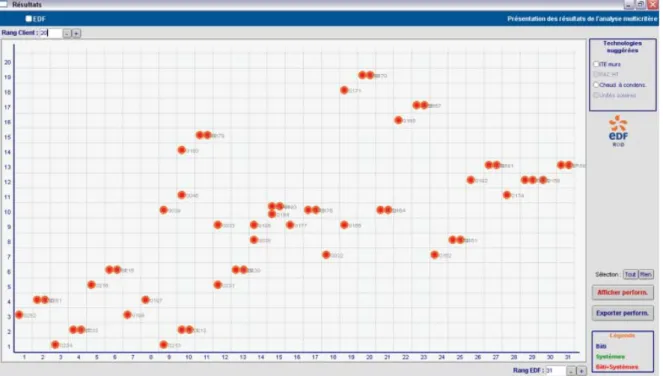
The software shows the different solutions (i.e. combi-nation of interventions) in a graphical 2-axes way, corres-ponding to the performances chosen by the user, to select the most suitable solutions, while shrinking the fi eld of possibilities.
The solutions are also differentiated by the object that is concerned: the envelope, the systems or both of them. The colour of their representative point on the graphic is therefore different (Figure 4: blue points for the envelope only, green points for system interventions only, red points when both are concerned).
E. Multicriteria Analysis
When the user has run through each criterion that is likely to help him prune the tree of solutions, the software proposes four multicriteria analyses [4, 6], which can be distinguished from each other by the importance given to each criterion. The multicriteria analyses suggested are:
• Prométhée I ; • Prométhée II ; • Electre III ; • Distances method.
The results are shown in a graphical form, and sorted in decreasing order. The solutions are ranked differently according to the user’s point of view (private user or EDF), as the weighted factor and considered criteria (additional criteria for EDF) could be different in the two cases. The best solution is the one found in rank 1.
The user can increase or decrease the number of ranks shown in the picture (Figure 5).
The user can visualize the solutions relative to high temperature heat pump, external insulation, condensing boiler and solar panels.
F. Results
The solutions can be selected and the module allows the user to inspect the performances of each solution. These ones are shown in a comparative board.
The fi gured performances of the different solutions are displayed, to know more precisely which interventions are suggested in the solutions. All the results can be exported in an Excel fi le.
III. FUTURE DEVELOPMENT
This software has been developed for EDF, and deli-vered in 2007. Now it is taken out of the shelf, dusted and brought back to more fi t the Belgian context. Several evo-lutions are planned:
• An update of the databases and fl owcharts (Figure 6) are needed in order to integrate the Belgian specifi cities of construction (and renovation) fi elds;
• The aim is to implement the Walloon legal energy calculation method to replace the French one. The “new” method will be based on the one already applied to rule the energy requirements of every new construction, but also on the one used to certify the standard energy consumption of the existing dwellings that are sold or rented on the Walloon territory [7];
• New functionalities will be integrated, such as the addition of a new volume as part of a renovation;
• A chronologic display of the interventions could be added, so the user will be able to adapt the scenario to his fi nancial plan;
• A study will be led in order to minimise the errors due to the calculation method, to better approach the users’ energy behaviour and to evaluate the “rebound effect”: after a renovation of his dwelling, the user is tempted to increase
Figure 6. New “decision tree” for wall description
set temperatures, therefore to increase his comfort, so that the previously foreseen energy saving is never obtained in practice;
• The databases should also be improved by a study on the costs drifting due to higher fuzziness of any cost eva-luation of renovation works, than new construction ones.
IV. CONCLUSIONS
Easy use and taking into account of cost criteria are two important assets of this software. The development of this help-decision tool is a fi rst step to the energy effi ciency renovation, compulsory stage of the struggle with climate warming and preservation of energy resources.
It is also, last but not least, a tool at the user’s dispo-sal, in order to prepare himself to an increasing expensive energy era.
REFERENCES
[1] S. Azar, C. Baltus, J.-M. Hauglustaine, “Rénovation et effi cacité énergétique : approche multicritères”, Research contrat EnergySuD-ULg – EDF-R&D Building Physics & Studies n°4300015759, Final report, 2007.
[2] S. Monfi ls, J.-M. Hauglustaine, “Réno2020: Méthodologie d’inser-tion des nouvelles technologies dans la rénovad’inser-tion durable du logement wallon”, Intermediate Scientifi c report, March 2010.
[3] European Parliament and Council, “Directive 2002/91/CE approved the 16th of December, 2002, about Energy Performance of Buildings”, edited in the Offi cial Journal of the European Communities, the 4th of January, 2003, 2002.
[4] J.-M. Hauglustaine, “Méthode de conception optimisée de l’enve-loppe de bâtiment aux stades préliminaires du projet architectural – Re-cherche du meilleur projet, privilégiant les performances d’énergie et de coût”, Ph-D thesis defended the 3rd of July 2001, to obtain the diploma of Doctor in Applied Sciences, University of Liège, 2001.
[5] M. Descamps, “Optimisation d’une stratégie d’intervention sur un bâtiment existant, pour en améliorer les performances”, Final work to obtain the Master of Advanced Studies in Applied Sciences, University of Liege, 2008.
[6] J.-P. Brans, P. Vincke, B. Mareschal, “How to Select and How to Rank Project: the Promethee Method”, Editor: European Journal of Operational Research, «n°24 (2)», 1986.
[7] Walloon Government, “Arrêté du gouvernement wallon du 17 avril 2008 déterminant la méthode de calcul et les exigences, les agréments et les sanctions applicables en matière de performance énergétique et de climat intérieur des bâtiments”, 2008.
ACKNOWLEDGMENT
Thanks to Électricité de France – Research & Develop-ment, Building and Physics Studies, that has granted the research and the development of the software REFLEX.