On the phases of Polonium
Matthieu J. Verstraete1,2∗ 1Nano-Bio group & ETSF, Dpto. F´ısica de Mat., Univ. Pa´ıs Vasco UPV/EHU, Centro F´ısica de Mat. CSIC-UPV/EHU and DIPC, E-20018 San Sebasti´an, Spain and
2
Unit´e PCPM, Universit´e Catholique de Louvain, Louvain-la-Neuve, Belgium
The thermodynamical properties of the main phases of metallic polonium are examined using Density Functional Theory. The exceptional nature of the solid-solid phase transition of α to β Po is underlined: it induces a lowering in symmetry, from cubic to rhombohedral, with increasing temperature. This is explained as the result of a delicate balance between bonding and entropic effects. Overall agreement with existing experimental data is good by state-of-the-art standards. The phonons of Po present Kohn anomalies, and it is shown that the effect of spin-orbit interactions is the inverse of that in normal metals: due to the non-spherical nature of the Fermi Surface, spin-orbit effects reduce nesting and harden most phonon frequencies.
PACS numbers: 61.66.Bi, 61.50.Ah, 63.20.dk, 64.70.kd
A frantic race is underway to find exotic new phases of elemental solids under pressure[1–4]. With the advent of extreme diamond-anvil cell experiments with pressures beyond 1 MBar, a whole slew of new phases can be synthesized: with increasing pressure, the distance be-tween atoms decreases, electron hybridization changes, and the nature of chemical bonds as well, changing co-ordination numbers and bonding directionality, orbital occupations, and so on. This is particularly dramatic in the recent demonstration that simple metals can become semiconducting if valence and core orbitals are forced to hybridize, through the application of pressure[2, 3].
Comparatively much rarer are purely temperature in-duced solid to solid phase transitions. Although about half[5] of the elements present some form of solid-solid transition with T, most are in very limited pressure ranges, the critical pressure being more or less constant with T. Almost all of these transitions either increase or maintain the level of crystal symmetry (usually hexago-nal to cubic, or cubic to cubic). This is intuitive, as tem-perature will increase inter-atomic distances, and tend to rotationally average orbital configurations, leading to high-symmetry (most often BCC) then liquid structures. The exceptions are the usual suspects: elements with complex bonding (boron, sulfur, phosphorous and bis-muth), and a few of those with delicate electronic shell effects, such as Ce or Dy. In these systems, an increase in temperature can give rise to a solid phase with lower symmetry.
Polonium also falls into this category. It is one of the strangest elements of the periodic table, and the only element which adopts the simple cubic (SC)[6] structure at ambient pressure (α-Po, joined by a few others such as Ca-III and As-II[7] at higher pressure). Upon increasing temperature, between 290 and 330 K[8], Po transforms to the β phase, with a rhombohedral structure.
Despite its intriguing nature, experiments on Po are very difficult and rare, and little is known about its prop-erties. Only a few laboratories in the world can
synthe-size Po in sufficient quantities to perform characteriza-tion. Due to their high radioactivity (with a half life of at most 100 years, depending on the isotope), samples heat and decay very quickly into Pb or Bi.
By chemical analogy, Po should behave like Se and Te, its 4p and 5p cousins, and adopt a trigonal spiral struc-ture at low T. However, it was shown recently[9, 10] that the SC structure is stabilized over the spiral structure by relativistic effects (though there is debate over whether the scalar relativistic (SR) or spin-orbit (SO) terms dom-inate - see comments to Ref. 9). It was predicted that a simple rhombohedral structure would be stabilized under pressure. A qualitative explanation for the appearance of the SC structure is that the valence p states do not hybridize with s, because of strong relativistic repulsion of the s[11, 12]. The p states can therefore sustain purely right-angle bonding and an SC structure. Something sim-ilar probably happens in Ca and As, due to the relative (but not necessarily relativistic) changes in the s and p energy levels under pressure.
In this Letter, the vibrational and thermodynamical properties of crystalline Po are calculated from first prin-ciples. First, the effect of the spin-orbit interaction on the phonons of α-Po is shown to be counter-intuitive, harden-ing phonons and reducharden-ing the nestharden-ing of the Fermi surface (FS), the opposite behavior of simple metals. Thermody-namical quantities are calculated for the low temperature phase, and agreement with experiment confirms the pre-cision of the first principles methods. Finally, the transi-tion temperature of Polonium is calculated at 0 pressure, comparing the Gibbs free energy of the different phases. Entropic and bonding effects are delicately balanced and determine the stability of the α and β phases as a func-tion of temperature.
Density Functional Theory (DFT)[13] and the per-turbation theory built on top of it (DFPT)[14] provide highly accurate calculations of the total energy and vibra-tional properties of materials from first principles. The implementation in the ABINIT package[15] is employed,
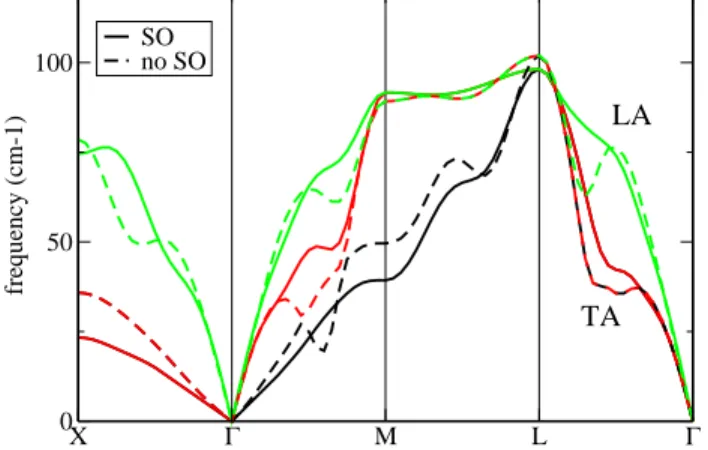
X Γ M L Γ 0 50 100 frequency (cm-1) SO no SO LA TA
FIG. 1: The phonon band structure of SC polonium along high symmetry directions of the Brillouin Zone, including the spin-orbit interaction (solid line), and without it (dashed). Contrary to most normal metals, in Polonium spin-orbit de-creases nesting, removes Kohn anomalies, and hardens most phonon frequencies.
with a plane wave basis (cut off at 435 eV) and pseudopo-tentials in the local density approximation[16]. Relativis-tic corrections are included through a pseudopotential of the HGH form[17]. The corrections are decomposed into SO and SR contributions. The calculations confirm the interpretation of Ref. 9 that the SR terms are sufficient to stabilize the simple cubic phase. Calculations without the SR relativistic terms will not be considered, because the of the structure of the pseudopotentials used, and because for heavy elements this is quite unrealistic. It is the spin-orbit term which has the largest influence on the shape of the Fermi surface (which is the central quantity affecting phonon structure in metals). The DFPT for-malism with SO is described in Refs 18, 19. The thermo-dynamics of polonium are treated in the quasiharmonic approximation, fitting volume and temperature depen-dencies as described by Grabowski et al.[20] The Bril-louin Zone is sampled with 163
k-points for electrons and 83
q-points for phonons.
The α phase of polonium is simple cubic, with a lattice constant of 3.345 ˚A. The theoretical equilibrium lattice constant is 3.335 ˚A, in good agreement, and will be used in the following. The phonon band structure of Po is shown in Fig. 1, with and without the effect of the SO interaction. In a simple metal, the Fermi surface departs only slightly from a sphere. Kohn anomalies (KA)[21] ap-pear for phonons with reciprocal space vectors ~q which are nested in the surface, i.e. those ~q which connect many pairs of points on the surface. These phonons are screened particularly strongly by the electrons, which renormalizes their frequency. Distorting a spherical FS, in particular because of the SO interaction, will always increase the nesting for certain ~q (sometimes dramatically as in Pb[19]). In polonium, the opposite happens: due to the orbital nature and SC crystal structure, the Fermi
FIG. 2: Fermi surface of simple cubic Po, with (left) and without (right) the spin-orbit interaction. The SO interaction reduces the nesting of the Fermi surface, which in turn reduces the Kohn anomalies in Fig. 1.
surface is more cubic than spherical (see Fig. 2). As a result, the deformations due to the SO interaction will decrease the nesting, instead of increasing it. The small spherical hole pocket around Γ is also removed when the SO interaction is added. These nesting features, and their removal by the SO interaction were first analyzed with dielectric response properties in Ref. [10]. The result is quite clear in the phonon bands of Fig. 1: when includ-ing the SO interaction (goinclud-ing from dashed to full lines), the dips due to Kohn anomalies are reduced, and the lon-gitudinal (LA) frequency increases. The transverse (TA) frequencies increase or decrease in different regions of the Brillouin Zone, but also present KA which are reduced by the spin-orbit interaction. From the vibrational cal-culations for the α phase with and without SO, it is clear that inclusion of full relativistic effects is crucial to the correct representation of the thermal properties of Po. On this basis, the thermodynamical behavior of α and β Po (and their relative stability) will be examined in the following including both SR and SO terms.
Thermodynamical quantities are calculated from the phonon bands of the bulk. To capture thermal expansion, full phonon calculations are also performed for a volume 3% larger than equilibrium, and the mode-Gr¨uneisen pa-rameters are extracted (see e.g. Ref. 20). The volumetric thermal expansion of Po is shown in Fig. 3 (solid line); it is initially negative, which is found in many materi-als. For low temperatures the mode behavior near the Brillouin Zone center is crucial. The contribution from the smallest ~q vectors (up to 1/8 of the Brillouin Zone) is therefore fit to explicit calculations at small ~q, and integrated numerically.
The principal thermodynamical quantities for which there is experimental data are the thermal expansion co-efficient and the heat capacity. Brocklehurst et al.[22] found a thermal expansion coefficient of 23 ± 1.5 · 10−6
K−1 at 298 K. Here, first principles calculations give
16 · 10−6 K−1 which is in reasonable agreement. The
tabulated heat capacity of polonium at 300 K is CP =
0 100 200 300 400 T [K] -40e-06 -20e-06 0 20e-06 40e-06
volume thermal expansion (1/K)
FIG. 3: Volumetric thermal expansion of Po as a function of temperature. Solid line: α phase. Dashed line: constant angle rhombohedral β phase. Experiments[6, 22] give 23 ±1.5 10−6K−1at 300 K for α-Po, and 50 ±25 10−6K−1for β-Po.
of 24.9 J mol−1 K−1 found here. The correction due
to SO coupling is slight (+0.1 J mol−1 K−1). A fit
to Murnaghan’s[24] equation of state for α-Po gives a bulk modulus B = 39.45 GPa, volume 250 bohr3
and B′= 4.89.
We now turn to the thermodynamics of β-Po, and the explanation of why this lower-symmetry phase is favored at higher temperatures, examining the contributions to the free energy which stabilize α or β Po at different tem-peratures. The beta phase of Polonium is rhombohedral, with a lattice constant of 3.359 ˚A and an angle of 98◦
13’. It corresponds to a cube slightly compressed along the (111) diagonal, and possesses fairly low symmetry. As noted in previous studies, the structure is interme-diate between the SC and a body-centered-cubic phase. For compressed volumes, first one rhombohedral phase becomes stable, for volumes smaller than about 0.93V0
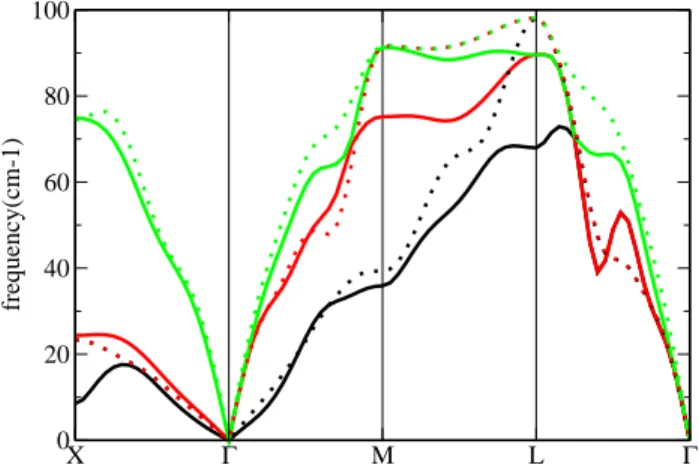
X Γ M L Γ 0 20 40 60 80 100 frequency(cm-1)
FIG. 4: The phonon band structure of β polonium along high symmetry directions of the Brillouin Zone. The SC phonons are included for comparison (dotted lines)
(calculated pressure of 1 GPa), with an angle larger than 90◦. At compressions below 90% (1.5 to 2 GPa), a
sec-ond phase is also stabilized, with an angle smaller than 90◦ (as in Ref. 9). Given the good performance of the
DFT methods for the SC phase, the experimental unit cell is used to compute the phonon bands of β-Po, and the equation of state is fit for a constant rhombohedral angle (giving B = 40.15 GPa, volume 247 bohr3
and B′ = 4.49). Thermal expansion effects are then taken
into account as for the α phase. This will be a very good approximation for volumes and temperatures close to our reference point, which is the experimental volume at around 348 K[6]. At higher temperatures it can be ex-pected that the rhombohedral angle will change slightly. The thermal expansion for the fixed-angle beta phase is reported in Fig. 3 (dashed line), and is consistent with ex-isting experimental data, being higher than (about twice) that of the α phase.
The phonon band structure of β-Po is shown in Fig. 4, along the same high-symmetry directions as in Fig. 1 (the SC nomenclature is used for simplicity). The phonons are calculated at 0 K (with thermal expansion as for the α phase), and would change somewhat due to anharmonic effects (see e.g. Ref. 25). Work in this direction is ongo-ing, but the current agreement with experiment suggests that anharmonic effects are small. Frozen phonon calcu-lations, carried out at zone boundary points confirm this. The reduced anharmonic force constants are calculated, as defined in Ref. [26]. For both α and β phases, the reduced third order constants are negligible (k3≤10−8)
and the fourth order constants (k4 ≤ 0.005) are one to
two orders of magnitude smaller than in the case of doped diamond. It has been checked that lowering the elec-tronic temperature does not lead to unstable phonons in the dip between L and Γ, such that the thermodynamics described by the 0 K phonons is physical.
The free energy is calculated for α and β-Po, adding the ground state energy to the vibrational and electronic free energies. The free energies are calculated at a sec-ond volume V′, and an additional correction is added,
taking the thermal expansion into account (bottom panel of Fig. 5): ∆Fx(T ) = (Fx(V′, T ) − Fx(V0, T )) · (V (T ) −
V0)/(V′−V0) where x is vibrational or electronic. The
volume V (T ) is obtained by inverting the volume depen-dency in the Murnaghan terms of P = −∂Ftot/∂V = 0.
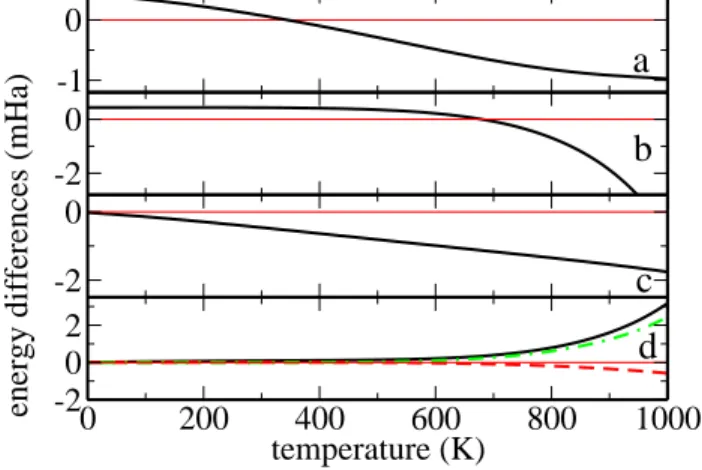
Inserting V (T ) in the equation of state to give the “in-ternal energy”. The differences in the total free energy and its components, between the α and the β phases, are shown in Fig. 5. In Ref. 9 the relativistic stabilization of α-Po is calculated to be 0.15 mHa. Up to ∼600 K, the internal energy difference between the phases (including the relativistic stabilization and the volume expansion for both) is ca. 0.4 mHa. At 350 K the vibrational entropy difference is also of the order of 0.4 mHa, but favors the β phase. The other terms are small. The transition can be explained by the different vibrational
0
200
400
600
800
1000
temperature (K)
-2
0
2
-2
0
energy differences (mHa)
-2
0
-1
0
a
b
c
d
FIG. 5: Free energy differences (mHa) between β and α Polo-nium, as a function of temperature (Kelvin). Negative values favor β Polonium. (a): total free energies. (b): internal en-ergy. (c): vibrational free energy at constant volume Fvib. (d): volume-correction ∆Fvib (solid), electronic free energy Fel(dash), and volume-correction ∆Fel(dot-dash). It is the vibrational free energy terms and the volume corrections that determine the transition Tcfrom α to β Po.
entropy terms, favorable to β-Po, overcoming the inter-nal energy difference. The basic phase diagram for heavy elements of the Se-Te column is thus restored at higher temperatures, once the relativistic stabilization of the α phase is overcome. The symmetry lowering can therefore be explained as the “normal” series of trigonal phases (trigonal spiral then β-Po then BCC) being disrupted by relativistic bonding effects at temperatures low enough for the bonding and entropic terms to be comparable.
Comparing the full Gibbs free energy (P=0) of α-Po and β-Po determines the transition temperature Tc. The
theoretical Tc(at 0 pressure) from the α to the β phase is
350 ±50 K. The error is estimated from the convergence of the free energy fit parameters, and does not take into account anharmonic corrections. Experimental data give a range of Tc from 290 to 330 K. Omitting the thermal
expansion or the free energy terms stabilizes α-Po for all T.
In summary, this Letter presents an ab initio study of the different thermodynamical phases of crystalline Po. The effect of spin-orbit coupling on the phonon band structure of simple cubic Po is first shown to be the opposite of that on simple metals: as the initial Fermi surface (without SO) is strongly nested, the SO correction reduces the nesting and the resulting Kohn anomalies, and hardens most phonon frequencies. The inclusion of SO effects is essential to the correct repre-sentation of the phonons. Due to the delicate bonding characteristics of Po, whose low-temperature simple cu-bic phase is stabilized by relativistic effects, increasing the temperature has the completely counter-intuitive ef-fect of stabilizing a less symmetric phase (rhombohedral
β-Po). This transition originates in the competition of the 0K total energy difference (including relativistic sta-bilizing effects), which favors the α phase, and slightly more favorable vibrational entropy (at higher tempera-tures) for the β phase. A number of other elements are likely to have temperature behaviors similar to Po: either due to relativistic or pressure effects, complex bonding environments open the way for radically different sym-metry breaking as a function of temperature, when en-tropic effects are of the same order of magnitude as the energy differences between bonding types.
The author wishes to thank M. ˇSob, N. Helbig, and O. Eriksson for useful discussions. This research has been supported by the Belgian FNRS, the EU FP6 project DNA Nanodevices (G.A. 029192), and the EU FP7 through the ETSF I3 e-I3 project (G.A. 211956). Com-puter time was provided by UCLouvain-CISM, CINES, and the Red Espa˜nola de Supercomputacion.
∗ Electronic address: matthieu.jean.verstraete@gmail. com
[1] A. R. Oganov et al., Nature 457, 863 (2009).
[2] T. Matsuoka and K. Shimizu, Nature 458, 186 (2009). [3] Y. Ma et al., Nature 458, 182 (2009).
[4] W. L. Mao et al., Science 302, 425 (2003).
[5] E. Y. Tonkov, High Pressure phase transformations (Gor-don and Breach, Philadelphia, 1992).
[6] W. H. Beamer and C. E. Maxwell, J Chem Phys 17, 1293 (1949).
[7] M. I. McMahon and R. J. Nelmes, Chem Soc Rev 35, 943963 (2006).
[8] C. E. Maxwell, J Chem Phys 17, 1288 (1949).
[9] D. Legut, M. Fri´ak, and M. ˇSob, Phys Rev Lett 99, 016402 (2007).
[10] B. I. Min et al., Phys Rev B 73, 132102 (2006).
[11] R. E. Kraig, D. Roundy, and M. L. Cohen, Sol. State Comm. 129, 411413 (2004).
[12] P. Karen, Physics Today September, 10 (2008). [13] R. M. Martin, Electronic Structure (Cambridge
Univer-sity Press, Cambridge, 2004).
[14] S. Baroni, S. de Gironcoli, A. Dal Corso, and P. Gian-nozzi, Rev. Mod. Phys. 73, 515 (2001).
[15] X. Gonze et al., Zeit. Krist. 220, 558 (2005).
[16] W. Kohn and L. J. Sham, Phys. Rev. 140, A 1133 (1965).
[17] C. Hartwigsen, S. Goedecker, and J. Hutter, Phys. Rev. B 58, 3641 (1998).
[18] A. Dal Corso, Phys. Rev. B 76, 054308 (2007). [19] M. J. Verstraete et al., Phys Rev B 78, 045119 (2008). [20] B. Grabowski, T. Hickel, and J. Neugebauer, Phys. Rev.
B 76, 024309 (2007).
[21] W. Kohn, Phys. Rev. Lett. 2, 393 (1959).
[22] R. Brocklehurst, J. Goode, and L. Vassamillet, J. Chem. Phys. 27, 985 (1957).
[23] J. Dean, ed., Lange’s Handbook of Chemistry (McGraw-Hill, 1999), 15th ed.
[24] F. Murnaghan, Proc. Nat. Acad. Sci. 7, 244 (1944). [25] P. Souvatzis, O. Eriksson, M. Katsnelson, and S. Rudin,
Phys. Rev. Lett. 100, 095901 (2008).
[26] P. Zhang, Y. Xue, and P. Dev, Sol. State Comm. 148,