
Entropy flow and energy efficiency analysis of extractive distillation processes with a heavy entrainer
Texte intégral
Figure





Documents relatifs
In this work, we propose a systematic approach for energy-efficient extractive distillation processes for the separation of a biazeotropic mixture that involves thermodynamic insights
In this work, we propose a systematic approach for energy-efficient extractive distillation processes for the separation of a biazeotropic mixture that involves thermodynamic insights
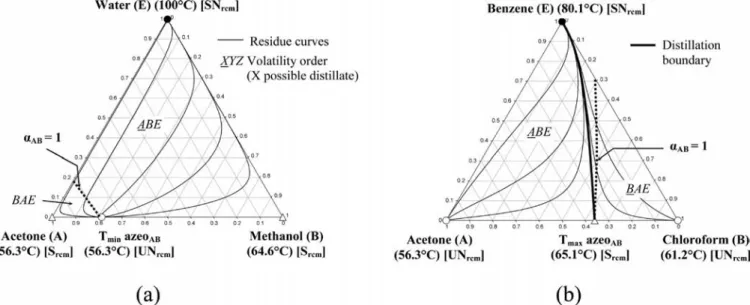
For homogeneous extractive distillation with an entrainer forming no new azeotrope, the feasible diagrams belong to the following classes: (1.0–1a) (separation of minT with E heavy
We have obtained optimal parameters for an extractive distillation process for separating the minimum boiling azeotropic mixture acetone-methanol with water (class 1.0-1a)
A feasibility method to study the separation of maximum (1.0-1a Serafimov’s class) and minimum (1.0-2 Serafimov’s class) boiling temperature azeotropic mixtures with
azeotropic batch distillation with heterogeneous entrainers. In this article, a systematic study of the separation of the n-hexane - ethyl acetate mixture with an entrainer
