http://jfm.sagepub.com/
Journal of Feline Medicine and Surgery
http://jfm.sagepub.com/content/15/7/598
The online version of this article can be found at:
DOI: 10.1177/1098612X13489222
2013 15: 598
Journal of Feline Medicine and Surgery
Radford, Etienne Thiry, Uwe Truyen and Marian C Horzinek
Herman Egberink, Katrin Hartmann, Margaret J Hosie, Albert Lloret, Hans Lutz, Fulvio Marsilio, Karin Möstl, Alan D
Tadeusz Frymus, Tim Gruffydd-Jones, Maria Grazia Pennisi, Diane Addie, Sándor Belák, Corine Boucraut-Baralon,
Dermatophytosis in Cats: ABCD guidelines on prevention and management
technique does not amount to an endorsement of its value or quality, or the claims made by its manufacturer. those of the authors and the inclusion in this publication of material relating to a particular product, method or of animals and interpretation of published materials lies with the veterinary practitioner. The opinions expressed are from actions or decisions based on information contained in this publication; ultimate responsibility for the treatment
arising country. The authors, editors, owners and publishers do not accept any responsibility for any loss or damage advertising material, it is the responsibility of the reader to check that the product is authorised for use in their own bear this in mind and be aware of the prescribing laws pertaining to their own country. Likewise, in relation to Furthermore, drugs may be mentioned that are licensed for human use, and not for veterinary use. Readers need to formulations that are not available or licensed in the individual reader's own country.
The Journal of Feline Medicine and Surgery is an international journal and authors may discuss products and Disclaimer
Published by:
International Society of Feline Medicine
American Association of Feline Practitioners
and
http://www.sagepublications.com
can be found at:
Journal of Feline Medicine and Surgery
Additional services and information for
http://jfm.sagepub.com/cgi/alerts Email Alerts: http://jfm.sagepub.com/subscriptions Subscriptions: http://www.sagepub.com/journalsReprints.nav Reprints: http://www.sagepub.com/journalsPermissions.nav Permissions:
What is This?
- Jun 27, 2013
Version of Record
>>
at Universite de Liege on September 3, 2013
jfm.sagepub.com
Agent properties
In contrast to single-celled yeasts, dermatophytes (‘skin plants’) are complex fungi growing as hyphae and forming a mycelium. About 40 species belonging to the genera Microsporum, Trichophyton and
Epidermophyton are considered as dermatophytes. Over 90% of feline
dermatophytosis cases worldwide are caused by Microsporum canis.1
Others are caused by M gypseum, T mentagrophytes, T quinckeanum,
T verrucosum or other agents. With the exception of M gypseum, all of
these agents produce proteolytic and keratolytic enzymes that enable them to utilise keratin as the sole source of nutrition after colonisation of the dead, keratinised portion of epidermal tissue (mostly stratum corneum and hairs, sometimes nails).
Dermatophytes produce arthro spores, which are highly resistant,
surviving in a dry environment for 12 months or more [EBM grade
III].2In a humid environment, however, arthro spores are short-lived.
High temperatures (100°C) destroy them quickly. Arthrospores adhere very strongly to keratin.
Depending on the source of infection and reservoirs, dermatophyte species are classified into zoophilic, sylvatic, geophilic and anthro-pophilic fungi.
Epidemiology
Dermatophytosis is worldwide the most common fungal infection of cats and one of the most important infectious skin diseases in this species. It may be transmitted to other animal species, and is also an important zoonosis.
M canis is a typical zoophilic dermatophyte.
It was generally thought that subclinical infections are very common in cats, espe-cially in longhaired animals over 2 years of age. However, in many groups the preva-lence is relatively low. Therefore, M canis
C L I N I C A L
R E V I E W
DERMATOPHYTOSIS IN CATS
ABCD guidelines on prevention
and management
Tadeusz Frymus, Tim Gruffydd-Jones, Maria Grazia Pennisi, Diane Addie, Sándor Belák, Corine Boucraut-Baralon, Herman Egberink, Katrin Hartmann, Margaret J Hosie, Albert Lloret, Hans Lutz, Fulvio Marsilio, Karin Möstl, Alan D Radford, Etienne Thiry, Uwe Truyen and Marian C Horzinek
European Advisory Board on Cat Diseases www.abcd-vets.org
Corresponding author: Tadeusz Frymus Email: [email protected]
Overview: Dermatophytosis, usually caused by
Microsporum canis, is the most common fungal
infection in cats worldwide, and one of the most important infectious skin diseases in this species. Many adult cats are asymptomatic carriers. Severe clinical signs are seen mostly in kittens or immunosuppressed adults. Poor hygiene is a predisposing factor, and the disease may be endemic in shelters or catteries. Humans may be easily infected and develop a similar skin disease.
Infection: Infectious arthrospores produced by dermatophytes may survive in the environment for about a year. They are transmitted through contact with sick cats or healthy carriers, but also on dust particles, brushes, clothes and other fomites.
Disease signs: Circular alopecia, desquamation and sometimes an erythematous margin around central healing (‘ringworm’) are typical. In many cats this is a self-limiting disease with hair loss and scaling only. In immunosuppressed animals, the outcome may be a multifocal or generalised skin disease.
Diagnosis: Wood’s lamp examination and microscopic detection of arthrospores on hairs are simple methods to confirm M canis infection, but their sensitivity is relatively low. The gold standard for detection is culture on Sabouraud agar of hairs and scales collected from new lesions.
Disease management: In shelters and catteries eradication is difficult. Essential is a combination of systemic and topical treatments, maintained for several weeks. For systemic therapy itraconazole is the drug of choice, terbinafine an alternative. Recommended topical treatment is repeated body rinse with an enilconazole solution or miconazole with or without chlorhexidine. In catteries/shelters medication must be accompanied by intensive decontamination of the environment.
Vaccination: Few efficacy studies on anti-M canis vaccines (prophylactic or therapeutic) for cats have been published, and a safe and efficient vaccine is not available.
Zoonosis
M canis is the causative
JFMSCLINICAL PRACTICE
599
should not be considered part of the normalfungal flora of cats and its isolation from a healthy animal indicates either subclinical infection or fomite carriage.1
Arthrospores are transmitted through con-tact with sick or subclinically infected ani-mals, mainly cats, but also dogs or other species. In sick animals, the infected hair shafts are fragile and hair fragments contain-ing arthrospores are very efficient in spread-ing infection. In addition, uninfected cats can passively transport arthrospores on their hair, thereby acting as a source of infection. Risk factors include: introducing new animals into a cattery, cat shows, shelters, mating, etc. Indirect contact is very important too; transmission may occur via contaminated collars, brushes, toys, environments, etc. Arthrospores are easily spread on dust parti-cles, even to rooms without access for cats.
Outdoor cats, especially in rural areas, can be exposed by digging to M gypseum, a geophilic fungus living in soil. Cats may be infected with T mentagrophytes or T
quinck-eanum through contact with small rodents,
and with T verrucosum through contact with cattle.
Pathogenesis
Healthy skin acts as an effective barrier against fungal invasion. The increased rate of regeneration of epidermal cells in response to the dermatophyte, with the consequent removal of fungus from the skin surface, is another protective mechanism. As dermato-phytes cannot penetrate healthy skin, many cats are merely passive carriers of the arthrospores or remain subclinically infected. Whether such an infection will lead to clinical disease depends on many factors. Predisposing factors to disease include: a young age (first 2 years of life), immunosup-pression (including immunosuppressive treatment), other diseases, nutritional deficits (especially proteins and vitamin A), high tem-perature and high humidity.1
Very important for the facilitation of infec-tion is any kind of skin trauma resulting from increased moisture, injury by ectoparasites or scratches due to pruritus, playing
or aggressive behaviour, clipping, etc. In general, poor hygiene is a predisposing factor. In over-crowded feline groups, social stress may play an important role. This can make eradication of ringworm very difficult in catteries or shelters infected with M canis.
The potential immunosup-pressive effect of feline
R E V I E W/ABCD guidelines on dermatophytosis
immunodeficiency virus (FIV) and feline leukaemia virus (FeLV) on the prevalence of fungal infection has been investigated. The higher prevalence of M canis in FIV-infected animals compared with normal cats reported in one survey3was not observed by another
group.4It has been suggested that any
associ-ation may be related to differences in the envi-ronment rather than to the retroviral status of the cats.5
The incubation period of ringworm caused by M canis is 1–3 weeks. During this time, hyphae grow along the hair shafts through the stratum corneum to the follicles where they produce spores that form a thick layer around the hair shafts. As dermatophytes are suscep-tible to high temperatures, they cannot colonise deeper parts of the skin or the follicle itself. Therefore, the hair grows normally but breaks easily near the skin surface, resulting in hair loss. Several metabolic products of the fungus may induce an inflammatory response in the skin, and may be observed mainly around the infected area, forming sometimes ring-like lesions with central areas of healing and papules on the periphery (‘ringworm’).
In many immunocompetent cats living in hygienic conditions these lesions are limited (eg, to the head) and disappear after several weeks. In immunosuppressed animals, the outcome may be a multifocal or generalised skin disease with secondary bacterial infec-tions. On rare occasions, a marked inflamma-tory reaction to hyphae induces a nodular granulomatous reaction involving dermis and draining on the skin surface. These so-called pseudomycetomas are more often seen in Persian cats, sometimes concurrently with classical lesions.
The pathogenesis of other dermatophyte infections is similar to that described above.
Immunity
Naturally occurring ringworm is rarely recur-rent, suggesting an effective and long-lasting immunity. Experimental studies confirm that animals express increased resistance to subse-quent challenge by the homologous fungus. Reinfections may occur, but require a much greater number of spores, and usually these subse-quent infections are cleared more rapidly.1 It has been
suggested that for the devel-opment of full immunity, the infection must run its entire natural course, as in cats whose infection was aborted with antifungal treatment the delayed type hypersensitivity reactions were often weaker.6
European Advisory Board on Cat Diseases
The European Advisory Board on Cat Diseases (ABCD) is a body of experts in immunology, vaccinology and clinical feline medicine that issues guidelines on prevention and management of feline infectious diseases in Europe, for the benefit of the health and welfare of cats. The guidelines are based on current scientific knowledge of the diseases and available vaccines concerned.
The latest version of the dermatophytosis in cats guidelines is available at www.abcd-vets.org
Dermatophytes
(‘skin plants’)
are complex
fungi growing
as hyphae and
forming a
mycelium. Over
90% of feline
dermatophytosis
cases
worldwide are
caused by
Microsporum
canis.
EBM gradesThe ranking system for grading the level of evidence of various statements within this article is described on page 533 of this Special Issue.
at Universite de Liege on September 3, 2013
jfm.sagepub.com
Although dermatophyte infection is confined to the superficial keratinised tissues, a humoral and cellular immune response is induced. Prominent activation of T helper type 2 (Th2) cells and the cor-responding cytokine profile leads to anti-body formation followed by chronic disease, whereas activation of Th1 cells stimulates a cell-mediated response char-acterised by interferon-γ, and interleukins 12 and 2, and leads to recovery.1,7 Such
cats are protected against reinfection.8The
role of the humoral response in dermato-phytosis is unclear, although antibodies could have a fungistatic effect by means of opsonisation and complement activation.9
Clinical signs
In many cats, dermatophytes cause a mild, self-limiting infection with hair loss and scal-ing (Figure 1).
The typical presentation of ringworm in cats is regular and circular alopecia (Figure 2), with hair breakage, desquamation and sometimes an erythematous margin and central heal-ing.1,10The lesions are sometimes very small,
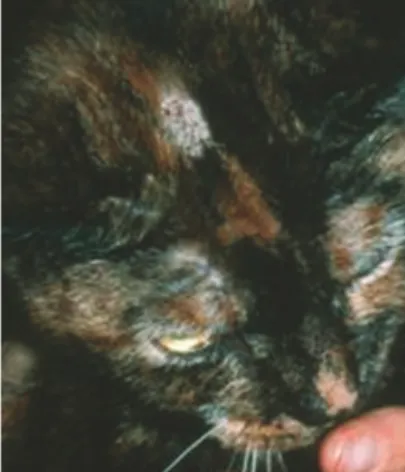
but occasionally may have a diameter of 4–6 cm. Lesions may be single or multiple, and are localised mostly on the head (Figure 3) but also on any part of the body, including the distal parts of the legs and the tail. Young cats, in par-ticular, display lesions localised at first to the bridge of the nose and then extending to the temples, the external sides of the pinnae and auricular margins (Figure 4). Multiple lesions may coalesce. Pruritus is variable, generally mild to moderate, and usually no fever or loss of appetite is observed.1,10
In some cats, dermatophytosis can present as a papulocrustous dermatitis (‘miliary der-matitis’) affecting mainly the dorsal trunk.
In immunosuppressed cats, extensive lesions with secondary bacterial involvement are
some-times associated with chronic ringworm. Such patients demonstrate atypical, large alopecic areas, erythema, pruritus, exudation and crusts (Figure 5). At this stage, dermato-phytosis may mimic other dermatological conditions. Typical signs may be still visible at the margins of the lesions.
A rare outcome is onyxis and perionyxis and, exceptionally, nodular granulomatous dermatitis (pseudomycetoma) with single or multiple cutaneous nodules, firm and not painful on palpation.11 Fistulisation
of these nodules is possible. Pseudo -mycetoma occurring as abdominal masses may be a rare complication of laparotomy in animals with cutaneous dermatophytosis.12
Diagnosis
As dermatophytosis can produce lesions simi-lar to many feline skin diseases, it should be considered in all cats with any cutaneous condition. If possible, dermatophyte diagnosis should be undertaken before any treatment.
An inexpensive and simple screening tool for M canis infection is the Wood’s lamp exam-ination. However, it is not very sensitive: only about 50% of M canis strains fluoresce and other dermatophytes do not fluoresce at all.13
Furthermore, debris, scale, lint and topical medications (eg, tetracycline) can produce false-positive results. Thus, Wood’s lamp find-ings should be confirmed by other methods.
Direct microscopic examination is another simple and rapid method to detect dermato-phytes on hairs or scales. It is recommended to pluck hairs for this purpose under Wood’s lamp illumination, or from the edge of a lesion. The sample should be cleared with 10–20% potassium hydroxide solution before examina-tion. There are a number of techniques to improve the visualisation of fungal elements on the hair shafts.1 Hairs or hair fragments
with hyphae and arthrospores are thicker, with Figure 1 In some cats, especially immunocompetent adults,
the only sign of dermatophytosis may be scaling. Courtesy of
Tadeusz Frymus
Figure 2 Circular alopecia caused by M canis infection.
Courtesy of Tadeusz Frymus
Figure 3 On many occasions dermatophytosis lesions start on the head.
Courtesy of International Cat Care (formerly Feline Advisory Bureau)
As
dermato-phytosis can
produce
lesions similar
to many feline
skin diseases,
it should be
considered in
cats with any
cutaneous
condition.
R E V I E W/ABCD guidelines on dermatophytosis
JFMSCLINICAL PRACTICE
601
a rough and irregular surface. However, direct microscopic examination may give false-positive results, especially if saprophytic fun-gal spores are present or debris is interpreted as fungal elements. Also, the sensitivity of this technique is relatively poor and has been assessed as 59%.14Higher sensitivity (76%) has
been achieved by fluorescence microscopy with calcafluor white – a special fluorescent stain that binds strongly to structures contain-ing cellulose and chitin.13
Culture on Sabouraud dextrose agar or other media is the gold standard for the detection of dermatophytes. This method is very sensitive and can determine the species. Samples (hairs, scales) should be collected from the margin of new lesions after gently swabbing with alcohol to reduce contamination. If a subclinical infec-tion or passive carriage is suspected, brushing for 5 mins with a sterile brush is the best method for collecting sample material. A brand new toothbrush is mycologically sterile.1
Several in-house dermatophyte test media (DTM) based on colour change are available commercially. However, few attempts have been made to evaluate the performance of such media with veterinary samples.10 Therefore,
suspect colonies must be examined microscop-ically to confirm the presence of a fungus.1
Polymerase chain reaction has been pro-posed for the detection of M canis sequences in suspected material from animals.15
Disease management
In immunocompetent cats, isolated lesions dis-appear spontaneously after 1–3 months and may not require medication. However, treat-ment of such cases will reduce the disease course as well as the risk for other animals and humans, and contamination of the environment.
Topical treatment is generally less effective in cats compared with humans due to poor penetration of the medicines through the hair coat, lack of tolerance of this treatment by many cats and the possible existence of un -noticed small lesions (Figure 6). Thus, therapeutic measures should include a combi-nation of systemic and topical treatment, maintained for at least 10 weeks. Generally, cats should be treated not only until the lesions completely disappear, but until the dermatophyte can no longer be cultured from the hairs on at least two sequential brushings 1–3 weeks apart.
In catteries and shelters, dermatophyte infection is very difficult, time-consuming and expensive to eradicate. Good compliance by the owner is therefore essential. A treatment programme is necessary, together with com-plete separation of infected and uninfected animals and intensive decontamination of the environment. This will necessitate interrup-tion of breeding programmes and shows. All animals in the cattery should be treated. A far less preferable alternative is to divide the cats into groups and treat according to infection status. Special hygiene measures should be taken when handling infected animals in order to prevent infection of humans (gloves, disinfection of cat scratches or any other injury).
Figure 6 Some dermatophytosis lesions may become visible only after clipping. Courtesy of Tadeusz Frymus
Figure 4External sides of the pinnae may also be affected by dermatophytosis. Courtesy of Tadeusz Frymus Figure 5In some cats, particularly immunocompromised ones, the outcome of dermatophytosis may be a multifocal or generalised skin disease. Courtesy of
International Cat Care (formerly Feline Advisory Bureau)
M canis should not be considered part of
the normal fungal flora of cats. Its isolation
from a healthy animal indicates either subclinical
infection or fomite carriage.
at Universite de Liege on September 3, 2013
jfm.sagepub.com
Topical therapy
In cats with a limited number of lesions, hairs should be clipped away from the periphery of lesions incorporating a wide margin. Clipping should be gentle to avoid spreading the infec-tion due to microtrauma. Spot treatment of lesions may be of limited efficacy; instead, whole body shampooing, dipping or rinsing is recommended. In patients with generalised disease, longhaired cats and for cattery decon-tamination, clipping the entire cat is useful to make topical therapy application easier and to allow for better penetration of the drug. This approach also limits the spread of the spores into the environment, to people and to other animals. The entire hair coat, including whiskers, should be gently clipped and all infected hairs should be wrapped and disinfected before disposal. Chemical or heat sterilisation of instruments is essential. Cats should not be clipped in veterinary clinics to avoid environmental contamination. The best place for clipping is in the cat’s own house-hold, where the environment is already contaminated.
Topical antifungal drugs differ widely in their efficacy. One of the most effective proce-dures is a whole body treatment with a 0.2% enilconazole solution performed twice week-ly.1Local or general side effects are very
sel-dom reported provided that grooming is prevented (Elizabethan collar) until the cat is dry.16 Very effective is also 2% miconazole
with or without 2% chlorhexidine as a twice weekly body rinse or shampoo.1In the USA,
lime-sulphur solution is commonly used.
Systemic therapy
Itraconazole
Though relatively expensive, itraconazole is currently the preferred drug in feline der-matophytosis and is licensed for this indica-tion.1It is comparable (or superior) in efficacy
to ketoconazole or griseofulvin and is much better tolerated by cats. The only adverse reac-tion occasionally reported is anorexia. The embryotoxicity and teratogenicity of itracona-zole also seems to be lower than that of keto-conazole. Nevertheless, its administration in pregnancy is not recommended. Use in kittens as young as 6 weeks is possible.
Most veterinary dermatologists will use itraconazole as so-called pulse therapy, which is also suggested by the manufacturer. This protocol is effective and also reduces the cost of treatment. A pulse administration of 5 mg/kg/day for 1 week, every 2 weeks for 6 weeks has been suggested.17Another study
demonstrated that there were sufficient levels of itraconazole in the plasma and the fur of cats with ringworm that had been given three cycles of treatment consisting of 1 week with
treatment (5 mg/kg) and 1 week without. A 25–30% reduction in levels was observed after the week without treatment, but the concentra-tions were still high enough even 2 weeks after the last administration [EBM grade IV].18These
data illustrate that such a treatment schedule (3 x 7 days of dosing) provides actual coverage of at least 7 weeks.
Terbinafine
An alternative is terbinafine administered orally 30–40 mg/kg once daily.1,11 It seems
also suitable for pulse therapy. After adminis-tration lasting 14 days, terbinafine persisted in the hair of cats at inhibitory concentrations for 5.3 weeks [EBM grade III].19Occasional
vom-iting and intensive facial pruritus has been observed as side effects.
Ketoconazole
Ketoconazole has been used orally at 2.5–5 mg/kg twice daily. However, cats are relative-ly susceptible to side effects with this drug, which include liver toxicity, anorexia, vomit-ing, diarrhoea and suppression of steroid hormone synthesis. Ketoconazole is also contraindicated in pregnant animals.
Griseofulvin
In some countries, griseofulvin is still used. However, it is not now generally recommend-ed as more safe and effective preparations are available. It is administered orally for at least 4–6 weeks at 25–50 mg/kg q12–24h. Griseofulvin is poorly soluble in water and micronised formulation as well as administra-tion with fatty meals enhance absorpadministra-tion. Adverse reactions include anorexia, vomiting, diarrhoea and bone marrow suppression, particularly in Siamese, Himalayan and Abyssinian cats. The use of griseofulvin is contraindicated in kittens younger than 6 weeks of age and in pregnant animals as the compound is teratogenic, particularly during the first weeks of gestation. There are a few reports suggesting that FIV infection predis-poses cats to griseofulvin-induced bone mar-row suppression. Therefore, cats should be tested for this infection prior to therapy. If griseofulvin is chosen, a complete blood count should be carried out monthly to detect possi-ble bone marrow suppression.
Lufenuron
Lufenuron is a chitin synthesis inhibitor, used for the prevention of flea infestations in dogs and cats. As chitin is also a component of the fungal cell wall, some antifungal activity had been anticipated. However, studies in cats have not demonstrated antifungal effect and lufenuron is not recommended for the treat-ment of dermatophytosis.1
Generally,
cats should
be treated
until the
dermatophyte
can no longer
be cultured
from hairs on
at least two
sequential
brushings 1–3
weeks apart.
JFMSCLINICAL PRACTICE
603
R E V I E W/ABCD guidelines on dermatophytosis
mals. A trend of improvement in all cats fol-lowing therapeutic vaccination was observed, although this improvement was not signifi-cantly different from that seen in the placebo-treated cats.
Environmental decontamination
Thorough vacuuming and mechanical clean-ing is essential to remove infective material (no visible hairs should be present), especially in households with one or a few cats where disinfection is impractical and unnecessary. However, in catteries or shelters, disinfection is very important. Most disinfectants labelled as ‘antifungal’ are fungicidal against mycelialOther options
In cattle and furbearing animals, immuno -therapy with anti-dermatophyte vaccines is believed to reduce the lesions and to acceler-ate their disappearance. Although M canis vaccines have been marketed for treatment of affected cats, controlled studies demonstrat-ing efficacy of this procedure in cats are hard to find. Results of a placebo-controlled double-blind study performed on 55 cats with severe dermatophytosis caused by M canis or
T mentagrophytes have been published.20 An
inactivated vaccine containing antigens of M
canis, M canis var distortum, M canis var obe-sum, M gypseum and T mentagrophytes was
given three times intramuscularly to sick
ani-V a c c i n a t i o n
Very few efficacy studies on anti-M canis vaccines (prophylactic or therapeutic) for cats have been performed and published. Although considerable success has been achieved in prophylactic or therapeutic use of anti-dermatophyte vaccines in cattle and fur-bearing animals, a safe and efficient vaccine for cats is still not available.10,22
A killed M canis cell wall vaccine induced both humoral and cell-mediated immunity in experimental cats; however, these responses did not protect cats against challenge.23 Similarly, M canis antigens combined with a live Trichophyton vaccine did not induce protective immunity against topical challenge with M canis.24A commercial vaccine consisting of killed M canis components in adjuvant was licensed in the USA for treatment of cats rather than prevention. However, in experimental cats, this vaccine did not
prevent the establishment of a challenge infection and also did not provide a more rapid cure of an established infection in vaccinated cats compared with unvaccinated controls.24 The product was withdrawn from the market. Some other studies to develop dermatophytosis vaccines have been reviewed elsewhere.22
Not recommended
The ABCD does not recommend dermatophytosis vaccination.
< Dermatophytosis, caused usually by M canis, is the most common fungal infection in cats and one of the most important infectious skin diseases in this species.
< M canis produces arthrospores that may remain infective for about a year and are easily transmitted by direct
contact or by fomites to cats, other animal species and humans.
< Many cats are infected subclinically or are fomite carriers of the arthrospores.
< Dermatophytosis may be endemic in groups of cats, especially in poor environmental conditions, and the eradication of the disease is very difficult in such cases.
< Circular alopecia, desquamation and sometimes an erythematous margin around central healing (‘ringworm’) are typical lesions of this chronic skin disease.
< In many cats it is a self-limiting disease with hair loss and scaling only. In young animals and immunosuppressed adults, the outcome may be a multifocal or generalised skin disease.
< The gold standard for the detection of dermatophytes is culture on Sabouraud agar. Wood’s lamp examination and microscopic detection of arthrospores on hairs are much less sensitive.
< In severe cases systemic and topical therapy must be combined and maintained for several weeks. In catteries and shelters, medication must be accompanied by intensive decontamination of the environment.
< For systemic therapy itraconazole is the drug of choice.
< Recommended topical treatment is repeated body rinsing with an enilconazole solution or miconazole with or without chlorhexidine.
< As a safe and efficient vaccine for cats is still not available, the ABCD does not recommend vaccination.
KEY
POINTS
at Universite de Liege on September 3, 2013
jfm.sagepub.com
Funding
The authors received no specific grant from any funding agency in the public, commercial or not-for-profit sectors for the preparation of this article. The ABCD is supported by Merial, but is a scientifically independent body.
Conflict of interest
The authors do not have any potential conflicts of interest to declare.
References
1 Moriello KA and DeBoer DJ. Dermatophytosis. In: Greene CE (ed). Infectious diseases of the dog and cat. 4th ed. St Louis: Elsevier, 2012, pp 588–602.
2 Sparkes AH, Werrett G, Stokes CR and Gruffyd-Jones TJ.
Microsporum canis: inapparent carriage by cats and the
via-bility of arthrospores. J Small Anim Pract 1994; 35: 397–401.
3 Mancianti F, Giannelli C, Bendinelli M and Poli A.
Mycological findings in feline immunodeficiency virus-infected cats. J Med Vet Mycol 1992; 30: 257–259.
4 Sierra P, Guillot J, Jacob H, Bussiéras S and Chermette R.
Fungal flora on cutaneous and mucosal surfaces of cats infected with feline immunodeficiency virus or feline leukemia virus. Am J Vet Res 2000; 61: 158–161.
5 Mignon BR and Losson B. Prevalence and characterization of
Microsporum canis carriage in cats. J Med Vet Mycol 1997; 35:
249–256.
6 Moriello KA, DeBoer DJ, Greek J, Kukl K and Fintelman M.
The prevalence of immediate and delayed-type hypersensi-tivity reactions to Microsporum canis antigens in cats. J Feline Med Surg 2003; 5: 161–166.
7 Sparkes AH, Stokes CR and Gruffydd-Jones TJ. Experimental
Microsporum canis infection in cats: correlation between
immunological and clinical observations. J Med Vet Mycol
1995; 33: 177–184.
8 Sparkes AH, Stokes CR and Gruffydd-Jones TJ. Humoral
immune responses in cats with dermatophytosis. Am J Vet Res 1993; 54: 1869–1873.
9 Sparkes AH, Stokes CR and Gruffydd-Jones TJ. SDS-PAGE
separation of dermatophyte antigens, and Western immunoblotting in feline dermatophytosis. Mycopathologia
1994; 128: 91–98.
10 Chermette R, Ferreiro L and Guillot J. Dermatophytoses in
animals. Mycopathologia 2008; 166: 385–405.
11 Nuttall TJ, German AJ, Holden SL, Hopkinson C and McEwan NA. Successful resolution of dermatophyte mycetoma
fol-lowing terbinafine treatment in two cats. Vet Dermatol 2008;
19: 405–410.
12 Black SS, Abernethy T, Tyler JW, Thomas MW, Garma-Avia and Jensen HE. Intraabdominal dermatophytic pseudo
-mycetoma in a Persian cat. J Vet Intern Med 2001; 15: 245–248.
13 Sparkes AH, Werrett G, Stokes CR and Gruffydd-Jones TJ.
Improved sensitivity in the diagnosis of dermatophytosis by fluorescence microscopy with calcafluor white. Vet Rec 1994;
134: 307–308.
14 Sparkes AH, Gruffydd-Jones TJ, Shaw SE, Wright AI and Stokes CR. Epidemiological and diagnostic features of canine
and feline dermatophytosis in the United Kingdom from 1956 to 1991. Vet Rec 1993; 133: 57–61.
15 Nardoni S, Franceschi A and Mancianti F. Identification of
Microsporum canis from dermatophytic pseudomycetoma in
paraffin-embedded veterinary specimens using a common PCR protocol. Mycoses 2007; 50: 215–217.
16 Hnilica KA and Medleau L. Evaluation of topically applied
enilconazole for the treatment of dermatophytosis in a Persian cattery. Vet Dermatol 2002; 13: 23–28.
17 Colombo S, Cornegliani L and Vercelli A. Efficacy of
itracona-zole as combined continuous/pulse therapy in feline der-matophytosis: preliminary results in nine cases. Vet Dermatol
2001; 12: 347–350.
18 Vlaminck KMJA and Engelen MACM. Itraconazole: a treatment
with pharmacokinetic foundations. Vet Dermatol 2004; 15: 8.
19 Foust AL, Marsella R, Akucewich LH, Kunkle G, Stern A, Moattari S, et al. Evaluation of persistence of terbinafine in
the hair of normal cats after 14 days of daily therapy. Vet Dermatol 2007; 18: 246–251.
20 Westhoff DK, Kloes M-C, Orveillon FX, Farnow D, Elbers K and Mueller RS. Treatment of feline dermatophytosis with
an inactivated fungal vaccine. Open Mycology J 2010; 4: 10–17.
21 Carlotti DN, Guinot P, Meissonnier E and Germain PA.
Eradication of feline dermatophytosis in a shelter: a field study. Vet Dermatol 2009; 21: 259–266.
22 Lund A and DeBoer DJ. Immunoprophylaxis of
dermatophy-tosis in animals. Mycopathologia 2008; 166: 407–424.
23 DeBoer DJ and Moriello KA. The immune response to
Microsporum canis induced by fungal cell wall vaccine. Vet
Dermatol 1994; 5: 47–55.
24 DeBoer DJ, Moriello KA, Blum JL, Volk LM and Bredahl LK.
Safety and immunologic effects after inoculation of inacti-vated and combined live-inactiinacti-vated dermatophytosis vac-cines in cats. Am J Vet Res 2002; 63: 1532–1537.
Available online at jfms.com
Reprints and permission: sagepub.co.uk/journalsPermissions.nav forms of the dermatophyte or macroconidia
but not against arthrospores. Most efficient against arthrospores are 1:33 lime-sulphur, 0.2% enilconazole, and 1:10 to 1:100 house-hold chlorine bleach.1 All surfaces should
be cleaned with one of these solutions. An
enilconazole smoke fumigant formulation is available in many European countries.
Detailed decontamination procedures, as well as the management of infected catteries and shelters during treatment, are described elsewhere.1,21