Chicory Roots for Prebiotics and Appetite Regulation: A Pilot Study
in Mice
Marion Fouré,
†Camille Dugardin,
†Benoît Foligné,
‡Philippe Hance,
†Thierry Cadalen,
†Abigael Delcourt,
†Bernard Taminiau,
§Georges Daube,
§Rozenn Ravallec,
†Benoit Cudennec,
†Jean-Louis Hilbert,
†and Anca Lucau-Danila*
,††
EA 7394, ICV
−Institut Charles Viollette, Université Lille, INRA, ISA, Université Artois, Université Littoral Côte d’Opale, F-59000
Lille, France
‡
INSERM, CHRU, Universite
́ Lille, LIRIC-UMR 995, F-59000 Lille, France
§
Faculty of Veterinary Medicine, FARAH, University of Lie
̀ge, B-4000 Liège, Belgium
*
S Supporting InformationABSTRACT:
The objectives of this work are to address the prebiotic e
ffects of chicory (Cichorium intybus) together with its
possible role in appetite control. We compared nine chicory genotypes in order to determine if variations in the content of
metabolites in the roasted roots would lead to modi
fications in release of satiety hormones and in composition of gut microbiota.
To this aim, a 5-week dietary-intervention study was achieved using mice fed with distinct chicory-based preparations. A 16S
rRNA gene-based metagenetic analysis of fecal microbiota was performed. In vitro gastrointestinal digestions were performed in
order to study the e
ffect of chicory intestinal digests on gut hormone regulation in enteroendocrine cells. Firmicutes/
Bacteroidetes ratio and gut bacterial groups, such as Alloprevotella, Blautia, Alistipes, and Oscillibacter, were found to be modulated
by chicory. On the other hand, CCK and GLP-1 satiety hormones were demonstrated to be signi
ficantly increased by chicory in
vitro.
KEYWORDS:
Cichorium intybus, prebiotics, metabolomics, metagenetics, satiety hormones
■
INTRODUCTION
The chicory root represents the main industrial source of
inulin
1and is also used as a food ingredient in the form of
flour
or roasted products. It goes into our food under various forms
entailing an implicit consumption of inulin. Inulin-type
prebiotics include fructooligosaccharides (FOS), oligofructose,
and inulin.
2They escape digestion in the digestive superior
tract and arrive in the colon, where they constitute the ideal
fermentative substrate for resident bacteria. These ingredients
are legally classi
fied as food or food ingredients and are
included in the daily diet.
3Inulin is especially consumed and
has received a notice from the European Food Safety Authority
concerning positive health e
ffects. Inulin is incorporated into
numerous foodstu
ffs such as yogurts and cheeses,
4cakes,
5and
dough.
6Added to co
ffee, inulin showed an effect on satiety by
mitigation of the sensation of hunger.
7By reinforcing the gut
microbiota, inulin participates in the increase of resistance to
infections as observed for the anti-in
flammatory effects on
asthmatic patients.
8Similarly, by stimulating the growth of
lactobacilli, inulin is able to activate T cells and NK cells as well
as the phagocytes.
9Functional food refers to food containing
ingredients that aid speci
fic bodily functions in addition to
being nutritious,
10and so inulin is currently used as functional
food, particularly in a variety of dairy products, to enhance the
intensi
fication of the beneficial intestinal bacteria.
11A prebiotic is de
fined as a substrate that is selectively utilized
by host microorganisms conferring to this host a health
benefit.
12This new definition expands the concept of prebiotics
to include noncarbohydrate substances, applications to body
sites other than the gastrointestinal tract, and diverse categories
other than food. The community of microorganisms that makes
up the gut microbiota has been the object of many studies. The
analysis of genetic material recovered directly from
environ-mental samples by metagenomic approaches reproduces the
pro
file of microbial biodiversity in the initial sample. Sequence
analysis of the 16S rRNA gene has been widely used to identify
bacterial species from the digestive tract, and next-generation
sequencing techniques that have emerged during the past
decade have facilitated the rapid analysis of these samples.
13This technique facilitates the monitoring of di
fferent
modi
fications of the gut microbiota under different treatments
or diets.
Concerning the food-intake regulation, it is known that the
short-term regulation implicates multiple actors including the
brain and the intestine, which coordinate with nervous and
endocrine signals. Intestinal hormones, secreted by
enter-oendocrine cells (EECs) scattered along the gastrointestinal
tract, are primordial signals implicated in this regulation. Thus,
in response to nutrient sensing at their apical side, EECs secrete
a wide range of gut hormones acting as peripheral signals
transmitted to the brain to regulate appetite, energy
expenditure, and insulin secretion.
14,15Among the many
hormones produced by the gut, cholecystokinin (CCK) and
Received: February 27, 2018 Revised: June 5, 2018 Accepted: June 6, 2018 Published: June 6, 2018 Article pubs.acs.org/JAFCCite This:J. Agric. Food Chem. XXXX, XXX, XXX−XXX
© XXXX American Chemical Society A DOI:10.1021/acs.jafc.8b01055
glucagon-like peptide 1 (GLP-1) are well-studied anorexigenic
hormones. However, released GLP-1 is quickly inactivated by
the dipeptidyl peptidase IV (DPP-IV). Consequently, DPP-IV
represents a good target for type 2 diabetes mellitus (T2DM)
management, and the search for natural DPP-IV inhibitors
seems today to be a promising approach.
16,17The chicory root contains other major compounds as
chlorogenic acids and sesquiterpene lactones,
18which may be
of further interest. The potential synergies between inulin and
these di
fferent specialized metabolites are not yet described.
Consequently, we interrogated many di
fferent chicory
genotypes for their metabolites composition by a proton
nuclear magnetic resonance spectroscopy (
1H NMR) and
liquid chromatography-UV (LC-UV) for absolute
quantifica-tion. Chicory roasted roots from di
fferent genotypes were next
used to feed mice. Gut microbiota variations were then
analyzed by NGS sequencing of 16S rRNA gene and
metagenetic analysis in order to be associated with roots
metabolites composition. In addition, the e
ffects of roasted
chicory on intestinal hormone modulation were investigated in
vitro with the combination of simulated gastrointestinal
digestion, secretion study using the STC-1 enteroendocrine
cell line, and a dipeptidyl peptidase-IV (DPP-IV) inhibition
assay.
■
MATERIALS AND METHODS
Chicory Metabolomics. Nine industrial chicory (Cichorium intybus) genotypes selected from a 48 genotype diversity field trial, conducted by Florimond-Desprez Veuve et Fils SAS (Cappelle-en-Pévèle, France) in year 2011 and located in Coutiches (France), were used to produce fresh chicory roots. Roots were dried and roasted by Leroux SAS (Orchies, France). Samples (roasted products) were freeze-dried (48 h), ground (Waring 7011G blender with glass container, Waring), and sieved to 355μm. Extraction of metabolites was performed by the decoction procedure. Warm water (100 mL, 85 °C) was added to a 150 mL glass tube containing 3 g of powder. The mixture was incubated for 20 min at 80°C under weak agitation. The solution wasfiltered through a coffee filter, filtrates were centrifuged at 30 000g for 10 min at 4°C, and the supernatants were store at −80 °C until feeding. The concentration of the decoctions was normalized on the basis of dry matter to 15.5 ± 0.5 mg/mL. 1H NMR absolute
quantification was carried out according to Moing et al.19 by the ERETIC method using calibration curves of C1H-(α+β) glucose.20 For chlorogenic acids and sesquiterpene lactones determination, LC-UV analyses were performed according to Willeman et al.18 All experiments were conducted in triplicate. Statistical analysis was performed using R 2.15.1 for Windows with FactoMineR and agricolae libraries to perform principal component analysis (PCA) and analysis of variance (ANOVA), respectively. Normality and homogeneity of the variance were checked by Shapiro−Wilk’s test and Bartlett’s test, respectively, followed by Tukey’s test to assess significant differences
between means of groups. Differences were considered significant for a p-value of <0.05.
In Vitro Simulated Gastrointestinal Digestion. In vitro simulated gastrointestinal digestion (SGID) was performed as previously described,21 with some modifications. The first three steps of digestion were simulated (mouth, stomach, and duodenum), and threefluids were prepared to mimic the physiological conditions of each step. The composition of eachfluid is described in Table 1, and the pH of the solutions was adjusted to physiologically relevant values using NaOH (5 M) and HCl (5 M) solutions. The whole digestion process was performed in a 200 mL reactor controlled at 37 °C under constant stirring with a magnetic stirrer over 240 min. Two g of chicory roasted roots (dry weight) was added to the reactor and solubilized in 16 mL of salivaryfluids at pH 6.8 (125 g·L−1dry matter) containing amylase at an enzyme/substrate (E/S) ratio of 1:430 (w/ w). Sampling of 4 mL was performed at the end of the salivary step. Twenty-four mL of gastricfluids containing pepsin at an (E/S) ratio of 1:40 (w/w) were added after saliva sampling, and the pH solution was adjusted (2.5−3.0). After 2 h, sampling of 16 mL was performed at the end of the gastric step (41.67 g·L−1 dry matter). Thirty-six mL of intestinalfluids (24 mL of duodenal juice and 12 mL of bile juice) containing pancreatin at an E/S ratio of 1:50 (w/w) and 4 mL of 1 M NaHCO3 were then added to the batch, and the pH solution was
adjusted to 7. Intestinal digestion was carried out again over 2 h, and sampling of 60 mL was performed at the end of the intestinal step. Final digest concentration reaches 13.89 g·L−1 dry matter. Once
heated at 95°C for 10 min to ensure enzyme denaturation, all samples were centrifuged at 13 400g for 10 min at room temperature. Supernatants were collected and frozen for further analysis.
CCK and GLP-1 Secretion Study. The murine enteroendocrine STC-1 cell line was a gift gratefully received from Dr. C. Roche Grangette (INSERM U865, Lyon, France). The STC-1 cells were grown at 37°C, 5% CO2atmosphere, in Dulbecco’s modified Eagle’s
medium (DMEM, 4.5 g·L−1 glucose) supplemented with 10% fetal
bovine serum (FBS), 100 U·mL−1 penicillin, 100 μg·mL−1 streptomycin, and 2 mM glutamine. STC-1 cells were seeded to reach 60−80% confluence. Cells were washed twice with fresh media (without FBS) and incubated with 3 different concentrations (0.2, 0.5, and 1% (w/v)) of chicory roasted roots compared to their in vitro simulated gastrointestinal digestion (SGID) products diluted in incubation buffer (4.5 mM KCl, 1.2 mM CaCl2, 1.2 mM MgCl2,
140 mM NaCl, and 20 mM Hepes-Tris, pH 7.4) for 2 h at 37°C in 5% CO2 atmosphere. Cell supernatants were collected on ice and
centrifuged (2 000g for 7 min). The supernatants were frozen and stored at−20 °C for further hormone-concentration determinations. Secreted CCK and active GLP-1 concentrations (pM) in culture media of STC-1 cells were assayed using commercial RIA kits (Active Glucagon-Like Peptide RIA kit from EMD Millipore from Merck KGaA, Darmstadt, Germany, and Gastrin kit from CisBio, France).
DPP-IV Inhibition Assay. The DPP-IV inhibitory activity of the native chicory roasted roots compared to their SGID products was assayed according to the method described by Lacroix and Li-Chan22 with some modifications. Briefly, 25 μL of chicory samples and their corresponding SGID products at concentrations ranging from 0.87 to 13.89 mg/mL (dry matter) were preincubated with 75μL of Tris/HCl
Table 1. Chemical Composition, Protease Concentration, and pH Used for the Di
fferent Steps of the In Vitro Simulated
Gastrointestinal Digestion
saliva gastric juice duodenal juice bile juice
chemical composition KCl (12 mM) KCl (11 mM) KCl (7.6 mM) KCl (5 mM)
KSCN (2 mM) NaH2PO4(2.2 mM) KH2PO4(0.6 mM) NaCl (90 mM)
NaH2PO4(7.4 mM) NH4Cl (5.7 mM) NaCl (120 mM) NaHCO3(69 mM)
Na2SO4 (4 mM) NaCl (47 mM) NaHCO3(40 mM) HCl (1.5 mM)
NaCl (5 mM) HCl (6.5 mM) HCl (1.8 mM) CO(NH2)2(4 mM)
NaHCO3 (20 mM) CaCl2(2.7 mM) MgCl2(0.5 mM)
CO(NH2)2(3.3 mM) CO(NH2)2(1.4 mM) CO(NH2)2(1.7 mM)
enzymes amylase 1/430 (w/w) pepsin 1/40 (w/w) pancreatin 1/50 (w/w)
pH 6.8± 0.2 1.3± 0.2 8.1± 0.2 8.2± 0.2
Journal of Agricultural and Food Chemistry
DOI:10.1021/acs.jafc.8b01055
J. Agric. Food Chem. XXXX, XXX, XXX−XXX B
buffer (100 mM, pH 8.0) and 25 μL of DPP-IV (25 μL at 0.018 U· mL−1) at 37°C for 5 min in a 96-well plate. For control purposes, the sample was replaced with Tris/HCl buffer (100 mM, pH 8.0). The reaction was initiated by the addition of 50 μL of Gly-Pro-p-nitroanilide (1 mM). All the samples and reagents were diluted in Tris/HCl buffer. The plate was incubated at 37 °C for 30 min, and the absorbance of the released p-nitroaniline at 405 nm at 2 min intervals was read using a microplate reader (ELx808, Biotek, U.S.A.). The concentration of the sample required to cause 50% inhibition of the DPP-IV activity (IC50) was determined by plotting the % DPP-IV
inhibition as a function of sample final concentration natural logarithmic.
Animal Experiments. Six-week-old female BALB/c BYj were used to evaluate the prebiotic effects of chicory in agreement with the directive 2010/63/EEC for the protection of animals used for scientific experiments and according to the law 2012-10 (2012) and 2013-118 (2013). The protocol was approved by the Ethics Committee for the experiment on animals (APAFIS 6539). The mice were randomly divided into groups (n = 5/group) and housed in a controlled environment (with a temperature of 22°C, a 12 h/12 h light/dark cycle and ad libitum access to standardized food and water). Mice were fed with an aqueous decoction concoction (produced as described before) of the roasted powders from two selected genotypes (G12 and G35). This solution corresponded to 7 mg of chicory roasted roots/ mouse/day, which was considered to be the human equivalent weight/ body mass for a moderated alimentary dose. The mice gavages consisted in a daily force-feeding of 500 μL of stemming solution decoctions of roasted roots besides the standardized diet. Controls will undergo an equivalent force-feeding with water. Five mice by
condition were used for 30 days followed by a week of resilience. Feces were individually harvested just prior to the starting of the treatment (D0), after 30 days of treatment (D30), and next to the washout period (D36). Samples were immediately frozen and preserved at−80 °C.
16S rRNA Gene Library Construction and Sequencing. Genomic DNA extraction from each fecal sample was performed with the QIAamp DNA Stool Mini Kit (kit QA) according to manufacturer’s instructions. Quality and quantity of DNA extracted from fecal sample were determined using Agilent 2100 Bioanalyzer system (Agilent). Polymerase chain reaction (PCR) amplification of the V1−V3 region of the 16S rDNA and library preparation were performed with the following primers (with Illumina overhand adapters): forward (5′-GAGAGTTTGATYMTGGCTCAG-3′) and reverse (5′-ACCGCGGCTGCTGGCAC-3′). Each PCR product was purified with the Agencourt AMPure XP beads kit (Beckman Coulter, Pasadena, U.S.A.) and submitted to a second PCR round for indexing, using the Nextera XT index primers 1 and 2. After purification, PCR products were quantified using the Quant-IT PicoGreen (Thermo-Fisher Scientific, Waltham, U.S.A.) and diluted to 10 ng μL−1. Afinal quantification, by qPCR, of each sample in the library was performed using the KAPA SYBR FAST qPCR kit (KapaBiosystems, Wilmington, U.S.A.) before normalization, pooling, and sequencing on a MiSeq sequencer using v3 reagents (ILLUMINA, U.S.A.). Positive control using DNA from 20 defined bacterial species and a negative control (from the PCR step) were included in the sequencing run. Sequence read processing was used as previously described using, respectively, MOTHUR software package v1.3523 and UCHIME algorithm24 for alignment and clustering and chimera detection. Clustering distance of Figure 1.Chicory metabolites content. Principal component analysis (PCA) with individuals factor map (A) and variables factor map (B) of the LC-UV and1H NMR metabolite profile differentiating roasted chicory root product of nine genotypes. Plots are based on the two first components, both explaining 53.85% of total variance. (C) Average levels of major metabolites detected in the two selected genotypes G12 and G35. Statistically significant differences measured by ANOVA (p < 0.05) according to genotype are shown with different letters in the same column (Tukey’s test). Roasted roots of G12 genotype present higher proportion of citrate, fumarate, lactate, formate, acetate, and inositol than those of G35 genotype. Inversely, roasted roots of G35 genotype were richer in inulin, sucrose, and fructose as well as in 3-mono-O-caffeoylquinic acid and dihydrodeoxylactucin.
Journal of Agricultural and Food Chemistry
ArticleDOI:10.1021/acs.jafc.8b01055
J. Agric. Food Chem. XXXX, XXX, XXX−XXX C
0.03 was used for OTU generation. 16S Reference alignment and taxonomical assignation were based upon the SILVA database (v1.28) of full-length 16S rDNA sequences.25 Species assignment of representative sequence for each OTU was based upon a BlastN algorithm search using SILVA v1.28 database with an identity cutoff of 0.01. From 1 938 786 raw reads, we obtained 1 515 443 reads after cleaning (length and sequence quality). We retained 8 000 reads per sample as a subsampling process, which were further screened for chimeric contaminants. Finally, 217 790 reads (median: 7 632 per sample) were used for OTU clustering and taxonomic assignment. Good’s coverage estimator was used as a measure of sampling effort for each sample, with a mean value of 98.44%. Subsample data sets were obtained and used to evaluate ecological indicators, richness estimation (Chao 1 estimator), microbial biodiversity (reciprocal Simpson index), and population evenness (derived from Simpson index) using MOTHUR. Population structure and community membership were assessed with MOTHUR using distance matrix based on Bray−Curtis dissimilarity index as a measure of community structure, which considers shared OTUs and their relative abundances.26 Ordination analysis and 3D plots were performed with Vegan, Vegan3d, and rgl packages in R. Nonmetric dimensional scaling, based upon the Bray−Curtis dissimilarity matrix, was applied to visualize the biodiversity between the groups. AMOVA test was performed to assess the diversity clustering of treatment groups with Bray−Curtis matrix using MOTHUR.27Statistical differences between bacterial biodiversity, richness, and evenness were assessed with two-way ANOVA corrected for multitesting (Benjamini, Krieger, and Yekutieli) using PRISM 7 (Graphpad Software); differences were considered significant for a p-value of <0.05. Statistical differences of population abundance between groups were assessed with ANOVA, using STAMP software.28 Statistical paired differences between treatment groups of specific bacterial populations were assessed by two-way ANOVA and Tukey−Kramerposthoc test using PRISM 7 (Graphpad Software); differences were considered significant for a p-value of <0.05. All the biosample raw reads have been deposited at the National Center for Biotechnology Information (NCBI) and are available under ID PRJNA433087. Microbial profiling was validated for the most important bacterial phyla, using quantitative PCR (Supporting Information).
■
RESULTS
Metabolomic Analyses in Chicory Plants. Nine
industrial chicory genotypes were selected from a 48 genotype
diversity
field trial. This selection was performed through a
genetic diversity characterization using the combination of 47
metabolomic signals and 170 alleles issued from 19 monoloci,
codominant, well-dispersed on the genome as informative
chicory-speci
fic simple sequence repeat (SSR) markers
(unpublished results). From 9 interrogated chicory genotypes,
metabolomic analyses revealed two very distinct genotypes:
G12 and G35 (
Figure 1
). The G12 genotype presented
signi
ficantly more citrate, fumarate, lactate, formate, acetate,
and inositol than G35. Inversely, roasted roots of G35 genotype
where richer in inulin, sucrose, and fructose as well as in
3-mono-O-ca
ffeoylquinic acid and dihydrodeoxylactucin. G12
and G35 genotypes were selected and used for mice feeding in
order to observe modi
fications at the gut microbiota level.
In Vitro Gut Hormone Regulation. The roasted roots
were predigested using SGID to mimic the
first three
compartments of the gastrointestinal tract, in order to compare
the e
ffects of the roots from two different genotypes. The
samples for which SGID was not undertaken were incubated
alongside the duodenal digests for 2 h with the STC-1 cells.
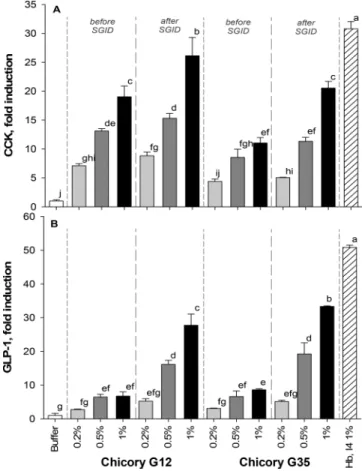
Results showed that each genotype exerted a signi
ficant
dose-dependent stimulation of CCK release before and after SGID,
and interestingly, the SGID treatment led to an increase in the
CCK release for the G12 and the G35 genotypes (
Figure 2
A).
These increases were signi
ficant for the highest dose assayed
(1% w/v) and represented 20- and 25-fold the value of the
control (bu
ffer), respectively. In comparison, the hemoglobin
digest, which was previously described as a strong stimulator of
CCK release
21and used here as positive control, led to an
increase of 30-fold of control.
The impact of SGID on the stimulation potential of GLP-1
secretion observed was signi
ficant (
Figure 2
B). Thus, the e
ffects
of the roasted roots before SGID on GLP-1 secretion were
relatively weak and similar for the G12 and the G35 genotypes
but signi
ficant compared to control (6- and 8.5-fold of control
for the two highest doses). After the SGID treatment, a
dose-dependent increase on GLP-1 release, signi
ficant for 0.5 and
1.0% w/v, was observed for the G12 and G35 genotypes
(28-and 33-fold of control, respectively). At the same dose, the
positive control, i.e., the hemoglobin digest, led to a 50-fold
increase in GLP-1 release. Moreover, the DPP-IV inhibition
capacities of the di
fferent roasted roots samples before and after
SGID were assayed. No signi
ficant inhibition of the DPP-IV
activity could be observed for any of the samples (data not
shown).
Figure 2. Effect of chicory roasted roots on intestinal hormone secretion by STC-1 cells. STC-1 cells were incubated with different final concentrations (0.2, 0.5, and 1% dry matter) of chicory roasted roots (G12 and G35 genotype), before and after SGID, in Hepes buffer, pH 7.4. Bovine hemoglobin intestinal hydrolysate (Hb, I4, 1% dry matter final concentration) was used as positive control. Supernatants were collected after 2 h of incubation. (A) Cholecystokinin (CCK) and (B) glucagon-like peptide-1 (GLP-1) levels were determined by RIA and expressed as % of control (buffer) levels. Data are expressed in mean (n = 3)± SD. Means without a common letter are different (p < 0.05) using one-way ANOVA with Tukey’s test for pairwise comparisons.
Journal of Agricultural and Food Chemistry
DOI:10.1021/acs.jafc.8b01055
J. Agric. Food Chem. XXXX, XXX, XXX−XXX D
Metagenetic Analyses in Chicory-Treated Mice.
Roasted roots of G12 and G35 chicory genotypes were used
for 30 days of daily supplementary dietary feeding of mice at
350 mg·kg
−1, a concentration estimated to be proportional to
human daily consumption. No signi
ficant difference on the
body weights of mice was found after treatments and after the
washout period (
Supporting Information
). Fecal samples from
mice before and after 30 days of chicory feeding and after the
1-week washout were used for DNA extraction and 16S rRNA
gene sequencing in order to perform a metagenetic analysis.
The microbial
α-diversity within each group (G12, G35, and
control) was quanti
fied for each treatment range. Composed of
scores between 0 and 5, the Shannon index (SI) represents a
synthetic numerical value of the ecological
α-diversity of the
microbiota in each fecal sample, a higher SI indicating a greater
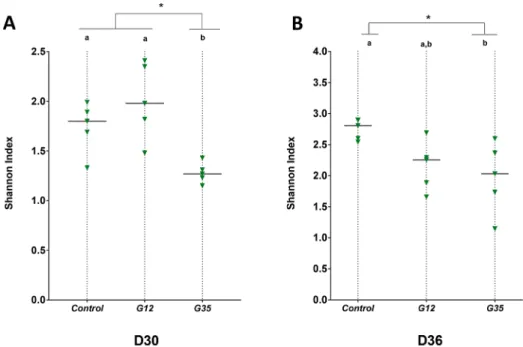
diversity. A signi
ficant decrease in SI was observed after 30 days
of treatment with G35 (
Figure 3
A), suggesting that the e
ffect
on microbiota could be dependent on the dietary chicory
genotype. After the washout period (D36), both chicory
genotypes seemed to maintain a decreased level of
α-diversity
compared to control (
Figure 3
B).
Chicory-dependent microbiota pro
file was next explored at
the phylum level (
Table 2
). Four weeks of chicory diet induced
several changes in the gut microbial community at the phylum
level compared with the control (no-treated mice). The relative
abundance of Firmicutes was less changed in G12-treated mice
(15.6% vs 14.1%) but greatly reduced in G35-treated mice
(3.1% vs 14.1%). The Bacteroidetes phylum was also less
modi
fied in the G12 group (83.6% vs 85.5%) but increased in
the G35 group (96.5% vs 85.5%). Other phyla showed low
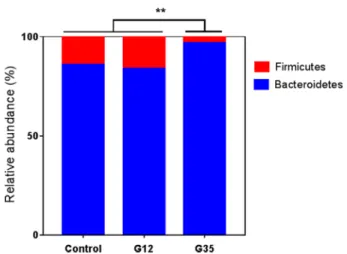
variations during chicory treatment, <1%. In addition, the ratio
of Firmicutes (F) to Bacteroidetes (B) was higher in
G12-treated mice and signi
ficantly lower in G35-treated mice
compared to the control (0.187 to 0.032 vs 0.165) (
Figure 4
).
qPCR analyses on three di
fferent feces samples confirmed this
result (
Supporting Information
).
At the genus level, all changes observed in the relative
abundance after 30 days of chicory treatment are represented in
Figure 5
and the
Supporting Information
. Beta diversity among
Figure 3.Shannon index of bacterial diversity during different chicory diets. G35 chicory triggered the most reduced bacterial diversity in fecal samples after 30 days of diet (D30). After the washout period (D36), both chicory genotypes indicate a decreased level ofα-diversity compared to control. Significant differences (p < 0.05) are indicated with letters (a, b); * indicates p < 0.05.
Table 2. Mean Relative Abundances (%) of Bacterial Phyla in Mice Microbiota During Di
fferent Chicory Diets (D30)
acontrol G12 G35
phylum mean (%) SD mean (%) SD mean (%) SD
Bacteroidetes 85.593 a 5.114 83.646 a 3.960 96.500 b 1.256 Firmicutes 14.131 a 5.155 15.670 a 3.760 3.122 b 1.209 Verrucomicrobia 0.018 0.022 0.066 0.099 0.032 0.053 Proteobacteria 0.042 0.032 0.023 0.029 0.169 0.032 Cyanobacteria 0.150 0.140 0.464 0.225 0.141 0.064 Tenericutes 0.046 0.032 0.089 0.091 0.023 0.035 Actinobacteria 0.009 0.011 0.000 0.000 0.004 0.008 Deferribacteres 0.000 0.000 0.000 0.000 0.000 0.000 TM7 0.009 0.018 0.042 0.031 0.000 0.000 Fusobacteria 0.000 0.000 0.000 0.000 0.009 0.010
aStandard deviations (SD) were calculated for each phylum abundance, and statistically significant differences were measured by ANOVA (p < 0.05)
and are shown with different letters (Tukey’s test).
Journal of Agricultural and Food Chemistry
ArticleDOI:10.1021/acs.jafc.8b01055
J. Agric. Food Chem. XXXX, XXX, XXX−XXX E
di
fferent conditions as a measure of genera turnover was
considered by factorial correspondence analysis (FCA) (
Figure
6
) and showed a speci
fic distribution of the significant bacterial
genera abundances around each chicory treatment. Two taxa
seemed to be more associated with the G35 treatment:
Bacteroidales_unclassi
fied and Alloprevotella, as they present a
signi
ficantly increased abundance in G35 treatment. Six other
taxa, Ruminococcaceae_unclassi
fied, Alistipes, Oscillibacter,
Lach-nospiraceae_unclassi
fied, Blautia, and Clostridiales_unclassified,
showed an important decrease in the G35 group (
Supporting
Information
). The signi
ficant variations in classified taxa were
compared to controls after 30 days (
Figure 7
). Alloprevotella
relative abundance increased while abundance of Alistipes,
Blautia, and Oscillibacter decreased during G35 chicory feeding.
■
DISCUSSION
Many studies have already been done on the inulin of chicory
and its prebiotic e
ffect. Our work was oriented toward a new
analytical dimension. The composition of roasted roots of
chicory was considered for the
first time by all major metabolic
compounds and also by the variability of these compounds. We
tested the e
ffects of the roasted products of chicory on the
intestinal microbiota of mice, and these tests were performed
for the
first time on murine model. There are no safe or
e
ffective doses established for chicory consumption in humans
as yet, but common doses that have been traditionally used
range from 3 to 6 g of chicory root per day.
29,30Taking this into
account, 7 mg of roasted roots/mouse/day was used, which was
considered to be the equivalent of a moderated human
alimentary dose. We then analyzed the daily feeding
consequences on mice gut microbiota composition and, in
parallel, the in vitro e
ffects on two satiety hormones. All results
were then converged to be
finally associated with the
metabolite composition of each chicory genotype in order to
estimate their e
ffect as prebiotic and on appetite control.
Chicory Genotypes Contain Di
fferent Metabolites
Proportions. G12 and G35 chicory genotypes contain
carboxylic compounds such as citrate, fumarate, lactate,
Figure 4.Relative abundance (%) of Firmicutes and Bacteroidetes in mice microbiota after chicory diet. Relative abundance of phyla Firmicutes and Bacteroidetes detected by NGS is expressed as a mean (Tukey’s test, n = 5/group, ** indicates p < 0.01).
Figure 5. Relative abundance (%) of main genera in mice fecal microbiota after chicory diet. Relative abundance of genera are indicated when their values are >0.1%. Genera with a low relative abundance were assigned as“other”.
Figure 6.Factorial correspondence analysis (FCA) of the significant abundant bacterial genera. FCA was used to describe variability among genera abundance (8 must abundant genera were used as variables, black letters) in the two analyzed chicory genotypes G12 and G35 (used as factors, red letters). The commonality created around the chicory G12 seems richer than those of G35. A genotype-dependent effect could be observed (the two rings).
Journal of Agricultural and Food Chemistry
DOI:10.1021/acs.jafc.8b01055
J. Agric. Food Chem. XXXX, XXX, XXX−XXX F
formate, or acetate, but a signi
ficant increasing amount of these
was observed for G12 (
Figure 1
). Lactate and citrate could
contribute to acetate production,
31−33known as a short-chain
fatty acid (SCFA).
34An important source of SCFAs is also
inulin. This fermentable carbohydrate is a soluble dietary
fiber
that is present in noticeable amounts in chicory roots. In our
experiments, inulin content of both chicory genotypes are
elevated, with a signi
ficant increased amount for G35,
representing 236.6% more inulin than G12. Similarly, fructose
and sucrose contents were found to be signi
ficantly increased in
G35 (
Figure 1
). It was demonstrated that supplementation of
inulin resulted further in signi
ficantly elevated concentrations of
total SCFAs in the cecum with positive e
ffects on lipid
metabolism and obesity development.
35Fructose indirectly
contributed to the formation of SCFAs because of its presence
in fructans and fructooligosaccharides (FOS) that generate
SCFAs under microbiota fermentation.
36Either ingested with food or produced by gut microbiota
metabolism, SCFAs are then absorbed and used in di
fferent
biosynthetic routes by the host, entering diverse carbohydrate
and lipid metabolic pathways. The involvement of SCFAs in
energy and lipid metabolism has largely been analyzed, and the
potential role of SCFAs in the control of metabolic syndrome
has also been observed and discussed in the literature. Butyrate
and propionate have been reported to induce the production of
the glucagon-like peptide-1 (GLP-1) gut hormone, thus
reducing food intake.
37Acetate has also been found to reduce
the appetite, but mainly through the interaction with the central
nervous system, by a hypothalamic mechanism involved in the
control of body weight.
38Chlorogenic acids were detected in roasted chicory roots
with a significant increased concentration for
3-mono-O-ca
ffeoylquinic acid (cqa) in G35 (
Figure 1
). Chlorogenic
acids refer to a related polyphenol family of esters that can play
a role in blood-pressure reduction
39,40and have potential
anti-in
flammatory effects.
41Another group of biologically active compounds in chicory
are sesquiterpene lactones (SLs). SLs possess anti-in
flammatory
and antitumor activity and are the main determinants of
bitterness. Control of their concentrations is a key point for the
market value of di
fferent chicory varieties.
42Among SLs we
noticed that the amount of 11
β,13-dihydro-8-deoxylactucin
(DHdLc) varied signi
ficantly between chicory genotypes
(
Figure 1
), as G35 is richer in DHdLc than G12.
To conclude, we focused on the most signi
ficant differences
between G12 and G35 chicory genotypes. The G35 roasted
roots contained a higher amount of fermentable carbohydrates
(inulin and fructose) that are considered as SCFA generators
during colon digestion and present a potential satiety control
by different digestive mechanisms. G12 roasted roots showed
less fermentable carbohydrate content than G35 but an
increased amount of acetate, which is involved also in the
control of body weight. Moreover, G35 showed an increased
content of anti-in
flammatory compounds as cqa and DHdLc.
Taking into account these signi
ficant differences, we then
addressed one further question, whether the feeding with G12
and G35 chicory roots has di
fferent effects on the production of
satiety hormones and on gut microbiota composition.
Satiety Hormones Increase Is Dependent on Chicory
Genotype. To the best of our knowledge, this is the
first work
to describe the e
ffect of chicory on the regulation of gut
hormones in vitro. Thus, the results obtained highlight for the
first time the capability of roasted chicory roots to enhance
both CCK and GLP-1 secretion in EECs. Interestingly, SGID
enhances the ability to induce both CCK and GLP-1 secretion
for the G12 and G35 genotypes. Considering the small
intestine compartment of the SGID, the e
ffects obtained on
CCK and GLP-1 secretion with G35 and G12 are very
signi
ficant when compared to those obtained for the
hemoglobin intestinal digest (used as positive control), which
was previously reported to be a strong stimulator of gut
hormone secretion.
21Interestingly, the bioactivities were
Figure 7. Significant variations in four genera of mice microbiota after chicory diet. Bar graphs compare relative abundance of each condition between D0 and D30 for the most significant genera variations analyzed by NGS and metagenetics. Relative abundance is expressed as mean ± SD (* indicates P < 0.05, Student’s t test, n = 5/group).
Journal of Agricultural and Food Chemistry
ArticleDOI:10.1021/acs.jafc.8b01055
J. Agric. Food Chem. XXXX, XXX, XXX−XXX G
impacted by the genotype; the G12 was more e
fficient to
induce CCK secretion, whereas G35 was more potent for
GLP-1 secretion. This is presumably due to the difference observed
in the metabolite composition of the two genotypes as
commented on earlier and shown in
Figure 1
. Thus, it is
well-known that carbohydrates such as glucose and fructose are
strong stimulators of gut hormone secretion.
43Moreover,
recently an increasing number of works have shown the
implication of polyphenols in energy homeostasis as potent
stimulators of gut hormone secretion and/or inhibitors of
DPP-IV activity.
44,45These properties together with the previously
described e
ffect of inulin and oligofructose on satiety, via its
action on gut microbiota,
46make chicory a very promising
ingredient for testing for e
ffects on obesity and T2DM in
di
fferent experimental assays.
Diversity of the Gut Microbiota Changes with Chicory
Genotype. Daily feeding with G12 and G35 genotypes of
roasted chicory equivalent to a human moderated alimentary
dose triggered changes in
α-diversity, as indicated in
Figure 3
.
At this level of analysis, the microbial community diversity
alone does not necessarily provide understanding of
community function, as was observed for other studies,
47but
indicates a genotype-speci
fic effect of the chicory feeding. The
fact that the SI sustainably decreased in mice microbiota during
G35 diet suggests that the composition of di
fferent specific
metabolites of the G35 chicory genotype could probably more
rapidly alter the gut microbiota.
Composition of the Gut Microbiota Changes with
Chicory Genotype. The ratio between the Firmicutes and
Bacterioidetes phyla was calculated for di
fferent chicory
treatments, and a genotype-dependent e
ffect was observed
(
Figure 4
). The G35 genotype, which is richer in inulin and
fructose, led to a decrease in the abundance of Firmicutes and a
signi
ficant lower F/B ratio. A change of F/B ratio may be
important in itself because this can in
fluence the efficiency of
processing of otherwise indigestible complex polysaccharides in
the diet. In our pilot study, roasted chicory roots were used for
feeding mice for a short period (30 days), and body weight was
not signi
ficantly altered (
Supporting Information
), while a
small decrease in body weight was observed for G35 feed mice.
It was observed that diet-inducing obesity triggered changes in
the F/B ratio as the abundance of Firmicutes dramatically
increased within the distal gut microbiota.
48This ratio was
found also to be signi
ficantly increased in patients developing
type 1 diabetes.
49Parnell and Reimer
50demonstrated a
signi
ficant shift in the Bacteroidetes and Firmicutes groups
with increasing doses of prebiotic
fiber intake; F/B was thus
reduced with bene
ficial effects on obesity physiopathology.
Presently, changes in intestinal microbial composition are
thought to be an important causal factor in the development of
obesity.
51Animal data and human studies have reported that
the overall F/B proportion is increased in obese people
compared to lean people.
52,53However, this criterion is not
consistent to our study design. In this context, we observed an
e
ffect of the G35 chicory genotype, which must be further
investigated in di
fferent analogous models or in human subjects
in order to specify the metabolic action related to diabetes and
obesity.
Daily feeding with roasted chicory triggered changes in the
relative abundance of several bacterial genera also (
Figure 5
).
FCA was used to select the genotype-speci
fic bacterial genera
(
Figure 6
). Thus, the abundance of Alloprevotella was found to
be increased in all chicory-treated groups and signi
ficantly
increased in G35 treatment. The abundance of Blautia, Alistipes,
and Oscillibacter was found to be signi
ficantly decreased in G35
treatments (
Figure 7
).
Alloprevotella belongs to Prevotelaceae family that was
recently associated with an important role in gut
−brain
interactions as well as in metabolic disorders. Furthermore,
low levels of Prevotellaceae have been reported in patients with
autism
54but also in patients with type 1 diabetes.
55The mean
abundance of Prevotellaceae in the feces of patients with
Parkinson disease was reduced by 77.6% in comparison with
control subjects.
56On the basis of these observations, high fecal
abundance of Prevotellaceae was proposed as a useful biomarker
to exclude Parkinson disease.
56Blautia is a genus in the bacterial family Lachnospiraceae that
participates in nutrient assimilation.
57An increased abundance
of Blaudia has been observed during antibiotic administration,
58giving reason to believe that this bacterial genus could be
involved in antagonistic relationships at the gut microbial
ecosystem level. The change in abundance must be correlated
to other imbalanced bacterial groups and be speci
fically
associated with a particular diet
59or pathology
60on a
case-by-case basis.
Alistipes is a genus belonging to the Bacteroidetes phylum
and was observed to be significantly correlated with autism
disorders. Thus, decreased levels of ileal serotonin in the
intestinal epithelial cell layer were associated with an increased
abundance of the Alistipes genus.
61Oscillibacter belongs to the Clostridia class of Firmicutes, and
in human gut microbiota it grows fermentatively, producing
predominantly valerate when grown using glucose as a carbon
source.
62Valeric acid is similar in structure to GBH (
γ-hydroxybutyric acid) and GABA (
γ-aminobutyric acid), which
are involved in neurotransmission in the mammalian central
nervous system. Increasing abundance of Alloprevotella and
decreasing Blautia, Alistipes, and Oscillibacter levels during
chicory feeding could be further more closely correlated to
these putative neurological e
ffects and/or metabolic disorders.
In conclusion, we investigated many di
fferent chicory
genotypes for their content of metabolites, and two genotypes,
G12 and G35, were retained for their di
fferent compositions.
The most important di
fferences concerned amounts of
fermentable carbohydrates (inulin and fructose), carboxylic
compounds such as acetate, chlorogenic acids such as cqa, and
sesquiterpene lactones (for example, DHdLc). In the literature,
the majority of chicory analyses use the di
fferent compounds
that are isolated and employed for targeted investigations. We
did not extract isolated compounds but rather used chicory
roasted roots from G12 and G35 genotypes as part of the food
matrix to feed mice in order to analyze satiety hormones as well
as variations in the gut microbiota. Because chicory treatments
were performed with moderate quantities of roasted roots and
because the two investigated chicory genotypes belong to the
same species, no qualitative di
fferences were observed in
microbiome bacterial abundance. However, a
genotype-depend-ent e
ffect was observed. The G35 chicory genotype, which is
richer in fermentable carbohydrates and also in
anti-in
flammatory compounds such as cqa and DHdLc, could
more rapidly alter the gut microbiota
α-diversity. Also, a
significant change in F/B ratio was generated by the G35
intake. CCK and GPL-1 secretion were found to be increased
by the samples obtained after in vitro digestion of chicory for
both genotypes, with G35 inducing the most signi
ficant
increase of GLP-1. These observations explain for the
first
Journal of Agricultural and Food Chemistry
DOI:10.1021/acs.jafc.8b01055
J. Agric. Food Chem. XXXX, XXX, XXX−XXX H
time the potential of chicory products in appetite control by
inducing increased levels of satiety hormones. With the aim of
de
fining the benefits of chicory for functional food, further
studies must therefore be targeted through investigating
microbiota composition and intestinal hormone levels in
association with metabolomic composition of chicory, for a
more detailed understanding of appetite-regulation mechanisms
conferred by this plant. The abundance of Alloprevotella,
Blautia, Alistipes, and Oscillibacter in the gut microbiota was also
found to be modi
fied during G35 chicory feeding. As these
bacterial genera were described as neuroprotective or associated
with gut
−brain axis, there could be an interesting perspective to
open for testing the psychobiotic e
ffect of different chicory
genotypes.
■
ASSOCIATED CONTENT
*
S Supporting InformationThe Supporting Information is available free of charge on the
ACS Publications website
at DOI:
10.1021/acs.jafc.8b01055
.
Microbial pro
filing using quantitative PCR; body weight
of mice during chicory feeding; changes in the relative
abundance of bacterial genera after daily feeding with
roasted chicory roots; and changes in the relative
abundance of signi
ficant and genotype-specific bacterial
genera after daily feeding with roasted chicory roots
(
)
■
AUTHOR INFORMATION
Corresponding Author*E-mail:
[email protected]
.
ORCIDAnca Lucau-Danila:
0000-0002-9379-6241 FundingThe work was funded by the University of Lille and has been
carried out in the framework of Alibiotech project, which is
financed by European Union, French State, and the French
Region of Hauts-de-France.
Notes
The authors declare no competing
financial interest.
■
ACKNOWLEDGMENTS
The authors wish to thank Florimond Desprez SA and Leroux
for providing genetic material and roasted products.
Metab-olomic characterization of the genotypes was part of the
Qualichic program (2013-2017). The
1H NMR analyses were
performed at the Metabolome Facility-MetaboHUB of
Bordeaux Functional Genomic Center.
■
REFERENCES
(1) Shoaib, M.; Shehzad, A.; Omar, M.; Rakha, A.; Raza, H.; Sharif, R. H.; Shakeel, A.; Ansari, A.; Niazi, S. Inulin: Properties, health benefits and food applications. Carbohydr. Polym. 2016, 147, 444−454.
(2) Roberfroid, M. B. Inulin-type fructans: functional food ingredients. J. Nutr. 2007, 137 (11), 2493S−2502S.
(3) Coussement, P. A. A. Inulin and oligofructose: Safe intakes and legal status. J. Nutr. 1999, 129, 1412S−1417S.
(4) Karimi, R.; Azizi, M. H.; Ghasemlou, M.; Vaziri, M. Application of inulin in cheese as prebiotic, fat replacer and texturizer: A review. Carbohydr. Polym. 2015, 119, 85−100.
(5) Liu, J.; Luo, D.; Li, X.; Xu, B.; Zhang, X.; Liu, J. Effects of inulin on the structure and emulsifying properties of protein components in dough. Food Chem. 2016, 210, 235−241.
(6) Latoch, A.; Glibowski, P.; Libera, J. The effect of replacing pork fat of inulin on the physicochemical and sensory quality of guinea fowl pate. Acta Sci. Pol., Technol. Aliment. 2016, 15 (3), 311−320.
(7) Singer, J. M. D.; Grinev, M. R. N.; Silva, V. M. S.; Cohen, J. M. D.; Singer, P. M. D. Safety and efficacy of coffee enriched with inulin and dextrin on satiety and hunger in normal volunteers. Nutrition 2016, 32, 754−760.
(8) Halnes, I.; Baines, K. J.; Berthon, B. S.; MacDonald-Wicks, L. K.; Gibson, P. G.; Wood, L. G. Soluble Fibre Meal Challenge Reduces Airway Inflammation and Expression of GPR43 and GPR41 in Asthma. Nutrients 2017, 9, 57.
(9) Kelly-Quagliana, K. A.; Nelson, P. D.; Buddington, R. K. Dietary oligofructose and inulin modulate immune functions in mice. Nutr. Res. (N. Y., NY, U. S.) 2003, 23 (2), 257−267.
(10) Hasler, C. M. A new look at an ancient concept. Chem. Ind. 1998, 2, 84−89.
(11) Menne, E.; Guggenbuhl, N.; Roberfroid, M. Fn-type chicory inulin hydrolysate has a prebiotic effect in humans. J. Nutr. 2000, 130, 1197−1199.
(12) Gibson, G. R.; Hutkins, R.; Sanders, M. E.; Prescott, S. L.; Reimer, R. A.; Salminen, S. J.; Scott, K.; Stanton, C.; Swanson, K. S.; Cani, P. D.; Verbeke, K.; Reid, G. Expert consensus document: The International Scientific Association for Probiotics and Prebiotics (ISAPP) consensus statement on the definition and scope of prebiotics. Nat. Rev. Gastroenterol. Hepatol. 2017, 14 (8), 491−502.
(13) Bragg, L.; Tyson, G. W. Metagenomics using next-generation sequencing. Methods Mol. Biol. 2014, 1096, 183−201.
(14) Rønnestad, I.; Akiba, Y.; Kaji, I.; Kaunitz, J. D. Duodenal luminal nutrient sensing. Curr. Opin. Pharmacol. 2014, 19, 67−75.
(15) Gribble, F. M.; Reimann, F. Enteroendocrine cells: chemo-sensors in the intestinal epithelium. Annu. Rev. Physiol. 2016, 78, 277− 299.
(16) Caron, J.; Domenger, D.; Dhulster, P.; Ravallec, R.; Cudennec, B. Protein Digestion-Derived Peptides and the Peripheral Regulation of Food Intake. Front. Endocrinol. 2017, 8, 85.
(17) Nongonierma, A. B.; FitzGerald, R. J. Enhancing bioactive peptide release and identification using targeted enzymatic hydrolysis of milk proteins. Anal. Bioanal. Chem. 2018, 410, 3407.
(18) Willeman, H.; Hance, P.; Fertin, A.; Voedts, N.; Duhal, N.; Goossens, J. F.; Hilbert, J. L. A Method for the Simultaneous Determination of Chlorogenic Acid and Sesquiterpene Lactone Content in Industrial Chicory Root Foodstuffs. Sci. World J. 2014, 2014, 1−11.
(19) Moing, A.; Maucourt, M.; Renaud, C.; Gaudillere, M.; Brouquisse, R.; Lebouteiller, B.; Gousset-Dupont, A.; Vidal, J.; Granot, D.; Denoyes-Rothan, B.; Lerceteau-Kohler, E.; Rolin, D. Quantitative metabolic profiling by 1-dimensional 1H-NMR analyses: application to plant genetics and functional genomics. Functional Plant Biology 2004, 31, 889−902.
(20) Akoka, S.; Barantin, L.; Trierweiler, M. Concentration Measurement by Proton NMR Using the ERETIC Method. Anal. Chem. 1999, 71 (13), 2554−2557.
(21) Caron, J.; Cudennec, B.; Domenger, D.; Belguesmia, Y.; Flahaut, C.; Kouach, M.; Lesage, J.; Goossens, J. F.; Dhulster, P.; Ravallec, R. Simulated GI digestion of dietary protein: Release of new bioactive peptides involved in gut hormone secretion. Food Res. Int. 2016, 89, 382−390.
(22) Lacroix, I. M.; Li-Chan, E. C. Evaluation of the potential of dietary proteins as precursors of dipeptidyl peptidase (DPP)-IV inhibitors by an in silico approach. J. Funct. Foods 2012, 4, 403−422. (23) Schloss, P. D.; Westcott, S. L.; Ryabin, T.; Hall, J. R.; Hartmann, M.; Hollister, E. B.; Lesniewski, R. A.; Oakley, B. B.; Parks, D. H.; Robinson, C. J.; Sahl, J. W.; Stres, B.; Thallinger, G. G.; Van Horn, D. J.; Weber, C. F. Introducing mothur: open-source, platform-independent, community-supported software for describing and comparing microbial communities. Appl. Environ. Microbiol. 2009, 75, 7537−7541.
Journal of Agricultural and Food Chemistry
ArticleDOI:10.1021/acs.jafc.8b01055
J. Agric. Food Chem. XXXX, XXX, XXX−XXX I
(24) Edgar, R. C.; Haas, B. J.; Clemente, J. C.; Quince, C.; Knight, R. UCHIME improves sensitivity and speed of chimera detection. Bioinformatics 2011, 27 (16), 2194−200.
(25) Quast, C.; Pruesse, E.; Yilmaz, P.; Gerken, J.; Schweer, T.; Yarza, P.; Peplies, J.; Glöckner, F. O. The SILVA ribosomal RNA gene database project: improved data processing and web-based tools. Nucleic Acids Res. 2012, 41, D590−D596.
(26) Bray, J. R.; Curtis, J. T. An ordination of upland forest communities of southern Wisconsin. Ecol. Monogr. 1957, 27, 325−349. (27) Martin, A. P. Phylogenetic approaches for describing and comparing the diversity of microbial communities. Appl. Environ. Microbiol. 2002, 68, 3673−3682.
(28) Parks, D. H.; Beiko, R. G. Identifying biologically relevant differences between metagenomic communities. Bioinformatics 2010, 26 (6), 715−21.
(29) Ulbricht, C. E. Natural Standard Herb& Supplement Guide: An Evidence-Based Reference; Mosby Elsevier: Missouri, U.S.A., 2010.
(30) Ulbricht, C.; Basch, E. The Authority on Integrative Medicine. Natural Standard.https://naturalmedicines.therapeuticresearch.com.
(31) Duncan, S. H.; Louis, P.; Flint, H. J. Lactate-Utilizing Bacteria, Isolated from Human Feces, That Produce Butyrate as a Major Fermentation Product. Appl. Environ. Microbiol. 2004, 70 (10), 5810− 5817.
(32) Flint, H.; Duncan, S.; Scott, K.; Louis, P. Links between diet, gut microbiota composition and gut metabolism. Proc. Nutr. Soc. 2015, 74 (1), 13−22.
(33) Hugenholtz, J. Citrate metabolism in lactic acid bacteria. FEMS Microbiol. Rev. 1993, 12, 165−178.
(34) Rios-Covián, D.; Ruas-Madiedo, P.; Margolles, A.; Gueimonde, M.; de los Reyes-Gavilán, C. G.; Salazar, N. Intestinal Short Chain Fatty Acids and their Link with Diet and Human Health. Front. Microbiol. 2016, 7, 185.
(35) Weitkunat, K.; Schumann, S.; Petzke, K. J.; Blaut, M.; Loh, G.; Klaus, S. Effects of dietary inulin on bacterial growth, short-chain fatty acid production and hepatic lipid metabolism in gnotobiotic mice. J. Nutr. Biochem. 2015, 26, 929−937.
(36) Peshev, D.; Van den Ende, W. Fructans: Prebiotics and immunomodulators. J. Funct. Foods 2014, 8, 348−357.
(37) Lin, H. V.; Frassetto, A.; Kowalik, E. J., Jr.; Nawrocki, A. R.; Lu, M. M.; Kosinski, J. R.; Hubert, J. A.; Szeto, D.; Yao, X.; Forrest, G.; Marsh, D. J. Butyrate and propionate protect against diet-induced obesity and regulate gut hormones via free fatty acid receptor 3-independent mechanisms. PLoS One 2012, 7 (4), e35240.
(38) Frost, G.; Sleeth, M. L.; Sahuri-Arisoylu, M.; Lizarbe, B.; Cerdan, S.; Brody, L.; Anastasovska, J.; Ghourab, S.; Hankir, M.; Zhang, S.; Carling, D.; Swann, J. R.; Gibson, G.; Viardot, A.; Morrison, D.; Thomas, E. L.; Bell, J. D. The short-chain fatty acid acetate reduces appetite via a central homeostatic mechanism. Nat. Commun. 2014, 5, 3611.
(39) Zhao, Y.; Wang, J.; Ballevre, O.; Luo, H.; Zhang, W. Antihypertensive effects and mechanisms of chlorogenic acids. Hypertens. Res. 2012, 35 (4), 370−374.
(40) Onakpoya, I. J.; Spencer, E. A.; Thompson, M. J.; Heneghan, C. J. The effect of chlorogenic acid on blood pressure: a systematic review and meta-analysis of randomized clinical trials. J. Hum. Hypertens. 2015, 29 (2), 77−81.
(41) Tajik, N.; Tajik, M.; Mack, I.; Enck, P. The potential effects of chlorogenic acid, the main phenolic components in coffee, on health: A comprehensive review of the literature. Eur. J. Nutr. 2017, 56 (7), 2215−2244.
(42) Orofino Kreuger, M. R.; Grootjans, S.; Biavatti, M. W.; Vandenabeele, P.; D’Herde, K. Sesquiterpene lactones as drugs with multiple targets in cancer treatment. Focus on parthenolide. Anti-Cancer Drugs 2012, 23, 883−896.
(43) Sternini, C.; Anselmi, L.; Rozengurt, E. Enteroendocrine cells: a site of“taste” in gastrointestinal chemosensing. Curr. Opin. Endocrinol., Diabetes Obes. 2008, 15 (1), 73−78.
(44) Domínguez Avila, J. A.; Rodrigo García, J.; González Aguilar, G. A.; de la Rosa, L. A. The Antidiabetic Mechanisms of Polyphenols
Related to Increased Glucagon-Like Peptide-1 (GLP1) and Insulin Signaling. Molecules 2017, 22 (6), E903.
(45) Kim, H. Y.; Kim, K.; Lee, Y. M.; Cho, H. Aster pseudoglehni extract stimulates cholecystokinin and serotonin secretion in vitro and reduces gastric emptying in vivo. J. Funct. Foods 2017, 35, 436−446.
(46) Delzenne, N. M.; Cani, P. D.; Neyrinck, A. M. Modulation of glucagon-like peptide 1 and energy metabolism by inulin and oligofructose: experimental data. J. Nutr. 2007, 137 (11), 2547S− 2551S.
(47) Lozupone, C. A.; Stombaugh, J. I.; Gordon, J. I.; Jansson, J. K.; Knight, R. Diversity, stability and resilience of the human gut microbiota. Nature 2012, 489 (7415), 220−230.
(48) Turnbaugh, P. J.; Backhed, F.; Fulton, L.; Gordon, J. I. Diet-induced obesity is linked to marked but reversible alterations in the mouse distal gut microbiome. Cell Host Microbe 2008, 3 (4), 213−23. (49) Wen, L.; Ley, R. E.; Volchkov, P. V.; Stranges, P. B.; Avanesyan, L.; Stonebraker, A. C.; Hu, C.; Wong, F. S.; Szot, G. L.; Bluestone, J. A.; Gordon, J. I.; Chervonsky, A. V. Innate immunity and intestinal microbiota in the development of Type 1 diabetes. Nature 2008, 455 (7216), 1109.
(50) Parnell, J. A.; Reimer, R. A. Prebiotic fiber modulation of the gut microbiota improves risk factors for obesity and the metabolic syndrome. Gut Microbes 2012, 3 (1), 29−34.
(51) Sonnenburg, J. L.; Bäckhed, F. Diet-microbiota interactions as moderators of human metabolism. Nature 2016, 535, 56−64.
(52) Koliada, A.; Syzenko, G.; Moseiko, V.; Budovska, L.; Puchkov, K.; Perederiy, V.; Gavalko, Y.; Dorofeyev, A.; Romanenko, M.; Tkach, S.; Sineok, L.; Lushchak, O.; Vaiserman, A. Association between body mass index and Firmicutes/Bacteroidetes ratio in an adult Ukrainian population. BMC Microbiol. 2017, 17, 120.
(53) Barlow, G. M.; Yu, A.; Mathur, R. Role of the gut microbiome in obesity and diabetes mellitus. Nutr. Clin. Pract. 2015, 30, 787−97.
(54) Kang, D. W.; Park, J. G.; Ilhan, Z. E.; Wallstrom, G.; LaBaer, J.; Adams, J. B.; Krajmalnik-Brown, R. Reduced incidence of prevotella and other fermenters in intestinal microflora of autistic children. PLoS One 2013, 8 (7), e68322.
(55) Brown, C. T.; Davis-Richardson, A. G.; Giongo, A.; Gano, K. A.; Crabb, D. B.; Mukherjee, N.; Casella, G.; Drew, J. C.; Ilonen, J.; Knip, M.; Hyöty, H.; Veijola, R.; Simell, T.; Simell, O.; Neu, J.; Wasserfall, C. H.; Schatz, D.; Atkinson, M. A.; Triplett, E. W. Gut microbiome metagenomics analysis suggests a functional model for the develop-ment of autoimmunity for type 1 diabetes. PLoS One 2011, 6 (10), e25792.
(56) Scheperjans, F.; Aho, V.; Pereira, P. A.; Koskinen, K.; Paulin, L.; Pekkonen, E.; Haapaniemi, E.; Kaakkola, S.; Eerola-Rautio, J.; Pohja, M.; Kinnunen, E.; Murros, K.; Auvinen, P. Gut microbiota are related to Parkinson’s disease and clinical phenotype. Mov. Disord. 2015, 30 (3), 350−358.
(57) Biddle, A.; Stewart, L.; Blanchard, J.; Leschine, S. Untangling the genetic basis of fibrolytic specialization by Lachnospiraceae and Ruminococcaceae in diverse gut communities. Diversity 2013, 5, 627− 640.
(58) Banerjee, S.; Sar, A.; Misra, A.; Pal, S.; Chakraborty, A.; Dam, B. Increased productivity in poultry birds by sub-lethal dose of antibiotics is arbitrated by selective enrichment of gut microbiota, particularly short-chain fatty acid producers. Microbiology 2018, 164 (2), 142−153. (59) Jiao, J.; Wu, J.; Wang, M.; Zhou, C.; Zhong, R.; Tan, Z. Rhubarb Supplementation Promotes Intestinal Mucosal Innate Immune Homeostasis through Modulating Intestinal Epithelial Microbiota in Goat Kids. J. Agric. Food Chem. 2018, 66 (4), 1047−1057.
(60) Shen, Y.; Xu, J.; Li, Z.; Huang, Y.; Yuan, Y.; Wang, J.; Zhang, M.; Hu, S.; Liang, Y. Analysis of gut microbiota diversity and auxiliary diagnosis as a biomarker in patients with schizophrenia: A cross-sectional study. Schizophr. Res. 2018, DOI: 10.1016/ j.schres.2018.01.002.
(61) de Theije, C. G.; Wopereis, H.; Ramadan, M.; van Eijndthoven, T.; Lambert, J.; Knol, J.; Garssen, J.; Kraneveld, A. D.; Oozeer, R. Altered gut microbiota and activity in a murine model of autism spectrum disorders. Brain, Behav., Immun. 2014, 37, 197−206.
Journal of Agricultural and Food Chemistry
DOI:10.1021/acs.jafc.8b01055
J. Agric. Food Chem. XXXX, XXX, XXX−XXX J
(62) Iino, T.; Mori, K.; Tanaka, K.; Suzuki, K.; Harayama, S. Oscillibacter valericigenes gen. nov., sp. nov., a valerate-producing anaerobic bacterium isolated from the alimentary canal of a Japanese corbicula clam. Int. J. Syst. Evol. Microbiol. 2007, 57, 1840−1845.
Journal of Agricultural and Food Chemistry
ArticleDOI:10.1021/acs.jafc.8b01055
J. Agric. Food Chem. XXXX, XXX, XXX−XXX K