Science Arts & Métiers (SAM)
is an open access repository that collects the work of Arts et Métiers Institute of
Technology researchers and makes it freely available over the web where possible.
This is an author-deposited version published in: https://sam.ensam.eu Handle ID: .http://hdl.handle.net/10985/19518
This document is available under CC BY license
To cite this version :
Gladys JAUSSAUD, Jocelyn REBUFA, Marc FOURNIER, Matthieu LOGEAIS, Nabil
BENCHEIKH, Marc REBILLAT, Nazih MECHBAL - Improving Lamb Wave detection for SHM using a dedicated LWDS electronics - In: 11th Symposium on NDT in Aerospace, France, 2019-11 - Proceedings of the 2019-11th Symposium on NDT in Aerospace - 2019
Any correspondence concerning this service should be sent to the repository Administrator : [email protected]
Improving Lamb Wave detection for SHM using a dedicated LWDS
electronics
Gladys Jaussaud
1, Jocelyn Rebufa
1, Marc Fournier
1, Matthieu Logeais
1Nabil Bencheikh
1, Marc Rébillat
2, and Mikhail Guskov
21 Cedrat Technologies,
59 Chemin du Vieux Chêne – Inovallée – 38246 Meylan Cedex – France
2Arts et métiers ParisTech, PIMM Laboratory
151 Bd de l’Hôpital – 75013 Paris – France E-mail: [email protected]
Abstract
In the context of Condition Based Maintenance (CBM) for aircrafts, Structural Health Monitoring (SHM) is one main field of research. Detection and localization of damages in a structure request reliability of the equipment and repeatability of the measurements and process. An electronic device called Lamb Wave Detection System (LWDS) have been developed and manufactured to manage piezo-electric patches either in emission or reception mode with a high commutation rate. Besides, integration of the piezo patches is another crucial aspect of reliability. Several methods as modelling and dispersion curves can define the frequency range of Lamb waves to optimize the piezo-electric coupling.
This work which takes part of the H2020 ReMAP project about adaptative aircraft maintenance planning, is presented in the article.
1.
Introduction
Ultrasonic waves generated by piezo-electric patches offer a very promising way to perform Structural Health Monitoring (SHM) of composite aeronautic structures. Permanently bonded sensor arrays are interesting for on-demand interrogation of the structure in order to detect and localize damages (pits, disbonds), or to follow damage progression (cracks, delaminations). At the opposite of NDT techniques, SHM is independent from the operators. Many applications have been reported for space applications [1], aircrafts [2] or civil engineering [3]. One can divide the piezoelectric elements applications between passive and active methods [4]. In passive methods piezoelectric elements array can be used to monitor acoustic emissions [5]. Active methods use signal generation on piezoelectric transducer to interact with the structure. Usual piezoelectric elements array are generally used to generate Lamb waves in plates [6]. The transmitted Lamb waves are received by another piezoelectric element in a pitch-catch
mode, or by the same piezoelectric element in pulse-echo mode. The wave generation can be controlled by phased array of various forms and distribution [4], [7]–[10]. Diverse signal processing methods can be used for damage monitoring with the signal measured with piezoelectric elements, such as transfer functions, time of flight analysis with cross correlation envelope [4], instantaneous baseline [11], time reversal [12], [13]. This can lead to an efficient damage localization mapping of the structure. However, the positioning of the emitting and receiving piezoelectric elements, or the management of the commutation between these two states are of prior importance to ensure the covering of the whole structure as well as optimal signal quality.
Recently, Lamb waves detection techniques have been enhanced by developing a dedicated electronic system called Lamb Wave Detection System (LWDS) [8]. This module allows to use each piezoelectric element in an array either in emission or reception mode. Each sensor can not only be used in the usual pitch-catch method, (i.e. one sensor is emitting and the other sensors are receiving the propagated wave information), but also in pulse-echo (i.e. emitting a lamb wave and listening to the echo simultaneously on the same patch). This feature can drastically improve PZT network efficiency for SHM purposes as one additional information source (the signal received back by the exciter) is made available. All transducers can be used simultaneously to scan the structure, and directly listen to the structure response. It facilitates the use of advanced methods such as instantaneous baseline, beamforming in emission and reception, time reversal or other advanced algorithms. Moreover the quality of signals is also highly impacted by the robustness of the sensor integration [14], [15]. Complex contributions such as the effects of temperature [16], or also adhesive nonlinearities [17] have been highlighted. The
durability of sensor is also crucial for the proper application of SHM algorithms [18].
In order to overcome these difficulties and to improve SHM detection techniques, this paper presents a combination of an advanced electronic system with a robust piezo wafer integration within the host structure.
First, the electronics detection system is presented in detail. Commutation rates against capacitive loads of piezo patches is discussed, as well as Signal to Noise Ratio (SNR) improvement. Second, a focus is made on a fine study of coupling efficiency between the piezoelectric patches and Lamb wave propagation through so-called tuning curves. This feature helps in selecting the correct frequency range for ultrasonic SHM interrogation and the dimensions of the piezo patches for a given sample plate. These results are compared to FEM simulation on ATILA/GiD software. In the last part, functional testing allows to discuss the correlation between simulation and tests and to estimate the influence of the integration process on reliability.
2. Lamb Wave Detection System
2.1. Description of the LWDS hardware
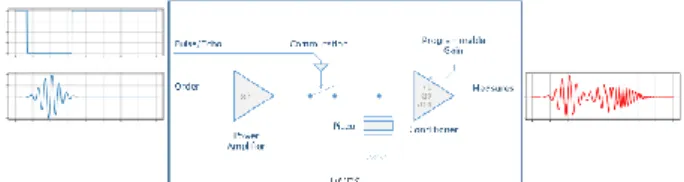
The LWDS electronics is made for multi-channel Lamb wave excitation and measurement of thin structures. From the hardware point of view, a channel suited for piezoelectric patches is described on Figure 1. This channel is typically composed of three analog functions: • A power amplifier to drive the piezoelectric patches in order to emit the acoustic waves on the structure. • A conditioner to be able to read the acoustic waves incoming on the piezoelectric patches.
• A commutation function to be able to switch each piezoelectric patch between emission and reception modes. The power amplifiers offer an unloaded wide bandwidth of 2.5 MHz with a current limit of 0.5 A peak, in order to reach the ultrasonic range and feature a high SNR (more than 70 dB).
They are specifically designed to drive capacitive loads, since the piezo elements have a capacitive behavior.
Figure 1: High frequency commutation with LWDS The conditioners offer a wide bandwidth to match the amplifier bandwidth and a very high SNR to be able to receive acoustic waves of low amplitude. If required, the conditioners can feature a variable amplifier gain up to 100,
which is particularly interesting for laboratory setups. A picture of the LWDS module with 36 channels is presented on Figure 2.
Figure 2: Up to 36 PZT channels simultaneously emitting or receiving signals with 1µs selective commutation 2.2. Operation of the LWDS, commutation
The switching function, allowing pulse-echo technique, offers the possibility to switch the patch between emission mode and reception mode. This enables to emit a signal with a patch and to monitor the echo of the signal on the same patch. Such a process maximizes the detection ability for a given quantity of patches, cables and boards. It is thus a cost-effective solution which reduces the complexity of the system.
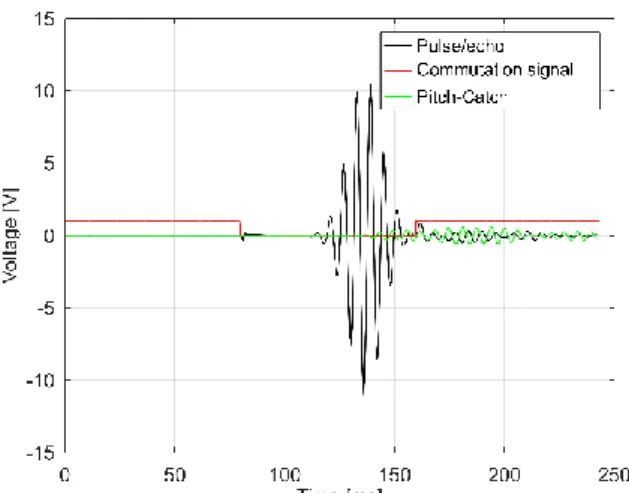
In order to take advantage of this function, the commutation time has to be short enough to be able to catch the echo. As an example, a burst of 5 cycles at 1 MHz lead to a commutation time of 5 µs. The LWDS allows commuting between emission and detection within 1 µs. The echo can be caught even if the damage is very close from the patch. An example of emitted, reflected, and transmitted signals is shown on Figure 3. The upper part of the figure shows the pulse signal applied by the emitting patch. The commutation signal enables the recording of the same patch for the reflected wave analysis. The center graph is a zoom on y-axis to observe reflected waves with around 20% of the emitted wave amplitude. The lower graph shows the signals measured by a second patch at the same order of magnitude as the echo signal.
Figure 3: Pulse/echo and pitch/catch signals
In addition to the previous functions, some generation and sampling functions are required to send the orders, and to record the received signals for analysis. This could be done with regular generators and with oscilloscopes or acquisition platforms. However, SHM application often require specific equipment since multiple channels are required, as well as very high refresh rates. In order to reduce the time for acquisition and the complexity of the setup, dedicated generation and acquisition platforms are recommended. These platforms feature:
• Several synchronized input or output channels with refresh rates up to 10 MSps.
• High resolution to comply with the high SNR requirements of the SHM applications.
• Arbitrary generator channels so that the user can generate any waveform, to fit with his application.
• Interface with computers and dedicated GUI for loading the signals to be generated and recovering the recorded data A picture of a full setup is presented on Figure 4. The simultaneous excitation of all the piezo array with appropriate phase shifts allows beamforming for excitation [10] in excitation mode, as well as retro-propagation beamforming for acoustic wave field reconstruction [12] in listening mode.
The high frequency of commutation allows as correct patch selection to get closer to a defect and rapidly converge toward the spatial position of a damage.
Figure 4: Test bench of Lamb wave emission and acquisition using LWDS
3. Coupling effect
SHM is based on sensorization of samples with piezo patches. These patches are driven by the LWDS and the patches signals are then post-treated to detect and localize some damages. A good piezo-electric coupling is necessary to allow the success of the method. This coupling is dependent on several parameters such as gluing process of the patches, size of the patches, frequency range of actuation, sample thickness, etc.
3.1. Dispersion curves
Dispersion curves are 2D analytical curves which give the Lamb waves propagation in frequency/wave number domain. They depend on the material and thickness of the plate. They are generated under the assumption of homogeneous material and no edge effect. The material used in the study, called UPAT, is a composite material made of graphite-epoxy Hexcel IM7/8552 in various plies orientation, with 1.7mm thick. The UPAT material properties have been analytically homogenized to not consider the properties of the plies in the thickness. The dispersion curves of this orthotropic homogenized UPAT plate is shown on Figure 5.
Figure 5 : Dispersion curves of sample UPAT with coupling representation
S0
By superposition on the classic dispersion curves the coupling can be represent in the graph, for given dimensions of piezo patch. The analysis of these curves allows to identify if the choice of the patch is relevant regarding frequency of actuation and the size of the damages that can be detected.
A first criterion is the definition of the patch diameter according to the frequency range of actuation. Because of symmetrical geometry of piezo patch and electrodes, the coupling is dependent on the wavelength, as illustrated on Figure 6. Considering the diameter 𝐷𝑃𝑍𝑇 of the piezo patch and the wavelength of the considered mode, the coupled dispersion curve takes into account that:
• If:
𝐷𝑃𝑍𝑇= 𝑛. (1)
the patch cannot couple (excite or detect) the considered mode.
• If:
𝐷𝑃𝑍𝑇= (2𝑛 + 1) /2 (2)
the patch maximally couples (excites or detects) the considered mode.
Because the wavelengths of A0 and S0 modes are different for a given frequency, both modes are not equally coupled. That can be seen on Figure 5 as the two dispersion curves have not the same color for a given frequency. This allows to choose a frequency for which only one mode of Lamb Wave is coupled. For example, at 100kHz, only the S0 mode will propagate. This frequency is interesting because the coupling decreases with n.
Figure 6: Coupling vs patch deformation
A second criterion is to reduce the number of waves which propagate in the structure. Concerning UPAT material, modes A1 and S1 appears at frequency up to 600kHz. That’s why only two curves are visible in the graph. It is interesting to work with frequency lower than 600kHz to
limit the number of waves and then make the exploitation of the signals easier.
Then the patch dimensions and the frequency of actuation have to be compatible with the size of the damage to be detected. The coupling aspect also manages the choice of the patch diameter with respect to the damage. A damage will be better detected if its diameter 𝐷𝐷𝑎𝑚𝑎𝑔𝑒 is half of the wavelength.
• If:
𝐷𝐷𝑎𝑚𝑎𝑔𝑒= /2 (3) the damage is optimally detected.
This last criterion is more qualitative than very predictive because of the different kinds and shapes of damages that the wave can encounter.
So, for a given set of material, plate thickness, and patch dimension, the coupled dispersion curve is a tool for choosing how to couple S0 or A0 modes by selecting the frequency. That exhibits one role of the coupling. The definition of the piezo patch is not limited to the choice of its dimension. The material is also a significant parameter. It’s selected to have a high value of 𝑑31 coefficient. This means that the voltage difference applied on the patch electrodes, implies a high in-plane deformation to the board, the polarization of the patch being orthogonal. Then, a low Q factor, a low aging and a thermally stable behavior are requested.
The approached described give relevant arguments for the definition of the piezo patches. Some aspects have not been considered yet such as the patch thickness and the interface between the patch and the sample plate. The influence of the patch thickness on the coupling can be studied by numerical simulation. The behavior of the glue is more difficult to predict. The comparison between simulation and tests will allow to estimate the influence of the glue for coupling.
3.2. Simulation of wave propagation
A numerical simulation study has been performed following several goals. The first is the comparison with dispersion curve analysis to check the choice of the patches. Simulation takes into account the real geometry of the sample plate including edge effect. So, it’s less idealistic than dispersion curves. Then, the propagation of the waves in the plate brings element to define a relevant location to glue the piezo patches. Finally, simulation allows to test the influence of the patch thickness on the coupling.
Numerical simulation is performed using ATILA/Gid finite element software. A multi-physic model allows to represent the wave propagation in a sample excited by a piezo patch driven by an applied voltage. The sample is a 3D plate of 40mm width and 200mm length. The UPAT homogenized orthotropic material is specified for the sample. PZT5 material is selected for the piezo patches of
DPZT = (n=1): low coupling
DPZT = 3/2 (n=1): good coupling
20mm diameter and 0.5mm thick. The mesh is made of 3D-tetrahedral elements. Figure 7 shows this model.
Figure 7: meshing of the sample plate
A first simulation consists in observing the Lamb wave propagation generated by a piezo patch. The patch is driven by a burst signal of 1V at a given frequency. The burst is characterized by a number of cycles Nc, a voltage
A, and a central frequency f0. It’s described by the
following equation:
𝑥(𝑡) = 𝐴𝑠𝑖𝑛(2𝜋𝑓0𝑡)𝑠𝑖𝑛 (𝜋𝑓0𝑡 𝑁𝑐 ), 𝑓𝑜𝑟 0 < 𝑡 < 𝑁𝑐/𝑓0 (4) An example of tone burst is shown on Figure 8.
Figure 8: Tone burst, A=1V, f0=100kHz, Nc=5
The plate is considered clamped at its two opposite edges. Two patches are modelled and set symmetrically on the same face of the plate. The gluing is supposed perfect by a direct coincidence between the nodes of the plate and of the patches. So, the glue behavior is not taken into account. One piezo patch is driven by a burst signal between its electrodes. The other is 0V/floating potential. This second patch is used to measure the voltage created by the plate deformation.
The calculation of the transient displacement of the plate under a burst signal of 100kHz is given on
Figure 9. The displacement distribution has a shape of cross because of the orthotropic materiel properties: the wave velocity is not the same in the two axis of the plate. The simulation results show that the piezo patch is able to generate a wave in the plate. That confirms the coupling between the piezo patch and the structure.
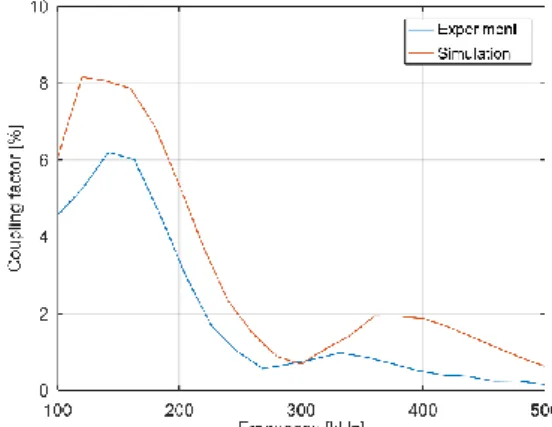
Figure 9: Displacement in the composite plate, at 100kHz The influence of the coupling effect is studied by varying the frequency of the tone burst. The maximum displacement at the center of the second patch, which works in reception mode, is read. That gives the variation of the maximum displacement in function of the frequency. The coupling is then expressed as the ratio between the maximum voltage in emission at the first patch and the maximum voltage in reception as the second patch. This result is represented on
Figure 10 which compares the values of coupling by simulation or experiment. It appears that the simulation gives a good approximation of the evolution of the coupling with the frequency despite the model assumptions.
Figure 10: Coupling effect studied by simulation 0 0.5 1 1.5 2 2.5 3 3.5 x 10⁻⁵ -10 -8 -6 -4 -2 0 2 4 6 8 10
tone burst for ERT
V o lt a g e (V ) time (s)
4. Sensorization process
After ensuring the theoretical good coupling between the patch and the structure, i.e. the possibility to generate and to detect Lamb waves using piezo patches, the real case has to be considered through prototyping and testing. Two main topics should be approached. One is the driving of the piezo patches with both possibilities to send a signal and to read it, at high frequency (100-500kHz). This is the role of the LWDS electronics. The other point is the integration of the piezo patches on the samples. The gluing process has to be studied carefully to allow good coupling, repeatability of gluing, simplicity of integration, and good properties of aging. That defines several criteria about the choice of the glue:
- Low thickness, - High shear modulus, - High thermal range, - High chemical resistance
- Cure time at ambient temperature < 48h Finally, an epoxy glue has been chosen to perform the gluing. The glue thickness and gluing reproducibility is ensured by an accurate gluing process. An overview of a sensorized UPAT plate is given on Figure 11.
Figure 11: Composite plate sensorized with two piezo patches
5. Reliability testing
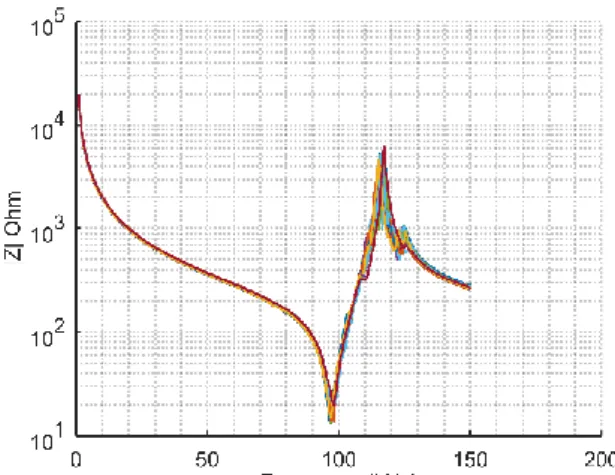
Once all the element about sample plates, piezo patches, electronic devices and actuation have been defined, some tests are performed to estimate the repeatability of SHM equipment. 4 plates have been sensorized with 2 patches. The admittance is the piezo patches before gluing is first measured to ensure all the patches are similar. After sensorization of the samples the impedance of the piezo patches is compared. The comparison is shown on Figure 12 and Figure 13.
Figure 12: Patches impedance before gluing
Figure 13: Patches impedance after gluing
The measurement curves show that the piezo patches have similar resonance frequency. After the gluing, the resonance frequency is always in the range 100-200kHz but it varies from one patch to another due to integration process. Before 100kHz and after 180kHz, the reproducibility is satisfying because of a low dispersion of the impedance between the patches. Finally, the excitation at 100kHz can be acceptable in terms of coupling and reproducibility of the results.
6.
Conclusions
In the frame of ReMAP project, a study is performed to improve the reliability of the SHM. Cedrat Technologies involves ensuring the accurate behavior of the SHM equipment.
A first element is the development of a dedicated electronics able to generate Lamb Waves in a structure by driving piezo patches. This functionality requires a large bandwidth to generate waves at more than 500kHz. The LWDS is compatible with the application with a bandwidth of 2,5MHz. Other major feature is the commutation time of 1µs. The commutation allows each patch to be either in emission or in reception mode and to do pulse-echo measurements. This method can optimize the detectability
of damages by increasing the number of measured signals for a given number of piezo patches or interrogating the structure with subsets of piezo patches.
The other aspect of the study concerns the sensorization of the samples. That requires to define de piezo elements, to choose the signal of excitation, and to establish an accurate integration process. Dispersion curves, multiphysics numerical simulation and coupling study allowed to conclude that the excitation with a tone burst at 100kHz, using patches of Ø20mm diameter and 0.5mm thick are relevant for the material of the sample.
Then the tests performed after integration of the patches clarify the frequency range to be applied.
7. Acknowledgement
Most of the results have been achieved in the framework of H2020 ReMAP Project Grant n° 769288 : Real-time Condition-based Maintenance for Adaptive Aircraft Maintenance Planning, https://h2020-remap.eu/
8. References
[1] V. Giurgiutiu, B. Lin, G. Santoni-Bottai, et A. Cuc, « Space Application of Piezoelectric Wafer Active Sensors for Structural Health Monitoring », J. Intell. Mater. Syst. Struct., vol. 22, no 12, p. 1359‑1370, août 2011.
[2] K. Diamanti et C. Soutis, « Structural health monitoring techniques for aircraft composite structures », Prog. Aerosp. Sci., vol. 46, no 8, p. 342‑352, nov. 2010.
[3] D. Feng et M. Q. Feng, « Computer vision for SHM of civil infrastructure: From dynamic response measurement to damage detection – A review », Eng. Struct., vol. 156, p. 105‑117, févr. 2018.
[4] L. Yu et V. Giurgiutiu, « Advanced signal processing for enhanced damage detection with piezoelectric wafer active sensors », Smart Struct. Syst., vol. 1, no 2, p. 185‑215, avr. 2005.
[5] Nihon-Hihakai-Kensa-Kyōkai, Éd., Practical acoustic emission testing. Tokyo: Springer, 2016.
[6] Z. Sun, B. Rocha, K.-T. Wu, et N. Mrad, « A Methodological Review of Piezoelectric Based Acoustic Wave Generation and Detection Techniques for Structural Health Monitoring », Int. J. Aerosp. Eng., vol. 2013, p. 1‑22, 2013.
[7] L. Yu et V. Giurgiutiu, « In situ 2-D piezoelectric wafer active sensors arrays for guided wave damage detection », Ultrasonics, vol. 48, no 2, p. 117‑134, avr.
2008.
[8] T. Porchez, N. Bencheikh, et F. Claeyssen, « Piezo-composite patches applied to the detection of defects using Lamb wave focusing », in ResearchGate, 2011.
[9] W. Wang, H. Zhang, J. P. Lynch, C. E. S. Cesnik, et H. Li, « Experimental and numerical validation of guided wave phased arrays integrated within standard data acquisition systems for structural health monitoring », Struct. Control Health Monit., vol. 25, no 6, p. e2171, juin
2018.
[10] P. Kudela, M. Radzienski, W. Ostachowicz, et Z. Yang, « Structural Health Monitoring system based on a concept of Lamb wave focusing by the piezoelectric array », Mech. Syst. Signal Process., vol. 108, p. 21‑32, août 2018.
[11] S. Park, S. R. Anton, J.-K. Kim, D. J. Inman, et D. S. Ha, « Instantaneous baseline structural damage detection using a miniaturized piezoelectric guided waves system », KSCE J. Civ. Eng., vol. 14, no 6, p. 889‑895, nov. 2010.
[12] R. Zhu, G. L. Huang, et F. G. Yuan, « Fast damage imaging using the time-reversal technique in the frequency– wavenumber domain », Smart Mater. Struct., vol. 22, no 7,
p. 075028, juill. 2013.
[13] J. He, C. A. C. Leckey, P. E. Leser, et W. P. Leser, « Multi-mode reverse time migration damage imaging using ultrasonic guided waves », Ultrasonics, vol. 94, p. 319‑331, avr. 2019.
[14] J. Agrahari et S. Kapuria, « Effect of Piezoelectric Transducer Bonding on Time Reversibility of Lamb Waves in Plates », in Structural Health Monitoring 2015, 2015. [15] S. Mustapha et L. Ye, « Bonding Piezoelectric Wafers for Application in Structural Health Monitoring– Adhesive Selection », Res. Nondestruct. Eval., vol. 26, no 1,
p. 23‑42, janv. 2015.
[16] E. Balmès, M. GUSKOV, M. REBILLAT, et N. MECHBAL, « Effects of temperature on the impedance of piezoelectric actuators used for SHM », in 14th Symposium on Vibration, Shock and Noise (VISHNO), France, 2014, p. 1–6.
[17] S. Shan, L. Cheng, et P. Li, « Adhesive nonlinearity in Lamb-wave-based structural health monitoring systems », Smart Mater. Struct., vol. 26, no 2, p.
025019, févr. 2017.
[18] H. Pfeiffer, F. Fransens, et M. Wevers, « Durability and Self-Testing of Sensor Bondings used in Structural Health Monitoring », présenté à EU Project Meeting on Aircraft Integrated Structural Health Assessment (AISHA), 2007.