PHYSICAL REVIEW C VOLUM E
11,
NUMB ER 2 FEBRUARY1975
Background
phaseshift
inR-matrix
theory
J.
Cugnon~~Physics Department, University ofLiege at Sart Tilman, B-4000Liege I, Belgium (Received 25 June 1974)
R-matrix theory and other theories involving a division ofthe configuration space into an internal and an external region are derived in the frame ofa projection operator formalism. The continuity condition particularly is investigated. In connection with this problem, we show that the introduction of the hard sphere phase shift is quite arbitrary and that it can be replaced by any other phase shift.
NUCLEAR REACTIONS R-matrix theory: derivation by means ofprojection
operator formal.ism. Mathematical origin ofthe hard sphere phase shift.
I.INTRODUCTION
In the analysis of many resonance reactions, such as isobaric analog resonances and photo-nuclear reactions, the
8-matrix
theory' has been used together with the shell-model theory.'
The respective merits of these two theories have been compared in Ref.2.
In particular, it has beenstressed'
that the main drawback ofR-matrix theory is that few levels approximationsare
bound-ed to fail whenever the hard sphere phase shift differs from the experimental background phase shift. This situation may, however, be improvedby allowing the external region to contain some part of the nuclear interaction, which thus
modi-fies
the nonresonant phase shift. In order to achieve a better understanding in the relationship between the two theories, itis
highly desirable to have ageneral formulation ofwhich the8-matrix
and shell-model theoriesare
two particularcases.
Sucha
formulationis
contained in the comprehen-sive formalism of Lane and Hobson,'
which has greatly clarified the existing situation. The main aim of the present paperis
to construct another general formulation with the help ofprojection operators, which provide the advantage of writing the continuity condition in asimple way, as weshall
see.
The projection operators have already been used in the shell-model theory. Hence, weconcentrate our attention on the formulation ofthe
B-matrix
theory by means ofprojection operators. More precisely, the aim ofthis paper is twofold.(i)We show how to write the
R-matrix
equations starting from the projection operators. We also show briefly that our formulation contains, more-over,as
particularcases,
what we shall call the8-matrix-type
theories,i.e.
, the theories whichinvolve adivision of the configuration space i.nto
an internal and an external region. In some sense, our work
is
similar to the work by Lane and Hob-son,'
for
the generality of the formulation, and tothe work by Feshbach,
'
for the relation between theB
matrix and the projection operator formal-ism.(ii) We investigate how the continuity condition has been fulfilled in
8-matrix
theory. In connec-tion with this problem, we show, and thisis
the main result ofthis paper, that the introduction of the hard sphere phase shiftis
quite arbitrary andthat it can be replaced,
at
least formally, by any other phase shift. This, or course, changes the relation between the resonance parameters and the reduced width amplitudes. We formulate a new theory using this freedom, and exhibit its interest. Inparticular, we show in a numerical example the advantage of the one-level approxi-mation in this new theory, where the nonresonant phase shift can be chosen appropriately to repro-duce the background phase shift.This work
is
divided as follows.Sec.
IIis
a brief summary of the projection operators formal-ism. InSec.
III, we define the projectionoper-ators
relevant to the R-matrix-typetheories.
Section IV contains the derivation ofthe A-matrix equations with the help of
projectors.
InSec.
V, we sketch the derivation of other R-matrix-typetheories.
InSec.
VI, we construct a new theory,which generalizes the
R-matrix
theory, byallow-ing the nonresonant part ofthe collision matrix to be different from the hard sphere collision matrix. As an illustration of the new theory, we study the one-level approximation in
a
numericalcase.
Section VII contains some conclusions.II. PROJECTION OPERATORS FORMALISM
We briefly
recall
the principal feature of this formalism, which has been developed extensively in Ref.5.
Let us assume a HamiltonianH and two projection operatorsP
and Q such thatP'=P,
Q'=Q, PQ= QP=O,P+Q=1.
(2.1)J.
CUGNON The Schrodinger equation(E H)-$'~=0 (2.2)
write
Qg' =
g""
+—
QHP
Pg',
(2.5)is
equivalent tothe following system of equations (E —PHP)
Pgs —PHQ Qg'8 =0,
(E —QHQ)qgE —
QHPPfz
=0.
(2.3a)
(2.3b) (E —qH q)q',&'&
=0.
(2.6a) where g', "&is the scattering wave associated with
the Hamiltonian QHQ:
We make the assumption that the asymptotic states of the system
(i.
e.
, the states which describe thesplitting ofthe system in two subsystems that do
not overlap)
is
entirely described by the subspacespanned by the
projector
Q. We assumethrough-out this paper that the wave function
is
normal-ized such that asymptotically we haveThe function g',"& behaves asymptotically like
C UC'
(2.6b) We put the value of Q&I&~ in Eq. (2.3a)and get
[E
—PHP
—PHQ(E'
—QHQ) 'QHPj Pg~ =PHQ&t&",".
(2.7) 1g~-Qrg~-g,
(I,6cc —Sc~cOc),
VC C(2.4) We solve Eq. (2.7)
for
Pgs and substitute the resultin Eq. (2.5); we obtain where
I,
and0,
.
are
the familiar incoming andoutgoing waves, and where v,
is
the relativeve-locity in channel
c'.
We
recall
the procedure to obtain the scattering matrix fromEqs.
(2.3).
From Eq. (2.3b), we1 Qg' =P',"&+
—,
QHPX—
I
pHq
'&'&E
—PHP
—PHQ(E'
—QHQ) 'QHP (2.8)and for the scattering matrix
1 c(+)'
E
—PHP
—PHQ(E+ —QHQ) 'QHP We can also find another expressionfor
the wavefunction in space Q by extracting Pg~ from Eq. (2.3)and inserting its value in Eq. (2.4). We have
E
—QHQ —QHP-
PHQ Qtgr,=0,
1 (2.9) whose solution is QPC yC&+& 1 O 1E
—QH Q—QHPF
—IHP
—
PHQ Now, we have QHP —,—
PHQg"&
(2.11)
1 1 1E'
—QHQ —QHP PHQE'
—qHq
E'
—qHq —qHP
—
PHq
E
—PHP
E"
—QHQ 'We solve this equation
for
the "perturbed" Green function and we use this result in Eq. (2.11)
(2. 12)
,
(,) 1 1 8=k&& E+ qHq 1—QHP—
PHQ —QHP — — PH Q&I&"+&.
(2.13)For
the scattering matrix, we find0
I
@+
qH
p
—
pHq~y',BACKGROUND
PHASE
SHIFT
IN R-MATRIX THEORY
293Expression (2.9) has been used in most of the existing theories in order to derive a parametri-zation of the scattering matrix. This is usually achieved, as we show
later,
by diagonalizing the effective Hamiltonian contained in the left-'handside of Eq. (2.
7).
Expression (2.14) provides another parametrization of the scattering matrix. IfS,
',
is
diagonal in the channel indices, ittakes the form ofa A-matrix parametrization.Ofcourse, expressions (2.9)and (2.14)
are
equivalent. This proceeds from the following relationQHP 1 1
E
PH-P —PHQ(E" —QHQ) 'QHP 1 1E
—PHP
E'
—QHQ that we demonstrate as follows. %ehave(2.15)
E
—PHP
—PHQ,
1 QHPE
—PHP
E-PEIP
E'-QHQ
1E
—PHP
—PHQ +QHP.
(2.16)III.R-MATRIX TYPE THEORIES
The relevant projection operators
are'
P=,
Ha, —r,
(3.
1)(3.
2) Multiplying this equatfon by QHP on the right andsolving it formally, we obtain Eq. (2.
15).
& (b,
)PA=&,
(b )Q4' Z (b,)P|)',
=Z,
(b,)Qq'„
(3.5c)
(3.
5d) whereb,
e b,and where2(b)
is the Blochoper-ator,
'
by the continuity condition which is not a
conse-quence of the dynamics, but rather of the special structure oftheP
and Qspaces.
The continuity condition may be writtenas
[H,
P] =[H,
Qj=0.
(3.
3)This
is
easily verified, sincefor
x,
larger than a certain value, whichis
smaller thanor
equal toa„
the Hamiltonian can be represented by8'
l(l+1)k'e'
C C C C
(3.
4) Thisexpresses
the absence of polarizingforces
beyond a certain distance: That
is
the basicas-sumption ofA-matrix theory. Equation
(3.
3) shows that Eq. (2.2) is equivalent to(E —PH
P)
Pfs
=0,
(E —QHQ) Qge=
o.
(3.5a)
(3.
5b) However, these equations must be complemented where 8(x)=1
forx&0,
8(x)=0
forx&0.
'
The quantitiesr„a„ad
nQ,are
the relative coordi-nate, the channel radius, and the surface function in channelc,
respectively. ' The operatorsI'
andQfulfill the conditions (2.1)and the commutation
relations
(3.
6)3RPge= JR
Qg,
(3.
7b)where
A2
I
4.
)~(&.—&.)(A. I.c
(3.
8)But, if Ps
satisfies
the two relations(3.
7), itsatisfies
relation(3.
5c) for any value of b,On.
the other hand, if gs
satisfies (3.5c}
and(3.
5d), The plus or minus signs inEqs.
(3.
5) mean that the derivative should be taken from outside andinside, respectively. %eshow
later
that thisis
important. The quantities b, and b2are
vectors in a space whose dimension is given by the num-ber of channels. The (in}equality between b, and b, should be understoodas
(in)equality betweenvectors.
The continuity condition is strictly294
J.
CUGNONi.
e.
, the equation A similar procedure transforms Eqs.(3.
5b) and(3.
5d) in which we take b,=~,
into for thvo Chfferent values of b, it satisfies(3.
7a}and
(3.
7b).There
are
many ways to rewriteEqs.
(3.
5)in a form analogous to (2.3).
This freedom has givenrise
to the variety of the R-matrix-type theories. In fact, we show below that all the freedom hasnot been fully exploited yet.
IV. R-MATRIX THEORY
[E
—PHP+2
(b)]PP'
=Z,
(b)QP' . (4.2a) Wefirst
rewrite Eq.(3.
5a)as in Ref.4:
[E
—PHP+2
(b)]Pg'=2
(b)P)'
.
(4.l)
The introduction ofthe Hamiltonian
PHP
—2
(b) allows to derive an expansion of PP'e in terms of the eigenstates of an Hermitian Hamiltonian,namely
PHP
—2
(b). This has been shown by Lane and Hobson.'
The continuity condition(3.5c)
for b,=b and Eq. (4. 1)yield
[Z —QHQ+lim
Z,
(P)]Qg=lim2
(P)Pg.
(4.3) 8The solution P',
"'
ofthe homogeneous equation (4.4) where QH Q is given by Eq.(3.
4), is the hard sphere wave function in channelc.
We have written the R-matrix basic equations
in the form (2.
3)-(2.
4), with the correspondencePHP
—
PHP
—g (b), PHQ—
2+(b),
QH
Q-
QH Q—&+( ), QHQ-
&-(
)~(4 5) We must be careful and keep in mind that the last equation should be understood
as
a limiting equa-tion,i.
e.
,Equation (2.7)becomes
E
—PHP+2
(b)—Z,
(b),
—
g(~)
Ptg~=g, (b)q"+ (4.6)We show that this equation is
strictly
equivalent to the equation giving the Az in the R-matrix theory. The latter quantitiesare
defined byPP'hh
=+A
gxg, (4.7a)&&.=(XxIPkz&
.
The Xq's
are
solutions of the equation[E
—PHP +2
(b)]X„=
0.
introducing the expansion (4.7a) in Eq. (4.6) and projecting on X~, we have
(4.7b)
(4.8)
(4.9)
The Green's function
is
given by(4. 10) ( )
=-h
Q
lk.
) ~' [f.
(r.
)-~l.
'O.(r, )]O.(r, )(4,
I,C
where
0,'
is the diagonal element of the hard sphere collision matrix. The operatorsZ,
(b)andg (~}
containing 5functions, we have to take the Green's function at
r,
,r,
'=a,
.
However, it is not the same to taker,
=r, „,
r,
'=r„or
r,
=r„,
r„'=r„since
the operatorg,
(b) contains a derivative and that the deriva. -tive ofthe Green's function is discontinuous atr,
=r,
'.
The indices + and —inZ,
(b)and2
(~)
show thatwe have to take
r,
=r„,
r,
'=r„.
Hence, Eq. (4.9) becomes(&-&„)&,
+hpg(X,
IZ, (b)I4,
o,
(r,
)) @,&'([f,
(r,
')-n,
'o,
(r,
')]y,
Iz
()Ix„)A„
BACKGBOUND
PHASE
SHIFT
INR-MATHIX
THEORY
295 where we have used Eq. (2.6b). Using thedefini-tion
(3.
6), it can be shown that:&x,
Iz,
(b)iy,
o,
(r,
))hold:
2MC+c
m d~c c*Xp=yacc (4.15)
y„
l.
,
'(b)O,
(a,},
(4.12)e'
2M,
I
acIim u(p,
r, )(„,
=.
=(I,
-n,
'O,)(„,
.
=0,
8-+oo (4.16) lim u,(P,
r,
)—
'
=(I,
—0,
0,
)~„,
=„
QC =-f
(21)"'~,
'"g,
y„,
. (4.13)I.
(a.
) C C (4.17)For
the matrix element of2
(~),
we have&(f,
-n,
'o,
)y,
Iz
()Ix„&
I'
=lim I
dr,
(u, (P,r,
)5(r,
—a,
)8
„2M,
(4.14) where u,(P,
r,
)is
the radial part of the solutionof
[E
—QHQ+Z,
(P)]g=0.
The following relationsI',
I,
(a,)0,
(a,) =k,a,
, we can rewrite Eq. (4.11)
as(4.18)
(E-E~)Ax++
Q
L.'(k)yx.
y„.A„
P —C
7(2@)12P ~~2II y (4
19)
whichis
the well-known equationfor
the Az co-efficients.'
Equations (4.19)and (2.9)yield the S matrix in terms ofthe level matrix.The parametrization of the collision matrix in terms of the R matrix
is
obtained from Eq. (2.14).
Taking account ofall these results and ofthe rela-tionWe have, using Eq. (4.
5):
p 2
SCC=SC.
,
+@1
--1
-(
)E-fIff
+Z, (I)
'(
)Z'-qaq+Z,
( )-(")E-IRI
+Z, (f)
(4.20) It is easy to check that the operator whose inverse
is
involved in this equation, when expressed in the basisg,
is diagonal in the energy indices, but not in the channel indices. We emphasize that thisis
a property of R-matrix-type theories, whichis
due to the separability of the Green functionfl/[E'
—QHQ+Z,
(~)]]
when sandwiched between operatorsZ,
and2 .
Equation (4.16)
becomes:(4.21)
which, with the help of
Eqs.
(4.12)to(4.
18) re-duces toa
well-known relation ofR-matrix
theory[Eq.
(VII.1.
6a)ofRef.1].
As an illustration of the power ofthe projection operators technique, we derive in Appendix the equation (4.19)
when afew levelsare
treated on a separate footing.V. OTHER R-MATRIX-TYPETHEORIES A. Freedom inR-matrix-type theories
In
Secs.
IIIand IV, we have described the main degrees offreedom contained in theR-matrix
math-J.
CUG NON ematical parameters ofwhich the physicalquanti-ties,
mainly the collision matrix,are
independent. Thes edegrees offreedomare
related to the chan-nel radiia,
and the quantities b, and b, of Eqs.(3.
5c)and(3.
5d). In standardR-matrix
theory, the freedom associated witha,
and b, has been used, while the freedom associated with b, has been left since one takes6,
=~.
We note, inci-dentally, that an undeterminacyarises
in the theory, whenb(=b,
)is taken equal to infinity,in agreement with the discussion of
Sec. III.
Anew theory can be constructed by taking advantage of the freedom associated with
6,.
Wedemon-strate
later the interest of such a theory.Finally, other degrees offreedom
are
lying in the representation of the Green functions (E —PHP)'
and(E'
—QHQ)'.
In the following, wereview how these degrees of freedom
are
used in some R-matrix-type theories.[E
—PHP+2
(b) ]Xg=0,
but rather of the solutions of
[Z, -ZHZ+B.
C.]X,
=0,
(5.3)
(5.4) where H contains
P
(PIt =P)
and-where
B.
C. meansany kind ofboundary conditions guaranteeing the completeness ofthe
set
JXqj and the Hermiticityof
"IiHR
—B.
C.."
Equation (4.19) is only slightly modified. We haveg
&'&X~IX„&r-&X&)HIX„&&++I.
'(bb~, x„, &„
C
C. Extended R-matrix theory ofTobocman {Ref.9) This theory diff ers from standard R -matrix theory in the fact that the Green's function in the internal region (or the expansion of the inner part of the wave function) is not expressed in terms of the solutions of
B.Kapur-Peierls theory {Ref.8)
This theory is differentiated from the standard
A matrix by the choice of the value of
b„namely,
the one which corresponds to b inR-matrix theo-ry. Here, the
first
line in Eq. (4.5) is replaced byPHP-
PHP
—2
(Ic),
PHQ-Z,
(Ic).
(5.1)
Hence
[see
Eq. (4.12)],(5 2) all other things remaining the same. We draw the attention to the fact that the two parametrizations (2.9)and (2.14)
are
identical in this theory.=-i
(2h)"'P"'n
y (5 5)where the subscript
P
means that the integrationinvolved must be performed over the
P
space. VI. GREEN'S FUNCTION INTHE EXTERNAL REGION: RELATION TO THEBACKGROUND COLLISION MATRIXIn this section, we exploit the freedom
associ-ated with the choice of b.,
in Eq.(3.
5d)by leaving it unspecified. We show that the interest of such atheory is connected with the problem of thebackground in the one-level approximation. We
note that boundary parameters b,
c
~
have been used previously."
However, we introduce themin a more natural way relating them to the con-tinuity condition and to the background phase shift.
Instead of Eq. (4.6), we have
Z—
PHP+2
(b)—g,
(b).
. .
g
(b,) Pge=g
(b)g'&'&,where g",
"
is given byg",
"
=v,"'[I,
(~)-n,
'(b,
)o,
(r)]
y,
. (6.2)(di,
/dr, )n,
'(b)(do, /dr,
)—
I
—0
'(b,
)o,
It is easy to check that we have
0
c'(b )=' '
0
'
.
2 IQ(b) c (6.4)
The quantity
0,
'(b,
)is such that the logarithmicderivative of
g"'
on the surfaceis
equal tob„
hence,
Equation
(6.
1)gives the wave function in the in-ternal region. The transformation of Eq. (6.1)
into an equationfor
theAz's is not as straight-forward as in standard A-matrix theory. The reasonis
that the operator2
(b,)whichacts
on Pg'e contains a derivative operator at thesurface.
It is not allowed to commute the derivation andsummation operations. However, like in standard
R-matrix
theory, Eq.(6.
1)is
useful only if PP'zis
given accurately by a finite number of com-ponents along theXz's.
Itis
only in thatcase
that Eq. (6.1)is
interesting, since inverting an infinite matrix is impossible. Inthe following,BACKGROUND
PHASE
SHIFT
INR-MATRIX
THEORY
implicitly in most of the theories, that g~ can be described accurately by
a
finite number ofterms.
Then Ec{.(6.1)
can, using the same method as inSec.
IV, be transformed into(&-Fi)&i+Q
(Q
s.
L.
"(&)vi.
r„)&,
*=
-z (2a)"2P,
"'q,
n, y„,
, (6.6) Hence, we have (b )E
—+x
+q L (b)yxE
-&i
+qcI:(b)rx.
'
(6.
15) Moreover, it can be checked that the following relation holdsIm!q,
I.
,
'(b)]
=P,
lq,l'.
(6.
16)b —b2 qc Lo(b
) (6.6)
We
are
finally left with the following form forS„,
It is easy tosee
that whenb2-
~,
q,—
I,
were-cover Eq. (4.19)of standard ft-matrix theory. Making b,=b (in the sense of
vectors)
givesrise
to an undeterminacy (q,=0),
as we mentioned inSec. III.
The scattering matrix reads
8,
,
=0,
'(b,
)6„—
i0,
q,P,
,'I'y~,,E
-&~+qcI
c(b)&').e'
' (6.17)which
is
obviously unitary.We have tested formula
(6.11)
in the frame of a simple model developed by Wej.denmuller."'
'
This model describes a particle interacting with asystem of two bound states ln), n =1,2 and assumes that the wave function"Q&~p 'P.
"'ll.
qcl')„ (6.7)(6.
18a)is
determined by the two-channel Schrodinger&),
„=(&
-&~)~),
„+Q
q.L.
'(bb~,
1„,
(6.
8)Equation (6.7)may be written as S ~
=n
'(b )6 ~ —iver,
.
"2&,
-'r
(6.
9)0.
75
r,
.
'"
=(2P,
)'"n,
q,~„,.
(6.10) 1/2p 1/2S.
.
.
=n,
'(b, )6.
.
.
—(6.11)
where ~x=&~-Q
q.I-.
'(b)rx.
'.
(6.12) It can be checked that this approximation isuni-tary.
Here, we demonstrate this property for the one-channel case only. Equations(6.11),
(6.12), (6.10), and
(6.
6)giveThe one-level approximation is obtained by
select-ing only one level ~
0.50
0.
25—
I3.
025
r ~ r r l lIiI
! tl~
3.
050
E {VeV) I3.
075 2&c~c'qc'r
x.
'
Equations (6.6)and (6.4) yield
n,
'q,
'
=n,
'(b,
)lq,l'.
(6.13)
(6.
14)FIG.
1.
Cross section in channel 1 of the modeldescribed by the Eqs. (6.18). Full curve is the exact cross section. Dashed curve is the standard R-matrix
one-l.eveI.approximation. Dot-and-dashed curve is the value of expression (6.11) for b&=1.75and b=oin
J.
CUGNON equation(6.18b)
(6.18c)
Moreover, the functions
V„(r)
= V„(r)
have a square well shape(6.18d) (6.18e) We choose the parameters
r,
=6fm,e, =0, e,
=6
MeV,V»=-31
MeV,V»=-41
MeV,=
-0.
1MeV. The square welle,
+V» has abound state at F.=3.
0512MeV. Because of the couplingV», this state changes into
a
resonance in channel1.
TheEqs. (6.
18b)and(6.18c}
can be solved usingB-matrix
techniques (for the detail,see
Ref.
3).
Lejeune and Mahaux,'
intheir study of this model,stressed
that the one-level approxi-mation ofthe standard A-matrix theoryis
boundto fail, whenever the hard sphere phase shift
is
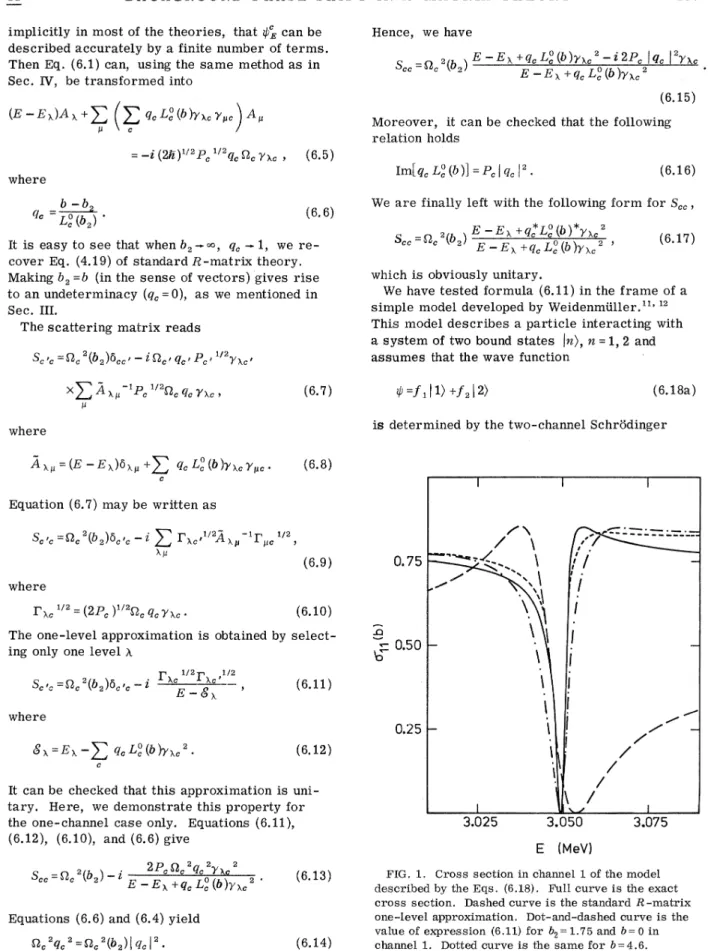
different from the background phase shift. Figure 1 shows the comparison between the exactcross
section, the result ofthe standard
R-matrix
one-level approximation, and the result of Eq. (6.11).
The parameters
a,
and b, have been chosen sameas
in Ref. 3, namely,a,
=6fm, b,=S,
(Ez),
c =1, 2. The parameter b, (c=1}
has been deter-mined by fitting the background, andis
equal to1.
75.
The remarkable feature ofthe resultis
that formula (6.12)not only reproduces the back-ground, but also the width of the resonance. This is probably due tothe fact that for b,=
S,
, Ip,I&1as shown by
Eq. (6.
6). We note that the fitting of the background does not uniquely determine the parameter b,.
In general, thereare
two possible values ofb,.
In the numericalcase
above, the two valuesare
1.
75and4.02.
The latter one gives a good value for the background and for the width, but does not correctly reproduce the small asym-metry of the resonance, giving a small peak inthe
cross
section below the dip and not above. Gnthe other hand, when the value of
b, is
chosen to reproduce the background, the resultsare
almost independent ofbas
indicated by the dotted curve ofFig.
1, which corresponds toh (c=1)=4.
6. We emphasize that, for the standardB-matrix
one-level approximation, this value ofb yields a good value of the width, but
a
completely wrongvalue ofthe position of the resonance and of the background. It should, homever, be noticed that
the most sophisticated versions of
8-matrix
theory yield more satisfactory one-level approximation generally by including more than the hard sphere in the external region.In both theories (standard A matrix and present theory), the inner wave function
for
the one-level approximation is practically the same(i.
e.
,pro-portional to
X~}.
Hence, it may be surprising that the two theories give quite different results, specially outside the resonance. We show that this difference comes from the prescription used to obtain the scattering matrix from the internalwave function. The prescription in our theory is different from that used in standard
8
matrix, and it actually generalizes the latter, as we willsee
below. The dynamicalEqs.
(3.
8)show that the external wave functionis
related to the in-ternal wave function by@4=4:"'+
~,
& (h.)PP,
(6»)
or
c Sc' d c(6.
20b)This prescription generalizes the one used in standard R-matrix theory. The latter can be
re-covered by dividing Eq.(6.
20b) by h, and making6,
tend towards infinity. One finds easily(6.
21) Sc'which amounts to equating the external and the internal wave functions on the
surface.
The theory of Lane and Hobson,
'
when applied toB-matrix-type theories,is
entirely based onEqs.
(4.1)
and (6.21).
The argument above shows that thisis
equivalent to the Eqs. (4.2)and that the theory of Lane and Hobson is implicitly con-tained in our formalism. We check thatprescrip-tion (6.20) correctly reproduces the collision matrix for the one-level approximation. The in-ternal wave function is given by Isee Eq. (6.
5)]:
(6.22) where the function g',
"'
has a logarithmic deriva-tive equal tob,
on thesurface.
We multiply Eq.(6.
19)by g+(b,)on theleft.
We have, with the helpof Eq.
(4.
10) (for b, replacing infinity in the argu-ment of2),
BACKGROUND
PHASE
SHIFT
INR-MATRIX
THEORY
299 and we write Qg asQf=
~(I,
b„i
—S„i
O,i)P,
c Uc' Hence,
(6.
23) b,—
1(4.
IPI& 0„..«b-b,
'
(0, I»/)
Qc~
a,
.
I«'E
E„+—
P
q, Lo(b) y~,'
~c'
[L,
'
(b,)*I,
(a,
)6„.
-S„L,
o(b,)0,
(a,
)].
c~VVc
(6.
25)S„=Oc
'(bo)«(2P.
)"'q.
&.
y.
.
(2P.
)"'q.
&.
y~.E
-Ex+2
q. L:(b)y~.
'
(6.
27)which is exactly Eq. (6.
11).
This shows, however, that using the continuity condition in the derivation of the collision matrix from the internal wavefunction is not a trivial choice
as
it might appear from the standard derivation ofR-matrix theory. We finally makea
remark on the one-level ap-proximation in the one-channelcase.
Itis
known, in standardR-matrix
theory, that the one-level approximation yields an exact result atE =Eq.
This is related to the fact that the inner wave
function is then equal to
Xz.
"
We show that this result remains in our theory. Indeed,Eqs. (6.11)
givesS,
.
(E„)=a,
'(b,
)—
i2P,
q, Q,c
(6.
26)
or,
with the help ofEqs. (6.
4)and(6.
6)Equations
(6.
24) and(6.
25) yield[L:
(b,)]*I.
(a
),
L,
'.
(b,)0,
(a,.
)«(b
-b,
)(2h)'"
P,
.
"'n,
y~,y„,
.
L,
'
(b,)0,
(a,.
)E
E«,+P
q—,
I,
'(b)y„,
'
(6.
26) and, with the help ofEqs.
(6.4)and (4. 18),VII. CONCLUSIONS
We have formulated the
R-matrix
theory in terms ofprojection operators, and have shownhow to do the same
for
other R-matrix-typetheo-ries.
We find two advantages of such a reformu-lation.Firstly,
it provides auseful tool to com-pare different theories with each other, since we have a general formalism for all thosetheories.
Secondly, we have exhibited the mathematical origin of the arbitrariness in the R-matrix theoryand of the appearance of the hard sphere phase shift in this theory. Particularly, we have shown
that the nonresonant collision matrix is quite arbitrary, and that one can choose any other uni-tary diagonal collision matrix instead of the hard sphere collision matrix. We have constructed a new theory making advantage of this freedom. We have proved on anumerical example, that the one-level approximation in this theory can yield agood description of the background. This is an alternative to the one-level plus constant back-ground approximation in standard
R-matrix
theo-ry or to one-level approximation of sophisticatedR-matrix
theory where the external region con-tainsa
part of the nuclear interaction.We
are
grateful toProfessor
C. Mahaux for helpful discussions. APPENDIX (),
[L,
'(b,
)]*L,
'(b) —2«P,(b—b,) cc X c Lo(b )Lo(b)„.
L.
'(b,
)[L.
'(b)]*
c Lo(b )Lo(b )
(6.
29)P=P
+P',
(A1)Here, we derive the
R-matrix
equations when a few levelsare
treated on a separate footing. Let us divide theP
space in two subspaceswhich is obviously independent of
b,
andis
equal to the result ofstandardR-matrix
theory.where
P'
projects
on the retained levels (X,««) and300
J.
CUGNON can be written as[E
—P'HP'+2
(b)]P'
rPz——Z,
(b)Qgs,[E
—P'HP'+Z
(b)]P'gs
=g,
(b)Qg's, (A2) (A3)Equations (A2) and (A6) yields
[E P-'HP'+Z
(b) S-, (b)O'Z, ()]P'y',
=Z,
(b)X',&'&.
(Alo)E
—QHQ+&, ( ) 1*+(
)E-PoHPO+Z
(b) +( ) Q~'=& (")P'O'E (A5) The solution of this equation
is
Qtjr=
X"
+ O'Z (~)P'
gs,
(A6) where X,"
is
the solution of the homogeneous equation obtained from (A5) by setting the right-hand side equal tozero.
The Green's functionIE —QHQ+&,( )jQPs=& ( )P'4's
+Z
(~)P'qs.
(A4) Let usfirst
eliminateP'.
Equations (A3)and (A4)yield
Byprojecting on the basis spanned by the Xz, we have
(E —Eg)&), Q-&&g~&,(b)O'2 (
)~&„)A„
=&X,
]Z,
(b)iX',&"& .(All)
We now need a representation for
8'
and X',"'.
It is easy tosee
that the operator whose inverse is involved inEqs.
(A8)and (AB)is diagonal in the energy indices, when sandwiched betweeng
(E)
and
g~(E').
Using this fact, and the results (4.12) to (4.17), it can be shown that the Green's func-tion8',
when sandwiched between aZ+ operator on the left and a g operator on the right[as
in Eq. A(10)] is given byO' =
E
—QHQ+2+( )—«2(~)
1 -1
"E-P~~.
Z (b)'"'
can be written in the formg+ 1
E'
—QHQ+g,
( ) 1E-P'HP'+Z,
(b) (A7) xQ
[1
—R'L'(b)]
„
i CIISimilarly the function X'o"'
is
given by X","
=0, P,
"'g
[1
-R'L'(b)]
„i
1 -1xg,
b E'-QHQ+ L( ) (A8) Clt —&/2II yc&+) (A13)Similarly, the function Xo'
is
also given by1 &" ~=&~ ~
'-'-'
)E-WP"~(b)
In the last two equations,
8'
is given bygO
~
~GC ~GCCC
0 (A14)
1
+( )E+
QHQ
g
( ) UsingEqs.
(A12)and (A13)and the results (4.12) to (4. 17), it is easy to see that Eq. (A12)reduces to(E —E&)A
&+P
g
L (b)y& [1 —ROL (b)] ~y„A&
——i(25)
~ Pc -Q~g
(1-R
L)«
~y&,
i,
«
C(A15)
BACKGROUND
PHASE
SHIFT
IN8
-MATRIX THEOR
Y 301*Chercheur Institut Interuniversitaire des Sciences Nucleaires, Belgium.
~Present address: Division de Physique Theorique, IPN, BPNo. 1, 91-0rsay, France.
~A.M. Lane and R.G.Thomas, Rev. Mod. Phys. 30,
257 (1958).
2C. Mahaux and H.A. Weidenmull, er, Shell-Model
Approach to
¹eleaw
Reactions (North-Hol. l.and,Am-sterdam, 1969).
3A. Lejeune and C.Mahaux, Nucl. Phys, A145, 613
(1970).
4A.M. Lane and D.Robson, Phys. Rev. 151, 774 (1966). ~H.Feshbach, Ann. Phys. (N.Y.} 19, 287 (1962).
We do not include the point a~=a, . The
P
and Q com-mute with H andP
+@=1,in the sense that&PkP+g)lg) =&gll[g) for any& and g, except for
distributions centered at a~. We could include the
point r~=a~. Then,
P
+@=1also holds fordistribu-tions. The projectors P, Q do not commute with H any more, but they do with H+S(b) [see Eq. (3.6)].
We are led, however, tothe same result (4.5). We
choose the first method, excluding
r
= a from theprojectors
P
and Q, because itinvolved the continuitycondition ona more natural. way. 7C.Bloch, Nucl. Phys. 4, 503 (1957).
P. I,.Kapur and R.
E.
Peierl.s, Proc. R. Soc.Lond. A166, 277 (1938).9L. Garside and W.Tobocman, Phys. Rev. 173, 1047
(1968).
~OR.
J.
Philpott andJ.
George, to be published.H. A.Weidenmuller, Ann. Phys. (N.Y.)29, 60 (1964). H.A.Weidenmull. er, Ann. Phys. (N.Y.)29, 378(1964).