HAL Id: hal-00667997
https://hal.archives-ouvertes.fr/hal-00667997
Submitted on 8 Feb 2012
HAL is a multi-disciplinary open access
archive for the deposit and dissemination of
sci-entific research documents, whether they are
pub-lished or not. The documents may come from
teaching and research institutions in France or
abroad, or from public or private research centers.
L’archive ouverte pluridisciplinaire HAL, est
destinée au dépôt et à la diffusion de documents
scientifiques de niveau recherche, publiés ou non,
émanant des établissements d’enseignement et de
recherche français ou étrangers, des laboratoires
publics ou privés.
Fast and precise kinematic skeleton extraction of 3D
dynamic meshes
Julien Tierny, Jean-Philippe Vandeborre, Mohamed Daoudi
To cite this version:
Julien Tierny, Jean-Philippe Vandeborre, Mohamed Daoudi. Fast and precise kinematic skeleton
extraction of 3D dynamic meshes. 19th IEEE International Conference on Pattern Recognition (ICPR
2008), Dec 2008, Tampa, Florida, United States. pp.MoBT8.22. �hal-00667997�
Fast and precise kinematic skeleton extraction of 3D dynamic meshes
Julien Tierny
1, Jean-Philippe Vandeborre
1,2and Mohamed Daoudi
1,2 1LIFL (UMR USTL/CNRS 8022), Lille, France
2
Institut TELECOM; TELECOM Lille 1, Lille, France
{julien.tierny, jean-philippe.vandeborre, mohamed.daoudi}@lifl.fr
Abstract
Shape skeleton extraction is a fundamental pre-processing task in shape-based pattern recognition. This paper presents a new algorithm for fast and precise extraction of kinematic skeletons of 3D dynamic surface meshes. Unlike previous approaches, surface motions are characterized by the mesh local length deviation in-duced by its transformation through time. Then a static skeleton extraction algorithm based on Reeb graphs ex-ploits this latter information to extract the kinematic skeleton. This hybrid static and dynamic shape analysis enables the precise detection of objects’ articulations as well as potentially-articulated immobile shape features. Experiments show that the proposed algorithm is faster than previous techniques and still achieves better accu-racy.
1. Introduction
Shape skeleton extraction and segmentation are fun-damental shape pre-processing tasks in computer vision and shape-based pattern recognition. They provide an intrinsic structural shape description, which is useful for further applications dealing with shape understanding, like shape recognition or retrieval. With the ongoing development of 3D technologies, 3D dynamic shapes (time-varying 3D data) are becoming a media of in-creasing importance. Such data can be provided by sci-entific simulations, animation softwares, video games or security systems and are mostly modeled by constant connectivity surface meshes with time-varying geome-try. Like 3D static shapes, 3D dynamic shapes also need to be pprocessed for their understanding and have re-cently drawn shape analysis community’s interest [6, 3]. However, only few papers have addressed the 3D dy-namic surface mesh segmentation [5, 4] or skeleton ex-traction [1, 8, 2] specific problems.
While static 3D shape segmentation methods aim at extracting a meaningful structural representation of the shape by decomposing it into parts of uniform
geome-try, 3D dynamic shape segmentation methods propose to exploit the temporal information to decompose the shape into parts of uniform motion along the sequence. Indeed, this approach is a faithful hypothesis for ex-tracting the functional and thus meaningful structure of an object, revealing its articulation points for example. Consequently, existing techniques first try to character-ize the motion uniformity over the surface mesh and then use clustering techniques to decompose it.
As most of real life objects’ motions can be defined in terms of local rigid transformations (translations and local rotations), Mamou et al. [5], in the context of dy-namic shape compression, propose to locally compute the optimal rigid transformations along the sequence frames for small surface neighborhoods using the least square method. Then, surface neighborhoods affected by the same rigid transformations are gathered using the k-means algorithm to produce the final segmentation. Lee et al. [4] adopt a similar strategy by first computing the so-called deformation gradient to characterize the rigid transformation prediction error over the surface and then employ a clustering-based static mesh segmen-tation algorithm on this error field. Skeleton-extraction techniques for 3D dynamic surface meshes [1, 8, 2] also characterize surface motion with rigid transformation predictions combined with clustering algorithms.
However, predicting local rigid transformations turns out to be computationally expensive and from our experience the computation (especially using least square methods) can suffer from numerical instabilities. Moreover, most of the existing techniques only exploit the temporal information and thus cannot extract immo-bile shape features which still potentially correspond to functional parts of the object.
In this paper, we present a novel hybrid technique for the extraction of 3D dynamic surface mesh kinematic skeletons, a shape representation that reveals the shape kinematic characteristics over the time. This work brings the following contributions. First, we propose a simple, fast and efficient technique for surface motion characterization which is not based on rigid transfor-mation prediction. Then, we present a combined
dy-(a) (b) (c) (d) (e) Figure 1. Example frames of the horse dy-namic surface mesh (1(a), 1(b), 1(c)) and its local length deviation (1(d), 1(e)).
namic and static approach that precisely identifies the articulations of the object through time and which also distinguishes specifically immobile shape features that contain potential articulated parts. The rest of the paper is structured as follows: we present motion characteri-zation in section 2, skeleton extraction in section 3, ex-periments and results (with comparisons to other tech-niques) in section 4 and finally demonstrate the preci-sion and the applicative interest of our technique in the context of animation reverse engineering (section 5).
2. Local length deviation analysis
Let M be a constant connectivity closed surface mesh, whose vertices’ positions vary through time pt(vi) = (xi, yi, zi)t, ∀vi ∈ M . Surface portions
that exhibit high rigid transformation prediction er-ror through time correspond to the articulations of the object (affected by elastic transformations) and thus should match the boundaries of the final segmentation.
Considered transformations (translations and local rotations) belong to the group of isometric maps (length preserving isomorphisms). Thus, length preservation is also an invariant of rigid transformations. Conse-quently, we propose to detect surface portions that are not motioned through rigid transformations by com-puting the surface repartition of the edge-length devi-ation along the frames. In particular, we introduce the quadratic local length deviationLd∀vi∈ M , where T
is the number of frames in the sequence,N (vi) is the
set of vertices sharing an edge withviandd is the
eu-clidean distance: Ld(vi) = T −1X t=0 X vj∈N(vi) 1 |N (vi)| × [d(pt(vi), pt(vj)) − d(pt+1(vi), pt+1(vj))]2 (1)
Figure 1 shows a dynamic shape and its corresponding local length deviation (reported on the first frame). No-tice in figures 1(d) and 1(e) that light pink surface por-tions (low local length deviation) have been affected by local rotations in the sequence and correspond to rigid portions of the object. Moreover, the articulations of the legs exhibit a high local length deviation (dark red) as they have been affected by elastic transformations.
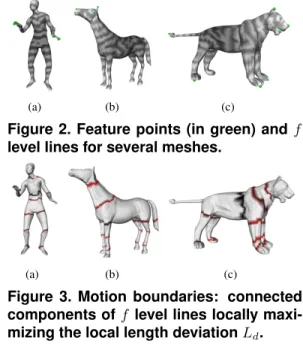
(a) (b) (c)
Figure 2. Feature points (in green) and f
level lines for several meshes.
(a) (b) (c)
Figure 3. Motion boundaries: connected components off level lines locally
maxi-mizing the local length deviationLd.
3. Surface mesh skeleton extraction
3.1. Segmentation boundary computation
The local length deviation provides an information similar to the deformation gradient [4] or the rigid er-ror function [8]. Thus, a clustering based segmenta-tion technique can be applied at this stage. Instead, we propose to adapt a static skeleton extraction tech-nique based on Reeb graphs [9] in order to also dis-tinguish immobile shape features that potentially corre-spond to functional parts. This technique first computes automatically the shape feature points (vertices located at the extremity of prominent components, in green in figure 2) by intersecting geodesic maps extrema [9]. Then, in order to have a pose-invariant shape represen-tation, it computes the following function, where g is the geodesic distance andvfis the geodesic-closest
fea-ture points fromvi:f (vi) = g(vi, vf) ∀vi∈ M(t=0).
Then, for each vertexvi∈ M , the algorithm extracts
an upper-value discrete approximation of f−1(f (v i)),
which follows the edges of M [9]. In particular, let cf(vi) be the ”contour” of vi (the connected
compo-nent off−1(f (v
i)) approximation containing vi).
As f level lines follow the protrusions of the ob-ject (see figure 2), their connected components are good candidates for the definition of the segmentation bound-aries. To select these boundaries among the collection of contours, for each contourcf(vi), we compute its
av-erage local length deviation (averagingLd(vj) / vj ∈
cf(vi)). Then, we identify the contours cf that locally
maximize this value (with regard to their adjacent con-tours) as motion boundaries (see figure 3).
(a) (b) (c) (d)
(e) (f) (g) (h) (i)
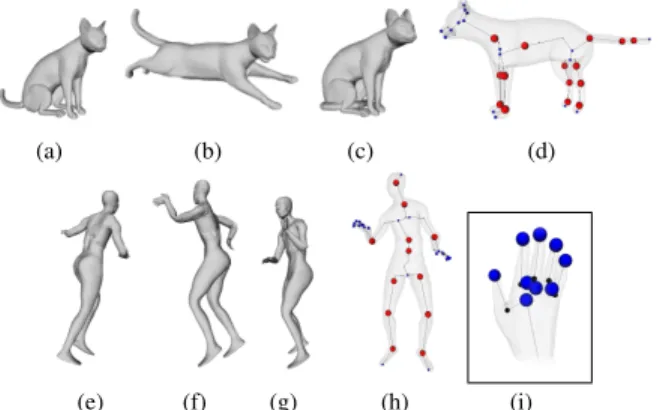
Figure 4. 3D dynamic surface meshes and their extracted kinematic skeletons.
corresponding to potentially functional parts, f criti-cal points are extracted at the vertices where contours merge, split or terminate as f evolves [9]. The con-tours related to these vertices are denoted as topological boundaries, which are the boundaries of the Reeb graph [7] decomposition ofM .
3.2. Skeleton embedding
To embed the kinematic skeleton in 3D, we first place the nodes of the Reeb graph (f critical points, in blue in figure 4) at the barycenter of the topological boundaries. Then, the edges of the Reeb graph (linking f critical points) are subdivided at motion boundaries to produce the final kinematic skeleton. In particular, motion nodes(in red in figure 4) have been placed at the barycenters of the motion boundaries.
4. Experiments and results
Figure 4 shows 3D dynamic meshes and their ex-tracted kinematic skeletons. Notice that the motion nodes (in red) are precisely placed at the articulations of the objects (see the next section for precision evalu-ation). Moreover, the edges of the kinematic skeleton (black lines) correspond to rigid parts of the objects. Thus, motion nodes provides an information about the object motion, revealing the reference points of rigid part rotations. Moreover, the shape topology is effi-ciently captured by the Reeb graph [7]. Thus, the kine-matic skeletons preserves the object’s topology.
Figure 5 presents a visual comparison of our algo-rithm with existing techniques. Notice that in figure 5(a) the hooves of the horse dynamic shape are not ex-tracted as individual rigid parts, while their motion is different from the rest of the leg. On the contrary, our method precisely identifies articulations and is compat-ible with de Aguiar’s algorithm’s decomposition (fig.
(a) (b) (c)
Figure 5. Visual comparison between Lee’s segmentation [4] (5(a)), de Aguiar’s skeleton [2] (5(b)) and our method (5(c)).
Dynamic mesh Faces Frames Extraction (s.)
Cat 14410 10 9.6
Dance 14118 201 21.2 Horse 16843 49 12.7
Lion 9996 10 6.0
Snake 18354 134 20.2
Table 1. Computation times of kinematic skeleton extraction for several dynamic surface meshes (P4 3GHz CPU).
5(b)). However, thanks to the Reeb graph and the fea-ture point extractions, our algorithm can also extract and decompose specifically immobile shape features (in blue) like the hands of the dancer, or the mouth and the ears of the horse, which are actually articulated parts of these objects in reality.
As our motion analysis is not based on rigid trans-formation prediction (which requires matrix inversion), our algorithm runs faster than existing techniques (see tables 1 and 2). Local length deviation computation runs in linear time: O(n × T ) steps, with n the num-ber of vertices in M and T the number of frames in the dynamic shape. Reeb graph extraction (topologi-cal boundaries) only requires O(n2) steps [9]: as M
has constant connectivity, its topology does not evolve; thus, the Reeb graph is computed only once (forMt=0).
5. Animation reverse engineering
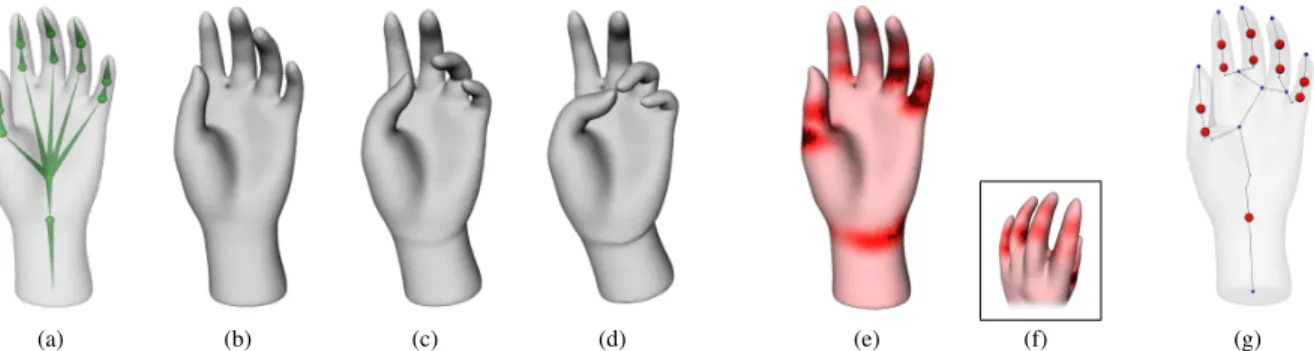
To demonstrate the precision of our algorithm and its applicative interest, in the following experiment, given a skeleton-driven animation of a static shape (realized with an animation software) we propose to retrieve the kinematic model of the animation by kinematic skele-ton extraction. Figures 6(a), 6(b), 6(c) and 6(d) show the original designed skeleton and the resulting anima-tion. Figure 6(e) shows the local length deviation of this dynamic shape. Notice that the index and the mid-dle fingers have been slightly articulated but still exhibit length deviation (fig. 6(f)). Finally, figure 6(g) shows the extracted kinematic skeleton. Notice that each artic-ulation of the original skeleton has been extracted as a motion node of the kinematic skeleton. Moreover, the
(a) (b) (c) (d) (e) (f) (g) Figure 6. Animation reverse engineering: a dynamic surface mesh (6(b), 6(c), 6(d)) is gener-ated from a predefined skeleton of a static mesh (6(a)). Local length deviation (6(e), 6(e)) and extracted kinematic skeleton (6(g)). Motion node location error: 0.44%.
Algorithms Skeleton extraction (s.) Our algorithm 12.7
de Aguiar’s [2] 21 Lee’s [4] 806
Table 2. Computation times for the horse dynamic surface mesh.
(a) (b) (c) (d) (e) (f)
Figure 7. New dynamic surface meshes generated using the extracted kinematic skeletons.
average height (y) difference between the original and the extracted skeletons’ articulations is only 0.44% of the height of the object bounding box, which is a sat-isfactory precision (against 1.7% in the best case for [2]). Finally, as skeleton extraction is achieved by seg-menting the mesh at motion and topological bound-aries, there is a full correspondence between the skele-ton edges and the related surface segments. Thus, input dynamic shapes can be re-edited from their kinematic skeletons by applying local rotations on the edges of the skeleton, as shown in figure 7.
6. Conclusion and future works
In this paper, we presented a new hybrid algorithm for fast and precise kinematic skeleton extraction of 3D dynamic surface meshes based on local length deviation computation and Reeb graph extraction.
Experiments showed the rapidity of this method and demonstrated its precision. Thanks to this representa-tion which concisely encodes the dynamic shape mo-tion characteristics, dynamic shapes can be efficiently edited. As the edges of the skeleton represent rigid parts
of the object, their motion can be modeled by simple ro-tations.
In the future, we would like to use this representation for 3D dynamic shape comparison (for gesture recogni-tion), by comparing the rotations affecting the edges of the skeleton. Moreover, a limitation of the proposed al-gorithm is the assumption that dynamic shapes evolve through nearly rigid motions only. In the future, we would also like to adapt the framework to efficiently model surface elastic transformations.
References
[1] D. Anguelov, D. Koller, H. Pang, P. Srinivasan, and S. Thrun. Recovering articulated object models from 3D range data. In Uncertainty in Artifical Intelligence, pages 18–26, 2004.
[2] E. de Aguiar, C. Theobalt, S. Thrun, and H.-P. Seidel. Automatic conversion of mesh animations into
skeleton-based animations. Computer Graphics Forum, 27:In
press, 2008.
[3] A. G. Kirk, J. F. O’Brien, and D. A. Forsyth. Skeletal parameter estimation from optical motion capture data. In IEEE CVPR, pages 782–788, 2005.
[4] T.-Y. Lee, Y.-S. Wang, and T.-G. Chen. Segmenting a deforming mesh into near-rigid components. The Visual Computer, 22:729–739, 2006.
[5] K. Mamou, T. Zaharia, and F. Prˆeteux. Multi-chart geom-etry video: A compact representation for 3D animations. In IEEE 3DPVT, pages 711–718, 2006.
[6] T. B. Moeslund and E. Granum. A survey of computer vision-based human motion capture. Computer Vision and Image Understanding, 81:231–268, 2001.
[7] G. Reeb. Sur les points singuliers d’une forme de Pfaff compl`etement int´egrable ou d’une fonction num´erique. Comptes-rendus des S´eances de l’Acad´emie des Sciences, 222:847–849, 1946.
[8] S. Schaefer and C. Yuksel. Example-based skeleton ex-traction. In Symposium on Geometry Processing, pages 153–162, 2007.
[9] J. Tierny, J.-P. Vandeborre, and M. Daoudi. Invariant high level Reeb graphs of 3D polygonal meshes. In IEEE 3DPVT, pages 105–112, 2006.