Université de Montréal
A layered JavaScript virtual machine supporting dynamic instrumentation
par Erick Lavoie
Département d’informatique et de recherche opérationelle Faculté des arts et des sciences
Mémoire présenté à la Faculté des études supérieures en vue de l’obtention du grade de
Maître ès sciences (M.Sc.) en informatique
Avril, 2013
c
Résumé
L’observation de l’exécution d’applications JavaScript est habituellement réalisée en instrumentant une machine virtuelle (MV) industrielle ou en effectuant une traduction source-à-source ad hoc et com-plexe. Ce mémoire présente une alternative basée sur la superposition de machines virtuelles. Notre approche consiste à faire une traduction source-à-source d’un programme pendant son exécution pour exposer ses opérations de bas niveau au travers d’un modèle objet flexible. Ces opérations de bas niveau peuvent ensuite être redéfinies pendant l’exécution pour pouvoir en faire l’observation. Pour limiter la pénalité en performance introduite, notre approche exploite les opérations rapides originales de la MV sous-jacente, lorsque cela est possible, et applique les techniques de compilation à-la-volée dans la MV superposée. Notre implémentation, Photon, est en moyenne 19% plus rapide qu’un interprète moderne, et entre 19× et 56×plus lente en moyenne que les compilateurs à-la-volée utilisés dans les navigateurs web populaires. Ce mémoire montre donc que la superposition de machines virtuelles est une tech-nique alternative compétitive à la modification d’un interprète moderne pour JavaScript lorsqu’appliqué à l’observation à l’exécution des opérations sur les objets et des appels de fonction.
Mots-clés: Méta-circularité, Instrumentation, Dynamisme, Modèle Objet, Flexibilité, Performance, Machine Virtuelle, JavaScript
Abstract
Run-time monitoring of JavaScript applications is typically achieved by instrumenting a production virtual machine or through ad-hoc, complex source-to-source transformations. This dissertation presents an alternative based on virtual machine layering. Our approach performs a dynamic translation of the client program to expose low-level operations through a flexible object model. These low-level operations can then be redefined at run time to monitor the execution. In order to limit the incurred performance overhead, our approach leverages fast operations from the underlying host VM implementation whenever possible, and applies Just-In-Time compilation (JIT) techniques within the added virtual machine layer. Our implementation, Photon, is on average 19% faster than a state-of-the-art interpreter, and between 19× and 56× slower on average than the commercial JIT compilers found in popular web browsers. This dissertation therefore shows that virtual machine layering is a competitive alternative approach to the modification of a production JavaScript interpreter when applied to run-time monitoring of object operations and function calls.
Keywords: Metacircularity, Instrumentation, Dynamism, Object Model, Flexibility, Performance, Virtual Machine, JavaScript
Acronyms
Acronym Definition
API Application Programming Interface
JIT Just-In-Time
JS JavaScript
OO Object-Oriented
OOPSLA The International Conference on Object Oriented Program-ming, Systems, Languages and Applications
Pn Photon Virtual Machine
Pn-fast Photon Virtual Machine with a fast instrumentation Pn-spl Photon Virtual Machine with a simple instrumentation SM Mozilla SpiderMonkey Virtual Machine
V8 Google V8 Virtual Machine
Remerciements
Un grand merci à mes colocataires des trois dernières années, Jérôme, Claire, Estelle puis plus tard Noël ainsi qu’à mes ami(e)s en particulier Awa et Bianka, qui ont été aux premières loges pour partager mes joies et frustrations mais surtout pour avoir offert un environnement qui m’a permis de décrocher quand j’en avais besoin.
Merci à Paul (Khuong) et Paul (Raymond-Robichaud) pour les discussions stimulantes, Étienne et David pour le partage de leur expérience du milieu académique, ce qui a brisé mon sentiment d’isolement aux moments où j’avais l’impression d’être seul face à certaines difficultés.
Merci également à tous ceux qui sont passés par le lab pendant mon séjour, en particulier Benoît, pour la co-création de la version la plus épique d’un Pacman 3D moustachu à laquelle j’aie participé, Eric, Vincent et Benjamin pour avoir démontré un intérêt pour mes nombreuses "démos" de versions intermédiaires du système ainsi que Maxime pour m’avoir montré un calibre de programmation que je n’avais pas connu jusqu’à mon entrée au lab.
Merci au personnel administratif du département d’informatique et de recherche opérationnelle, en particulier Mariette Paradis, pour les nombreux accomodements et les judicieux conseils prodigués pour la navigation au travers des requis administratifs inhérents à la poursuite d’études graduées dans un contexte institutionnel. Cela a grandement simplifié ma vie.
Merci à Bruno Dufour, qui aurait mérité d’être officiellement co-directeur vu son niveau d’implication dans mon projet de maîtrise. L’identification du problème d’instrumentation dynamique efficace est une conséquence directe de nos discussions. L’instrumentation dynamique a fourni un usage pratique à une solution qui était en recherche d’un problème. Tu es également le premier à avoir pleinement reconnu l’intérêt académique de mon travail.
Merci à Marc Feeley, mon directeur, d’avoir servi d’exemple spécifiquement par son soucis du détail et du mot juste ainsi que ses capacités techniques remarquables. Bien que ca n’ait pas toujours été intentionnel, merci également de m’avoir sorti de ma zone de confort. Mes limites personnelles ont été dans certains cas repoussées et dans d’autres cas raffermies.
Contents
Résumé ii Abstract iii Acronyms iv Remerciements v List of Tables ix List of Figures x 1 Introduction 1 1.1 Overview . . . 2 1.1.1 Design goals . . . 21.1.2 Overview of the components . . . 3
1.1.3 Bottom-Up Overview . . . 4 1.2 Background material . . . 5 1.2.1 JavaScript . . . 5 1.2.2 Object model . . . 5 1.2.3 Function-calling protocol . . . 6 1.3 Outline . . . 7 2 Previous Work 8 2.1 Historical roots . . . 8 2.1.1 Openness . . . 8 2.1.2 Extensibility . . . 9 2.1.3 Dynamism . . . 10 2.1.4 Performance . . . 11 2.2 Instrumenting JavaScript VMs . . . 11
3 Design 15
3.1 Message-sending foundation . . . 15
3.1.1 Semantics . . . 15
3.1.1.1 Message sending as a method call . . . 16
3.1.1.2 Reifying function calls . . . 16
3.1.1.3 Providing a memoization hook . . . 17
3.1.2 Translating reified operations to message-sending . . . 17
3.1.3 Efficient implementation . . . 18
3.1.3.1 Cache states and transitions . . . 20
3.2 Object representation . . . 23
3.2.1 Representation for objects . . . 23
3.2.2 Fixed arguments number specialization . . . 27
3.3 Compilation example . . . 27
4 Flexibility 30 4.1 Obtaining object model operation information . . . 31
4.2 Obtaining a dynamic call graph . . . 33
4.2.1 Protecting the profiling code in a critical section . . . 35
4.3 Enforcing run-time invariants . . . 38
4.3.1 Ensure that all accesses are made to existing properties . . . 38
4.3.2 Ensure that a constructor always returns the object it receives . . . 39
5 Performance 41 5.1 Setting . . . 42
5.2 Performance with no instrumentation . . . 43
5.3 Effect of send caching . . . 46
5.4 Comparison with interpreter instrumentation . . . 46
5.5 Performance with instrumentation . . . 48
6 Conclusion 50 6.1 Limitations . . . 50
6.1.1 Accessing the__proto__property leaks the internal representation . . . 51
6.1.2 Meta-methods can conflict with regular methods if they have the same name . . . 51
6.1.3 Setting the__proto__property throws an exception . . . 51
6.1.4 Operations onnullorundefinedmight throw a different exception . . . 51
6.1.5 Limited support for eval . . . 52
6.2 Future work . . . 52
6.2.1 Improve compilation speed . . . 53
6.2.2 Allow a finer-grained redefinition of meta-methods . . . 53
6.2.3 Efficient instrumentation . . . 53
6.2.3.1 Improve the inherent overhead . . . 53
6.2.3.2 Provide mechanisms to optimize the instrumentation code . . . 53
Bibliography 55
List of Tables
3.1 Call types and their equivalent message sends . . . 18
3.2 Object operations and their equivalent message sends . . . 18
3.3 Cache states . . . 21
3.4 Cache events . . . 22
3.5 Cache transition conditions . . . 23
3.6 Object representation operations and their interface . . . 26
A.1 Inherent overhead of Photon . . . 59
A.2 Execution speed slowdown of Photon with deactivated send caches . . . 60
A.3 Performance of the V8 benchmark suite executed by Photon without instrumentation . . 60
A.4 Execution speed slowdown of Photon with a simple instrumentation . . . 61
List of Figures
1.1 Components of Photon virtual machine and the features they provide, implement and use 3
3.1 Cache states and transitions . . . 22
3.2 Representation for objects . . . 24
3.3 Representation for special objects . . . 25
4.1 Modification channels . . . 31
4.2 Call graph for example code . . . 34
5.1 Inherent overhead of Photon . . . 43
5.2 Ratios of operations for V8 benchmarks . . . 44
5.3 Slowdown and ratio ofthisoperations . . . 45
5.4 Execution speed slowdown of Photon with deactivated send caches . . . 46
5.5 Performance of the V8 benchmark suite executed by Photon without instrumentation . . 47
Chapter 1
Introduction
Run-time instrumentation of JavaScript (JS) is currently used for widely different purposes. Notable examples are automatic benchmark extraction from web applications [27], empirical data gathering about the dynamic behavior of web applications [28] and access permission contracts enforcement [11]. All these examples require instrumentation of object operations, such as property accesses, updates and deletions. They also require instrumentation of all function calls made to global functions, object methods, or function references, either directly or indirectly through theircallor applymethods.
Standard JavaScript semantics do not have reflection features that globally reify all object operations and function calls. To work around this limitation, two main approaches are usually employed.
In the first approach, a production virtual machine (VM), usually written in C++, is modified to provide hooks on selected operations. It is increasingly complex on modern JS VMs because those VMs are optimized for performance. The resulting instrumented VM then becomes a burden to maintain up-to-date with its evolving counterpart.
In the second approach, an ad hoc source-to-source translator and run-time library are written for the problem at hand and the system is expected to run on top of a production VM. Guaranteeing that instrumented objects cooperate with the rest of the system is deceptively difficult in practice.
In both cases, instrumentation is achieved at a significant performance cost. On one hand, modifi-cations of production VMs are usually done on an interpreter because the instrumentation hooks can break invariants assumed throughout the JIT-compiler implementation. The modified VM will therefore at best run at interpreter-level speed at best. On the other hand, source-to-source translations can break the performance advantage of having a JIT-compiler by producing code that is hard for the JIT-compiler to optimize.
In this dissertation, we present Photon, a framework based on virtual machine layering. It is inspired by previous work on metaobject protocols [15] but has been adapted to work efficiently on modern JS VMs and provides a better separation of concerns than ad hoc source-to-source translations, while performing
the source-to-source translation at run time. The optimization techniques presented in this dissertation make Photon run 19% faster on average than a state-of-the-art interpreter. We argue that it makes our approach efficient enough to replace instrumentations that were previously targeted at interpreters on production VMs.
This dissertation therefore shows that virtual machine layering is a competitive alternative approach to VM instrumentation for run-time monitoring of object operations and function calls. It makes the following contributions:
• An object representation designed to take advantage of the method caching behavior of the under-lying host VM to efficiently specializes its behavior (Section 3.2);
• A message-sending optimization exploiting the underlying host VM fast global function calls to specialize a reified operation to its call site (Section 3.1.3);
• A prototype JavaScript implementation, Photon, comprising both a runtime library (around 1700 lines of code) and a JavaScript-to-JavaScript compiler.
1.1 Overview
In a conventional JS setting, an application runs over a high-performance host VM. In the case of a metacircular VM, an additional VM layer is inserted between the application and the host VM. This layer can be a full or a differential implementation. In a full implementation, the metacircular VM provides all functionalities of the source language. In a differential setting, however, the metacircular VM only implements parts of the required functionality, and delegates the remaining operations to the underlying host VM. Our approach follows a differential strategy. Object operations are handled by one of the layers introduced by Photon while primitive operations are handled by the host VM.
This section discusses the objectives that guided the design decisions, followed by an overview of the Photon VM and its components.
1.1.1 Design goals
Our design aims to achieve the following properties:
• Isolation: The application is isolated to avoid any interference with instrumentation code, while still allowing an instrumentation to fully inspect and modify the application state.
• Flexibility: The semantics of object operations and function calls are exposed as methods so that they can be extended or completely redefined, as required by the instrumentation.
• Dynamism: The semantics of object operations and function calls can be redefined while the application is running to allow instrumentations to precisely control the start and duration of their monitoring (e.g., only after the startup phase of the application).
• Abstraction: Low-level details, mostly related to performance optimizations, are encapsulated by specific layers to simplify the definition of instrumentations.
• Performance: Since native features provided by the host VM are often implemented very ef-ficiently, our implementation reuses them when possible (e.g., the scope chain and control-flow operations). Furthermore, Photon leverages the performance of some host feature (e.g., fast global function calls) to perform optimizations that reduce the overhead introduced by the abstraction layers.
1.1.2 Overview of the components
Instrumentation
High-Performance Virtual Machine with a JIT Compiler Source-to-Source JIT Compiler
Message Sending Object Representation Component Application Fast Global Function Calls Control-flow, Primitives, etc.
Function Calls, Object Ops
Literal Object Creation
Instrumented Object Ops and
Function Calls
Native Objects Data Structures Inline Caching and
Specialization of Method Calls Caching and Specialization Specialization Control-flow, Primitives, etc. Object Ops Dynamically Redefinable
Function Calls and Object Ops
Full JavaScript Support provides
implements uses Object Ops, Function Calls Legend Containers Native Objects
Figure 1.1: Components of Photon virtual machine and the features they provide, implement and use
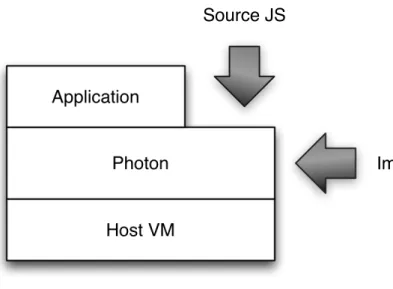
In a conventional JS setting, we can view an application as running over a host high-performance VM. The metacircular VM approach adds another layer between the two, allowing instrumentations to target the middle layer instead of the host VM. Figure 1.1 explains the vertical interaction between layers by naming components and detailing which features are implemented using features of components below it as well as the feature they provide to the layer above. Note that the diagram represents a structural
view of component interactions and not the execution model of the application. For example, after JIT compilation, the application code directly runs over the host VM, albeit in a different form, although it is shown as being over the source-to-source JIT compiler. Note that no meaning is associated to horizontal proximity.
We present each component, in a bottom-up fashion, in terms of the abstractions they provide and the key features of their implementation.
1.1.3 Bottom-Up Overview
Object representation. The object representation is the implementation of JS objects (including functions) from the point of view of the Photon VM. For efficiency, it uses native objects as property containers. The native objects are proxied with a second native object to provide encapsulation of invariants of the implementation in proxy methods. It has the benefit of simplifying the implementation of instrumentations because it abstracts implementation details required for performance. It also provides object-specific instrumentation information to be stored on a proxy without risk of interference with the application properties. Object representation operations can be specialized to certain classes of objects for performance, such as indexed property accesses on arrays.
Message Sending. The message-sending layer builds on top of the object representation to provide dynamically redefinable object operations and function calls. This extra level of indirection is used to spe-cialize those operations at their call site, depending on the call site data available, such as argument types and values, as well as the instrumentation state of the VM. It provides dynamic optimization of unin-strumented and inunin-strumented operations. By implementing specialized operations as global functions, the underlying VM will further specialize their behavior and even inline the operations in-place when possible. The invariants implied by the implementation of the message-sending layer are encapsulated in the object representation operations.
Source-to-Source Compiler. The source-to-source compiler translates the original JavaScript code to use the run-time environment of Photon. Non-reified elements, such as control-flow operations and primitive values and operations are preserved. Object operations and function calls are translated to message sends and become dynamically redefinable. Literal object creation is translated to use the object representation. The source-to-source compiler is in JavaScript and is therefore available at run-time. By staging it in front of every call toeval, it effectively provides a JIT compiler to Photon.
Instrumentation. An instrumentation can redefine the behavior of object operations and function calls by replacing the corresponding method on a root object with an instrumented version using the object representation operations. The ability to completely replace a method provides maximum flexibility to instrumentation writers compared to being limited to a specific event before and after an operation. An instrumentation is written at the same level as the VM, which means that it has access directly to the
execution environment of the VM and can use native objects as data structures.
1.2 Background material
To complement the introduction and overview, we elaborate on the specificities of the JavaScript language and our definitions of object model and function calls.
1.2.1 JavaScript
JS is a dynamic language, imperative but with a strong functional component, and a prototype-based object system similar to that of Self.
A JS object contains a set of properties (a.k.a. fields in other OO languages), and a link to a parent object, known as the object’s prototype. Properties are accessed with the notation obj.prop, or equivalently obj["prop"]. This allows objects to be treated as dictionaries whose keys are strings, or as one-dimensional arrays (a numeric index is automatically converted to a string). When fetching a property that is not contained in the object, the property is searched in the object’s prototype recursively. When storing a property that is not found in the object, the property is added to the object, even if it exists in the object’s prototype chain. Properties can also be removed from an object using thedelete
operator. JS treats global variables, including the top-level functions, as properties of the global object, which is a normal JS object.
Anonymous functions and nested functions are supported by JS. Function objects are closures which capture the variables of the enclosing functions. Common higher-order functions are predefined. For example, themap,forEachandfilterfunctions allow processing the elements of an array of data using closures, similarly to other functional languages. All functions accept any number of actual parameters. The actual parameters are passed in an array, which is accessible as the arguments local variable. The formal parameters in the function declaration are nothing more than aliases to the corresponding elements at the beginning of the array. Formal parameters with no corresponding element in the array are bound to a specific undefined value.
JS also has reflective capabilities (enumerating the properties of an object, testing the existence of a property, etc.) and dynamic code execution (evalof a string of JS code).
1.2.2 Object model
An object model is a set of object kinds, their supported operations and the time at which those operations can be performed. Examples of object kinds are arrays, numbers, associative arrays and classes. Examples of operations are object creation, addition, removal or update of properties as well as modification of the inheritance chain. Examples of time for performing operations are run time, when a program is
executing, compile time, when a program is being compiled, or edit time, when a program’s source code is being modified. An object model structures programs to obtain properties on the resulting system such as security, extensibility, or performance. Most object models for programming languages provide an inheritance mechanism to facilitate extensibility by allowing an object to be incrementally defined in terms of an existing object.
Different languages have different object models. Class-based object-oriented languages use class objects to describe the properties and the inheritance chain of instance objects. For example, C++ class objects exist only at compile time. Property values can be updated at run time. Properties can only be added or removed at edit time and all their accesses are verified at compile time. Java uses run-time objects to represent classes and allows new classes to be added at run time. Classes cannot be modified at run time unless their new definition is reloaded through the debugger API. Ruby class objects exist at run time and new properties can be added also at run time. Prototype-based object-oriented languages forgo the difference between class and instance objects. Objects and their inheritance chain are defined directly on objects. Self and JavaScript object properties can be added or removed at run time.
Message sending is an operation that invokes a behavior on an object by executing a program asso-ciated to a given message. A message can exist at run time and be an object like any other or it can exist only at compile time. Message sending decouples the intention of a program from its implemen-tation by adding a level of indirection between the invocation and the execution of a given behavior. This indirection allows the behavior to change during a program’s execution. Therefore, it is a source of dynamism.
Some languages label the program associated with a message, a method implementation, the message, a method name and the act of sending a message, method calling. This terminology is closely tied to an implementation strategy where the implementation is a function, the method name is a compile-time symbol and the method call is a lookup followed by a synchronous function call. We use the message-sending terminology because it is more abstract.
A message-sending object model is an object model that takes message sending as its primitive operation. It defines every other operation in terms of message sends. By doing so, all other operations of the object model become dynamic, i.e. they can change at run time. By being based on a single message sending primitive, the optimization effort can be focused on this primitive and run-time information can be used to specialize the behavior invoked, providing an opportunity for performance.
1.2.3 Function-calling protocol
The function-calling protocol is a contract between a caller and a callee function and defines what opera-tion each should perform before and after a call. For implementers, it usually refers to the way arguments are passed between the caller and the callee and who is responsible for clean-up of shared data structures
such as the stack.
In our system, there is no difference between the passing of arguments of the host VM and the layered VM. However, to react to function-calling events, there is a need to have a place to define operations to be executed before and after calls. We will therefore refer to the function-calling protocol as the operations that are performed before and after a call.
Thecallmethod on functions in JS is already a form of reified calling protocol. Our design exploits it to change the behavior of all function calls when it is modified, which is not the case in the current standard.
1.3 Outline
The remainder of this dissertation covers the following subjects: • Chapter 2 presents previous work on flexible computer systems.
• Chapter 3 explains the design of the VM with a particular emphasis on the message-sending foun-dation and the object representation.
• Chapter 4 presents use cases in modifying the VM that are either difficult or impossible to do with existing JS implementations.
• Chapter 5 compares our implementation with a state-of-the-art implementation to establish the overhead of providing the flexibility and show suitability to replace existing instrumented inter-preters.
• Finally, the conclusion in Chapter 6 explains the current limitations of the system and sketches ideas for further work using our current results
Chapter 2
Previous Work
“Those who cannot remember the past are condemned to repeat it.” — George Santayana, 1863 − 1952
The work described in this dissertation started as an exploration of the possibilities offered by an object model based on the open, extensible object model by Piumarta and Warth [23]. In this chapter, we first trace back the original sources of core ideas that eventually influenced our implementation by organizing them around four themes, openness, extensibility, dynamism and performance and by focusing on issues pertaining to the object model and function-calling protocol. We finally review other existing systems that perform dynamic instrumentation of JavaScript and compare them to Photon.
2.1 Historical roots
The previous work is presented in chronological order to provide a sense of evolution and temporal distance. Throughout the exposition, we make explicit the elements that inspired our work and we contrast the elements that are different.
2.1.1 Openness
The meaning of open depends on what is being qualified. Perhaps the most common usage is open source. It refers to accessibility of the text representation, or source code, that was used to produce the system. Accessibility of the source code and development tools allows a motivated person to modify the text representation and generate a new version of the system incorporating the change. However, it says nothing about the nature and the number of changes that are be required to obtain a desired behavior.
We use the term open as an implementation qualifier. It therefore means that the behavior of the system can be modified by first-class data structures, e.g. closures. The range of behavior modifications
allowed by an implementation characterizes the degree of openness.
The earliest account of the need for open implementations seems to be made by Shaw and Wulf in 1980 [29]. In it, they argue that the approach taken to define abstract data types should also be used to define the behavior of language operations, namely to separate the specification from its implementation. They identify storage layout, variable handling, operator semantics, dynamic storage allocation, data structure traversal and scheduling and synchronization as areas ripe to benefit from being opened. Com-pared to our focus on opening the object model operations and function-calling protocol, these elements are closer to the machine execution model than to the language’s semantics.
Smith worked concurrently on similar areas with a different approach. He first asked how a system could reason about its own inference processes. This was an inherently philosophical question. In his PhD dissertation in 1982 [30], he answered it, not only by clarifying the notions behind reflectivity, but also by showing how an interpreter for Lisp could be built to satisfy those notions. His work planted the seeds for an influential line of research. Compared to Shaw and Wulf work, it directly addressed the semantic implications of opening implementations while they merely suggested that some elements should not be bound early without giving any indication on how to define the semantics of a programming language to do so. The notion of reflection is also stronger because it implies the ability to modify the implementation from within the language itself. Among the notions Smith introduced, we use the causal connection criteria to think about JavaScript semantics in section 3.1.1.2. This criteria says that a data structure is causally connected to the behavior of a system if changing the data structure changes the behavior of the system.
In a landmark OOPSLA paper in 1987 [20], Maes showed how to bring reflection to object-oriented programming languages through meta-objects. These objects were shown to encapsulate various elements of the language implementation. Later in 1991, Ramano Rao introduced the open implementation term to replace the reflection architecture term that was previously in use to emphasize that not only lan-guage implementations can be open but also applications [24]. Then, a methodology for designing open implementations was suggested by Maeda and al. [19], first by taking an existing closed implementation and then by progressively opening all the elements of interest. This line of work took the conceptual underpinnings of reflection and integrated it with other language developments at the time, showing that it could be used in practice to build not only programming languages but whole systems around those principles. In the same spirit, our work applies the open implementation idea to a mainstream language, JavaScript, and solves the associated design and performance issues associated with it.
2.1.2 Extensibility
The term extensible means that a VM’s components can be independently modified or replaced, that new components can be supported without having to modify existing components and they can be
incrementally defined in terms of existing components. Encapsulation and modularity covers a subset of that definition.
A major breakthrough in structuring the definition of computer systems was the introduction of the notion of inheritance in 1966 by Dahl, Myrhaug and Nygaard in the Simula 67 language [8]. The language had the notion of classes and objects and new classes could be defined in terms of existing classes through its inheritance mechanism. The language had a major influence on the design of Smalltalk [13] and C++ [31].
Another major idea for extensibility was the notion of encapsulation, initially called information hiding by Parnas in 1972 [22]. In his paper, he argued that instead of decomposing systems by subroutines performed, they should be decomposed such that modules encapsulate key design decisions, in a way that is as independent as possible from other decisions. Later Dijkstra argued for a similar idea which he named separation of concerns and applied it not only to system design but also problem-solving and general thinking. The first occurrence of the term seems to be found in ’A Discipline of Programming’ [10]. The object-oriented community finally adopted encapsulation to describe the idea, when applied to computer systems.
In the object-oriented community, a class-based approach to object decomposition was favored until Lieberman proposed in 1986 [18] to use a prototype-based approach to implement shared-behavior. This latter mechanism was shown to be more expressive since it could be used to implement an equivalent class-based mechanism but the opposite was not possible. This had a major influence on the design of Self [35] which later influenced the design of JavaScript.
The object representation presented in section 3.2 exploits prototype-based inheritance and a method-based behavior definition that allows encapsulation of design decisions made for optimizations. It allows instrumentations to be written for our system with minimal knowledge about its inner working. Our work does not contribute new ideas for extensibility but uses powerful existing ones to simplify its implementation and evolution.
2.1.3 Dynamism
Dynamism has seen an increasing usage through the popularization of dynamic languages. Again, the actual meaning of dynamism in dynamic languages is fuzzy. The common thread however is the presence of late-binding of some aspects of the programming language, namely deferring until run time the actual computation required to implement a given functionality.
There is an overlap between the work presented in the previous section and this one because ideas for extensibility evolved in parallel with ideas for dynamism.
The earliest account of dynamic strong typing seems to be in the initial Lisp paper by McCarthy in 1960 [21]. In it, the type of variables was enforced (strong typing) at run time (dynamic typing).
Later, polymorphism through message-sending, or the ability of a given identifier to invoke different behavior during execution, was pioneered both in its asynchronous version in the Actor model by Hewitt in 1973 [12] and in its synchronous version by the Smalltalk crew, led by Kay between 1972 and 1976 [13]. The main difference between the asynchronous version and the synchronous version is that in the former, the flow of control returns to the sender before the message has been processed while it waits for the message to be processed in the latter. In both cases, message-sending is the primitive operation on which all the other operations are based.
Going back to Smith in 1982 [30], in his work on reflection, we can also note that the emphasis was put on the ability to reflect upon the dynamic behavior of programs, which would later be called behavioral reflection although the term Smith used was procedural reflection.
Finally, one important characteristic of prototype-based inheritance, as explained by Lieberman in 1986 [18] is its dynamic nature. The prototype of an object is known and can change during program execution.
JavaScript uses dynamic strong typing and prototype-based inheritance. We exploit these character-istics for dynamic instrumentation. In our work, the idea of using message-sending as a foundation was inspired by Smalltalk and the dynamic nature of the instrumentation we perform owes a great deal to the behavioral reflection work. We use reflection capabilities in chapter 4 to show how to change the semantics of object model operations.
2.1.4 Performance
Dynamic languages have had the reputation of being slow and inefficient. This is changing as main-stream languages incorporate more dynamic features and considerable engineering efforts are targeted at improving their performance. Apart from optimizations deriving from idioms of a particular language, two historical papers provide the ground works we used.
In 1984, Deutsch an Schiffman introduce the inline cache technique to optimize method dispatch on class-based object-oriented languages [9]. The technique uses dynamic code patching to memoize the class of the receiver to store the lookup result at the call site for faster later execution. In 1989, Chambers and al. generalized the technique to prototype-based languages by introducing the concept of map, an implicit class constructed by the implementation as objects are created and modified during execution [7].
Both of these techniques were inspirations for the optimizations we explain in section 3.1.3.
2.2 Instrumenting JavaScript VMs
Kikuchi et al. reported on the real-world applicability of instrumenting JS to enforce security policies [16]. They discuss instrumentation of web applications by intercepting and rewriting incoming JS code in
web pages by a proxy server operating in-between a client browser and a web server. Their work is complementary to ours. Their rewriting strategy could be adjusted to use Photon’s execution model and applied to other problems than security policy application. Their rewriting strategy also targeted object model operations and function calls and they reported an impact of less than a factor of two in execution time on web applications, such as GMail. However, these results were obtained in 2008, at the beginning of JIT compilation strategy adoption in web browsers. Given our performance evaluation, a higher ratio would be expected on modern VMs.
Sandboxing frameworks for JS, such as Google Caja [1], BrowserShield [26] and ADSafe [2] guarantee that guest JS code cannot modify the host JS environment outside of a permitted policy. We focus here on Google Caja as a representative candidate. The Caja sandbox provides a different global object to the guest code and performs a source-to-source translation to ensure that all operations on host objects are mediated by proxies enforcing a user-defined security policy. Photon also provides a different global object to the running application and performs a source-to-source translation to mediate object operations through proxies. However, it is done to simplify reasoning about instrumentations while providing an acceptable level of performance. Our sandboxing strategy does not need to be as stringent, therefore we deem acceptable the possibility of leaking the native objects by accessing the __proto__ property. Documentation of the run-time performance penalty of their approach is sparse. However, the authors do report a ˜17×slowdown on EarleyBoyer when running over Rhino 1.6.71, a somewhat slower JS VM than the Firefox interpreter (in comparison, Photon has a 9.53×slowdown for EarleyBoyer on the Firefox interpreter).
JSBench [27] performs instrumentation of object operations and function calls for recording execution traces of web applications that can be replayed as stand-alone benchmarks. Instrumented operations then call global functions, in a way similar to the esprof prototype we built (Section ??). Its authors report an impact on performance that is “barely noticeable on most sites” even when running in interpreter mode on Safari. JSBench instrumentation is specially tailored to the task of recording benchmarks while Photon aims to be a general instrumentation framework.
The idea of using aspect-oriented programming for profiling tasks has been successfully used in the past, although some limitations of the model have been identified (e.g., [6]). AspectScript [34] has similar aims as Photon, namely providing for JS a general interface for dynamic instrumentation of object operations and function calls. It uses a source-to-source translation scheme with a single reifier primitive which is analogous to our message-sending primitive. They document a scoping strategy that allows targeting a single object or function, instead of all objects globally, which is more flexible than Photon’s current strategy. We believe that Photon could be extended similarly. Compared to our instrumentation interface, they use the dynamic weaving of aspect formalism instead of our “operations as methods” approach. Because of the use of the aspects formalism, their approach provides better encapsulation
of the instrumentation strategy at the expense of flexibility and performance. We executed the latest version of AspectScript against the V8 benchmarks, and found it to be between 10× and 454× slower than Photon on Safari. Additionally, only four of the benchmarks ran without errors.
Js.js [33] is a JS port of the Firefox interpreter compiled using the Emscriptem C++ to JS compiler. It is intended for sandboxing web applications. The resulting JS interpreter then runs in the browser on top of an existing VM. However, this is a heavy-weight approach with a significant performance overhead. The authors report slowdowns between 100× and 200× for most cases with worst cases of 600×on SunSpider benchmarks. The large slowdown can be attributed to the full simulation of a native interpreter in JS. Photon avoids reimplementing features of the language outside object operations and function calls. The resulting implementation is both faster and simpler to instrument.
Other approaches target the host VM for efficiency reasons. JSProbes [5] is a series of patches to the Firefox interpreter that allow instrumentations to be written in JS and target pre-defined probe points, such as object creation, function calls and implementation events such as garbage collector start and stop events. JSProbes provides much of the same properties as Photon at a much lower execution overhead and with additional information about implementation events that are inaccessible to Photon. It is however less flexible since for the same language operations, JSProbes is limited to a fixed set of predefined events while Photon allows the semantics of operations to be changed. Unfortunately, targeting a VM implemen-tation requires maintenance to follow the upstream modifications. At the time of writing, maintenance of JSProbes has stopped, making the approach unavailable in practice. In a different setting, Lerner et al. explored the requirement for implementing aspect support in an experimental JIT-compiler [17]. They reported a simpler and more efficient implementation than other aspect-oriented approaches. Their work was intended to inform possible ways to open native implementations to instrumentation with an aspect formalism. So far, no production VM implements aspects, which makes this approach unavailable in practice. Photon does not require modifications to the host VM. It therefore does not add to the maintenance cost of production VMs to be usable in practice.
Recently a new low-level implementation of the JavaScriptCore interpreter optimized for performance became available. In our tests on the V8 benchmark suite, the new interpreter is roughly 3× faster than the Firefox interpreter. The performance gains are attributable to using an assembly language. As this new interpreter matures its complexity will likely increase, negating most of the simplicity usually attributed to interpreters. This makes the task of instrumenting the new JavaScriptCore interpreter much harder to achieve and maintain, and consequently, the Firefox interpreter is currently the only JS interpreter that is reasonably fast and sufficiently easy to instrument.
The Narcissus JS in JS interpreter implementation by Mozilla reifies all the language operations of the language. It could be instrumented by inserting hooks in the corresponding case statements of the main interpretation loop. However, compared to Photon, Narcissus is much slower. Unfortunately, none of the V8 benchmarks could be executed. However, on a micro-benchmark stressing the function calling
protocol, it was two orders of magnitude slower than Photon. The overhead can be attributed to the reification of activation records for function calls. In contrast, Photon uses the execution environment of the host VM to provide better performance.
Chapter 3
Design
“There are only two kinds of languages: the ones people complain about and the ones nobody uses.” — Bjarne Stroustrup1
In this chapter, we elaborate on the design of the message-sending and object-representation layers because they are the key components of Photon’s runtime environment. As introduced previously, the former is the primitive used to reify low-level operations and the latter serves to efficiently isolate the application from the instrumentation code. We first introduce the semantics of the message-sending operation and discuss its efficient implementation. We then introduce our object representation, which takes advantage of the method invocation optimizations performed by the underlying VM. Finally, a brief compilation example is provided to illustrate how JavaScript can be compiled to this runtime environment.
3.1 Message-sending foundation
In our design, the message-sending operation serves to unify all reified operations, namely operations on objects and function calls, around a single mechanism. It facilitates the achievement of correctness, because a single primitive operation needs to be added to the implementation, and performance, because its implementation targets the highest performing operations of the underlying system. The particular choice of message-sending as a foundation was motivated by its tried and true application to Smalltalk and Self with success for the obtention of a dynamic, open and fast implementation.
3.1.1 Semantics
We now see the chosen semantics for the message-sending operation, in steps. We first discuss the basic operation, that closely corresponds to a method call in JavaScript. We then reify the function call to
allow its redefinition. We then reify the memoization operation performed by inline caches to enable functions to specify their cached behavior.
The implementation of message sends uses our object representation but could accomodate other representation choices. Our object representation will be fully explained in the next section. For now, it is sufficient to think of our representation as proxies to native objects with methods for reified operations that provide isolation and encapsulate low-level details necessary for optimization. This section uses the following methods:
• call(rcv, ..args): calls the object as a method with the rcv receiver and argsarguments and returns its return value
• get(name): returns the value of thenameproperty on this object and implicitly performs a lookup on the prototype chain
• unbox(): returns the native object wrapped by the representation
Unless specified, the pseudo-code follows the regular JavaScript semantics. For presentation simplicity, we use the rest and spread operators (..args), to appear in the next version of JavaScript [4], and we omit primitive values, missing values and error handling.
3.1.1.1 Message sending as a method call
The basic version essentially performs a regular lookup followed by a call to the function retrieved with the receiver object. This corresponds to the semantics of a method call in JavaScript:
function send(rcv, msg, ..args) { var m = rcv.get(msg);
return m.call(rcv, ..args);
}
3.1.1.2 Reifying function calls
In JavaScript, thecallmethod on every function reifies the calling protocol and allows a program to call into a function at run time, as if it was done through the direct mechanisms. The exact behavior of a function call should be the same, whether it is called directly or indirectly. However, there is no causal connection between the state of the call method and the behavior of function calls. In other words, redefining thecallmethod on Function.prototypedoes not affect the behavior of call sites.
We can establish this causal relationship with a slight modification of the send operation:
function send(rcv, msg, ..args) { var m = rcv.get(msg);
var callFn = m.get("call");
return callFn.call(m, rcv, ..args);
}
3.1.1.3 Providing a memoization hook
When designing an instrumentation framework, a choice in the granularity of instrumentation needs to be made. For example, a corse-grained design would use a single method implementation for all operation call sites. For Photon, we chose a fine-grained design, where the implementation of every call site can be different. An operation, instrumented or not, is specialized with the information available at the call site. We expose this functionality to instrumentation writers through a special__memoize__method, specific to each reified operation.
Our mechanism allows a method to inspect its arguments and receiver to specialize itself for subsequent calls. The first call is always performed by calling the original function while all subsequent calls are made to the memoized function. A__memoize__ method on a reified operation is called the first time the operation is invoked to provide the specialized method that will be used on all subsequent calls.
There is an unfortunate interaction between memoization and the reification of the call protocol. Care must be taken because memoization can only occur if the call method of the function has not been redefined. Otherwise, the identity of the function passed to the call method would not be the same. To preserve identity while allowing memoization, the behavior of the cache can be different depending on the state of theFunction.prototype’scallmethod. If its value is the default one, the identity of the function is not important and memoization can be performed. Otherwise, memoization is ignored.
The extended semantics, including memoization at the call site is the following:
var defaultCallFun = root.function.get("call"); function send(rcv, msg, ..args) {
var m = rcv.get(msg); var callFn = m.get("call"); if (callFn === defaultCallFn) {
var memFn = m.get("__memoize__").call(m, rcv, ..args); if (memFn !== null) {
...Store memFn in cache
}
return m.call(rcv, ..args);
} else {
return callFn.call(m, rcv, ..args);
} }
3.1.2 Translating reified operations to message-sending
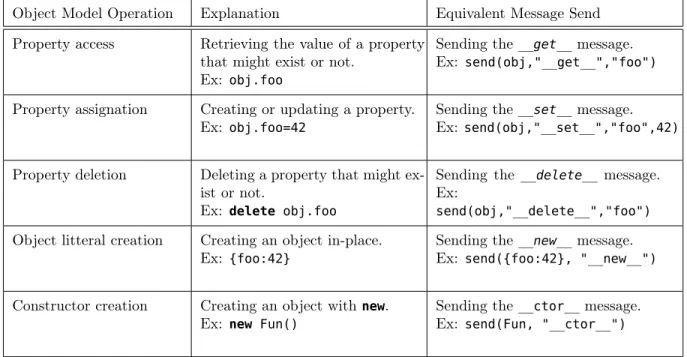
Reifying object operations and function calls is done by translation to corresponding message sends. Table 3.1 summarizes all the different source code occurrences of calls and their equivalent message sends and Table 3.2 explains the translations for object operations.
Table 3.1: Call types and their equivalent message sends
Call Type Explanation Equivalent Message Send
Global Calling a function whose value is in a global variable.
Ex: foo()
Sending a message to the global object.
Ex: send(global,"foo") Local Calling a function in a local
vari-able. Ex: fn()
Sending the call message to the function.
Ex: send(fn,"call")
Method Calling an object method.
Ex: obj.foo() Sending a message to the object.Ex: send(obj,"foo") applyorcall Calling thecallorapplyfunction
method. Ex: fn.call()
Sending the call or apply mes-sage.
Ex: send(fn,"call")
Table 3.2: Object operations and their equivalent message sends Object Model Operation Explanation Equivalent Message Send Property access Retrieving the value of a property
that might exist or not. Ex: obj.foo
Sending the__get__message. Ex: send(obj,"__get__","foo") Property assignation Creating or updating a property.
Ex: obj.foo=42 Sending theEx: send(obj,"__set__","foo",42)__set__message. Property deletion Deleting a property that might
ex-ist or not.
Ex: delete obj.foo
Sending the __delete__ message. Ex:
send(obj,"__delete__","foo") Object litteral creation Creating an object in-place.
Ex: {foo:42} Sending theEx: send({foo:42}, "__new__")__new__message. Constructor creation Creating an object with new.
Ex: new Fun() Sending theEx: send(Fun, "__ctor__")__ctor__message.
3.1.3 Efficient implementation
The reification of low-level operations of JS with message sends introduces a performance penalty com-pared to a native execution. Our design takes advantage of optimizations performed by the host VM to efficiently implement reified operations. The core insight behind our implementation comes from see-ing global function calls of the host VM both as an optimized callsee-ing mechanism and as a dynamically specializable operation. They provide the same ability as code patching in assembly. On the current
version of V8, when the number of arguments expected matches the number of arguments supplied, it opens the possibility of inlining the function at the call site. If the global function changes at a later time, the call site is deoptimized transparently. It is a really powerful mechanism because much of the complexity of run-time specialization is performed by the underlying host. We can simply piggyback on those optimizations.
To motivate the actual optimizing implementation, let’s use the following unoptimizing translation of a call to the methodbaron the objectobjinside a functionfoo:
function foo(obj) {
send(obj, "bar"); // Equivalent to obj.bar(); }
Notice that by specializing the operation to the information available at its call site, a more efficient version can be provided. In this example, the name of the method is constant. If we further suppose that thecallmethod onFunction.prototypehas not been redefined, the implementation of a message-send can be inlined and stripped of the generality required to reify function calls. Using the memoization mechanism the resulting call site will be specialized to the following implementation:
var codeCache0 = function (rcv, x0) { return rcv.get("bar").call(rcv);
};
function foo(obj) {
codeCache0(obj, "bar"); }
In Photon, this specialization is done at run time. Initially, the global variable corresponding to the call site is initialized with a generic function that will be replaced by the specialized version during the first call to the reified operation. The next listing shows the actual implementation in the initial state of the cache:
var initState = function (rcv, dataCache, ..args) { var dataCacheName = "dataCache" + dataCache[0]; var codeCacheName = "codeCache" + dataCache[0]; var msg = dataCache[1];
var callFn = method.get("call"); if (callFn === defaultCall) {
var memMethod = method.get("__memoize__").call(method, rcv, args, dataCache); if (memMethod !== null) {
global[codeCacheName] = memMethod.unbox();
// Track memoization sites for invalidation
tracker.addCacheLink(msg, dataCache[0], dataCache);
return method.call.apply(method, [rcv].concat(args));
}
// Use a specialized version of a message send for a given message name, // also avoiding the call indirection introduced the function calls // reification
global[codeCacheName] = memNamedMethod(msg, args.length);
return method.call.apply(method, [rcv].concat(args));
} else {
return callFn.call.apply(callFn, [method, rcv].concat(args));
} };
var codeCache0 = initState; var dataCache0 = [0, "bar"]; function foo(obj) {
codeCache0(obj, dataCache0); }
Executing the code will eventually replace codeCache0with the expected method, corresponding to the second return statement in theinitStatefunction.
3.1.3.1 Cache states and transitions
The previous section has shown two different states of a message send call site, used to optimize subsequent calls to reified operations. In this section, we fully define the behaviors of the inline caches and the conditions that trigger those behaviors. We use a state machine formalism to present the different behaviors associated with inline caches and the triggers that are responsible for the transitions between those behaviors. In our formalism, due to the nature of synchronous message sends, a state transition occurs before the event has been fully processed. However, the processing of the event is not influenced by it.
To simplify the tracking of invariants, we decided to always perform lookups for regular method calls. By making the lookup operation as close as possible to the native operation of JavaScript, it allows the underlying VM to optimize it. In our design, the idea is to delegate the regular method call to the object representation. The other important operation was to allow specialization of object model operations,
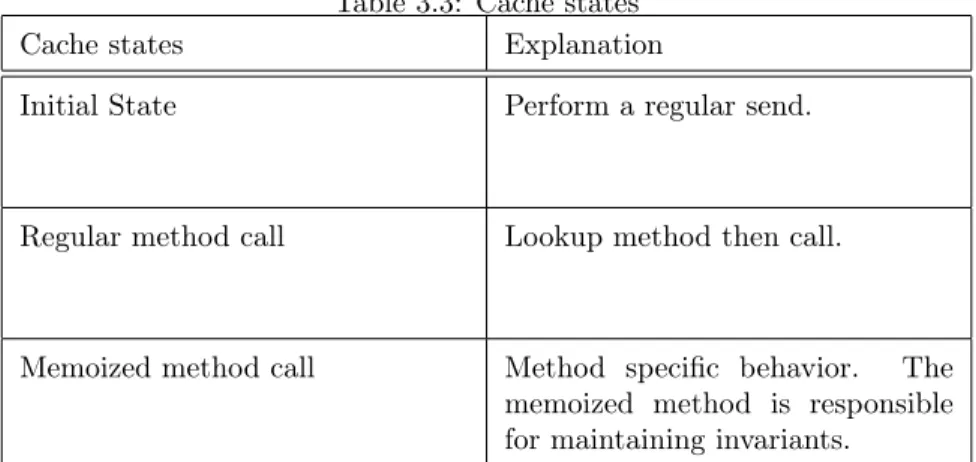
which is critical for speed. This is done by memoizing a specialized version in the inline cache. We therefore ended up with two states in addition to the initial state of the cache, as explained in table 3.3.
Table 3.3: Cache states
Cache states Explanation
Initial State Perform a regular send.
Regular method call Lookup method then call.
Memoized method call Method specific behavior. The memoized method is responsible for maintaining invariants.
Transitions between states happen on message sends and object model operation events. An insight was to realize that we could underapproximate the tracking of invariants and conservatively invalidate more caches than what would minimally be required. As long as the operations triggering the invalidation of caches are infrequent, the performance impact should be minimal. We therefore track method values cached in memoized states by name without consideration for the receiver object. If a method with the same name is updated on any object, all caches with a given message name are invalidated. Also, if the callmethod on theFunction.prototypeobject or any method with the__memoize__name is updated, all caches are invalidated. This way, we can only track caches associated with names. The upper bound on memory usage for tracking information is proportional to the number of cache sites.
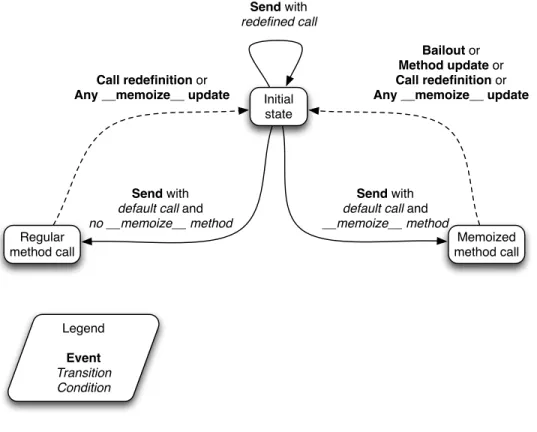
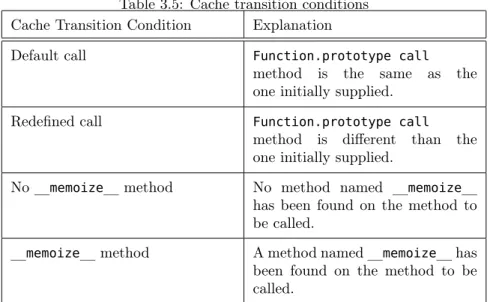
There is no state associated with a redefined callmethod. In that particular case, all caches stay in the initial state and a regular message send is performed. Figure 3.1 summarizes those elements in a state diagram. A more detailed explanation of every event and transition conditions are given in table 3.4 and table 3.5.
Initial state Memoized method call Regular method call Call redefinition or Any __memoize__ update
Send with
default call and no __memoize__ method
Send with
default call and __memoize__ method Send with redefined call Bailout or Method update or Call redefinition or Any __memoize__ update
Legend
Event
Transition Condition
Figure 3.1: Cache states and transitions
Table 3.4: Cache events
Cache Events Explanation
Send A message is sent to a receiver
ob-ject.
Call redefinition The call method on
Function.prototype is rede-fined.
Any memoized redefinition Any__memoize__method is being redefined.
Bailout A run-time invariant has been
vio-lated.
Method update An object’s method is being up-dated.
Table 3.5: Cache transition conditions Cache Transition Condition Explanation
Default call Function.prototype call
method is the same as the one initially supplied.
Redefined call Function.prototype call
method is different than the one initially supplied.
No__memoize__method No method named __memoize__ has been found on the method to be called.
__memoize__method A method named__memoize__has been found on the method to be called.
3.2 Object representation
The object representation in a virtual machine is a core aspect that has a major influence on its flexibility and performance. The following object representation has been designed to encapsulate the invariants of our implementation while enabling piggybacking on the underlying VM inline caches for performance. We believe that our particular usage of the underlying object model dynamism is new and could serve as a basis for other language implementations seeking performance on modern JS VMs.
Two insights led to the current design. First, on a well optimized VM, the most efficient imple-mentation of a given operation in a metacircular impleimple-mentation is frequently the exact same operation performed by the host VM. Second, method calls on JavaScript VMs are usually really fast. Therefore, Photon provides operations as method calls on objects whose internal representation is as close as possible to the host object being implemented.
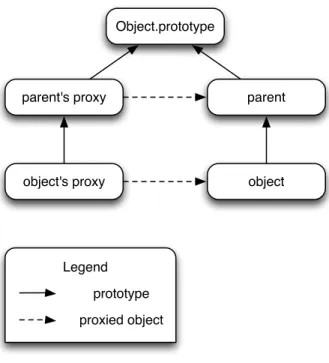
The core idea is to associate a proxy object to every object in the system and have the proxy prototype point to the parent object’s proxy. Photon optimizes the object representation operations at runtime by attaching specialized methods at the appropriate places on the proxy prototype chain.
The object representation is presented for native object types. A refinement is presented for special objects to preserve performance. We then see how the object representation is used to specialize methods for the number of arguments found at their call site.
3.2.1 Representation for objects
The first and simplest object type in JavaScript is the object. It has properties and a prototype. A proxy object has a reference to the native object to intercept every operation that goes to the object.
The prototype chain of proxies mirrors the object prototype chain. A JavaScript implementation, with Object.prototype, as the root of all objects, is illustrated in Figure 3.2.
Object.prototype
parent's proxy parent
object's proxy object
Legend prototype proxied object
Figure 3.2: Representation for objects
An advantage of this representation is that property accesses can be implemented directly as a native property access to the proxied object. It allows the host VM to do lookup caching. It even works for reified root objects, in this example, by considering parent theObject.prototypeof all objects of the metacircular VM.
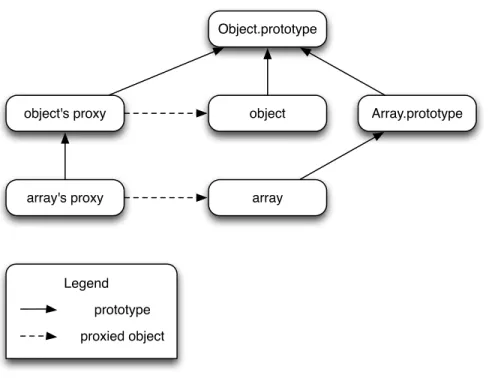
However, it does not work well with native types that can be created literally such as arrays, functions and regular expressions. These would require their prototype to be changed to another object at the creation site, ruining structural invariants assumed by the host VM. For those objects, the original native prototype is maintained and in cases where a lookup needs to be performed, it is done explicitly through the proxy prototype chain. This is illustrated with arrays in Figure 3.3.
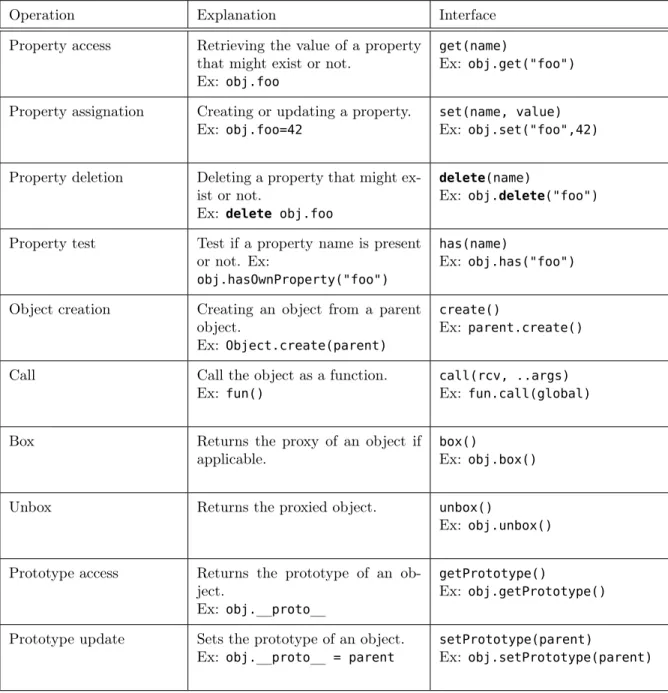
Given this structural representation for all object types, we can now define all object operations as methods on proxy objects as explained in Table 3.6. Remark that given the current JavaScript de facto standard of accessing the prototype object with the__proto__ name, if proper care is not taken in the property access method, the proxied object will be returned instead of the expected proxy object of the parent.2
Object.prototype
object's proxy object
array's proxy array
Legend prototype proxied object
Array.prototype
Figure 3.3: Representation for special objects
Proxies can adapt to dynamic circumstances by adding specialized methods at run time, which can be used for performance gains. The next section shows how Photon exploits this possibility to specialize operations to a fixed number of arguments. To avoid name clashing and ease reading we adopt the convention that specialized methods share the same prefix as basic methods with the type or value information and or number of arguments following in the name.
method call instead of a property. We could still preserve backward compatibility for literal object definitions but once the object is created, the prototype should not be accessible or modifiable through the__proto__property.
Table 3.6: Object representation operations and their interface
Operation Explanation Interface
Property access Retrieving the value of a property that might exist or not.
Ex: obj.foo
get(name)
Ex: obj.get("foo") Property assignation Creating or updating a property.
Ex: obj.foo=42 set(name, value)Ex: obj.set("foo",42) Property deletion Deleting a property that might
ex-ist or not.
Ex: delete obj.foo
delete(name)
Ex: obj.delete("foo")
Property test Test if a property name is present or not. Ex:
obj.hasOwnProperty("foo")
has(name)
Ex: obj.has("foo") Object creation Creating an object from a parent
object.
Ex: Object.create(parent)
create()
Ex: parent.create()
Call Call the object as a function.
Ex: fun() call(rcv, ..args)Ex: fun.call(global)
Box Returns the proxy of an object if
applicable. box()Ex: obj.box()
Unbox Returns the proxied object. unbox()
Ex: obj.unbox() Prototype access Returns the prototype of an
ob-ject.
Ex: obj.__proto__
getPrototype()
Ex: obj.getPrototype() Prototype update Sets the prototype of an object.
3.2.2 Fixed arguments number specialization
The object representation design does not require a special calling convention for functions. However, for maximum performance gains in JavaScript, we would like to avoid using thecalland applynative methods. We can do it by globally rewriting every function to explicitly pass the receiver object. This way, a specialized call operation can simply pass the references to the native function. An example implementation for acalloperation, specialized for one argument in addition to its receiver, is:
var fun = FunctionProxy(function ($this, x) { return x; });
fun.call1 = function ($this, arg0) {
return this.proxiedObject($this, arg0);
};
Specializing one proxy operation requires to specialize all objects for that particular operation to ensure that whatever receiver, function or object is called at a given site, a proper operation is supplied. Fortunately, the object-oriented nature of our chosen representation makes it easy. Only root proxies need to have an additional method and all other proxies then implement the specialized operation.
3.3 Compilation example
To wrap up and see how those different elements work together in practice, let’s finish with a brief compilation example. We use the following example:
(function () { var o = {};
o.foo = function () { return this.bar; };
o.bar = 42;
for (var i = 0; i < 2; ++i) {
o.foo(); }
})();
In this example, an anonymous function is called right after being created to provide a lexical scope, which means that the oand ivariables are local to the function. In this scope, we create an o empty object, which has the root object of the metacircular VM for prototype. Then, this object is extended with a foo method. This method returns thebar property of the receiver object. We then create and initialize thebarproperty of theoobject. Finally, we call thefoomethod two times to give it the chance to specialize the call site, both of thefoocall and thebarproperty access inside the foomethod.
We first see how compiling this example to message sends uses the inline caching idiom. The compiled code has been weaved with the original code in comments to allow the reader to follow easily:
(codeCache0 = initState); (dataCache0 = [0, "__new__",[]]); (codeCache1 = initState); (dataCache1 = [1,"__get__",["this","string"]]); (codeCache2 = initState); (dataCache2 = [2,"__new__",[]]); (codeCache3 = initState); (dataCache3 = [3,"__set__",["get","string","icSend"]]); (codeCache4 = initState); (dataCache4 = [4,"__set__",["get","string","number"]]); (codeCache5 = initState); (dataCache5 = [5,"foo",["get"]]); (codeCache6 = initState); (dataCache6 = [6,"__new__",[]]); (codeCache7 = initState); (dataCache7 = [7,"call",[]]); // (function () { (codeCache7((codeCache6( root.function, dataCache6,
(new FunctionProxy(function ($this,$closure) { var o = undefined;
var i = undefined;
// var o = {};
(o = (codeCache0(root.object, dataCache0, (root.object.create()))));
// o.foo = ...
(codeCache3(o, dataCache3, "foo",
// ... function () { return this.bar; };
(codeCache2(
root.function, dataCache2,
(new FunctionProxy(function ($this,$closure) { return (codeCache1($this, dataCache1, "bar"));
}))))));
// o.bar = 42;
(codeCache4(o, dataCache4, "bar", 42));
// for ... for ((i = 0); (i < 2); (i = (i + 1))) { // o.foo(); (codeCache5(o, dataCache5)); } })) // })(); )), dataCache7, root.global));
In addition to what has been discussed in this chapter, this example exhibits additional implementation details:
• Type information in data caches: During compilation, known types which directly correspond to abstract syntax tree nodes are preserved. It allows the runtime to exploit stable information. For example, indataCache1, the"string"type allows the runtime to know the property access is to a constant string name.
• Root objects are different from the host root objects: root.function,root.objectandroot.global virtualize the object model root objects to avoid interference with the host objects.
• Functions have an extra $closure parameter: This extra parameter is used to pass the proxy to the function to the code or dataCache information for the implementation to send the cache state to the cache function behavior.
Apart from those additional details, the compilation conforms to the explanation given in this chap-ter. The environment is used as such, without reification, objects are proxied or created from object representation methods.
After execution, the inline caches atcodeCache1andcodeCache5are respectively in a memoized state and a regular method call state, which correspond to the following behaviors:
codeCache1 = function ($this,dataCache,name) { return $this.get(name);
}
codeCache5 = function($this,dataCache) { return $this.get("foo").call0($this);
}
In the last case, we can see that the callmethod has been specialized for no arguments, exploiting optimization opportunities offered by our object representation. This example therefore summarizes the unification of object model operations to message sends, their efficient implementation and a novel object representation that can dynamically adapt itself to information available at runtime.
The next chapter shows how we can use the added flexibility for instrumentation and runtime invariant monitoring.