Anionic polymerisation of methyl methacrylate with complex initiator
system
Turgut Nugay1 , Nihan Nugay1 , Robert Jérôme2
1
Department of Chemistry/Polymer Research Center, Bogazici University, 80815, Bebek, Istanbul, Turkey
2
CE.R.M University of Liege, B6 Sart-Tilman 4000 Liège, Belgium
Abstract
Polymerisation of methyl methacrylate was conducted by using alkyl lithium/dimethylsulfoxide (DMSO) system as initiator in toluene. A special attention was focused on using some lithium polyetheralkoxides as
polymerisation promoters at ambient temperatures. Poly(methyl methacrylate) samples were characterized with Gel Permeation Chromatography (GPC), Nuclear Magnetic Resonance Spectroscopy (1H NMR) and Differential Scanning Calorimetry (DSC). The positive effect of the µ/σ type ligands such as lithium
2-(2-methoxyethoxy)ethoxide (LiOEEM), 2-(methoxy)ethoxide (LiOEM) on controlling the living character, molecular weight, stereo regularity and the yield of the produced polymers was demonstrated. It has been found that this approach provided high polymerisation yields and low polydispersity but low initiator efficiency.
Introduction
Maintainning a living system for the anionic polymerisation of (meth)acrylates has been a long –standing problem due to the existance of side reactions with ester carbonyl group of (meth)acrylates [1]. Partial answers have already come from the discoveries of “ group transfer polymerisation” (GTP) by DuPont research team [2], “metal- free anionic polymerisation” by Reetz [3], “ligated anionic polymerisation” by Teyssié [1] , Hatada [4] and Lochmann groups [5].
On the other hand, it has been already shown that dimsylsodium (methylsulfinylmethylsodium) in
dimethylsulfoxide (DMSO) solution initiates the polymerisation of vinyl monomers with electron-attracting substituents and the results were consistent with an anionic initiation [6]. In these studies, some evidence of termination by chain transfer to DMSO was observed. Very similar results were later reported by other authours [7]. Priola et. al. [8] studied the anionic polymerisation of styrene by using DMSO free solutions of
dimsylsodium in hexamethylenephosphoramide and a fast and quantitative polymerisation of styrene was reported. On the other hand, some rough and undetailed data about the anionic polymerisation of methyl methacrylate (MMA) at 25 °C in aprotic solvents (DMSO and N,N-dimethylacetamide) using sodium dispersion as initiator were given by Needles et. al [9].
In this study polymerisation of methacrylate was conducted by using alkyllithium/DMSO system as initiator in toluene. Special attention was focused on using some µ/σ type ligand -lithium polyether alkoxides as
polymerisation promoters at moderate temperatures. Since it has been known that these type of ligands have been proven to be very effective in anionic living polymerisation of (meth)acrylates and synthesis of controlled highly syndiotactic poly(methylmethacrylate) even in toluene at elevated temperatures [10].
Experimental
The purification of chemicals, the preparation of various polydentate alkoxides (Table 1), initiators and anionic polymerisation of MMA have been well described in previous publication [11]. Compositions are given in Table 2.
Table 1. Polyether alkoxides (LiOEnM) used
LiOEM Lithium 2-( methoxy) ethoxide LiOEEM Lithium 2-(2-methoxyethoxy) ethoxide LiOEEEM Lithium 2-(2-methoxyethoxyethoxy) ethoxide
Table 2. Anionic polymerisation conditions of MMA in toluene in the presence of DMSO Code Temp, (°C) LiOEM (molex l04) HOEM (molex l04) Alkyl Li a (molex l04) DMSO (molex l04) 1 0 - 32.0 n-BuLi 35.2 3.2 2 20 - 32.0 n-BuLi 35.2 3.2 3 0 25.0 - αMStLi 5.0 650
a n-BuLi: n- butyl lithium, αMStLi: α methyl styryl lithium
Size Exclusion Chromatography (SEC) analysis was carried out by using Hewlett Packard 1090. Polystyrene standards were used for calibration in THF at 40 °C. Microstructure of samples was determined by 1H-NMR using Bruker AM 400.
Results and Discussion
Anionic polymerisation of MMA in toluene in the presence of DMSO- polyether alcohol (HOEM) and 2 equivalents excess of n-BuLi per mole of alcohol at ambient temperatures were conducted successfully in high yields (Table 3).
Table 3. Data related with anionic polymerisation of MMA in toluene in the presence of DMSO Tacticity
Code Yield (%) Mn (SEC) HI
syndio hetero iso
1 88.0 101300 1.52 74 23 1
2 97.2 84200 1.62 76 25 1
3 100 42400 1.22 74 25 1
It has to be noted here that coloration of the solution in terms of metallation of toluene was not observed during reaction. It has been previously reported that in the absence of DMSO, the same reaction causes the appearance of a red color due to metallation of toluene [12]. On the other hand, when MMA monomer was added to DMSO free solution no polymer was obtained in one-hour reaction period, due to the excess amount of n-BuLi reacting preferentially with the carbonyl group of MMA monomer, so preventing the polymerisation of MMA [13]. As a solution to this problem, it was proposed that whenever a well delocalized and crowded initiator, instead of n-BuLi, is used together with a polyetheralkoxide in the absence of DMSO, it is possible to obtain PMMA in high yields [14]. When α-MstLi was used as alkyl lithium compound a very narrow molecular weight distribution of PMMA sample was observed.
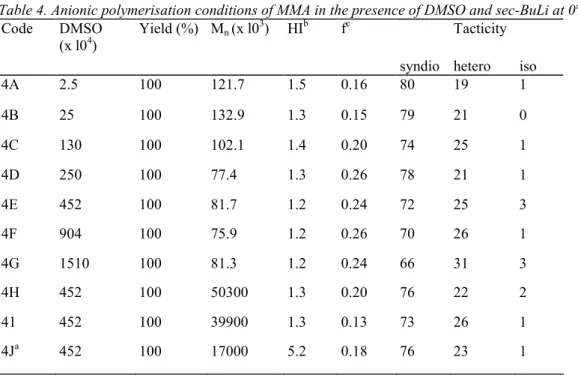
Table 4 shows the effect of the amount of DMSO on polymerization conducted with sec-BuLi.
Table 4. Anionic polymerisation conditions of MMA in the presence of DMSO and sec-BuLi at 0°C Tacticity
Code DMSO (x l04)
Yield (%) Mn (x l03) HIb fc
syndio hetero iso 4A 2.5 100 121.7 1.5 0.16 80 19 1 4B 25 100 132.9 1.3 0.15 79 21 0 4C 130 100 102.1 1.4 0.20 74 25 1 4D 250 100 77.4 1.3 0.26 78 21 1 4E 452 100 81.7 1.2 0.24 72 25 3 4F 904 100 75.9 1.2 0.26 70 26 1 4G 1510 100 81.3 1.2 0.24 66 31 3 4H 452 100 50300 1.3 0.20 76 22 2 41 452 100 39900 1.3 0.13 73 26 1 4Ja 452 100 17000 5.2 0.18 76 23 1
Here, all the samples up to 4 G and 4 J have the same concentration of sec-BuLi, 2.5 x 10⁻⁴ moles, whereas 4 H and 4 I both contain 5.0 x 10⁻⁴ moles and 10.0 x 10⁻⁴ moles in the presence of LiOEEM (25 x 10-4 moles), respectively.
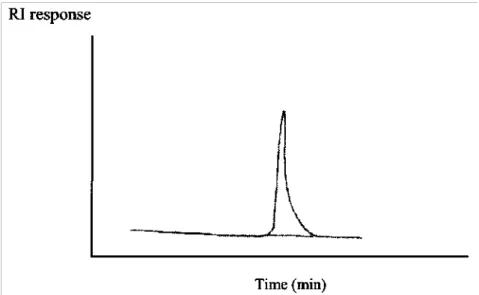
As it is clearly seen from Table 4, molecular weight and heterogeneity index values decrease (Figure 1) with an increasing amount of DMSO in the polymerization solution.
Figure 1. SEC chromatogram of PMMA sample 4 G.
These results are proving that the product of reaction between alkyl lithium (RLi) and DMSO acts as an active species in the polymerisation of MMA as a complex initiator system.
The active participation of DMSO in initiation mechanism as a complex initiator is thus obvious. Heterogeneity index (HI) values, moreover, are lower than those of PMMA samples synthesized almost in the absence of DMSO (ca 2.5) which indicates again the importance of DMSO in initiation of MMA polymerisation at relatively moderate temperature i.e. 0°C.
On the other hand, when the amount of sec-BuLi was increased by keeping the concentrations of DMSO and LiOEEM constant, the influence on the molecular weight has a linear character showing co-contribution of DMSO and sec-BuLi in a complex initiator system. The existence of a decrease in initiation efficiency from 0.24 to 0.13 may be attributed to possible termination reactions via chain transfer to DMSO as reported before [7]. Table 5 shows the effect of various types of polyether alkoxides on polymerization conducted with sec-BuLi in 2.5 x 10⁻⁴ moles.
Table 5. Anionic polymerisation conditions of MMA at 0°C in toluene and in the presence of DMSO and sec-BuLi as initiator
Tacticity Code LiOEnM DMSO
(x l04) Yield (%) Mn (x l0-3) HI f s h i 4A LiOEEM 452 100 81.7 1.2 0.24 80 19 1 5A LiOEM 452 100 58.6 1.4 0.34 79 21 0 6A LiOEEEM 452 100 102.1 1.3 0.25 74 25 1
There seems to be no significant effect of number of ethoxy group of lithium polyether alkoxides on polymerisation of methyl methacrylate .
The whole of these results at the same time indicate that any alkyl lithium- n-BuLi, or sec-BuLi -can give a complexation with DMSO especially in the presence of promoters -lithium polyether alkoxides and acts as active initiator system in the polymerisation of methylmethacrylates.
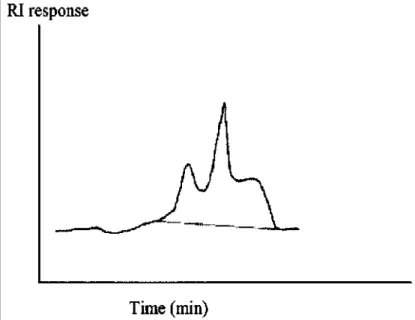
In order to determine the lifetime of the active centers on growing chain, a monomer resumption experiment was conducted for PMMA sample (4 J). Result is given in Figure 2.
Figure 2. SEC chromatogram of PMMA sample 4 J
A multimodal molecular weight distribution shows that the produced active chain end complex with DMSO, and/or LiOEEM is not stable for a long time which then give rise to polymer formation with different molecular weights.
Besides, as in the case of LiOEEM-DMSO-alkyllithium initiator system, high syndiotactic character of PMMA samples does not change deeply up to 10% DMSO.
Conclusions
It can be safely stated that alkyllithium/DMSO/LiOEEM initiator system is an efficient initiator for the anionic polymerisation of MMA in nonpolar solvents at 0°C. Yields are quantitative and molecular weight distributions are relatively narrow. An increase in DMSO content of initiator system causes increase in initiator efficiency, which is not higher than ca 0.34 as a drawback for this initiator system. There is no significant effect of number of ethoxy groups of lithium polyether alkoxide on polymerisation. In all cases, triad compositions are about 78% syndiotactic, 20% heterotactic and 2% isotactic.
Acknowledgements. The authors gratefully acknowledge the financial support given by ATOCHEM.
References
[1] Wang, J.S., Jérôme, R. and Teyssié, Ph. (1995), J.Phys.Org.Chem.; 8, 208
[2] a)Webster, O.W., Hertler, W.R., Sogah, D.Y., Farham, W.B. and Babu, V.R (1983), J.Am.Chem.Soc., 105; 5706 b) Sogah, D.Y., Hertler, W.R., Webster, O.W. and Cohen,G.M, (1987), Macromolecules, 20; 1473 [3] Reetz, M.T., (1988), Angew. Chem., Int. Ed. Eng., 27; 994
[4] Hatada, K., Ute, K., Tanaaka, K., Okamoto, Y. and Kityama, T., (1986), Polym.Bull., 18; 1037 [5] Lochmann,L., Rodova, M. and Trekoval, J., (1974), 12; 2091
[6] Trossarelli, L., Guaita, M. and Priola, A. (1967), J.Polym.Sci. B5; 535 [7] Mulvaney, J.E and Markam,R.L, (1965), J.Polym.Sci., B4; 343 [8] Priola, A., Trossarelli, L., Makromol. Chem. (1970), 139; 281 [9] Needles, H.I, ( 1969), J.Polym.Sci., Part A-1, 7; 1437
[10] Wang, J.S., Jérôme, R., Warin, R. and Teyssié, Ph., (1994), Macromolecules, 27; 4902
[12] Nugay, N., Nugay, T., Jerome, R. and Teyssié, Ph. , (2002), J. Molec.Cat. A: Chem., 179;59 [13] Hatada, K., Kitayana, T., Fumikana, K., Onta, K. and Yuki, H., Anionic Polymerisation: Kinetics, Mechanisms and Synthesis (edited by J.E.McGrath) (1981), ACS Symposium Series, 166; 327; Allen, R.D, Smith, S.D., Long, L.E. and McGrath, J.E, (1985), ACS Polym.Prepr., 26; 247