19
thINTERNATIONAL CONGRESS ON ACOUSTICS
MADRID, 2-7 SEPTEMBER 2007
DIFFUSION-BASED MODELS FOR PREDICTING SOUND FIELDS IN
ROOMS WITH MIXED SPECULAR AND DIFFUSE REFLECTIONS
PACS: 43.55.BrFoy, Cédric1; Billon, Alexis2; Picaut, Judicaël3; Valeau, Vincent4; Sakout, Anas2; Hodgson,
Murray5
1 CEBTP, 102 rte de Limours, 78471 St-Remy-Les-Chevreuse Cedex, France; [email protected] 2 LEPTAB, Pôle Sciences et Technologies, Av. M. Crépeau, 17042 La Rochelle Cedex 1,
France; [email protected]
3 LCPC, Section Acoustique Routière et Urbaine, Route de Bouaye, BP 4129, 44341
Bouguenais Cedex, France; [email protected]
4 LEA UMR CNRS 6609, 22 av. du Recteur Pineau, 86022 Poitiers cedex, France; [email protected]
5 UBC, Acoustics & Noise Research Group, SOEH-MECH, 3rd Floor, 2206 East Mall,
Vancouver, BC V6T 1Z3, Canada; [email protected]
ABSTRACT
A diffusion model, based on the numerical solution of a diffusion equation, was developed in the past to give accurate predictions of the sound-pressure level and of the sound decay at any location in a single enclosure or in coupled rooms. However, this model is limited to rooms with diffusely reflecting walls. In this study, two methods are presented to extend this model to rooms with mixed specular and diffuse reflections, defined by the classical room-acoustics scattering coefficient. The first method models the reverberant field by using a modified diffusion process, with an empirical diffusion constant departing from the theoretical one based on the mean free path. The set of these coefficients, which depend on the scattering coefficient, has been found empirically to fit the results given by a ray-tracing program. The second method is a hybrid approach. The reverberant sound field due to the diffuse reflections is first obtained with the original diffusion model. Then the sound field due to the specular reflections is modelled with an image-source model. The results given by the two approaches are compared to experimental data obtained for several types of rooms (a classroom, an office and some long rooms).
INTRODUCTION
Over the last years, a new model, based on a diffusion process, has been developed to predict the reverberant acoustic field in rooms [1,2]: a well-identified diffusion process, taking into account the room geometry (via the so-called diffusion constant), the surface absorption (via the boundary conditions) and the source power and location, is solved numerically to obtain accurate predictions of the sound-pressure level and of the temporal sound decay at any location in a single enclosure (empty or fitted with scattering objects [3]) or in coupled rooms [4]. The results obtained have been shown to be in good agreement with results given by the radiosity method [1,5], ray-tracing models [2,3,4] and experimental data [3,4]. A main advantage of this numerical method is that it can be applied to spaces with complex shapes (provided that a mean free path can be estimated), such as coupled spaces, and that the calculation times involved are very low. However, this so-called “diffusion model” is intrinsically limited to rooms with diffusely-reflecting boundaries (i.e., the reflection law is described by Lambert’s law [5]), and therefore has been validated only for diffusely-reflecting rooms.
The aim of this study is to show that this model can be adapted to take into account mixed types of reflection – i.e., with a given proportion of diffuse and specular reflections. This issue is indeed of critical importance, as it has been shown that sound fields in “real rooms” are the result of such mixed reflections [6]. Two alternative versions of the diffusion model are proposed. The first, called in the following the “empirical diffusion model”, is based on a
modified diffusion process, in which the diffusion constant has been adjusted empirically to model any given proportion of specular reflections. The second is a “hybrid model”: the reverberant field due to the diffuse reflections is calculated by using the original diffusion model, and the one due to the specular reflections is calculated by using the image-source model [5]. These two models are presented in the next section. Following that, the numerical results are compared with experimental data, in terms of spatial variations of sound pressure level (SPL) and reverberation time (RT). The cases considered are two rooms with homogeneous dimensions, and an elongated room. In the last section, conclusions are drawn about the performance of the proposed models.
DIFFUSION-BASED MODELS
The theoretical diffusion model [1,2]
Let us consider a single empty volume in which perfectly diffuse sound reflections are assumed. The input parameters for the room-acoustic diffusion model are the following:
• V and S, the room volume and the area of its surfaces, respectively, and consequently its mean free path, λ = 4V/S;
• the complete geometry of the room surfaces;
• the local absorption coefficients of the surfaces α. Arbitrary spatial variations of this coefficient are possible;
• an arbitrary number N of omnidirectional sound sources assumed to be points, with output acoustic power Pi(t) and location ri (i = 1...N);
• the frequency-dependent atmospheric attenuation coefficient m (in m-1).
The time- and space-dependent reverberant acoustic energy density, w(r,t), is then governed by the following diffusion equation :
).
(
)
(
)
,
(
)
,
(
)
,
(
1∑
=−
=
+
Δ
−
∂
∂
N i i it
r
r
P
t
r
mcw
t
r
w
D
t
t
r
w
δ
(Eq. 1)In this equation, Δ is the Laplace operator. D is the diffusion coefficient, with D= λc/3 (c is the speed of sound); it takes into account the room geometry, via the mean free path λ, and is theoretically valid only for diffuse reflections. The diffusion equation of Eq. 1 is solved numerically (by using the finite-element method), together with the following boundary conditions:
(
)
ln 1
( , )
( , )
0
4
c
w r t
D
t
α
−
∂
−
∂
w r t
=
(Eq. 2)
This equation models the sound absorption by the room surfaces. The solution w(r,t) of the system of Eqs. (1) and (2) permits the RT and SPL to be predicted at any location in the room [2].
The empirical diffusion model
A modified diffusion model has been derived to permit the modelling of rooms with mixed reflections. In the following, these mixed reflections are characterised by the well-known scattering coefficient s, defining the proportion of energy reflected in a diffuse manner. This coefficient ranges between 0 (for totally specular reflections) and 1 (for totally diffuse reflections). The development of this modified diffusion model follows from numerical observations: the spatial variations of the SPL in a given room, as obtained using a ray-tracing model for several values of the scattering coefficient s, can be modelled by a diffusion equation, provided that the diffusion constant is properly “empirically” adjusted [3] to a value Demp such that:
D
K
D
emp=
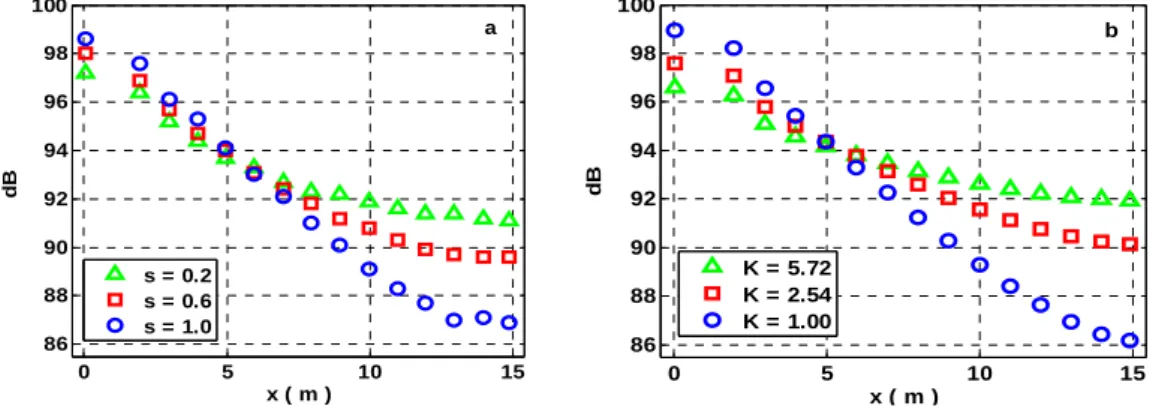
, (Eq. 3)An example of these observations is shown in Figure 1. The sound field is calculated using a ray-tracing model for a long room of length 15m and cross-section (2×3) m2, and for values of s of 0.2, 0.6 and 1.0. Results for the variation of SPL with position are plotted in Figure 1a, along the longer dimension of the room (from x=0 to x=15m; the source with a power level of 100 dB is located at x=1m). Diffusion-model results are shown in Figure 1b: the value of the adjustment constant K (defined in Eq. 3) has been adjusted so that the SPL curves (calculated from the solution of the diffusion equation) match those given by ray-tracing; the corresponding K values are 5.72, 2.54 and 1.00, respectively. The SPL curves given by the two methods behave in a very similar manner [6]: the curves cross each other at about x=5m. Further from the source, the SPL increases if the proportion of specular reflections increases – i.e., if s decreases or, equivalently, Demp=KD increases. These observations show that the SPL in a room with mixed reflections can be modelled by a well-identified diffusion process. The adjustment of the diffusion constant has been carried out for a set of rooms covering a wide range of aspect ratios. It was shown that the adjustment constant K is not a function of the aspect ratio of the room, but only of the scattering coefficient s.
0 5 10 15 86 88 90 92 94 96 98 100 x ( m ) dB a s = 0.2 s = 0.6 s = 1.0 0 5 10 15 86 88 90 92 94 96 98 100 x ( m ) dB b K = 5.72 K = 2.54 K = 1.00
Figure 1.- Variation of SPL with position in a (2×3×15) m3 room, along the longer dimension of the room. The source is located at x=1m. a/ Ray-tracing results for s=0.2, 0.6 and 1.0 (diffuse reflections). b/ Diffusion-model results for K=5.72, 2.54 and 1.00 (theoretical model, valid for
diffuse reflections).
The empirical model developed has also shown good performance in calculating the RTs for rooms with scattering coefficients s higher than 0.4. However, for rooms with a high proportion of specular reflections, the RT values, as calculated by a ray-tracing method, become excessively high, and the empirical diffusion model cannot predict the RT in such situations. The use of the ‘hybrid’ model, presented in the next section, is preferable.
The ‘hybrid’ diffusion-image model
In this hybrid model, the acoustic energy density due to specular and diffuse reflections is obtained by using two different models. The image model, intrinsically based on specular reflections, is used for calculating the reverberant field due to this type of reflections: it leads to a “specular” acoustic energy density, wspec(r,t). The theoretical diffusion model is used for estimating the reverberant field wdiff(r,t) due to diffuse reflections.
Assuming that, at a given receiver location, the relative proportion of “specular” and “diffuse” energy is identical to that reflected by the room surfaces, the total acoustic energy density calculated by the proposed hybrid approach is:
).
,
(
)
,
(
)
1
(
)
,
(
r
t
s
w
r
t
sw
r
t
w
=
−
spec+
diff (Eq. 4)Some examples of results given by the empirical and hybrid models are now presented, and compared to experimental data.
EXPERIMENTAL DATA VERSUS SIMULATED DATA Rooms with homogeneous dimensions
In order to validate both approaches, the empirical model and the “hybrid” model were compared to experimental data. Measurements were carried out by Hodgson [7] in an empty office and in an empty classroom (Figure 2), using a calibrated omnidirectionnal sound source. Room absorption coefficients were estimated from the measured reverberation times, using diffuse-field theory.
a b
Figure 2.- Room geometry. a/ Empty office [3.94:5.36:2.71] with a sound source located at (1.97,0.75,1.36). b/ Empty classroom [7.8:13.7:2.6] with a sound source located at (3.9,2.0,1.3).
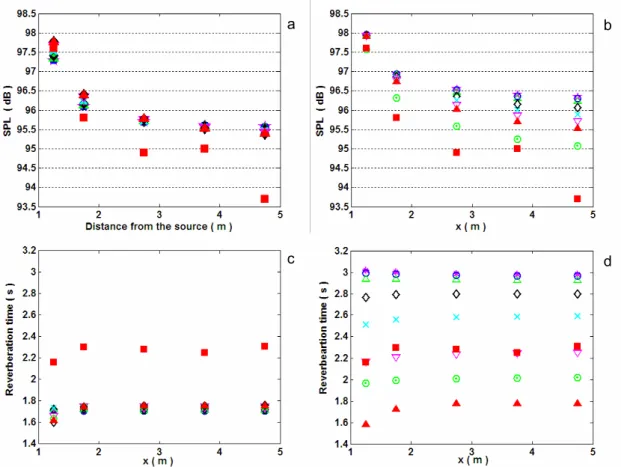
Measurements were carried out along the room length, passing through the sound source. As an example, Figure 4 shows the results for the office for the sound pressure level and the reverberation time at 1000 Hz. For the empirical model, the scattering coefficient s has no significant effect both on the sound pressure level and on the reverberation times. For the ‘hybrid’ model, the sound pressure level is a little bit more dependent on the scattering coefficient s, with deviation around 0.5 to 1.5 dB (increasing with the distance from the sound source) for s between 0 and 1. The agreement with the experimental data is quite good, especially for a scattering coefficient s equal to 0.8, with a mean error about 0.6dB and 0.51 s, for the empirical model and about 0.9 dB and 0.04 s for the ‘hybrid’ model for the 1000 Hz octave band. Better agreement is obtained for the empty classroom where s is found close to 1.
Long rooms
Measurements were also made in two corridors (Figure 3) with an omnidirectional sound source and using the sound measurement and analysis software DSSF3. The absorption coefficients of each element of the long rooms were estimated, for each octave band, using a common absorption-coefficient database. Since the sound source was not calibrated before the measurements, the sound pressure levels were normalised using a reference microphone located 3 m from the sound source.
a b
Figure 3.- Long room’s geometry (width, length, height). a/ Corridor B [1.65:41.45:2.56] with a sound source located at (0.8,9.0,1.2). b/ Corridor C [1.44:20.5:3.03] with a sound source located
a b
c d
Figure 4.-Empirical model (a/ and c/) and ‘hybrid’ model (b/ and d/) compared to experimental data ‘’ in the empty office, at 1000 Hz, for s=0.05 ‘’, s=0.1 ‘|’, s=0.2 ‘U’, s=0.4 ‘’, s=0.6 ‘´’,
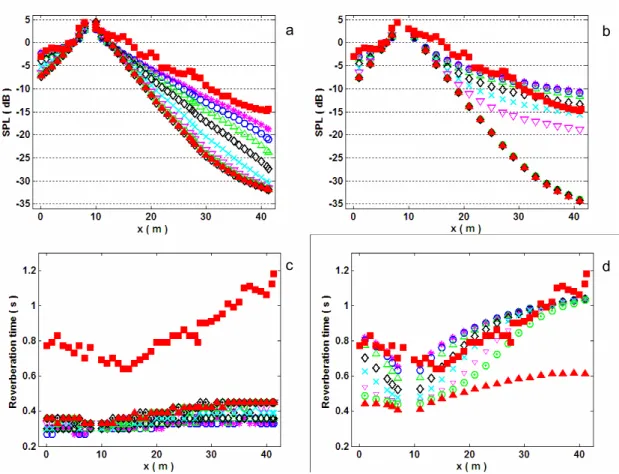
s=0.8 ‘V’, s=0.9 ‘’, s=1.0 ‘S’. a/ and b/: sound pressure level. c/ and d/: reverberation time. Regarding the sound pressure level for corridor B (Figures 5a and 5b), the empirical model gives accurate predictions for very low scattering coefficients while the hybrid model gives acceptable results up to s=0.6. One can remark that the spatial variation of the experimental sound attenuation along the corridor is almost linear, as predicted by the empirical model, while the ‘hybrid’ model gives a curved variation. For the reverberation times, the ‘hybrid’ diffusion model is in good agreement with experimental data for s=0.05 to 0.6. It also shows that the reverberation time increases with the distance source-receiver, as already observed by many authors. In comparison with the empirical model, the ‘hybrid’ model gives lager reverberation times. Moreover, unlike the empirical model, for the ‘hybrid’ model, the reverberation times increase when the scattering coefficient decreases, as already observed by several authors. Similar results are also found for other octave bands and for corridor C.
CONCLUSIONS
In this paper, we have proposed an extension to the diffusion model to take mixed specular and diffuse reflections into account. Two approaches were considered. The first one is based on an empirical correction of the theoretical diffusion constant, estimated in order to fit the results given by a ray-tracing program, as a function of the classical room-acoustics scattering coefficient. The second approach is a ‘hybrid’ model, defined by the coupling of the diffusion model with an image model, and using a coupling factor equal to the scattering coefficient. These two diffusion models have been compared to experimental data, obtained in rooms with homogeneous dimensions, and in long rooms. The results seem to show that the empirical model can be used to evaluate the spatial variation of the sound energy (mainly in rooms with homogeneous dimensions) but fails for the reverberation times whatever the room shapes. Conversely, the ‘hybrid’ model gives consistent results (i.e. for similar values of the scattering coefficient) both for the reverberation times and the sound pressure levels, for the rooms with homogeneous dimensions, as well for the long rooms.
a b
c d
Figure 5.-Empirical diffusion (a/ and c/) and ‘hybrid’ model (b/ and d/) compared to experimental data ‘’ in corridor B, at 2000 Hz, for s=0.05 ‘’, s=0.1 ‘|’, s=0.2 ‘U’, s=0.4 ‘’,
s=0.6 ‘´’, s=0.8 ‘V’, s=0.9 ‘’, s=1.0 ‘S’. a/ and b/: sound pressure level. c/ and d/ reverberation time.
References:
[1] J. Picaut, L. Simon, and J.-D. Polack: A mathematical model of diffuse sound field based on a diffusion equation, Acta Acustica united with Acustica 83, (1997) 614–621
[2] V. Valeau, J. Picaut, and M. Hodgson: On the use of a diffusion equation for room acoustic predictions, J. Acoust. Soc. Am. 119, (2006) 1504–1513
[3] V. Valeau, M. Hodgson, J. Picaut: A diffusion-based analogy for the prediction of sound in fitted rooms, Acta Acustica united with Acustica 93, (2007) 94-105
[4] A. Billon, V. Valeau, A. Sakout, J. Picaut: On the use of a diffusion model for acoustically coupled rooms, J. Acoust. Soc. Am. 120, (2006) 2043-2054
[5] H. Kuttruff: Room Acoustics, 4th edition, Spon press, London (1999)
[6] M. Hodgson: Evidence of diffuse surface reflections in rooms, J. Acoust. Soc. Am. 89, (1991) 765–771
[7] M. Hodgson and E.-M. Nosal: Experimental evaluation of radiosity for room sound-field prediction, J. Acoust. Soc. Am. 120(2), (2006) 808-819
![Figure 2.- Room geometry. a/ Empty office [3.94:5.36:2.71] with a sound source located at (1.97,0.75,1.36)](https://thumb-eu.123doks.com/thumbv2/123doknet/6710576.184546/4.892.187.717.270.475/figure-room-geometry-office-sound-source-located.webp)