HAL Id: hal-00008127
https://hal.archives-ouvertes.fr/hal-00008127
Submitted on 23 Aug 2005
HAL is a multi-disciplinary open access
archive for the deposit and dissemination of
sci-entific research documents, whether they are
pub-lished or not. The documents may come from
teaching and research institutions in France or
abroad, or from public or private research centers.
L’archive ouverte pluridisciplinaire HAL, est
destinée au dépôt et à la diffusion de documents
scientifiques de niveau recherche, publiés ou non,
émanant des établissements d’enseignement et de
recherche français ou étrangers, des laboratoires
publics ou privés.
Chaotic advection and targeted mixing
Tounsia Benzekri, Cristel Chandre, Xavier Leoncini, Ricardo Lima, Michel
Vittot
To cite this version:
Tounsia Benzekri, Cristel Chandre, Xavier Leoncini, Ricardo Lima, Michel Vittot. Chaotic
advec-tion and targeted mixing. Physical Review Letters, American Physical Society, 2006, 96, pp.124503.
�10.1103/PhysRevLett.96.124503�. �hal-00008127�
ccsd-00008127, version 1 - 23 Aug 2005
T. Benzekri∗,1 C. Chandre,1 X. Leoncini,2 R. Lima,1 and M. Vittot1
1
Centre de Physique Th´eorique†, CNRS Luminy, Case 907, F-13288 Marseille cedex 9, France 2
PIIM, Universit´e de Provence, Case 321, Centre de Saint J´erˆome, F-13397 Marseille cedex 20, France (Dated: 23rd August 2005)
The advection of passive tracers in an oscillating vortex chain is investigated. It is shown that by adding a suitable perturbation to the ideal flow, the induced chaotic advection exhibits two remarkable properties compared with a generic perturbation : Particles remain trapped within a specific domain bounded by two oscillating barriers (suppression of chaotic transport along the channel), and the stochastic sea seems to cover the whole domain (enhancement of mixing within the rolls).
PACS numbers: 05.45.Ac, 05.60.Cd, 47.27.Te
In order to enhance mixing in flows one often relies on chaotic advection [1]. This phenomenon translates the fact that despite the laminar character of a given flow, trajectories of fluid particles or advected passive tracers are chaotic. As a consequence, mixing is considerably enhanced in regions where chaos is at play, as it does not need to rely on molecular diffusion. Such phenom-ena are observed in a wide range of physical systems [2] and have fundamental applications, for instance, in geo-physical flows [3, 4] or chemical engineering. When con-sidering two dimensional incompressible flows, chaotic advection occurs when the flow is unsteady, see for in-stance Refs. [5, 6, 7, 8]. One peculiarity of these flows is that the dynamics of passive particles can be tack-led from the Hamiltonian dynamics point of view. The canonical variables are directly the space variables, hence the phase space is formally the two dimensional physical space. This feature allows a direct visualization of the phase space in experiments, and in a certain sense makes this framework an ideal one in order to confront theoret-ical results on Hamiltonian dynamics with experiments.
In this Letter, we address the problem of targeted mixing. Namely it is often desirable to reduce chaotic transport (see Ref. [9]) while one also often wants more chaos in order to enhance mixing (see, for instance, Refs. [10, 11] for microfluidic and microchannel devices). In order to achieve such properties, we consider the dy-namics of passive tracers in an array of alternating vor-tices. This flow has been realized experimentally using Rayleigh-B´enard convection or in a more controlled way by using electromagnetic forces [5, 6, 7]. The primary interest in this flow resides in the fact that being gener-ated by quite a few hydrodynamic instabilities, it may be considered as one of the founding bricks of
turbu-∗Permanent address: Universit´e des Sciences et de Technologie
H.B., B.P. 32, El Alia, Bab Ezzouar, Alger, Algeria
†Unit´e Mixte de Recherche (UMR 6207) du CNRS, et des
uni-versit´es Aix-Marseille I, Aix-Marseille II et du Sud Toulon-Var. Laboratoire affili´e `a la FRUMAM (FR 2291).
lence. As such, understanding its influence on the advec-tion of passive or active quantities is considered a nec-essary first step in order to uncover the different mecha-nisms governing for instance front propagation in turbu-lent flows [12, 13].
We consider the following integrable stream function which models the experiment with slip boundary condi-tions :
Ψ0(x, y) = α sin x sin y, (1)
where the x-direction is the horizontal one along the channel and the y-direction is the bounded vertical one. The constant α is the maximal value of vertical velocity. Passive particles follow the streamlines of Ψ0depicted on
Fig. 1(a). The dynamics given by Eq. (1) is integrable. Therefore no mixing occurs. The fluid is limited by two invariant surfaces y = π and y = 0 corresponding to the top and bottom roll boundaries. The flow has hyperbolic fixed points on these two invariant surfaces which are lo-calized at x = mπ for m ∈ Z. These points are joined by vertical heteroclinic connections for which the stable and unstable manifolds coincide. The phase space, which is here the real space, is then characterized by a chain of rolls with separatrices localized at x = mπ for m ∈ Z.
In the experiments [5, 6, 7], a typical perturbation f (x, y, t) is introduced as a time dependent forcing in or-der to trigger chaotic advection and then to study the re-sulting transport and mixing properties. More precisely the perturbation modifies the stream function as :
Ψc(x, y, t) = Ψ0(x + f (x, y, t), y). (2)
For instance, the following stream function has been pro-posed to model an experimental situation [5] :
Ψ1(x, y, t) = α sin(x + ǫ sin ω0t) sin y, (3)
i.e. the perturbation is f = ǫ sin ω0t and describes the
lateral oscillations of the roll patterns where ǫ and ω0are
respectively the amplitude and the angular frequency of the lateral oscillations. Without loss of generality, we
2 0 1 2 3 4 5 6 0 0.5 1 1.5 2 2.5 3 x y (a)
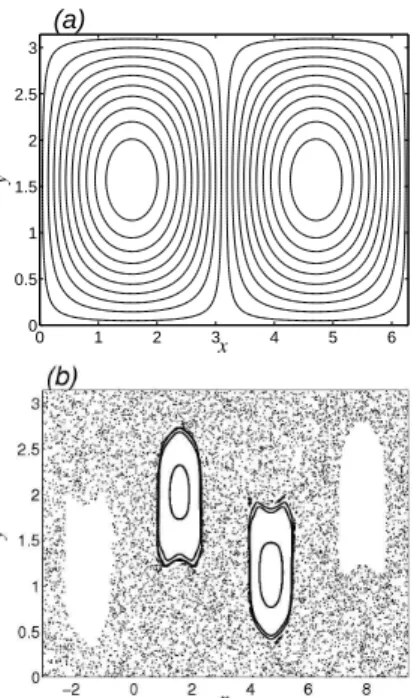
Figure 1: Poincar´e sections (a) for the stream function (1) which are also the streamlines and (b) for the stream func-tion (3). The parameters are α = 0.6 and ǫ = 0.63.
assume that ω0 = 1. The resulting streamlines which
are again closed curves correspond to lateral oscillations in the x-direction of the streamlines depicted in Fig. 1(a) with a periodic displacement of −ǫ sin t. However chaotic advection is triggered.
In order to infer transport and mixing properties we use Poincar´e sections of some trajectories of tracers. A typical Poincar´e section associated with the stream func-tion Ψ1 given by Eq. (3) is represented in Fig. 1(b) for
ǫ = 0.63 and α = 0.6. It shows that the transport along the channel is greatly enhanced [5] compared with no transport in Fig. 1(a). The advected tracers have now a non integrable Hamiltonian dynamics. The reason be-ing that, under the perturbation, the vertical heteroclinic connections between the vortices break down and the stable and unstable manifolds intersect transversely thus generating chaotic advection of passive tracers along the channel [14]. Therefore the mixing properties of the flow are enhanced. However, most of the time islands of sta-bility remain, among which the ones located around the centers of the vortices. They are characterized by regular (quasiperiodic) trajectories and a chaotic region around and between the rolls. Mixing within the center of the rolls can only rely on molecular diffusion while tracers in the chaotic sea are advected unboundedly along the chan-nel and chaotic mixing occurs. The main observation is that the regular patterns persist and chaos or mixing are not well developed.
In order to obtain what we called targeted mixing, we propose to adjust the time-dependent forcing f which we assume to depend on y and t such that the stream
func-tion Ψc given by Eq. (2) has the following properties :
First its attendant chaotic transport along the channel (x-direction) is confined by impenetrable barriers. Sec-ond, when restricted to each of these independent cells, we want to obtain good mixing properties.
A first possibility to create barriers given by invari-ant tori of the dynamics would be to use the method proposed in Refs. [9, 15] for controlling Hamiltonian sys-tems. This method uses an affine control (modifying the Hamiltonian or the stream function additively). However applying this method to the system under consideration would create some barriers but would also regularize the inside of the cell, thus drastically reducing the mixing.
In order to proceed in finding a more suitable per-turbation f (y, t), we start from a more generic situation for which the stream function given by Eq. (1) is a par-ticular case. We consider a generic integrable stream function Ψ0(x, y) which is L-periodic in x, and such that
∂xΨ0(x, 0) = ∂xΨ0(x, H) = 0 for all x ∈ R where H
is the height of the channel. The perturbed stream function is written as in Eq. (2) where f (y, t) is such that (i) there are barriers at x = xk(y, t) (for k ∈ Z)
which prevent the chaotic advection along the x-direction and (ii) there is a high mixing inside a region bounded by two consecutive barriers, e.g., x1 and x2. We
no-tice that the perturbed stream function is obtained by adding the perturbation to the canonical variables of the stream function and not to the stream function itself as in Refs. [9, 15]. The equations of the barriers are written as x = xk(y, t) = kL + ϕ(y, t) for k ∈ Z where ϕ is a
function to be determined. Using Hamilton’s equations ˙x = −∂Ψc ∂y = − ∂Ψ0 ∂y (x + f, y) − ∂f ∂y ∂Ψ0 ∂x (x + f, y) , ˙y = ∂Ψ0 ∂x (x + f, y) ,
and by imposing that xk locates a barrier we get for the
particles on the barrier ˙x =∂ϕ
∂t + ˙y ∂ϕ ∂y .
Thus a possible solution is obtained when f + ϕ is only a function of time, denoted Φ(t), and the condition on ϕ is
∂ϕ ∂t = −
∂Ψ0
∂y (Φ(t), y). The above equation is solved as
ϕ(y, t) = −Γ∂yΨ0(Φ(t), y),
where the linear operator Γ is a pseudo-inverse of ∂t, i.e.
acting on v(y, t) =Pkvkeikt as
Γv =X k6=0 vk ike ikt .
0 2 4 6 0 0.5 1 1.5 2 2.5 3 x y (a) 0 2 4 6 0 0.5 1 1.5 2 2.5 3 x y (b)
Figure 2: Streamlines of the stream function (5) at (a) t = 0 and (b) t = 3π/4. The parameters are α = 0.6 and ǫ = 0.63.
The perturbation f is then
f (y, t) = Φ(t) + Γ∂yΨ0(Φ(t), y), (4)
where Φ is any function of time.
We now apply these results to the array of vortices given by the stream function (1). In order to remain as close as possible to the experimental setup, we consider Φ(t) = ǫ sin t. The modified stream function given by Eq. (4) is then
Ψc(x, y, t) = α sin[x + ǫ sin t + α cos yCǫ(t)] sin y, (5)
where Cǫ(t) = X n≥0 −2 2n + 1J2n+1(ǫ) cos(2n + 1)t, (6) and Jl(for l ∈ N) are Bessel functions of the first kind.
We notice that y = 0 and y = π are still boundaries for the streamfunction (5) which comes from the fact that the modification is only on the x-term of the original stream function. The streamlines are then slightly mod-ified (non-uniformly in y) as it can be seen on Fig. 2(a) and (b) which depict the streamlines of the stream func-tion (5) for ǫ = 0.63 and α = 0.6 at two different times t = 0 and t = 3π/4 respectively. Moreover, the displace-ment of these rolls remains parallel to the x-axis as it is for the stream function Ψ1 given by Eq. (3). The fact
that the streamlines of the stream function (3) and the ones of Eq. (5) look similar comes from the fact that the stream function Ψc is a small modification of Ψ1 (for α
small) since we have |Ψc(x, y, t) − Ψ1(x, y, t)| ≤ α2ǫ/2.
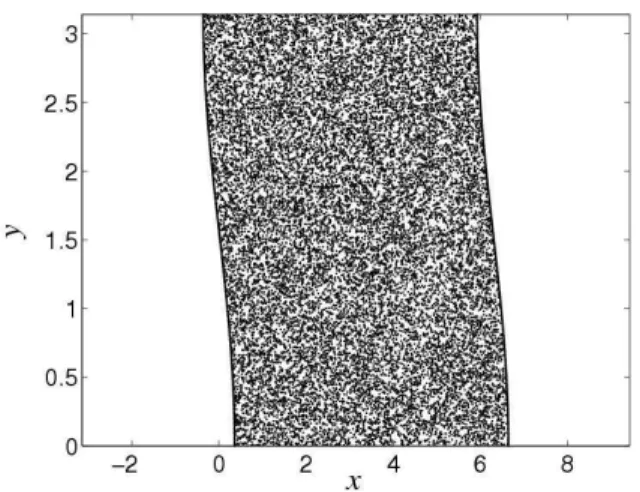
Figure 3: Poincar´e section for the stream function (5). The parameters are α = 0.6 and ǫ = 0.63.
Nevertheless, the dynamics of tracers is completely dif-ferent in both cases and targeted mixing is achieved. For the same values of ǫ and α as in Fig. 1(b), a Poincar´e section of the dynamics of passive tracers in a flow de-scribed by the stream function Ψc given by Eq. (5) is
represented in Fig. 3. We notice that there are invari-ant surfaces which have been created around x = 0 (mod 2π) (bold curves) and that mixing within these barriers is considerably enhanced. The equations of these transport barriers along the x-direction are :
x = xk(y, t) = 2kπ − α cos yCǫ(t). (7)
To be more specific, the barriers (7) are degenerate in-variant tori since each of them is a heteroclinic connexion between two hyperbolic periodic orbits (with period 2π), e.g., one locate at y = 0 and x(t) = −αCǫ(t) and the
other one at y = π and x(t) = αCǫ(t), moving in
oppo-site directions along the channel. Regarding the enhance-ment of mixing inside the cell bounded by the two barri-ers observed in Fig. 3, we notice that most of the regular trajectories observed for the stream function Ψ1are
bro-ken by the perturbation (in comparison with Fig. 1(b)). It means that, the perturbation given by Eq. (4) cre-ates two invariant surfaces around x = 0 and x = 2π, and destabilizes the inside of the cell and in particular the remainders of the regular motion near x = π/2 and x = 3π/2.
In order to get some clues on the origin of mixing enhancement, we consider the region in the middle of the cell of length L in the x-direction and compute the Melnikov function which measures the distance between the stable and unstable manifolds. First, we perform the (time-dependent) canonical transformation (x, y) 7→ (x′, y′) generated by F
2(y, x′, t) = yx′− ΓΨ0(Φ(t), y). In
the case of Ψ0 given by Eq. (1), the stream function
be-comes ˜
4
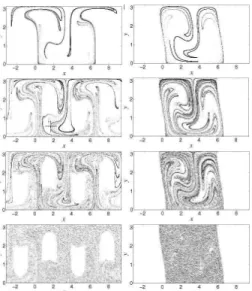
Figure 4: Numerical simulation of the dynamics of a dye at t = 30, t = 50, t = 70 and t = 140 (from top to bottom) : left column for the stream function (3) and right column for the stream function (5). The parameters are α = 0.6 and ǫ = 0.63.
The Melnikov function is defined as [8] M (t0) =
Z +∞
−∞
{Ψ0, ˜Ψc}(x0(t − t0), y0(t − t0)) dt,
where (x0(t), y0(t)) is a solution of the unperturbed
sys-tem Ψ0. The Poisson bracket between Ψ0and ˜Ψcis given
by
{Ψ0, ˜Ψc} = α2(1 − cos x) sin(Φ(t)) sin y cos y.
It is straightforward to see that the Melnikov function vanishes when x = 0 mod 2π, i.e. on the boundaries of the cell, and is maximum (in absolute value) when x = π mod 2π, i.e. in the middle of the cell. Therefore it is expected that the mixing is enhanced since then, there is a maximum flux inside the cell [10].
In order to test the robustness of the method and to try an experimentally more tractable perturbation, we truncate the series given by Eq. (6). The simplest possi-ble perturbation is obtained by considering only the first term of the series Cǫ(t) in Eq. (6) which leads to the
following stream function
Ψs(x, y, t) = α sin (x + ǫ sin t − 2αJ1(ǫ) cos y cos t) sin y,
(8) which has a much simpler time-dependence. We per-formed a Poincar´e section for this simplified stream func-tion Ψs given by Eq. (8) for α = 0.6 and ǫ = 0.63.
This Poincar´e section looks identical to the one depicted on 3 showing that the simplified perturbation remains efficient.
In Fig. 4, we depict a numerical simulation of the dy-namics of a dye in the fluid. The left column shows the evolution of the tracers for the stream function Ψ1given
by Eq. (3). The right column shows the mixing of a dye within a cell which is limited by two barriers created by the stream function Ψcgiven by Eq. (5). We see that the
mixing occurs through a combination of stretching and folding of the dye. The corresponding figure for Ψsgiven
by Eq. (8) shows some advected particles outside the cell but the same picture inside.
In conclusion, we considered a situation of time-dependent oscillating vortex chain. We have shown by adding a suitable perturbation (forcing) it is possible to suppress the chaotic advection along the channel by cre-ating dynamical barriers among the vortex chain, and at the same time, to enhance the mixing of passive tracers inside each of these isolated cells. The effect is obtained in spite of the oscillations of the rolls and is not too much affected by the use of a simplified version of the exact stream function.
This work is supported by Euratom/CEA (contract EUR 344-88-1 FUA F). We acknowledge useful discus-sions with M. Pettini, Y. Elskens, S. Boatto, A. Goullet and the Nonlinear Dynamics group at CPT.
[1] H. Aref, J. Fluid Mech. 143, 1 (1984).
[2] J.M. Ottino, The Kinematics of Mixing: Stretching, Chaos and Transport(Cambridge University Press, Cam-bridge, 1989).
[3] R.P. Behringer, S. Meyers, H. Swinney, Phys. Fluids A 3, 1243 (1991).
[4] M.G. Brown, K.B. Smith, Phys. Fluids A 3, 1186 (1991). [5] T.H. Solomon, J.P. Gollub, Phys. Rev. A 38, 6280
(1988).
[6] T.H. Solomon, N.S. Miller, C.J.L. Spohn, J.P. Moeur, AIP Conf. Proc. 676, 195 (2003).
[7] H. Willaime, O. Cardoso, P. Tabeling, Phys. Rev. E 48, 288 (1993).
[8] R. Camassa, S. Wiggins, Phys. Rev. A 43, 774 (1991). [9] C. Chandre, G. Ciraolo, F. Doveil, R. Lima, A. Macor,
M. Vittot, Phys. Rev. Lett. 94, 074101 (2005). [10] S. Balasuriya, Physica D 202, 155 (2005).
[11] A.D. Stroock, S.K.W. Dertinger, A. Ajdari, I. Mezic, H.A. Stone, G.M. Whitesides, Science 295, 647 (2002). [12] M. Abel, A. Celani, D. Vergni, A. Vulpiani, Phys. Rev.
E 64, 046307 (2001).
[13] A. Pocheau, F. Harambat, Experimental study of chemi-cal front propagation in a cellular flowpreprint (2005); A. Pocheau, F. Harambat, in Proceedings of the 21st Inter-national Congress of Theoretical and Applied Mechanics (2004).
[14] S. Wiggins, Chaotic Transport in Dynamical Systems (Springer-Verlag, Berlin, 1992).
[15] M. Vittot, C. Chandre, G. Ciraolo, R. Lima, Nonlinearity 18, 423 (2003).