Publisher’s version / Version de l'éditeur:
Proceedings of the International Communication Association, 2009, 2009-05-25
READ THESE TERMS AND CONDITIONS CAREFULLY BEFORE USING THIS WEBSITE.
https://nrc-publications.canada.ca/eng/copyright
Vous avez des questions? Nous pouvons vous aider. Pour communiquer directement avec un auteur, consultez la
première page de la revue dans laquelle son article a été publié afin de trouver ses coordonnées. Si vous n’arrivez pas à les repérer, communiquez avec nous à [email protected].
Questions? Contact the NRC Publications Archive team at
[email protected]. If you wish to email the authors directly, please see the first page of the publication for their contact information.
NRC Publications Archive
Archives des publications du CNRC
This publication could be one of several versions: author’s original, accepted manuscript or the publisher’s version. / La version de cette publication peut être l’une des suivantes : la version prépublication de l’auteur, la version acceptée du manuscrit ou la version de l’éditeur.
Access and use of this website and the material on it are subject to the Terms and Conditions set forth at Perspective Taking and Attitude Change Among Adolescent Participants Using Video technologies: A Case Study
Simms, Deanne C.; Fournier, Hélène; Molyneaux, Heather; O'Donnell, Susan
https://publications-cnrc.canada.ca/fra/droits
L’accès à ce site Web et l’utilisation de son contenu sont assujettis aux conditions présentées dans le site LISEZ CES CONDITIONS ATTENTIVEMENT AVANT D’UTILISER CE SITE WEB.
NRC Publications Record / Notice d'Archives des publications de CNRC:
https://nrc-publications.canada.ca/eng/view/object/?id=cb1d4392-171d-44cc-8eec-912f2ed048b4 https://publications-cnrc.canada.ca/fra/voir/objet/?id=cb1d4392-171d-44cc-8eec-912f2ed048b4
Proceedings of the International Communication Association Chicago, USA, May 21-25, 2009
Perspective Taking and Attitude Change Among Adolescent Participants
Using Video Technologies: A Case Study
Deanne C. Simms, Helene Fournier, Heather Molyneaux, Susan O’Donnell
National Research Council of Canada
Abstract
Diet and body image are particularly salient for adolescents as this developmental stage is characterized by great physical growth and change (Barlow, 1990). Messages from peers are of fundamental importance to adolescents’ attitudes and perspectives of their own diet and body image (Gravener, 2008; Phares, Steinberg & Thomposon, 2004; Vincent & McCabe, 2000). Furthermore, in North America, the increasing adoption of online technologies by adolescents for social interaction purposes (i.e., videos to interact with friends) (Madden, 2007; Zamaria & Fletcher, 2008) suggests this medium is of particular importance to adolescent’s communication of important issues such as diet and body image. Thus, we evaluated learning, perspective taking and attitude change that took place during a Virtual Classroom session wherein 520 adolescents from high schools across Canada discussed issues related to diet and body image via video technologies. Our investigation revealed that the students were able to learn and understand each other’s perspectives regarding diet and body image — particularly those who reported more frequent use of video technologies — and that knowing their peer’s viewpoints led to shifts in their own perspectives and attitudes. These findings suggest that the communication of opinions and attitudes which takes place between peers during in-person interaction can also occur during discussions over video technologies. We discuss these findings and propose that social presence is the mechanism through which these video mediated messages are successfully communicated and received.
Keywords: Youth, learning, perspective taking, attitudes, diet, body image, video technologies
Introduction
This study examines adolescents’ communication and reception of each other’s attitudes and perspectives regarding diet and body image via synchronous and
asynchronous video. Through analyses of a Virtual Classroom session wherein adolescent high school students across Canada discussed issues related to diet and body image via videoconference and short, peer-generated videos, we were able to evaluate communicative processes such as learning, perspective taking and attitude change that took place via these technologies.
Diet and body image are of fundamental importance to adolescents as this life stage involves great physical growth and change (Barlow, 1990). Research suggests that
messages from peers have more influence upon adolescents’ thoughts and attitudes of diet and body image than are those from the media or family members (Gravener, 2008; Vincent, 2000). While proximal peers (e.g., close friends) exert their influence via peer pressure, distal peers (e.g., acquaintances) exert their influence via a normative climate of values (Bearman, 2002; Bearman & Bruckner, 1999). We proposed that the observed ability of peers to influence each other’s tendency to learn, understand and shape each other’s attitudes and perspectives of diet and body image in-person would also occur during communication with peers across the country via video technology as a result of the ability of this medium to provide social presence - or feelings of connectedness - that most other communication technologies are not capable of.
Much concern exists over the ways in which adolescents (especially females) view themselves and their bodies in part because body image is predictive of esteem, self-efficacy and future disordered body image or eating (Stice, Schupak-Neuberg, Shaw & Stein, 1994; Williamson, Steward, White & York-Crowe, 2002) Although much research has focused on females as they have been shown to be under great societal pressure to achieve the “thin ideal”, Phares and colleagues (2004) found a similar pattern of influence of peers upon adolescent boy’s and girl’s body dissatisfaction. Thus it is important to evaluate the processes through which both male and female adolescents learn and
communicate with each other about this issue. Although many studies have considered the impact of peer messages during in-person communications, few have examined youth’s
communication and reception of these messages via video technologies. This is an
oversight as adolescents in North America consider the use of technology fundamental for social interaction with friends and family members (e.g., the internet, online video)
(Zamaria & Fletcher, 2008). Technology use for communication is almost universal for adolescents in the United States and Canada (Zamaria & Fletcher, 2008) and Madden (2007) found that young adults are the most active age group in contributing in
participatory features of online video (e.g., posting text comments). Moreover, our own earlier research on user-generated YouTube videos found that online video can contribute to learning outcomes (Milliken, Gibson, O’Donnell, & Singer, 2008; O’Donnell, Gibson, K., Milliken, & Singer, 2008). Thus it is important to examine the role that video
technologies play within communications between peers about diet and body image. Accurate interpretation of youth’s engagement and participation in discussions of diet and body image via videos will help to elucidate their experiences communicating via a medium they are comfortable and engaged with in other aspects of their lives.
Our report is based on data from a Virtual Classroom Diet and Body Image session that was held November, 2007. The session provided synchronous and asynchronous audio-visual technologies to facilitate communication among a large group of adolescents in multiple high schools across Canada. The event provided us with the opportunity to research the social benefits and challenges of using these technologies to communicate with peer groups. In particular, we were interested to know if students were able to learn and understand the perspectives of their peers via video communication (i.e., short, peer-generated videos and videoconference) and how they found this experience. Our
investigation revealed that students were able to learn and understand each other’s perspectives regarding diet and body image and, furthermore, that they found the use of this communication medium enjoyable. These findings suggest that the communication of opinions and attitudes which takes place between peers during in-person interaction can also occur during discussions using video technologies. We discuss these findings and propose that social presence is the mechanism through which these video mediated messages are successfully communicated and received.
Literature Review
Diet and Body Image
Diet and body image are predominant issues in the lives of adolescents. Body image may be defined as a mental representation of the body which consists of thoughts, feelings and perceptions about body size and shape (Slade, 1994). Body Image Disturbance (BID) occurs when those thoughts, feelings and emotions are distorted (e.g., overestimating one’s size, feeling overweight, feeling depressed and focused on dieting and weight loss), and may lead to unhealthy or disordered eating such as restrictive eating, bingeing or purging and other compensatory behaviors (Nathanson, 2001). Research shows that the majority of adolescent girls and many boys have developed weight and body concerns and many have tried dieting or other weight-loss strategies (Smolak & Levine, 2001; Thompson, Heinberg, Altabe & Tantleff-Dunn, 1999). Thomposon and Smolak (2001) estimate between 30-50% of adolescent girls are either concerned about their weight or are actually dieting. These concerns have been found to predict eating disturbances (Cattarin & Thompson, 1994; Stice, 2001) and no doubt contribute to the current estimates of prevalence rates of Anorexia and Bulimia in North America which are 0.5-3.7% and 1.1- 4.2% respectively (Calderon,Vander Stoep, Collett, Garrison, & Toth, 2007). North American adolescents exist in a culture that emphasizes and idolizes a slender frame or the ‘thin ideal’ which is communicated to them via sociocultural factors such as the media.
The mass media is rife with images of ideal body sizes and proportions. These ubiquitous messages contribute to youth’s evolving sense of self, community and world view (Goodman, 2003). However, despite the profound influence of the media in shaping adolescents body image, research suggests that peers play a paramount role in adolescents’ self-concept (Phares et al., 2004; Vincent et al., 2000). The Sullivan-Piaget social learning theory posits that peer relationships stem from adolescents reciprocating the behaviors of each other. This requires youth to reflect on each other’s ideas while constructing a shared representation of their world (Nathanson, 2001). Adolescence represents a developmental stage wherein individuals experience rapid psychological and physical development in a short period of time. At this stage, friendships and peer relations are very valuable as they begin to permit equality and new perceptions of self (Maxwell, 2002). Research shows that
that, due to their role as a primary socializing agents which effect identity formation
(Harris, 1995), influences from peers are more important to adolescents than guidance from media or their family in their conception of their body image (Phares et al., 2004; Vincent et al., 2000). This influencing effect may be seen in peer relations of varying proximity, for instance close friends (proximal) who may exert their influence via peer pressure, and other, less close peers (distal) who may influence attitudes via a normative climate of values (Bearman, 2002). Although much of the social learning that adolescents undergo occurs during in-person interactions, as young people increasingly use technology it is likely these messages will also be communicated via video technologies.
Adolescents’ use of video technologies
Media and visual literacies are now a life skill. In his 2007 study of technology use of 2,200 adolescents in the United States, Madden found that that 57% of people with internet access used it to watch video (19% on a daily basis), that young people were more likely to watch video than adults (76% of young adults - 18-29 years - compared to 57% of adults), and that 67% of adolescents share links of videos with their friends. Further, he found that young adults are the most active age group in contributing in participatory features of online video (e.g., posting text etc.). Another study of 1,600 adolescents in the Netherlands revealed that 57% of youth use webcams at least occasionally while instant messaging (Valkenburg& Schouten, 2006). These figures are similar to those of youth in Canada to whom online activity is nearly universal.
In a recent study by researchers at Ryerson University, a comprehensive survey on technology use in Canada found that almost all youth between 12 to 17 years of age are on the internet on a daily basis and 79% download and watch videos online– double the amount of engagement compared to users in other age groups. Further, 23% post their own videos online (2 to almost 3 times more frequently than other age groups) using sites such as YouTube and the majority report doing this at least once monthly (Zamaria & Fletcher, 2008).
are the most active contributors to these sites (e.g., uploading pictures, videos etc.). Interactive technologies are increasingly adopted by younger Canadian Internet users for social interaction and self-expression; the majority of youth surveyed reported frequently visiting social networking sites in order to interact with friends and family, actively using internet-based phone and video services (e.g., Skype), and frequently engaging in other forms of self expression (e.g., posting videos) (Zamaria & Fletcher, 2008). Thus today’s youth are often using various forms of technology, including video technologies, to interact with others who may, or may not be in geographically diverse locations. Perhaps the increase of the use of video technologies for social purposes has to do with this medium’s ability to transmit fundamental aspects of interpersonal communication in ways that other mediums such as text-messages and email are incapable of doing.
Social Presence
The importance of non-verbal aspects such as gestures and facial expressions to interpersonal communications has been well established and long recognized. For example, as early as 1972 Buck, Savin, Miller and Caul asserted that one’s ability to send and
receive expressive nonverbal facial expressions and gestures are important factors in an individual’s ability to communicate with others. The capacity of video to transmit these non-verbal behaviors during social interactions makes it an appropriate medium for communications of important messages such as attitudes and beliefs. For example, Juwah and colleagues (2006) showed that peer learning, a collaborative process wherein peers learn from each other in an egalitarian manner, occurs through complex intellectual, social and emotional interactions between participants (Juwah, 2006). Expressions of these complex interactions are limited in traditional asynchronous modes (e.g., email, message boards) but are transmittable through synchronous communication modes such as video which provide audio and visual cues that create the impression of connection or social presence.
Social presence is defined as “the degree of salience of the other person in a
mediated communication and the consequent salience of their interpersonal interactions”
(Short, Williams & Christie, 1976, p.65). That is, social presence is one’s perception of communicating with people (rather than inanimate objects) despite engaging over a
technological medium to others in different physical location. Roussel and colleagues (2007) argue that social presence is facilitated by observation of visual cues such as facial expressions and body movements. Social presence and media richness theories suggest that increased richness of the media leads to increased social presence. For example, video with its greater ability to support visual cues, such as facial expression recognition, will give people a greater sense of social presence than audio alone (Roussel & Gueddana, 2007). Social presence is necessary for effective peer learning and, as video is a technology rich in social presence, it is therefore an ideal means of communicating with users and promoting learning. In fact, congruent to the author’s findings (Milliken et al., 2008; O’Donnell et al., 2008) that online video can contribute to learning outcomes, in their report of student learning via peer-generated video in five high schools in Syndey, Australia, Schuck and Kearney (2004) demonstrated that the use of video in peer learning resulted in higher quality of learning. The authors found that the use of video increased student participation and engagement, motivation to learn about subject matter, and understanding and retention of subject material.
Research Focus
Concerns among adolescents about their weight, diet and body image are pervasive and are related to dysfunctional body image and eating behaviors (Cattarin & Thompson, 1994; Stice, 2001). Eating disorders commonly emerge during adolescence and are associated with physiological changes in the brain and body which may lead to life-threatening physical consequences as well as physiological and developmental delays (Calderon, 2007). Due to the importance of these thoughts and attitudes to the current and future well-being of adolescents, and that messages from peers are of fundamental
importance to adolescent’s self evaluation of these factors, it is important to evaluate the ways in which peers influence each other’s perspectives and attitudes of these issues. Furthermore, it is important to do so through investigation of means of communication which are ecologically relevant to this community such as video technology- an
increasingly popular social interaction tool used by adolescents in North America that affords rich transmission of social presence. Thus, the present study investigated the ability of adolescents to communicate and perceive each other’s thoughts and attitudes regarding
diet and body image via video technologies - synchronous videoconference and short, peer-generated videos. We examined the following questions:
1) Are adolescents able to learn and understand their peers’ attitudes and perspectives of diet and body image via video technology communication?
2) Can peer-generated messages transmitted via video technology lead to change in adolescents’ own perceptions and attitudes of diet and body image?
3) Does the extent to which students use video technologies predict the extent to which they are able to learn and understand peer attitudes and perspectives through videos and videoconference?
Methodology
Virtual Classroom Session
The Virtual Classroom is a project that links high school students across Canada by multi-site videoconference to discuss important issues, (O’Donnell, Singer, Milliken, & Fournier, 2007; Simms, Milliken, O’Donnell, Fournier & Emond, 2008).
Videoconferencing is real-time communication between people at geographically dispersed sites via transmission of audio and visual data through videoconferencing systems (Simms, O’Donnell & Perley, 2008). The Virtual Classroom Diet and Body Image Town Hall was held on November 21, 2007 and connected over 500 students from five secondary schools across four provinces of Canada (i.e., Edmonton, Alberta, Ottawa and Metcalfe, Ontario, Fredericton, New Brunswick and St. John’s, Newfoundland). The session provided a unique opportunity for students to discuss important issues related to diet and body image via technologies that were both synchronous (i.e., videoconference) and asynchronous (short videos made by the students using a novel technology that allowed them to post and share videos online instantly and exchange text on a web-based text program called
“Desire2Learn”).
The participating students came from a wide range of academic classes including health, food preparation, business technology, nutrition and biology and ranged in age across grades 9-12. The students in each school were separated into four groups- red, black, blue or green- each with self appointed leaders to coordinate their team members both at their own and other schools. Groups from each school researched topics such as the
influence of the media on body image and the impact of fast-food on obesity which they would discuss with each other during the videoconference and short videos. The event ran for three hours, of which one hour was devoted to plenary multi-site videoconferencing between all six schools, 85 minutes for local school discussion and production of online videos on specific topics assigned to the same-color team at each school, and the remainder devoted to on-site discussion within groups which ranged in size from six to more than 20 students.
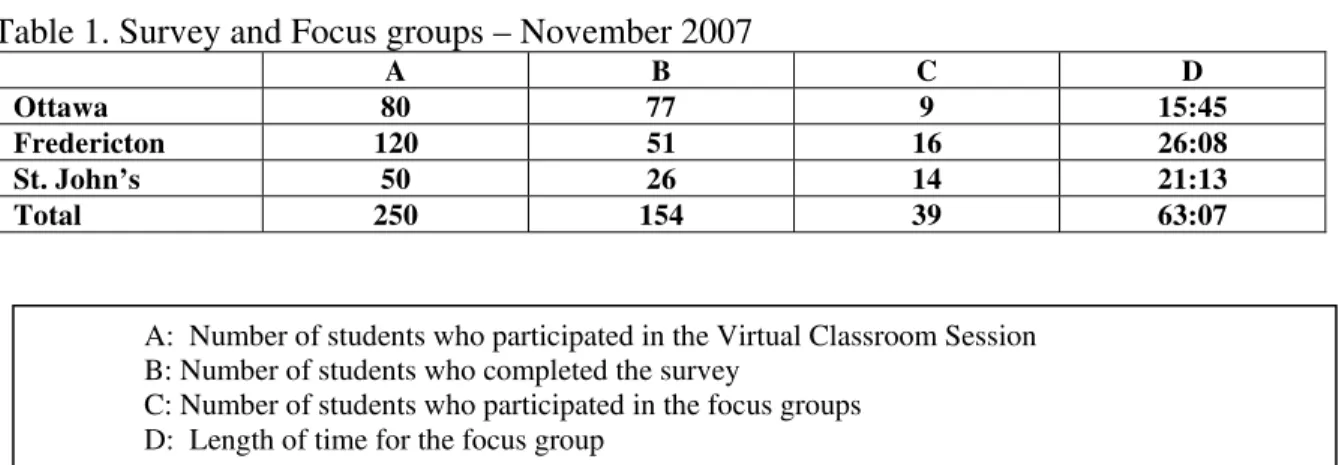
The research team received ethics approval from their research institute and the participating school boards to collect and analyze data. The students from all three schools were invited to complete a survey after the Virtual Classroom session had ended. Of the 250 students who participated in the Virtual Classroom session across the three schools, a total of 154 students completed the surveys (61% response rate). The questionnaires asked students to report on the specific technologies they used during the Virtual Classroom session such as online videos and videoconferencing. They also reported on their use of other forms of technology outside of the session (e.g., cellphones, email etc).
Questionnaires were checked for consistency and two questionnaires were removed from analysis due to invalid and incomplete responses. The valid and reliable data were analyzed for this report.
After completion of the questionnaires, students in all three schools were also invited to participate in focus group sessions. Due to time constraints (e.g., other classes to attend), many students were unable to participate in the focus groups. The focus groups ranged in size from 9 (Ottawa) to 16 (Fredericton) and varied in duration from 15 minutes (Ottawa) to as long as 26 minutes (Fredericton). During the focus group sessions
researchers followed a semi-structured interview guide consisting of open-ended questions and probes related to the Virtual Classroom session the students had just attended as well as questions pertaining to their technology use (e.g., most frequently used communication technologies, who they communicate with using these technologies, usefulness and ease of use of the technologies etc.).
Research Findings
Profile of Students Surveyed
Statistical analyses of the descriptive statistics of students were performed using frequencies analyses through SPSS statistical software. Of the 152 students who completed the survey, 40% were male and 60% were female. For 82% English was their first
language; for 4%, French; and for 14%, a language other than French or English.
Students reported that they were comfortable using computers. Twenty-nine percent of students rated their technical ability with computers in general as excellent and 66% rated their ability as average. Fifty percent of students reported that they liked working with computers “Very much” and 43% reported that working with computers is “Okay”. A further 59% of students reported that, in general, they like appearing on camera.
Students reported the information and communication technologies (ICT) they personally use and the frequency with which they use them. Using MSN, Yahoo! or other types of chat were the most frequently reported technologies: 62% of students indicated using them every day. Facebook, Second life or Myspace was the second most frequently used technology: 55% of students reported using these technologies every day. Using a cell phone for calls or texting was the third most common technology used: 49% of students reported doing this every day. The fifth most frequently used technology was using the home telephone with 44% of students reporting using this technology every day.
Differences at geographical locations
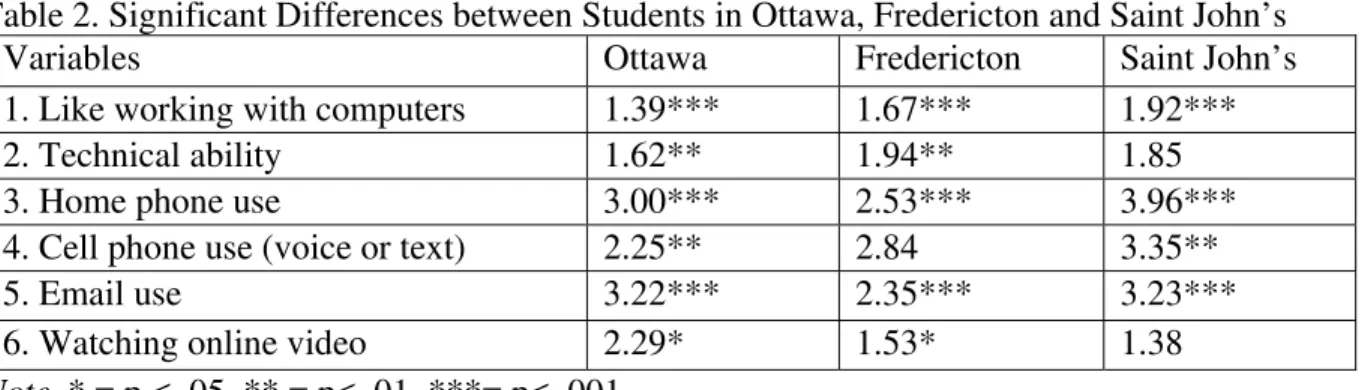
Some differences existed between students at the different geographical locations. Students in Ottawa reported they liked working with computers significantly more than students in Fredericton and Saint John’s (F (2, 149) = 8.50, p <.001), Students in Ottawa reported having significantly greater technical ability than students in Fredericton (F (2, 149) = 5.91, p <.01), Students in Saint John’s (M=3.69) reported using home phone significantly more frequently than students in Ottawa and Fredericton (F (2, 149) = 8.61, p <.001). Students in Saint John’s reported using their cell phones for voice or texting significantly more than students in Ottawa (F (2, 149) = 5.37, p <.01), students in
and Ottawa (F (2, 149) = 10.74, p <.001), and students in Ottawa reported watching online video significantly more than students in Fredericton and Saint John’s (F (2, 149) = 3.65, p <.05). Results of a MANOVA showed that, despite the differences in technology use and comfort across geographical regions, there were no significant differences in the learning and perspective taking variables between students in the three cities (F (10, 88) = .80, p> .05 using Wilks’ Lambda).
Video Content
The videos students made using the BVCam were viewed by two project
researchers for content analysis. The majority of videos were conducted by small groups (e.g., 2 to 3 students) and consisted largely of general statements students made about discussions they had had regarding diet and body image in their own locations. Students incorporated newly learned facts and statistics on diet and body image with personal opinions on topics such as body image, eating habits, social pressures of ideal body shape and size. These short videos were also used to respond to issues brought up in the larger, plenary session. This more intimate format allowed smaller groups to share their thoughts and ideas regarding the larger discussion in a personalized manner while drawing on the research they had conducted prior to the session. The BVCam videos also offered students who had not had a chance to contribute during the larger group format to share their views with their peers.
Learning and perspective taking of adolescents over video technologies
The overall finding derived from analysis of the questionnaire and qualitative data is that the majority of students enjoyed the Virtual Classroom session and found it a valuable learning experience. Statistical analyses of the student’s reports regarding the quality of viewing experience using the novel video technology were performed using frequencies analyses through SPSS statistical software.
Students suggest that online video is an appropriate means through which to communicate ideas about important issues. Ninety-one percent reported that they learned something about diet and body image from watching the videos, 75% percent reported that
image and a further, 93% reported that the videos helped them understand the perspectives or opinions of the students from other schools about diet and body image. Further, 51% of students reported that they thought videoconferencing was useful.
Results were also obtained on students’ personal use of information and communication technologies (ICT) and the frequency with which they use them (see Appendix 1). Using MSN, Yahoo! or other types of chat were the most frequently reported technologies: 62% of students indicated they used them every day. Facebook, Second life or Myspace was the second most frequently used technology: 55% of students reported using these technologies every day. Using a cell phone for calls or texting was the third most common technology used: 49% of students reported doing this every day. The fifth most frequently used technology was the home telephone with 44% of students reporting using this technology every day. Engaging in video chat such as Skype, iChat, or
Window’s Live Messenger was the eighth most frequently used technology with 32.9% of students reporting using this technology at least every week or so. Writing and mailing letters was the least frequently reported technology used: 66% of students reported never or rarely using this technology (see Appendix 1). Using a website/blog they built themselves and uploading a video to share with others were the second and third least frequently used technologies with 63% and 62% reporting never r rarely engaging in these activities, respectively. Finally, using a cell phone for taking pictures and making videos was the fourth least frequently used technology: 60% of students reported never or rarely doing this.
In addition to students’ confidence in their computer skills and their comfort level with appearing on video, students’ views of the utility of the technology for a creative outlet, communication and relationship building appeared to act as enablers for successful
participation with students at other sites. Forty–eight percent of students thought posting short videos was useful, 45% thought viewing short peer-generated videos was useful, 34% thought posting a text comment to an online video was a useful function of the software interface, and 36% thought reading a comment posted to an online video was useful for interacting with students at other schools during the session.
Adolescent’s Video Technology Use
To examine whether youth who had more experience with video technologies were more able to learn about diet and body image from watching peer-generated videos, we performed multivariate regression analyses with frequency of use of video chat, watching and uploading online videos as predictor variables of student’s reports of learning and perspective taking. We found that use of video technologies significantly predicted students’ ability to understand the perspectives or opinions of their peers at other schools about diet and body image during the virtual classroom session (R2 = .21, F (3, 53) = 4.06,
p <.05). Students who used video chat and watched or uploaded online videos more
frequently reported being able to understand their peer’s perspectives more so than students who did not use these technologies as often. (However, more frequent use of these video technologies did not predict student’s reports of learning about or changing their own attitudes or perspectives regarding diet and body image during the virtual classroom session (F (3, 55) = 1.31, p>.05, F (3, 55) = 2.13, p >.05 respectively).
Associations between Learning and Perspective Taking and Video Technology Use
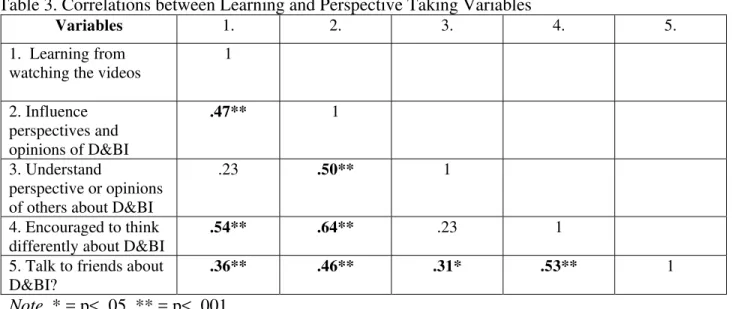
Examination of the zero order correlations between variables revealed that students who reported that their peer’s videos had helped them to learn about the topic area, had influenced their perspectives and opinions and had encouraged them to think differently about diet and body image and were more likely to report that they would talk to friends about what they had learned during the Virtual Classroom session (see Appendix 4).
Social Presence
Transcripts of the focus group data were analyzed to identify common themes in the student’s comments. According to students, the most frequently utilized application for video communication was desktop videoconference through Skype or MSN messenger. Students in Fredericton and Saint John’s specifically reported using their webcams to communicate mostly with family members living in other countries. Some youth stated that videoconferencing was the only way they could see their relatives or close friends.
F: I know a girl who, her boyfriend goes to hockey school away, and like they communicate through videos and they talk to each other. Rather than being on the phone, they actually have video conversations, which is kind of cool. That’s kind of for a different purpose. (St. John’s)
Students also reported that one of the main advantages to video communication was increased social presence:
F1: It’s great talking on a web cam with someone like, “live” feed… F2: …the visual aspect of it …
F1: Makes it more personal
F2: Yeah, it’s more personal. (Ottawa)
Students from all high schools in all three geographic locations believed that videoconferencing was a more personal means of communication than other, static technologies such as email:
M: I personally only use video on MSN only when, honestly, one of my friends changes their appearance, if they get a new haircut or new clothes or something and they want to model it off. Even my cousin, she got a new haircut and she just had to show me. That’s just how we do it. I never use it to sit there and talk to someone. I’ve never been that interested in that approach, in my entire computer experience. (Ottawa)
Discussion
Social presence and learning
Our findings are in keeping with past research which indicates that peers are important in shaping attitudes and perspectives regarding youth’s body images (Maxwell, 2002; Nathanson, 2001). Students reported that they had learned something about not only their peers attitudes and perspectives about diet and body image, but also about their own attitudes regarding diet and body image. This shows that peers were able to exert an influence on each other’s opinions on this important issue- even from a distance (i.e. distal peers both figuratively and literally). This finding supports Bearman’s assertions (2007)
that even peers who are distal are able to influence each other via communication of a normative climate of values.
Technical aspects may have impeded the full participation and engagement of the students such as the sound and image clarity, steadiness of the video streaming signal and the tendency for the image to break into pixels and get out of sync with the sound. These technical difficulties may have distracted the students. Indeed, it seemed to disrupt their engagement with the communication process; when the image quality lessened the students seemed to lose focus and would shift their attention away from the videoconference
session.
In the Virtual Classroom peers were distal both physically, in terms of geographical location, and socially as the students were only acquainted via the videoconferencing and video experience. That is, because students were watching videos that their peers made and by virtue of the fact that these videos were made in the first place communicates the
importance of the issue of diet and body image to these adolescents. Further, the content of the videos (e.g., comments about the negative messages in mass media and associations between these messages and disordered eating) communicated the values important to this peer group. Thus this presentation of a normative climate allowed students to understand and identify with attitudes and perspectives of their peers by shifting their own opinions on the topic.
Interestingly, examination of the correlations between variables revealed that students who reported they had learned about diet and body image and that watching peer videos had influenced their perspectives and opinions on diet and body image were more likely to report that they would talk to friends about what they had learned during the Virtual Classroom session. This finding demonstrates not only an impact on learning but increased engagement with the topic as students reported intentions of actively
disseminating the information they had received and retained from the session. Further, it has implications for messages directed towards adolescents; that is, perhaps an appropriate means of dissemination of information to youth is through a user-generated, egalitarian
process wherein those within the community define the messages and the method through which to share information with others.
The use of video in educational settings
The fact that students reported they felt able to share their own thoughts and ideas, as well as understand the perspectives of students at other schools through the
videoconference and short peer generated videos, speaks to the utility of video technology in educational settings.
In the focus groups the students all seemed to agree that the use of video, especially videoconferencing, added social presence and was a much more personal means of
communication than texting or social networking. If successful engagement can be conceptualized as conversation and action with respect to the subject material presented during the session, then the engagement of the students with the material was clearly demonstrated by reports from the majority of students stating they had learned about diet and body image through the videos. The fact that students reported that what they learned in the session encouraged them to think differently about diet and body image in their own lives, and that they would likely discuss what they had learned with others (e.g., friends and family members), demonstrates the impact of the session on the students at a personal level as well as an action-oriented response to the material.
Our findings underscore the importance of video technology in educational settings. Learners not only need to exchange information, but also need to have some control
(beyond reading, etc) to navigate and contribute. Greater freedom allows students to take control of their own learning (Sims & Hedberg, 2006). Scholars writing on technological tools for education focus on empowering students through collaborative and interactive design. Indeed, Zheng & Li (2008) found that 91.5% of sampled students considered peer interaction to be important or very important to learning. Hernandez- Ramos (2007) found that peer-generated, peer-viewed videos have the ability to create more meaningful, cooperative and authentic learning, especially with the realization that the instructor is not the sole audience. Peer-learning allows learners to regulate their own work and encourages community building (Bolous, 2006; 2007).
Conclusions
Methodological Problems: Participation
Participation levels varied across location in both survey completion and participation in the focus group sessions (see Appendix 2). Of the 250 students who
participated in the Virtual Classroom session, 154 completed our research questionnaire: 77 students in Ottawa (96%); 51 in Fredericton (42%); and 26 students (52%) in St. John’s. A further 49 students participated in the focus group sessions: 9 in Ottawa; 16 in Fredericton; and 14 in St. John’s. Reasons for the discrepancy in participation may be differential incentives used at the various locations. For example, students in Ottawa received
academic marks for their level of participation in the session which may have contributed to their high response rate. Furthermore, the design of the session was different at different schools. Some students were assigned the tasks of producing videos using the novel online video technology while at other schools all students had to make videos to receive course credit.
Also, the Virtual Classroom environments were often chaotic. Some sites operated out of small classrooms where noise levels were loud and potentially quite distracting. Ideally, locations that are uniformly quiet and more settled (e.g., having students remain seated in their chairs instead of walking around) would make for more appropriate settings. Also, if there had been an opportunity for all students at all of the sites to participate in the production and viewing of the videos, this would allow for increased participation at the individual level. Additionally, equivalent incentives provided for students at all the locations would encourage more balanced participation.
Another aspect which could have contributed to differential participation across settings is access to resources available in the Virtual Classroom sessions. In some of the schools the ratio of computers to students was too small to allow for adequate viewing of the videos. For example, at the school In Fredericton there were only 15 computers for 120 students and there were even fewer in St. John’s. The fact that some students were unable to access a computer made it less likely that they would view the videos the other groups and schools produced.
Limitations
Problems with the questionnaire data bring reliability of results of the current study into question. For example: when we asked in the questionnaire about their experience of viewing short videos, students did not consistently distinguish between the short videos made during the session using the novel online video technology and the short videos prepared before the session and shown by videoconference. It was also unclear if they distinguished between the videos they made themselves and videos made by other schools in their responses to questions. This limitation may also be considered a strength to the current findings in that, if their reports included both synchronous and asynchronous technologies, the learning and perspective taking the students reported may have happened across both forms of technology and not merely the synchronous (i.e., videoconference) format. Future research should examine this possibility.
Another limitation is that those students included in the focus groups were self-selected and thus may not represent the majority of their peers. Many students chose to leave or had to leave the event before the focus group sessions started, due to time
restraints. Only a small percentage of those who participated in the Virtual Classroom were able or willing to partake in the focus group session. Thus it may be that these students are different from their peers in their level of engagement in video technologies or had strong enough thoughts or feelings on the subject that they made a point to stay and participate. Thus, due to the comparatively smaller level of participation, generalization of the research findings may not be appropriate.
One more potential limitation is that focus groups which utilize adolescents who know each other may be vulnerable to social desirability bias. That is, engaging adolescents in a focus group may lead to peer pressure or concerns about what students feel they can or cannot say in front of their peers. However, we took care to address this possible confound in the following ways: we told students that participation was voluntary and thus only those who wanted to participate stayed to take part in the focus group discussions; students who attended the discussion but only wanted to listen were not pressured to speak; students were told that their names and identifying information would not be included in any reports from the research; the researcher actively looked for alternative viewpoints and validated
views expressed by students even when they were not supported by other students. Thus, we anticipate that we were able to minimize the influence of peer-pressure upon our study results.
Implications
The implications of the findings of the present study suggest that the use of video in adolescent’s learning is an invaluable tool. The rich social presence afforded by this
medium facilitates peer learning by allowing students to communicate and receive each other’s opinions and attitudes which fosters introspection and shifting in their own attitudes and perspectives of important issues. This suggests that processes such as those utilized during the Virtual Classroom session (e.g., the students are included in the inception and dissemination of messages they decide are important to share with their peers) would be valuable to effective interventions aimed at students at risk for developing negative diet and body images. Engaging youths to participate in conceptualizing and implementing
educational programs for each other would ultimately lead to ecologically relevant interventions via technologies which are popular means of communication among adolescents.
Despite its limitations, our study demonstrated that peers are a fundamental influence in adolescent’s body image and that communications regarding attitudes and perspectives that work to shape youth’s self-concept in-person are also conveyed and exert an influence in communication that takes place via video technology. We posit that the social presence which is afforded to video communications (e.g., short video clips,
videoconference) facilitates peer learning. That our sample of adolescents in geographically diverse regions of Canada was able to communicate, learn and perspective take through the influence of proximal peers communicating cultural norms (in this case the culture of Canadian youth) shows that this learning can take place with proximal as well as distal peers.
The authors would like to thank the students who participated in our study, the teachers and schools who supported and facilitated our data collection, and our colleagues at the National Research Council and the Communication Research Centre of Canada who support the ongoing Virtual Classroom program.
References
O’Donnell, S., Singer, J., Milliken, M., & Fournier, H. (2007). BVC-SI Technical Update Report. Report : 14 pages. June 2007. ERB-115-. NRC 49866.
Milliken, M., Gibson, K., O’Donnell, S., Singer, J. (2008). User-generated Online video and the Atlantic Canadian Public Sphere: A YouTube Study. Proceedings of the
International Communications Association (ICA, 2008). Montreal, Canada, May
22-26, 2008.
O’Donnell, S., Gibson, K., Milliken, M., & Singer, J. (2008). Reacting to YouTube Videos: Exploring Differences Among User Groups. Proceedings of the International
Communications Association (ICA, 2008). Montreal, Canada, May 22-26, 2008.
Simms, D. C., O’Donnell, S., & Perley, S. (2008). Attitudes Toward and Use of Video Communications by Educators in First Nation Schools in Atlantic Canada. Report: 8 pages. January 2008.
Simms, D. C., Milliken, M, O'Donnell, S., Fournier, H, Emond, B. (2008). BVCam in the Virtual Classroom. Report: 10 pages. Appendix: 7 pages. May 2008. ERB-1154. NRC 50411.
Bearman, P. S. (2002). Social network context and adolescent STD risk. New York: Institute for Social and Economic Research and Policy, Columbia University. Bearman, P. S., Bruckner, H., Brown, B. B., Theobald,W., & Philliber, S. (1999). Peer
potential: Making the most of how teens influence each other. Washington, DC:
National Campaign to Prevent Teen Pregnancy.
Boulos, M. N. K., Maramba, I., & Wheeler, S. (2006). Wikis, blog and podcasts: a new generation of Web-based tools for virtual collaborative clinical practice and education. BMC Medical Education, 6(41), 8.
Boulos, M. N. K., & Wheeler, S. (2007). The emerging Web 2.0 social software: an enabling suite of sociable technologies in health and health care education. Health
Buck, R.W., Savin, V.J., Miller, R.E., & Caul, W.F. (1972). Nonverbal communication of affect in humans. Journal of Personality and Social Psychology, 23, 362–371. Calderon, R., Vander Stoep, A., Collett, B., Garrison, M. M., & Toth, K. (2007). Inpatients
with eating disorders: Demographic, diagnostic and service characteristics from a nationwide pediatric sample. International Journal of Eating Disorders, 40(7), 622-628.
Cattarin, J. A., and Thompson, J. K. (1994). A three-year longitudinal study of body image, eating disturbance, and general psychological functioning in adolescent females.
Eating Disord. 2: 114–124.
Goodman, S. (2003) Teaching Youth Media: A Critical Guide to Literacy, Video Production and Social Change. New York: Teachers College Press.
Greavener, J. A., Haedt, A. A., Heatherton, T. F., & Keel, P. K. (2008). Gender and age differences in associations between peer dieting and drive for thinness.
International Journal of Eating Disorders, 41, 57-63.
Harris, J. R. (1995). Where is the child’s environment? A group socialization theory of development. Psychological Review, 102(3), 458-489.
Hernández-Ramos, P. (2007). Aim, shoot, ready! Future teachers learn to 'do' video. British
Journal of Educational Technology, 38(1), 33-41.
Juwah, C. (2006). Interactions in Online Peer Learning. In C. Juwah (Ed.), Interactions in
Online Education: Implications for Theory and Practice (pp. 171-190). New York:
Routledge.
Levine, M. P., and Smolak, L. (2001). Primary prevention of body image disturbances and disordered eating in childhood and early adolescence. In Thompson, J. K., and Smolak, L., (eds.), Body Image, Eating Disorders, and Obesity in Youth:
Assessment, Prevention, and Treatment. American Psychological Association,
Washington, DC, pp. 237–260.
Madden, M. (2007). Online Video. Washington, DC: Pew Internet & American Life Project.
Maxwell, K. A. (2002). Friends: The role of peer influence across adolescent risk behaviors. Journal of Youth and Adolescence, 31, 267-277.
Nathanson, A. I. (2001). Parents versus peers. Exploring the significance of peer mediation of antisocial television. Communication Research, 28(3) ,251-274.
functioning in preadolescent children. Journal of Youth and Adolescence, 33, 421-429.
Roussel, N. & Gueddana, S. (2007) Beyond ‘Beyond Being There’: Towards Multiscale Communication Systems. ACM. 238-246.
Schuck, S., Kearney, M. (2004). Students in the Director's Seat: Teaching and Learning
across the School Curriculum with Student-generated Video. Sydney, Australia:
Faculty of Education, University of Technology.
Slade, P. (1994). What is body image?. Behaviour Research and Therapy, 32(5), 497-502. Sims, R., & Hedberg, J. (2006). Encounter Theory: A Model to Enhance Online
Communication, Interaction and Engagement. In C. Juwah (Ed.), Interactions in
Online Education: Implications for Theory and Practice (pp. 27-45). New York:
Routledge.
Thompson, J. K., and Smolak, L. (2001). Body image, eating disorders, and obesity in youth: The future is now. In Thompson, J. K., and Smolak, L. (eds.), Body Image,
Eating Disorders, and Obesity in Youth: Assessment, Prevention, and Treatment.
American Psychological Association, Washington, DC, pp. 1– 39.
Thompson, J. K., Heinberg, L. J., Altabe, M., and Tantleff-Dunn, S. (1999). Exacting
Beauty: Theory, Assessment, and Treatment of Body Image Disturbance. American
Psychological Association, Washington, DC
Short, J., Williams, E., Christie, B. (1976) The Social Psychology of Telecommunications. Toronto: John Wiley & Sons.
Smolak, L., and Levine, M. P. (2001). Body image in children. In Thompson, J. K., and Smolak, L. (eds.), Body Image, Eating Disorders, and Obesity in Youth:
Assessment, Prevention, and Treatment. American Psychological Association,
Washington, DC, pp. 41–66.
Stice, E. (2001). Risk factors for eating pathology: Recent advances and future directions. In R. Striegel-Moore & L. Smolak (Eds.), Eating disorders: Innovative directions in
research and practice (pp. 51–73). Washington, DC: American Psychological Association.
Stice, E., Schupak-Neuberg, E., Shaw, H., & Stein, R. (1994). Relation of media exposure to eating disorder symptomatology: An examination of mediating mechanisms.
Journal of Abnormal Psychology, 103(4), 836-840.
Valkenburg, P.M., Schouten, A.P. (2007) Precursors of Adolescents’' use of Visual and Audio Devices During Online Communication. Computers in Human Behavior 23: 2473-2487.
Vincent, M. A., McCabe, M. P. (2000). Gender differences among adolescents in Family and peer influences on body dissatisfaction, weight loss and binge eating behaviors.
Journal of Youth and Adolescence, 29, 205-220.
Williamson, D.A., Stewart, T..M., White, M. A., & York-Crowe, E. (2002). An
information processing perspective on body image. In T. F. Cash & T. Pruzinsky (Eds.), Body image: A handbook of theory, research, and clinical practice (pp. 47-54). New York: Guilford Press.
Zamaria, C., Fletcher, F. (2007). Canada Online! The internet, media and emerging technologies: Uses, attitudes, trends and international comparisons. Canadian Internet project.
Zheng, Y., & Li, L. (2008). A Three-Dimensional Context-Awareness Model for Peer Recommendation in the E-Learning Context. International Journal on E-Learning,
Appendix 1. Frequency of Technology Use.
Frequency of Technology Use
0% 10% 20% 30% 40% 50% 60% 70% 80% 90% 100% 1 2 3 4 5 6 7 8 9 10 11 12 Every Day
Several Times a Week Every Week or so Every Month or so Never or Rarely
1. Writing and mailing letters 2. A website/blog you built yourself 3. Upload a video to share with others 4. Cell-phone- pictures or video
5. Video chat (Skype, IChat, Messenger) 6. Post a text comment to an online video 7. Watch online video
8. Cell phone- voice or text
9. MSN, Yahoo! or other types of chat 10. Facebook, Secondlife or Myspace 11. Home phone
Appendix 2. Participation at the Virtual Classroom session.
Table 1. Survey and Focus groups – November 2007
A B C D
Ottawa 80 77 9 15:45
Fredericton 120 51 16 26:08
St. John’s 50 26 14 21:13
Total 250 154 39 63:07
A: Number of students who participated in the Virtual Classroom Session B: Number of students who completed the survey
C: Number of students who participated in the focus groups D: Length of time for the focus group
Appendix 3. Differences between Geographical Locations
Table 2. Significant Differences between Students in Ottawa, Fredericton and Saint John’s Variables Ottawa Fredericton Saint John’s 1. Like working with computers 1.39*** 1.67*** 1.92*** 2. Technical ability 1.62** 1.94** 1.85 3. Home phone use 3.00*** 2.53*** 3.96*** 4. Cell phone use (voice or text) 2.25** 2.84 3.35** 5. Email use 3.22*** 2.35*** 3.23*** 6. Watching online video 2.29* 1.53* 1.38
Note. * = p < .05, ** = p< .01, ***= p< .001.
Appendix 4. Correlations between Learning and Perspective Taking Variables.
Table 3. Correlations between Learning and Perspective Taking Variables
Variables 1. 2. 3. 4. 5.
1. Learning from watching the videos
1 2. Influence perspectives and opinions of D&BI .47** 1 3. Understand perspective or opinions of others about D&BI
.23 .50** 1
4. Encouraged to think differently about D&BI
.54** .64** .23 1
5. Talk to friends about D&BI?
.36** .46** .31* .53** 1