
HAL Id: halshs-00586022
https://halshs.archives-ouvertes.fr/halshs-00586022
Preprint submitted on 14 Apr 2011
HAL is a multi-disciplinary open access
archive for the deposit and dissemination of sci-entific research documents, whether they are pub-lished or not. The documents may come from teaching and research institutions in France or abroad, or from public or private research centers.
L’archive ouverte pluridisciplinaire HAL, est destinée au dépôt et à la diffusion de documents scientifiques de niveau recherche, publiés ou non, émanant des établissements d’enseignement et de recherche français ou étrangers, des laboratoires publics ou privés.
job insecurity
Andrew E. Clark, Andreas Knabe, Steffen Rätzel
To cite this version:
Andrew E. Clark, Andreas Knabe, Steffen Rätzel. Boon or Bane? Others’ unemployment, well-being and job insecurity. 2008. �halshs-00586022�
WORKING PAPER N° 2008 - 67
Boon or bane? Others’ unemployment,
well-being and job insecurity
Andrew E. Clark Andreas Knabe
Steffen Rätzel
JEL Codes: D84, J60, Z83
Keywords: Unemployment, externalities, job insecurity, well-being
P
ARIS-
JOURDANS
CIENCESE
CONOMIQUESL
ABORATOIRE D’E
CONOMIEA
PPLIQUÉE-
INRA48,BD JOURDAN –E.N.S.–75014PARIS TÉL. :33(0)143136300 – FAX :33(0)143136310
www.pse.ens.fr
CENTRE NATIONAL DE LA RECHERCHE SCIENTIFIQUE –ÉCOLE DES HAUTES ÉTUDES EN SCIENCES SOCIALES ÉCOLE NATIONALE DES PONTS ET CHAUSSÉES –ÉCOLE NORMALE SUPÉRIEURE
Job Insecurity
Andrew Clark
*Paris School of Economics and IZA
Andreas Knabe
**Freie Universität Berlin and CESifo
Steffen Rätzel
***Otto-von-Guericke-University Magdeburg
December 2008
Abstract
The social norm of unemployment suggests that aggregate unemployment reduces the well-being of the employed, but has a far smaller effect on the unemployed. We use German panel data to reproduce this standard result, but then suggest that the appropriate distinction may not be between employment and unemployment, but rather between higher and lower levels of labour-market security. Those with good job prospects, both employed and unemployed, are strongly negatively affected by regional unemployment. However, the insecure employed and the poor-prospect unemployed are less negatively, or even positively, affected. We use our results to analyse labour-market inequality and unemployment hysteresis.
JEL Classification Codes: D84, J60, Z83.
Keywords: Unemployment, Externalities, Job Insecurity, Well-Being.
*
PSE, 48 Boulevard Jourdan, 75014 Paris, France. Tel.: +33-1-43-13-63-29. E-mail: [email protected].
**
Freie Universität Berlin, Boltzmannstr. 20, 14195 Berlin, Germany. Tel.: +49-30-83851241. E-mail: [email protected].
***
Otto-von-Guericke-University Magdeburg, Faculty of Economics and Management, P.O. Box 4120, 39016 Magdeburg, Germany. Tel.: +49-0391-67-12158. E-mail: [email protected].
We are grateful to Cahit Guven, John Haisken-De New, Ronnie Schöb and seminar participants at the 8th International SOEP User Conference in Berlin for useful comments. The data used in this publication were made available to us by the German Socio-Economic Panel Study (SOEP) at the German Institute for Economic Research (DIW), Berlin.
1. Introduction
Unemployment is widely considered to be one of the strongest correlates of individual well-being. Losing a job is not only associated with a significant drop in income, but also with the loss of all of the non-pecuniary benefits associated with working. The latter might well include a loss in social status, fewer contacts with people outside the family, a weaker time structure leading to motivational disorientation, and a general lack of sense of purpose and goals in life. In the well-being literature, these non-pecuniary effects are most often estimated to be more important than the loss of income itself, so that the “compensating differential” for unemployment (the rise in income that would make the unemployed just as happy as the employed) is typically an order of magnitude larger than the observed difference in income between the employed and the unemployed.
While a number of papers have traced out the link between own unemployment and own well-being, a separate literature has underlined the relationship between individual well-being and others’ unemployment. At the broadest level, the novel work on the macroeconomics of happiness has shown that individual well-being is related to aggregate macroeconomic variables such as the unemployment rate, inflation, and the interest rate (see Blanchflower, 2007, and Di Tella et al., 2001). The estimated coefficients on these aggregate variables can be used to construct sacrifice ratios.
This macro literature calculates the average effect of unemployment or inflation, say, across all individuals in a region or a country. It is also of interest to see if different groups are affected differently. In this context, a number of papers have distinguished between the effect of aggregate unemployment on the employed and the unemployed. Aggregate unemployment is commonly found to be associated with lower levels of well-being amongst the employed. Perhaps the most obvious relationship is with the individual’s own perception of job insecurity: bad news for others makes me feel more afraid for myself. Job insecurity is only one of the characteristics of a job, but it is obviously contextual in the sense that it is heavily influenced by what happens to others; it is also considered to be one of the most important of the job domains (see Clark, 2001 and 2008). Other channels of influence that have been emphasised in the psychological literature include the feelings of guilt experienced by those remaining employed during periods of layoffs, and individuals staying in distressing jobs that they would otherwise likely have quit had labour market conditions been better.
The effect of aggregate unemployment on the unemployed is arguably more contentious. Greater unemployment reduces the chances of finding work for a given unemployed person, absent some kind of powerful thick-market externality, which makes their future prospects
greyer. On the other hand, the unemployed may benefit from a “social-norm effect”: as more people become unemployed, one’s own unemployment represents a smaller deviation from the norm. Clark (2003) finds, using British Household Panel Survey (BHPS) data, that regional unemployment reduces the well-being of the employed, but that the unemployed report higher levels of well-being in regions with higher unemployment rates. This is consistent with social norms in the labour market.
In this paper, we attempt to shed some more light on the social-norm effect of unemployment by questioning the assumption that the appropriate cleavage is between the employed and the unemployed. We instead argue that a more appropriate distinction appeals to labour market security or attachment. Specifically, those with less-secure attachment to the labour market (the employed with insecure jobs, and the unemployed with poor re-employment prospects) are more prone to the social-norm effect of unre-employment.
Eisenberg and Lazarsfeld (1938) noted many years ago that individuals’ perceptions of labour market risk and uncertainty are far more important for their well-being than their actual labour force status:
“Just having a job itself is not as important as having a feeling of economic security. Those who are economically insecure, employed or unemployed, have a low morale.” (p. 361)
The perception of labour-market risk or attachment (the employed’s job security and the unemployed’s employment prospects) is indeed an important determinant in and of itself of subjective well-being (Knabe and Rätzel, 2008). We here go further and suggest that this attachment represents a natural dividing line regarding the social-norm effect of others’ unemployment. In the results below, the employed suffer from greater unemployment, but this negative effect weakens for those with less secure jobs (if they become unemployed, they will deviate less from the social norm). The unemployed also suffer from higher regional unemployment, but with a weaker negative, or even a positive, effect when finding work is more difficult (as, again, unemployment becomes more “normal”).
We therefore suggest that others’ unemployment has a number of different effects on well-being in the labour market. First, and most obviously, it reduces the well-well-being of those who move from employment into unemployment. Second, it affects the well-being of those who remain in employment, with more profound negative effects on those with secure jobs. Third, it affects the well-being of the existing unemployed, with less negative or even positive
effects on those who are more likely to remain unemployed. Last, aggregate conditions will likely affect the way in which individuals evaluate their own employment or unemployment, so that labour-market prospects themselves change with others’ unemployment. We will provide a decomposition of these phenomena using our regression results.
The paper is structured as follows. In the next section, we provide an overview of the existing literature of the well-being effects of others’ unemployment. Section 3 describes the data and the estimation methodology, and Section 4 contains the empirical results. The last section provides a summary and concludes.
2. Literature review
It is well-established in both social psychology and economics that own unemployment is amongst the most detrimental experiences for individual well-being. Eisenberg and Lazarsfeld (1938), using a descriptive method, were the first psychologists to examine the emotionally destructive effects of unemployment. They showed that job loss deprives individuals not only of their labour income, but also of the non-pecuniary benefits of work. These latter include the external imposition of a time structure on the working day, regularly-shared experiences and contact with people outside of the family, links to goals and purposes that transcend the individual, the definition of personal status and identity, and the enforcement of activity (Jahoda 1981, 1988). Unemployment is destructive mainly because it withdraws these latent functions from individuals.1
More recent work in Economics on subjective well-being has produced overwhelming support for these findings. Clark and Oswald (1994), using the first wave of the BHPS, show that unemployment is associated with significantly lower mental well-being scores, as measured by the answers to twelve psychological functioning questions (the GHQ-12). Other social surveys, for example the German Socio-Economic Panel (GSOEP), contain direct information on life satisfaction. Gerlach and Stephan (1996) and Winkelmann and Winkelmann (1998) use the GSOEP to show that unemployment reduces life satisfaction beyond what would be expected from the loss of labour income. Blanchflower and Oswald (2004) find similar results for Great Britain and the United States. Research using panel data has addressed causality by showing that unemployment is still associated with lower well-being even controlling for individual fixed effects.
1
Feather (1990) presents a comprehensive survey of the social psychology literature on the psychological impact of unemployment.
Research in social psychology has suggested that unemployment affects not only the mental well-being of those concerned, but also that of their families, colleagues, neighbours, and others who are in direct or indirect contact with them. Evidence on the negative intra-familial consequences of unemployment goes back at least to the Great Depression, when Oakley (1936) reported that the unemployment of German parents produced a drop in their children’s school grades of two-thirds.2 More recent work has found that children with unemployed fathers are at risk of socio-emotional problems, deviant behaviour, and reduced aspirations and expectations (McLoyd, 1989). Unemployment is also harmful for the mental health of spouses. McKee and Bell (1986) underline the difficulties faced by spouses, typically the wives of unemployed men, in trying to cope with the partner’s intrusive presence at home, supporting distressed partners and dealing with intra-family conflict. Jones and Fletcher (1993) provide further evidence that the occupational stress and distress from unemployment can be transmitted between partners.
At a broader level, unemployment may also affect the employed. One strand of the literature has considered “survivors” – those who remain in organisations after their colleagues have been made redundant. Higher unemployment increases individuals’ perceptions of their own future unemployment prospects (and by more than the actuarial rise in risk). Cobb and Kasl (1977), Fryer and McKenna (1987, 1988), and De Witte (1999) have all emphasised that the anticipation of redundancy is at least as distressing as the experience of unemployment itself. Hartley et al. (1991), in their survey of job insecurity, found that those with falling perceived job security also report severe uncertainty in other life areas, impaired mental health (as expressed by psychosomatic symptoms and depression), lower job satisfaction, reduced organisational commitment and trust in management, resistance to change and deteriorating industrial relations. Nelson et al. (1995) and Ferrie et al. (1995) present evidence from case studies in the UK in which formerly public organisations were privatised and parts of the workforce were made redundant. These privatisations increased the perceived job insecurity of employees and caused significant falls in their mental well-being. Dekker and Schaufeli (1995) present complementary evidence showing that, after it had become clear who would be laid off, those who knew that they would be made redundant actually experienced a rise in their well-being. This illustrates the harmful impact of job insecurity compared to actually becoming unemployed.
Even without a job security effect, surrounding unemployment may still reduce employees’ well-being. Workers who see their co-workers becoming unemployed may suffer some
2
psychological impact as well. Managers in firms where layoffs took place report that these had deleterious effects on the remaining workers’ productivity, morale and commitment to the firm (Brockner, 1988 and 1992). Survivors have feelings of guilt, show poor concentration and increasingly seek alternative employment (Noer, 1993). In addition, Cooper (1986) shows that occupational stress, which workers typically react to by changing jobs, increases with unemployment as individuals are more likely to be stuck in mentally-distressing jobs.
The externalities from higher unemployment are not restricted to employees, but also affect those who were already unemployed. Here the sign of the externality may change: higher unemployment may be beneficial (or at least less harmful) for the unemployed. The social psychology literature provides some evidence. Kessler et al. (1987, 1888) find that support from others reduces the negative impact of unemployment by helping the unemployed to escape from boredom and establish a goal direction in daily activities. It is easier for the unemployed to establish social contacts if others in the local area are also unemployed. Cohn (1978) finds that the unemployed’s satisfaction with self is lower if there is no external cause to which unemployment can be attributed: satisfaction among the unemployed is higher in regions with higher local unemployment rates. Jackson and Warr (1987) find similar results for the UK. Unemployed men in England and Wales have significantly better psychological health if they live in areas where unemployment is chronically high compared with those living in areas with moderate or low unemployment. Dooley et al. (1988), however, find that the aggregate unemployment rate has a negative impact on the unemployed when investigating psychological symptoms in the Los Angeles area.
While social psychology has contributed very detailed accounts of particular case studies and qualitative research, economists have recently started to make use of large-scale datasets to quantitatively examine the effect of unemployment on others. Clark (2003) uses seven waves of the BHPS to examine the impact of other’s unemployment on both the employed and the unemployed. Other’s unemployment is measured at the regional, household, and couple level. While surrounding unemployment generally has a negative effect on the employed at all three levels, there is evidence of a counteracting effect for unemployed men, whose well-being rises with others’ unemployment. These results are consistent with a utility return from adhering to an employment norm. They are consistent with work on suicides and para-suicides by the unemployed, which have been shown to be more prevalent in low-unemployment regions (Platt and Kreitman, 1990, and Platt et al., 1992).
Work in other countries or with other datasets generally finds similar results. Using Australian data, Shields et al. (2008) show that people suffer less from unemployment if they
live in a region with higher unemployment. Powdthavee (2007) finds a weaker social norm effect in South Africa. His findings suggest that unemployed people suffer much less from regional unemployment than employed people, but they still suffer nevertheless. Social norm effects also appear for the informally employed (casual wage employees), whose life satisfaction is less adversely affected by regional unemployment than that of regularly employed workers.
Shields and Wheatley Price (2005) use an index of multiple deprivation at the regional level that consists of six deprivation domains (low income, employment, education and training, poor health and disability, poor housing, and poor geographical access to services). They show that the detrimental effect of unemployment on psychological health is greater in low employment-deprivation areas than in highly-deprived areas. However, Scutella and Wooden (2006), using Australian data, do not find any social norm effect at the household level: the well-being of the unemployed rather worsens as other household members become unemployed.
A different approach to modelling the prevalence of an (un)employment norm was taken by Stutzer and Lalive (2004), who infer the social work norm in Swiss cantons from the outcome of a referendum in which the population voted on cuts in unemployment benefits. Stronger cantonal support for this cut is interpreted as corresponding to a stronger social norm of work. The results show that a weaker work ethic is correlated with greater subjective well-being of the unemployed.
Overall, the literature clearly provides evidence of both adverse psychological effects of own unemployment, as well as spillover effects on others. The employed suffer from, for example, increased job insecurity, feelings of guilt, and higher workloads. However, for those who are already unemployed, any social norm effect mitigates this effect, and may even turn it positive.
3. Data and Methodology
To estimate spillovers from others’ unemployment, we use the first 23 waves (1984-2006) of the German Socio-Economic Panel (GSOEP).3 We include all individuals aged between 21 and 60 who are either employed or registered unemployed. This yields roughly 60,000 observations (from 9,000 different individuals) for each sex. Our dependent variable is life satisfaction, which is measured on a 0 to 10 scale (where 0 denotes “not satisfied at all” and 10 stands for “completely satisfied”).
In a first step, we explain life satisfaction by a fairly standard set of variables, including the respondent’s own employment status and the regional unemployment rate. To test for a social norm effect, we then include interaction terms between own employment status and the regional unemployment rate. We therefore estimate the following equation:
(
it it)
(
it it)
it t itit i
it UE E UERATE UE UERATE X
LS =α +β1 +β2 * +β3 * +γ' +µ +ε (1)
where αi is an individual fixed effect, Eit is a dummy for own employment, UEit is a dummy for own unemployment, and UERATEit is a measure of the regional unemployment rate4 (at the German federal state level).5 The vector Xit is a set of standard control variables that might
potentially be correlated with individual well-being (such as income and marital status), µt
represents the wave dummies, and εit is a random error term. We first check whether we can
replicate the results of the social-norm literature mentioned above using the GSOEP data. We have three prior hypotheses regarding equation (1):
0
1 <
β (the unemployed are less happy than the employed);
0
2 <
β (higher regional unemployment makes the employed less happy); and 2
3 β
β > (there is a counteracting social norm effect for the unemployed, who are thus less negatively affected by regional unemployment than are the employed).
3
The data used in this publication were made available by the German Socio-Economic Panel Study (GSOEP) at the German Institute for Economic Research (DIW), Berlin. The data were extracted using the Add-On-package PanelWhiz for Stata, see Haisken-DeNew and Hahn (2006) for details.
4
We here use the yearly unemployment rate by region. Experiments with the monthly rate, matched to month of interview, produced very similar results (these data are currently only available from 1991 onwards).
5
As we only us observations on the employed or registered unemployed, the specification in (1) allows us to read β2 and β3 as the impact of aggregate unemployment on the employed and the unemployed respectively.
The third hypothesis reflects the status versus signal distinction in how others’ bad fortune is interpreted.6 Were all individuals to compare their own situation to the regional average (the status effect), then greater unemployment should make everyone better off: apart from those who switch from employment to unemployment, everyone’s relative position in the labour market has improved. However, the signal component for the employed corresponds to a heightened risk that they will be making the same employment-unemployment transition themselves in the future, which reduces their well-being.7
The second empirical specification explicitly tests our hypothesis that the fault line is labour market insecurity rather than labour force status. We therefore estimate the extended regression below: (2)
(
)
(
)
(
1 2 3 4 5 6 7 * _ _ * * * * _ _ * * _ _ * * * * it i it it it it it it it it it it it it it it it it itLS E Low Job Security
UE Good_Prospects UE Bad_Prospects
UERATE E High Job Security
UERATE E Low Job Security
UERATE UE Good_Prospects UERATE UE Ba α β β β β β β β = + + + + + + + ' it it t it d_Prospects X γ µ ε + + +
)
Here High_Job_Securityit and Low_Job_Securityit are respectively dummy variables for employees saying that their job is relatively secure or insecure. These are constructed from the following question, asked of the employed only: “How concerned are you about your job
security?”, with the possible replies: “Not concerned at all”, “Somewhat concerned”, and
“Very concerned”. High job security corresponds to the response “Not concerned at all” and low job security otherwise. The Good_Prospectsit and Bad_Prospectsit dummies correspond to the GSOEP question asked of the unemployed: “If you were currently looking for a new
job: Is it or would it be easy, difficult or almost impossible to find an appropriate position”?
Good prospects corresponds to the response “Easy” and bad prospects otherwise.8 The omitted category in equation (2) is employees with high job security.
Our hypotheses in this expanded estimation are as follows:
6
As analysed in the context of others’ income by Senik (2004) and Clark et al. (2008).
7
It can be countered that there is equally a signal component for the unemployed, that they are less likely to make the unemployment-employment transition. Empirically, the distinction between the effect of others’ unemployment on the employed and unemployed is consistent with the signal being relatively stronger for the employed and status being relatively stronger for the unemployed.
8
We grouped the answers to the job security question “somewhat concerned” and “very concerned” together, as well as the “difficult” and “almost impossible” prospects, as the translated categories are very similar in German and difficult for individuals to distinguish.
0
1 <
β Job insecurity reduces the well-being of the employed
3 2
0>β >β The unemployed with good prospects are better off than the unemployed with bad prospects; both do worse than the employed with secure jobs
What most interests us here is the effect of the regional unemployment rate on the different labour-market groups. In this respect, we expect the following:
0
4 <
β Regional unemployment reduces the well-being of the
secure employed 4
5 β
β > Regional unemployment has a less negative, or even
positive, effect on the insecure employed 6
7 β
β > Regional unemployment has a less negative effect on the
unemployed with bad prospects than on the unemployed with good prospects
We therefore group individuals together on the labour market according to both their prospects and their labour force status per se. We ask whether the insecure employed are analogous to the unemployed with bad prospects, and the secure employed to the unemployed with good prospects. The spillover from regional unemployment is expected to be decidedly negative for this second group (who face less labour-market risk), but less negative for the first group.
4. Results
4.1. Descriptive Statistics
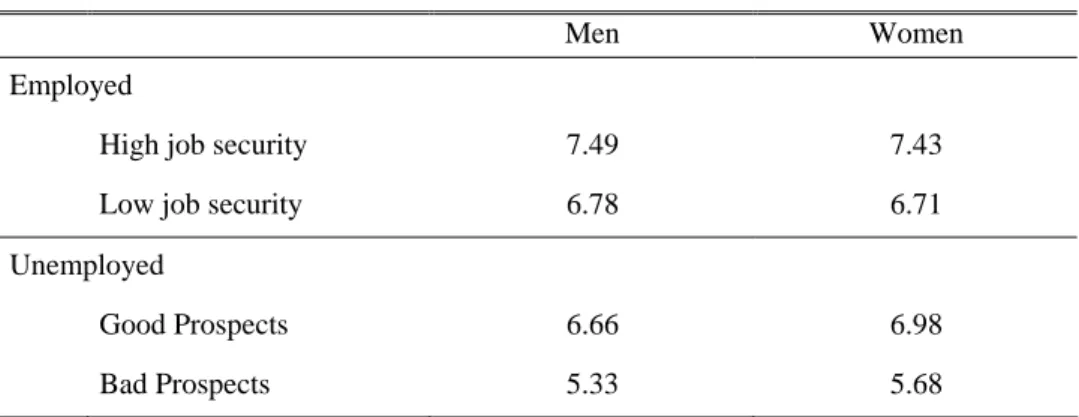
We start with some descriptive statistics.9 Table 1 shows the mean life satisfaction scores amongst the different labour-market groups defined above. For both men and women, the secure employed are the most satisfied, and bad-prospects unemployed are the least satisfied. However, the average satisfaction of the insecure employed and the good-prospects unemployed are remarkably similar. The differences in the satisfaction scores by insecurity (for the employed) and by prospects (for the unemployed) are significant at all conventional levels.
9
Table 1: Mean life satisfaction scores
Men Women
Employed
High job security 7.49 7.43
Low job security 6.78 6.71
Unemployed
Good Prospects 6.66 6.98
Bad Prospects 5.33 5.68
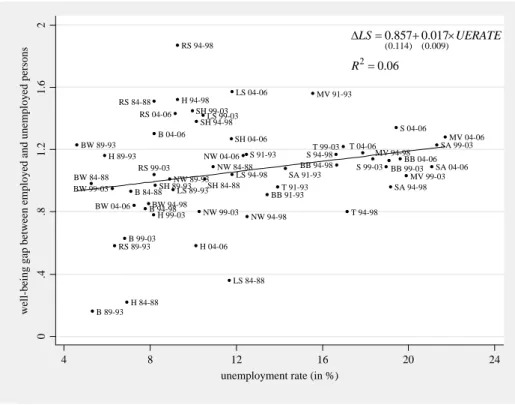
We are most interested in the relationship between well-being and regional unemployment for these different groups. Figures 1 and 2 make a first pass by illustrating, for men and women respectively, the correlation between regional unemployment and the difference between the mean life satisfaction of the employed and the unemployed, by region and by five-year periods from 1984 to 2006. These figures therefore plot out the well-being loss from unemployment, as a function of the regional unemployment rate.
Figure 1 shows that there is a negative relationship between this loss and regional unemployment for men. This is consistent with a social norm effect: the employed always report higher satisfaction than the unemployed, but this gap closes in high-unemployment regions. It is difficult to detect any social norm effect in Figure 2 for women, as the relationship appears to be positive, if anything, rather than negative. This is reminiscent of the BHPS figures in Clark (2003), where no social norm effect of unemployment was found for women.
Figure 1: Employed-unemployed life satisfaction gaps and regional unemployment: Men B 04-06 B 84-88 B 89-93 B 94-98 B 99-03 BB 04-06 BB 91-93 BB 94-98 BB 99-03 BW 04-06 BW 84-88 BW 89-93 BW 94-98 BW 99-03 H 04-06 H 84-88 H 89-93 H 94-98 H 99-03 LS 04-06 LS 84-88 LS 89-93 LS 94-98 LS 99-03 MV 04-06 MV 91-93 MV 94-98 MV 99-03 NW 04-06 NW 84-88 NW 89-93 NW 94-98 NW 99-03 RS 04-06 RS 84-88 RS 89-93 RS 94-98 RS 99-03 S 04-06 S 91-93 S 94-98 S 99-03 SA 04-06 SA 91-93 SA 94-98 SA 99-03 SH 04-06 SH 84-88 SH 89-93 SH 94-98 SH 99-03 T 04-06 T 91-93 T 94-98 T 99-03 .6 1 1.4 1.8 2.2 2.6 wel l-bei ng gap bet w een empl
oyed and unempl
oyed persons
4 8 12 16 20 24
unemployment rate (in %)
(0.124) (0.010) 2 1.918 0.029 0.15 LS UERATE R ∆ = − × =
Figure 2: Employed-unemployed life satisfaction gaps and regional unemployment: Women
B 04-06 B 84-88 B 89-93 B 94-98 B 99-03 BB 04-06 BB 91-93 BB 94-98 BB 99-03 BW 04-06 BW 84-88 BW 89-93 BW 94-98 BW 99-03 H 04-06 H 84-88 H 89-93 H 94-98 H 99-03 LS 04-06 LS 84-88 LS 89-93 LS 94-98 LS 99-03 MV 04-06 MV 91-93 MV 94-98 MV 99-03 NW 04-06 NW 84-88 NW 89-93 NW 94-98 NW 99-03 RS 04-06 RS 84-88 RS 89-93 RS 94-98 RS 99-03 S 04-06 S 91-93 S 94-98 S 99-03 SA 04-06 SA 91-93 SA 94-98 SA 99-03 SH 04-06 SH 84-88 SH 89-93 SH 94-98 SH 99-03 T 04-06 T 91-93 T 94-98 T 99-03 0 .4 .8 1.2 1.6 2 wel l-bei ng gap bet w een empl
oyed and unempl
oyed persons
4 8 12 16 20 24
unemployment rate (in %)
(0.114) (0.009) 2 0.857 0.017 0.06 LS UERATE R ∆ = + × =
Notes to both figures. Observations by German Federal States averaged over the following periods: 1984-1988 (only former West Germany), 1989-1993 (1991-1993 for East Germany), 1994-1998, 1999-2003, and 2004-2006. We exclude the three city states (Berlin, Hamburg, Bremen) as there are fewer than three observations per period. Key: B = Bavaria, BB = Brandenburg, BW = Baden-Württemberg, H = Hessen, LS = Lower Saxony, MV = Mecklenburg-West Pomerania, NW = North Rhine-Westphalia, RS = Rhineland-Palatinate/Saarland, S = Saxony, SA = Saxony-Anhalt, SH = Schleswig-Holstein, and T = Thuringia.
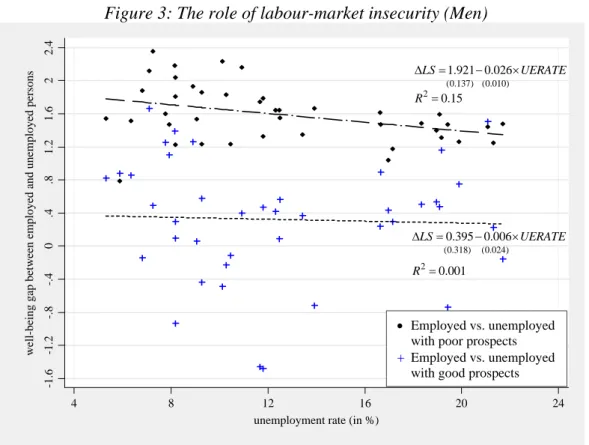
Our main hypothesis is, however, that the dividing line for the social norm is given by labour-market insecurity, rather than employment and unemployment. Figure 3 therefore reproduces Figure 1, but now dividing the unemployed up into those with good and bad prospects. The life satisfaction gap is larger between employment and bad-prospects unemployment than that with good-prospects unemployment: the unemployed with good prospects report life satisfaction not that much different from the employed. Of most interest for social norms is the slope of the regression lines. This is negative for the bad-prospect unemployed (so that being unemployed hurts less, relative to employment, in a high-unemployment region). However, there is no relationship between the well-being gap and regional unemployment for the good-prospect unemployed.10
Figure 3: The role of labour-market insecurity (Men)
-1.6 -1.2 -.8 -.4 0 .4 .8 1.2 1.6 2 2.4
well-being gap between empl
oyed and unemployed pers
ons
4 8 12 16 20 24
unemployment rate (in %)
(0.137) (0.010) 2 1.921 0.026 0.15 LS UERATE R ∆ = − × = (0.318) (0.024) 2 0.395 0.006 0.001 LS U R ERATE ∆ = − × = • Employed vs. unemployed with poor prospects
+ Employed vs. unemployed with good prospects
Note: Observations by German Federal States averaged over the following periods: 1984-1988 (only former West Germany), 1989-1993 (1991-1993 for East Germany), 1994-1998, 1999-2003, and 2004-2006. We exclude the three city states (Berlin, Hamburg, Bremen) due to a lack of sufficient observations (less than three observations per period).
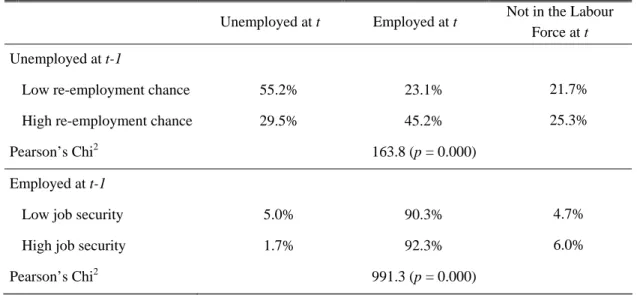
Before we move on to the econometric analysis, we should take seriously the criticism that individuals may not be able to judge their future employment prospects accurately. A simple test is to see whether individuals’ subjective scores are correlated with what actually happens to them in the future. Table 2 shows the percentage of individuals who are employed or
10
As such, the gap between good- and poor-prospect unemployment shrinks in higher unemployment regions: the two regression lines approach each other in Figure 3.
unemployed in year t, as a function of their subjective evaluations one wave earlier at t-1. In the top panel, the probability that the unemployed remain so from t-1 to t is clearly correlated with the prospects they reported at t-1. Of those with bad prospects at t-1, 55.2% are still unemployed at t; the analogous figure for the unemployed with good prospects at t-1 is 29.5%. The analogous figures for being in employment at t are 23.1% and 45.2% respectively.
Table 2: Future labour-force status and current perceptions of job insecurity
Unemployed at t Employed at t Not in the Labour
Force at t
Unemployed at t-1
Low re-employment chance 55.2% 23.1% 21.7%
High re-employment chance 29.5% 45.2% 25.3%
Pearson’s Chi2 163.8 (p = 0.000)
Employed at t-1
Low job security 5.0% 90.3% 4.7%
High job security 1.7% 92.3% 6.0%
Pearson’s Chi2 991.3 (p = 0.000)
A similar story unfolds for the employed in the bottom panel of Table 2 with respect to their job security. The differences in percentage points for the employed are smaller than those for the unemployed, partly because far fewer of them actually transit between statuses from one year to the next. Even so, the percentage of the employed becoming unemployed is almost three times higher amongst those reporting job insecurity, so the same broad conclusion holds that what individuals say about their labour-market insecurity has a counterpart in what actually occurs to them in the future.
Table 3: Well-Being and Others’ Unemployment (Fixed Effects OLS: “within”)
Without Future Expectations With Future Expectations
(1) (2) (3) (4)
Men Women Men Women
Reference Full-time
employed
Full-time employed
Full-time employed with secure job
Full-time employed with secure job Employed -0.363*** -0.216*** x Low security (0.034) (0.035) -0.017*** -0.008 x U Rate (0.005) (0.006) -0.018*** -0.005 x U Rate x High Security
(0.005) (0.006)
-0.012** -0.008 x U Rate x Low Security
(0.005) (0.006) -1.185*** -0.445*** Unemployed (0.088) (0.089) 0.147 0.236 x Good Prospects (0.273) (0.288) -1.571*** -0.599*** x Poor Prospects (0.095) (0.099) 0.002 -0.027*** x U Rate (0.007) (0.007) -0.047** -0.050** x U Rate x Good Prospects
(0.020) (0.024)
0.009 -0.028*** x U Rate x Poor Prospects
(0.007) (0.008)
Income (Monthly net household income divided by number of household members)
0.247*** 0.202*** 0.233*** 0.196***
Income/1000
(0.021) (0.023) (0.020) (0.023)
Individual controls Yes Yes Yes Yes
Individual fixed effects Yes Yes Yes Yes
Wave dummies Yes Yes Yes Yes
R2 0.059 0.041 0.069 0.047
No. observations 65468 55744 65468 55744
Note: OLS estimation with individual fixed effects and wave dummies, clustered standard errors. Individual controls include marital status, number of children, years of education, part-time, age dummies, living in owned accommodation, and having a household member in need of care. Standard errors in parentheses. * denotes significance at the 10% level, ** at the 5% level, and *** at the 1% level.
4.2. Regression results
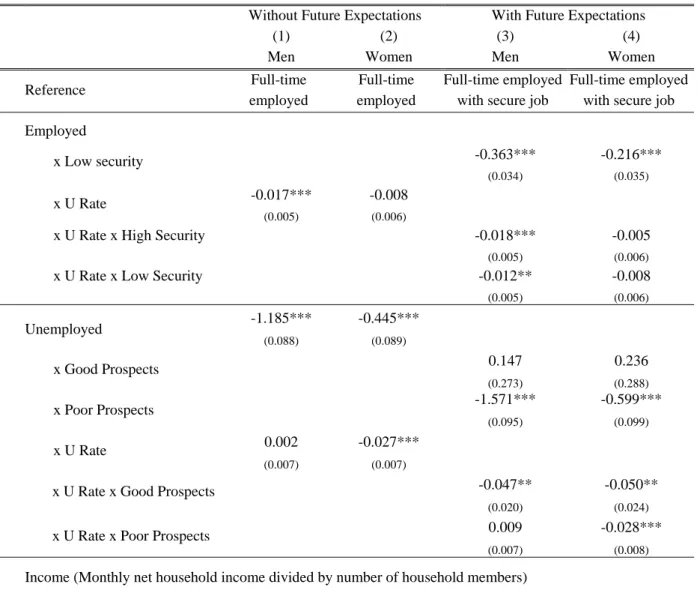
To analyze the effects of aggregate unemployment on well-being, we now turn to econometric analysis. The first two columns of Table 3 show the results of estimating specification (1) via OLS with individual fixed effects (i.e. a “within” analysis) for men and
women respectively. The standard errors in the regression are clustered, as regional unemployment is aggregated at a higher level than the dependent variable (see Moulton, 1990). The results here with German data are consistent with those found in a number of other countries (see Section 2 above). Own unemployment is associated with sharply lower well-being, and higher regional unemployment is negatively correlated with well-being for the employed. This highlights two of the channels through which unemployment affects well-being: negatively so for those who become unemployed, but also for those who remain employed. A ten percent higher regional unemployment rate (corresponding, for example, to the unemployment gap between the German federal states of Hesse and Mecklenburg-West Pomerania in 2006), is estimated to reduce the life satisfaction of an employed man (woman) by 0.17 (0.08) points on the 11-point scale.11
On the contrary, there is no significant effect of regional unemployment on the well-being of unemployed men, in line with the social norm hypothesis. The difference between the effect of regional unemployment on employed and unemployed men is statistically significant at the 1% level. The unemployed therefore suffer significantly less than the employed from higher regional unemployment (although we can not conclude that it actually makes them feel better). There is no evidence of a social norm effect for women.
We now turn to specification (2), where we distinguish individuals by their labour-market security. The estimation results are shown in columns 3 and 4 of Table 3. Both insecure jobs and bad prospects when unemployed reduce well-being, with sizeable impacts. Deteriorating job security from high to low produces a 0.363 point fall in subjective well-being for men, and a 0.216 point fall for women (disregarding the interaction effects, i.e. evaluated at a regional unemployment rate of zero). The unemployed with bad prospects have life satisfaction scores that are 1.571 points lower than those of the employed in secure jobs (again disregarding the interaction effects). However, the unemployed with good prospects are at least as happy as the employed. This supports the analysis of Eisenberg and Lazarsfeld (1938) cited in the introduction.
One major result from this econometric analysis is that the effect of aggregate unemployment on individual well-being depends on the degree of labour-market insecurity to which the individual is exposed. For men, regional unemployment is associated with lower well-being for the secure employed and for the unemployed with good prospects. This negative effect is attenuated for the employed with insecure jobs, and actually becomes positive (although not significant) for the unemployed with poor prospects. The difference in
11
The compensating differential for this effect is substantial: 8,600 Euros of household income per year for men, and about 7,100 Euros of household income per year for women.
the effect of regional unemployment for the secure and insecure employed is significant at the 10% level, and that between the good- and bad-prospect unemployed is significant at the 1% level. These results provide some support for the hypothesis that the dividing line for the social norm effect of aggregate unemployment is not employed vs. unemployed, but rather good vs. bad prospects. A ten percentage point rise in the regional unemployment rate reduces the life satisfaction of an unemployed man with good prospects by 0.47 life satisfaction points, but has no effect on the life satisfaction of an unemployed man with bad prospects. Those who feel stuck in unemployment are not negatively influenced by worsening labour-market conditions.
There are no significant effects of regional unemployment on the well-being of employed women. The interaction coefficients for the unemployed are both significant and negative, with that for the poor-prospect unemployed being less negative than that for the good-prospect unemployed, as was the case for men.
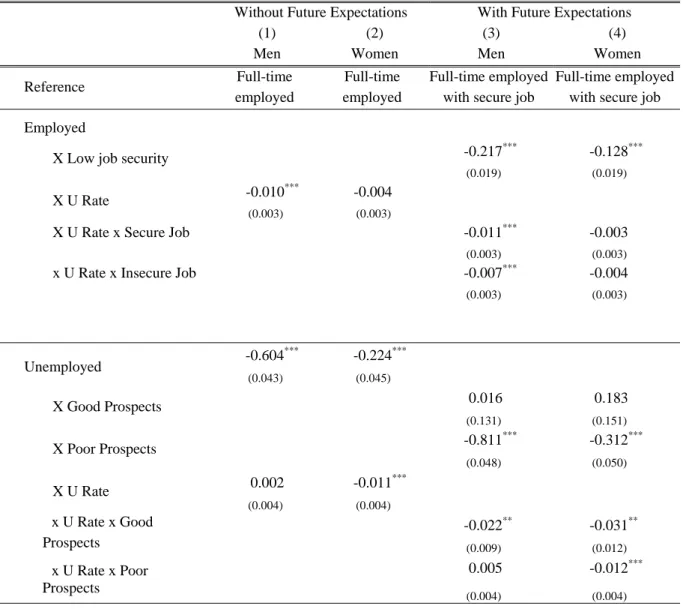
The above regression has used linear techniques to analyse life satisfaction. It can be argued that cardinal and ordinal analyses of well-being often produce similar results (Ferrer-i-Carbonell and Frijters, 2004). To check, we appeal to a second estimation method that respects the ordinality of the dependent variable – the Probit-adjusted OLS (POLS) approach of Van Praag and Ferrer-i-Carbonell (2004). In contrast to standard OLS which assumes equal distances between the life satisfaction categories, POLS transforms these latter on the entire real axis by using the overall sample distribution. Van Praag (2004) shows that the results generated by traditional ordered probit and Probit OLS are the same up to a multiplication factor. The advantage of POLS lies in the possibility of applying panel data methods, such as individual fixed effects, to the original ordinal variable without having to dichotomise the latter, as in fixed-effect logit estimation.12
Table 4 presents the results from POLS regressions with fixed effects and clustered standard errors. The results are qualitatively similar to the linear regressions in Table 3. The difference between the effect of regional unemployment on employed men (negative) and unemployed men (zero) in column (1) is significant at the 1% level. However, as before, the unemployed and the employed are not homogeneous groups. Column 3 shows that regional unemployment reduces the being of the secure employed by more than it does the well-being of the insecure employed, with the difference well-being significant at the five per cent level. It also reduces the satisfaction of the good-prospect unemployed (who are more like the employed in this respect), but has a positive coefficient for the poor-prospect unemployed.
12
We did also estimate conditional fixed-effect logits, finding similar qualitative results to those in Tables 3 and 4.
The difference between the two coefficients is significant at the one percent level. We again do not find any such social norm effects for women.
Table 4: Well-Being and Others’ Unemployment (Fixed Effects Probit-adjusted OLS)
Without Future Expectations With Future Expectations
(1) (2) (3) (4)
Men Women Men Women
Reference Full-time
employed
Full-time employed
Full-time employed with secure job
Full-time employed with secure job Employed
-0.217*** -0.128*** X Low job security
(0.019) (0.019)
-0.010*** -0.004 X U Rate
(0.003) (0.003)
-0.011*** -0.003
X U Rate x Secure Job
(0.003) (0.003)
-0.007*** -0.004
x U Rate x Insecure Job
(0.003) (0.003) -0.604*** -0.224*** Unemployed (0.043) (0.045) 0.016 0.183 X Good Prospects (0.131) (0.151) -0.811*** -0.312*** X Poor Prospects (0.048) (0.050) 0.002 -0.011*** X U Rate (0.004) (0.004) -0.022** -0.031** x U Rate x Good Prospects (0.009) (0.012) 0.005 -0.012*** x U Rate x Poor Prospects (0.004) (0.004)
Income (Monthly net household income divided by number of household members)
0.130*** 0.106*** 0.122*** 0.102*** Income/1000
(0.011) (0.012) (0.011) (0.012)
Individual controls Yes Yes Yes Yes
Individual fixed effects Yes Yes Yes Yes
Wave dummies Yes Yes Yes Yes
R2 0.055 0.039 0.066 0.045
No. observations 65,468 55,744 65,468 55,744
Note: Probit-adjusted OLS estimation with individual fixed effects and clustered standard errors. Individual controls include marital status, number of children, years of education, part-time, age dummies, living in owned accommodation, and having a household member in need of care. Standard errors in parentheses. * denotes significance at the 10% level, ** at the 5% level, and *** at the 1% level.
4.3 Labour market implications
Both regression tables make clear that the externalities from others’ unemployment depend both on one’s own labour-force status, and one’s own future prospects. Those with good prospects in the labour market interpret others’ unemployment more as a signal of their own future prospects (i.e. negatively), whereas this effect is mitigated for those with poorer prospects (the insecure employed and the poor-prospect unemployed).
It is however unlikely that the proportion of good- and bad-prospects labour market participants will be unaffected by aggregate developments: rising unemployment will surely push some employees into feeling insecure, for example (as in Clark and Postel-Vinay, 2008). Our estimates actually allow us to calculate this probability. In what follows, we do so for men, where we have identified a social-norm effect of unemployment.
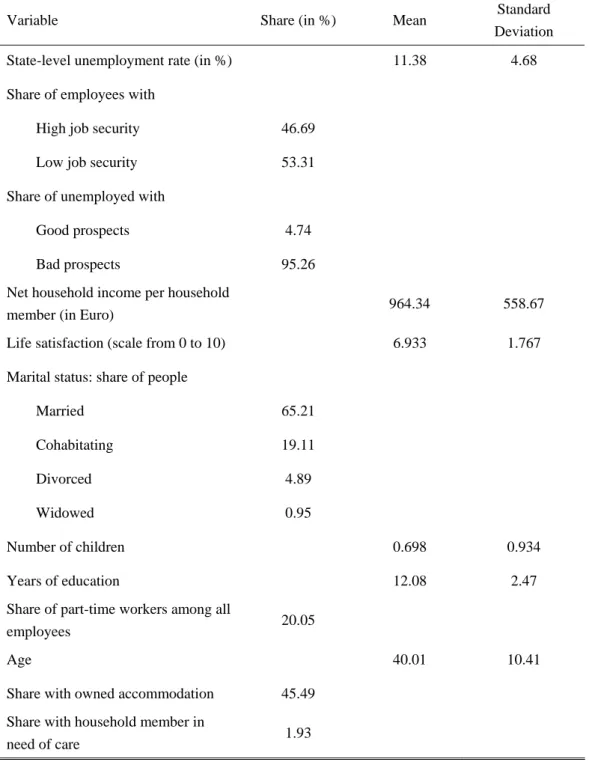
In Table 3, the coefficients in column (1) show the overall effect of aggregate unemployment on the well-being of the employed, and of the unemployed. Column (3) shows the separate effects of regional unemployment within labour-force status, depending on insecurity. We know the share of high-security vs. low-security employees (47% vs. 53%) and of good-prospect vs. bad-prospects unemployed (5% vs. 95%). If we weigh the estimated effects of the unemployment rate on well-being for the employed with secure and insecure jobs by their respective shares, we obtain an “average” effect that actually underestimates the negative total estimate for all employees (both secure and insecure) in column (1). This difference comes about because higher unemployment increases job insecurity. We can calculate the change in the percentage of insecure employees, for example, which is necessary for the weighted sum of the coefficients in column (3) to add up to the combined coefficient in column (1). This produces a marginal effect of -0.75: every one percentage point rise in unemployment reduces the percentage of secure employees by 0.75 points. The analogous calculation for the unemployed produces a marginal effect of -0.40.
We can check these figures by running linear probability models (with fixed effects and clustered standard errors) on the probability of reporting high job security, and of reporting good job prospects when unemployed. This produces very similar figures.
The marginal effect of unemployment on job insecurity might be thought to be too low here: after all a ten percentage point rise in unemployment will only reduce the percentage saying that their job is secure by 7.5 points. In this context, it should be remembered that there are many public sector workers in Germany, whose jobs might be thought to be largely insured against macro conditions. Luechinger et al. (2008) find evidence of exactly this phenomenon
using both GSOEP panel data, and American (GSS) and European (Eurobarometer) cross-section data.
We can use the above results to address two topics of particular policy relevance: inequality and unemployment hysteresis. Unemployment is often thought to bring increased inequality in its wake because it shifts people towards the bottom end of the well-being distribution. The social-norm effect, however, reduces the average well-being gap between the employed and the unemployed. The effect on unemployment on inequality is therefore a priori ambiguous, and depends on both the estimated parameters and the initial unemployment rate. At the average unemployment rate of 11% observed in our data, these two effects work in opposite directions, but produce an overall increase in well-being inequality, as measured by the Gini coefficient.
The inclusion of labour-market insecurity brings more detail to the analysis, as we now drop the assumption that the employed and unemployed are homogeneous groups. As such, we consider inequality within each group, as well as the inequality between the employed and unemployed described above.
The within-group effect of rising unemployment is in fact analogous to the between effect above: a higher unemployment rate is associated with a shift of individuals from the high well-being (secure) to the low well-being (insecure) group, at the same time as the well-being gap between the two groups shrinks. The key difference is in terms of the initial distribution of the “good” and “bad” groups. In the case of employment vs. unemployment considered in the between analysis above, 89% of the sample were initially in the good group. For the within analysis, only 47% of employees report a secure job, and only 5% of the unemployed report good prospects. At these values, the good-prospects groups are already relatively small, so that reducing their share actually reduces inequality in our data. This ensures that both effects of unemployment (the shift, and the shrinking gap) work in the same direction. In our sample then, unemployment produces greater inequality between the employed and the unemployed, but less inequality within each group.
The heterogeneity of the different labour-market groups may also impact on their behaviour. It is likely that the intensity of job search depends on the difference between the well-being values of employment and unemployment. The social-norm literature has pointed out that higher unemployment can reduce this gap, leading to the possibility of hysteresis (see Clark, 2003). The results in Tables 3 and 4 above show that this analysis continues to hold for the unemployed with poor prospects: as unemployment rises, the value of any employment relative to poor-prospect unemployment falls, producing the possibility of hysteresis in
unemployment. This conclusion is reversed for the good-prospect unemployed. Greater unemployment continues to reduce the value of employment, but critically has a far larger negative effect on the well-being of the good-prospect unemployed. As such the well-being gap between the employed and unemployed actually widens, increasing the value of getting back to work. For this group, worsening aggregate labour-market conditions may act as an encouragement to leave unemployment.
Overall, this finding strengthens the importance of the social-norm effect for unemployment hysteresis. Not all of the unemployed are affected equally, but those who already have poorer chances to return to the labour market are discouraged even more, while those with relatively good chances push harder to get back into the market. Rising unemployment thus drives a large share of potential employees away from the market and diminishes their prospects of returning to employment.
5. Conclusion
Unemployment is widely considered to generate negative externalities, quite apart from its effect on those who lose their jobs. A distinction is often made between the influence on the employed and the unemployed: aggregate unemployment reduces the well-being of the employed, but has a far smaller, or even positive, effect on the unemployed. This latter is suggested to reflect a social norm in labour market status.
We here use long-run German panel data to reproduce this standard result. Our main contribution is to suggest that the relevant fault line in externalities may not be between employment and unemployment, but rather via labour-market security. This latter is measured as job security for the employed, and the ease of finding a new job for the unemployed. The good-prospects group, both employed and unemployed, are strongly negatively affected by regional unemployment. However, the insecure employed and the poor-prospect unemployed are far less, or not at all, affected. This distinction appears to be particularly relevant for men.
While unemployment affects the good- and bad-prospect groups differently, it also shifts individuals between groups. Our estimations are consistent with a one percentage point rise in unemployment reducing the percentage of employees with a secure job by 0.75 percentage points. One implication of the shift-share and social-norm findings is that greater labour inequality (in terms of well-being) resulting from unemployment may be accompanied by falling inequality within each labour-force status.
This paper has appealed to measures of subjective well-being to distinguish groups in the labour market. One obvious application of these results is to job search, which has as one of
its keystones the value of employment compared to the value of unemployment. Our findings suggest that unemployment hysteresis may result from the social norm effect of unemployment. As the social-norm effect is stronger for the unemployed with poor reemployment chances, it is this group which is at risk of permanently higher unemployment. Future research should perhaps pay greater attention to heterogeneity in the labour market, not only in terms of the current labour market position, but also in terms of future prospects, as perceived by individuals themselves.
Appendix
Table A.1: Descriptive statistics
Variable Share (in %) Mean Standard
Deviation
State-level unemployment rate (in %) 11.38 4.68
Share of employees with
High job security 46.69
Low job security 53.31
Share of unemployed with
Good prospects 4.74
Bad prospects 95.26
Net household income per household
member (in Euro) 964.34 558.67
Life satisfaction (scale from 0 to 10) 6.933 1.767 Marital status: share of people
Married 65.21 Cohabitating 19.11 Divorced 4.89 Widowed 0.95 Number of children 0.698 0.934 Years of education 12.08 2.47
Share of part-time workers among all
employees 20.05
Age 40.01 10.41
Share with owned accommodation 45.49 Share with household member in
References
Blanchflower, D. (2007): Is Unemployment more Costly than Inflation?, NBER Working Paper No. 13505.
Blanchflower, D., and A. Oswald (2004): “Well-being over time in Britain and the USA“,
Journal of Public Economics, 88, 1359– 1386.
Brockner, J. (1988): “The Effects of Work Layoffs on Survivors: Research, Theory and Practice”, in B. Staw and L. Cummings (eds.): Research in Organizational Behaviour, Vol. 10, Greenwich: JAI Press, 213-55.
Brockner, J. (1992): “Managing the Effects of Layoffs on Survivors”, California Management
Review, 34, 9-28.
Clark, A.E. (2001): “What Really Matters in a Job? Hedonic Measurement Using Quit Data”,
Labour Economics, 8, 223-242.
Clark, A.E. (2003): “Unemployment as a Social Norm: Psychological Evidence from Panel Data”, Journal of Labor Economics, 21, 323-351.
Clark, A.E. (2008): Work, Jobs and Well-Being Across the Millennium. PSE, mimeo.
Clark, A.E., N. Kristensen, and N. Westergård-Nielsen (2008): “Job Satisfaction and Co-worker Wages: Status or Signal?”, Economic Journal, forthcoming.
Clark, A.E., and A. Oswald (1994): “Unhappiness and Unemployment”, Economic Journal,
104, 648-659.
Clark, A.E., and F. Postel-Vinay (2008): “Job Security and Job Protection”, Oxford Economic
Papers, forthcoming.
Cobb, S., and S. Kasl (1977): Termination: The Consequences of Job Loss, Cincinnati: US Department of Health, Education and Welfare.
Cohn, R. (1978): “The effect of employment status change on self-attitudes”, Social
Psychology, 41, 81-93.
Cooper, C. (1986): “Job distress: Recent research and the emerging role of the clinical occupation psychologist”, Bulletin of the British Psychological Society, 39, 325-331. De Witte, H. (1999): “Job Insecurity and Psychological Well-being: Review of the Literature
and Exploration of Some Unresolved Issues”, European Journal of Work and
Organizational Psychology, 8, 155-177.
Dekker, S., and W. Schaufeli (1995): “The effects of job insecurity on psychological health and withdrawal: A longitudinal study”, Australian Psychologist, 30, 57-63.
Di Tella, R., R, MacCulloch, and A. Oswald (2001): “Preferences over Inflation and Unemployment: Evidence from Surveys of Happiness”, American Economic Review, 91, 335-341.
Dooley, C., R. Catalano, and K. Rook (1988): “Personal and aggregate unemployment and psychological symptoms”, Journal of Social Issues, 44, 107-123.
Eisenberg, P., and P. Lazarsfeld (1938): “The psychological effects of unemployment”,
Psychological Bulletin, 35, 358-390.
Feather, N. (1990): The Psychological Impact of Unemployment, New York: Springer.
Ferrer-i-Carbonell, A., and P. Frijters (2004): “How important is methodology for the estimates of the determinants of happiness?”, Economic Journal, 114, 641-659.
Ferrie, J., M. Shipley, M. Marmot, S. Stansfeld, and G. Smith (1995): “Health effects of anticipation of job change and non-employment: Longitudinal data from the Whitehall II study”, British Medical Journal, 311, 1264-1269.
Fineman, S. (1990): Supporting the jobless: Doctors, clergy, police, probation officers, London: Tavistock/Routledge.
Fryer, D., and S. McKenna (1987): “The laying off of hands – unemployment and the experience of time”, in S. Fineman (ed.): Unemployment: Personal and social
consequences, London: Tavistock.
Fryer, D., and S. McKenna (1988): “Redundant skills: temporary unemployment and mental health”, in M. Patrickson (ed.): Readings in organisational behaviour, Sydney: Harper and Row.
Gerlach, K., and G. Stephan (1996): “A paper on unhappiness and unemployment in Germany”, Economics Letters, 52, 325-330.
Haisken-De New, J. P., and M. Hahn (2006): PanelWhiz: A Flexible Modularized Stata
Interface for Accessing Large Scale Panel Data Sets, http://www.panelwhiz.eu.
Hartley, J., D. Jacobson, B. Klandermans, T. van Vuuren, with L. Greenhalgh and R. Sutton (1991): Job Insecurity: Coping with jobs at risk, London: Sage.
Jackson, P., and P. Warr (1987): “Mental health of unemployed men in different parts of England and Wales”, British Medical Journal, 295, 525.
Jahoda, M. (1981): “Work, employment, and unemployment: Values, theories, and approaches in social research”, American Psychologist, 36, 184-191.
Jahoda, M. (1988): “Economic recession and mental health: Some conceptual issues”, Journal
of Social Issues, 44, 13-23.
Jones, F., and B. Fletcher (1993): “An empirical study of occupational stress transmission in working couples”, Human Relations, 46, 881-903.
Kessler, R., J. House, and J. Turner (1987): “Unemployment and health in a community sample”, Journal of Health and Social Behaviour, 28, 51-59.
Kessler, R., J. Turner, and J. House (1988): “The effects of unemployment on health in a community survey: main, modifying, and mediating effects”, Journal of Social Issues, 44, 69–85.
Knabe, A., and S. Rätzel (2008): Scarring or Scaring? The psychological impact of past
unemployment and future unemployment risk, CESifo Working Paper Nr. 2457, Munich.
Luechinger, S., S. Meier, and A. Stutzer (2008): Why Does Unemployment Hurt the
Employed? Evidence from the Life Satisfaction Gap between the Public and the Private Sector, WWZ Working Paper 03/08, University of Basel.
McKee, L., and C. Bell (1986): “His unemployment, her problem: the domestic and marital consequences of male unemployment”, in S. Allen, S. Waton, K. Purcell, and S. Wood (eds.): The experience of unemployment, Basingstoke: Macmillan.
McLoyd, V. (1989): “Socialisation and development in a changing economy: The effects of paternal job and income loss on children”, American Psychologist, 44, 293-302.
Moulton, B. (1990): “An Illustration of a Pitfall in Estimating the Effects of Aggregate Variables on Micro Units”, Review of Economics and Statistics, 72, 334-38.
Nelson, A., C. Cooper, and P. Jackson (1995): “Uncertainty amidst change: The impact of privatization on employee job satisfaction and well-being”, Journal of Occupational and
Organizational Psychology, 68, 57-71.
Noer, D. (1993): “Healing the Wounds: Overcoming the Trauma of Layoffs and Revitalizing
Downsized Organizations”, San Francisco: Jossey-Bass.
Oakley, C. (1936): “Some psychological problems of a depressed area”, Human Factor, 10, 393-404.
Platt, S., and N. Kreitman (1990): “Long term trends in parasuicide and unemployment in Edinburgh, 1968-87”, Social Psychiatry and Psychiatric Epidemiology, 25, 56-61.
Platt, S., R. Micciolo, and M. Tansella (1992): “Suicide and Unemployment in Italy: Description, Analysis and Interpretation of Recent Trends”, Social Science & Medicine,
34, 1191-1201.
Powdthavee, N. (2007): “Are there geographical variations in the psychological cost of unemployment in South Africa?”, Social Indicators Research, 80, 629–652.
Scutella, R., and M. Wooden (2006): Effects of Household Joblessness on Subjective
Well-Being, Melbourne Institute Working Paper Series, Working Paper No. 10/06.
Senik, C. (2004): “When Information Dominates Comparison: A Panel Data Analysis Using Russian Subjective Data”, Journal of Public Economics, 88, 2099-2123.
Shields, M., and S. Wheatley Price (2005): “Exploring the Economic and Social Determinants of Psychological and Psychosocial Health”, Journal of the Royal Statistical Society
(Series A), 168, 513-538.
Shields, M., S. Wheatley Price, and M. Wooden (2008): “Life Satisfaction and the Economic and Social Characteristics of Neighbourhoods”, forthcoming in Journal of Population
Stutzer, A., and R. Lalive (2004): “The role of social work norms in job searching and subjective well-being”, Journal of the European Economic Association, 2, 696-719.
Te Grotenhuis, H., and J. Dronkers (1989): “Unequal opportunities in a West-European Welfare State”, The Netherlands Journal of Social Sciences, 25, 18-29.
Van Praag, B. M. S. (2005), The Connection between Old and New Approaches to Financial Satisfaction, in: L. Bruni and P. Porta (eds.), Economics and Happiness: Framing the
Analysis, Oxford, 196-222. .
Van Praag, B. M. S., and A. Ferrer-i-Carbonell (2004): Happiness Quantified: A Satisfaction
Calculus Approach, Oxford: Oxford University Press.
Winkelmann, L., and R. Winkelmann (1998): “Why are the unemployed so unhappy? Evidence from panel data”, Economica, 65, 1-16.
![Modelization of the fragmentation dynamics of krypton clusters (Kr[sub n],n=2–11) following electron impact ionization](data:image/gif;base64,R0lGODlhAQABAIAAAP///wAAACH5BAEAAAAALAAAAAABAAEAAAICRAEAOw==)