HAL Id: tel-00603331
https://tel.archives-ouvertes.fr/tel-00603331
Submitted on 24 Jun 2011HAL is a multi-disciplinary open access
archive for the deposit and dissemination of sci-entific research documents, whether they are pub-lished or not. The documents may come from teaching and research institutions in France or abroad, or from public or private research centers.
L’archive ouverte pluridisciplinaire HAL, est destinée au dépôt et à la diffusion de documents scientifiques de niveau recherche, publiés ou non, émanant des établissements d’enseignement et de recherche français ou étrangers, des laboratoires publics ou privés.
contribution
Sarwan Abbasi
To cite this version:
Sarwan Abbasi. Human-computer interaction in 3D object manipulation in virtual environments: A cognitive ergonomics contribution. Computer Science [cs]. Université Paris Sud - Paris XI, 2010. English. �tel-00603331�
manipulation in virtual environments:
A cognitive ergonomics contribution
Doctoral Thesis submitted to the Université de Paris‐Sud 11, Orsay
Ecole Doctorale d'Informatique
Laboratoire d'Informatique pour la Mécanique et les Sciences de l'Ingénieur
(LIMSI‐CNRS)
26 November 2010
By
Sarwan Abbasi
Jury
Michel Denis (Directeur de thèse)
Jean‐Marie Burkhardt (Co‐directeur)
Françoise Détienne (Rapporteur)
Stéphane Donikian (Rapporteur)
Philippe Tarroux (Examinateur)
Indira Thouvenin (Examinatrice)
Acknowledgements
One of my former professors, M. Ali YUSUF had once told me that if I learnt a new language in a culture different than mine, it would enable me to look at the world in an entirely new way and in fact would open up for me a whole new world for me. I have found what he had said to be entirely true. So this was one of the things which had motivated me to look for a scholarship in a country, where the primary language of communication was not English (or for that matter, any of the other local South‐Asian languages that I learnt as a child), and hence I am here today writing my thesis in France. More concretely, this research was made possible through a contract between Higher Education Commission (HEC) and the French Embassy in Pakistan. While HEC funded most of my research for which I am grateful; the French Embassy arranged for us (me and certain other selected scholars) to learn and discover the French language and its culture by means of immersive language courses as well as arranging visits to different parts of the country before the commencement of academics. My interactions with the different people that I have met in France as well as the exploration of its different cities and regions has enabled me to enrich myself personally, academically, and culturally.
This research came into being as a result of a meeting that was held between me and Michel DENIS, who has become my thesis director at LIMSI‐CNRS at the Université Paris‐Sud 11 (Orsay). Since that time and up until now, it would not have been possible to carry on, had it not been for the help provided to me by him on a continual basis. He has always been there whenever I have needed him for his intervention in the capacity of my aid, be it administrative or academic. He has gone beyond the normal limits, in helping me out with progressing farther, even when sometimes I had thought that it was beyond my limits, though his aid was not limited just to encouraging me only. He responded to my emails most promptly, and always gave invaluable, timely, and relevant feedback whenever I had needed it. This was indeed extraordinary. Michel, I really thank you for that.
I was lucky enough to have gotten a chance to work under the direct supervision of Jean‐ Marie BURKHARDT, my co‐director, and with whom I also shared the same work‐place at the Université Paris Descartes. Whether at his office desk or at lunch table, he provided me with invaluable academic feedback on a continual basis and helped me learn and generate new ideas whenever I had needed them, and made me see things from a fresh point of view. I cannot thank him enough, for other than giving me useful advises throughout my research, he also ensured that I had enough resources for my personal sustenance especially towards the end of my thesis.
No research takes place in isolation and without the interaction and/or help from a vast variety of people and my research is not an exception to that. The most critical portion of the technical facilities and assistance was provided by the VENISE team at the LIMSI‐CNRS lab at Université Paris‐Sud 11 (Orsay). I would primarily like to thank Patrick BOURDOT, who is also the director of VENISE, who kindly accepted to let his virtual reality room and other facilities at his lab be used for my research. I cannot possibly thank him enough for accepting to help me, as a major part of my research would not have been possible without it. In addition to just the place and equipment, I was also helped by various other people of the VENISE team, including Pierre MARTIN, Damien TOURAINE and Jean‐Marc VEZIEN, without whose help also, the experiments in the virtual setting would not have materialised. In particular, Pierre MARTIN helped me extraordinarily, to make my underlying ideas about the virtual puzzle (especially the interactions part) come to life. I cannot thank him enough for the devoted and untiring effort that he put in for me. I am grateful to Françoise DETIENNE and Stéphane DONIKAN for agreeing to be reviewers of my thesis. They provided me feedback and suggestions which proved very valuable for me and which are reflected in the current version of the thesis. I am also thankful to Philippe TARROUX and Indira THOUVENIN who graciously accepted to be the examiners of my thesis.
There are many other people that I would like to thank, who have helped me in one way or the other, and I will probably not be able to name them all here. They appear here in no
particular order: my former colleague Rami AJAJ (researcher in graphics), a former student and an internee at Université Paris Descartes, Gosia TARASEWICZ (ergonomist), internee Adrien SCHWARTZ (ergonomics student) and Karin HEIDLMAYR (psychology student). I am thankful also to many friends and family members, particularly Safdar Abbas KHAN, Sohail IQBAL, Issa ABBASI, Tjaša NABERGOJ, Marie‐Laure LE GUEN, Asim ARIF and Taj KHAN, who helped me at different times and in different ways, whether their help was in the form of brain‐storming, typing, proof‐reading, giving ideas when I got stuck, or in the form of giving helpful advices and encouragement.
I thank also all the people who graciously accepted to participate in my experiments and without whom this research would also not have been possible.
Last but not the least, I would like to thank my colleagues Julien NELSON, Cécile GIRARD, Amel Ben AYED, Sophie CAPO, Jeannine BOURDEAUX, Katarina BOHACOVA and Stanislas COUIX, who helped me at different times and in different ways with my research work, as well as with my personal development. It is perhaps impossible to name everyone, and I am sure there would still be a lot of people whose names I have forgotten, and for which I sincerely apologise in advance.
Executive Summary
It is proposed to investigate the cognitive processes involved in assembly/disassembly tasks, and then to apply the findings to the design of 3D virtual environments (VEs). Virtual Environments are interactive systems that enable one or more users to interact with the simulation of objects and scenes usually in three dimensions, in a realistic fashion, by means of a set of computational techniques covering one or more sensory modalities (vision, touch, haptic, hearing, etc.). Often described as the ultimate direct manipulation interface, this technology seeks to make the interface eventually ‘disappear’ in order to provide users with a ‘natural’ mode of interaction. Virtual reality (VR) is the experience of being within a VE. One objective of the VR technology is indeed to exploit natural human behaviour without requiring any learning from their users [Fuchs2003], [Bowman2005].
Moreover, VEs are a stimulating field of research because they involve perceptually and cognitively novel situations [Burkhardt2003]. VEs also offer a large potential of innovative solutions to existing application problems. Among others, assembly tasks are a major focus for VEs [Boud2000], [Brooks1999], [Lok2003‐a], [Lok2003‐b], due to their numerous potential applications, such as assembly/disassembly of objects, scientific research (e.g., molecular docking [Ferey2009] etc.). The common feature in VEs is the use of representations and devices to support the users in handling and arranging several distinct elements in a three dimensional (3D) space under specific constraints.
Most of the current devices and interaction techniques have focused on providing users with high‐fidelity sensory stimulations, rather than targeting real‐life or task‐centred functions associated with the corresponding interfaces. While many contributions have been made to the field of VR, there are only few empirical data that have been published. We believe that it is very unlikely that more adapted VEs and assistance to users’ task – in the specific context of assembly tasks – will follow either just by chance [Brooks1999], by making repeated trials, by tuning what we already have at hand, or
by more realistic sensory renderings, without any reference to the ‘specific properties of the tasks’ including its cognitive dimension. Consequently, a clear picture of the cognitive processes and constraints in real tasks involving spatial manipulation should lead to a significant enhancement of the users’ interactions with VEs. This enhancement can be made by creating better or new guidance mechanisms (e.g., video feedback, object collision detection, or avoidance mechanisms) adapted to the users' goals and strategies. This project thus involves work both from the cognitive side and its implications on 3D interactions in industrial VEs.
The objective of this doctoral work is to contribute to a better understanding of human factors (HF) – including performance and cognitive processes – related to assisting spatial 3D manipulation and problem‐solving in assembly/disassembly tasks in VEs. For that purpose, we compared performance and strategies of subjects while they solve a simplified spatial task requiring them to assemble pieces to form a specified shape in various conditions of interfacing actions in real and virtual environments. The assembly task chosen was neither very easy such as put peg‐in‐a‐hole type task, as in [Zhang2005], [Pettinaro1999], or [Unger2001], nor highly complex and specific, such as performing open heart or liver surgery [Torkington2001] (one whose results could be applied only to that specific kind of task). The chosen task was semi‐complex, in which the users were required to construct a 3D cube using seven rectangular blocks of different sizes and shapes.
The methodology used had two tiers: real and virtual. For the chosen assembly task, a study was first conducted in real settings, which was to provide inspiration, input, and insight for the main experiment to follow. The main experiment that followed was similar in design, but the difference was that it was conducted in virtual settings. The experiment in virtual settings was conducted in three modalities – the classical keyboard‐mouse, the gestural modality, and the vocal modality.
The thesis is divided into two parts. Part I discusses the motivations for our problem and problem domain: puzzles. It then focuses on theoretical aspects underlying puzzles – more specifically spatial puzzles. Chapter 1 discusses the motivation behind our work and gives a broad introduction to our problem domain, the state of the art in VR and VEs, particularly with reference to the works supporting assembly tasks. It highlights the importance of the HFs related to assembly tasks in virtual and real environments. Chapter 2 focuses on problems and problem solving, and the relationship of problem solving with puzzles. It discusses the categorisation of different problems as well as the role and nature of constraints while solving problems. This chapter also discusses the role puzzles have played in the popular and scientific culture of problem solving.
Chapter 3 is dedicated to a special category of puzzles, the spatial puzzles, because our chosen problem (and experiment) is also categorised as a type of spatial puzzle. This chapter briefly discusses some of the popular classical spatial puzzles of historical importance, and also proposes to categorise the different kinds of spatial puzzles on the basis of their physical and structural aspects.
Chapter 4 discusses the issues related to interfaces and highlights the importance of their characteristics, and the role they can play (both in real and virtual settings) in rendering any problem easy or difficult. Part II is dedicated to our experiments designed to studying 3D objects manipulation tasks in real and virtual environments.
Chapter 5 lays the groundwork for the two experiments (one in the real setting, and the other in the virtual one) to follow. It explains the idea and motivation behind the experiment
which is in fact a spatial puzzle. The chapter also discusses the methodological aspects regarding the experiments, including physical and technical aspects of the puzzle. Chapter 6 is dedicated to the experiment that was conducted in the real setting. It discusses the experiment design and methodology used, followed by the result of the experiment and analysis. Chapter 7 is dedicated to the experiment designed and conducted in the virtual settings. The experiment was in fact based on the same puzzle which was discussed in chapters 5 and 6. This chapter thus discusses the aspects that are specific to the virtual settings, including the structure (hardware and software components) of the experiment and the different modalities used. It discusses the existing related work. Different modalities used and the method employed for the experiment are presented followed by the results of the experiment. Finally it summarises, compares and discusses the results of the experiment in different settings followed by analysis, observations and our commentary/explanations on them.
Lastly, chapter 8 is the concluding chapter. It gives the quick overview of our work. It draws general conclusions followed by our suggestions and recommendations. Two sections provide distinct sets of conclusions regarding the contribution of our study to knowledge in ergonomics and its contribution to informatics and human‐computer interactions. In the end, we discuss applications for our work and future possibilities.
CONTENTS PART I 5 INTRODUCTION AND THEORETICAL FRAMEWORK 5 1 CHAPTER 1: INTRODUCTION 6 1.1 VR IN SUPPORTING ASSEMBLY TASKS 7 1.2 HUMAN FACTORS RELATED TO ASSEMBLY TASKS IN REAL AND VIRTUAL ENVIRONMENTS 9 1.2.1 Assembly/disassembly and handling of objects: Ergonomic approaches in real situations 10 1.2.2 Assembly and manipulation in virtual environments: Current work and results from an ergonomic point of view 10
1.3 AN ALTERNATIVE FRAMEWORK: SPATIAL COGNITION, PROBLEM SOLVING AND 3D PUZZLES 12
1.4 CONCLUSION: THE OVERALL APPROACH TAKEN IN THIS WORK 15
2 CHAPTER 2: PROBLEM AND PROBLEM SOLVING: BACK TO BASICS 17
2.1 DEFINITIONS 18
2.2 THE NOTION OF PROBLEM SPACE: MODEL FOR ANALYSIS VS. REPRESENTATION ELABORATED BY THE SUBJECTS 20
2.3 ROLE AND NATURE OF CONSTRAINTS 24 2.4 TYPES OF PROBLEMS 24 2.5 DIFFERENT WAYS OF PROGRESS/REDEFINITION 27 2.6 OTHER APPROACHES TO PROBLEM SOLVING 29 2.7 CONCLUSIONS: PUZZLES AND PROBLEM SOLVING 30 3 CHAPTER 3: SPATIAL PUZZLES: AN OVERVIEW, ISSUES INVOLVED, AND NEW PERSPECTIVES 32 3.1 INTRODUCTION TO SPATIAL PUZZLES 33 3.1.1 Dissection puzzles 36 3.1.2 Mechanical puzzles 42 3.1.3 Mazes 44 3.2 DISCLAIMER TO FINALITY OF CATEGORISATION 45 3.3 COMPUTERISATION CHANGING THE NATURE OF PUZZLES 45 3.4 BUTLER'S CATEGORISATION OF SPATIAL PUZZLES 47 3.5 OTHER APPROACHES TO 3D PROBLEM SOLVING IN RELATED DOMAINS 49 3.6 CONCLUSIONS: TOWARDS MORE COHERENT CATEGORISATION OF PUZZLES 50 4 CHAPTER 4. INTERFACE, PRESENTATION MEDIUM AND CONSTRAINTS 52
4.1 PRESENTATION MEDIUM, INTERFACE, CONTROLS 53
4.3 INTERFACE‐RELATED CHARACTERISTICS OF SPATIAL PUZZLES 57 4.4 VISUALISATION 58 4.5 CONCLUSIONS: THE CRUCIAL ROLE OF PRESENTATION AND INTERACTION 60 PART II 61 EXPERIMENTAL CONTRIBUTIONS TO THE STUDY OF 3D OBJECTS MANIPULATION TASK IN REAL AND VIRTUAL ENVIRONMENTS 61 5 CHAPTER 5: THE PUZZLE EXPERIMENTS 62 5.1 THE IDEA AND MOTIVATIONS BEHIND THE EXPERIMENT 63 5.1.1 Questions raised in our experiments 64 5.1.2 The task chosen 64 5.2 MATERIALS, PHYSICAL AND TECHNICAL ASPECTS OF THE PUZZLE 65 5.2.1 Materials 66 5.2.2 Conventions used for measurement of the dimensions of blocks 68 5.2.3 Comparison of the blocks used in our experiments with the Soma Cube 69 5.2.4 The complexity of the blocks 70 5.2.5 Formal description of the cube including the different orientations and the positioning of the blocks 74 6 CHAPTER 6. THE BLOCKS MANIPULATION TASK: THE EXPERIMENT IN REAL SETTINGS 83 6.1 PHYSICAL SETTING 84 6.2 DESIGN AND METHOD 86 6.2.1 Participants 86 6.2.2 Procedure 86 6.3 DATA COLLECTION 88 6.4 METHOD OF ANALYSIS 88 6.5 NOTATIONS OF MOVES 91 6.5.1 The idea of attempt as the container of moves 93 6.6 RESULTS 93 6.6.1 Overall performance 93 6.6.2 Moves and attempts 97 6.6.3 Types of moves 104 6.6.4 Styles of solving and classification of blocks 105 6.6.5 Verbalisations 107 6.6.6 Post‐experimental comments 109 6.6.7 Conclusions 110
7 CHAPTER 7: THE VIRTUAL 3D‐PUZZLE 111 7.1 HARDWARE/SOFTWARE 113 7.2 BIG PICTURE: THE OVERALL SCENE AND THE SETUP 113 7.3 LITTLE PICTURE: THE COMPONENTS OF THE SCENE AND THE BEHAVIOURAL ASPECTS COMMON TO ALL MODALITIES 114 7.3.1 The convention for axes 115 7.3.2 The blocks 115 7.3.3 Selected and deselected blocks 115 7.3.4 Arrow emanating from the moving objects denoting the axis of movement 116 7.3.5 Casting of the shadows 116 7.3.6 Collisions 117 7.3.7 Occlusion 117 7.3.8 Six degrees of freedom (6‐DOF) 117 7.3.9 The view‐ball 118 7.3.10 Virtual levitation (lack of gravity) 119
7.4 EXISTING RESEARCH ON MODALITIES AND INTERACTION TECHNIQUES AND THE CHOICES MADE FOR THE VIRTUAL PUZZLE 119
7.4.1 Our chosen modalities 124 7.4.2 Other related issues 125 7.5 DESCRIPTION OF MODALITIES FOR THE EXPERIMENT IN THE VIRTUAL SETTINGS 127 7.5.1 Keyboard/mouse: The classical modality 127 7.5.2 Gestural modality 130 7.5.3 Vocal modality 138 7.5.4 Multimodality (G+V) 139 7.5.5 Salient features of the interface 145 7.6 METHOD EMPLOYED FOR THE RESEARCH 145 7.6.1 THE OVERALL PROTOCOL 145 7.7 RESULTS 151 7.7.1 Participants 151 7.7.2 Overall performance 153 7.7.3 Partial success distribution for G and V 154 7.7.4 Mean times for solution 156 7.7.5 Comparison of moves in different modalities 156 7.7.6 Solution as a function of number of attempts 161 7.8 COMPARISONS AND DISCUSSION 166
7.9 THE MULTIMODAL CONDITION (WITH BOTH G AND V) 172
7.9.1 Success rate 172
7.9.3 Average number of moves 173 7.9.4 Number of moves per attempt 174 7.9.5 Number of attempts 174 7.10 CONCLUSIONS 174 8 CHAPTER 8: DISCUSSION, CONCLUSIONS, AND PERSPECTIVES 176 8.1 OVERVIEW 177 8.2 CONTRIBUTION TO ERGONOMICS KNOWLEDGE 178 8.3 CONTRIBUTIONS TO INFORMATICS AND HUMAN‐COMPUTER INTERACTION 180 8.3.1 Difficulties to map the knowledge from real setting onto the interactions commands in a virtual environment 180 8.3.2 Performance with multimodal inputs and suggestions for improvement 180 8.4 PERSPECTIVES 182 8.4.1 Research perspectives 182 8.4.2 Applications (of manipulation of objects in 3D space) 184
Part I
1 Chapter 1: Introduction
This chapter discusses the motivation and gives a broad introduction to our problem domain, presents the state of the art in virtual reality and virtual environments, particularly with reference to the works supporting assembly tasks. It highlights the importance of the human factors related to assembly tasks in real and virtual environments. It touches upon the ergonomics of assembly tasks in real life situations, and how an improvement in that area can lead to improved efficiency. It concludes by analysing different approaches taken to study human problems, one of them being the use of spatial puzzles for studying human spatial cognition. Finally, it briefly explains the experiments that we conducted in real and virtual settings using various interaction modalities.
Assembly tasks are a major focus for virtual environments (VEs) [Boud2000], [Brooks1999], [Lok2003‐b], since their potential applications are enormous [Fuchs2006]. VEs use various representations, devices and interaction techniques, either generic or tailored to specific devices, to support their users in handling and arranging several distinct elements in a three‐ dimensional (3D) space under specific constraints. For example, in desktop computing, a mouse is a generic device which uses certain generic interaction techniques, such as the pointer which represents the placement of the mouse on desktop, and moving the mouse moves the mouse pointer over the desktop. To select an object on the desktop, the user may first move the mouse so that the mouse pointer is over the desired object, and then click the mouse key to select the object over which the mouse pointer was placed. Likewise, the keyboard is another such standard input device for desktop computers. In VEs, there are no such omnipresent devices which are accepted by the whole industry [Brooks1999]. Improvements in interfaces that resemble any kind of "realistic" or real‐life like situation would in turn help advance the field of VEs itself.
1.1 VR in supporting assembly tasks
What Poupyrev said back in 1997 (“manipulation of objects in VEs is often awkward and inconvenient”) still seems to be quite relevant, acknowledging that tiny factors, such as lack of tactile feedback, or poor design of interaction techniques, can turn a reasonably simple task (i.e. simple in the real‐world) of grabbing and moving an object into a frustrating experience in the virtual world [Poupyrev1997].
[Wang1998] deals with grasping (or prehension) and makes a comparison of performances in real and virtual tasks. MacKenzie and Iberall [MacKenzie1994] discuss the versatilities and the complexities of the human hand, and talk about the complexities involved in grasping and the task of ‘manipulation’ in general.
More recent works related to assembly/disassembly or manual (hand related) tasks generally involve comparative experiments in which the users perform the task in “real” and “virtual” settings. See, for example, the work of Axelsson and colleagues [Axelsson2001], who tests performance in real and virtual settings (though their focus is rather geared towards factors such as presence, co‐presence, collaboration and even leadership shown among participants). [Wideström2000] focuses more on the collaboration, and not the interactions or the interface.
A variety of tasks are used for this purpose, and performance is compared in real and virtual environments. It is reported that performances are indeed different under the two settings, but this does not help answer the critical reasons behind those differences, or identify the shortcomings which could point one in the right direction, eventually helping build VEs which could reduce those performance gaps.
We believe that the focus right from the start should be to try to focus on the interface and interaction techniques and to try to identify (or shortlist) the critical differences in interaction techniques which could play the most critical role in users' performance, and then to work on those interaction techniques.
[Froehlich2000] developed a new interesting input device which was in the form of a cube shaped box, with rods projected out of the six sides of cube (with in fact three perpendicular rods passing through the box) and buttons at the top (Figure 1.1). The rods could be pushed and pulled and they represented the X, Y and Z axes, which is promising for certain applications due to its natural mappings with the real 3D world.
We are constantly reminded that the right VE interface depends highly on the unique set of requirements of a given application: scale of distances, required form of movements and operations [Bowman2005] and other requirements such as power and precision [MacKenzie1994] Figure 1.1: The Cubic Mouse Device
1.2 Human factors related to assembly tasks in real and virtual
environments
There is no denying of the fact that the human hand is indeed a very versatile and complex tool [MacKenzie1994]. We use it for a vast variety of complex tasks ranging from writing to hammering nails, from turning the steering wheel of the car to changing its gear, from playing golf to pushing/pulling heavy objects. All these tasks have different power or precision requirements, and necessitate different hand postures and grasping techniques to perform each of them. MacKenzie and Iberall have treated the subject in great detail in their book ‘The Grasping Hand’ [MacKenzie1994].1.2.1 Assembly/disassembly and handling of objects: Ergonomic approaches in real situations
Much of the work in ergonomics related to assembly tasks by operators in "real" situations is yet to be developed. The domain lacks a definition of guidelines for the design of physical machines [Wartenberg2004]. The focus is on the physical and physiological (workload, gesture, posture) and rarely consider the detailed features of the task (for example tolerance to precision, visual and manipulation requirements), which affect the task itself (even if one ignores other factors like ‘poor work posture’ which have their own costs in the long run [Li1999]). It has been shown (for example in [Wartenberg2004]) that the presence of constraints such as increase in the precision requirements greatly increases the assembly times (sometimes by over 100%) and induces greater numbers of shorter cycles of movement, more control, verification and "immobility" (i.e. a strong restriction of space and a reduction in variation) of body movement and posture. The assembling tasks have also been addressed in ergonomics literature on procedural instructions and on learning process (for example in [Ganier2004]). This second approach is often focused on the effect of the instructions on assembly performance and their characteristics rather than on the processes of spatial problem‐solving, like reasoning, and the effect of physical properties of materials, and manipulation. These studies provide data on 'cognitive processes' as follow‐up procedural instructions. They suggest principles and potential solutions on improvement and assistance by means of instructions and documents. 1.2.2 Assembly and manipulation in virtual environments: Current work and results from an ergonomic point of view Current research on using assembly tasks have been conducted in the context of designing VEs. For a long time, such tasks were considered uniquely from the scientific and technical view‐point [Pettinaro1999] and more recently as a major axis for VR and Augmented Reality
(AR) [Boud2000]. Indeed, many real applications such as assembly/disassembly of objects in the industry with goals pertaining to training or maintenance, evaluation of the conceived product [Fuchs2006], scientific research (for example molecular docking [Férey2009]), and also with the objectives of training, result in evaluation or assistance in finding solutions, or using problem situations for conceptual learning [Roussou2006].
The technical literature is filled with strong hypotheses, about how VEs can contribute to assembling. Yet one rarely finds empirical evidence published on the utility or usability of VEs conceived for using different situations and specific tasks [Abbasi2009‐b]. A finding based on expert opinion and confirmed by some empirical studies [Boud2000] shows that this type of task is difficult in VEs and the manipulation is quite often unintuitive, even for "experts" of the domain. Several explanations have been put forward, such as mismatch and the difference in scale between physical and digital manipulation spaces, or the lack of comprehensive information feedback during the direct manipulation of objects.
To improve the ergonomics of these systems, researchers are committed to making the design of the interaction techniques more effective, employing three different approaches (sometimes combined). The first approach involves the development and evaluation of interaction metaphors based on an inventory of actions of the objects in 3D space. In this approach, the assembly is seen as a task of manipulating objects consisting of three generic actions: the selection, the positioning and the rotation of objects (see for example [Bowman2005]). The second approach tries to evaluate the contribution of high‐fidelity sensory information, with the performance in VEs. These studies focus for example on the visual modality, in particular stereoscopy [Werkhoven1998]. Recently a lot of work has focused on tactile (touch) and haptics (force feedback) [Boud2000], [Unger2001], [Lécuyer2002]. The third approach deals with "augmentation" or "substitution" of sensory information presented to subjects, for improving their performance in VEs. These studies compare and assess the contribution of different combinations of information ‐
complementary or redundant, according to the varied formats ‐ of visual, auditory and haptic information, for example [Lécuyer2002] and [Petzold2004].
These studies converge, amongst others, on four main results. (1) The time to complete an assembly task in "virtual" environment takes much longer (twice as long or more), than in "real" environment [Boud2000], [Unger2001]. (2) The visual information, according to its format and function (realistic, simplified, depth information, type of avatar etc.) strongly affects the user performance [Werkhoven1998], [Petzold2004], [Kadri2007]. (3) The addition of haptic information generally facilitates the assembly of objects in space [Boud2000], [Lécuyer2002], [Petzold2004]. And (4), the provision of information on more than one modality has mixed effects, as it may either assist or confuse the subjects with information overload and thus induce lower performance.
The dimensions of spatial‐reasoning and problem‐solving are missing in these studies, which poses a limitation in that it is difficult to say how their findings apply to tasks involving complex reasoning (for example tasks that require spatial reasoning and planning for solving them), like in 3D assembly task. Moreover, these works are based on extremely simple experimental or "atomic" situations, for example inserting a coin in a hole, stacking boxes, etc. The assembly situations and puzzle solving found in some studies are more of a pretext to create interactions between users in collaborative virtual environments [Heldal2005].
1.3 An alternative framework: Spatial cognition, problem solving and
3D puzzles
There are some works that have made use of assembly and manipulation tasks in their research to understand different human aspects, like problem solving. [Svendsen1991] used object manipulation tasks to study the different approaches in problem solving, where differences in cognitive load impact strategies and learning modes. In particular, he showed
that command interfaces more likely induce a learning mode based on insight, whereas direct manipulation tends to induce trial and error learning. Interestingly, when people use command interfaces, they are more able to verbalise the principles governing the solution of the problem than when using a direct manipulation interface.
There is some work done in spatial visualisation and mechanical reasoning but it tends to focus on issues other than those directly related to cognitive reasoning. For example, [Keehner2006] discusses spatial visualisation and mechanical reasoning in the context of the differences in performance of spatial skills of people earlier in their careers; versus when they have acquired enough experience to the extent that their actions become more automatic and less attention‐demanding. That is to say that it tests whether spatial ability contributes to performance, and how the contributions of the abilities change with greater practice and familiarisation.
We believe that before going farther in finding technology oriented applications to spatial‐cognitive problems, it seems more reasonable to invest resources in studying such problems in real‐life settings from different aspects, and to know more about them. However, even in these contexts where spatial dimensions and manipulation are involved in the problem to be solved, we have not found any investigation addressing methods and issues about how physical manipulation and environmental constraints might interplay with the cognitive aspects of the solving process implied in the situation.
[Hinckley1994] surveys the works focusing on design issues of free‐space input devices, and complains that there is a big void of works whose findings could be applied to different circumstances. The ones which do exist are either about single applications built for users with specialised tasks, or there are other formal studies, but which analyse individual phenomena in isolation. There are other studies based on the differences between the
performance in the real world and virtual or augmented environments (for example [Kabbash1993], [Wang1997]).
We would rather emphasise that more research is needed on such realistic problems which require object manipulation, but where the users are also requested to perform some problem resolution. So there is great value for research to focus on how users solve 3D object manipulation tasks which require not only mechanical skills (that is, tasks with just the manipulation aspect associated to it), but also require problem resolution skills.
In order to be usable, the technology (for humans) ought to be designed in such a way that one takes into account the way humans interact with everyday objects. Spatial cognition approach ought to take into account concepts such as affordance and other human tendencies such as following patterns based on Gestalt principles. Affordance (or Don Norman’s preferred term perceived affordance) is a visual clue to the function of an object [Norman1988]. The designer cares more about the perceived affordance (the affordance which also takes into account the ‘context’, ‘culture’, ‘instinct’ and ‘mental model’), or in other words what actions the user perceives to be possible rather than what is true. For example, in the context of a website, the perceived affordance of underlined text is that it indicates a hyperlink; by clicking, the user will link to information that relates to the hyperlinked word or phrase. The Gestalt theory attempts to describe how people organise visual elements into groups or unified wholes (based on certain principles such as similarity, continuation, closure, and proximity).
In addition, there could be other principles such as capitalising on well‐established conventions (for example, it would be hard today to introduce new keyboards other than the prevailing Qwerty/Azerty ones) and making use of principles learnt from previous experiences (for example, when a rigid body comes in contact with another, they collide
rather than merge). The human dimensions of the interface can become of increasingly greater importance. For example, if one is to compare two systems, both of which are slow and one of them responds to a certain command after a few seconds while the other shows a rotating hour‐glass and responds after the same time, the users show a preference for the second one [Nielsen1994], [Lautenbach1999]. Firstly, this is so because in the first system, in the absence of feedback, the user thinks that the systems is simply not responding, gets frustrated and tries to give another command. On the other hand, if the second system shows an hour‐glass sign, it has the effect of simply reassuring the user that the system is performing some action in response to the user's command. This sole fact induces the user to be more patient. In some cases, even when the waiting time in both cases is equal, the user’s perceived sense of waiting time is reduced in the latter case.
Thus, as one can see in the light of this experiment, human dimensions (especially human perceptions) are important in designing interfaces. Various principles have been introduced and have evolved as good practices in creating interfaces that are perceived to be more usable by humans.
1.4 Conclusion: The overall approach taken in this work
In the current chapter, we discussed that while Assembly tasks are increasingly becoming a major focus for VEs due to their enormous potential applications, their usability still continues to be an issue due to two things: firstly, due to the lack of standardisation of devices and interaction techniques (unlike the traditional desktop computing where the devices and interactions have reached a certain maturity already); and secondly, the potential possibilities applications of VE is also much vast and diversified in comparison to the traditional desktop computing. We also emphasised the importance that one approach to make VEs more usable is to not only consider the current task at hand in the VE, but an even better approach is to start even a step before, by first understanding the task at hand and considering human factors related to it in the real world.
In our research, we used 3D‐object manipulation puzzles. Puzzles can be 2D or 3D. Encyclopaedia Britannica defines a puzzle as a problem difficult to solve, or a mental challenge. According to Oxford Advanced Learner's Dictionary (OALD) the term puzzle is described as “a game that one has to think about carefully in order to answer it or to do it”. Apart from this primary meaning, there are two other alternative descriptions proposed by OALD. According to one of them, puzzles specifically refer to "jigsaws" (in which users have to assemble a 2D figure from various parts). According to the other, more general definition, a puzzle is "something that is difficult to understand or explain". It may be worth mentioning here that the term puzzle in French is also generally used in the sense of jigsaw, or more precisely a game of patience composed of many fragments which must be assembled to conform to a figure (for example in Larousse dictionary the term puzzle is defined as "Jeu de patience, composé d'un grand nombre de fragments découpés qu'il faut rassembler pour reproduire un sujet complet" [Larousse1991]). However, the definition that we intend to use in this text is the first one, according to which a puzzle is “a game or a mental challenge that one has to think about carefully in order to answer or solve it”.
Two separate experiments were conducted in the scope of this work, which were based on solving 3D‐object manipulation puzzles. One of these experiments was conducted in real settings (using real 3D blocks) while the other one was conducted in virtual settings using various interaction techniques. In the virtual experiment, the users operated and manipulated the blocks by means of the classical keyboard‐mouse modality, as well as by gesture and voice‐based modalities.
The next chapter introduces and discusses the notion of problems, the different kinds of (simple and complex) problems that humans encounter, how they solve them, the different ways in which the problems can be solved as well as the role of constraints under which problems have to be solved.
2 Chapter 2: Problem and Problem Solving: Back to
Basics
Humans encounter problems every day. However, to find a solution to a given problem, it is indispensable to define a framework where the problem can be expressed clearly. For the problem formulation, this chapter presents and discusses the notions of problem space and solution space, as well as the role of constraints in handling problems, and how they might affect and make a problem easier or more difficult. It points to the fact that puzzles have a special place in the history of problem solving, in that humans invent them for challenging others, for fun and entertainment, and even for studying problem solving per se in a controlled fashion.
2.1 Definitions
The nature of human problem‐solving activity has been studied by psychologists over the past hundred years. In the cognitive literature, problem‐solving has been defined as a higher‐order cognitive process that requires the modulation and control of more routine or fundamental skills.
According to Newell and Simon [Newell1972], problem solving is illustrated by every situation where from the outset an agent does not have an obvious already available procedure to reach the final objective. In other words, a person is said to be confronted with a problem when he/she wants something and does not know immediately what series of actions he/she can perform to get it. This definition implies that situations where the procedure to reach the final objective is already available may not be categorised as problem solving.
Problem solving is the cognitive processing directed at finding solutions and performing a sequence of operations. The actions involved in obtaining the desired object could be specific or general, physical or abstract, and may include physical actions, or perceptual or mental activities.
To have a problem implies that at least certain information is given to the problem solver: information about what is desired, under what conditions, by means of what tools and operations, starting with what initial information, and with access to what resources (i.e. goal, resources, side conditions, etc.).
Newell and Simon [Newell1972] define a problem as follows: A person is confronted with a problem when he/she wants something and does not know immediately what series of
actions he/she can perform to get it. The desired objective can be tangible (an apple to eat) or abstract (remembering something or proving a theorem); it may be specific (for example eating an apple) or general (eating something to appease hunger). The actions involved in obtaining the desired objective (whether physical or abstract) can include physical actions (walking, writing), perceptual activities (looking, listening), or mental activities (judging the similarity of two symbols, remembering a scene, etc.).
Depending upon ‘what is the task at hand’, ‘who is solving it’, and ‘the expertise of that person to solve the given task’, a given “problem” at hand could either be a ‘situation of elaboration’ of procedure, or a ‘situation of execution’ in which the solution is obtained by simply following the known procedures. In other words, what defines a ‘problem’ (or a ‘situation of execution’) is not only the situation, but also the relationship between the task and the competence of the subject. A certain task that may be a ‘problem’ for a certain subject may just be ‘situation of execution’ for the other. (See figure 2.1.)
Problem :) I know how to solve this :( I don’t know how to solve this! What previous knowledge do I have about this problem domain Fetch + Use that knowledge Search for Procedure from LTM Environment / Context Figure 2.1: Traditional information processing point of view of problem solving
2.2 The notion of problem space: Model for analysis vs.
representation elaborated by the subjects
We (humans) are generally said to be using our problem‐solving skills to proceed from a given state of a problem to a desired goal state. To elaborate, one can face a problem in two ways:
one possesses the knowledge applicable at the situation (that allows one to activate a certain procedure that may be applied in such a situation); or
one does not possess the knowledge applicable that permits/allows one to elaborate what actions to take (i.e. it doesn’t allow us to activate a certain procedure that may be applied in such a situation). The situation is thus perceived as a ‘problem’, and thus one must furthermore construct an interpretation of problem.
The notion of “problem space” is initially a generic model to analyse the solving process of a problem in an information‐processing framework. It is based on the idea that solving a given problem has three main components: a given state (or initial‐state); a goal state (or final‐ state); and a set of operators which one applies while one is actively solving the problem [Newell1972]. The set of all possible operations that can be performed in an attempt to reach a solution is called the “problem space”; while solution space is defined as the displacement in search‐space that may be represented by the graph of which the nodes represent the states that can take the situation based on (or followed by) the actions taken by the subject [Newell1972]. In the classical view, the problem difficulty can be attributed to two major sources: the amount of knowledge required to solve the problem; and the exponential growth of the search‐space as problem length and complexity increases It is worth noting that a difference should be made clear between the concrete realisation of the problem and the abstract description than can be made of its problem and solution space.
The notion of problem space is at the very core of the construction of this interpretation, called “representation of the problem”. Representation of the problem means constructing an interpretation of the situation that allows one to define the “search space”. This interpretation comprises three components of the problem situation: the interpretation of the initial situation or state, interpretation of the final state, and interpretation of the allowed (or legal) actions or operations that one can perform.
At certain times the operators that one would be using, and how will they be used to reach the goal state, may be fairly straightforward, while at other times they may not be.
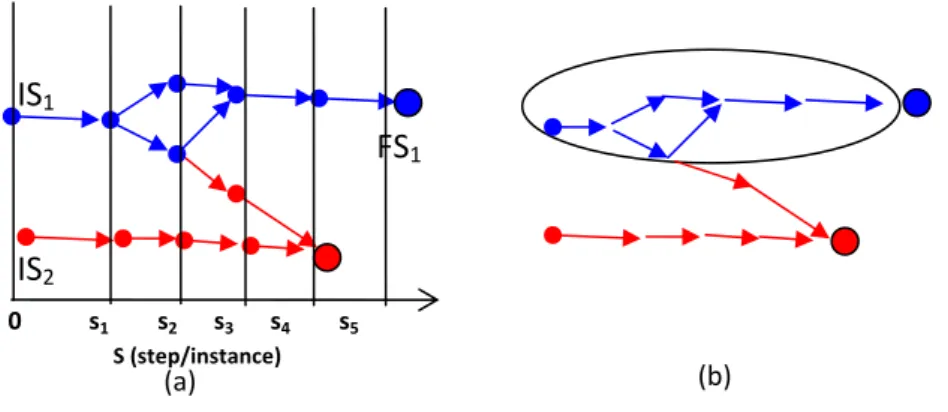
Figure 2.2: Problem Space (represented by the whole diagram), Solution Space (represented in blue), Initial States (IS1 and IS2) and the Final State (FS1)
Figure 2.2 can help better visualise the idea. In this figure, the presence of an arc between two states indicates that one can pass from one state to the other, meaning that there exists a valid (or legal) action that permits to pass from one state to another. The initial state (IS) and the final state (FS) are two different nodes on the graph (the start‐node and the end‐ node), while the solution is a path connecting the start and the end nodes. It can be the case that the search space doesn’t contain a solution state. In that case, it is not possible to achieve the solution in that search‐space and the problem is insolvable. The subject must thus revise certain aspects of the interpretation of the problem, notably the ones concerning legal actions, for example by eliminating too restrictive interpretations. In figure 2.2 above, there are two possible initial states and only one of them leads to the final state. Note that first of all, it is only possible to reach the final state if one starts from the first of the two initial states (i.e. IS1 and not IS2). Moreover, it is possible to reach the
solution at any given time, while one is in one of the states shown inside the oval (ellipse) in figure 2.2(b). But if one reaches to a state outside the ellipse, then in the current problem, it is no longer possible to reach the solution. FS1 IS2 IS1 0 s1 s2 s3 s4 s5 (b) (a) S (step/instance)
Of course, every problem can have its own graph with its own unique properties. Furthermore, as stated above, one finds solutions to problems based on the given circumstances and within the given parameters of the problem at hand. Before solving the problem, one must first know what it is that wishes to solve, under what conditions, under which constraints, and what available resources are at hand. While for some tasks, one may know this information explicitly, while for the others, this information may be hidden or implicit, and one may have to discover it as one goes along (the exploratory phase). When a child is asked to move a big stone from one place to the other, he/she might not know that it is too heavy for him/her to lift. The child might realise this by actually trying to lift is up, and realising that even a reasonably small stone may have an enormous mass (and weight). Similarly, knowing that a sponge is a very light material might make one think that it may be very easy to displace a very large piece of sponge (say 5 x 5 meters), until one finds by trying it out for the first time that it is in fact too heavy to be lifted unaided and bare‐handed.
To achieve a certain objective, when proceeding from the initial state to the goal‐state (under certain conditions), the user almost invariably passes through several intermediary steps. The ‘initial‐state’ ‐ the state in which the problem is presented ‐ is sometimes visual in nature, be it on paper or as a physical object in three dimensions, depending upon the problem at hand. Real life, however, is more complex than a jigsaw puzzle, and so what exactly constitutes a solution can also change from the solvers’ view point. In real life, problem solving also entails finding satisfactory solutions based on a personally defined solution‐space including the goal‐state, the resources available, and the constraints at hand. To explain this idea, the term satisficing was coined [Newell1972]. The concept is defined as setting an acceptance level or aspiration level as final criterion and taking an action based on that acceptance level or aspiration level (and which may not necessarily be the best or most optimised action in the given circumstances). What this means is that in most of the real world tasks, one sets for oneself a task (final‐state or goal‐state). When realising that there is a constraint or a limitation of a certain resource, one can decide to alter or modify the goal‐ state. In other words, this could translate to downplaying one's expectations.
2.3 Role and nature of constraints
Everything operates under certain constraints. We and other living things are all constrained on earth. The earth’s gravity constrains us, and thus we cannot escape off into space. Any given problem also operates under certain constraints, which can be of different kinds, tangible, intangible, physical, etc. Physical properties of the matter may impose certain constraints on how they may be handled or manipulated. A particular nut goes only with a certain kinds of compatible bolts, for example a bolt thicker in diameter than the inner hole or a certain nut, would not pass through that nut in normal circumstances.
Constraints can also take the form of verbal rules, for example in case of the physical incarnation of Tower of Hanoi, the user cannot move the disks horizontally (sideways) directly from one bar to the other because of physical constraints; however, the other constraints come only in the form of verbal rule, such as ‘moving only one disk at a time’ or ‘not stacking a bigger over a smaller one’. Although there is no physical hindrance and one can move two disks at a time or place a larger disk over a smaller one, nevertheless such a move is disallowed and is against the declared rules [Richard1993].
2.4 Types of problems
As per [Greeno1978], problems may be distinguished into three types, namely: Problems of induction of structure: Problems that require identifying the “relationship” characterising the group of given elements for example to find the rule governing a series of numbers and predict the next one in the series or simply to find a rule that it characterises. Here is an example of a problem of this type: 1, 2, 4, 8, . . . .
The goal here is to identify the relationship between the successive numbers and to predict the next number in the series. In the current case, the solver has to identify that
each number is obtained by multiplying the value of its immediate neighbour to the left by 2 (thus 1 multiplied by 2 yields the next number in the series i.e. 2, similarly 2 multiplied by 2 yields the next number in the series i.e. 4, and so on and so forth). Thus the correct response to the problem above is 16.
Transformation‐of‐state problems: A transformation‐of‐state problem has an initial state, and one must arrive at the final state, by utilising the permitted operators that allow one to transform the given or current situation. Some examples of puzzles that lie in this category include Chinese Rings Puzzle (or other wire or entanglement puzzles), Tower of Hanoi, missionaries and cannibals, while some real‐life examples include preparation of eggs (or any other meal), or making finished end products in a factory using raw materials (say, fabricating silicon‐chips from silicon).
Arrangement problems: In arrangement problems, one has a group of elements arranged in a certain manner at the beginning, and one must find one or more other arrangements that satisfy a certain criterion or criteria. For example when a child arranges his toys in a big basket or bucket so that they all fit inside, or when a fruit and vegetable seller does an arrangement of his fruits vegetables. Note the objective of the fruit‐seller could be either compactness (to maximise space), or it could just be to arrange his things aesthetically, or both. Other examples are anagram or cryptarithmetic, where anagram is a type of word play, the result of rearranging the letters of a word or phrase to produce a new word or phrase, using all the original letters exactly once; while cryptarithmetic aka “Verbal‐arithmetic” is a type of mathematical equation with unknown numbers, whose digits are represented by letters. The goal is to identify the value of each letter.
It can be argued that situations where objects change their given form in a more permanent (or an almost irreversible manner) like in chemical reactions or where the given object is torn or broken into two are the only situations that should be qualified as transformation of state. If one accepts this definition, then making a chair from raw wood qualifies as well, since it undergoes transformation since one has to cut and carve it out some wood, and since this transformation is fairly permanent and irreversible; however, building a house from Lego bricks does not qualify as transformation‐of‐state problem. We however prefer the less strict definition, whereby all those situations are to be qualified as transformation‐of‐state problems, in which the given object changes its form, regardless of whether the transformation is chemical or physical, or reversible or irreversible. Thus for example, if the aim is to form a complicated object (like a house or a car) out of Lego bricks, it is considered as a transformation‐of‐state problem. To clarify a bit more, whenever the transformation is of the form where the goal or aim is inherently focused on the transformation of state, it is considered as a transformation‐of‐ state problem, but in situations where the focus is not specifically on the transformation‐of‐ state per se, but rather in the way things are arranged with respect to each other, then it is considered as an arrangement problem. The missionaries and cannibals problem is an example of this type. The problem states that: there are three missionaries and three cannibals on one side of a river, along with a boat that can hold one or two people; and one is asked to find a way to get everyone to the other side of the river, without ever leaving more cannibals than missionaries on any side at any given time. Notice that the main focus is not to transform the objects at hand but to arrange them physically; or temporally in a certain order (manner). Notice also that in this problem, it doesn’t really matter in which order the cannibals cross the river, i.e. their order or their inter‐arrangement with each other is not of any importance.
To recap, it really depends how one defines transformation, but despite of that it could in fact be a very slippery slope. Since the two definitions have in fact arisen by studying some examples and naming and creating a category by seeing some sort of a resemblance amongst them based on certain generalisable characteristics, and not the other way round.
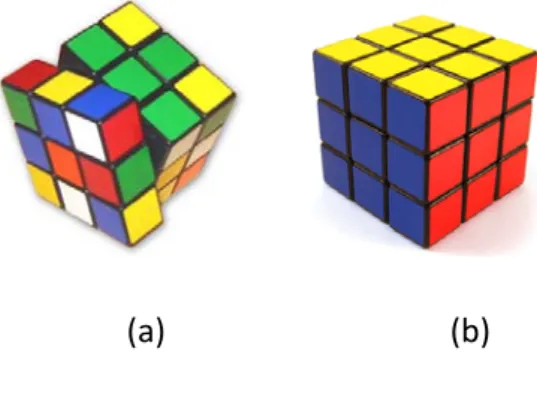
However they had not been devised in a fashion that guaranteed mutual exclusion. Due to this reason, some problems may qualify under both headings. For example if we were to consider the Tower of Hanoi, its objective is to arrange the disks on the three pegs or towers in a certain fashion (thus qualifying it as an arrangement problem), however, in the process, the towers made up of the pegs and disks transforms from one form to the other (thus one could also argue that this problem qualifies as a transformation‐of‐state problem as well). Similarly, Rubik’s cube can possibly be considered as an instance of both as well, depending upon how one looks at the problem. (Rubik’s cube is described and discussed in more detail in chapter 3.)
In summary, there are many examples of spatial puzzles and games that either do not precisely lie in either of the above mentioned categories, or do not uniquely lie in one category, but in more than one at the same time.
2.5 Different ways of progress/Redefinition
While one is in the process of solving a problem, or in the event of failure or an impasse, one undergoes the process of redefinition. This may be done by means of:
Redefinition of the task objectives (which could mean identifying subtasks and solving those subtasks, and trying to achieve local victories, as a stepping stone to reach the overall bigger goal); or
redefinition of available resources (which could mean gathering more tools, for example buying a spanner to open up a box to further probe and explore what might have gone wrong inside of the box; or thinking out of the box and rediscovering that the possibilities, tools or operators available at hand are more than one thought, or that there exist less constraints than one had at first thought).
In the well‐known case of the nine dots problem, the objective is to cross out all the nine dots by drawing four straight lines, without lifting the pencil in between (Figure 2.3). Figure 2.3 : The nine dots problem Figure 2.4 : One possible solution to the nine dots problem One of the techniques of solving some problems is to realise that some operations are too restrictive, and that one needs to rethink (reassess) if one is implicitly placing more restrictive conditions than has been explicitly mentioned. In the nine dots problem, the reassessment/redefinition of available resources translates into a modification of the inferred rules of action or reassessing the constraints imposed upon oneself. One possible solution to the problem is shown in figure 2.4. The solution to the problem becomes easier when one realises that one has not been told that the straight lines cannot go beyond the boundaries of the imaginary square that many people see.