• Aucun résultat trouvé

Effect of additives, heat treatment and mechanical deformations on hydrogen storage properties of BCC alloys

N/A
N/A
Protected

Academic year: 2021

Partager "Effect of additives, heat treatment and mechanical deformations on hydrogen storage properties of BCC alloys"

Copied!
147
0
0

Texte intégral

(1)

mechanical deformations on hydrogen

storage properties of BCC alloys

Submitted in partial fulfilment of the requirements

of

the degree of

Doctor of Philosophy

by

Amol Kamble

(Roll

No. 144178001)

Under the guidance of

Prof. Pratibha Sharma

&

Prof. Jacques Huot

(Co-supervisor)

(Supervisor)

Université du Québec

à

Trois

-

Rivières

Department of Energy Science and Engineering

Indian Institute of Technology Bombay

Mumbai

(2)

Université du Québec à Trois-Rivières

Service de la bibliothèque

Avertissement

L’auteur de ce mémoire ou de cette thèse a autorisé l’Université du Québec

à Trois-Rivières à diffuser, à des fins non lucratives, une copie de son

mémoire ou de sa thèse.

Cette diffusion n’entraîne pas une renonciation de la part de l’auteur à ses

droits de propriété intellectuelle, incluant le droit d’auteur, sur ce mémoire

ou cette thèse. Notamment, la reproduction ou la publication de la totalité

ou d’une partie importante de ce mémoire ou de cette thèse requiert son

autorisation.

(3)
(4)

This the sis entitled

"

E

ff

ect of additives, heat treatment and

mechanical deformations on hydrogen storage properties of Bee

alloys

"

by Mr. Amol Kamble is approved for the degree of Doctor

of Philosophy.

Examiners

r-f\dl~

1

.

__

~~~~~

________

____ _

Prof. Ani! Kumar Emadabathuni

(External Examiner)

2

.

--

g

--i+-"-+

~

-

-Prof. pra ...

r;.

Ghosh

(In

t

ernhl E

x

aminer)

J:il

\\

)'Y\~ )s

l

o~)?ol?

Prof. P. Vellaisamy

(Chai

r

-Person)

.

Prof. P6rtibha Sharma

(Supervisor)

te

P-Prof. Jacques Huot

(Co

-

Supervisor)

Date

:

15

th

March 2019

(5)

1

declare that this written submission represents my ideas in my own

w

ords and where others' ideas or words have been included

,

1 have

adequately cited and referenced the original sources

.

1 also declare

that 1 have adhered to aIl princip les of academic honesty and integrity

and have not misrepresented or

'

fabricated or falsified any

idea/data/fact/source in my submission. 1 understand that any

violation of the above will be cause for disciplinary action by the

Institute and can also evoke penal action from the sources which have

thus not been properly cited or from whom proper permission has not

been taken when needed.

Date:

03 (04

'!l..o~

Amol Kamble

Roll No.: 144178001

(6)

The BCC 52Ti-12V-36Cr

alloy

has high

gravimetric

hydrogen capacity

at

room temperature

under low hydrogen pressure

(2

MPa)

,

but it has long incubation time during first

hydrogenation. The

effects

of

additives

,

heat treatment

,

bail milling

and

parti cie

size

on first

hydrogenation

were analysed

to find

suitable additive and synthesizing

technique

with

optimized first hydrogenation

.

The impacts of

zirconium and

nickel

as

individual

additives with

respect to

additive

Zr

7

Niio

on first hydrogenation

were

investigated. Ail

additives

resulted in reduction in the incubation

time by at least two orders

of

magnitude, probable reason

could

be presence of Zr-Ni rich

secondary

phase. Fast intrinsic kinetics

(slope of

hydrogenation

curve at

mid-capacity)

is

observed in presence of

zirconium while

high hydrogen

capacity 3.78wt

%

is

achieved in

presence of nickel. The

Zr

7

Niio

was found

to be the most

effective additive among

the

studied

additives

with optimized

absorption

properties.

The BCC 52Ti-12V-36Cr

alloy with

different

additives was

further processed for heat

treatment of l-week

at

1273K. The

effect of

heat treatment

on crystal structure,

microstructure

and

first hydrogenation has been

studied. The

unwanted incubation time

got

eliminated

but it

adversely

reduced hydrogen

capacity

by 30%. The

elimination

of incubation

time is observed probably due to change in phase compositions and their

abundance

.

The loss

ofhydrogen capacity may be due to reduced BCC phase abundance

after

heat treatment.

The effect of bail milling on BCC 52Ti-12V-36Cr

alloy casted with additive (4wt% of

zirconium

used

as additive) was studied.

Bail milling

although

reduced the

crystallite size

to

a

large

extent but was observed

to have

adverse effect

in terms

of

reduced intrinsic

kinetics,

total and reversible hydrogen

capacity.

The behaviour of hydrogenation

still

remained

unexplainable.

When the

zirconium was

added to pre-cast of BCC52Ti-12V -36Cr

alloy

mechanically using

bail milling for durations of

30

and 60 minutes

,

no

absorption was

observed. Bail milling for

15 minutes

shows

heterogeneous layering of

zirconium over

BCC parti

cl es which

affects

stability

of hydride phase

and

increases desorption plateau pressure.

There

is loss

of

reversible hydrogen

capacity and

intrinsic kinetics.

The additional

decrease

of intrinsic

(7)

surface morphology.

The relative importance of particle size and additive was studied for cast of BCC

52Ti-12V-36Cr without/with additive (4wt

%

of zirconium) for selected ranges of particle size: less than

0

.

5 mm, between 0.5-1.0 mm and greater than 1.0 mm

.

The additive has stronger impact than

particle size on both the incubation time and intrinsic kinetics. The alloys have monolithic

hydrogenation curves.

In short, the Zr

7

Ni 10

is most effective additive and just melting together with additive could

be considered as optimized synthesizing technique for BCC alloys .

(8)

1 take this opportunity to

express a

bottomless

sense

of

gratitude

towards my

guide

Prof.

Pratibha

Sharma

and

Prof.

Jacques

Huot for

providing

excellent guidance,

inspiration

and

encouragement

throughout the journey

with

liT Bombay

and UQTR Canada

in

order

to

fuI

filment

of

my doctoral

studies.

1 thanks to both

of

them

for creating good working

environment

by knowledgeable discussions

,

sticking

to planned

schedule and

providing

excellent laboratory facilities.

1

am

heartily thankful to my

research

progress

committee

member

,

Prof. P.

C.

Ghosh

and

Prof.

Srinivas Seethamraju

for

their

valuable suggestions and

queries

,

which

help me to

improve my thesis

and

the research

works a lot.

1

am

extremely thankful to

Prof.

R.

Banerjee,

HOD of

Department

of

Energy

Science

&

Engineering at

lIT Bombay

and

Prof. Richard Chahine,

Director, Institute of Hydrogen

Research

at University

du Quebec

Trois-Rivieres,

QC

,

Canada for accepting

me

as

doctoral

research

scholar, approving

my

student ex change

program

and

helping me during pursue of

the doctoral degree.

1

express

my

special

thanks to

faculty adv

isor

Prof.

Chetan Solanki

and other

professors

Prof.

Sankara Sarma V

Tatiparti, Prof.

Suneet Singh

and

Prof.

Sandip

Kumar

Saha for

their

valuable guidance and support

during my

course work at

lIT Bombay.

How could 1 forget the team

which

offered funding through

Queen

Elizabeth

II Diamond

Jubilee Fellowship during my

stay

at

UQTR, Canada. 1

appreciate

their the most

valuable

unconditional financial

support for

my joumey

with

UQTR. 1

am grateful

to

fe

llowship

coordinator

Ms. Genevieve Cote for taking

care of continuous funding

required

for

research

and

trainings.

(9)

Education Society's Pillai HOC college of Engineering

&

Technology, Rasayani

(PHCET-Rasayani)

and

D

Y Patil

School

of Engineering Academy, Ambi (DYPSOEA,

Ambi)

for allowing me

to

complete doctoral studies while working with their

institutions.

1

am very grateful for time to time guidance, suggestions and continuation of support provided

by Mr. Vilas Nitnaware, Principal, DYPSOEA, Ambi.

1

appreciate the technical support of Ms. Marie-Eve Marchand in various mechanical and heat

treatments and Ms.

Lejeune Agnes

in

Scanning Electron Microscopy(SEM) plus Energy

Dispersive Spectroscopy(EDS). 1 am also thankful

for professional coordination and valuable

suggestions

during

experimentation from

my lab

mates

Ms.

Sai

ma

Sieiman,

Ms. Viney

Dixit, Ms.

Volatiana Razak, Mr.

Abhishek Patel, Mr. Joydev Manna, Mr. Meraj Alam,

and

Mr. Peng Lv. 1

also grateful to Hydrogen

&

Photovoltaic research group

members

Mahavas, Saurabh, and Animesh

.

Lastly

but

most

important, 1 would

like

to acknowledge my family for altogether

their love

and encouragement. 1 want to thank my parents

Late Mr. Gulabrao Kamble

and

Mrs.

Anjana Kamble,

who worked hard and

did

whatever possible to

make

me successful and

who

never

stopped cheering me. 1 am also

thankful

to

my

brother

Prashant

and sister

Kanchan

, for their

love and belief in me. And most of ail

, 1 am gratified to

my sweet heart

Anjali

and

my daughter Priyadarshini,

for their

love,

support,

encourage and patience

during

this four-year

'

s joumey and gladly accepting the

pain

of living

far away from

me

(10)

Abstract...

...

.

...

v

Acknowledgements...

.

..

...

.

...

.

vii

Table of Content...

ix

List of

Figures...

xii

List of Tables...

xiv

Nomenclature..

.... ...

... ...

....

...

... ...

... ...

.

... ..

.

... ... ..

.

... ...

...

xvi

1.

INTRODUCTION

1

1.1

Background...

..

..

...

.

..

..

..

...

..

....

.

...

.

....

...

...

...

.

..

..

.

....

.

.

2

1.2 Energy carrier-Hydrogen

.

....

..

...

..

..

....

.

...

.

...

...

.

..

..

... ....

3

1.3 Why BCC solid solution?

...

..

...

...

...

...

...

...

...

...

...

7

lA Choice of alloy composition

.

..

..

..

.

..

.

.

..

..

..

.

...

..

...

....

...

.

...

...

...

....

7

1.5 Research

aim and objectives

..

.

..

..

..

.

....

..

..

.

..

....

..

..

..

.

..

...

.

...

..

...

..

...

.

.. ...

9

1.6 Significance of study-Industrial applications....

...

.

...

.

...

...

..

..

...

.

..

...

.

9

1.7 Thesis Structure.... ..

.... ..

.

.

... ..

.

.. ..

..

... .

..

.

.

.... ... ...

... ..

.

..

.

.

... ..

.

...

.

.. ...

10

2.

LITERATURE REVIEW

Il

2.1 Overview.

...

..

....

.

...

....

.

..

...

.

...

.

...

.

...

.

...

..

...

.

..

...

.

.

.

12

2.2 Hydrogen Storage Properties

.

..

.

.

..

...

...

..

....

.

....

.

..

...

...

....

.

..

....

..

.

...

.

..

..

.

..

.

12

2.2.1 Storage Capacity...

.

...

.

..

...

..

..

...

...

.

..

...

.

...

.

...

.

..

.

...

12

2.2.2 Hydrogen Absorption Kinetics

.

..

.... ..

.

....

..

.

..

...

.

.. .

..

..

.. ..

.

...

.

..

..

..

.

..

..

13

2.2.3 First Hydrogenation

.... ... ...

.

... ... .... ...

.

... ..

... ... ...

15

2.3 Factors affecting first

hydrogenation....

.

..

..

.

..

..

....

.

...

...

.

..

...

...

.

.

16

2.3.1 Effect of additives on hydrogen sorption properties...

....

...

.

...

.

...

16

2.3.2 Effect ofmechanical deformations on

hydrogen sorption properties

.

... ...

19

2.3.3 Effect ofheat treatment on hydrogen sorption properties.

.

...

.

...

22

204 Ti-V-Cr Temary Phase Diagram.... ...

.

....

.

..

.... ...

...

..

.

..

.. ..

.

.. ..

...

.

.... ..

.

.. ...

26

3.

MA TERIAL SYNTHESIS &

CHARACTERIZA TION

29

3.1 Overview

..

... ... ...

... .... ...

.

.... ...

.

.

.... ...

..

..

...

..

.

..

.

...

.

.. ... ...

.

..

.

....

....

30

3.2 Weight %

&

atomic %...

...

...

...

...

...

30

3.3 Raw materials...

.

...

.

...

...

..

..

.

..

...

.

..

....

.

...

..

.

...

...

...

.

.

...

....

32

3.4 Arc melting.

.

...

.

..

.

....

....

..

...

..

..

...

...

..

.

...

...

...

.

.

...

.

....

.

...

33

3.5 Bail milling.

...

..

.

...

.

...

..

.

..

...

.

...

...

...

...

.

...

.

..

...

....

.

...

.

...

.

..

.

34

3.6 Heat treatment...

..

...

..

....

...

...

..

....

.

..

.

..

...

.

...

.

..

...

..

..

..

...

...

.

..

...

.

.

.

35

3.7 X-ray Diffraction (XRD)

...

...

.

....

...

..

...

..

..

..

.

..

...

.

..

..

..

.

...

.

..

...

...

....

.

36

3.8 Scanning Electron Microscopy (SEM)....

.

..

..

..

..

..

.

..

...

.

.

..

...

.

...

.

..

..

... ....

38

3.9 Energy Dispersive X-ray Spectroscopy (EDS)..

.

....

.

....

...

.

..

.

...

.

....

...

..

..

39

(11)

4

.2 C

h

o

ic

e of A

dditi

ve.

.

.

.

...

.

...

47

4

.3 Ex

p

e

rim

e

nt

a

l P

ro

c

e

dur

es....

.

.

.

... ....

47

4.4 R

es

ult

s

&

Di

sc

u

ss

ion.

.

.

.

.

.

....

.

....

.

.

...

..

.

..

.

.

.

.

...

.

.

.

..

.

..

.

.

.

.

.

.

.

.

.

...

...

.

..

.

....

.

.

...

.

.

4

8

4.4

.

1

M

i

c

ro

st

ru

c

tur

e

o

f as

-

cas

t B

CC 52

Ti-1

2V

-

3

6

C

r

w

it

h/w

i

t

h

o

u

t a

dditi

ve...

.

.

4

8

4.4

.2 E

n

e

r

gy

D

is

p

e

r

sive X

-r

ay S

p

ec

tr

osco

p

y (E

D

S)

..

.

.

.

...

..

.

.

.

.

..

.

....

.

.

.

.

.

..

.

....

5

1

4.4.3 X

-r

ay

di

ffrac

ti

o

n

(

XRD

) of as cas

t

a

ll

oys

.

.

.

..

..

.

...

.

..

.

.

.

..

.

.

.

.

..

.

...

..

.

...

..

.

.

5

4

4.4

.4 F

ir

s

t h

y

dro

ge

n

a

tion.

.

..

.

.

.

.

....

.

... ...

.

... .... ....

.

.

.

. ... .

.

.

.

. ..

.

.... ...

.

.

.

.

55

4.4

.5 X

-r

ay

di

ffra

ct

io

n

(X

RD

) afte

r h

y

dr

oge

n

a

ti

o

n..

...

..

...

..

...

.

...

.

...

.

.

57

4

.

5

C

onclu

s

ion...

.

.

.

.

.

.

..

.

....

.

.

.

.

.

....

.

....

.

...

.

...

.

...

.

.

.

.

.

..

.

....

.

...

.

....

.

.

.

.

58

5.

EFFECT OF ANNEALING ON 52Ti-12V-36Cr WITH ADDITIVES

59

5.

1 O

verv

i

ew...

.

...

.

...

.

...

.

...

.

...

.

60

5.

2 Ex

p

e

rim

e

nt

a

l P

roce

dur

es

.

...

.

...

.

..

..

...

.

....

.

...

.

.

.

.

.

.

.

..

.

..

.

.

.

.

..

.

....

.

.

..

...

.

.

.

.

..

.

.

...

60

5

.3 R

es

ult

s

&

D

isc

u

ss

ion.

.

....

.

.

.

.

.

..

.

...

.

..

.

.

.

..

.

.

.

.

...

.

.

.

...

.

.

.

.

.

.

.

...

.

...

.

...

61

5.

3.

1

M

i

c

ro

s

tru

c

tur

a

l

s

tud

y

.

.

.

.

.

...

..

...

.

..

.

.

.

.

.

.

.

...

..

.

.

....

.

...

61

5.3.2 E

ner

gy

Di

s

p

e

r

sive X-ray S

p

ec

t

r

o

sco

p

y (E

DS

)...

.

... ....

6

3

5

.

3

.3

C

r

ys

t

a

l Stru

c

tur

e

b

ef

or

e

h

y

dro

ge

n

a

t

i

on

...

.

...

66

5.3.4 F

ir

s

t h

y

dr

oge

n

at

i

o

n

...

.

.

.

..

.

...

..

...

.

.

..

..

.

.

...

.

.

.

...

.

.

.

.

.

...

..

.

.

6

8

5.3.5 C

r

ys

t

a

l

St

ructur

e afte

r h

y

d

roge

n

a

ti

o

n

..

...

..

...

.

.

..

.

..

.

.

.

.

.

....

.

..

...

.

.

.

.

.

69

5.4 C

on

c

lu

s

ion...

.

..

...

.

.

.

..

.

.

.

.

....

.

.

..

.

.

.

.

....

.

.

.

...

.

...

.

..

.

...

..

.

.

.

.

..

.

.

.

..

.

.

.

.

.

..

.

.

....

7

1

6.

EFFECT OF MECHANICAL DEFORMATION ON BCC ALLOY

73

52Ti-12V -36Cr

6

.

1 O

ve

rvi

ew...

.

.

.

.

.

.

.

..

.

..

.

.

.

.

..

.

..

.

...

.

....

..

...

.

.

.

.

.

.

74

6

.2

Ex

p

e

rim

e

nt

a

l Pr

oce

dur

es.

.

...

...

..

.

...

..

.

..

...

.

.

...

.

..

..

.

..

..

.

...

...

.

...

.

...

74

6.

3

R

es

ult

s

&

Di

s

cu

ssi

on

....

.

.

.

...

.

...

.

....

.

..

.

.

.

...

...

.

..

.

...

..

.

.

....

.

....

.

.

..

...

.

..

.

.

..

.

75

6

.3.

1

X

RD o

f

b

a

il mill

e

d

of as cas

t B

CC 52T

i-1

2

V-

3

6

C

r

+

4

wt%Z

r.

...

.

...

..

.

.

75

6.

3

.

2 F

ir

s

t h

y

dr

oge

n

a

tion

....

.

.

.

....

.

...

..

...

.

...

.

.

...

.

.

.

....

.

.

..

...

....

...

.

.

77

6.3.3 Sca

nn

i

n

g E

l

ectro

n

Microsco

p

y (SEM).

.

..

.

.

.

.

..

.

.

.

...

...

.

... ...

78

6.3

.4

E

n

e

r

gy

Di

s

p

ers

i

ve X

-r

ay S

p

ec

tr

osco

p

y (E

D

S)

.

...

.

...

...

79

6

.3

.

5

Pr

ess

ur

e

-

Co

n

ce

nt

ra

tion I

so

th

e

rm

s

.

.

...

.

.

.

..

...

.

... .

.

.

82

6.4

C

on

c

lu

s

i

o

n

...

..

.

.

.

.

....

.

.

.

.

.

..

.

.

.

.

..

.

..

...

.

...

.

.

.

...

.

..

.

..

83

7.

EFFECT OF PARTICLE SIZE IN 52Ti-12V-36Cr ALLOY WITH AND 84

WITHOUT ADDITIVE

7

.

1 O

verv

i

ew.

.

....

.

...

..

.

...

.

..

.

.

...

.

.

.

...

.

...

.

.

..

.

.

.

.

..

.

.

..

.

.

.

.

.

..

.

.

.

8

5

7.

2 Ex

p

e

rim

e

nt

a

l Pro

ce

dur

es.

.

...

.

...

.

.

.

.

...

.

..

.

.

.

.

...

.

.

.

.

.

... .

.

.

.

8

5

7

.3

R

es

ult

s

&

Di

sc

u

ss

ion..

.

....

.

.

.

.

...

..

...

.

.

.

.

.

.

..

..

..

.

..

.

...

.

..

..

.

.

.

.

.

....

.

....

.

.

..

...

86

7

.3

.1 P

a

rticl

e s

i

ze a

n

a

l

ys

i

s.

.

.

..

..

....

.

.

.

.

...

..

.

.

.

..

.

...

.

..

86

7

.3

.

2 F

i

rs

t h

y

dro

ge

n

at

i

o

n...

.

.

.

.

...

.

..

.

.

....

.

.

.

.

..

.

....

.

... ....

8

7

7.4

C

on

c

lu

s

ion

...

.

...

.

...

.

..

.

.

..

.

..

.

.

.

.

...

.

...

....

...

.

...

..

...

.

..

.

..

.

.

....

.

.

.

91

(12)

References...

...

...

96

(13)

Figure

1.1

Figure

1.2

Figure

1.3

Figure

1.4

Figure 2.1

Figure 2.2

Figure 3

.1

Figure 3.2

Figure 3.3

Figure 3.4

Figure 3.5

Figure 3.6

Figure 3.7

Figure 3.8

Figure 3.9

Figure 3.10

Figure 3.11

Figure 3.12

Figure 3.13

Figure 3.14

Figure 3.15

Figure 3.16

Figure

4.1

Figure 4.2

Figure 4.3

Figure 4.4

Figure

4.5

Figure

4.6

Figure 4.7

Figure 5.1

The trends

of contributions

by

energy sources

Schematics of (a)

high

pressure gaseous and (b)

liquid hydrogen

storage.

Schematics for

hydrogen

storage

in

advanced materials: (a) surface

adsorption, (b) metal

hydrides,

(c) complex

hydrides

and (d) chemical

hydrides.

Summary of

the

work.

PC isotherms

of TiVO.8Cr

1.2

at 297

K

and of

the

composite TiVO.8Cr

1.2

+ 4

wt.%

Zr7NilO

at 288

K

Isothermal

sections

through

Ti-V -Cr system at

1273 K

Titanium

Vanadium

Chromium

Zirconium

Nickel

Arc

Melter

(Centorr Associates

Inc,

USA).

Bali miller

Spex 8000M.

Heat treatment

set-up with Tube

furnace

(Branstead thermolyne).

D8

Focus

BRUKER

X-ray

Powder Diffractometer.

Schematic of Scanning Electron

microscope

JSM-5500

with

mas

ter and slave

installed

with Oxford

Instruments

software.

Hydrogen

Titration System.

PCT

Sample Holder.

GUI

Hydrogene Home

page.

Operation manual Interface.

Kinetics measurement parameters

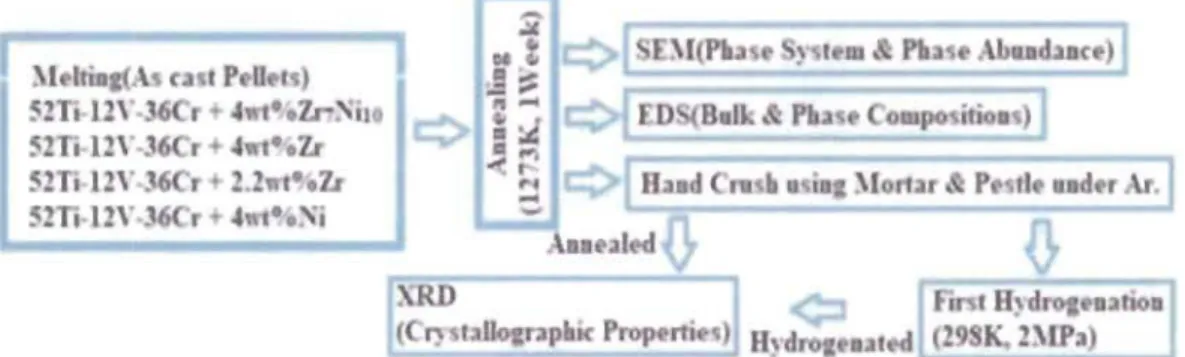
Flow chart of synthesis &

characterization of

BCC

52Ti-12V

-36Cr

alloy with

and without additive.

Backscattering

electrons (BSE) SEM

micrographs

of

the

as-cast

BCC

52Ti-12V-36Cr

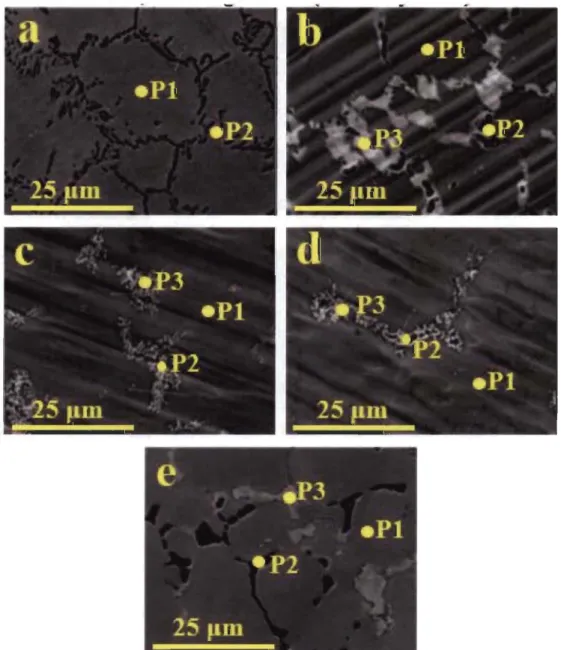
(a)without additives and with (b)4wt% Zr

7

NiIO, (c)4wt%Zr,

(d)2.2wt%Zr and (e)4wt%Ni additives.

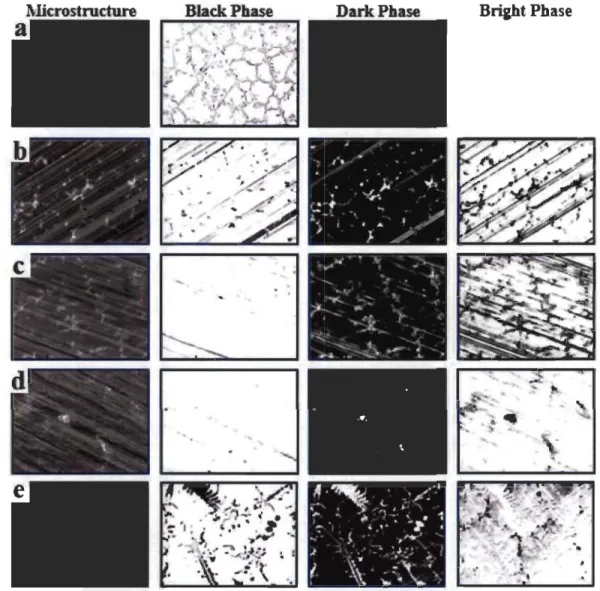
ImageJ

analysis of as-cast

BCC

52Ti-12V-36Cr (a)without additives and with

(b)4wt% Zr7NiIO, (c)4wt%Zr, (d)2.2wt%Zr and (e)4wt%Ni additives.

Point mapping

on

micrographs

of

the

as-cast

BCC

52Ti-12V-36Cr (a)without

additives and with (b)4wt% Zr

7

NiIO, (c)4wt%Zr, (d)2.2wt%Zr and (e)4wt%Ni

additives.

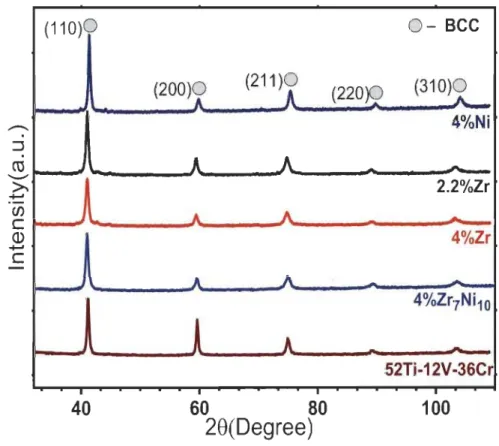
XRD

patterns of as-cast BCC

52Ti-12V-36Cr

alloys with and without

additives.

First hydrogenation of as-cast

BCC

52Ti-12V-36Cr alloys with and without

additives.

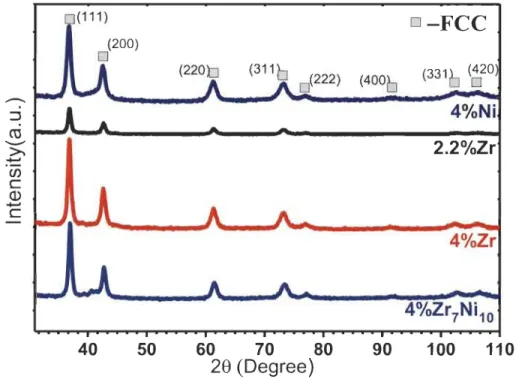
XRD patterns

of

hydrogenated BCC

52Ti-12V -36Cr alloy with and without

additives.

Flow chart of

the

synthesis

process, heat

treatment and characterization.

2

5

6

9

13

27

32

32

32

32

32

33

34

35

36

38

39

40

40

41

42

44

48

49

50

52

54

56

57

60

(14)

Figure 5.3

Figure 5.4

Figure 5.5

Figure 5.6

Figure 6.1

Figure 6.2

Figure 6.3

Figure 6.4

Figure 6.5

Figure 6.6

Figure 6.7

Figure 7

.1

Figure 7.2

Figure 7.3

Figure 7.4

Figure 7.5

(c,d)

4wt%Zr,

(e,f) 2.2wt%Zr and (g,h)

4wt%Ni

additives.

Point mapping

of dark phase

(1),

black phase

(2) and bright phase (3) on

micrographs

of as cast (Ieft) and annealed (right)

BCC

52Ti-12V-36Cr with

(a,b)4wt% Zr7

NilO, (c,d)4wt%Zr, (e,f)2.2wt%Zr and (g,h)4wt%Ni additives.

XRD patterns of annealed BCC 52Ti-12V

-36Cr with/without additive.

First

hydrogenation

curves for

heat

treated

BCC

52Ti-12V

-36Cr

with

additive.

XRD

patterns

of

hydrogenated

heat-treated

BCC

52Ti-12V -36Cr

with/without additive.

Synthesis and characterization

melted

and

bail milled BCC

52Ti-12V-36Cr

with Zr.

XRD

patterns

of (a) cast

BCC

52Ti-12V

-36Cr+4wt%Zr

milled

for (b)

15

min, (c) 30 min, (d) 60

min.

XRD

patterns

of cast

BCC

52Ti-12V-36Cr

milled

with 4wt%Zr for (a)15

min, (b)30 min, (c)60 min.

First hydrogenation curves of (a)as cast BCC 52Ti-12V-36Cr+4wt%Zr milled

for (b)15

min,

(d)30

min,

(f)60

min

and cast

BCC

52Ti-12V-36Cr

milled

with 4wt%Zr for (c) 15 min, (e )30

min, (g)60 min.

BSE

of (a)as

mi lied

cast of

BCC 52Ti-12V-36Cr+4wt%Zr and (b)cast

BCC

52Ti-12V -36Cr milled with 4wt%Zr for

15 min

.

Elemental

mapping

of (a)

milled

of as casted (BCC

52Ti-12V-36Cr+4wt%Zr) and (b) cast of BCC 52Ti-12V-36Cr milled

with 4wt%Zr for

15 minutes.

PCT desorption curves at 483K of(a) BCC 52Ti-12V-36Cr+4wt%Zr, (b) bail

milled

(BCC 52Ti-12V-36Cr+4wt%Zr) for

15 min

and (c)cast

BCC52Ti-12V-36Cr bail milled with 4wt%Zr for

15 min.

Flow chart for synthesis and characterization of sieved

BCC 52Ti-12V-36Cr

with and without Zr.

Particle size distribution

of 52Ti-12V

-36Cr + 4wt%Zr powder.

Secondary Electron

Images

of 52Ti-12V-36Cr

+

4wt%Zr alloy. (a)

PS<0.5

mm, (b) 0.5<PS<1.0mm, (c) PS>

1.0mm and (d) as-crushed.

First hydrogenation

curves of 52Ti-12V

-36Cr doped with 4%Zr for

different

parti cie

size and for the as-crushed sample.

First hydrogenation

curves of 52Ti-12V

-36Cr alloy for

different particle size

for the as-crushed sample.

64

66

68

69

74

75

76

77

79

80

82

85

86

87

88

89

(15)

Table 2.1

Rate limiting step model equations

14

Table 2.2

Effects of additives/substitutes over hydrogen sorption.

18

Table 2.3

Effects of

mechanical deformations

over hydrogen sorption.

21

Table 2.4

Effects of

heat treatment over hydrogen sorption

25

Table 2.5

Crystallographic data of

Ti-V

-Cr system

28

Table 3.1

Atomic percent, weight percent and weights of each element

31

Table 3.2

Rawelements.

32

Table 3.3

Melting points of

Ti, V,

Cr, Zr and Ni

33

Table 4.1

Fraction of area (in

%)

occupied

by

each

phase in

as cast 52Ti-12V-36Cr

50

alloys with and without additives. Uncertainty on each measurement is ± 1

%

Table 4.2

Element abundances

as measured

from EDS for

bulk compositions of as cast

51

52Ti-12V -36Cr

alloys with and without additives.

Uncertainties on

measured

composition are ±

1 at%.

Table 4.3

Composition of dark phases in

as-cast

BCC

52Ti-12V-36Cr alloys with and

53

without additives.

Table 4.4

Composition of black phases in

as-cast

BCC

52Ti-12V-36Cr alloys with and

53

without additives.

Table 4.5

Composition of bright phases in

as-cast

BCC 52Ti-12V-36Cr

alloys with and

54

without additives.

Table 4.6

Crystal structure

parameters

as

determined by Rietveld refinement

of 52Ti-

55

12V -36Cr with and without additive. The number in parentheses is the error on

the last significant digit.

Table 4.7

Hydrogenation

characteristics of

BCC

52Ti-12V-36Cr with and without

56

additive.

Table 4.8

Rietveld refinement ofBCC 52Ti-12V-36Cr with and without additive.

57

Table 5.1

Fraction area (in %) occupied

by

each

phase in

as-cast and

heat treated BCC

62

52Ti-12V-36Cr with additive. Uncertainty on each measurement is ±

I%

Table 5.2

Element abundances as

measured

for

bulk

compositions of heat treated

52Ti-

63

12V-36Cr alloys with additives. Uncertainties on

measured

composition are ±

Table 5.3

Chemical composition of dark phases in

52Ti-12V

-36Cr alloys with additives.

65

Uncertainties on measured composition are ±

1 at%.

Table 5.4

Chemical

composition

of

bright phases in

52Ti-12V-36Cr alloys with

65

additives. Uncertainties on measured composition are ±

1 at%.

Table 5.5

Chemical composition of black phases in

52Ti-12V

-36Cr alloys with additives.

65

Uncertainties on

measured composition are ±

1 at%.

Table 5.6

Crystal structure

parameters

as

determined by Rietveld refinement

of heat

67

treated 52Ti-12V-36Cr with additive.

The number in parentheses is the error on

the last significant digit.

Table 5.7

Hydrogen storage properties ofheat treated BCC 52Ti-12V-36Cr with additive.

69

Table 5.8

Rietveld refinement

of hydrogenated heat

treated

BCC

52Ti-12V

-36Cr

with

70

(16)

Table 6.1

Refinement

of cast

BCC

52Ti-12V-36Cr+4wt%Zr

milled

for

15 min,

30

min,

76

60 min.

Table 6.2

Hydrogen

sorption

properties

of

bail milled

sampi es

78

Table 6.3

EDS of

bail milled BCC

52Ti-12V-36Cr+4wt%Zr for

15

,

30 and 60

min.

The

80

uncertainty measured

on each

measurement

is ±

1

at%.

Table 6.4

EDS of cast of

BCC

52Ti-12V-36Cr

milled

with

4wt%Zr

for

15

,

30 and

60

81

min. The uncertainty measured

on each

measurement is

±

1

at%.

Table

7.1

Average

Partic\e

Size of sample

powder

(Ilm)

for

the

alloy 52Ti-l2V-36Cr +

87

4wt%Zr.

Table

7.2

Incubation

ofwith (tw) and without (tw

/

o) additive samples.

89

Table

7.3

Ratio

of

incubation time

of with and without additive samples with

the

same

90

partic\e

size.

Table 7.4

Effect of

partic\e

size on

incubation.

90

(17)

List of

symbols

at%

Atomic percentage

wt%

Weight percentage

X

Concentration factor

k

~-phase

y-phase

wt%

at%

wt%j

at%j

Wi

IJ

a,c

Pl

P2

P3

H

%

tw/o

L

o

.

s

Instantaneous time during reaction ofhydrogen absorption.

Slope

Mono-hydride phase

Di-hydride phase

Weight percentage ofelement 'i'

Atomic percentage of element 'i'

Weight percentage of

element

'

j

'

Atomic percentage of

element 'j

'

Atomic weight of element 'i'

Atomic weight of element

'j'

Elements

in alioy

Raw element size

Ball to Powder weight ratio in milling vial

Wavelength ofX-ray radiation

Miller Indices of

Bragg's plane

Bragg

's

angle

Interatomic planer distance between Bragg

's

plane hlk.

Lattice parameters

Representative location ofEDS measurement for dark phase on micrographs.

Representati

ve

location ofEDS measurement for black phase on micrographs.

Representative location of EDS

measurement for bright phase on

micrographs

.

Hydrogen storage gravimetric capacity.

Incubation time for BCC

alloy with additive.

Incubation time for

BCC alloy without additive.

(18)

t

+l.

O

Incubation time for particles with size greater than 1.0 mm.

List of acronyms

US

United States

HD

Hydrogen Decrepitation

BCC

Body Centered Cubic

LHV

Lower Heat Value

JMA

Johnson-Mehl-Avrami

2D

2-Dimensional

3D

3-Dimensional

CV

Contracting Volume

SPL

Surface Passivation Layer

XRD

X-ray Diffraction

HPT

High Pressure Torsion

EACP

Equal Angle Channel Pressure

SS

Stainless Steel

TEM

Transmission Electron Microscopy

PCT

Pressure-Concentration-Temperature

SEM

Scanning Electron Microscopy

BSE

Back Scattered Electron

SE

Secondary Electron

EDS

Energy Dispersive Spectroscopy

GUI

Graphies User Interface

SG

Space Group

FCC

Face Centered Cubic

a.u.

Arbitrary Unit

ECD

Equivalent Circular Diameter

(19)
(20)

1.1 Background

The energy is

the driving

force of economic and societal

development.

Currently, the

energy market is highly dominated by

conventional fuels

like

gasoline,

diesel

,

natural

gas

and coal.

But

,

these carry issues such as

localized

supply source (mostly

middle

east

producers)

,

uncertain

source amount creating

uncertainty

over price,

less

efficient and

associated

pollution

(air and environmental),

as weil global warming. Sorne of

these key

factors encouraging

the development

of

new

and renewable energy

technologies.

As such

the renewables

share

in

world energy consumption is growing.

The

Figure

1.1

shows

the

world energy consumption

by

energy sources

till

2040 analysed

by

US energy

information

administration

[1-2].

World energy consumption by energy source (1990

.

2040)

quadr

i

llion British thermal units

2015

250

h

istory

1

projection

150

50

o

Ir--.---.---.---.--~--.---.---r--.---.

1990

1995 2000 2005 2010 2015 2020 2025 2030 2035 2040

Figure 1.1- The trends of contributions by energy sources [1-2].

While

significant,

the development

of

renewable

sources globally exc\uding

hydro power

have been

at a slower

pace than

expected. Thus

,

with

the increase in utilization

of

renewable

energy, the

use of

fossil

fuels

could also accelerate

in

order

to

achieve

increasing demand.

According

to unique

explorative scenario

presented by World

Energy

Council

in

2014,

by

2050,

the energy

demand

will

be doubled

and

increasing

with faster

rate than the primary

energy supply from fossil fuels. The energy consumption from

renewable

energy sources showed

more

significant

increase during

2005-2010. The

council

mentioned that the

solar energy could

be listed

as fastest

rising unconventional

source and will share about 20-30%

share of energy supply.

But

the share

of

fossil fuels

for energy supply will

increase

with CUITent trend and remain

dominating.

This is

(21)

threatening notice

from World Energy Council. This could

increase the

global warming

emission gases

double

/

triple

by

2050 compared to

1990 levels

with

the potential to turn

energy infrastructure to disasters

.

The energy

prices and

high

volatility will

become more

critical with the absence of c1ear path

for the taxes

on C0

2

emissions. The faster change in

policies

,

scientific

innovations

and consumer's outlooks are creating energy

market

increasingly

complex

.

However

,

the

energy efficiency remains as

priority but requires

a

long-term

approach. Thus, we need to increase our efforts to access energy for the world's

growing

population. Otherwise,

according

to

World Energy Council analysis

reported in

2014,

530 million people

could still

lack

access to even

basic

forms of energy in 2050

.

Thus

,

it is

time

to think

about

policies

and

,

scientific

innovations that

could

deliver

tomorrow's

sustainable energy. Let

'

s

hope

for sorne suitable solutions and cheap

sustainable energy could

be found by addressing energy trilemma

,

the triple

challenge of

providing

secured

,

affordable and environrnentally sensitive energy.

That

concludes the

research direction towards

c1ean

renewable

energy sources and energy storages

that

are

scalable to combat fossil fuels

.

These alternative

renewable sources could hold

the key to combat issues raised during the

use

of conventional fuels.

A renewable energy sources are found environment friendly and

do not produce greenhouse gas emissions

[3-4].

Though the initial

co st of technology and

infrastructure is quite high, these

are cheaper for

long run [3-4].

With advancements

in

technologies

renewable energy is getting

more

accessible, affordable and efficient.

However, the major

challenges with renewables are related to scalability and

intermittency.

Storage

need to be

an integral component for

large

scale

deployrnent

of

renewables.

1.2 Energy carrier-Hydrogen

Hydrogen like

electricity

is

an energy carrier and

has

several advantages. Hydrogen

has

highest

abundance and energy content about

120

.

7 MJ/kg which

is

almost triple

that

of

gasoline and

diesel. Probably in future

,

hydrogen

will

be a

potential

candidate to be used

as a raw material

and as an energy carrier

,

hence becoming a feasible alternative to fossil

fuel

[5]. Hydrogen has been

acknowledged for a wide variety of applications: the

hydrogen decrepitating

(RD)

process has been

applied

to

successfully

produce

SmC0

5

,

Sm

2

(Co

,

Fe,

Cu

,

Zr)

17

and Nd

2

Fel

4

B-type magnets [6]. Other

kinds of applications

reported use

of hydrogen

are food

industries

,

semiconductor

industry

,

manufacturing

(22)

industries

,

petroleum

and chemical

processes

,

aviation industry, and

in

a

limited

capacity,

as clean fuel and power [7]. The exhaust from combustion of

hydrogen

or

hydrogen

operated fuel cells

is

H

2

0, which is environmentally friendly, contrasting radioactive

waste from redundant

nuclear power

plants or global warming gas emissions from fossil

fuels.

But the use

of

hydrogen

is

limited due

to its

low density

(Gaseous H

2

-0.0899

g/L

@

1

atm.)

[8]

and

high

flammability. The

low density

of

hydrogen

creates the

need

of

bulk

y

storage volume which makes

the design bulky,

otherwise reduce

driving

range

/

amount of total energy. Hydrogen

is

smallest element on

the

earth with

high

diffusivity

as such it is

highly liable

for

leak.

Besides

it has

a wide

flammability limit

,

which

makes the use

of ail safety

procedures

essential while producing, storing,

transporting

or

using hydrogen.

To

make use

of

hydrogen

as a

fuel like petrol

and

diesel,

while you

run the

application,

it

must be

stored so

that it

can

be used

as-you-go

[9]

.

However, safe storage facility will

be

one of

the major bottleneck

ofusing

hydrogen.

For various stationary

/

mobile

applications,

hydrogen

storage will

be required

at stationary

power

sites,

hydrogen production

sites,

hydrogen-refuelling

stations and on-board

in

vehicles

.

Developing

safe,

reliable

,

compact

and co st-effective

hydrogen

storage technologies are technically challenging

barri

ers to its

widespread

use

as an energy carrier. Hydrogen can

be

stored in

three

forms

[10]

as:

a. Gaseous

hydrogen

b

.

Liquid

hydrogen

c. Advanced

materials

a. Gaseous

hydrogen

storage- The

hydrogen

is stored

in

tanks

in its

compressed gaseous

form at

high pressure between 17.5-70

MPa

[10]

.

Figure

1.2

shows

the

comparative

schematic of gaseous and

liquified hydrogen

storage. The

density

of

hydrogen

is

increased

using

compression, however energy goes

in

compressing

hydrogen to high

pressures

.

There are four types of

tanks based

on

the

tank

material

,

the

weight of

tank

and

the

pressure they can withstand.

However

,

highly pressurized tanks

are suspicious

for

leak

which raises the safety issue

.

Totally of 341

hydrogen

coincidences

happened

since 2007

because

of

usage

and storage, where

-

208 were related

to

failure in

dispensing

station,

piping

fittings and valves

[11].

(23)

b

• •

... ... . -.

••• ••• ••• •••• ••

Figure

1.2 Schematics

of

(a)

high pressure

gaseous and (b)

Iiquid(b) hydrogen

storage.

b. Liquid hydrogen

storage-

Liquid hydrogen has density of 0.07099 x 10

3

glL,

i.e.

required approximately 1000 times

sm aller volume

compared with

gaseous storage.

But

,

it requires

cryogenic

liquefaction process

at

20.28 K, the process is highly energy

intensive

and can

consume upto 40

%

energy

out of total

energy available with

hydrogen [12).

As well,

these

storages

need

a special

kind of

storage

facility

with

the

refrigeration unit to maintain hydrogen in

cryogenic state.

For any mobile application,

the

entire

refrigeration

system

to maintain the temperature of liquid hydrogen need to

be carried on board.

c. Advanced materials-

It

has been observed that

,

hydrogen is

getting adsorbed

or

absorbed

on reacting

with some

of the

advanced

materials [10]

.

Due to

shortcomings

with gaseous and

liquid hydrogen

storage

methods

,

the researchers are

aiming

at light

weight, safe

and

cost effective composite

materials that reduce the

weight

and

volume

of

storage system.

It has been found that the hydrogen

can

be

stored

in advanced

materials

safely and

cost effectively [10).

Some

of the materials like

activated

carbon!

carbon nanotubes has been reported for

st

orage in which hydrogen

stored

by

adsorption. These materials have high

specific surface

area. In adsorption, the

molecules or

atoms

of hydrogen

are

bonded

with

the

surface as shown

in

Figure

1.3(a). By increasing

specific surface area,

the

storage capacity can

be improved for

these materials. But

,

the bonding is

weak van

der

waals and

lead to dissociation of

hydrogen

easily.

Secondly, the hydrogen could be dissociated

at

the

surface

of metals

/

alloys and

get

absorbed

inside the

solid

lattice framework

as shown

in

Figure

1.3(b). These kinds of

storage

materials

are

popularly called metal hydrides.

Thus

,

absorption

of hydrogen

could be

achieved

in relatively

smaller volume

at room temperature un der low

pressure

.

Figure

Figure 5.3  Figure 5.4  Figure 5.5  Figure 5.6  Figure 6.1  Figure 6.2  Figure 6.3  Figure 6.4  Figure 6.5  Figure 6.6  Figure 6.7  Figure 7 .1  Figure  7.2  Figure 7.3  Figure 7.4  Figure 7.5
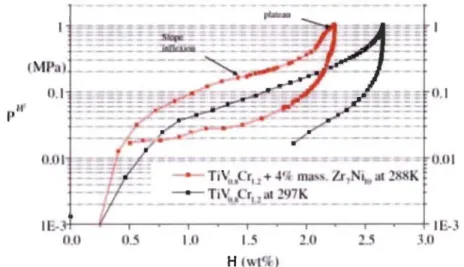
Figure 2.1  PC  isotherms of TiVo.sCrt .2  at 297  K  and  of the composite TiVo.sCrt.2  +  4  wt
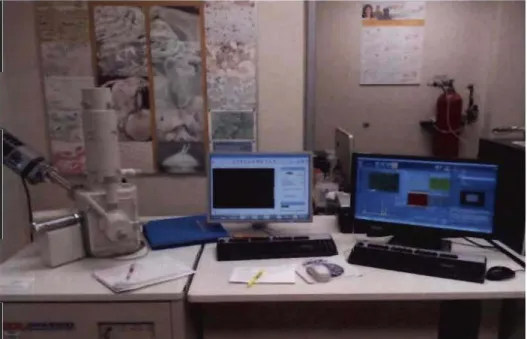
Figure 3.11- JSM-5500 with  master and slave installed with Oxford Instruments software
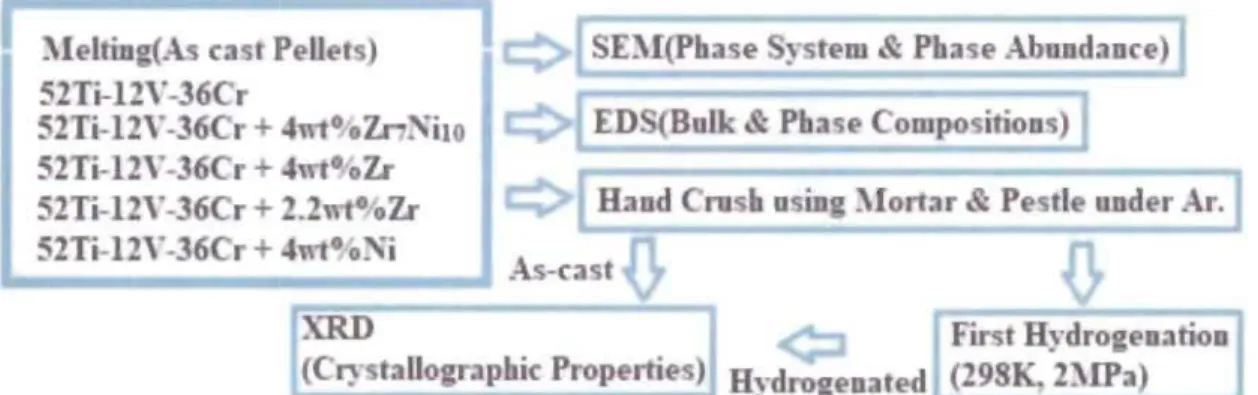
Figure 4.1- Flow chart of  synthesis  &amp;  characterization of BCC 52Ti-12V -36Cr alloy  with and without additive
+7

Références

Documents relatifs

Il en ressort que la majorité des femmes ont des connaissances médiocres et insuffisantes en matière de contraception: Seulement 40% des femmes ont appris leurs informations sur

Abstract: Duplex stainless steels 2205 are widely used in constructional and petrochemical applications because of their good mechanical and corrosion properties. The objective of

Boîte de liste orientée données pour afficher à l'exécution les valeurs trouvées dans les colonnes d'une autre table.. DBLookupCombo Boîte à options de référence de base

Five different treatments were applied to the OPS, then their effects on the following properties of concrete were studied: apparent density, porosity accessible to water,

For each treated wood species, ANOVA analyses highlighted the fact that thermal modification process has a significant effect on the modulus of rupture of the heat treated

2 0 This will overestimate the value of reserves because this rental component of the price includes quasi rents from the investment/exploration phase (oil reserves

One first year ridge representative of the ridges characterized during a field program off West Coast Newfoundland in March 1999 is used to develop a comprehensive methodology for

S'intéresser à cet objet est d'autant plus pertinent qu'il nous semble que la gestion, en tant que processus spécifique de rationalisation porté par des principes, des acteurs,