HAL Id: hal-02016678
https://hal.archives-ouvertes.fr/hal-02016678
Submitted on 12 Feb 2019
HAL is a multi-disciplinary open access
archive for the deposit and dissemination of
sci-entific research documents, whether they are
pub-lished or not. The documents may come from
teaching and research institutions in France or
abroad, or from public or private research centers.
L’archive ouverte pluridisciplinaire HAL, est
destinée au dépôt et à la diffusion de documents
scientifiques de niveau recherche, publiés ou non,
émanant des établissements d’enseignement et de
recherche français ou étrangers, des laboratoires
publics ou privés.
Abstract Encoding of Auditory Objects in Cortical
Activity Patterns
Bruno Giordano, Stephen Mcadams, Robert Zatorre, Nikolaus Kriegeskorte,
Pascal Belin
To cite this version:
Bruno Giordano, Stephen Mcadams, Robert Zatorre, Nikolaus Kriegeskorte, Pascal Belin. Abstract
Encoding of Auditory Objects in Cortical Activity Patterns. Cerebral Cortex, Oxford University Press
(OUP), 2013, 23 (9), pp.2025-2037. �10.1093/cercor/bhs162�. �hal-02016678�
Abstract Encoding of Auditory Objects in Cortical Activity Patterns
Bruno L. Giordano
1,2, Stephen McAdams
2, Robert J. Zatorre
3, Nikolaus Kriegeskorte
4and Pascal Belin
1,51
Institute of Neuroscience and Psychology, University of Glasgow, Glasgow, UK
2Department of Music Research, Centre for
Interdisciplinary Research in Music, Media and Technology, McGill University, Montreal, QC, Canada
3Montréal Neurological
Institute, McGill University, Montreal, QC, Canada,
4Medical Research Council Cognition and Brain Sciences Unit, University of
Cambridge, Cambridge, UK and
5International laboratories for Brain, Music and Sound (BRAMS), Universite de Montreal &
McGill University, Montreal, QC, Canada
Address correspondence to Bruno L. Giordano, Institute of Neuroscience and Psychology, University of Glasgow, 58 Hillhead Street, Glasgow G12 8QB, UK. Email: [email protected]
The human brain is thought to process auditory objects along a
hierarchical temporal
“what” stream that progressively abstracts
object information from the low-level structure (e.g., loudness) as
processing proceeds along the middle-to-anterior direction.
Empiri-cal demonstrations of abstract object encoding, independent of
low-level structure, have relied on speech stimuli, and non-speech
studies of object-category encoding (e.g., human vocalizations)
often lack a systematic assessment of low-level information (e.g.,
vocalizations are highly harmonic). It is currently unknown whether
abstract encoding constitutes a general functional principle that
operates for auditory objects other than speech. We combined
multivariate analyses of functional imaging data with an accurate
analysis of the low-level acoustical information to examine the
ab-stract encoding of non-speech categories. We observed abab-stract
encoding of the living and human-action sound categories in the
fine-grained spatial distribution of activity in the middle-to-posterior
temporal cortex (e.g., planum temporale). Abstract encoding of
auditory objects appears to extend to non-speech biological sounds
and to operate in regions other than the anterior temporal lobe.
Neural processes for the abstract encoding of auditory objects
might have facilitated the emergence of speech categories in our
ancestors.
Keywords: categorization, condition-rich design, fMRI, multivariate
information-based mapping, temporal cortex
Introduction
Two questions are at the heart of theories concerning the
cor-tical processing of naturally occurring auditory objects: 1)
Which low-level features drive neural processing and 2) how
do computations lead to abstract semantic categories robust
to large variations in the low-level features? These questions
continue to stir a lively debate within the domain of auditory
neuroscience. For example, there is a lack of consensus
con-cerning which low-level features are represented in the cortex
(
Schönwiesner and Zatorre 2009
;
Recanzone and Cohen
2010
), and processing models based on the concept of
spec-trotemporal receptive
fields have had only partial success in
accounting for the cortical responses to naturalistic sounds
(
Machens et al. 2004
;
Bar-Yosef and Nelken 2007
). Further,
the empirical evidence for abstract cortical encoding
indepen-dent of low-level structure is limited to a very speci
fic class of
stimuli, harmonic sounds such as human vocalizations or
musical tones (
Hasson et al. 2007
;
Leaver and Rauschecker
2010
;
Kilian-Hütten et al. 2011
), whereas studies of highly
diverse naturalistic sounds (e.g., animal vocalizations vs.
human-action sounds such as sawing wood;
Lewis et al. 2005
)
did not test for abstract encoding. As a consequence, it is still
unknown whether the abstraction of cortical representations
is a general functional principle that operates for all classes of
naturalistic auditory objects. We addressed these questions by
analyzing the extent to which the
fine-grained spatial
func-tional magnetic resonance imaging (fMRI) patterns measured
for highly heterogeneous environmental sounds selectively
encoded information about the low-level and
category-membership features (Fig.
1
).
There is a wide consensus on the hierarchical nature of the
auditory cortex, which relies on modules that progressively
abstract from the low-level structure to optimize the analysis
of auditory objects (e.g.,
“what/where model,”
Romanski
et al. 1999
). However, 1) There is currently a large
disagree-ment on the location of such abstract sound-processing
modules and 2) the majority of the empirical evidence on the
existence of such modules has been collected by focusing on
a restricted number of the auditory objects that our brain
ana-lyzes during our daily life, that is, human vocalizations and,
more speci
fically, speech. Focusing on the location of
abstract-processing modules, it has, for instance, been
ob-served that the primary auditory cortex (A1) retains less
infor-mation
about
the
spectrotemporal
structure
but
more
information about abstract properties such as stimulus
iden-tity, than does inferior colliculus (
Chechik et al. 2006
).
Con-sistently, a recent study of perceptually ambiguous speech
argues for abstract object-like representations in the early
auditory
cortex
(
Kilian-Hütten
et
al.
2011
).
Abstract-processing aspects have also been attributed to the planum
temporale (PT), an area hypothesized to be involved in
matching stored spectrotemporal templates to the incoming
sound information (
Grif
fiths and Warren 2002
) and to
implement a process that abstracts from the
fine-grained
spec-tral shape of the incoming signal (
Warren et al. 2005
;
Kumar
et al. 2007
). Other in
fluential studies locate abstract modules
in the anterior temporal cortex, part of a ventral pathway
in-volved in the recognition of auditory objects (
Romanski et al.
1999
;
Rauschecker and Tian 2000
;
Scott et al. 2000
;
Davis and
Johnsrude 2003
;
Hasson et al. 2007
;
Rauschecker and Scott
2009
;
Goll et al. 2010
;
Leaver and Rauschecker 2010
, for
studies involving speech stimuli). Other empirical
investi-gations observe instead abstract categorical processes in the
posterior superior temporal sulcus ( pSTS; e.g.,
Desai et al.
2008
;
Okada et al. 2010
, for speech stimuli and
Warren et al.
2006
, for voices), or even argue for abstract representation in
the entire sound-sensitive cortex, including areas traditionally
© The Author 2012. Published by Oxford University Press. All rights reserved. Cerebral Cortex September 2013;23:2025–2037
doi:10.1093/cercor/bhs162
Advance Access publication July 16, 2012
assumed to be involved in low-level processing (
Formisano
et al. 2008
;
Staeren et al. 2009
). An important aspect of
pre-vious studies further obscures our understanding of abstract
sound encoding in the cortex: They have almost exclusively
focused on a relatively homogeneous class of stimuli, that is,
highly harmonic vocalizations (e.g., speech or animal
vocali-zations) and musical instrument tones (
Leaver and
Rauscheck-er 2010
). This aspect of past studies not only reduces the
general validity of current stances on abstract sound
proces-sing in the cortex (i.e., it is unknown whether the cortex
rep-resents abstractly many non-speech naturalistic auditory
objects), but it is also associated with potential
methodologi-cal problems. Indeed, given the high plasticity and
context-dependence of auditory cortical computations (
Ulanovsky
et al. 2003
;
Jääskeläinen et al. 2007
;
Asari and Zador 2009
), it
is likely that the presence of a large number of speech-like
stimuli within the experimental context triggers the activation
of language-related abstract-processing modules. More
impor-tantly, reverse hierarchy theories of perceptual processing
(
Ahissar et al. 2009
) predict a stronger emphasis on abstract
representation for sets of sounds that are relatively similar in
the low-level structure (e.g., speech and crying baby, both of
which are highly harmonic) than for sets of sounds that are
highly heterogeneous in the low-level structure (e.g.,
inhar-monic crackling
fire and crying baby). For these reasons, it is
currently unknown whether abstract processing constitutes a
general functional principle implicated in the cortical
proces-sing of all classes of naturalistic sounds. To address these
issues, we used a condition-rich design with a stimulus set
that is heterogeneous in both low-level and category
struc-tures. The stimulus set included distinctions between living
and living, human and human and vocal and
non-vocal sounds, very few human non-vocalizations, and no speech
stimuli (Supplementary Table S1).
The cortical encoding of highly diverse categories of
natur-alistic non-speech auditory objects has been investigated by
several fMRI and electroencephalography studies (
Belin et al.
2000
,
2002
;
Fecteau et al. 2004
,
2005
;
Lewis et al. 2005
,
2006
,
2010
;
Pizzamiglio et al. 2005
;
Kraut et al. 2006
;
Murray et al.
2006
;
Altmann et al. 2007
;
Kaplan and Iacoboni 2007
;
Doehrmann et al. 2008
;
Galati et al. 2008
;
Engel et al. 2009
;
De Lucia et al. 2010
;
Leaver and Rauschecker 2010
). Despite
showing a cortical sensitivity for object categories, this
litera-ture is unable to prove the existence of abstract cortical
en-coding modules because it has not assessed the extent to
which category sensitivities can be accounted for by
systema-tic between-category differences in the low-level structure
(e.g., a neural network that is selectively activated by
vocali-zations and not by tool-action sounds might simply be
pro-cessing
a
reliable
low-level
difference
between
these
categories, namely, harmonicity [HNR]). For this reason, it is
largely unknown whether the previous category-sensitivity
results were the product of abstract cortical encoding based
on high-level features that optimize the categorization of
sound stimuli even in the absence of systematic
between-category differences in the low-level structure. A notable
ex-ception to this trend is the recent study by
Leaver and
Rauschecker (2010)
, which considered 6 different low-level
Figure 1. Pipeline for the analysis of representational similarity (RSA). For each stimulus, thefine-grained spatial distribution of the blood oxygenation level dependent (BOLD) effect is extracted within a spherical searchlight (radius = 6.25 mm). For each pair of stimuli, the dissimilarity between thefine-grained spatial fMRI patterns is defined as 1 minus the correlation between their voxel-specific estimates of the BOLD effect inside the searchlight. The complete square dissimilarity matrix computed for each pair of stimuli is termed RDM. The RDM isfinally correlated with a SDM. The analysis is repeated for each possible gray matter location of the spherical searchlight. In this study, the RSA method was adopted to assess what stimulus features drive the dissimilarity of BOLD responses within the searchlight. We considered 24 potential proxy measures that capture the low-level sensory dissimilarity (12 SDMs), and the higher level category-membership dissimilarity (12 SDMs). Significant encoding of a stimulus feature in the spatial fMRI pattern was inferred if the correlation and partial correlation between the RDM and SDM had the same sign and were both significant. The partial correlation between the target SDM and the RDM was computed after removing from both the variance they shared with all of the non-target SDMs (see text).
alternative
hypotheses
for
the
cortical
encoding
of
auditory-object categories. Importantly, however, this study
investigated only highly harmonic sounds (human and
animal vocalizations and musical instrument tones), and is,
for this reason, characterized by the same general validity
and methodological caveats that we noted for speech-based
investigations of abstract cortical encoding. In the present
study, we extended the approach of Leaver and Rauschecker
by considering a larger number of low-level features
describ-ing both the long-term and the time-varydescrib-ing sound structure
(e.g.,
Giordano and McAdams 2006
;
Giordano, Rocchesso,
et al. 2010
for the psychophysical relevance of the temporal
structure of naturalistic sounds and, e.g.,
Zatorre and Belin
2001
;
Poeppel 2003
;
Boemio et al. 2005
;
Schönwiesner et al.
2005
;
Zatorre and Gandour 2008
, for their cortical
proces-sing). The characterization of the low-level features adopted
in this study is, to date, the most extensive among those
carried out in previous brain imaging studies of naturalistic
auditory objects. Our category-encoding tests thus take into
account a comparatively large number of low-level alternative
hypotheses about the nature of the cortical sensitivity to
cat-egories (Fig.
4
for the cortical encoding of the low-level
fea-tures considered in this study).
We measured the encoding of object-category and low-level
features in the stimulus-speci
fic fine-grained spatial fMRI
pat-terns. For this purpose, we adopted the multivariate method
of representational similarity analysis (RSA;
Kriegeskorte,
Mur, Bandettini 2008
), previously applied only in the study of
visual object processing (
Kriegeskorte, Mur, Ruff, et al. 2008
;
Fig.
1
for our analysis pipeline). The RSA method assesses the
encoding of stimulus-feature information in representational
dissimilarity matrices (RDMs), measuring the dissimilarity of
the spatial fMRI patterns for different stimuli. The RSA
method combines the high statistical sensitivity of multivariate
classi
fication methods (
Kriegeskorte et al. 2006
;
Kriegeskorte
and Bandettini 2007
;
Staeren et al. 2009
), with a greater
flexi-bility in testing the encoding of feature structures whose
rep-resentation cannot be easily veri
fied with classical massively
univariate analyses. For example, within a univariate
frame-work, category encoding is assumed when the blood
oxygen-ation level dependent (BOLD) response for the exemplars of
1 category differs signi
ficantly from that for a different
refer-ence category. Importantly, this
“activation”-based method
can measure between-category differences, but cannot detect
within-category effects (e.g., the neural responses for different
face pictures are more similar to each other than to the neural
responses for pictures of cats;
Haxby et al. 2001
). The
“information-based” RSA approach made it possible to assess
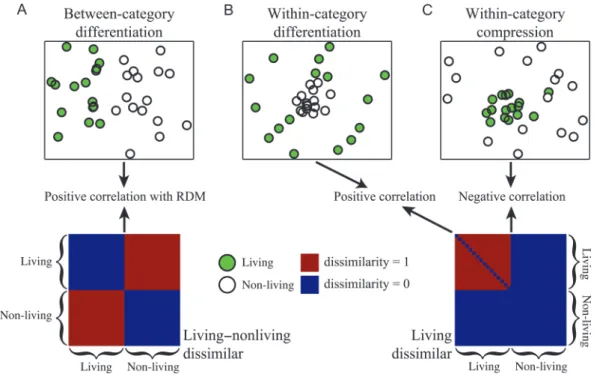
a larger number of abstract category-membership effects: 1)
Cortical representation of the distinction between categories
(between-category differentiation); 2) cortical enhancement of
the diversity of the stimuli within the same category
(within-category differentiation); and 3) cortical suppression of the
differences of stimuli within the same category
(within-category compression; Figs
2
and
5
).
During scanning, participants were presented with highly
identi
fiable environmental sounds (Supplementary Table S1)
and carried out a 1-back repetition-detection task. Analyses
relied on the measurement of the association between RDMs
and stimulus-feature dissimilarity matrices (SDMs; Figs
1
and
2
,
Figure 2. Cortical encoding of category-membership information. We tested for 3 different effects of category-membership information on the dissimilarity of the spatial fMRI patterns. These effects are exemplified in the top 3 panels for the living versus non-living category-membership distinction. In each of these panels, the dissimilarity between the spatial fMRI patterns for different stimuli (circles) is represented as the distance between stimuli within a 2-dimensional Euclidean space where stimuli that evoke largely different fMRI patterns lie farther apart. Similar Euclidean representations can be computed by analyzing RDMs with multidimensional scaling (MDS) models. (A) The cortical patch represents the distinction between the living and non-living categories. This outcome of between-category differentiation leads to a positive correlation between the RDM and a living–nonliving dissimilar matrix equal to 0 if 2 sounds are both living or non-living and equal to 1 if 1 sound is living and the other is non-living. (B) The cortical patch enhances the distinctions between members of the living category. This outcome of within-category differentiation leads to a positive correlation between the RDM and a living-dissimilar matrix equal to 1 if 2 sounds are both living and equal to 0 otherwise. (C) The cortical patch suppresses distinctions between members of the living category. This outcome of within-category compression leads to a negative correlation between the RDM and the living-dissimilar matrix.
and see Material and Methods). Twelve low-level SDMs were
derived from the time-varying: 1) Loudness; 2) spectral
cen-troid, a measure of the perceived brightness of a sound; 3)
pitch; and 4) harmonic-to-noise ratio (HNR) or, in short,
har-monicity, a measure of the amount of periodicity. For each of
the 4 time-varying features, we computed 3 SDMs by
consid-ering: 1) The median value across time; 2) the amount of
tem-poral change (interquartile range dissimilarity, IQR); and 3)
the overall pattern of temporal variation (cross-correlation
dis-similarity). Twelve object-category SDMs were derived from
the following distinctions: 1) Living versus non-living; 2)
human versus non-human; 3) vocal versus non-vocal. One
group of object-category SDMs assessed between-category
differences in spatial fMRI patterns (Fig.
2
A); another group
assessed within-category effects such as a large similarity of
the fMRI patterns for same-category stimuli (e.g., highly
similar fMRI patterns for living sounds; Fig.
2
B,C).
Variance-decomposition methods made it possible to measure the
selec-tive encoding of each of the stimulus features independently of
their covariation with non-target features (both low-level and
object category). Thus tested, cortical selectivities for
object-category features were taken as evidence of abstract cerebral
encoding of auditory objects. Based on this methodology, we
were able to measure the cortical encoding of several low-level
features (Fig.
4
) and, most importantly, we observed the
abstract cortical encoding of sound-object categories (Fig.
5
).
Materials and Methods
Stimuli
Sound stimuli were selected from those investigated by Giordano,
McDonnell, et al. (2010). Following standard practices, sounds were
equalized in root mean square (RMS) level. Note, however, that corti-cal activation does not appear to follow the physicorti-cal intensity of a sound but rather its loudness (Langers et al. 2007), and that RMS equalization does not guarantee constant loudness because it does not take into account the changes in sensitivity across spectral fre-quencies (Moore 2003). Sounds were 3 s in duration. Sounds from
Giordano, McDonnell, et al. (2010)shorter than 3 s were replaced by
an alternate excerpt generated by a similar event selected from a variety of commercial databases of sound effects (e.g.,Sound Ideas 2004). We selected 32 stimuli: 16 living sounds, generated by the vibration of an object that is part of the body of a living being, such as hands in “clapping hands” and 16 non-living sounds; 16 human-action sounds, generated as a consequence of the motor activity of a human being (such as in“hammering nail”) and 16 non-human sounds; 8 vocal sounds, generated as the consequence of the vibrations in the larynx or syrinx (e.g.,“croaking frogs”) or which in-cluded such vibrations (e.g., “panting man”) and 24 non-vocal sounds. The human–non-human categorical distinction was perfectly orthogonal to the living–non-living distinction. The vocal–non-vocal distinction was orthogonal to the human–non-human distinction within the category of living sounds (by definition, all vocal sounds are living sounds). Given these stimulus selection constraints, we ran-domly extracted 20 million stimulus sets from the available samples. Among these random selections, we chose for thefinal set sounds that: Maximized the average identification performance and had a minimum identification performance score of 50% correct, as measured by Giordano, McDonnell, et al. (2010); minimized the across-sound standard deviation [SD] of the peak of the time-varying level in dB SPL; did not include significant between-category differ-ences (e.g., living versus non-living) in peak dB SPL and in identi fia-bility (P ≥ 0.1). The measures of identification performance considered during the sound selection process were collected by
Giordano, McDonnell, et al. (2010). Identification performance was
also measured with the participants in this experiment, subsequent to
the scanning session. Based on these measures, all sounds were very accurately identified (average correct = 94%; SD = 6%; minimum correct = 79%), and no differences in identification performance emerged between living and non-living, human and non-human, and vocal and non-vocal sounds (t ≤ 1.74; P ≥ 0.09). Supplementary Table S1 reports the properties of the selected stimuli.
Stimulus-Feature Dissimilarity Matrices
We computed 12 matrices quantifying the pairwise dissimilarity of the sound stimuli relative to various category attributes. The strategy followed to compute category-feature dissimilarity matrices is exem-plified in Fig.2. Thefirst 6 category dissimilarities focused on each of the following categorical dimensions in turn: Living versus non-living; human versus non-human; vocal versus non-vocal. The living –non-living dissimilar matrix equaled 1 if 2 sounds did not belong to the same category (i.e., one sound living, the other non-living) and 0 if the 2 sounds belonged to the same category (i.e., both sounds living or both sounds non-living). The living-dissimilar matrix equaled 1 if the 2 sounds were living and 0 otherwise. A third non-living-dissimilar matrix, equal to 1 if the 2 sounds are non-living and 0 otherwise was not considered to avoid problems with the partial-correlation analyses (see below). Indeed, the sum of this third matrix with the living-nonliving dissimilar and living-dissimilar matrices is a constant. As such, the correlation of any of these 3 matrices with a fourth dependent variable would equal 0 after the other 2 matrices are partialed out of the correlation. We adopted the same approach to compute the following matrices: Human –non-human dissimilar; –non-human dissimilar; vocal–non-vocal dissimilar; vocal dissimilar. The final 6 dissimilarities considered the intersection of the 3 main categorical distinctions. Because all vocal sounds are, by definition, living sounds, the intersection of the 3 main categorical distinctions defined 6 independent classes of sound stimuli (e.g., living–human–vocal sounds). The dissimilarity corresponding to each of these 6 intersection classes equaled 1 if both sounds were members of the same intersection class (e.g., both were living– human–vocal sounds) and 0 otherwise. It should be noted that among these matrices, only the living–non-living, human–non-human, and vocal–non-vocal matrices were capable of assessing the differentiation between 2 sound categories. All the other matrices could instead model effects specific to a single category, specifically either a comparatively higher differentiation or a comparatively higher similarity of the sounds within the category of interest.
We computed 12 matrices quantifying the dissimilarity of different low-level properties of the sound stimuli. We initially quantified the time-varying profile of 4 different low-level features: Loudness in sones, defined for each frame of analysis as the sum of the specific loudness for the different cochlearfilters; spectral centroid in Equival-ent Rectangular Bandwidth-rate units (ERB; Moore and Glasberg 1983), defined as the specific-loudness–weighted average of the spec-tral frequency; HNR, defined as the ratio of the periodic-to-non-periodic energy in the sound signal (HNR) in dB; pitch in ERB-rate units. Time-varying loudness and spectral centroid were derived from the time-varying specific loudness of the sound signals, as computed according to the model ofGlasberg and Moore (2002). Time-varying HNR and pitch were computed using the Praat software (Boersma
and Weenink 2009). The temporal resolution of each of the
time-varying features was 1 ms. We derived 3 dissimilarity matrices for each of the 4 time-varying sound features by using 1 of 3 different mathematical operators. 1) Thefirst 4 dissimilarity matrices measured the absolute value of the difference in the median of the time-varying feature between each pair of sounds. Median dissimilarities focus on the time-independent scale of the sound features. 2) The next 4 matrices measured the absolute value of the difference in the inter-quartile range of the time-varying feature between each pair of sounds. The interquartile range dissimilarities focus on the amount of temporal change of the sound features. 3) The last 4 dissimilarity matrices measure the between-sounds diversity in the entire pattern of temporal variation, independently of scale (e.g., high- vs. low median pitch). To this purpose, dissimilarity was defined as 1 minus the maximum cross-correlation between the time-varying feature
measured on sounds A and B (e.g., time-varying loudness for both sounds). The cross-correlation was normalized so as to yield a value of−1 for the cross-correlation between 1 signal and its negative at lag 0, and a value of 1 for the cross-correlation between 1 signal and its replica (i.e., autocorrelation) at a temporal lag of 0. In order to yield a scale-independent measure of the dissimilarity between the time-varying profiles, time-varying features were range normalized between 0 and 1 before being analyzed with the cross-correlation algorithm. Importantly, the cross-correlation measures of dissimilarity are independent of onset-time differences between 2 sounds. Finally note that the number of possible low-level measures of sound dissim-ilarity is in principle infinite because multiple basic representations of the acoustical structure and multiple mathematical or statistical oper-ators can be adopted to quantify the differences between 2 sounds with 1 single number (Peeters et al. 2011, for an extensive list of acoustical features). In this study: 1) We equated the number of low-level and category-membership dissimilarities to avoid skewing the likelihood of observing significant encoding of features belonging to 1 of these 2 groups (e.g., consider a study with 100 low-level and 1 category-membership dissimilarity); 2) we considered plausible models of how the auditory system computes the temporal variation of 4 basic sensory attributes; 3) we applied the same set of (simple) statistical operators to each of the 4 features.
Participants
Twenty subjects took part in this study (10 females, 10 males; age = 23.8 years, SD = 4.8 years; average years of experience with English language = 20.6 years, SD = 5.6 years; number of native English speak-ers = 11). All participants had limited musical training (years of music performance experience = 2.6, SD = 4.8 years), had normal hearing as assessed with a standard audiometric procedure (Martin and
Cham-plin 2000;ISO 2004), and were right handed (average laterality
quoti-ent = 74.3, SD = 17.6) as assessed with an Edinburgh handedness inventory (Oldfield 1971). Informed consent was obtained from all individuals, and the protocol was approved by the Ethics Committee of the University of Glasgow.
fMRI Task
Participants performed a 1-back repetition-detection task, that is, were requested to press a key when they heard 2 subsequent presen-tations of the same stimulus. On each block of trials, participants were presented with the 32 stimuli in random order and with 1 rep-etition of 2 of the 32 stimuli, for a total of 34 stimulus presentations per block. At the end of each block, participants were presented with 6 subsequent silent stimuli of 3 s duration each. Throughout the experiment, each participant carried out 16 blocks of trials. Through-out the experiment, we had a total of 32 subsequent repetitions of 1 sound, 1 for each of the stimuli. The entire scanning session lasted approximately 60 min.
fMRI Data Acquisition
Participants were scanned with a Siemens 3 Tesla Tim Trio scanner (Siemens, Erlangen, Germany), using a 12-channel head coil. Sound stimuli were presented through electrostatic headphones (Nordic Neuro Lab, Bergen, Norway) at a level of 68 dB SPL. The time to rep-etition (TR) was 5 s, composed of a 2-s acquisition time and a 3-s silent period during which sound stimuli were played on a silent background. No stimulus-onset jittering was used, and the silent period of 3 s between acquisitions was occupied in its entirety by the auditory stimulation (i.e., inter-stimulus interval = TR and stimulus duration = TR− acquisition time). Each brain volume contained 31 slices of 2.2-mm thickness with an inter-slice distance of 2.75 mm in an axial orientation along the direction of the temporal lobe, provid-ing near full-brain coverage ( part of the superior prefrontal cortex and the posterior part of the occipital cortex were not acquired in several subjects and were thus excluded from analysis). The in-plane voxel size was 2 × 2 mm2 (64 × 64 matrix). A whole-brain, high-resolution, structural T1-weighted MP-RAGE image (192 sagittal slices,
256 × 256 matrix size, 1 × 1 × 1 mm3voxel size) was also acquired to characterize the subjects’ anatomy.
fMRI Data Analysis
All analyses were carried out using SPM8 and custom Matlab code. Functional images were slice-time corrected to the onset of thefirst slice and spatially realigned using a 6-parameter affine transformation. High-resolution T1images for each of the participants were
coregis-tered to the average functional image and segmented into gray matter, white matter, and cerebrospinalfluid.
The first step of the analysis pipeline involved fitting a first-level native-space generalized linear model (GLM) to the unsmoothed func-tional images for each participant (Kriegeskorte, Mur, Bandettini
2008;Kriegeskorte, Mur, Ruff, et al. 2008). The GLM focused on gray
matter voxels, as identified on the basis of the segmented T1 scan,
and included 33 conditions, 1 for each of the 32 sound stimuli and 1 for sound repetitions and key presses. The GLM also included head-motion parameters estimated during the spatial realignment step, and an intercept term modeling activation during the implicit silent base-line condition. Stimulus-specific BOLD effects were estimated by con-volving the sound-stimulus onsets with the canonical hemodynamic response function.
The second step aimed at extracting RDMs (Kriegeskorte, Mur,
Bandettini 2008;Kriegeskorte, Mur, Ruff, et al. 2008), measuring the
(scale-independent) dissimilarity between thefine-grained spatial dis-tribution of the BOLD effect for each pair of stimuli. Given a target center voxel, we extracted the stimulus-specific BOLD estimates from the contrast images of each of the 32 sounds (sound–silence) inside a spherical volume or searchlight (Kriegeskorte et al. 2006). We chose a searchlight radius of 6.25 mm (89 voxels), because previous simu-lation studies showed that searchlight radii containing a similar number of voxels optimize the discrimination of experimental con-ditions (Kriegeskorte et al. 2006). The dissimilarity between the spatial pattern of activation for 2 sounds was thus computed as 1 minus the Pearson correlation between the voxel-specific BOLD esti-mates for the 2 sounds within the searchlight (Kriegeskorte, Mur,
Bandettini 2008;Kriegeskorte, Mur, Ruff, et al. 2008). RDMs were
ex-tracted for each gray matter center voxel, provided that at least 50% of the spherical volume included gray matter voxels. Participant-specific RDMs were normalized to MNI space using the normalization par-ameters obtained from the segmentation procedure and were smoothed using a Gaussian kernel (6-mm full-width at half-maximum, FWHM). In practice, for each of the participants, the normalization and smoothing algorithms were applied independently to each of the 496 maps measuring the dissimilarity between each of the 496 pairs of the 32 sound stimuli. The normalization and smoothing steps were necessary for carrying out random-effects analyses. After normaliza-tion voxels were 2 mm3in size.
The third and final step of the analysis pipeline adopted a random-effects approach to test the association between RDMs and SDMs (Fig.1), independently of variance common to the different SDMs (both low-level and category-feature dissimilarities). At thefirst level, we thus computed the Spearman rank correlation between the RDMs on the one hand and each of the SDMs on the other. For each SDM, this procedure yielded 1 rank- correlation map for each partici-pant. Correlation maps were transformed into Z-maps by applying the variance-stabilizing Fisher Z-transform. For each SDM, we then com-puted 1 random-effects t-test to assess whether the correlation between the RDMs and the SDMs was significantly different than 0 at the group level [degrees of freedom (df ) = 19; P < 0.0001, extent threshold = 20 voxels]. This initial correlational test ignored the var-iance common to the different SDMs. We thus repeated the same random-effects analysis approach by considering the partial Spear-man correlation between RDMs and each of the SDMs (df = 19 for t-test; P < 0.0001, extent threshold = 20 voxels). The partial correlation analysis discarded all sources of variance shared between the particu-lar SDM and all the other SDMs. Note that the partial-correlation analysis can potentially reveal significant effects even in the absence of a significant correlation, and that the sign of correlations and partial correlations can potentially differ. Both of these potential
results have an unclear functional interpretation. We thusfinally con-sidered for each of the SDMs the conjunction of the correlation and partial-correlation group-level t-tests (P < 0.0001, and extent threshold = 20 voxels for both correlation and partial correlation,Nichols et al. 2005), where the correlation and partial correlation had the same sign. The conjunction analysis thus revealed that those areas where both the correlation and partial correlation between the RDMs and the SDM were significantly different than zero and had the same sign (Figs4and5). Note that an alternative analysis approach based on the smoothed and normalized correlation maps computed in native space yielded highly similar results to those presented in this study, based on smoothed and normalized RDMs.
Results
An initial analysis measured the anatomical overlap in the
sen-sitivity to category and low-level features. This analysis did
not discard the variance that was common among all the
stimulus features and was meant to illustrate some
proble-matic aspects of studies of the encoding of object categories
that do not consider low-level explanations (Fig.
3
). The
second and third analyses assessed the cortical selectivity for
low-level and object-category features, respectively (Figs
4
and
5
). For each of the features, signi
ficant selectivities were
measured by a simultaneous correlation and partial
corre-lation between the RDMs and the SDM (both correcorre-lation and
partial correlation with same sign). The partial correlation
dis-carded the variance common between the SDM for the target
feature and non-target category and low-level SDMs. The
third analysis thus assessed the presence of cortical modules
that encode categories of auditory objects abstractly. Table
1
summarizes the results of analyses 2
–3.
Large Extents of the Temporal Cortex are Sensitive to
Both Object-Category and Low-Level Features
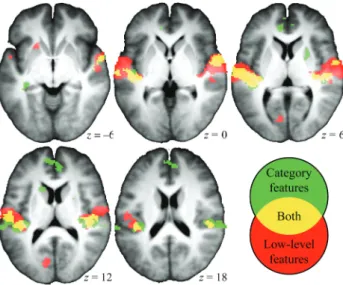
Figure
3
shows part of the cortical regions in which we
ob-served a signi
ficant correlation between the RDMs and at least
1 of the object-category or low-level features (P < 0.0001,
un-corrected). In particular, areas marked in yellow are sensitive
to both low-level and object-category structure (signi
ficant
RDM correlation with at least 1 category SDM and at least 1
low-level SDM). Large portions of the bilateral temporal
cortex are characterized by dual category/low-level sensitivity,
including Heschl
’s gyrus (HG), whose medial two-thirds are
classically assumed to correspond to the core primary
audi-tory
fields (
Rademacher et al. 1993
;
Morosan et al. 2001
), and
the superior temporal plane both anterior and posterior to
HG, that is, the PT and the aSTG. The functional meaning of
these results is uncertain, however: It could, for example, be
the simple product of a statistical association between
low-level and object-category features.
Fine-Grained Spatial fMRI Patterns in Both the
Temporal and Extratemporal Cortex Selectively Encode
Several Low-Level Features
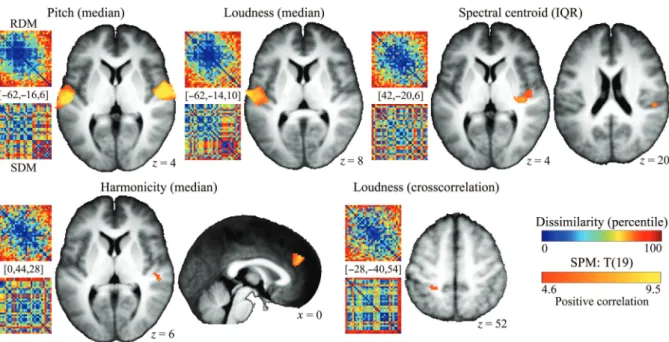
Figure
4
shows those regions where we observed a
simul-taneous correlation and partial correlation between the RDMs
and the low-level feature SDMs (P < 0.0001, uncorrected for
both; partial correlation discards the variance common
between target low-level and non-target low-level features
and object-category features). These regions meet the
strin-gent statistical criteria of feature selectivity (e.g.,
Hall and
Plack 2009
). We observed encoding of: 1) The median value
of the time-varying pitch in a large temporal cluster in both
hemispheres, comprising the lateral aspects of HG and
includ-ing the most anterior portions of the PT; 2) the median value
of the time-varying loudness in a large patch of the left
audi-tory cortex extending laterally from the middle portion of HG
to the anterior aspects of the left PT; 3) the amount of
tem-poral change of the spectral centroid (spectral centroid IQR
SDM) in the most medial aspect of the right HG and the right
PT; 4) the median value of the time-varying HNR in the
right-lateralized temporal cortex ( posterior superior temporal gyrus
[ pSTG]/STS) and in a bilateral frontal cluster comprising the
medial frontal gyrus (medFG) and the anterior cingulate
cortex (ACC), with a peak effect in the right hemisphere; 5)
the overall pattern of temporal variation of loudness (loudness
cross-correlation SDM) in the anterior aspect of the superior
parietal lobule (SPL).
The Right Planum Temporale and Posterior Superior
Temporal Gyrus Represent Abstract Categories of
Auditory Objects
Figure
5
shows those regions where both the correlation and
partial correlation between RDMs and category-feature SDMs
were signi
ficant (P < 0.0001, uncorrected for both). These
regions are potentially involved in the abstract representation
of categories of auditory objects because none of the low-level
features we considered explains their encoding in the cortex.
We observed encoding of: 1) The category of living sounds,
comprising both vocal and non-vocal sounds, as well as
human and non-human sounds, in the medial right PT,
bor-dering the medial HG; 2) the category of human sounds,
com-prising both vocal and non-vocal sounds, as well as both
Figure 3. The anatomical overlap of regions sensitive to both category and low-level features (yellow) exemplifies the potential interpretational problems that arise from a study of category encoding independent of the assessment of low-level alternative hypotheses. The measurement of cortical sensitivity is based on the (unpartialed) correlation between RDMs and category or low-level SDMs, and thus considers both the variance specific to each feature, and that shared between the features. With feature-rich sets of naturalistic stimuli, like the 1 in this study, the cortical sensitivity to sound categories can simply be mediated by systematic category differences in neurally relevant low-level structures. Color codes—significant correlation of RDM with: red = only low-level features (one or several); green = only category features (one or several); yellow = at least 1 low-level feature and at least 1 category feature (P < 0.0001, uncorrected, extent threshold = 20).
Figure 4. Selective encoding of low-level features is revealed after partialing out of the variance shared with other low-level features and with category features. For each of the low-level features revealed by this analysis, larger low-level differences result in a larger dissimilarity of thefine-grained spatial fMRI patterns (positive RDM-SDM correlation). Clusters show the statistical parametric map (t-test) for testing a significant correlation between RDMs and low-level feature SDMs only within those cortical regions characterized by a significant partial correlation between the same low-level SDM and the RDM with the same sign as the correlation (P < 0.0001, uncorrected; extent threshold = 20 voxels for both the correlation and partial correlation tests). The statistical parametric maps are overlaid onto the group-averageT1. IQR = interquartile range of
time-varying low-level feature. For each of the features, we display the group-average RDM for the peak effect and the relative SDM (numbers between square parentheses = MNI coordinates). The RDMs are displayed in anti-Robinson form (dissimilarity increases moving away from the diagonal); the relative SDM is resorted accordingly. Note the analyses reported in this manuscript have been carried out on the participant-specific RDMs, and not on the group-average RDMs. Group-average RDMs are reported in this figure in order to give a clearer picture of the across-participants structure in the RDM that most likely reflects the stimulus feature at hand.
Figure 5. Selective abstract encoding of sound categories is revealed after partialing out of the variance shared with other category features and with low-level features. See Fig.4for the meaning of statistical parametric maps and of dissimilarity matrices, and Fig.2for details on category SDMs. This analysis reveals 2 temporal regions where all human-action sounds give rise to similarfine-grained spatial fMRI patterns, the right PT/pSTG and left medHG (negative correlation of RDM with human-dissimilar SDM; top slices). A similar effect is observed for the category of living sounds in the right PT/medHG (negative correlation of RDM with living-dissimilar SDM; bottom slice). For both human and living sounds, we thus observe a significant within-category effect (significantly lower diversity of spatial fMRI patterns for sounds within the same category; Fig.2B,
C) that differs qualitatively from the between-category differences detected with “activation-based” univariate analyses (Fig.2A). To further illustrate the observed within-category
effects, we display for each of the category features a 2-dimensional multidimensional scaling (MDS) model of the group-average RDM for the spherical searchlight centered at the peak-correlation voxel (numbers between square parentheses = MNI coordinates). Within the MDS models, points separated by a large distance represent stimuli associated with highly dissimilar fMRI patterns. Note the higher proximity of human compared with non-human sounds (top) and of living compared with non-living sounds (bottom), representing a higher dissimilarity of fMRI patterns within each of these categories. MDS space captions = average representational dissimilarities (RD) for various categories of interest.
living and non-living sounds, in the right pPT/pSTG, and in
the most medial aspect of the left HG. In both cases, we
de-tected a signi
ficant within-category effect measuring a greater
similarity of the spatial fMRI patterns within the living and
human categories (Fig.
2
, for more details on the strategy
adopted to assess the encoding of object-category features).
Discussion
Our study aimed to assess the abstract encoding of categories
of non-speech naturalistic auditory objects independently of
systematic
fingerprints of their low-level structure. The main
goal of this study also led us to assess the cortical encoding
of a large number of low-level features of naturalistic
sounds. We adopted a condition-rich design coupled with
information-based analyses of the spatial fMRI patterns. The
selectivity for both object-category and low-level features was
assessed after partialing out their shared variance. Selective
encoding was observed for several low-level features: The
brain imaging of naturalistic sounds can represent a powerful
instrument for characterizing the signal-processing
architec-ture of the cortex. In both hemispheres, posterior temporal
regions, among which the PT, appeared to encode abstractly
the categories of living and human sounds. These results 1)
reveal domain-general processes for the abstract encoding of
auditory objects; 2) motivate a revised hierarchical processing
model of increasing information abstraction with the distance
from A1 both in the anterior and posterior directions
(
Rauschecker and Tian 2000
;
Peelle et al. 2010
); 3) suggest
that part of the by-product of the template-matching process
that takes place in the PT (
Grif
fiths and Warren 2002
) is
ab-stract in nature.
Accurate Models of the Cortical Encoding of Sound
Categories Should Consider Their Low-Level Structure
Our current understanding of the processing of naturalistic
auditory objects in the human cortex focuses on the encoding
of categorical structure and largely disregards low-level
fea-tures (see, e.g.,
Rauschecker et al. 1995
and
Leaver and
Rauschecker 2010
, for exceptions in the human and animal
literature, respectively). The presence of large cortical patches
sensitive to both low-level and object-category features
(Fig.
3
) exempli
fies the ambiguity of this approach. The
observation of a dual low-level/object-category sensitivity can
indeed have 2 interpretations. First, it might be the simple
product of a statistical association between categories of
objects and low-level features. Secondly, it might be the
product of multifunctionality, that is, of the simultaneous
en-coding of low-level and object-category features in the same
neural population (see
Bizley et al. 2009
, for encoding of
mul-tiple low-level features in the same neural populations in A1
in the ferret). Variance decomposition methods, like those
adopted in the current study, are necessary to decide between
these alternative hypotheses and to assess abstract object
en-coding independently of the rich low-level structure of
natura-listic sounds.
Abstract Representation of Biological Sounds
We observed cortical encoding of 2 categories of auditory
objects: Living (right medHG/PT) and human-action auditory
objects (left HG and right pPT/pSTG; Fig.
5
). In both cases,
objects belonging to the same category emerged as evoking
similar spatial fMRI patterns. This particular within-category
effect could not be detected with conventional univariate
analysis approaches, and reveals that the cortical encoding of
object categories does not necessarily rely on the ability to tell
apart different category exemplars. The comparatively large
set of low-level features considered in this study cannot
explain these results because the measurement of category
encoding ignored the variance common between
object-category and low-level features. It is possible that additional
low-level features, not considered in this study, account for
these results. Another interpretation, however, is that these
areas encode high-level abstract features optimized for the
Table 1Summary of random-effects representational similarity analyses: Correlations between stimulus dissimilarities and RDMs, masked for the significant partial correlation with the same sign (P < 0.0001, uncorrected, df = 19, extent threshold = 20 voxels for both correlation and partial correlation)
Left hemisphere Right hemisphere
Location BA Z Vox x y z ρ Z Vox x y z ρ
Pitch (median)
lHG/PT 41 5.69 718 −62 −16 6 0.27 – – – – – –
lHG/PT 41 – – – – – – 5.67 669 68 −10 2 0.18
Loudness (median)
HG/mSTG/aPT 41/42 5.41 680 −62 −14 10 0.19 – – – – – –
Spectral centroid (interquartile range)
medHG 41 – – – – – – 4.92 178 42 −20 6 0.27 PT 41 – – – – – – 4.38 32 54 −30 20 0.25 Harmonicity (median) medFG/ACC 9/32 – – – – – – 4.83 236 0 44 28 0.28 pSTS/pSTG 22/42 – – – – – – 4.55 31 48 −22 4 0.12 Loudness (cross-correlation) Anterior SPL 7 4.18 24 −28 −40 54 0.32 – – – – – – Human dissimilar PT/pSTG 22/42 – – – – – – 4.73 228 70 −30 18 −0.24 medHG 41 4.38 99 −44 −20 0 −0.34 – – – – – – Living dissimilar PT/medHG 41 – – – – – – 4.74 80 44 −28 12 −0.24
Note: Theρ columns report the Spearman correlation between group-average RDMs on the 1 hand and 1 specific SDM on the other.
BA = Brodmann area;Z = Z-score; Vox = number of voxels in cluster; pSTG/pSTS = posterior superior temporal gyrus/sulcus; mSTG = middle STG; HG = Heschl’s gyrus; lHG = lateral HG; HS = Heschl’s sulcus; medHG = medial HG; ACC = anterior cingulate cortex; medFG = medial frontal gyrus; SPL = superior parietal lobule; PT = planum temporale; aPT = anterior planum temporale.