CASE REPORT
Parenteral Nutrition Independence in a Patient Left
with 25 cm of Ileum and Jejunum: A Case Report
Laurence Genton&Patrizia Nardo&Olivier Huber&Claude Pichard
Received: 15 December 2009 / Accepted: 28 January 2010 / Published online: 26 February 2010
# Springer Science+Business Media, LLC 2010
Abstract A 44-year-old woman with a history of Roux-en-Y gastric bypass (RYGBP) suffered small bowel volvulus. She was left post-operatively with an intact duodenum, 25 cm of jejunum and ileum, and a colon in continuity, a situation synonymous to short bowel syndrome. This report describes her surgical, medical and nutritional follow-up until complete weaning of parenteral nutrition despite of her very short remnant small bowel and persistently low citrullinemia. The discussion aims at demonstrating the rarity of these compli-cations after RYGBP according to the literature. Furthermore, it challenges the validity of the present markers of parenteral nutrition independence (remnant small bowel length, citrulli-nemia) in case of short bowel syndrome.
Keywords Short bowel syndrome . Gastric bypass . Parenteral nutrition . Body composition . Citrulline
Introduction
Short bowel syndrome (SBS) is a rare condition with an incidence of≈two per million and a prevalence of two to four per million subjects in most western countries [1]. It generally results from surgical bowel resection related to recurrent Crohn’s disease, mesenteric arterial infarct, venous
throm-bosis, volvulus, trauma or tumour. A functional SBS may also occur in case of severe malabsorption with intact bowel length as in radiation enteritis, pseudo-obstruction, refractory sprue or congenital villous atrophy [1]. Patients present with permanent or transient intestinal failure leading to water, mineral and macronutrient malabsorption [2] and thus often require long-term parenteral nutrition (PN). Messing et al. showed that the cut-off values for permanent intestinal failure, defined as PN dependency over 2 years duration, was 100 cm in case of end-jejunostomy and 70 cm in case of jejunocolic or jejuno-ileocolic anastomosis [3]. This article reviews the case of a woman who reached PN independence with an intact duodenum, about 25 cm jejunum and ileum and a colon in continuity.
Case Report
A 44-year-old women with a BMI of 45 kg/m2benefited from bariatric surgery in July 2006. Her medical history was otherwise not relevant. She underwent a laparoscopic proximal Roux-en-Y gastric bypass (RYGBP) and a cholecystectomy for pigment stone (day −561) (Fig. 1a). Biopsies showed a discrete macrovacuolar steatosis of the liver, a chronic cholecystitis and cholesterolosis. On August 2007, she complained of abdominal post-prandial cramps and underwent a laparoscopic section of an adhesion in regard of the jejuno-jejunal anastomosis.
Massive Enterectomy, End-jejunostomy and Nutritional Support (day 0)
In February 2008, while she was in Bolivia, she suffered from a hypovolemic shock related to an extended small bowel necrosis following a Roux limb volvulus. She L. Genton
:
P. Nardo:
C. Pichard (*)Clinical Nutrition, Geneva University Hospital, Rue Gabrille-Perret-Gentil 4, 1211 Geneva 14, Switzerland
e-mail: [email protected] O. Huber
Visceral and Transplantation Surgery, Geneva University Hospital,
Rue Gabrille-Perret-Gentil 4, 1211 Geneva 14, Switzerland
underwent subtotal enterectomy with placement of a gastrostomy and a jejunostomy (day 0) and was transferred to the University Hospital of Geneva 9 days later. At day 18, she underwent an exploratory laparotomy, which showed an intact colon, the presence of the appendix and 5 cm of distal ileum closed proximally. The remaining jejunum and proximal ileum measured about 25 cm, were anchored distally to the skin as jejunostomy and proximally to the duodenum and distal gastric pouch, which was equipped with a feeding gastrostomy (Fig. 1b). The proximal gastric pouch had been left with one cm of small
bowel. The one cm of jejunum attached to the proximal gastric pouch was removed and a gastro-gastric anastomo-sis performed (Fig. 1c).
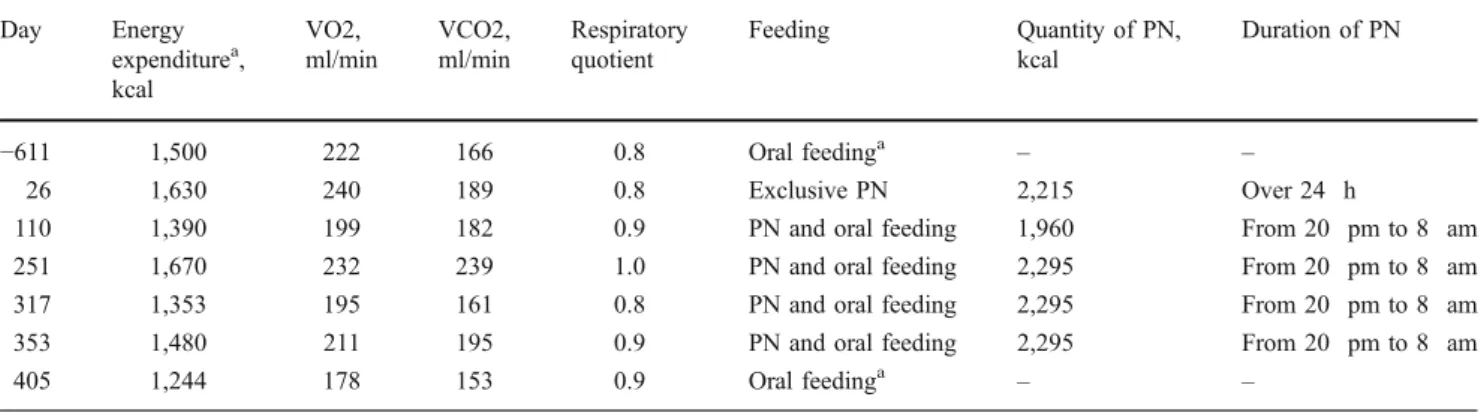
The patient was fed through a central venous catheter since day 10. She weighed 64 kg for a height of 160 cm. PN provided 2,215 kcal daily (1,875 ml, 270 g carbohy-drates, 108 g amino acids, 75 g fat; Nutriflex®, B. Braun Medical, Crissier, Switzerland). Trace elements (10 ml Addamel®, Fresenius Kabi, Stans, Switzerland), vitamins (5 ml Cernevit®, Baxter, Volketswil, Switzerland) and glutamine (80 kcal, 134 g L-glutamine, 82 g L-alanine; Dipeptiven ®, Fresenius Kabi, Stans, Switzerland) were added into the PN bag. On day 31, an indirect calorimetry showed an energy expenditure under PN of 1,630 kcal, estimated at 1,900 kcal with physical mobilisation (Table1). Thus, PN was decreased to 1,890 kcal daily. Intravenous hydration and electrolytes were supplemented daily accord-ing to the losses through the jejunostomy, which varied between 1.5 and 4 l/day, renal function and osmolality. To promote bowel adaptation, the patient received daily 750 kcal of a polymeric fibre-enriched enteral nutrition (500 ml Novasource Energy®, Nestlé, Vevey, Switzerland) through the gastrostomy until she resumed oral feeding and gastrostomy could be removed (day 34). To limit jejunos-tomy output, she received soluble fibre supplementation and esomeprazole. Regarding oral feeding, she was advised to limit intakes of raw fruits and vegetables, add 8–10 g/day salt to her diet and drink high-salt containing water to increase water absorption, dissociate drinking from eating to reduce transit time, limit lactose-containing food as it may induce osmotic diarrhoea and to have at least six small intakes per day. Nutritional support is detailed on Fig.2.
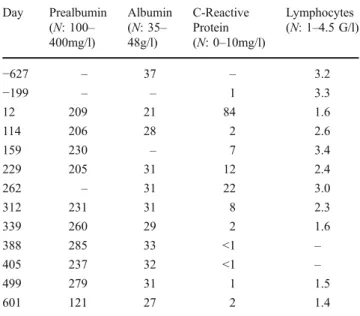
The patient was discharged on day 44 with 1,890 kcal/day nocturnal PN, oral feeding, esomeprazole, buprenorphine for parietal, pain and anticoagulation because of a thrombosis of the mesenteric vein and a right segmental lung emboly discovered fortuitously on a CT-scan. Between day 45 and day 121, the patient remained under the same feeding regimen but received also 0.5 to 2 L NaCl 0.9% per day intravenously according to renal function and osmolality. Evolution of weight and body composition is shown on Fig.3. Nutritional plasma parameters are presented on Table 2. During the whole follow-up, liver tests and triglycerides remained within normal limits while plasma citrulline remained below limits (between 7 and 10 umol/l; normal values: 15– 55 umol/l). Levels of plasma vitamins were measured every 2 months and supplemented when necessary.
Jejuno-ileo-sigmoid Continuity and Nutritional Support (day 122)
The patient was again hospitalised on day 122 to establish jejuno-ileal continuity. As the stomy output frequently Fig. 1 Abdominal status after gastric bypass (a), at admission to the
Geneva University Hospital after intestinal volvulus in Bolivia (b), after the laparoscopy performed at the Geneva University Hospital (c), after establishment of jejuno-ileo-sigmoid continuity (d) and finally after establishment of ileo-colic continuity (e)
exceeded 1,200 ml/day, it was decided to perform a temporary sigmoidostomy and not to establish colonic continuity at once to allow colonic adaptation and avoid anal irritation by frequent stools (Fig.1d). She was treated from day 111 to 133 with 12 IU (4 mg) human recombinant growth hormone (Saizen®, Serono, Geneva, Switzerland) daily to stimulate bowel trophicity. Nocturnal PN was increased in parallel to 2,215 kcal to account for the increased needs due to growth hormone-induced anabolic effect.
She was discharged on day 136 and frequency of PN administration could progressively be decreased to 2,215 kcal 5 days/week because of stable weight. The patient was asked to consume an oral powder supplement containing 10 g glutamine (Glutamine Plus®, Fresenius, 10 g glutamine and 80 kcal/pack) thrice a day during the PN-free days.
Sigmoido-rectal Continuity and Nutritional Support (day 272)
She finally underwent reestablishment of continuity be-tween the sigmoid and rectum on day 272 (Fig. 1e). To stimulate bowel trophicity, she was treated again with growth hormone daily (12 UI/day) during 14 days pre- and 5 days post-operatively and frequency of PN was increased from 5 to 7 days/week. The post-operative period was uncomplicated and the patient rapidly discharged. On day 286, PN was decreased to five times per week. Oral glutamine was stopped on day 303.
At this time, bowel transit was studied with ingestion of liquid barium and with ingestion of a breakfast containing metallic markers. After barium ingestion, the stomach was emptied within 30 min and colon and rectum largely opacified 2 h later. In contrast, the ingestion of the breakfast led to a surprisingly long intragastric phase as the metallic markers were still in the
stomach 4 h later and the ileo-caecal valve was reached only 6 h later, suggesting a slower transit time with solid meals compared with liquids.
The follow-up was significant for an infection of the implantable chamber (day 326) with Klebsiella pneumonia and Staphylococcus epidermidis. The chamber was excised as its sterilisation failed with 2 weeks of antibiotic treatment (intravenous ceftobiprole and vancomycine-lock), and a new chamber was implanted on day 345. PN was
0 500 1000 1500 2000 2500 3000 3500 0 60 120 180 240 300 360 420 480 540 600 days kcal/d
Parenteral nutrition Glutamine iv Enteral nutrition
Fig. 2 Nutritional support by enteral and parenteral nutrition since the occurrence of the intestinal volvulus
Table 1 Energy expenditure measured by indirect calorimetry from day−627 (before the Roux-en-Y gastric bypass) until day +405 (weaning of home parenteral nutrition to twice per week)
Day Energy expenditurea, kcal VO2, ml/min VCO2, ml/min Respiratory quotient Feeding Quantity of PN, kcal Duration of PN −611 1,500 222 166 0.8 Oral feedinga – – 26 1,630 240 189 0.8 Exclusive PN 2,215 Over 24 h
110 1,390 199 182 0.9 PN and oral feeding 1,960 From 20 pm to 8 am
251 1,670 232 239 1.0 PN and oral feeding 2,295 From 20 pm to 8 am
317 1,353 195 161 0.8 PN and oral feeding 2,295 From 20 pm to 8 am
353 1,480 211 195 0.9 PN and oral feeding 2,295 From 20 pm to 8 am
405 1,244 178 153 0.9 Oral feedinga – –
a
maintained at 2215 kcal five times per week through a jugular vein catheter during this complication. Thereafter, its frequency could progressively be decreased because of weight maintenance to reach twice per week on day 405. However, on day 445, she weighed 61.4 kg (−3 kg in 1 month) and complained about thirst which motivated additional intravenous hydration with 500 ml/day.
The patient was hospitalised again on day 457 for acute renal failure due to ingestion of non steroidal anti-inflammatory drugs. She was discharged with 1,475 kcal PN daily, which could rapidly be decreased again to 2,215 kcal twice a week.
On day 538, the patient experienced a new infection of the implantable chamber, this time with E. faecalis.
Because the chamber could not be sterilised with antibiotics (intravenous gentamycine and amoxicilline), the chamber was excised on day 544. No other central venous access was implanted in accordance with the patient. On day 552, her weight fell to 52.6 kg (13% loss in one month) but remained stable the following 2 months despite of the absence of PN. The patient presented no clinical signs for steatorrhea.
Discussion and Conclusion
This patient with a history of RYGBP 2 years earlier underwent massive enterectomy for a volvulus of the Roux limb. She was left with an intact duodenum, about 25 cm of ileum and jejunum and an intact colon. She reached independence of parenteral nutrition 1.5 years after this massive enterectomy.
The incidence of small bowel volvulus in western countries is estimated as 1.7 to 5.7 cases per 100,000/year and the associated mortality ranges from 9% to 35%, which increases to 20–100% in case of bowel gangrene [4]. Small bowel volvulus can be primary when twisting of a bowel loop occurs without any apparent predisposing anatomical abdominal abnormality (10–20 % of cases in the Western World). However, in 80% to 90% of cases, it is secondary to anatomic malformations and malrotations, mesenteric or omental defects, adhesive bands, or associated with a stoma or pregnancy [5].
In our patient, small bowel volvulus probably resulted from a strangulated internal hernia after RYGBP but this
Table 2 Plasma values of nutritional parameters from day −627 (before the Roux-en-Y gastric bypass) until day +601 (total weaning of home parenteral nutrition)
Day Prealbumin (N: 100– 400mg/l) Albumin (N: 35– 48g/l) C-Reactive Protein (N: 0–10mg/l) Lymphocytes (N: 1–4.5 G/l) −627 – 37 – 3.2 −199 – – 1 3.3 12 209 21 84 1.6 114 206 28 2 2.6 159 230 – 7 3.4 229 205 31 12 2.4 262 – 31 22 3.0 312 231 31 8 2.3 339 260 29 2 1.6 388 285 33 <1 – 405 237 32 <1 – 499 279 31 1 1.5 601 121 27 2 1.4
Weight
0 20 40 60 80 100 120kg
Fat-free mass
0 20 40 60 80 100 120kg
Fat mass
0 20 40 60 80 100 120 -630 30 90 150 210 270 330 390 450 510 570 630 days kg subtotal enterectomy for volvulus-induced small bowel necrosisFig. 3 Evolution of weight (kg), fat mass (kg) and fat-free mass (kg). Body composition measured by 50-kHz bioimpedance analysis (Nutriguard-M ®, Data Input, Darmstadt, Germany), was calculated according to the Geneva formula. Only the first measurement at −630 days (before gastric bypass) was measured by dual-energy X-ray absorptiometry (Discovery ®, Hologic Inc, Waltham, MA, USA) since BIA has not been validated in obese subjects
could not be checked since the patient was first operated in Bolivia. In a retrospective study including 702 consecutive patients who underwent gastric bypass between 2002 and 2007, 27 patients (3.8%) developed acute small bowel obstruction and 11 patients (1.6%) intermittent small bowel obstruction. Out of these, three patients were found with a small bowel volvulus during elective laparoscopic explora-tion [6]. Besides of this retrospective study, several case reports describe small bowel volvulus one to two years after RYGBP in subjects with no other relevant disease [7,8], in pregnant women [9–12] or in a woman who underwent caesarean section [13].
Our patient remained post-operatively with an intact stomach and duodenum (due to RYGBP reversal), 25 cm of jejunum and ileum, and a whole colon in continuity, thus a situation synonymous of SBS. A retrospective study of 265 patients who underwent bariatric surgery showed that 4% of the patients had one or several operations resulting in SBS [14]. Conversely, in a retrospective review of 210 patients with SBS, SBS resulted from volvulus in 6% of the cases and from gastric bypass in 2% of the patients [15]. Thus, this patient cumulated rare complications after RYGB, whether small bowel volvulus or the occurrence of postoperative SBS.
This case report is also particular regarding nutritional support. This patient was initially dependent on parenteral nutrition but could be weaned from PN over 1.5 years despite of the remnant 25 cm of jejunum and ileum. This contrasts with the reported cut-off value below 70 cm for permanent intestinal failure in case of jejunocolic or jejuno-ileocolic anastomosis [3]. The explanations of the success-ful PN weaning in our patient remain unclear. Her stable weight without PN at the end of this report suggests that the remaining small bowel must have adapted sufficiently within 2 years to absorb her daily calorie needs. In animals, bowel adapts to enterectomy within the first 2 years by increasing diameter and villous height and thus the absorptive surface. In SBS patients, increased protein absorption was shown 6 months or more after re-establishment of digestive continuity [2]. However, despite of bowel adaptation, the remaining length of 25 cm of jejunum and ileum seems too low to achieve PN independence according to present literature. Maybe, the immediate post-operative enteral feeding and the bowel rehabilitation strategies, i.e. intravenous glutamine or punctual addition of recombinant growth hormone before surgical procedures optimally increased intestinal trophicity and thus macronutrient absorption.
Surprisingly, citrullinemia remained below normal values throughout the follow-up, with no tendency of increase. Crenn et al. showed that citrullinemia was a marker of enterocyte mass in patients with SBS and that a value <20 umol/l after a minimal follow-up of 2 years was a
powerful indicator of permanent intestinal failure [16]. This result was contested by Luo et al. who found that citrullinemia, measured by the same method, was an indicator of small bowel length but not of absorptive capacity in 24 SBS patients [17]. Similarly, a retrospective study demonstrated PN weaning over 1 year in five SBS patients with a citrullinemia <20 umol/l [18]. Thus, our case report confirms these former studies.
In conclusion, this woman suffered a rare complication of RYGBP, i.e. small bowel volvulus, which led to a very short remnant jejunum and ileum (25 cm) post-operatively. She could be weaned of PN despite of her very short small bowel and low citrullinemia.
Acknowledgment We thank the Foundation Nutrition 2000Plus for financial support as well as Emilie Karsegard for her help in drawing the figures.
Conflict of Interest None of the authors has declared a conflict of interest. The project was granted by the public Foundation Nutrition 2000Plus.
Disclosure This work was supported financially by the Foundation Nutrition 2000Plus.
References
1. Buchman AL, Scolapio J, Fryer J. AGA technical review on short bowel syndrome and intestinal transplantation. Gastroenterology. 2003;124:1111–34.
2. Crenn P, Morin MC, Joly F, et al. Net digestive absorption and adaptive hyperphagia in adult short bowel patients. Gut. 2004;53:1279–86.
3. Messing B, Crenn P, Beau P, et al. Long-term survival and parenteral nutrition dependence in adult patients with the short bowel syndrome. Gastroenterology. 1999;117:1043–50.
4. Iwuagwu O, Deans GT. Small bowel volvulus: a review. J R Coll Surg Edinb. 1999;44:150–5.
5. Frazee RC, Mucha Jr P, Farnell MB, et al. Volvulus of the small intestine. Ann Surg. 1988;208:565–8.
6. Gandhi AD, Patel RA, Brolin RE. Elective laparoscopy for herald symptoms of mesenteric/internal hernia after laparoscopic Roux-en-Y gastric bypass. Surg Obes Relat Dis. 2009;5:144–9. discussion 9.
7. Novotny NM, Mattar SG, Falimirski ME. Roux limb volvulus after long-limb Roux-en-Y gastric bypass. Obes Surg. 2007;17:1523–4.
8. Keyser EJ, Ahmed NA, Mott BD, et al. Double closed loop obstruction and perforation in a previous Roux-en-Y gastric bypass. Obes Surg. 1998;8:475–9.
9. Gazzalle A, Braun D, Cavazzola LT, et al (2009). Late Intestinal Obstruction due to an Intestinal Volvulus in a Pregnant Patient with a Previous Roux-en-Y Gastric Bypass. Obes Surg (in press) 10. Naef M, Mouton WG, Wagner HE (2009). Small-Bowel Volvulus in Late Pregnancy Due to Internal Hernia After Laparoscopic Roux-en-Y Gastric Bypass. Obes Surg (in press)
11. Wang CB, Hsieh CC, Chen CH, et al. Strangulation of upper jejunum in subsequent pregnancy following gastric bypass surgery. Taiwan J Obstet Gynecol. 2007;46:267–71.
12. Loar 3rd PV, Sanchez-Ramos L, Kaunitz AM, et al. Maternal death caused by midgut volvulus after bariatric surgery. Am J Obstet Gynecol. 2005;193:1748–9.
13. Fleser PS, Villalba M. Afferent limb volvulus and perforation of the bypassed stomach as a complication of Roux-en-Y gastric bypass. Obes Surg. 2003;13:453–6.
14. McBride CL, Petersen A, Sudan D, et al. Short bowel syndrome following bariatric surgical procedures. Am J Surg. 2006;192:828– 32.
15. Thompson JS, DiBaise JK, Iyer KR, et al. Postoperative short bowel syndrome. J Am Coll Surg. 2005;201:85–9.
16. Crenn P, Coudray-Lucas C, Thuillier F, et al. Postabsorptive plasma citrulline concentration is a marker of absorptive enter-ocyte mass and intestinal failure in humans. Gastroenterology. 2000;119:1496–505.
17. Luo M, Fernandez-Estivariz C, Manatunga AK, et al. Are plasma citrulline and glutamine biomarkers of intestinal absorptive function in patients with short bowel syndrome? JPEN J Parenter Enteral Nutr. 2007;31:1–7.
18. Weseman R, Di Baise JK, Sudan D, et al. Successful restoration of nutritional autonomy in short bowel syndrome (SBS) patient with very low citrulline concentration. Nutr Clin Prac. 2004;19:86–7.