Preface
Lake Brienz Project: An interdisciplinary catchment-to-lake
study
Alfred W est1,2,*, Markus Zeh3and Josef D. Ackerman4
1Surface Waters – Research and Management, Swiss Federal Institute of Aquatic Science and Technology,
Eawag, CH-6047 Kastanienbaum, Switzerland
2Institute of Biogeochemistry and Pollutant Dynamics, ETH Z/rich, CH-8092 Z/rich, Switzerland 3Laboratory for Water and Soil Protection of Canton of Bern (GBL), Schermenweg 11, CH-3014 Bern,
Switzerland
4Department of Integrative Biology and Faculty of Environmental Sciences, University of Guelph, Guelph,
Ontario, N1G 2W1, Canada
Key words. Dams and reservoirs ; downstream effects; fish decline; hydropower; oligotrophic and turbid lakes; Lake Brienz.
Introduction
Lakes are influenced by their catchments in many different ways. Besides the natural factors, such as geological and hydrological settings, human activities often leave traces of profound and complex impacts. One type of major anthropogenic change is the extensive river damming that has occurred in the European Alps. Indeed, numerous investigations have focussed on the effects of water diversion and hydro-logical alterations on downstream river ecology (Tharme, 2003), and on suitable requirements for the resulting environmental flows (King et al., 2003). Though often ignored, downstream lakes are also impacted by damming-related removal of sediments (Vçrçsmarty et al., 2003) and nutrients (Humborg, 2000), as well as changes of the hydrological and thermal regime (Meier et al., 2003). In addition, despite the partly remote locations, many Alpine lake catchments have also been affected by anthropogenic nutrient inputs.
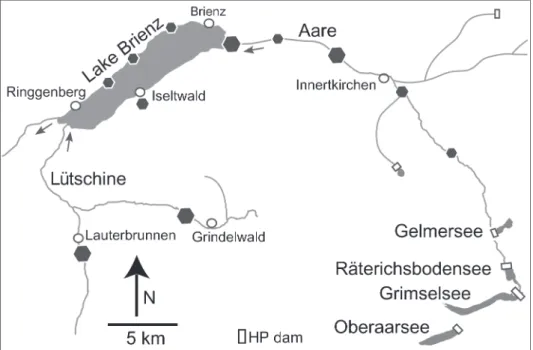
Lake Brienz and its Aare catchment, located in central Switzerland, provide an excellent example of an anthropogenic impact on a peri-alpine lake (Fig. 1). It received much public attention in Switzerland two decades ago, when fishermen blamed the upstream hydropower operation (Fig. 1) for an alleged increase of the turbidity of the lake water, which they related to the rapid decline of whitefish (Coregonus sp.) catches. Preliminary studies in the early 1990s (Naturaqua, 1993; Eawag, 1996) concluded that hydropower operations had altered the seasonality of the river flow and reduced the overall particle input from the upstream glaciers to Lake Brienz. However, it was not possible to link such changes to biotic elements of the lakeCs ecosystem, as there were only a few ecological studies available from the past (Kirchhofer, 1990). Not surprisingly, speculative hy-potheses were proposed: (1) Particles from the reservoirs were thought to reduce the light and subsequently the productivity in the lake; (2) the same particles were also argued to have an adverse effect on whitefish egg survival and hence reproduc-tive success; (3) the pump-storage operation (Fig. 1) was considered to alter the size and shape of small particles (Blaser and B/hler, 2001) and consequently to cause abrasion in the whitefish gills (M/ller R.,
* Corresponding author phone: +41 41 349 2181; fax: +41 41 349 2162; e-mail: [email protected] Published Online First: June 6, 2007
DOI 10.1007/s00027-007-0016-0 J Eawag, D/bendorf 2007
pers. comm.). As a first measure to overcome this data deficit, the Cantonal Environmental Authority adopt-ed a lake monitoring program in 1993 with monthly sampling of phytoplankton and zooplankton and measurements of temperature, conductivity, oxygen, pH, light transmission and photosynthetically active radiation (PAR). This data set proved to be extremely helpful for the research projects presented in this issue. In 1999, in the midst of these ongoing discussions on the potential role of the hydropower operation on Lake Brienz, the whitefish catches were found to have declined by 90 % (Fig. 2) in parallel to a collapse of the Daphnia (water flea) population. These events, how-ever, brought a new twist to the discussion, because the external conditions were indeed exceptional in 1999; after a snow-laden and cold winter, the acci-dental coincidence of both snowmelt and rainfall in May caused 2 to 3-times normal discharge and intensive flooding.
Thereafter the responsible representatives of the Cantonal Government urged the stakeholders (see list in acknowledgement) to form a joint taskforce to assess the nature of the observed ecological changes. It was rapidly realized that a broader and interdiscipli-nary approach was needed, and that other influences, such as the effect of the implementation of the waste water treatment plants (Fig. 1) – reducing nutrients – or climate change – causing stronger glacial melting in summer – also needed to be considered. All the relevant facts and findings were collected and assessed
(GBL, 2003). Based on this analysis, the steering committee decided to initiate a research project focussing on the following three key questions: (1) What caused the long-term decline of fishing yield since the late 1970s?
(2) What caused the collapse of (i) the whitefish catches and (ii) the Daphnia population in 1999/2000? and
(3) Will such collapses reoccur in the future and could they be prevented by adequate management? Before we preview the seven papers in this special issue that attempt to answer these questions, we first introduce the hydrological setting of Lake Brienz.
Lake Brienz and its catchment
Lake Brienz, situated in central Switzerland at an elevation of 564 m asl (Fig. 1), is a typical example of the peri-alpine lakes in the European Alps with steep slopes (no shallow littoral zones), a deep (259 m) basin and ultra-oligotrophic (~1 mg m-3phosphate),
unpol-luted water quality. With a surface area of 29.7 km2
and a volume of 5.15 km3, Lake Brienz has an average
water renewal time of ~960 days (throughflow ~62 m3/
s). The longitudinal axis of the lake is orientated NE – SW, parallel to the main geological structures, which also defines the two prevailing wind directions.
The catchment covers 1,134 km2with a maximum
elevation of 4,272 m asl (Finsteraarhorn). Of this area,
Figure 1. Four largest hydropower reservoirs (Table 1) and eleven waste water treatment plants – the two major changes in the 20thcentury
– in the catchment of Lake Brienz along the two tributaries, the L/tschine (no dams) and Aare (with dams) Rivers. The area of the hexagon scales with the capacity of the plant. The glaciers (source of turbidity) are located in the headwaters of both rivers. A pump-storage scheme exists between Grimselsee and Oberaarsee (bottom right).
56 % is unproductive (glaciers, rocks), 21 % is forested and only 21 % host extensive agriculture. Approxi-mately 400,000 tons of inorganic material is mobilized annually from the glaciers covering ~20 % of the area (Anselmetti et al., 2007), and is partly flushed into Lake Brienz leading to a turquoise to a milky-grey appearance of the lake water. Since the construction of the hydropower dams (Table 1) in the headwaters of the Aare River (Fig. 1), however, a significant portion of the glacial till is retained in the upstream reservoirs. Whereas the flow pattern of L/tschine has re-mained almost unaltered in the past, the hydrology of Aare has undergone a substantial shift due to the hydropower dams in the Grimsel region (Figs. 1 and 3). The natural regime of L/tschine – and the natural regime of Aare prior to alterations – is characterized by high flow and large particle loads in summer (due to snow and glacier melting) but very low flow of clear water in winter. The first dam (Gelmersee) in the Grimsel region came into operation in 1932. Since then, the hydropower scheme has been extended to include about one third of the catchment of Lake Brienz (Table 1). Seven reservoirs can store 0.195 km3
of water and supply nine hydropower plants, housing 26 turbines. In addition, a pump-storage unit between Grimselsee and Oberaarsee (Fig. 1), which has been operating since 1980, can shift energy production from low- to peak-demand periods (Fig. 3).
This upstream storage (Table 1) has a significant influence on the seasonal and daily discharge and the particle load of the Aare. The alteration by hydro-power operation has shifted ~17 % of the annual flow from summer to winter (Fig. 3), and the particle load in winter is now about four-fold larger compared to pre-dam conditions (Finger et al., 2006).
Despite the low population density in the catch-ment, eleven waste water treatment plants (Fig. 1) were installed between 1975 and 1994, which treat the waste water of ~36,000 persons. As all but one small plant apply phosphate precipitation technique, the phosphorus removal is quite high (~90 %). As shown below, this reduction in phosphorus input has had a significant effect on the lakeCs productivity.
Figure 2. Annual whitefish (Corregonus sp.) catch in Lake Brienz (commercial fishery only) since 1931. The 90 % drop in 1999 – the trigger for the presented study – was accompanied by a virtual disappearance of the Daphnia. Inset: Monthly wet biomass of Daphnia (g/m2)
integrated over the top 100 m water column at the center of the lake.
Table 1. The four largest of the seven reservoirs along the Aare River (data source: Kraftwerke Oberhasli AG).
Reservoir Elevation
(m asl)
Storage volume (Million m3)
Operational since Comments
Grimselsee 1909 94 1932 Lower basin of pump-storage scheme
Oberaarsee 2303 57 1954 Upper basin of pump-storage scheme
RNterichsbodensee 1767 25 1950
Preview on the papers of the special issue
The goal of the above mentioned pre-study (GBL, 2003) was a best-possible analysis of the existing data and the formulation of well-defined research hypoth-eses. Given the usual funding limitations, a prioritized list of the relevant factors for the three research questions was produced. Based on these hypotheses and priorities, the conceptual model provided in Figure 4 was used as a structural scheme to cluster the different issues into seven subprojects (GBL, 2003). The field and laboratory measurements were undertaken from 2003 to 2005 and the results synthe-sized in 2006. The following seven papers – which do not correspond directly to the subprojects – summa-rize the findings.
Anselmetti et al. (2007) present a seismic inves-tigation in the upstream reservoirs (Fig. 1), which they use to balance the particle fluxes from the glacier and the release of fine particles to the downstream turbines and Lake Brienz. They show that ~230,000 t/yr of glacial till are deposited and thus retained in the reservoirs and only the fine (< 5 to 20 mm) particles pass through and arrive in Lake Brienz. Due to the seasonal water retention, part of the load of fine particles has been shifted from summer to winter.
By comparing the colloid contents in L/tschine and Aare, Chanudet and Filella (2007a) show that the reservoir operation results in an almost continuous
Figure 3. Seasonal water flow of the Aare River before hydro-power operation in the Grimsel area (1905 to 1928) and recent data (1980 to 2003). Data source: Federal Office of the Environment (FOEN). The two major changes are: a shift of 200 Million m3/yr
from summer to winter as a result of the reservoirs (upper panel); and (2) the daily discharge fluctuations due to the electricity production (lower panel). Note the low flow on weekends.
Figure 4. Conceptual model of the factors affecting Lake BrienzCs ecosystem. The seven individual research projects and their interfaces were organized along this structure. Arrows point in the direction of the major effects.
colloidal input from the Aare River. In contrast, the natural flow of the L/tschine River in winter is low and contains very little colloidal material. However, although colloid concentrations in the photic zone of the lake are high in summer, they fall back to low levels in winter. As the finest particles are relevant for the turbid appearance of the lake, their coagulation rates were examined with respect to the presumably higher carbohydrate levels during the mesotrophic conditions in the late 1970s. The assessment indicates that both the historic and the current organic matter concentration (Chanudet and M. Filella, 2007b) is too low to significantly affect coagulation of lake inor-ganic colloids.
Based on the particle budget in Lake Brienz (Finger et al., 2006) and past Secchi depth records, Jaun et al. (2007) reconstruct the light attenuation for the last decades and the early 1920s. As a result of the hydropower operation, Lake BrienzCs PAR attenua-tion was ~ twice as strong in summer under pre-dam conditions, whereas it is now ~ twice as strong in winter compared to the pre-dam conditions. The analysis of the reflectance shows that the lake appeared less turbid for the mesotrophic conditions in the late 1970s, as the scattering was smaller but the attenuation was stronger (Jaun et al., 2007).
M/ller et al. (2007a) balance the bio-available phosphorus (P) – the second limiting factor, after PAR, for primary production – over the last decades by analyzing the P input by the rivers, the current lake internal fluxes, as well as the sediment record. These analyses reveal that: (i) the P input in the late 1970s was about four times the current value; (ii) the retention of P in the upstream reservoirs is substantial (M/ller et al., 2006), but still small compared to the anthropogenic input; and (iii) the current level of P leads directly to the ultra-oligotrophic conditions.
A low primary productivity of less than 70 gC/(m2
yr) is reported by Finger et al. (2007) based on in situ measurements. These data and the reconstructed light regime (Jaun et al., 2007) allows them to estimate – through a comparison of different models – the impact of the upstream reservoirs on the productivity in Lake Brienz (Finger et al., 2007). Although the intrusion depths of the particle-laden rivers changed signifi-cantly as a result of the upstream reservoirs (less dense water), the productivity did not decrease due to upstream damming.
Rellstab et al. (2007) demonstrate that the size of the Daphnia population has been decreasing in the last decade (Fig. 2) as a result of the declining phytoplankton density. Their analysis of the collapse of the Daphnia population in 1999 reveals that it resulted from a combination of: (i) a flood-induced higher washout rate; and (ii) lower temperatures. The
particle concentration present in the lake did not have a negative effect on the fitness of Daphnia. Finally, Rellstab et al. (2007) show that Daphnia had been absent from the lake before, as no resting eggs could be found in the sediment prior to 1955 – a period with similar productivity as today.
In the last paper, a key outcome is provided by M/ller et al. (2007b). As a result of the lack of Daphnia in 1999, the whitefish apparently starved and did not grow. Although the fish were present in the lake at their usual numbers, they were too small and too slim to be caught by the gillnets used. This is the first instance where “bottom-up” control of whitefish populations under oligotrophic conditions has been documented. In contrast, feeding pressure by the whitefish, i.e. “top-down” control played only a minor role in Daphnia dynamics. Given the natural fluctua-tions in the growth factors of Daphnia, future collap-ses in both the Daphnia populations and the whitefish fishing yield are to be expected.
Acknowledgements
This project received much support from different sources. First, we thank the members of the steering committee – representatives of the Cantonal Govern-ment Bern, KWO hydropower, local communities and NGOs – for their continuous interest and input: Fritz Abegglen, Renate Amstutz, Gianni Biasiutti, Peter Friedli, Raymond Kocher, Hansruedi L/thi, Hans Michel, Ueli Ochsenbein, Wilhelm Regez, Roland Seiler, Beat Schwabe and Heinz Peter Tscholl. Addi-tional input came from fishermen and citizens. The project planning and supervision profited much from the colleagues in the experts group: Hans Rudolf B/rgi, Stefan Hasler, Peter Huggenberger, Adrian Jakob, and Rudolf M/ller, as well as from Johannes B/hler, Christoph Siegenthaler and Michael Sturm working on pre-projects. But foremost we very much appreciated the effort of the many researches and their collaborators, as mentioned in the author lists and acknowledgments of the following seven papers. Most papers profited from hydological data provided by FOEN and KWO. The study was funded by (1) Cantonal Government of the Canton Bern, (2) Kraftwerke Oberhasli AG KWO, (3) Swiss Federal Office of Environment (FOEN) and (4) lake-shore communities of Lake Brienz and (5) Eawag. Thank you all for the great commitment for this project – it was a pleasure!
References
Anselmetti, F. S., R. B/hler, D. Finger, S. Girardclos, A. Lancini, C. Rellstab and M. Sturm, 2007. Effects of Alpine hydropower dams on particle transport and lacustrine sedimentation. Aquat. Sci. 69: doi 10.1007/s00027-007-0875-4.
Blaser, S. und J. B/hler, 2001. Werden durchlaufende Partikel in hydraulischen Maschinen fragmentiert? Wasser Energie Luft 93 (11/12): 305 – 311, www.eawag.ch/brienzersee/.
Chanudet, V. and M. Filella, 2007a. The fate of inorganic colloidal particles in Lake Brienz. Aquat. Sci. 69: doi 10.1007/s00027-007-0877-2.
Chanudet, V. and M. Filella, 2007b. Submicron organic matter in a peri-alpine, ultra-oligotrophic lake. Org. Geochem. doi:10.1016/j.orggeochem.2007.02.011.
Eawag, 1996. Das Verhalten von Schwebstoffen im Brienzersee. Bericht im Auftrag des Amtes f/r GewNsserschutz und Abfall-wirtschaft des Kantons Bern, www.eawag.ch/brienzersee/. Finger, D., M. Schmid and A. W/est, 2006. Effects of upstream
hydropower operation on riverine particle transport and turbidity in downstream lakes. Water Resour. Res. 42: W08429, doi: 10.1029/2005WR004751.
Finger, D., P. Bossard, M. Schmid, L. Jaun, B. M/ller, D. Steiner, E. SchNffer, M. Zeh and A. W/est, 2007. Effects of alpine hydropower operations on primary production in a down-stream lake. Aquat. Sci. 69: doi 10.1007/s00027-007-0873-6. GBL, 2003. VerNnderungen im Rkosystem Brienzersee, Phase II:
PrioritNtensetzung. Bern, GewNsser- und Bodenschutzlabor des Kantons Bern (GBL), Part 1 and 2, www.eawag.ch/ brienzersee/.
Humborg, C., D. J. Conley, L. Rahm, F. Wulff, A. Cociasu and V. Ittekkot, 2000. Silicon retention in river basins: Far-reaching effects on biogeochemistry and aquatic food webs in coastal marine environments. AMBIO 29 (1): 45 – 50.
Jaun, L., D. Finger, M. Zeh, M. Schurter and A. W/est, 2007. Effects of upstream hydropower operation and oligotrophica-tion on the light regime of a turbid peri-alpine lake. Aquat. Sci. 69: doi 10.1007/s00027-007-0876-3.
King, J., C. Brown and H. Sabet, 2003. A scenario-based holistic approach to environmental flow assessments for rivers. River Res. Appl. 19 (5 – 6): 619 – 639.
Kirchhofer, A., 1990. Limnologische und ichthyologische Unter-suchungen im Brienzersee unter besonderer Ber/cksichtigung der Differenzierung der sympatrischen Felchenpopulationen. Ph.D. thesis, University Bern, Bern, http://www.eawag.ch/ brienzersee/.
Meier W, C. Bonjour, A. W/est, and P. Reichert. 2003. Modeling the effect of water diversion on the temperature of mountain streams. J. Environ. Engin.-ASCE 129 (8): 755 – 764. M/ller, B., R. Stierli and A. W/est, 2006. Phosphate adsorption by
mineral weathering particles in oligotrophic waters of high particle content. Water Resources Research 42: W10414, doi: 10.1029/2005WR004778.
M/ller, B., D. Finger, M. Sturm, V. Prasuhn, T. Haltmeier, P. Bossard, C. Hoyle and A. W/est, 2007a. Present and past bio-available phosphorus budget in the ultra-oligotrophic Lake Brienz. Aquat. Sci. 69: doi 10.1007/s00027-007-0871-8. M/ller, R., M. Breitenstein, M. Mbuenemo Bia, C. Rellstab and A.
Kirchhofer, 2007b. Bottom-up control of whitefish populations in ultra-oligotrophic Lake Brienz. Aquat. Sci. 69: doi 10.1007/ s00027-007-0874-5.
Naturaqua, 1993. Tr/bung Brienzersee. Schlussbericht im Auftrag des Amtes f/r GewNsserschutz und Abfallwirtschaft des Kantons Bern, www.eawag.ch/brienzersee/.
Rellstab, C., V. Maurer, M. Zeh, H.R. B/rgi and P. Spaak, 2007. Temporary collapse of the Daphnia population in turbid and ultra-oligotrophic Lake Brienz. Aquat. Sci. 69: doi 10.1007/ s00027-007-0872-7.
Tharme, R. E., 2003. A global perspective on environmental flow assessment: Emerging trends in the development and applica-tion of environmental flow methodologies for rivers. River Res. Appl. 19 (5 – 6): 397 – 441.
Vçrçsmarty, C. J., M. Meybeck, B. Fekete, K. Sharma, P. Green and J. P. M. Syvitski, 2003. Anthropogenic sediment retention: major global impact from registered river impoundments. Global and Planetary Change 39: 169 – 190.