REVIEW
The impact of smoking on HPV infection
and the development of anogenital warts
Reto Kaderli
&Beat Schnüriger
&Lukas E. Brügger
Accepted: 8 June 2014 / Published online: 17 June 2014 # Springer-Verlag Berlin Heidelberg 2014
Abstract
Purpose The worldwide prevalence of human papillomavirus
(HPV) infection is estimated at 9–13 %. Persistent infection
can lead to the development of malignant and nonmalignant
diseases. Low-risk HPV types are mostly associated with
benign lesions such as anogenital warts. In the present
sys-tematic review, we examined the impact of smoking on HPV
infection and the development of anogenital warts,
respectively.
Methods A systematic literature search was performed using
MEDLINE database for peer-reviewed articles published
from January 01, 1985 to November 30, 2013. Pooled rates
of HPV prevalence were compared using the
χ
2test.
Results In both genders, smoking is associated with higher
incidence and prevalence rates for HPV infection, whereas the
latter responds to a dose-effect relationship. The overall HPV
prevalence for smoking patients was 48.2 versus 37. 5 % for
nonsmoking patients (p<0.001) (odds ratio (OR)=1.5, 95 %
confidence interval (CI) 1.4–1.7). Smoking does also increase
persistence rates for high-risk HPV infection, while this
cor-relation is debatable for low-risk HPV. The incidence and
recurrence rates of anogenital warts are significantly increased
in smokers.
Conclusions Most current data demonstrate an association
between smoking, increased anogenital HPV infection, and
development of anogenital warts. These data add to the long
list of reasons for making smoking cessation a keystone of
patient health.
Keywords Smoking . Human papillomavirus . Anogenital
warts
Introduction
According to the World Health Organization (WHO), 630
million people are infected with genital human papillomavirus
(HPV), resulting in an estimated worldwide prevalence of 9–
13 % [
1
,
2
]. HPV is transmitted via genital contact and is the
most common sexually transmitted infection worldwide [
3
,
4
].
There is no consensus on a gender-specific risk of acquiring
HPV [
5
]. Whereas at least 40 % of HPV infections are
asymp-tomatic and transient, with subsequent clearance by the
im-mune system, some infections persist [
2
,
5
]. Persistent
infec-tion can lead to the development of malignant and
premalig-nant or nonmaligpremalig-nant diseases, so-called
“anal intraepithelial
neoplasia” (AIN). Over 100 HPV types have been identified.
Approximately 40 of these affect the anogenital region [
2
,
6
].
HPV infections are detected by collecting material with
brushes or swabs, followed by polymerase chain
retion analysis, genotyping, and HPV classificaretion
ac-cording to their risk of causing cervical cancer [
2
]:
Low-risk HPV types are mostly associated with benign
lesions such as anogenital warts (AIN grade I), and
high-risk or oncogenic types are also associated with
cancers and their precursors (AIN grade II/III) [
6
]. More
than 90 % of anogenital warts are caused by low-risk
HPV types 6 and 11 [
7
,
8
]. Infected basal cells move
toward the surface layer, where they ultimately develop
to anogenital warts [
2
]. The worldwide prevalence of
visible anogenital warts ranges from 0.13 to 5.1 % [
9
].
These may regress spontaneously, with reported
R. Kaderli
:
B. Schnüriger (*):
L. E. BrüggerDepartment of Visceral Surgery and Medicine, Bern University Hospital, University of Bern, 3010 Bern, Switzerland e-mail: [email protected]
R. Kaderli
e-mail: [email protected] L. E. Brügger
clearance rates varying widely from 0 to 55 % [
10
-
12
].
However, even with therapy (topical, surgical, and/or
destructive), the recurrence rate within 3 months is
25–67 % [
10
].
Apart from genital contact, risk factors for HPVacquisition
include younger age, early coitarche, number of lifetime
sex-ual partners, failure to use condoms consistently, marital
sta-tus, history of sexually transmitted infections,
immunosup-pression (including patients with human immunodeficiency
virus), history of other HPV-mediated neoplasia, and low
socioeconomic status [
13
,
4
]. Furthermore, smoking is
postu-lated to be an additional risk factor, due to increased
suscep-tibility to the acquisition of HPV [
14
].
In the present systematic review, we examined the impact
of smoking on the incidence, persistence, and prevalence of
HPVand of anogenital warts.
Methods
A systematic literature search was performed using
MEDLINE database for peer-reviewed articles published
in English. The search was carried out for articles
published from January 01, 1985 to November 30,
2013, using the following keywords: smoking AND
human papillomavirus AND/OR incidence AND/OR
prevalence AND/OR persistence AND/OR condylomata
acuminata AND/OR anogenital warts AND/OR genital
warts. The references in the identified articles were also
reviewed. Titles and abstracts, when available, were
scrutinized to select relevant studies addressing the
re-lation of smoking and HPV infection and/or the
occur-rence of anogenital warts. All studies addressing the
relation in the abstract and/or the full text manuscript
were subsequently included. Case reports, letters to
ed-itors, and review articles were excluded. In addition,
studies restricted to patients with cervical or AIN and
cervical or anal cancer were excluded. Furthermore,
studies examining HPV infection or warts in other
re-gions than the genital or anal were excluded.
Pooled rates of HPV prevalence were compared
be-tween smoking and nonsmoking patients, using the
χ
2test. For this analysis, only prospective studies were
included. As time intervals for incidence and persistence
were different between studies with an analysis of
dif-ferent HPV types, comparison of these pooled rates was
not practicable. To assess the clinical significance of
differences in prevalence rates between smoking and
nonsmoking patients, the 95 % confidence interval
(CI) for the difference was derived. Statistical Package
for Social Sciences (SPSS Windows) version 21.0
(SPSS, Chicago, IL) was used for all analyses.
Results
Incidence of HPV
Fifteen studies (14 prospective and one retrospective) are
available on the impact of smoking on the incidence of HPV
[
15
-
29
]. The retrospective study—including 1,880 patients—
did not reveal an association [
17
]. Of the 14 prospective
studies, 12 investigated genital [
15
,
16
,
18
-
26
,
29
], one
anogenital [
27
], and one solely anal [
28
] HPVinfections. Nine
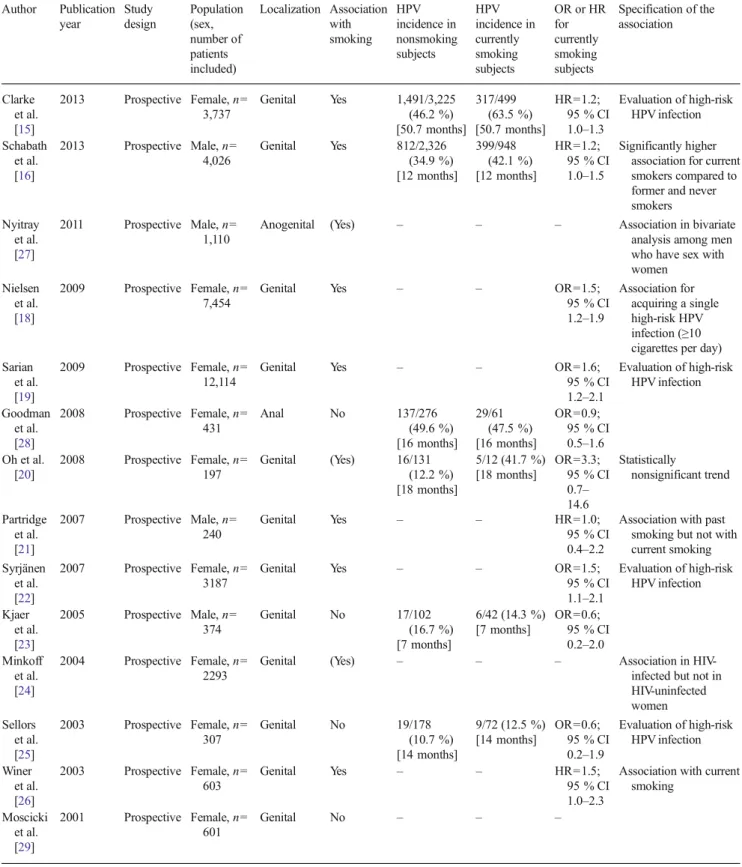
of these 14 studies demonstrated a significant [
15
,
16
,
18
,
19
,
21
,
22
,
24
,
26
,
27
], one a nonsignificant [
20
], and four no
association between HPV incidence and smoking (Table
1
)
[
28
,
30
,
25
,
29
].
A gender-specific analysis revealed that three out of four
prospective studies including a total of 5,376 male patients
found a significant association between smoking and the
incidence of HPV [
16
,
27
,
21
]. Only one prospective study
with 374 male patients did not reveal an association [
23
].
Similarly, six out of ten prospective studies comparing
27,508 smoking and nonsmoking female patients found a
significant association [
15
,
18
,
19
,
22
,
24
,
26
]. Additionally,
Oh et al. found a statistically nonsignificant trend toward an
association among female patients [
20
]. Three remaining
pro-spective studies, including 1,339 female patients, did not
reveal an association [
28
,
25
,
29
].
Whereas the above-mentioned studies focused on the
as-sociation of HPVincidence to current smoking, Partridge et al.
found an association solely between past smoking and HPV
infection (hazard ratio (HR)=1.6, 95 % CI 1.1–2.4) [
21
].
Persistence of HPV
Thirteen prospective studies including a total of 18,529
pa-tients investigated the impact of smoking on the persistence
rate of anogenital HPV during time intervals of 4 [
31
], 6 [
27
,
32
-
34
,
23
,
35
,
16
], or more [
36
,
37
,
20
,
38
] months (one
missing specification of time interval [
39
]). Nevertheless, the
association between smoking and the persistence of HPV is
not conclusive with regard to the number of patients in the two
groups: Eleven of these 13 studies, including a total of 10,503
patients, found a statistically significant association (seven
studies [
27
,
32
,
33
,
36
,
31
,
39
,
38
]) between HPV persistence
and smoking or a trend (four studies [
16
,
20
,
34
,
23
]) toward
higher rates among smokers compared to nonsmokers [
16
,
27
,
32
,
33
,
36
,
31
,
20
,
34
,
23
,
39
,
38
]. Maucort-Boulch et al. even
found a dose-effect relationship: Smoking >20 cigarettes per
day was associated with a significantly increased risk of
persistence of HPV infection among women, when compared
with women who smoked <10 cigarettes per day (odds ratio
(OR)=1.43, 95 % CI 1.02–2.01) [
33
]. The remaining two
studies prospectively included a total of 8,026 patients but
could not establish a positive relationship between smoking
and the persistence rate of HPV [
37
,
35
]. Interestingly, Ho
et al. even found that smoking >5 cigarettes per day was
protective against persistent HPV infection (OR=0.3, 95 %
CI 0.2
–0.7) [
35
].
Table 1 Summary of all prospective studies evaluating the association between the incidence of HPVand smoking Author Publication year Study design Population (sex, number of patients included) Localization Association with smoking HPV incidence in nonsmoking subjects HPV incidence in currently smoking subjects OR or HR for currently smoking subjects Specification of the association Clarke et al. [15] 2013 Prospective Female, n= 3,737 Genital Yes 1,491/3,225 (46.2 %) [50.7 months] 317/499 (63.5 %) [50.7 months] HR=1.2; 95 % CI 1.0–1.3 Evaluation of high-risk HPV infection Schabath et al. [16] 2013 Prospective Male, n= 4,026 Genital Yes 812/2,326 (34.9 %) [12 months] 399/948 (42.1 %) [12 months] HR=1.2; 95 % CI 1.0–1.5 Significantly higher association for current smokers compared to former and never smokers Nyitray et al. [27] 2011 Prospective Male, n= 1,110
Anogenital (Yes) – – – Association in bivariate analysis among men who have sex with women Nielsen et al. [18] 2009 Prospective Female, n= 7,454
Genital Yes – – OR=1.5; 95 % CI 1.2–1.9 Association for acquiring a single high-risk HPV infection (≥10 cigarettes per day) Sarian
et al. [19]
2009 Prospective Female, n= 12,114
Genital Yes – – OR=1.6; 95 % CI 1.2–2.1 Evaluation of high-risk HPV infection Goodman et al. [28] 2008 Prospective Female, n= 431 Anal No 137/276 (49.6 %) [16 months] 29/61 (47.5 %) [16 months] OR=0.9; 95 % CI 0.5–1.6 Oh et al. [20] 2008 Prospective Female, n= 197 Genital (Yes) 16/131 (12.2 %) [18 months] 5/12 (41.7 %) [18 months] OR=3.3; 95 % CI 0.7– 14.6 Statistically nonsignificant trend Partridge et al. [21] 2007 Prospective Male, n= 240 Genital Yes – – HR=1.0; 95 % CI 0.4–2.2
Association with past smoking but not with current smoking Syrjänen et al. [22] 2007 Prospective Female, n= 3187
Genital Yes – – OR=1.5; 95 % CI 1.1–2.1 Evaluation of high-risk HPV infection Kjaer et al. [23] 2005 Prospective Male, n= 374 Genital No 17/102 (16.7 %) [7 months] 6/42 (14.3 %) [7 months] OR=0.6; 95 % CI 0.2–2.0 Minkoff et al. [24] 2004 Prospective Female, n= 2293
Genital (Yes) – – – Association in HIV-infected but not in HIV-uninfected women Sellors et al. [25] 2003 Prospective Female, n= 307 Genital No 19/178 (10.7 %) [14 months] 9/72 (12.5 %) [14 months] OR=0.6; 95 % CI 0.2–1.9 Evaluation of high-risk HPV infection Winer et al. [26] 2003 Prospective Female, n= 603 Genital Yes – – HR=1.5; 95 % CI 1.0–2.3
Association with current smoking Moscicki et al. [29] 2001 Prospective Female, n= 601 Genital No – – –
Prevalence of HPV
With respect to the prevalence of anogenital HPV, most
stud-ies showed an association with smoking for both men and
women. Forty-seven studies (four prospective [
40
,
19
,
41
,
24
],
one retrospective [
42
], and 42 cross-sectional [
43
-
68
,
14
,
69
-
83
] studies)—including a total of 83,480 patients—found
a significant association (35 studies [
19
,
40
-
44
,
46
,
48
-
53
,
55
-
59
,
61
-
64
,
66
-
68
,
14
,
69
-
71
,
75
-
77
,
79
,
80
,
83
]) with
smoking or a trend (12 studies [
24
,
45
,
47
,
54
,
65
,
72
-
74
,
60
,
78
,
81
,
82
]) toward an association, whereas 16 studies
(one prospective [
84
] and 15 cross-sectional [
17
,
85
-
98
]
stud-ies)—with a total of 12,188 patients—did not. Four out of five
prospective studies—including 19,581 patients—found a
sig-nificant association (three studies) between HPV prevalence
and smoking or a trend (one study) toward higher rates among
smokers compared to nonsmokers (Table
2
) [
40
,
19
,
41
,
24
].
The remaining prospective study with 576 patients did not
reveal an association [
84
].
A statistical analysis of all prospective studies evaluating
association between the prevalence of HPV and smoking
showed that the overall HPV prevalence for smoking patients
was 48.2 versus 37.5 % for nonsmoking patients (p<0.001)
(OR=1.5, 95 % CI 1.4–1.7). For female patients only, the
prevalence was 40.8 % for smokers versus 25.2 % for
non-smokers (p<0.001) (OR=2.0, 95 % CI 1.8–2.3) and for male
patients 68.2 versus 63.2 % (p=0.006) (OR=1.2, 95 % CI
1.1–1.5).
There are ten studies comparing current with past smoking
with regard to the prevalence of HPV [
49
,
51
,
40
,
61
,
19
,
14
,
69
,
72
,
77
,
90
]. Except for one study, no impact of past
smoking on the prevalence of HPV was shown [
49
,
51
,
40
,
61
,
19
,
14
,
69
,
72
,
77
].
Four cross-sectional studies among current smokers
showed increasing prevalence of HPV with the number of
cigarettes smoked [
49
,
50
,
14
,
69
]. Nielson et al. found a
stronger association between HPV detection and smoking
≥10 cigarettes than for smoking <10 cigarettes per day
(OR=2.3, 95 % CI 1.0
–5.3) [
69
]. In contrast, Roura et al.
and Schabath et al. did not find any impact of the intensity of
smoking on the prevalence of HPV [
51
,
40
].
High-risk HPV
Four prospective studies focused on the incidence of high-risk
HPV infection [
15
,
19
,
22
,
18
]. These investigators
Table 2 Summary of all prospective studies evaluating the association between the prevalence of HPVand smoking Author Publication year Study design Population (sex, number of patients included) Localization Association with smoking HPV prevalence in nonsmoking subjects HPV prevalence in currently smoking subjects OR or HR for currently smoking subjects Specification of the association Schabath et al. [40] 2012 Prospective Male, n= 4,054 Genital Yes 1,485/2,348 (63.2 %) 655/960 (68.2 %) OR=1.2, 95 % CI 1.0– 1.4
Association with current but not past smokers. No association between intensity of smoking and HPV prevalence Sarian et al. [19] 2009 Prospective Female, n= 12,114 Genital Yes 444/2,699 (16.5 %) 215/990 (21.7 %) OR=1.6, 95 % CI 1.2– 2.1 Evaluation of high-risk HPV infection. Association with current but not past smokers Kliucinskas et al. [41] 2006 Prospective Female, n= 1,120 Genital Yes 109/892 (12.2 %) 25/128 (19.5 %) OR=1.8, 95 % CI 1.2– 2.8 Evaluation of high-risk HPV infection Minkoff et al. [24] 2004 Prospective Female, n= 2,293 Genital (Yes) 516/966 (53.4 %) 735/1,294 (56.8 %) OR=1.1, 95 % CI 1.0– 1.4 Association in HIV-infected but not in HIV-uninfected women Feldman et al. [84] 1997 Prospective Female, n= 576 Genital No 174/370 (47.0 %) 93/206 (45.1 %) OR=0.9, 95 % CI 0.7– 1.3 Total 2,728/7,275 (37.5%) 1,723/ 3,578 (48.2%) OR=1.5, 95% CI 1.4– 1.7 OR odds ratio, HR hazard ratio
consistently found a significant association between smoking
and high-risk HPV incidence.
Regarding persistence of high-risk HPVinfection, three out
of four prospective studies with a total of 827 patients revealed
a significant association with smoking [
32
,
39
,
38
], whereas
one study with 7,418 patients did not [
37
].
An analysis of HPV types in female patients revealed no
significant difference in prevalence of high- or low-risk HPV
genotypes when comparing female smokers to nonsmokers
[
99
]. In two prospective studies including a total of 13,234
patients, a significant impact of smoking on the prevalence of
high-risk HPV was found [
19
,
41
].
Development of anogenital warts
Smoking has been shown to significantly increase the
incidence of anogenital warts (Table
3
). The risk of
developing anogenital warts increases with the number
Table 3 Summary of all published studies evaluating the association between the incidence of anogenital warts and smoking Author Publication
year
Study design Population (sex, number of patients included) Localization Association with smoking Incidence of anogenital warts in nonsmoking subjects Incidence of anogenital warts in currently smoking subjects OR or HR for currently smoking subjects Specification of the association Massad et al. [103] 2011 Prospective Female, n=3766 Genital Yes – – HR=1.8, 95 % CI 1.4– 2.4
Association with current but not with former smoking Wiley et al. [113] 2009 Prospective Male, n= 2835 Genital Yes – – – Massad et al. [104] 2004 Prospective Female, n=2031
Genital Yes – – – Association with current but not with former smoking Feldman et al. [84] 1997 Prospective Female, n=576 Genital Yes – – – Hansen et al. [102] 2010 Retrospective Female, n= 58094 Genital Yes – – HR=1.3, 95 % CI 1.2– 1.4.
Increasing risk with increasing number of cigarettes smoked per day Kjaer et al. [114] 2007 Retrospective Female, n= 69147 Genital Yes 2,936/35,799 (8.2 %) 2,251/15,965 (14.1 %) OR=1.1, 95 % CI 1.0– 1.2
Association with smoking for >59 pack-years
Wen et al. [13]
1999 Retrospective Male and female, n=1954 Genital Yes 89/631 (14.1 %) 154/644 (23.9 %) OR=1.9, 95 % CI 1.0– 2.3
Smokers of more than 10 cigarettes per day were twice as likely to have genital warts as were nonsmokers Habel et al. [106] 1998 Retrospective Female, n=282 Anogenital (Yes) 45/118 (38.1 %) 35/67 (52.2 %) OR=1.8, 95 % CI 1.0– 3.3 Statistically nonsignificant association Munk et al. [100] 1997 Retrospective Female, n= 10838
Genital Yes – – OR=1.5, 95 % CI 1.2– 1.8
Increasing risk with increasing pack-years of cigarette smoking Brisson et al. [101] 1988 Retrospective Female, n=520
Genital Yes – – – Increasing risk with increasing number of cigarettes smoked per day Daling et al. [115] 1986 Retrospective Female, n=245 Anogenital Yes – – –
of cigarettes smoked per day and the number of
pack-years [
13
,
100
-
102
]. However, this association only
applies to current but not to past smoking [
103
,
104
].
Luu et al. investigated the impact of current smoking on
the size of anal warts but failed to find a relationship
[
105
]. Smoking for 10 or more years has been found to
increase the risk of recurrent genital warts (relative risk
(RR) = 4.5, 95 % CI 1.4–13.8) [
106
].
Discussion
In both genders, smoking is associated with higher
incidence and prevalence rates for HPV infection,
whereas the latter responds to a dose-effect relationship.
Smoking does also increase persistence rates for
high-risk HPV infection, while this correlation is debatable
for low-risk HPV. The incidence and recurrence rates of
anogenital warts are significantly increased in current
smokers.
Smoking has deleterious effects on systemic and local
immunity, as it suppresses both cell-mediated and
hu-moral immune responses, which might lead to the
pres-ent finding of increased susceptibility to HPV infection
and development of anogenital warts [
107
]. Nicotine,
the addictive substance in cigarette smoke, has been
shown to be the main immunosuppressive constituent
of cigarette smoke [
107
]. Moreover, smoking has been
found to increase metaplasia and DNA damage in
var-ious tissues [
108
-
111
].
Although most studies adjusted for sexual behavior,
unmeasured high-risk sexual behavior might be a
poten-tially important confounder in the association between
smoking and the incidence of HPV infection [
16
,
15
,
26
]. This is supported by Herrero et al., who found that
sex with multiple partners is more prevalent among
smokers [
112
].
The prevalence of HPV infection seems to decrease in
patients who quit smoking, but the time period after which
nonsmoker levels are reached is not yet clear.
The association of smoking with HPV infection and
devel-opment of anogenital warts, respectively, is well supported by
current data. However, the cascade from HPV infection to the
development of anogenital warts is still not well understood.
Furthermore, prospective data on the impact of smoking on
the spontaneous recovery rate of anogenital warts are still
lacking.
Studies are more often performed for female than male
patients, probably due to regular gynecologic controls. On
the other hand, comparison of the studies did not reveal gender
differences in the impact of smoking.
Conclusion
Most current data demonstrate an association between
smoking, increased anogenital HPV infection, and
develop-ment of anogenital warts. These data add to the long list of
reasons for making smoking cessation a keystone of patient
health.
References
1. WHO Vaccines against human papilloma virus. http://www.who. int/vaccines/en/hpvrd.shtml. Accessed April 01, 2014
2. Forcier M, Musacchio N (2010) An overview of human papilloma-virus infection for the dermatologist: disease, diagnosis, manage-ment, and prevention. Dermatol Ther 23(5):458–476. doi:10.1111/j. 1529-8019.2010.01350.x
3. Markowitz LE, Dunne EF, Saraiya M, Lawson HW, Chesson H, Unger ER (2007) Quadrivalent human papillomavirus vaccine: recommendations of the Advisory Committee on Immunization Practices (ACIP). MMWR Recommendations and reports: Morbidity and mortality weekly report Recommendations and re-ports / Centers for Disease Control 56 (Rr-2):1-24
4. Hathaway JK (2012) HPV: diagnosis, prevention, and treatment. Clin Obstet Gynecol 55(3):671–680. doi:10.1097/GRF. 0b013e31825caa36
5. Fleischer AB Jr, Parrish CA, Glenn R, Feldman SR (2001) Condylomata acuminata (genital warts): patient demographics and treating physicians. Sex Transm Dis 28(11):643–647
6. Stanley M (2007) Prophylactic HPV vaccines: prospects for elim-inating ano-genital cancer. Br J Cancer 96(9):1320–1323. doi:10. 1038/sj.bjc.6603695
7. Gross G, Pfister H (2004) Role of human papillomavirus in penile cancer, penile intraepithelial squamous cell neoplasias and in genital warts. Med Microbiol Immunol 193(1):35–44. doi:10.1007/ s00430-003-0181-2
8. Tay EH, Garland S, Tang G, Nolan T, Huang LM, Orloski L, Lu S, Barr E (2008) Clinical trial experience with prophylactic HPV 6/11/ 16/18 VLP vaccine in young women from the Asia-Pacific region. Int J Gynaecol Obstet Off Organ Int Fed Gynaecol Obstet 102(3): 275–283. doi:10.1016/j.ijgo.2008.03.021
9. Patel H, Wagner M, Singhal P, Kothari S (2013) Systematic review of the incidence and prevalence of genital warts. BMC Infect Dis 13:39. doi:10.1186/1471-2334-13-39
10. Scheinfeld N, Lehman DS (2006) An evidence-based review of medical and surgical treatments of genital warts. Dermatol Online J 12(3):5
11. Wiley DJ, Douglas J, Beutner K, Cox T, Fife K, Moscicki AB, Fukumoto L (2002) External genital warts: diagnosis, treatment, and prevention. Clin Infect Dis Off Publ Infect Dis Soc Am 35(Suppl 2): S210–S224. doi:10.1086/342109
12. Kodner CM, Nasraty S (2004) Management of genital warts. Am Fam Physician 70(12):2335–2342
13. Wen LM, Estcourt CS, Simpson JM, Mindel A (1999) Risk factors for the acquisition of genital warts: are condoms protective? Sex Transm Infect 75(5):312–316
14. Vaccarella S, Herrero R, Snijders PJ, Dai M, Thomas JO, Hieu NT, Ferreccio C, Matos E, Posso H, de Sanjose S, Shin HR, Sukvirach S, Lazcano-Ponce E, Munoz N, Meijer CJ, Franceschi S (2008) Smoking and human papillomavirus infection: pooled analysis of
the International Agency for Research on Cancer HPV Prevalence Surveys. Int J Epidemiol 37(3):536–546. doi:10.1093/ije/dyn033
15. Clarke M, Schiffman M, Wacholder S, Rodriguez AC, Hildesheim A, Quint W (2013) A prospective study of absolute risk and deter-minants of human papillomavirus incidence among young women in Costa Rica. BMC Infect Dis 13:308. doi: 10.1186/1471-2334-13-308
16. Schabath MB, Villa LL, Lin HY, Fulp WJ, Lazcano-Ponce E, Salmeron J, Abrahamsen ME, Papenfuss MR, Quiterio M, Giuliano AR (2013) A prospective analysis of smoking and human papillomavirus infection among men in the HPVin Men Study. Int J Cancer J Int Cancer. doi:10.1002/ijc.28567
17. Almonte M, Silva Idos S, Asare A, Gilham C, Sargent A, Bailey A, Turner A, Desai M, Kitchener HC, Peto J (2011) Sexual behavior and HPV infection in British women, by postal questionnaires and telephone interviews. J Med Virol 83(7):1238–1246. doi:10.1002/ jmv.22085
18. Nielsen A, Iftner T, Munk C, Kjaer SK (2009) Acquisition of high-risk human papillomavirus infection in a population-based cohort of Danish women. Sex Transm Dis 36(10):609–615. doi:10.1097/ OLQ.0b013e3181a96d0e
19. Sarian LO, Hammes LS, Longatto-Filho A, Guarisi R, Derchain SF, Roteli-Martins C, Naud P, Erzen M, Branca M, Tatti S, de Matos JC, Gontijo R, Maeda MY, Lima T, Costa S, Syrjanen S, Syrjanen K (2009) Increased risk of oncogenic human papillomavirus infections and incident high-grade cervical intraepithelial neoplasia among smokers: experience from the Latin American screening study. S e x Tr a n s m D i s 3 6 ( 4 ) : 2 4 1–248. doi:1 0 . 1 0 9 7 / O L Q . 0b013e3181935a7d
20. Oh JK, Ju YH, Franceschi S, Quint W, Shin HR (2008) Acquisition of new infection and clearance of type-specific human papilloma-virus infections in female students in Busan, South Korea: a follow-up study. BMC Infect Dis 8:13. doi:10.1186/1471-2334-8-13
21. Partridge JM, Hughes JP, Feng Q, Winer RL, Weaver BA, Xi LF, Stern ME, Lee SK, O'Reilly SF, Hawes SE, Kiviat NB, Koutsky LA (2007) Genital human papillomavirus infection in men: incidence and risk factors in a cohort of university students. J Infect Dis 196(8):1128–1136. doi:10.1086/521192
22. Syrjanen K, Shabalova I, Petrovichev N, Kozachenko V, Zakharova T, Pajanidi J, Podistov J, Chemeris G, Sozaeva L, Lipova E, Tsidaeva I, Ivanchenko O, Pshepurko A, Zakharenko S, Nerovjna R, Kljukina L, Erokhina O, Branovskaja M, Nikitina M, Grunberga V, Grunberg A, Juschenko A, Santopietro R, Cintorino M, Tosi P, Syrjanen S (2007) Smoking is an independent risk factor for onco-genic human papillomavirus (HPV) infections but not for high-grade CIN. Eur J Epidemiol 22(10):723–735. doi:10.1007/ s10654-007-9180-8
23. Kjaer SK, Munk C, Winther JF, Jorgensen HO, Meijer CJ, van den Brule AJ (2005) Acquisition and persistence of human papilloma-virus infection in younger men: a prospective follow-up study among Danish soldiers. Cancer Epidemiol Biomark Prev Publ Am Assoc Cancer Res Cosponsored Am Soc Prev Oncol 14(6):1528– 1533. doi:10.1158/1055-9965.epi-04-0754
24. Minkoff H, Feldman JG, Strickler HD, Watts DH, Bacon MC, Levine A, Palefsky JM, Burk R, Cohen MH, Anastos K (2004) Relationship between smoking and human papillomavirus infec-tions in HIV-infected and -uninfected women. J Infect Dis 189(10): 1821–1828. doi:10.1086/383479
25. Sellors JW, Karwalajtys TL, Kaczorowski J, Mahony JB, Lytwyn A, Chong S, Sparrow J, Lorincz A (2003) Incidence, clearance and predictors of human papillomavirus infection in women. CMAJ: Can Med Assoc J 168(4):421–425
26. Winer RL, Lee SK, Hughes JP, Adam DE, Kiviat NB, Koutsky LA (2003) Genital human papillomavirus infection: incidence and risk factors in a cohort of female university students. Am J Epidemiol 157(3):218–226
27. Nyitray AG, Carvalho da Silva RJ, Baggio ML, Smith D, Abrahamsen M, Papenfuss M, Lin HY, Quiterio M, Salmeron J, Lazcano-Ponce E, Villa LL, Giuliano AR (2011) Six-month inci-dence, persistence, and factors associated with persistence of anal human papillomavirus in men: the HPV in men study. J Infect Dis 204(11):1711–1722. doi:10.1093/infdis/jir637
28. Goodman MT, Shvetsov YB, McDuffie K, Wilkens LR, Zhu X, Ning L, Killeen J, Kamemoto L, Hernandez BY (2008) Acquisition of anal human papillomavirus (HPV) infection in women: the Hawaii HPV cohort study. J Infect Dis 197(7):957–966. doi:10. 1086/529207
29. Moscicki AB, Hills N, Shiboski S, Powell K, Jay N, Hanson E, Miller S, Clayton L, Farhat S, Broering J, Darragh T, Palefsky J (2001) Risks for incident human papillomavirus infection and low-grade squamous intraepithelial lesion development in young fe-males. JAMA: J Am Med Assoc 285(23):2995–3002
30. Kjaer SK, Breugelmans G, Munk C, Junge J, Watson M, Iftner T (2008) Population-based prevalence, type- and age-specific distri-bution of HPVin women before introduction of an HPV-vaccination program in Denmark. Int J Cancer 123(8):1864–1870. doi:10.1002/ ijc.23712
31. Shvetsov YB, Hernandez BY, McDuffie K, Wilkens LR, Zhu X, Ning L, Killeen J, Kamemoto L, Goodman MT (2009) Duration and clearance of anal human papillomavirus (HPV) infection among women: the Hawaii HPV cohort study. Clin Infect Dis: Off Publ Infect Dis Soc Am 48(5):536–546. doi:10.1086/596758
32. Schmeink CE, Melchers WJ, Siebers AG, Quint WG, Massuger LF, Bekkers RL (2011) Human papillomavirus persistence in young unscreened women, a prospective cohort study. PLoS One 6(11): e27937. doi:10.1371/journal.pone.0027937
33. Maucort-Boulch D, Plummer M, Castle PE, Demuth F, Safaeian M, Wheeler CM, Schiffman M (2010) Predictors of human papilloma-virus persistence among women with equivocal or mildly abnormal cytology. Int J Cancer 126(3):684–691. doi:10.1002/ijc.24752
34. Koshiol J, Schroeder J, Jamieson DJ, Marshall SW, Duerr A, Heilig CM, Shah KV, Klein RS, Cu-Uvin S, Schuman P, Celentano D, Smith JS (2006) Smoking and time to clearance of human papillo-mavirus infection in HIV-seropositive and HIV-seronegative wom-en. Am J Epidemiol 164(2):176–183. doi:10.1093/aje/kwj165
35. Ho GY, Bierman R, Beardsley L, Chang CJ, Burk RD (1998) Natural history of cervicovaginal papillomavirus infection in young women. N Engl J Med 338(7):423–428. doi:10.1056/ nejm199802123380703
36. Louvanto K, Rintala MA, Syrjanen KJ, Grenman SE, Syrjanen SM (2010) Genotype-specific persistence of genital human papilloma-virus (HPV) infections in women followed for 6 years in the Finnish Family HPV Study. J Infect Dis 202(3):436–444. doi:10.1086/ 653826
37. Nielsen A, Kjaer SK, Munk C, Osler M, Iftner T (2010) Persistence of high-risk human papillomavirus infection in a population-based cohort of Danish women. J Med Virol 82(4):616–623. doi:10.1002/ jmv.21750
38. Phanuphak N, Teeratakulpisarn N, Pankam T, Kerr SJ, Barisri J, Deesua A, Rodbamrung P, Hongchookiat P, Chomchey N, Phanuphak P, Sohn AH, Ananworanich J, Palefsky JM (2013) Anal human papillomavirus infection among Thai men who have sex with men with and without HIV infection: prevalence, inci-dence, and persistence. J Acquir Immune Defic Syndr 63(4):472– 479. doi:10.1097/QAI.0b013e3182918a5a
39. Giuliano AR, Sedjo RL, Roe DJ, Harri R, Baldwi S, Papenfuss MR, Abrahamsen M, Inserra P (2002) Clearance of oncogenic human papillomavirus (HPV) infection: effect of smoking (United States). Cancer Causes Control: CCC 13(9):839–846
40. Schabath MB, Villa LL, Lazcano-Ponce E, Salmeron J, Quiterio M, Giuliano AR (2012) Smoking and human papillomavirus (HPV) infection in the HPV in Men (HIM) study. Cancer Epidemiol
Biomark Prev: Publ Am Assoc Cancer Res Cosponsored Am Soc Prev Oncol 21(1):102–110. doi:10.1158/1055-9965.epi-11-0591
41. Kliucinskas M, Nadisauskiene RJ, Minkauskiene M (2006) Prevalence and risk factors of HPV infection among high-risk rural and urban Lithuanian women. Gynecol Obstet Investig 62(3):173– 180. doi:10.1159/000093572
42. Kataja V, Syrjanen S, Yliskoski M, Hippelinen M, Vayrynen M, Saarikoski S, Mantyjarvi R, Jokela V, Salonen JT, Syrjanen K (1993) Risk factors associated with cervical human papillomavirus infections: a case-control study. Am J Epidemiol 138(9):735–745 43. Hoang HT, Ishizaki A, Nguyen CH, Tran VT, Matsushita K,
Saikawa K, Hosaka N, Pham HV, Bi X, Ta VT, Van Pham T, Ichimura H (2013) Infection with high-risk HPV types among female sex workers in northern Vietnam. J Med Virol 85(2):288– 294. doi:10.1002/jmv.23456
44. Nielsen A, Munk C, Jorgensen H, Winther J, van den Brule A, Kjaer S (2013) Multiple-type human papillomavirus infection in younger u n c i r c u m c i s e d m e n . I n t J S T D A I D S . d o i :1 0 . 11 7 7 / 0956462412472294
45. Remschmidt C, Kaufmann AM, Hagemann I, Vartazarova E, Wichmann O, Delere Y (2013) Risk factors for cervical human papillomavirus infection and high-grade intraepithelial lesion in women aged 20 to 31 years in Germany. Int J Gynecol Cancer: Off J Int Gynecol Cancer Soc 23(3):519–526. doi:10.1097/IGC. 0b013e318285a4b2
46. Brassard P, Jiang Y, Severini A, Goleski V, Santos M, Chatwood S, Lys C, Johnson G, Wong T, Kotaska A, Kandola K, Morrison H, Mao Y (2012) Factors associated with human papillomavirus infec-tion among women in the Northwest Territories. Can J Public Health 103(4):e282–e287
47. Bumbuliene Z, Alisauskas J (2012) Sexual behavior and high-risk human papillomavirus in 15- to 22-year-old Lithuanian women. Acta Obstet Gynecol Scand 91(4):511–513. doi: 10.1111/j.1600-0412.2011.01334.x
48. Monsonego J, Zerat L, Syrjanen K, Zerat JC, Smith JS, Halfon P (2012) Prevalence of type-specific human papillomavirus infection among women in France: implications for screening, vaccination, and a future generation of multivalent HPV vaccines. Vaccine 30(35):5215–5221. doi:10.1016/j.vaccine.2012.06.013
49. Pista A, de Oliveira CF, Cunha MJ, Paixao MT, Real O (2012) Risk factors for human papillomavirus infection among women in Portugal: the CLEOPATRE Portugal Study. Int J Gynaecol Obstet: Off Organ Int Fed Gynaecol Obstet 118(2):112–116. doi:10.1016/j. ijgo.2012.03.028
50. Roset Bahmanyar E, Paavonen J, Naud P, Salmeron J, Chow SN, Apter D, Kitchener H, Castellsague X, Teixeira JC, Skinner SR, Jaisamrarn U, Limson GA, Garland SM, Szarewski A, Romanowski B, Aoki F, Schwarz TF, Poppe WA, De Carvalho NS, Harper DM, Bosch FX, Raillard A, Descamps D, Struyf F, Lehtinen M, Dubin G (2012) Prevalence and risk factors for cervical HPV infection and abnormalities in young adult women at enrol-ment in the multinational PATRICIA trial. Gynecol Oncol 127(3): 440–450. doi:10.1016/j.ygyno.2012.08.033
51. Roura E, Iftner T, Vidart JA, Kjaer SK, Bosch FX, Munoz N, Palacios S, Rodriguez MS, Morillo C, Serradell L, Torcel-Pagnon L, Cortes J, Castellsague X (2012) Predictors of human papilloma-virus infection in women undergoing routine cervical cancer screen-ing in Spain: the CLEOPATRE study. BMC Infect Dis 12:145. doi:
10.1186/1471-2334-12-145
52. Yetimalar H, Kasap B, Cukurova K, Yildiz A, Keklik A, Soylu F (2012) Cofactors in human papillomavirus infection and cervical carcinogenesis. Arch Gynecol Obstet 285(3):805–810. doi:10.1007/ s00404-011-2034-3
53. Badano I, Pedrozo RW, Ruiz Diaz LS, Galuppo JA, Picconi MA, Campos RH, Liotta DJ (2011) Human papillomavirus (HPV) de-tection and Papanicolaou cytology in low-resource women in
Posadas city, Misiones, Argentina. Rev Argent Microbiol 43(4): 263–267. doi:10.1590/s0325-75412011000400005
54. Bell MC, Schmidt-Grimminger D, Jacobsen C, Chauhan SC, Maher DM, Buchwald DS (2011) Risk factors for HPV infection among American Indian and White women in the Northern Plains. Gynecol Oncol 121(3):532–536. doi:10.1016/j.ygyno.2011.02.032
55. Ferrera A, Tabora N, Flores Y, Zelaya A, Massuger L, Melchers WJ (2011) Assessment of HPV infection among female university students in Honduras via Roche linear array. Int J Gynaecol Obstet: Off Organ Int Fed Gynaecol Obstet 113(2):96–99. doi:10. 1016/j.ijgo.2010.11.016
56. Garland SM, Brotherton JM, Condon JR, McIntyre PB, Stevens MP, Smith DW, Tabrizi SN (2011) Human papillomavirus preva-lence among indigenous and non-indigenous Australian women prior to a national HPV vaccination program. BMC Med 9:104. doi:10.1186/1741-7015-9-104
57. Kasap B, Yetimalar H, Keklik A, Yildiz A, Cukurova K, Soylu F (2011) Prevalence and risk factors for human papillomavirus DNA in cervical cytology. Eur J Obstet Gynecol Reprod Biol 159(1):168– 171. doi:10.1016/j.ejogrb.2011.06.021
58. Montalvo MT, Lobato I, Villanueva H, Borquez C, Navarrete D, Abarca J, Calaf GM (2011) Prevalence of human papillomavirus in university young women. Oncol Lett 2(4):701–706. doi:10.3892/ol. 2011.290
59. Shikova E, Todorova I, Ganchev G, Kouseva-Dragneva V, Kalascheva-Zaimova P (2011) Prevalence of human papillomavirus infection among female sex workers in Bulgaria. Int J STD AIDS 22(5):278–280. doi:10.1258/ijsa.2009.009362
60. Cercato MC, Mariani L, Vocaturo A, Carrone A, Terrenato I, Morano G, Benevolo M, Rollo F, Germelli C, Paolini F, Venuti A (2010) Predictors of human papilloma virus (HPV) infection in Italian women. J Med Virol 82(11):1921–1927. doi:10.1002/jmv. 21887
61. Iftner T, Eberle S, Iftner A, Holz B, Banik N, Quint W, Straube AN (2010) Prevalence of low-risk and high-risk types of human papil-lomavirus and other risk factors for HPV infection in Germany within different age groups in women up to 30 years of age: an epidemiological observational study. J Med Virol 82(11):1928– 1939. doi:10.1002/jmv.21910
62. Ripabelli G, Grasso GM, Del Riccio I, Tamburro M, Sammarco ML (2010) Prevalence and genotype identification of human papilloma-virus in women undergoing voluntary cervical cancer screening in Molise, central Italy. Cancer Epidemiol 34(2):162–167. doi:10. 1016/j.canep.2009.12.010
63. Chan PK, Ho WC, Wong MC, Chang AR, Chor JS, Yu MY (2009) Epidemiologic risk profile of infection with different groups of human papillomaviruses. J Med Virol 81(9):1635–1644. doi:10. 1002/jmv.21575
64. Nielson CM, Harris RB, Flores R, Abrahamsen M, Papenfuss MR, Dunne EF, Markowitz LE, Giuliano AR (2009) Multiple-type hu-man papillomavirus infection in male anogenital sites: prevalence and associated factors. Cancer Epidemiol Biomark Prev Publ Am Assoc Cancer Res Cosponsored Am Soc Prev Oncol 18(4):1077– 1083. doi:10.1158/1055-9965.epi-08-0447
65. Silva KC, Rosa ML, Moyse N, Afonso LA, Oliveira LH, Cavalcanti SM (2009) Risk factors associated with human papillomavirus infection in two populations from Rio de Janeiro, Brazil. Mem Inst Oswaldo Cruz 104(6):885–891
66. Valles X, Murga GB, Hernandez G, Sabido M, Chuy A, Lloveras B, Alameda F, de San JS, Bosch FX, Pedroza I, Castellsague X, Casabona J (2009) High prevalence of human papillomavirus in-fection in the female population of Guatemala. Int J Cancer 125(5): 1161–1167. doi:10.1002/ijc.24444
67. Gonzalez C, Canals J, Ortiz M, Munoz L, Torres M, Garcia-Saiz A, Del Amo J (2008) Prevalence and determinants of high-risk human papillomavirus (HPV) infection and cervical cytological
abnormalities in imprisoned women. Epidemiol Infect 136(2):215– 221. doi:10.1017/s0950268807008382
68. Lindau ST, Drum ML, Gaumer E, Surawska H, Jordan JA (2008) Prevalence of high-risk human papillomavirus among older women. O b s t e t G y n e c o l 11 2 ( 5 ) : 9 7 9–989. doi:1 0 . 1 0 9 7 / A O G . 0b013e31818b0df2
69. Nielson CM, Harris RB, Dunne EF, Abrahamsen M, Papenfuss MR, Flores R, Markowitz LE, Giuliano AR (2007) Risk factors for anogenital human papillomavirus infection in men. J Infect Dis 196(8):1137–1145. doi:10.1086/521632
70. del Amo J, Gonzalez C, Losana J, Clavo P, Munoz L, Ballesteros J, Garcia-Saiz A, Belza MJ, Ortiz M, Menendez B, del Romero J, Bolumar F (2005) Influence of age and geographical origin in the prevalence of high risk human papillomavirus in migrant female sex workers in Spain. Sex Transm Infect 81(1):79–84. doi:10.1136/sti. 2003.008060
71. Beby-Defaux A, Bourgoin A, Ragot S, Battandier D, Lemasson JM, Renaud O, Bouguermouh S, Vienne Md Mde L, Agius G (2004) Human papillomavirus infection of the cervix uteri in women attending a Health Examination Center of the French social security. J Med Virol 73(2):262–268. doi:10.1002/jmv.20085
72. Shin HR, Franceschi S, Vaccarella S, Roh JW, Ju YH, Oh JK, Kong HJ, Rha SH, Jung SI, Kim JI, Jung KY, van Doorn LJ, Quint W (2004) Prevalence and determinants of genital infection with papil-lomavirus, in female and male university students in Busan, South Korea. J Infect Dis 190(3):468–476. doi:10.1086/421279
73. Chan PK, Chang AR, Cheung JL, Chan DP, Xu LY, Tang NL, Cheng AF (2002) Determinants of cervical human papillomavirus infection: differences between high- and low-oncogenic risk types. J Infect Dis 185(1):28–35. doi:10.1086/338010
74. Lazcano-Ponce E, Herrero R, Munoz N, Hernandez-Avila M, Salmeron J, Leyva A, Meijer CJ, Walboomers JM (2001) High prevalence of human papillomavirus infection in Mexican males: comparative study of penile-urethral swabs and urine samples. Sex Transm Dis 28(5):277–280
75. Nyari T, Cseh I, Woodward M, Szollosi J, Bak M, Deak J (2001) Screening for human papillomavirus infection in asymptomatic women in Hungary. Hum Reprod (Oxford, England) 16(10): 2235–2237
76. Sellors JW, Mahony JB, Kaczorowski J, Lytwyn A, Bangura H, Chong S, Lorincz A, Dalby DM, Janjusevic V, Keller JL (2000) Prevalence and predictors of human papillomavirus infection in women in Ontario, Canada. Survey of HPV in Ontario Women (SHOW) Group. CMAJ: Can Med Assoc J 163(5):503–508
77. Marrazzo JM, Koutsky LA, Stine KL, Kuypers JM, Grubert TA, Galloway DA, Kiviat NB, Handsfield HH (1998) Genital human papillomavirus infection in women who have sex with women. J Infect Dis 178(6):1604–1609
78. Burk RD, Ho GY, Beardsley L, Lempa M, Peters M, Bierman R (1996) Sexual behavior and partner characteristics are the predom-inant risk factors for genital human papillomavirus infection in young women. J Infect Dis 174(4):679–689
79. Davidson M, Schnitzer PG, Bulkow LR, Parkinson AJ, Schloss ML, Fitzgerald MA, Knight JA, Murphy CM, Kiviat NB, Toomey KE et al (1994) The prevalence of cervical infection with human papillomaviruses and cervical dysplasia in Alaska Native women. J Infect Dis 169(4):792–800
80. Palefsky JM, Shiboski S, Moss A (1994) Risk factors for anal human papillomavirus infection and anal cytologic abnormalities in HIV-positive and HIV-negative homosexual men. J Acquir Immune Defic Syndr 7(6):599–606
81. Bauer HM, Hildesheim A, Schiffman MH, Glass AG, Rush BB, Scott DR, Cadell DM, Kurman RJ, Manos MM (1993) Determinants of genital human papillomavirus infection in low-risk women in Portland, Oregon. Sex Transm Dis 20(5):274–278
82. Ley C, Bauer HM, Reingold A, Schiffman MH, Chambers JC, Tashiro CJ, Manos MM (1991) Determinants of genital human papillomavirus infection in young women. J Natl Cancer Inst 83(14):997–1003
83. Rohan T, Mann V, McLaughlin J, Harnish DG, Yu H, Smith D, Davis R, Shier RM, Rawls W (1991) PCR-detected genital papil-lomavirus infection: prevalence and association with risk factors for cervical cancer. Int J Cancer 49(6):856–860
84. Feldman JG, Chirgwin K, Dehovitz JA, Minkoff H (1997) The association of smoking and risk of condyloma acuminatum in women. Obstet Gynecol 89(3):346–350. doi: 10.1016/s0029-7844(97)00011-2
85. Simen-Kapeu A, La Ruche G, Kataja V, Yliskoski M, Bergeron C, Horo A, Syrjanen K, Saarikoski S, Lehtinen M, Dabis F, Sasco AJ (2009) Tobacco smoking and chewing as risk factors for multiple human papillomavirus infections and cervical squamous intraepithelial lesions in two countries (Cote d'Ivoire and Finland) with different tobacco exposure. Cancer Causes Control: CCC 20(2):163–170. doi:10.1007/ s10552-008-9230-x
86. Werden J, Schnatz PF, Mandavilli S, Allen G, Murphy JL, Greene JF, Egan JF, Sorosky JI (2008) Prevalence of the human papilloma-virus in an inner-city indigent population with previously normal Pap tests. Journal Lower Genit Tract Dis 12(4):287–292. doi:10. 1097/LGT.0b013e31817e307b
87. Hajjaj AA, Senok AC, Al-Mahmeed AE, Issa AA, Arzese AR, Botta GA (2006) Human papillomavirus infection among women attending health facilities in the Kingdom of Bahrain. Saudi Med J 27(4):487–491
88. O'Keefe EJ, Gardner A, Currie MJ, Garland S, Tabrizi S, Bowden FJ (2006) Prevalence of genital human papillomavirus DNA in a sample of senior school-aged women in the Australian Capital Territory. Sex Health 3(2):91–94
89. de Sanjose S, Almirall R, Lloveras B, Font R, Diaz M, Munoz N, Catala I, Meijer CJ, Snijders PJ, Herrero R, Bosch FX (2003) Cervical human papillomavirus infection in the female population in Barcelona, Spain. Sex Transm Dis 30(10):788–793. doi:10.1097/ 01.olq.0000080177.82204.e0
90. Franceschi S, Castellsague X, Dal Maso L, Smith JS, Plummer M, Ngelangel C, Chichareon S, Eluf-Neto J, Shah KV, Snijders PJ, Meijer CJ, Bosch FX, Munoz N (2002) Prevalence and determi-nants of human papillomavirus genital infection in men. Br J Cancer 86(5):705–711. doi:10.1038/sj.bjc.6600194
91. Svare EI, Kjaer SK, Worm AM, Osterlind A, Meijer CJ, van den Brule AJ (2002) Risk factors for genital HPV DNA in men resemble those found in women: a study of male attendees at a Danish STD clinic. Sex Transm Infect 78(3):215–218
92. Muckerman DR (1994) Subclinical human papillomavirus infection in a high-risk population. J Am Osteopath Assoc 94(7):545–550, 555-547
93. Hildesheim A, Gravitt P, Schiffman MH, Kurman RJ, Barnes W, Jones S, Tchabo JG, Brinton LA, Copeland C, Epp J et al (1993) Determinants of genital human papillomavirus infection in low-income women in Washington, D.C. Sex Transm Dis 20(5):279– 285
94. Wheeler CM, Parmenter CA, Hunt WC, Becker TM, Greer CE, Hildesheim A, Manos MM (1993) Determinants of genital human papillomavirus infection among cytologically normal women at-tending the University of New Mexico student health center. Sex Transm Dis 20(5):286–289
95. Kemp EA, Hakenewerth AM, Laurent SL, Gravitt PE, Stoerker J (1992) Human papillomavirus prevalence in pregnancy. Obstet Gynecol 79(5 ( Pt 1)):649–656
96. Meekin GE, Sparrow MJ, Fenwicke RJ, Tobias M (1992) Prevalence of genital human papillomavirus infection in Wellington women. Genitourin Med 68(4):228–232
97. Melbye M, Palefsky J, Gonzales J, Ryder LP, Nielsen H, Bergmann O, Pindborg J, Biggar RJ (1990) Immune status as a determinant of human papillomavirus detection and its association with anal epi-thelial abnormalities. Int J Cancer 46(2):203–206
98. Moscicki AB, Palefsky J, Gonzales J, Schoolnik GK (1990) Human papillomavirus infection in sexually active adolescent females: prevalence and risk factors. Pediatr Res 28(5):507–513. doi:10. 1203/00006450-199011000-00018
99. Sherman JF, Mount SL, Evans MF, Skelly J, Simmons-Arnold L, Eltabbakh GH (2008) Smoking increases the risk of high-grade vaginal intraepithelial neoplasia in women with oncogenic human papillomavirus. Gynecol Oncol 110(3):396–401. doi:10.1016/j. ygyno.2008.05.015
100. Munk C, Svare EI, Poll P, Bock JE, Kjaer SK (1997) History of genital warts in 10,838 women 20 to 29 years of age from the general population. Risk factors and association with Papanicolaou smear history. Sexually transmitted diseases 24(10): 567–572
101. Brisson J, Roy M, Fortier M, Bouchard C, Meisels A (1988) Condyloma and intraepithelial neoplasia of the uterine cervix: a case-control study. Am J Epidemiol 128(2):337–342
102. Hansen BT, Hagerup-Jenssen M, Kjaer SK, Munk C, Tryggvadottir L, Sparen P, Liaw KL, Nygard M (2010) Association between smoking and genital warts: longitudinal analysis. Sex Transm Infect 86(4):258–262. doi:10.1136/sti.2009.038273
103. Massad LS, Xie X, Darragh T, Minkoff H, Levine AM, Watts DH, Wright RL, D'Souza G, Colie C, Strickler HD (2011) Genital warts and vulvar intraepithelial neoplasia: natural history and effects of treatment and human immunodeficiency virus infection. Obstet Gynecol 118(4):831–839. doi:10.1097/AOG.0b013e31821a0f4d
104. Massad LS, Silverberg MJ, Springer G, Minkoff H, Hessol N, Palefsky JM, Strickler HD, Levine AM, Sacks HS, Moxley M, Heather Watts D (2004) Effect of antiretroviral therapy on the incidence of genital warts and vulvar neoplasia among women with the human immunodeficiency virus. Am J Obstet Gynecol 190(5): 1241–1248. doi:10.1016/j.ajog.2003.12.037
105. Luu HN, Amirian ES, Beasley RP, Piller L, Chan W, Scheurer ME (2012) Association between smoking and size of anal warts in
HIV-infected women. Int J STD AIDS 23(11):792–798. doi:10.1258/ijsa. 2012.011420
106. Habel LA, Van Den Eeden SK, Sherman KJ, McKnight B, Stergachis A, Daling JR (1998) Risk factors for incident and recur-rent condylomata acuminata among women. Popul-Based Stud Sex Transm Dis 25(6):285–292
107. Sopori M (2002) Effects of cigarette smoke on the immune system. Nat Rev Immunol 2(5):372–377. doi:10.1038/nri803
108. Peters EJ, Morice R, Benner SE, Lippman S, Lukeman J, Lee JS, Ro JY, Hong WK (1993) Squamous metaplasia of the bronchial mucosa and its relationship to smoking. Chest 103(5):1429–1432
109. Sekhon HS, Wright JL, Churg A (1994) Cigarette smoke causes rapid cell proliferation in small airways and associated pulmonary arteries. Am J Physiol 267(5 Pt 1):L557–L563
110. Feng Z, Hu W, Hu Y, Tang MS (2006) Acrolein is a major cigarette-related lung cancer agent: Preferential binding at p53 mutational hotspots and inhibition of DNA repair. Proc Natl Acad Sci U S A 103(42):15404–15409. doi:10.1073/ pnas.0607031103
111. Phillips DH, Hewer A, Scholefield JH, Skinner P (2004) Smoking-related DNA adducts in anal epithelium. Mutat Res 560(2):167– 172. doi:10.1016/j.mrgentox.2004.02.014
112. Herrero R, Brinton LA, Reeves WC, Brenes MM, Tenorio F, de Britton RC, Gaitan E, Garcia M, Rawls WE (1989) Invasive cervical cancer and smoking in Latin America. J Natl Cancer Inst 81(3):205– 211
113. Wiley DJ, Elashoff D, Masongsong EV, Harper DM, Gylys KH, Silverberg MJ, Cook RL, Johnson-Hill LM (2009) Smoking en-hances risk for new external genital warts in men. Int J Environ Res Public Health 6(3):1215–1234. doi:10.3390/ijerph6031215
114. Kjaer SK, Tran TN, Sparen P, Tryggvadottir L, Munk C, Dasbach E, Liaw KL, Nygard J, Nygard M (2007) The burden of genital warts: a study of nearly 70,000 women from the general female population in the 4 Nordic countries. J Infect Dis 196(10):1447–1454. doi:10. 1086/522863
115. Daling JR, Sherman KJ, Weiss NS (1986) Risk factors for condy-loma acuminatum in women. Sex Transm Dis 13(1):16–18