HAL Id: hal-00862321
https://hal.archives-ouvertes.fr/hal-00862321
Submitted on 18 Mar 2017HAL is a multi-disciplinary open access archive for the deposit and dissemination of sci-entific research documents, whether they are pub-lished or not. The documents may come from teaching and research institutions in France or abroad, or from public or private research centers.
L’archive ouverte pluridisciplinaire HAL, est destinée au dépôt et à la diffusion de documents scientifiques de niveau recherche, publiés ou non, émanant des établissements d’enseignement et de recherche français ou étrangers, des laboratoires publics ou privés.
Advanced approach to local magnetic field computation
in magnetocaloric materials characterization
Morgan Almanza, Ando Tiana Raminosoa, Afef Kedous-Lebouc, Salvatore
Miraglia
To cite this version:
Morgan Almanza, Ando Tiana Raminosoa, Afef Kedous-Lebouc, Salvatore Miraglia. Advanced ap-proach to local magnetic field computation in magnetocaloric materials characterization. IRMC 2013, XXII International Material Research Congress 2013, Aug 2013, Cancun, Mexico. �hal-00862321�
XXII INTERNATIONAL MATERIALS RESEARCH CONGRESS
Advanced approach to local magnetic field computation in magnetocaloric materials characterization
M. ALMANZA1, 2, A. RAMINOSA1, A. KEDOUS-LEBOUC1, S. MIRAGLIA2
1Grenoble Electrical Engineering Laboratory, G2Elab, Grenoble INP – UJF Grenoble – CNRS UMR 5269 2Néel Institute, CNRS – UPR 2940, UJF Grenoble, France
The knowledge of magnetocaloric materials properties as a function of temperature and magnetic field: M, S, Tadia, CH, , etc. is an important issue to design and optimize
magnetic refrigeration systems. Magnetocaloric materials characterizations are based on magnetometry, calorimetry or direct temperature measurements. To obtain the intrinsic properties, experimental data must be adjusted considering the specimen
shape and the demagnetizing field1. However, this requires a homogenous state
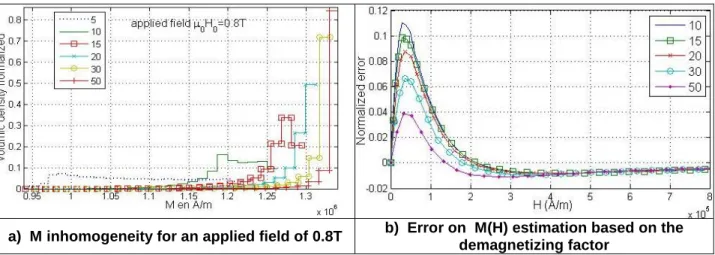
variable. In practice, the demagnetizing field modifies the applied field and breaks its homogeneity which affects the final results (Figure 1a).
This paper presents an original approach to determine the intrinsic magnetization curve M(H) of a material whatever the shape of the sample is. It combines experiment, finite element simulation and inverse problem resolution. Its relevance is showed numerically. Simulations of different size cylinders are performed and allow the field inhomogeneity to be analyzed. Then, the internal field is computed considering the demagnetizing factor2 (N) (Figure 1b) as well as the numerical inversion. This method is applied to characterize the M(H) of gadolinium using a parallelepiped sample along different
orientations. The results are compared to the ones obtained with N correcting factor3.
a) M inhomogeneity for an applied field of 0.8T b) Error on M(H) estimation based on the
demagnetizing factor
Figure 1 numerical simulation for a gadolinium cylinder with radius of 20 and height from 5 to 55 Keywords: demagnetizing field, demagnetizing factor, numerical inversion, homogeneity
1. Bahl, C. R. H. & Nielsen, K. K. The effect of demagnetization on the magnetocaloric properties of gadolinium. J. Appl. Phys. 105, 013916–013916–5 (2009).
2. Chen, D.-X., Brug, J. A. & Goldfarb, R. B. Demagnetizing factors for cylinders. Ieee Trans. Magn. 27, 3601 –3619 (1991).
3. Aharoni, A. Demagnetizing factors for rectangular ferromagnetic prisms. J. Appl. Phys. 83, 3432–3434 (1998).