HAL Id: hal-02990576
https://hal.archives-ouvertes.fr/hal-02990576
Submitted on 16 Nov 2020
HAL is a multi-disciplinary open access
archive for the deposit and dissemination of
sci-entific research documents, whether they are
pub-lished or not. The documents may come from
teaching and research institutions in France or
abroad, or from public or private research centers.
L’archive ouverte pluridisciplinaire HAL, est
destinée au dépôt et à la diffusion de documents
scientifiques de niveau recherche, publiés ou non,
émanant des établissements d’enseignement et de
recherche français ou étrangers, des laboratoires
publics ou privés.
Complexity of planar signed graph homomorphisms to
cycles
François Dross, Florent Foucaud, Valia Mitsou, Pascal Ochem, Theo Pierron
To cite this version:
François Dross, Florent Foucaud, Valia Mitsou, Pascal Ochem, Theo Pierron. Complexity of planar
signed graph homomorphisms to cycles. Discrete Applied Mathematics, Elsevier, 2020, 284,
pp.166-178. �10.1016/j.dam.2020.03.029�. �hal-02990576�
arXiv:1907.03266v2 [cs.DS] 9 Jul 2019
Complexity of planar signed graph homomorphisms to cycles
Fran¸cois Drossa,1, Florent Foucaudb,c,1,2, Valia Mitsoud,1, Pascal Ocheme,1,, Th´eo Pierronb,1,2
a
I3S, Universit´e Nice Sophia Antipolis, France
b
Univ. Bordeaux, Bordeaux INP, CNRS, LaBRI, UMR5800
c
Univ. Orl´eans, INSA Centre Val de Loire, LIFO EA 4022, F-45067 Orl´eans Cedex 2, France
dIRIF, Universit´e de Paris, France e
LIRMM, Universit´e de Montpellier, CNRS, Montpellier, France
Abstract
We study homomorphism problems of signed graphs from a computational point of view. A signed graph is an undirected graph where each edge is given a sign, positive or negative. An important concept when studying signed graphs is the operation of switching at a vertex, which is to change the sign of each incident edge. A homomorphism of a graph is a vertex-mapping that preserves the adjacencies; in the case of signed graphs, we also preserve the edge-signs. Special homomorphisms of signed graphs, called s-homomorphisms, have been studied. In an s-homomorphism, we allow, before the mapping, to perform any number of switchings on the source signed graph. The concept of s-homomorphisms has been extensively studied, and a full complexity classification (polynomial or NP-complete) for s-homomorphism to a fixed target signed graph has recently been obtained. Nevertheless, such a dichotomy is not known when we restrict the input graph to be planar, not even for non-signed graph homomorphisms.
We show that deciding whether a (non-signed) planar graph admits a homomorphism to the square C2
t of a cycle with t > 6, or to the circular clique K4t/(2t−1)with t > 2, are NP-complete problems. We use these results to show that deciding whether a planar signed graph admits an s-homomorphism to an unbalanced even cycle is NP-complete. (A cycle is unbalanced if it has an odd number of negative edges). We deduce a complete complexity dichotomy for the planar s-homomorphism problem with any signed cycle as a target.
We also study further restrictions involving the maximum degree and the girth of the input signed graph. We prove that planar s-homomorphism problems to signed cycles remain NP-complete even for inputs of maximum degree 3 (except for the case of unbalanced 4-cycles, for which we show this for maximum degree 4). We also show that for a given integer g, the problem for signed bipartite planar inputs of girth g is either trivial or NP-complete.
Keywords: signed graph, edge-coloured graph, graph homomorphism, planar graph
1. Introduction
In this paper, we study the computational complexity of graph and signed graph homomorphism problems. Our main focus is the case where the inputs are planar and the targets are cycles (but we also consider other cases). Homomorphisms are structure-preserving mappings between discrete structures; this type of problems is very general and models many combinatorial problems. Consequently, the
Email addresses: [email protected] (Fran¸cois Dross), [email protected] (Florent Foucaud), [email protected] (Valia Mitsou), [email protected] (Pascal Ochem), [email protected] (Th´eo Pierron)
1
This work is supported by the ANR project HOSIGRA (ANR-17-CE40-0022).
2
This author is partially supported by the IFCAM project “Applications of graph homomorphisms” (MA/IFCAM/18/39).
study of the algorithmic properties of homomorphism problems is a rich area of research that has gained a lot of attention. We refer to the book [26] as a reference on graph homomorphism problems. An edge-coloured graph is a graph with several types of (undirected) edges: each type corresponds to a colour. Given two edge-coloured graphs G and H, a homomorphism of G to H is a vertex-mapping f of V (G) to V (H) that preserves adjacencies and edge-colours, that is, if x and y are adjacent via a c-coloured edge in G, then f (x) and f (y) must be adjacent via a c-coloured edge in H as well. When such a homomorphism exists, we write G → H. This concept is studied for example in [1, 5, 24, 34, 41]. In this language, standard undirected graphs can simply be seen as 1-edge-coloured graphs. Signed graphs are a special type of 2-edge-coloured graphs whose edge-colours are signs: positive and negative. In this paper, we will consider two types of objects: standard undirected graphs (that will simply be called (1-edge-coloured) graphs), and signed graphs.
Computational homomorphism problems. The most fundamental class of algorithmic homomorphism
problems is the following one (where H is any fixed edge-coloured graph): Hom(H)
Instance: An (edge-coloured) graph G.
Question: Does G admit a homomorphism to H?
Problem Hom(H) has been studied for decades. For example, consider 1-edge-coloured graphs, and denote the 3-vertex complete graph by K3. Then, Hom(K3) is the classic 3-Colouring prob-lem, shown NP-complete by Karp [29]. (More generally, a proper t-colouring of a graph G is a homomorphism to the complete graph Kt.) Hom(H) for edge-coloured graphs is studied for example in [5, 6, 7, 9, 36].
Hom(H) is also studied under the name of Constraint Satisfaction Problem (CSP), see for example [15]. In this setting, edge-coloured graphs are seen as structures coming with a number of symmetric binary relations (one for each edge-colour). In the context of CSPs, one also considers discrete relational structures that may have relations of arbitrary arities. The celebrated Dichotomy
Conjecture of Feder and Vardi [15] and the subsequent work aims at classifying the complexity of
general CSP problems. While the conjecture was recently solved in [11, 50] (independently) using the tools and language of universal algebra, this algebraic formulation does not always provide simple explicit descriptions of the dichotomy. Thus, obtaining explicit dichotomy classifications for relevant special cases is still of major interest.
When studying Hom(H), we may always restrict ourselves to edge-coloured graphs H that are cores: H is a core if it does not have any homomorphism to a proper subgraph of itself (in other words, all of its endomorphisms are automorphisms). Moreover, the core of an edge-coloured graph H, noted core(H), is the smallest subgraph of H that is a core. It is well-known that the core of an edge-coloured graph is unique (up to isomorphism). It is not difficult to observe that the complexity of Hom(H) is the same as the one of Hom(core(H)). For more details on these notions see the book [26]. One of the most fundamental results in the area of CSP dichotomies is the one obtained for 1-edge-coloured graphs by Hell and Neˇsetˇril. They proved in [27] that if the core of an undirected graph H has at least two edges, Hom(H) is NP-complete, and polynomial-time otherwise. (Note that the latter condition equates to say that H is bipartite or has a loop, a property that is easily testable.) One may ask the following natural question: what is the behaviour of the above dichotomy for specific restrictions of the input graphs?
Planar instances. Colouring and homomorphism problems are studied extensively for the class of
planar graphs. One consequence of the Four Colour Theorem (that any planar graph is properly 4-colourable) is that, contrarily to the general case, Hom(K4) is trivially polynomial-time solvable for planar instances. In this paper, we will study the following restriction of Hom(H):
Planar Hom(H)
Instance: A planar (edge-coloured) graph G. Question: Does G admit a homomorphism to H?
A complexity dichotomy for Planar Hom(H) in the case of 1-edge-coloured graphs, if it exists, is probably not as easy to describe as the Hell-Neˇsetˇril dichotomy for Hom(H). Planar Hom(H) is known to be NP-complete for H = K3 [19], but, as mentioned before, it is trivially polynomial-time when H contains a 4-clique. There are other non-trivial examples that are polynomial-time. For example, consider the Clebsch graph C16, a remarkable triangle-free graph of order 16. It follows from [22, 37] that every triangle-free planar graph has a homomorphism to C16. Since C16 itself has no triangle, a planar graph maps to C16 if and only if it is triangle-free, and thus Planar Hom(C16) is polynomial-time solvable. Infinitely many such examples are known, see [25, 40].
Planar Hom(H) for 1-edge-coloured graphs was studied more extensively in [25, 33], where it was independently proved to be NP-complete when H is any odd cycle C2k+1, via two different techniques. It is also proved in [33] that Planar Hom(H) is NP-complete whenever H is subcubic and has girth 5. Planar Hom(H) is also proved NP-complete in [25] when H is an odd wheel, or the Penny graph.
Further instance restrictions. The difficulty of classifying the complexity of Planar Hom(H) makes
it meaningful to further refine the pool of graph instances to be examined. For example, restrictions on the maximum degree are studied in [18, 42]. In [42], it is proved that for every undirected non-bipartite graph H, there is an integer b(H) such that Hom(H) is NP-complete for graphs of maximum degree b(H). The value of b(H) can be arbitrarily large, but for many graphs H, b(H) = 3 [42]. In particular, it is proved in [18] that for all k ≥ 1, b(C2k+1) = 3, that is, Hom(C2k+1) is NP-complete for subcubic graphs. In fact, the result from [18] (combined with [25, 33]) also implies that Planar Hom(C2k+1) is NP-complete for subcubic graphs.
Other restrictions are on the girth of the input graph, that is, the smallest length of a cycle. It is known that for any k ≥ 1, there is an integer g = g(k) such that all planar graphs of girth at least g admit a homomorphism to C2k+1 [17]. A restriction to planar graphs of a conjecture of Jaeger [28] implies that g(k) = 4k, and it is known that 4k ≤ g(k) ≤ (20k − 2)/3 [4]. In [13], it is proved that for every fixed k ≥ 2 and g ≥ 3, either every planar graph of girth at least g maps to C2k+1, or Planar Hom(C2k+1) is NP-complete for such graphs. Other examples of this type of “hypothetical complexity” theorems exist in other contexts, see for example [14, 30].
Signed graphs and switching homomorphisms. Signed graphs are special types of 2-edge-coloured
graphs, whose edge-colours represent signs: positive and negative. Formally, a signed graph is a pair (G, σ), where G is the underlying graph (the graph containing both the positive and the negative edges) and σ : E(G) → {−1, +1} is the sign function that describes the edge-signs. Signed graphs were studied as early as the 1930’s in the first book on graph theory by K¨onig [32]. They were rediscovered in the 1950’s by Harary [23], who introduced the name signed graph and applied them to the area of social psychology. The concept was later developed by Zaslavsky in [45] and numerous subsequent papers [43, 45, 46, 47, 48] and has become an important part of combinatorics, with many connections to deep results and conjectures. See [44] for a dynamic bibliography on the topic.
Zaslavsky [45] introduced the switching operation: given a signed graph G and a vertex v, to switch at v is to change the sign of all edges incident to v (this can be seen as multiplying their signs by −1). We say that two signed graphs G and G′are switching-equivalent if G′ can be obtained from G by any sequence of switchings. Note that one can test switching-equivalence in polynomial time (on labelled graphs), see [7, 45].
The switching operation turns out to be important in the context of graph minors, and it relates to some outstanding problems in graph theory, see [21, 38, 39] for details. In this context, Guenin introduced in [21] a special kind of homomorphisms of signed graphs, whose theory was later developed in [38, 39]. Following the terminology in [7], we define an s-homomorphism of a signed graph G to a signed graph H as a vertex-mapping f from V (G) to V (H) such that there exists a signed graph G′ that is switching-equivalent to G, and f is a classic edge-coloured graph homomorphism of G′ to H. (Note that additionally one may allow switching at H; this does not change the problem, and we will generally not do so, but we can fix a convenient switching-equivalent sign function of H and stick to it.) When an s-homomorphism exists, we note G−→ H.s
Similarly to edge-coloured graph homomorphism, we say that a signed graph G is an s-core if G admits no s-homomorphism to a proper signed subgraph of itself, and the s-core of G is the smallest subgraph of G that is an s-core (it is unique up to s-isomorphism and switching [39]).
We next define the decision problem that corresponds to s-homomorphisms (with H a fixed signed graph).
s-Hom(H)
Instance: A signed graph G.
Question: Does G admit an s-homomorphism to H?
Note that for two switching-equivalent signed graphs H and H′, the definition of an s-homomorphism implies that s-Hom(H) and s-Hom(H′) have the same complexity.
Extending the Hell-Neˇsetˇril dichotomy [27] for Hom(H) for 1-edge-coloured graph problems, a complexity dichotomy for s-Hom(H) problems was proved in the papers [7, 10]. The authors showed that if the s-core of a signed graph H has at least three edges, then s-Hom(H) is NP-complete; it is polynomial-time otherwise. On the other hand, it was shown in [7] that a similar dichotomy for Hom(H) problems for signed graphs (that is, 2-edge-coloured graphs and no switching allowed), is as difficult to obtain as the one for general CSPs. This indicates that it probably cannot be stated in simple graph-theoretic terms.
The authors of [7] asked what is the complexity of s-Hom(H) problems when the input is planar. Let us define the corresponding analogue of Planar Hom(H).
Planar s-Hom(H)
Instance: A planar signed graph G.
Question: Does G admit an s-homomorphism to H?
An interesting case is the one when H = (Ck, σ) is a cycle (k ≥ 3). If H is switching-equivalent either to an all-positive Ck, or to an all-negative Ck, then the complexity of s-Hom(H) and Planar s-Hom(H) are the same as the ones of Hom(Ck) and Planar Hom(Ck), respectively [7]. When k is odd, one of these two cases holds, and thus by the results of [25, 33], in that case Planar s-Hom(H) is NP-complete.
To state the situation when k is even, it is convenient to introduce the notion of balance: a signed graph is balanced if every cycle contains an even number of negative edges. This central notion is already present in the work of K¨onig [32] but was theorized by Harary [23].
If k = 2t is even and H = (Ck, σ) is balanced, H is switching-equivalent to a positive 2-vertex complete graph and thus Planar s-Hom(H) is polynomial-time. When H is unbalanced, by switching H if necessary, we may assume that H has a unique negative edge and denote this signed graph by U C2t. Then, s-Hom(U C2t) has been proved to be NP-complete [7, 16], but the complexity of Planar s-Hom(U C2t) is not known. We settle this question in this paper.
We point out that homomorphisms of non-signed graphs to odd cycles are an important topic in the theory of homomorphisms and circular colourings. Odd cycles are among the simplest non-trivial graphs (with respect to homomorphisms) and are fundamental in the study of graph colourings. Several well-studied open questions and conjectures involving homomorphisms to odd cycles exist in the area, such as Jaeger’s conjecture and others (see [4, 13] for more details). For s-homomorphisms of bipartite signed graphs, unbalanced even cycles play a similar role as odd cycles for homomorphisms of non-signed graphs. Here also, certain interesting conjectures and theorems are stated, see [12] for a recent study. This motivates the study of the complexity of s-homomorphisms to cycles.
Our results. Our main goal is to prove that Planar s-Hom(U C2k) is NP-complete whenever k ≥ 2.
As a first step, in Section 3, we study non-signed graphs. We prove that Planar Hom(H) is NP-complete when H is the square of a cycle; in turn, this is used to prove that Planar Hom(H) is NP-complete when H is a cubic circular clique. In Section 4, we use these results to prove that Planar s-Hom(U C2k) is NP-complete whenever k ≥ 3. In Section 5, using a different technique, we prove that the case k = 2 is also NP-complete. In Section 6, we show that for every integer k ≥ 1 and
even integer g ≥ 2, either every planar bipartite signed graph of girth g admits a homomorphism to U C2k, or Planar s-Hom(U C2k) is NP-complete for planar bipartite inputs of girth g. In Section 7, we show that the results of Section 4 also apply to subcubic input signed graphs (except for U C4, for which this holds for maximum degree 4). We first start with some preliminary considerations in Section 2.
2. Preliminaries
This section gathers some preliminary considerations.
2.1. Some definitions
Given a graph G, the square of G, denoted G2, is the graph obtained from G by adding edges between all vertices at distance 2.
Given two integers p and q with gcd(p, q) = 1, the circular clique Kp/q is the graph on vertex set {k0, . . . , kp−1} with ki adjacent to kj if and only if q ≤ |i − j| ≤ p − q. Circular cliques are defined in the context of circular chromatic number, see for example [49].
2.2. Switching graphs
We now describe a construction that is important when studying s-homomorphisms.
Definition 2.1. Let G be a signed graph. The switching graph of G is a signed graph denoted ρ(G)
and constructed as follows.
(i) For each vertex u in V (G) we have two vertices u0 and u1 in ρ(G).
(ii) For each edge e between u and v in G, we have four edges between ui and vj (i, j ∈ {0, 1}) in
ρ(G), with the edges between ui and vi having the same sign as e and the edges between ui and
v1−i having the opposite sign (i ∈ {0, 1}).
See Figure 1 for examples of signed graphs and their switching graphs. (In all our figures, dashed edges are red/negative, while full edges are blue/positive). The notion of switching graph was defined by Brewster and Graves in [8] in a more general setting related to permutations (they called it
permu-tation graph). A related construction was used in [31] in the context of digraphs. The construction is
also used in [41] under the name antitwinned graph. Switching graphs play a key role in the study of signed graph homomorphisms, indeed they have several useful properties. One such property is that the switching graph of a signed graph contains, as subgraphs, all switching-equivalent signed graphs. Additionally, the following proposition allows us to study s-homomorphisms in the realm of standard homomorphisms.
Proposition 2.2 ([7]). Let G and H be two signed graphs. Then, G−→ H if and only if G → ρ(H).s Thus, we obtain the following corollary.
Corollary 2.3. Let H be a signed graph. Then, s-Hom(H) and Planar s-Hom(H) have the same
complexity as Hom(ρ(H)) and Planar Hom(ρ(H)), respectively. 2.3. The indicator construction
We recall the indicator construction, one of the main tools used in the proof of the Hell-Neˇsetˇril dichotomy for Hom(H) in [27].
Definition 2.4. Let H be a signed graph. An indicator (I, i, j), is a signed graph I with two
dis-tinguished vertices i and j such that I admits an automorphism mapping i to j and vice-versa. The
result of the indicator (I, i, j) applied to H is an undirected graph denoted H∗ and defined as follows.
(ii) There is an edge from u to v in H∗ if there is a homomorphism of I → H such that i 7→ u and j 7→ v.
We say that (I, i, j) preserves planarity if, given a planar undirected graph G, replacing each edge
uv with a copy of (I, i, j) by identifying u with i and v with j, we obtain a planar signed graph. The following result shows how we can use this tool.
Theorem 2.5 (Hell and Neˇsetˇril [27]). Let H be a signed graph, (I, i, j), an indicator and H∗, the
undirected graph resulting from (I, i, j) applied to H. Then, Hom(H∗) admits a polynomial-time
reduction to Hom(H).
Moreover, if the indicator construction preserves planarity, then Planar Hom(H∗) admits a
polynomial-time reduction to Planar Hom(H).
Proof. We sketch the proof. Given an input graph G of Hom(H∗), we construct a signed graph f (G)
by replacing each edge uv in G by a copy of (I, i, j) by identifying u with i and v with j. (If G is planar and (I, i, j) preserves planarity, then f (G) is also planar.) Now it is not difficult to show that G → H∗ if and only if f (G) → H.
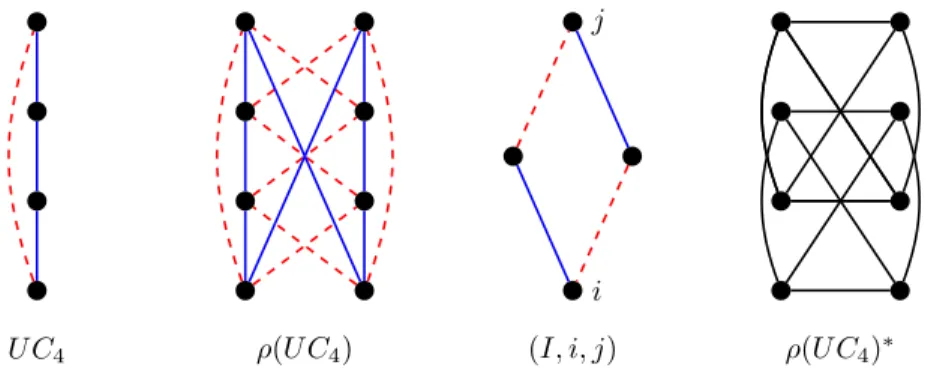
As an example, consider the signed graph U C4 and its switching graph ρ(U C4). Let I be the 4-cycle with two parallel negative and two parallel positive edges, where i and j are two non-adjacent vertices i and j. The result ρ(U C4)∗ of (I, i, j) applied to ρ(U C4) is shown in Figure 1: it consists of two disjoint copies of K4 (thus its core is K4). By Theorem 2.5 and Corollary 2.3, this implies that Hom(ρ(U C4)) and s-Hom(U C4) are NP-complete, by a reduction from Hom(K4). Note that the application of (I, i, j) preserves planarity; however it is useless to reduce Planar Hom(K4) to Planar Hom(U C4) since the former is polynomial-time solvable by the Four Colour Theorem. We thus handle this case with an ad-hoc proof in Section 5.
U C4 ρ(U C4)
i j
(I, i, j) ρ(U C4)∗
Figure 1: The unbalanced cycle U C4, its switching graph ρ(U C4), the indicator (I, i, j) and its resulting undirected
graph ρ(U C4)∗.
3. Some NP-complete (non-signed) Planar Hom(H) cases
In this section, we prove that Planar Hom(H) is NP-complete for two special cases which were not known to be NP-complete.
3.1. Squares of cycles
We first deal with the case where H is the square C2
t of a cycle Ct. The proof is inspired by the proof that Planar Hom(C2k+1) is NP-complete from [33]. Note that, C2
4 = K4 and C52 = K5, and thus by the Four Colour Theorem Planar Hom(Ct2) is polynomial-time solvable when t = 4, 5.
Theorem 3.1. For every t > 6, Planar Hom(C2
t) is NP-complete.
Proof. We will reduce from Planar Hom(C2k+1) for suitable values of k, which is NP-complete
whenever k ≥ 1 [33]. The proof is split into different cases depending on the values of t mod 3 and t mod 4.
If t ≡ 0 mod 3, then the core of C2
t is K3and we are done since Planar Hom(K3) is NP-complete. Otherwise, C2
t is a core. Let v0, . . . , vt−1 be its vertices and vivi+1 and vivi+2 be its edges (indices are taken modulo t).
If t ≡ 2 mod 4, then C2
t is planar, the set of edges vivi+1 induces a cycle of length t, and the set of edges vivi+2 induces two disjoint odd cycles of length t/2. We reduce Planar Hom(Ct/2) to Planar Hom(Ct2). Let G be a planar graph and let G′ be the planar graph obtained from G as follows. For every edge e of G, we add a copy of C2
t and we identify the edge v0v2 of this copy of Ct2 with e. One can see that G maps to Ct/2 if and only if G maps to C2
t, and we are done. If t is odd, then C2
t is not planar, the set of edges vivi+1 (resp. vivi+2) induces an odd cycle and there exists no automorphism of C2
t that maps an edge vivi+1 to an edge vivi+2. Consider the planar graph H obtained from C2
t by removing the edge v0v2. Notice that every homomorphism of H to Ct2 actually corresponds to an automorphism of C2
t. We reduce Planar Hom(Ct) to Planar Hom(Ct2). Let G be a planar graph and let G′ be the planar graph obtained from G as follows. For every edge e of G, we add a copy of H and we identify the edge v0v1 of this copy of H with e. Again, G maps to Ctif and only if G′ maps to C2
t and we are done.
If t ≡ 0 mod 4, then both the set of edges vivi+1 and the set of edges vivi+2 induce a bipartite graph. Thus, the kind of reductions above does not work. We use instead a reduction similar to the one used for odd cycles in [33]. We reduce Planar Hom(K3) (that is, Planar 3-Colouring) to Planar Hom(C2
t). Let us set t = 4k. Consider the graph H obtained from Ct2by removing the edges v2k−1v2k and v2kv2k+2. Notice that every homomorphism of H to C2
t that maps v0 to v0 also maps v2k to either v2k−1, v2k, or v2k+1.
Let G be a planar graph and let G′ be the planar graph obtained from a planar embedding of G as follows. For every face f of G, we first place a new vertex uf inside the face f , and then for every vertex w of G incident to f , we add a copy of H and identify v0with uf and v2k with w. Every vertex in the subgraph G of G′ is said to be old. If G is 3-colourable, then we can map the subgraph G of G′ to the triangle v
2k−1v2kv2k+1 of Ct2. Then we can extend this Ct2-colouring to G′ such that every vertex uf of G′ maps to v0.
It remains to show that if G′ maps to C2
t, then G is 3-colourable. So we suppose for contradiction that there exists a planar graph G such that G′ maps to C2
t and G is not 3-colourable. Moreover, we choose such a graph G with the minimum number of vertices.
Let us first show that G is a planar triangulation. Suppose to the contrary that G contains a face f of length at least 4. Then G′ has a C2
t-colouring that maps uf to v0. So, every old vertex in G′ that corresponds to a vertex incident with f in G is mapped to a vertex in {v2k−1, v2k, v2k+1}. Since |f | > 4, two such old vertices x and y in G′ get the same colour. Let H be the planar graph obtained from G by identifying x and y and removing multiple edges. Notice that H is not 3-colourable, whereas the graph H′ obtained by applying our reduction to H maps to C2
t. This contradicts the minimality of G and thus G is a planar triangulation.
Let w be any old vertex. Since G′ maps to C2
t, consider a Ct2-colouring of G′ that maps w to v0. Then every old vertex adjacent to w maps to a vertex in S = {v−2, v−1, v1, v2}. Notice that S induces a path in C2
t. Since G is a triangulation, the old vertices adjacent to w induce a cycle C which maps to S. So C maps to a bipartite graph and thus C is bipartite. This means that the length of C is even and thus that the degree of w in G is even. Thus, the degree of every vertex of G is even, that is, G is an Eulerian planar triangulation. This is a contradiction since every Eulerian planar triangulation is 3-colourable (see Exercise 9.6.2 in [3]).
3.2. Cubic circular cliques
Recall that K4t/(2t−1) is the circular clique with vertex set {k0, . . . , k4t−1} and such that ki is adjacent to ki+2t−1, ki+2t, and ki+2t+1 (indices being taken modulo 4t). We now use our result of
Section 3.1 to show the following.
Theorem 3.2. For every t > 2, Planar Hom(K4t/(2t−1)) is NP-complete.
Proof. We reduce Planar Hom(C2
4t), which is NP-complete by Theorem 3.1, to Planar Hom(K4t/(2t−1)). For this, consider the 1-edge-coloured indicator (C2t+1, i, j) consisting of a cycle of length 2t + 1 on which i and j are at distance 2. Clearly, this indicator construction preserves planarity. Now, con-sider a homomorphism f from (C2t+1, i, j) to K4t/(2t−1). By the symmetries of both graphs, we may assume that f (i) = ka for some a ∈ {0, . . . , 4k − 1}. Note that the shortest odd cycles in K4t/(2t−1) are of length 2t + 1. Thus, (C2t+1, i, j) must be mapped one-to-one. In fact, we must have f (j) ∈ {ka−2, ka−1, ka+1, ka+2} (where indices are taken modulo 4t). Thus, the graph K4t/(2t−1)∗ obtained from applying (C2t+1, i, j) to K4t/(2t−1)is isomorphic to C2
4t, and by Theorem 2.5 the proof is complete.
4. Unbalanced even cycles of length at least 6
We are now ready to prove that unbalanced even cycles of length at least 6 define an NP-complete s-homomorphism problem for planar graphs.
Theorem 4.1. For every k > 3, Planar s-Hom(U C2k) is NP-complete.
Proof. We will equivalently show that Planar Hom(ρ(U C2k)) is NP-complete.
Let u0, . . . , u4k−1 be the vertices of ρ(U C2k). The positive edges of ρ(U C2k) are uiui+1 and the negative edges are uiui+2k−1.
Consider the indicator (I, i, j) of Figure 1. Clearly, it preserves planarity. Now, consider a homo-morphism f of (I, i, j) to ρ(U C2k). By the symmetries of both graphs, we may assume that f (i) = ua for some a ∈ {0, . . . , 4k − 1}. Then, we must have f (j) ∈ {ua+2k−2, ua+2k, ua+2k+2} (indices taken modulo 4k).
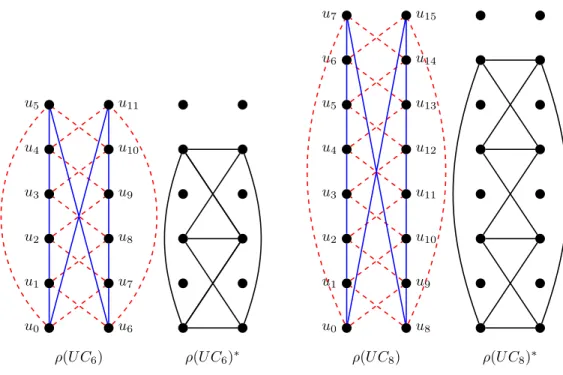
Thus, the graph ρ(U C2k)∗obtained from applying (I, i, j) to ρ(U C2k) is cubic. Notice that ρ(U C2k) is bipartite, and that (I, i, j) is bipartite too with i and j in the same part. It follows that ρ(U C2k)∗ will consist of at least two connected components. See Figure 2 for a picture when k = 3, 4. We now distinguish two cases to determine ρ(U C2k)∗.
Case 1: k is odd. In this case, ρ(U C2k)∗ contains a copy of the cycle Ck = {c0, . . . , c
k−1}, where c0 = u0 and ci+1 = ui+2k+2 when i is even and ci+1 = ui−(2k−2) when i is odd (thus, ck = u2k−2). Furthermore, we claim that Ck is the core of ρ(U C2k)∗: indeed, consider the k sets of vertices Uj = {uj, . . . , uj+3} for j = 0 mod 4 and 0 ≤ j < 4k. For ui ∈ Uj, let f (ui) = cj: f is a homomorphism from ρ(U C2k)∗ to its subgraph Ck.
Case 2: k is even. In this case, letting k = 2t with t ≥ 2, we have that ρ(U C2k)∗ consists of two
copies of the circular clique K4t/(2t−1): one on vertex set {ui | i = 0 mod 2} and the other on vertex set {ui | i = 1 mod 2}. Thus, the core of ρ(U C2k)∗ is K
4t/(2t−1).
In both cases, we have Planar Hom(ρ(U C2k)∗) NP-complete: by [25, 33] when k is odd and by Theorem 3.2 when k is even. We thus apply Theorem 2.5 to obtain a reduction from Planar Hom(ρ(U C2k)∗) to Planar Hom(ρ(U C2k)): this completes the proof.
5. Unbalanced cycles of length 4
The proof of Theorem 4.1 fails to show that Planar Hom(U C4) is NP-complete since ρ(U C∗ 4) is K4 and thus this would require Planar Hom(K4) to be NP-complete, which is false by the Four Colour Theorem. However, we give an ad-hoc reduction in this section.
u0 u1 u2 u3 u4 u5 u6 u7 u8 u9 u10 u11 ρ(U C6) ρ(U C6)∗ u0 u1 u2 u3 u4 u5 u6 u7 u8 u9 u10 u11 u12 u13 u14 u15 ρ(U C8) ρ(U C8)∗
Figure 2: The switching graphs ρ(U C6) and ρ(U C8), and the undirected graphs ρ(U C6)∗and ρ(U C8)∗resulting from
the application of the indicator (I, i, j) from Figure 1 (in which we only draw one of the two isomorphic components). The core of ρ(U C6)∗is K3and the core of ρ(U C8)∗is K8/3, the Wagner graph.
As before, we show equivalently that Planar Hom(ρ(U C4)) is NP-complete. It is easy to see that Planar Hom(ρ(U C4)) is in NP. We thus focus on proving NP-hardness. Recall that ρ(U C4) is the circulant graph with vertices u0, . . . , u7, positive edges uiui+1 and negative edges uiui+3 (it is depicted in Figure 1, see also Figure 3 for a symmetric drawing). We reduce Planar Hom(K3) (that is, Planar 3-Colouring), which is NP-complete [20], to Planar Hom(ρ(U C4)). In the following, G is an instance of Planar Hom(K3). Our goal is to construct a planar signed graph H such that G is 3-colourable if and only if H is a positive instance of Planar Hom(ρ(U C4)). We assume that G is connected, otherwise, we apply our construction to each connected component.
u0 u1 u2 u3 u4 u5 u6 u7
Figure 3: The signed graph ρ(U C4).
5.1. Outline of the reduction
We first present the generic ideas of our reduction. Note that the graph ρ(U C4) is bipartite. Therefore, H will be bipartite, otherwise there is no homomorphism from H to ρ(U C4). In our
construction of H, the important vertices belong to the same partite set. All of the vertices that will be named in our gadgets will always belong to that partite set. By the symmetry of ρ(U C4), we can assume that, in every homomorphism from one of our graphs to ρ(U C4), all of the named vertices will always be mapped to some ui with i = 0 mod 2.
For each vertex v of degree d in G, we will create a gadget Gv in H with 2d special vertices v0, · · · v2d−1(called ports) such that there is an embedding of that gadget in the plane where v0, · · · v2d−1 are on a facial trail in that order. We want that any homomorphism ϕ from H to ρ(U C4) satisfies:
1. ϕ(v0) 6= ϕ(v1)
2. for i = 0, 1, ϕ(vi) = ϕ(v(i mod 2)).
We will describe later how to enforce these conditions. Assuming that they are satisfied, let ϕ be any homomorphism from H to ρ(U C4). Let ϕ(v1) = ul and ϕ(v0) = uk. The difference l − k mod 8 will represent the colour of v in a valid 3-colouring of G. For the sake of readability, we identify uk with its index k, so that we can read the colour of v by the operation ϕ(v1) − ϕ(v0) mod 8. We shall call ϕ(v0) the ground of v and ϕ(v1) − ϕ(v0) its colour. Note that Condition 1 ensures that there are only three possible colours for v: 2, 4, and 6. Condition 2 asserts that the colour of v propagates d times throughout the vertex gadget as ϕ(v2i+1) − ϕ(v2i) mod 8, i ∈ {0, . . . , d − 1}, allowing us to use any pair (v2i, v2i+1) for retrieving it.
Recall that we want H to be a positive instance of Planar Hom(ρ(U C4)) if and only if G is 3-colourable. Therefore, we also want to ensure that any homomorphism H → ρ(U C4) assigns different colours to each pair of adjacent vertices in G. We thus construct H such that the following condition is satisfied:
3. For each homomorphism ϕ : H → ρ(U C4), two adjacent vertices in G receive the same ground, and different colours.
Note that if we manage to construct H such that the three conditions hold, then it is easy to recover a proper 3-colouring of G from any homomorphism H → ρ(U C4). In the following subsections, we describe our gadgets, and we prove that the previous conditions hold.
5.2. Construction of the gadgets
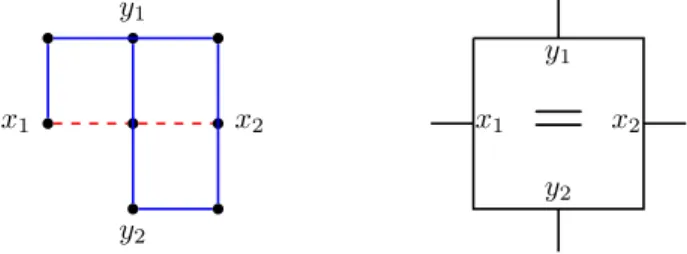
Tu build our vertex gadget, we need to start with several smaller gadgets. We start with a first construction allowing to make copies of a vertex that are mapped to the same image under any homomorphism, called copy gadget (see Figure 4).
x1 y2 y1 x2 y1 x1 x2 y2
=
Figure 4: Copy gadget and its schematic representation.
Lemma 5.2. Let ϕ be a homomorphism from the copy gadget from Figure 4 to ρ(U C4).
Then, ϕ(x1) = ϕ(x2), ϕ(y1) = ϕ(y2) and ϕ(y1) − ϕ(x1) ∈ {±2}.
Conversely, if we partially fix ϕ from {x1, x2, y1, y2} to {u0, u2, u4, u6} such that ϕ(x1) = ϕ(x2),
ϕ(y1) = ϕ(y2) and ϕ(y1) − ϕ(x1) ∈ {±2}, one can extend ϕ to a homomorphism from the copy gadget
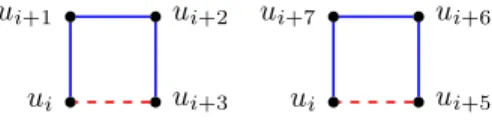
ui+1 ui+3 ui+2 ui ui+7 ui+5 ui+6 ui
Figure 5: The only possible homomorphisms for a copy of U C4. The indices are taken modulo 8.
Proof. The first thing to notice is that in a homomorphism from a copy of U C4to ρ(U C4), each vertex
maps to a distinct vertex, and the only ways to do it are shown in Figure 5.
Given the image of a vertex, there are two possibilities for the remainder of the copy of U C4, and given the images of two vertices, there is at most one way to complete the homomorphism. In a homomorphism from the gadget to ρ(U C4), assume without loss of generality that x1maps to u0. The two possibilities to map the vertices of the copy of U C4 containing x1 lead to y1being mapped either to u2or u6. Then, the mapping of the remainder of the vertices is forced, leading to x2 being mapped to u0 and y2 to the same vertex as y1. The symmetries of U C4 complete the proof of the lemma.
Given a vertex v in G, we want to use the copy gadget to ensure that Condition 2 holds in the vertex gadget Gv, by identifying x1 with v2i and x2 with v2i+2 for i = 0, . . . , d − 1 (indices are taken modulo 2d). However, we also need to have a copy of the ground between each xi.
To this end, we have to design a crossing-type gadget. Observe that the copy gadget allows to cross two images as soon as they differ by ±2.
We thus need to find a gadget that can handle the case where the difference is 4. To this end, we introduce the split gadget from Figure 6, which allows to encode a difference of ±2 or ±4 using two differences of ±2. x1 x2 y2 g1 g2 g3 g1 x1 x2 g2 y2 g3
f
Figure 6: Split gadget and its schematic representation.
Lemma 5.3. Let ϕ be a homomorphism from the split gadget from Figure 6 to ρ(U C4) such that ϕ(g1) = ϕ(g2) = ϕ(g3).
Then, ϕ(x2) − ϕ(g2) and ϕ(y2) − ϕ(g3) lie in {±2}. Moreover, ϕ(x1) − ϕ(g1) = 4 if and only if
ϕ(x2) 6= ϕ(y2), and ϕ(x1) − ϕ(g1) ∈ {±2} if and only if ϕ(x2) = ϕ(y2) = ϕ(x1).
Conversely, if we partially fix ϕ from {x2, y2, x1, g1, g2, g3} to {u0, u2, u4, u6} such that ϕ(g1) =
ϕ(g2) = ϕ(g3), ϕ(x2) − ϕ(g2) and ϕ(y2) − ϕ(g3) lie in {±2}, ϕ(x1) − ϕ(g1) = 4 if and only if ϕ(x2) 6= ϕ(y2), and ϕ(x1) − ϕ(g1) ∈ {±2} if and only if ϕ(x2) = ϕ(y2) = ϕ(x1), then one can extend ϕ to a homomorphism from the split gadget to ρ(U C4).
Proof. Consider a homomorphism ϕ from the gadget to ρ(U C4). Say that g1, g2, and g3are mapped to
u0. Similarly to the proof of Lemma 5.2, x2and y2can each only be mapped to u2or u6. Furthermore, x1 can only be mapped to u2, u4 or u6. Now, if x1 is mapped to u4, then its two neighbours in its copy of U C4 are mapped one to u3 and one to u5, forcing x2 and y2 to be mapped one to u2 and the other to u6. If x1 is mapped to u2, then its two neighbours in its copy of U C4 are mapped one to u1 and one to u3, forcing x2 and y2 to be mapped either both to u2 or both to u6. The case when x1 is
mapped to u6 is similar. If g1, g2, and g3 are mapped to another ui, then the symmetries of ρ(U C4) yield the result.
To prove the converse, one can check that every time we specified that something was forced above, there actually existed a homomorphism that verified the conditions.
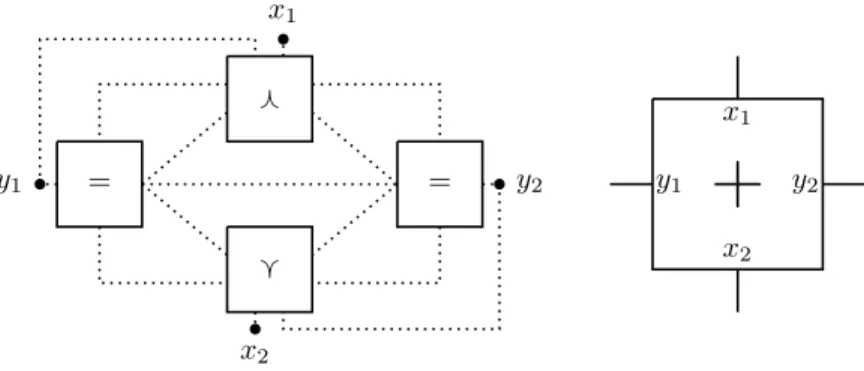
Note that the split gadget can be used in two ways: for splitting an image in {±2, ±4} into two images in {±2}, but also “backwards” for combining two images in {±2} into an image in {±2, ±4}. Thus, by combining the copy gadget and the split gadget, we obtain our crossing gadget, that allows a crossing between two images that differ from ±2 or ±4, see Figure 7. It is clear that the result is planar. Notice that the six vertices towards the center (the lower vertices of the upper split gadget, the upper vertices of the lower split gadget, the right vertex of the left copy gadget, and the left vertex of the right copy gadget) are all identified into one vertex.
f g = = x1 x2 y1 y2 x1 y1 y2 x2
+
Figure 7: Construction of the crossing gadget (dotted links mean identification of vertices) and its schematic represen-tation.
Lemma 5.4. Let ϕ be a homomorphism from the crossing gadget depicted in Figure 7 to ρ(U C4).
Then, ϕ(x1) = ϕ(x2), ϕ(y1) = ϕ(y2) and ϕ(y1) − ϕ(x1) ∈ {±2, ±4}.
Conversely, if we partially fix ϕ from {x1, x2, y1, y2} to {u0, u2, u4, u6} such that ϕ(x1) = ϕ(x2),
ϕ(y1) = ϕ(y2) and ϕ(y1) − ϕ(x1) ∈ {±2, ±4}, then one can extend ϕ to a homomorphism from the
crossing gadget to ρ(U C4).
Proof. The proof is a direct application of Lemmas 5.2 and 5.3. Consider a homomorphism from
the gadget to ρ(U C4). The vertices y1 and y2 must be mapped to the same vertex due to the copy gadgets. Say y1 and y2 are mapped to u0. Notice that in addition, due to the copy gadgets and the identifications of vertices, all vertices of type gi from the two split gadgets are mapped to u0as well. Thus, Lemma 5.3 can be applied to the two split gadgets.
By Lemma 5.3, x1 is mapped to u2, u4, or u6. If x1 is mapped to u2 or u6 (say, u2), then by Lemma 5.3, the remaining two labeled vertices (other than the gi’s) of the upper split gadget are also mapped to u2. So are their “copies” in the two copy gadgets, and by applying Lemma 5.3 to the lower split gadget, so is x2, as desired.
If x1 is mapped to u4, then by Lemma 5.3 the remaining two vertices of the split gadget are mapped one to u2 and one to u6; thus, again, so are their copies in the copy gadgets, and thus again by Lemma 5.3 x2 is mapped to u4.
The existence of a homomorphism extending any good mapping of x1, x2, y1, and y2to {u0, u2, u4, u6} can be checked similarly.
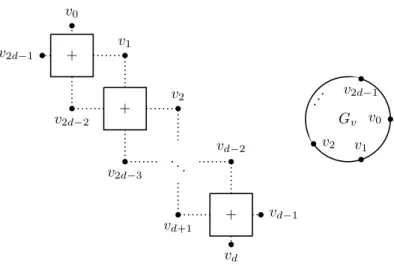
The whole vertex gadget is now created by gluing crossing gadgets, as shown in Figure 8. Due to Lemma 5.4, we obtain that Conditions 1 and 2 are satisfied.
We use again the crossing gadget to define the edge gadget. For each edge vw of G, we link two pairs (v2i, v2i+1) and (w2j, w2j+1) of consecutive ports of the vertex gadgets Gv and Gwby identifying
+ + + ... v0 v1 v2 vd−2 vd−1 vd vd+1 v2d−3 v2d−2 v2d−1 Gv ... v0 v1 v2 v2d−1
Figure 8: Vertex gadget Gv(dotted links mean identification of vertices) and its schematic representation.
v2i, v2i+1, w2j with x1, y1, x2, and adding an alternating path of length 2 between y2 and w2j+1 as shown in Figure 9. Gv v2i v2i+1 + Gw w2j w2j+1
Figure 9: Edge gadget (dotted links mean identification of vertices).
Due to this construction, any homomorphism H → ρ(U C4) must map the bottom vertex (x2) from the crossing gadget and w2j+1 to different images, with a difference in {±2, ±4}. Thus, Lemma 5.4 also ensures that Condition 3 holds since any homomorphism maps v2i+1 and w2j+1to the same image (the ground) and v2i and w2j to different ones (their colours).
To ensure that this construction outputs a planar graph H, we first fix a planar embedding of G. Then, we use the ports of the gadgets associated to v in the same cyclic ordering as the edges incident to v in G.
5.3. End of the proof
As we already saw, our three conditions are satisfied by H, hence if there is a homomorphism H → ρ(U C4), then G is 3-colourable. Conversely, given a 3-colouring of G, we can define a homomorphism ϕ : H → ρ(U C4). Given a vertex v of G with colour c ∈ {1, 2, 3}, we define ϕ(v2i) = u0 and ϕ(v2i+1) = u2c. We can then extend this partial homomorphism to each crossing gadget. Therefore, we obtain a reduction. Since H can be constructed in polynomial time, we finally obtain that Planar Hom(ρ(U C4)) (and thus, Planar s-Hom(U C4)) is NP-hard.
6. Planar graphs with large girth
In this section, we prove a “hypothetical complexity” type theorem for s-homomorphisms to unbal-anced even cycles, similar to the one in [13] for Planar Hom(C2k+1). This is motivated by the signed graph analogue of Jaeger’s conjecture: it is conjectured in [39] that every planar bipartite signed graph of girth at least 4k − 2 has an s-homomorphism to U C2k (see [12] for recent progress).
Theorem 6.1. Let g > 4 and k > 2 be fixed integers. Either every bipartite planar signed graph
with girth at least g has an s-homomorphism to U C2k, or Planar s-Hom(U C2k) is NP-complete for
planar signed graphs with girth at least g.
Proof. Note that by Proposition 2.2 and Corollary 2.3, the statement is equivalent to the one stating
that every bipartite planar signed graph with girth at least g has a homomorphism to ρ(U C2k), or Planar Hom(ρ(U C2k)) is NP-complete for planar signed graphs with girth at least g.
Suppose that H is a bipartite planar graph with girth at least g that does not map to ρ(U C2k) and that H is minimal with respect to the subgraph order. Let xy be a positive edge of H. By minimality, H \ xy is ρ(U C2k)-colourable. Let i be the smallest integer such that there exists a homomorphism that maps x to u0 and y to ui. So i is odd and 3 6 i 6 2k − 1. Let J be the graph obtained from H \ xy by adding a path x = x0, x1, . . . , xi−1, xi = y of i positive edges between x and y. So J is ρ(U C2k)-colourable and since ρ(U C2k) is edge-transitive, we can assume that x0 maps to u0 and x1 maps to u1. Then by minimality of i, xj maps to uj for every 0 6 j 6 i and we call this a canonical colouring. Now we consider the graph J′ obtained from two copies J1 and J2 of J by identifying the vertices xi−1 (resp. xi) of both copies. If a canonical colouring of the subgraph J1 is extended to J′, then both vertices x0 map to u0. Thus, every ρ(U C2k)-colouring of J′ maps both vertices x0 to the same vertex. Notice that the distance between the two vertices x0is 2i − 2 > 4.
Then, every instance G of Planar Hom(ρ(U C2k)) can be transformed into an equivalent instance G′ of Planar Hom(ρ(U C2k)) with girth at least g using, as a vertex gadget, sufficiently many copies of the gadget J′.
7. Restricting the maximum degree
We now consider instance restrictions according to the maximum degree. It is proved in [18] that Hom(C2k+1) can be reduced to Hom(C2k+1) for subcubic graphs using a gadget consisting of a sequence of copies of C2k+1 glued to each other. Furthermore, this reduction preserves the planarity, thus it follows from [25, 33] that Planar Hom(C2k+1) is NP-complete for subcubic graphs. Here, we show an analogue of this result for s-homomorphisms to unbalanced even cycles.
Theorem 7.1. Planar s-Hom(U C4) remains NP-complete for signed graphs with maximum degree 4.
For every k ≥ 3, Planar s-Hom(U C2k) remains NP-complete for subcubic signed graphs (of girth 2k).
Proof. In both cases, we reduce Planar s-Hom(U C2k) itself to Planar s-Hom(U C2k) on graphs
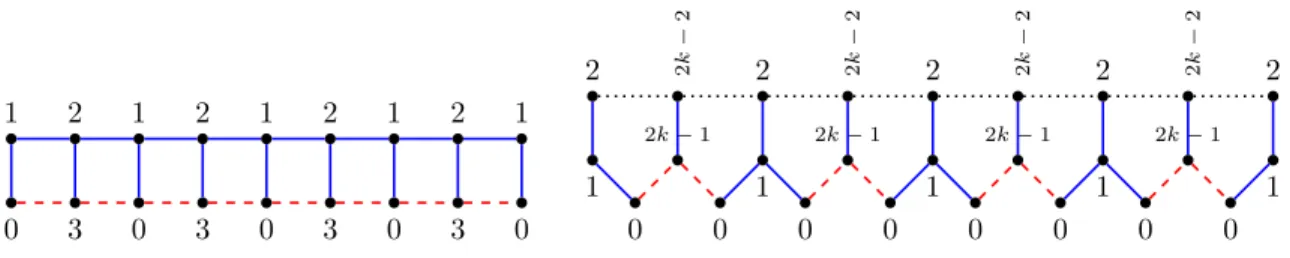
with maximum degree ∆ = 3 or 4 using a vertex-gadget with appropriate vertex degrees that forces the same colour (say colour 0) on arbitrarily many vertices of degree ∆ − 1. Our gadgets are similar to the ones from [18] for Planar Hom(C2k+1), and are depicted in Figure 10. For the reduction, each vertex v of degree d of the input graph is replaced by a copy Gv of this gadget containing 2d glued cycles, and if v and w are adjacent, we add an edge between a vertex of Gv and a vertex of Gwthat are labeled 0 in Figure 10. Since the gadgets have girth 2k and by Theorem 6.1, Planar s-Hom(U C2k) is NP-complete for inputs of girth 2k, our construction producees inputs of girth 2k.
Observe that this approach does not work for Planar s-Hom(U C4) on subcubic graphs: vertices coloured with 0 in the corresponding gadget have degree 3, not 2.
8. Concluding remarks
It would be interesting to settle the complexities of s-Hom(U C4) and Planar s-Hom(U C4) for graphs of maximum degree 3. Studying Planar s-Hom(H) for further classes of signed graphs H is also of interest. As Planar Hom(H) is connected to studies on homomorphism bounds for planar graphs [25, 37, 40], Planar s-Hom(H) is connected to the signed counterparts of these works, see for example [2, 38].
1 2 1 2 1 2 1 2 1 0 3 0 3 0 3 0 3 0 2 2k − 2 2 2k − 2 2 2k − 2 2 2k − 2 2 1 2k − 1 1 2k − 1 1 2k − 1 1 2k − 1 1 0 0 0 0 0 0 0 0
(a) Duplicating a colour in a U C4-colouring. (b) Duplicating a colour in a U C
2k-colouring. A dotted edge
corresponds to a path of 2k − 4 positive edges.
Figure 10: Gadgets with vertices of degree 3 or 2, that are mapped to the same vertex in a U C2k-colouring.
When it comes to non-signed graphs, combined results of Moser [35] and Zhu [49] show that for every rational q such that 2 6 q 6 4, there exists a planar graph with circular chromatic number q. The problem of deciding whether the circular chromatic number of a planar graph is at most q is NP-complete if q is equal to:
• 3 +12, by Theorem 3.1 since C2
7 = C7= K7/2. • 2 +1t for every t > 1 by [25, 33]
• 2 +2t−12 for every t > 2, by Theorem 3.2.
It would be nice to extend these results to every rational q with 2 < q < 4. References
[1] N. Alon and T. H. Marshall. Homomorphisms of edge-colored graphs and Coxeter groups. Journal
of Algebraic Combinatorics 8(1):5–13, 1998.
[2] L. Beaudou, F. Foucaud and R. Naserasr. Homomorphism bounds of signed bipartite K4-minor-free graphs and edge-colourings of 2k-regular K4-minor-K4-minor-free multigraphs. Discrete Applied
Math-ematics 261:40-51, 2019.
[3] A. Bondy and U. Murty. Graph Theory with Applications, American Elsevier Publishing Company, Inc., New York, 1976.
[4] O. V. Borodin, S. J. Kim, A. V. Kostochka and D. B. West. Homomorphisms from sparse graphs with large girth. Journal of Combinatorial Theory, Series B 90:147–159, 2004.
[5] R. C. Brewster. Vertex colourings of edge-coloured graphs, PhD thesis, Simon Fraser University, Canada, 1993.
[6] R. C. Brewster. The complexity of colouring symmetric relational systems. Discrete Applied
Math-ematics 49(1–3):95–105, 1994.
[7] R. C. Brewster, F. Foucaud, P. Hell and R. Naserasr. The complexity of signed graph and edge-coloured graph homomorphisms. Discrete Mathematics 340(2):223–235, 2017.
[8] R. C. Brewster and T. Graves. Edge-switching homomorphisms of edge-coloured graphs. Discrete
Mathematics 309(18):5540–5546, 2009.
[9] R. C. Brewster and P. Hell. On homomorphisms to edge-coloured cycles. Electronic Notes in
Discrete Mathematics 5:46–49, 2009.
[10] R. C. Brewster and M. H. Siggers. A complexity dichotomy for signed H-colouring. Discrete
[11] A. A. Bulatov. A dichotomy theorem for nonuniform CSPs. Proceedings of the 58th IEEE Annual Symposium on Foundations of Computer Science, FOCS 2017, IEEE Computer Society, pp. 319– 330, 2017.
[12] C. Charpentier, R. Naserasr and ´E. Sopena. Homomorphisms of sparse signed graphs. Manuscript,
2019. http://www.labri.fr/perso/sopena/pmwiki/uploads/Publications/mapping_to_UC2g_submitted.pdf [13] L. Esperet, M. Montassier, P. Ochem and A. Pinlou. A complexity dichotomy for the coloring of
sparse graphs. Journal of Graph Theory 73:85-102, 2012.
[14] T. Feder and C. Subi. On Barnette’s conjecture. Manuscript, 2006. https://eccc.weizmann.ac.il/report/2006/015/
[15] T. Feder and M. Y. Vardi. The computational structure of monotone monadic SNP and constraint satisfaction: a study through datalog and group theory. SIAM Journal on Computing 28(1):57– 104, 1998.
[16] F. Foucaud and R. Naserasr. The complexity of homomorphisms of signed graphs and signed constraint satisfaction. Proceedings of the 11th Latin American Symposium on Theoretical Infor-matics 2014, LATIN 2014, Lecture Notes in Computer Science 8392:526–537, 2014.
[17] A. Galluccio, L. Goddyn and P. Hell. High-girth graphs avoiding a minor are nearly bipartite.
Journal of Combinatorial Theory, Series B 83(1):1–14, 2001.
[18] A. Galluccio, P. Hell and J. Neˇsetˇril. The complexity of H-coloring of bounded degree graphs.
Discrete Mathematics 222(1–3):101–109, 2000.
[19] M. R. Garey and D. S. Johnson. Computers and intractability: a guide to the theory of
NP-completeness, W. H. Freeman, 1979.
[20] M. R. Garey, D. S. Johnson and L. J. Stockmeyer. Some simplified NP-Complete graph problems.
Theoretical Computer Science 1(3):237–267, 1976.
[21] B. Guenin. Packing odd circuit covers: a conjecture. Manuscript, 2005.
[22] B. Guenin. Packing T-joins and edge-colouring in planar graphs. Mathematics of Operations
Re-search, accepted.
[23] F. Harary. On the notion of balance of a signed graph. Michigan Mathematical Journal 2(2):143– 146, 1953-1954.
[24] P. Hell, A. Kostochka, A. Raspaud and ´E. Sopena. On nice graphs. Discrete Mathematics 234(1– 3):39–51, 2001.
[25] P. Hell, R. Naserasr and C. Tardif. Complexity of planar homomorphisms. Manuscript, 2006. [26] P. Hell and J. Neˇsetˇril. Graphs and Homomorphisms, Oxford Lecture Series in Mathematics and
Its Applications, Oxford University Press, 2004.
[27] P. Hell and J. Neˇsetˇril. On the complexity of H-coloring. Journal of Combinatorial Theory Series
B 48(1), 92–110, 1990.
[28] F. Jaeger. Nowhere-zero flow problems, in “Selected Topics in Graph Theory,” Vol. 3, pp. 71–96, Academic Press, New York, 1988.
[29] R. M. Karp. Reducibility among combinatorial problems. In R. E. Miller and J. W. Thatcher (editors), Complexity of Computer Computations. New York: Plenum. pp. 85–103, 1972.
[30] M. Kochol. Hypothetical complexity of the nowherezero 5flow problem. Journal of Graph Theory 28(1):1–11, 1998.
[31] W. Klostermeyer and G. MacGillivray. Homomorphisms and oriented colorings of equivalence classes of oriented graphs. Discrete Mathematics 274(1–3):161–172, 2004.
[32] D. K¨onig. Theorie der endlichen und unendlichen Graphen. Akademische Verlagsgesellschaft, Leipzig, 1936.
[33] G. MacGillivray and M. H. Siggers. On the complexity of H-colouring planar graphs. Discrete
Mathematics 309(18):5729–5738, 2009.
[34] A. Montejano, P. Ochem, A. Pinlou, A. Raspaud and ´E. Sopena. Homomorphisms of 2-edge-colored graphs. Discrete Applied Mathematics 158(12):1365–1379, 2010.
[35] D. Moser. The star-chromatic number of planar graphs. Journal of Graph Theory 24(1):33–43, 1997.
[36] N. Movarraei and P. Ochem. Oriented, 2-edge-colored, and 2-vertex-colored homomorphisms.
Information Processing Letters 123:42–46, 2017.
[37] R. Naserasr. Homomorphisms and edge-coloring of planar graphs. Journal of Combinatorial
The-ory, Series B 97(3):394–400, 2007.
[38] R. Naserasr, E. Rollov´a and ´E. Sopena. Homomorphisms of planar signed graphs to signed pro-jective cubes. Discrete Mathematics & Theoretical Computer Science 15(3):1–12, 2013.
[39] R. Naserasr, E. Rollov´a and ´E. Sopena. Homomorphisms of signed graphs. Journal of Graph
Theory 79(3):178–212, 2015.
[40] J. Neˇsetˇril and P. Ossona de Mendez. Tree-depth, subgraph colorings and homomorphism bounds.
European Journal of Combinatorics 27(6):1022–1041, 2006.
[41] P. Ochem, A. Pinlou and S. Sen. Homomorphisms of 2-edge-colored triangle-free planar graphs.
Journal of Graph Theory 85(1):258–277, 2017.
[42] M. H. Siggers. Dichotomy for bounded degree H-colouring. Discrete Applied Mathematics 157:201– 210, 2009.
[43] T. Zaslavsky. Characterizations of signed graphs. Journal of Graph Theory 5(4):401–406, 1981. [44] T. Zaslavsky. A mathematical bibliography of signed and gain graphs and allied areas.
Electronic Journal of Combinatorics, Dynamic Surveys in Combinatorics, #DS8.
[45] T. Zaslavsky. Signed graphs. Discrete Applied Mathematics 4(1):47–74, 1982. [46] T. Zaslavsky. Signed graph coloring. Discrete Mathematics 39(2):215–228, 1982.
[47] T. Zaslavsky. Chromatic invariants of signed graph. Discrete Mathematics 42(2–3):287–312, 1982. [48] T. Zaslavsky. How colorful the signed graph? Discrete Mathematics 52(2–3):279–284, 1984. [49] X. Zhu. Planar graphs with circular chromatic numbers between 3 and 4. Journal of Combinatorial
Theory, Series B 76(2):170–200, 1999.
[50] D. Zhuk. A Proof of CSP Dichotomy Conjecture. Proceedings of the 58th IEEE Annual Sympo-sium on Foundations of Computer Science, FOCS 2017, IEEE Computer Society, pp. 331–342, 2017.