HAL Id: hal-00760015
https://hal.archives-ouvertes.fr/hal-00760015
Submitted on 5 Oct 2018
HAL is a multi-disciplinary open access
archive for the deposit and dissemination of sci-entific research documents, whether they are pub-lished or not. The documents may come from teaching and research institutions in France or abroad, or from public or private research centers.
L’archive ouverte pluridisciplinaire HAL, est destinée au dépôt et à la diffusion de documents scientifiques de niveau recherche, publiés ou non, émanant des établissements d’enseignement et de recherche français ou étrangers, des laboratoires publics ou privés.
saturated basic sites
Guy Bouchoux, Jean-Yves Salpin
To cite this version:
Guy Bouchoux, Jean-Yves Salpin. Gas-phase basicities of polyfunctional molecules. Part 2 : saturated basic sites. Mass Spectrometry Reviews, Wiley, 2012, 31 (3), pp.353-390. �10.1002/mas.20343�. �hal-00760015�
Gas-phase basicities of
polyfunctional molecules.
Part 2: saturated basic sites
Guy Bouchoux
1,2*and Jean-Yves Salpin
3,4(1) Ecole Polytechnique - Laboratoire des Mécanismes Réactionnels (DCMR) - Département
de Chimie - 91120 Palaiseau. France.
(2) CNRS – UMR 7651
(3) Université d'Evry Val d'Essonne - Laboratoire Analyse et Modélisation pour la Biologie et
l'Environnement (LAMBE) – Bâtiment Maupertuis – Bd F. Mitterrand - 91025 Evry. France
(4) CNRS – UMR 8587
* Correspondence to: Guy Bouchoux. Laboratoire des Mécanismes Réactionnels.
Département de Chimie. Ecole Polytechnique. 91120 Palaiseau. France.
E-mail address:
[email protected]
Telephone: (33) 1 69 33 48 42
FAX:
(33) 1 69 33 48 03
Table of contents
I. Introduction
A. Thermochemical parameters
B. Methods of determination of GB, PA and
pS°
C. Internal hydrogen bonds
II. Amines
A. Aliphatic polyamines
a. Hydrazines
b. Diamines and polyamines
B. Cyclic and aromatic polyamines
a. Cyclic diamines
b. Aryl-alkyl amines
c. Aromatic diamines, proton sponges
C. Aminoalcohols
a. Hydroxylamine and derivatives
b. - aliphatic aminoalcohols
III. Alcohols and ethers
A.Unsaturatedalcohols and phenols
B.Saturated acyclic and cyclic polyols
a. Hydrogen peroxide and derivatives
b. -diols
c. Acyclic triols
d. Cyclic polyols
C.thers and hydroxy-ethers
a. Peroxides and methoxy oxides
b. Methoxy alcohols
c. Aliphatic polyethers
d. Cyclic mono-ethers
e. Cyclic polyethers
References
Abstract
The present article is the second part of a general overview of the gas-phase protonation thermochemistry of polyfunctional molecules. The first part of the review (Mass Spectrom. Rev., 2007, 26:775-835) was devoted to the description of the physico-chemical concepts and of the methods of determination, both experimental and theoretical, of gas-phase basicity. Several clues concerning the structural and energetic aspects of the protonation of isolated species have been emphasized. In the present paper, specific examples are examined. The field of investigation is limited to molecules containing a "saturated" basic site i.e. nitrogen or oxygen atoms engaged in simple bonds with their neighbouring. Aliphatic, cyclic and aromatic poly- amines, aminoalcohols, alcohols, ethers and hydroxyl-ethers, are successively presented.
Keywords
Protonation thermochemistry; Protonation site; Intramolecular hydrogen bond; Polyfunctional interactions.
Running title
I. Introduction
The different methods of ion formation developed in mass spectrometry during the last 45 years, from chemical ionization to electrospray and matrix assisted laser desorption ionization, invariably involve protonation (or deprotonation) of the sample molecules. In addition to its powerful analytical applications mass spectrometry also allows the study of intrinsic molecular properties among which thermochemical parameters such as gas-phase basicities and acidities. In this review we intend to present a survey of the structural and energetic aspects of the gas phase protonation process of "real", i.e. polyfunctional, molecules.
In the first part of the present review (Bouchoux, 2007), experimental and theoretical methods of determination of gas-phase basicities were presented and the structural effect upon these quantities (nature of the basic site, substituent effects, hydrogen bonding...) were recalled. This second part focuses on selected types of polyfunctional molecules. We limit here the field of investigation to molecules containing a "saturated" basic site i.e. nitrogen or oxygen atoms engaged in simple bonds with their neighbouring. This, somewhat arbitrary choice, includes polyfunctional molecules containing amines, alcohols or ethers functional groups on aliphatic and alicyclic backbone. In this survey, we also consider species where the basic atoms are bonded to unsaturated carbons.
After a brief reminder of the necessary fundamentals of gas-phase basicity, the review is organized in two chapters entitled "Amines" and "Alcohols and Ethers". Each chapter provides evaluated experimental and theoretical protonation thermochemistry data and describes the structure and behavior of the formed protonated species.
A. Thermochemical parameters
Proton affinity, PA(M), and gas-phase basicity, GB(M), of a molecule M are defined as the standard enthalpy and standard Gibbs free energy of reaction (1) at 298.15 K (Lias et al., 1984; Lias et al., 1988; 2005; Bouchoux, 2007):
MH+ M + H+ (1)
(gas) (gas) (gas)
Proton affinity, PA(M) = 1H298° Gas phase basicity, GB(M) = 1G298°
Introducing the entropy of the reaction (1),1ST°, the thermodynamic relationship GT° = HT° - TST° leads to eq. (2) at 298 K:
GB(M) = PA(M) - 2981S298° (2)
It is a custom to denote "protonation entropy" or "half reaction entropy" the difference in absolute entropies:
pST°(M) = ST°(MH+) - ST°(M) (3)
GB(M) = PA(M) -298 [S298°(H+) - pS298°(M)] (4) , with S298°(H+) being the translational entropy of one mole of protons (i.e., equal to 108.7 J.mol-1.K-1 if considered as an ideal monoatomic gas at 298 K).
B. Methods of determination of GB, PA and
pS°.
As detailed in the first part of the present review (Bouchoux, 2007) all the experimental methods of determination of gas phase basicity or proton affinity are related to a proton transfer reaction (i) between the molecule of interest, M, and a reference base, Bi:
MH+ + B
i M + BiH+ (i)
Thus, it is essential to recall the thermochemical relationships associated with reaction (i) at an operational (actual or "effective") temperature T. Assuming that the enthalpy and entropy variations in the temperature range 298T are negligible (i.e. iH°298T and iH°298T ~ 0 (Bouchoux, 2007)), the standard Gibbs free energy of reaction (i) at temperature T may be expressed by:
iG°T ~ GB(M) – GB(B) - (T-298) iS°298 (5)
or iG°T ~PA(M) - PA(B) - T iS°298 (6)
with iS°298 = pS°298(B) - pS°298(M) (7)
The experimental methods allowing the determination of gas phase basicity or proton affinity consist in obtaining iG°T (or an approximation of it) from experimental observables (essentially ion abundances) through "master" relationships based on thermochemical and kinetic theories. These procedures are the so-called "equilibrium", "kinetic" and "thermokinetic" methods (Ervin, 2001; Gal et al., 2001; Bouchoux, 2007). A summary of these methods and of their underlying statements is given in Table 1.
Table 1. Summary of the experimental methods of determination of gas-phase basicities.
Method Experimental
devicea Basic principle and experimental observable Master equation
Equilibrium ICR, HPMS, FA Determination of equilibrium constant of a proton transfer reaction (i):
MH+ + Bi M + BH+
Ki = [M]eq[BH+]eq/ [MH+]eq[B]eq
iG°T = - RT ln Ki
Kinetic tandem MS Branching ratio measurement of the competitive dissociations of a protonated
iG°T /RT = ln([MH]+/[BiH]+) [MHBi]+
[MH]+ + B i
adduct:
Thermokinetic FT-ICR Measurement of the bimolecular rate constant kbim: kbim MH+ + Bi M + BH+ kbim/kcoll = [1 + exp((iG°T)/RT)]-1
a) FT- ICR=Fourier Transform-Ion Cyclotron Resonance, HPMS= High Pressure Mass Spectrometry, FA= Flowing Afterglow.
In the "equilibrium method", the equilibrium constant Ki of reaction (i) is measured at a temperature T and related to the Gibbs free energy change by the well-known relationship iG°T = - RT ln Ki. Then, the 298K gas-phase basicity of M is deduced from eq. (5). Moreover, if experiments are conducted at variable temperature, the enthalpy and entropy components of iG°T may be disclosed by plotting lnKi against 1/T following the well-known van't Hoff method. This procedure may consequently lead to PA(M) and pS°(M). Ki is generally deduced from measurements of MH+ and BH+ ion abundances and partial pressures of the neutrals. Another procedure consists in determining the forward and reverse rates of reaction (i), kf and kr, and to estimate the equilibrium constant via Ki= kf / kr. The accuracy of the method is lying on the precise knowledge of the true temperature T of the experiment and of the partial pressure of M and B (Meot-Ner, 2003; Bouchoux, 2007).
Rather than considering a direct bimolecular proton exchange such as in reactions (i), the "kinetic methods" use the competitive dissociations of an adduct ion [MHB]+ into MH+ + B or M + BH+, i.e. the reactants and products of reaction (i). By using a tandem mass spectrometer, the adduct [MHBi]+ may be selected and its dissociations analysed by the second part of the instrument. Considering gas phase basicity determination, the ratio of peak intensities [MH+]/[B
iH+] is ideally related to iG°T via the relationship iG°T = RT ln([MH+]/[BiH+]). A series of experiments using several bases Bi is treated by plotting ln([MH+]/[BiH+]) vs PA(Bi) in order to deduce the relevant thermochemical parameter. There are two means to handle the data. In the so called "simple kinetic method", the x-intercept of the ln([MH+]/[B
iH+]) vs PA(Bi) fitting line is equated to PA(M). However, the x-intercept is equal to an "apparent proton affinity" equal to the difference [PA(M) – T(pS°(M)-pS°(B))]. The determination of PA(M) by the "simple kinetic method" supposes consequently that the term T(pS°(M)-pS°(B)) can be neglected. In situations where this quantity is not negligible a more elaborate method such as the "extended kinetic method" is needed. This latter allows the determination of both parameters PA(M) and pS°(M) by considering several sets of experiments corresponding to different temperatures Tj. A crucial caveat of the kinetic method is that Tj does not correspond to a true thermodynamic temperature but to an empirical parameter (called the "effective temperature") depending on the ion activation conditions (Ervin, 2002; Ervin & Armentrout, 2004; Bouchoux, 2007).
Finally, the "thermokinetic method" makes use of the bimolecular rate constant kbim of the forward reaction (i). By using the canonical thermodynamic formulation of the transition state theory, kbim can be related to the Gibbs free energy of the reaction, iG°T, and consequently to GB(M). This latter parameter may be obtained by plotting kbim for a series of experiments involving different bases Bi and fitting the data by a sigmoid parametric function.
Beside experimental determinations, protonation thermochemistry may be obtained using quantum chemistry calculations. Moreover, these latter methods bring valuable structural information on the neutral and
ionized species hardly obtainable experimentally. The theoretical proton affinity of a molecule M, i.e. the standard enthalpy of reaction (1) at 298 K, is given, by:
PA(M) = E°(M) + ZPVE(M) + H°0298(M) - E°(MH+) - ZPVE(MH+) - H°0298(MH+) + 6.2 kJ/mol (8) where E° is the potential energy of the system relative to infinitely separated electrons and nuclei (the so-called "total energy"), ZPVE the zero point vibrational energy and H°0298 the thermal contribution to enthalpy at 298K. The 6.2 kJ/mol term appearing in equation (8) corresponds to the translational enthalpy of the proton (5/2RT) at 298 K.
Reliable computation of proton affinity thus needs a high accuracy on E° and on the vibrational contribution to energy ZPVE and H°0298. Fortunately, the extraordinary development of quantum chemistry calculations during the last ten years has brought methods able to predict enthalpy variations at the "chemical accuracy level" (i.e. with deviation less than 4 kJ.mol-1). Presently, techniques which may approach this level of accuracy are essentially composite methods such as Gn (Curtiss et al., 1991; Baboul et al., 1999; Curtiss et al., 2000; Curtiss & Raghavachari, 2002; Curtiss et al., 2005), CBSn (Ochterski et al., 1996) and Wn (Martin & de Oliveira, 1999) and the last generation of density functional theory (Zhao & Truhlar, 2008; Schwabe & Grimme, 2008). Accuracy on the theoretical protonation thermochemistry is obviously dependent on the level of theory used but also to the effectiveness of identifying the most stable neutral and ionized structures and conformations. Moreover, care should be taken to compare theoretical data where the zero point energies and thermal correction for enthalpies at finite temperature (298 K) have been conveniently considered.
C. Internal hydrogen bonds
PA (M) and GB (M) increase with increasing the basic strength of the molecule M and are therefore direct measures of its intrinsic basicity. Protonation entropy,pS°(M), the necessary link between PA (M) and GB (M), may be seen as a measure of the disorder appearing or disappearing upon protonation of the molecule M. Structural effects, in particular, substituent interactions in polyfunctional molecules M, or their protonated forms MH+, have a profound influence on PA (M), GB (M) and pS°(M) values. Internal hydrogen bonding is one of the factors that may affect these thermochemical parameters because it stabilizes differently the neutral and the protonated forms of the molecule.
Intramolecular hydrogen bonding of the type X-H...Y is expected to stabilize the corresponding species if the donor group, X-H, and the acceptor part, Y, may interact without insurmountable constraint. As mentioned in part 1 of this review during the examination of bimolecular systems (Bouchoux, 2007), hydrogen bond energies are considerably enhanced when the hydrogen donor is a protonated molecule. Stabilization through hydrogen bonding typically amount to 10-20 kJ/mol for neutral molecules and to 50-140 kJ/mol for ionized species. A stronger stabilization is consequently expected during the formation of intramolecular hydrogen bonds in the protonated molecule MH+ than in the neutral M. The first consequence is an increase of the proton affinity of the corresponding molecule. This explains why polyfunctional molecules present generally higher proton affinities than their monofunctional counterparts. Simultaneously, the formation of this strong
intramolecular hydrogen bond leads to higher rotational barriers in MH+ than in M. In other word, internally hydrogen bonded conformations are more constrained in MH+ than in M due to the difference in the hydrogen bond strengths. The consequence is that the entropy of the protonated structure becomes lower than that of the neutral base and protonation thus results in a negative pS°(M).
Ideal systems for studying such effect are molecules possessing two basic sites separated by a flexible aliphatic chain. It is thus not surprising that this phenomenon has been first evidenced in studies devoted to the gas phase basicities of aliphatic -diamines (Aue et al., 1973; Yamdagni & Kebarle, 1973). It has been amply illustrated latter on for a large variety of polyfunctional molecules. The scope of the present review is however limited to "saturated" basic sites i.e. to molecules containing amine, alcohol or ether functions. Unsaturated polyfunctional molecules will be examined in a separated part of this review.
Thermochemistry of internal hydrogen bonds has been tentatively evaluated under several angles: (i) The difference between the PA of the considered polyfunctional molecule M and the PA of a monofunctional reference B may be used to estimate the internal hydrogen bond strength (Meot-Ner, 2005). The value HM-B = PA(M) – PA(B) is obviously dependent on the choice of the monofunctional base B (the best approach is probably to compare two molecules M and B of similar polarizabilities). It is generally observed that HM-B increases when the distance between the two basic sites X and Y increases. Another interesting observation is that the difference HM-B also increases with the difference in electronegativity between X and Y.
(ii) A comparison of HM-B and the ionic hydrogen bond enthalpies of bimolecular XH+…Y clusters (cHXY, see part I of this review (Bouchoux, 2007)) provides an insight on the strain energies associated with the cyclisation by internal hydrogen bonding. Indeed, the difference Hstrain =cHXY -HM-B decreases with increasing the ring size, as expected (Meot-Ner, 2005).
(iii) Another means to measure the structural and energetic changes induced by the protonation is to use the measured protonation entropy pS°(M). As indicated above, a decrease in entropy is expected upon protonation thus leading to a negative pS°(M). The general observation is that pS°(M) is indeed negative for aliphatic bifunctional molecules but that its absolute value increases as the X-Y distance increases. This observation is obviously in line with the decrease in entropy associated with a cyclisation of the system. To a rough comparison it may be recalled that the entropy difference between a cycloalkane and its corresponding linear counterpart is -40, -50, -60 and -100 J.mol-1.K-1 for the C
3-C6 series (Benson, 1976). A similar trend is observed for pS°(M) of diamines, diols, aminoalcohols and ethers.
(iv) The overall stability provided by protonation has been characterized by Mautner (Meot-Ner, 2005) in term of the temperature required to open the internal hydrogen bond. Assuming thermal equilibrium, half of the population is opened at a temperature Topen which gives G = 0 i.e. HM-B /pS°(M) (Meot-Ner, 2005). Indeed, an increase of Topen with the number of carbon atoms is observed for diamines, diols and diketones but the situation is more balanced for diethers and methoxy alcohols (Meot-Ner, 2005).
(v) For most of the polyfunctional molecules studied in the present review, HM-B i.e. the increase in proton affinity originating from internal hydrogen bonding falls in the 10-100 kJ/mol range. On the other hand, protonation entropies pS°(M) are generally situated around -20 to -100 J.mol-1.K-1. This corresponds to a T1S°
contribution to the gas phase basicity of -6 to -30 kJ/mol. The overall effect of the occurrence of internal hydrogen bonding is consequently to increase the gas phase basicity of polyfunctional molecules.
(vi) Quantum chemistry calculations may be also used to estimate internal hydrogen bond strength by simply comparing the enthalpies of the cyclized and fully opened conformers (Deakyne, 2003; Bouchoux, 2007). Concerning protonation entropies, theoretical estimates are less evident to obtain since entropy calculation for large molecular systems containing several internal rotations need a detailed knowledge of all the rotational barriers and an accurate method of calculation of the entropy of hindered rotations (Bouchoux, 2007).
II. Amines
Before examining the polyfunctional molecules containing an amino group, the major trends observed on the gas-phase basicities of simple alkylamines can be briefly recalled. Firstly, an increase of the proton affinity is observed with increasing the chain length since the stabilizing interaction between the charge and the polarizable alkyl chain increases. Secondly, a significant increase in basicity is observed when passing from primary to secondary and tertiary amines. The consequences of these two major structural effects are illustrated by the PA values of the first members of the alkylamine series in Table 2.
Table 2. Proton affinities of selected alkyl amines (kJ/mol).
R PA(RNH2) PA(RNHCH3) PA(RN(CH3)2)
CH3 899.0 929.5 948.9 C2H5 912.0 942.2 960.1 n-C3H7 917.8 [964.4] 962.8 n-C4H9 921.5 969.2 n-C5H11 923.5[924.5] [969.9] n-C6H13 927.5[926.5] [973.0] n-C7H15 923.2[928.0] [975.0] n-C8H17 [928.9]
a) From the Hunter & Lias compilation (Hunter & Lias, 1998). Into brackets, estimated by comparison with homologous molecules. Note that the protonation entropies pS298°(M) of primary, secondary and tertiary amines are assigned -2, -5 and +5.6 J.K-1.mol-1, respectively in Hunter & Lias (Hunter & Lias, 1998). The corresponding gas phase basicities are thus easily deduced using equation (4).
Another illustration of the alkyl chain (or polarizability) effect is the increase in proton affinity observed in the series aziridine, azetidine, pyrrolidine and piperidine (905.5, 943.4, 948.3, 954.0 kJ/mol (Hunter & Lias, 1998). With the exception of aziridine, these PA values are comparable to those of the corresponding alkyl secondary amine. The very low PA value of aziridine may be explained by the occurrence of significant strain energy in the protonated form due to the repulsion between the two methylene groups and the increase of electronegativity of the nitrogen atom due to the increased s character of its atomic orbitals containing the lone pairs.
Moreover, linear relationships are generally observed in homogeneous series between the proton affinities (or the gas-phase basicities) and parameters related to the number of atoms of the molecule or of the aliphatic chain (Bouchoux, 2007). For example, Figure 1 illustrates the correlations PA vs. 1/n (where n is the total atom number of the molecule) for the primary and tertiary amines.
The basicity properties of the amino group is dramatically modified if bonded to an unsaturated C=C group. Accordingly, it is expected that the conjugation of the nitrogen lone pair with -electrons would result in a lower basicity of the amino group. Moreover, protonation on the C=C may produce a cation stabilized by the donating effect of the nitrogen lone pair. It is exactly what has been established by G2 computation on both ethynylamine and vinylamine (Mó et al., 1999). In fact, these simple molecules appear to be carbon and not nitrogen bases (Scheme 1). Protonation at the C atom is preferred by 61.5 (vinylamine) and 98.8 kJ/mol (ethynylamine) over the nitrogen atom. (Note that the PA values given in Hunter&Lias for vinylamine, 899 J/mol, is of questionable accuracy).
NH2 NH2 NH2 NH3 H+ H+ PA(C) = 924.2 kJ.mol-1 PA(N) = 862.7 kJ.mol-1 NH2 C NH2 C NH2 NH3 H+ H+ PA(C) = 892.9 kJ.mol-1 PA(N) = 794.1 kJ.mol-1 Scheme 1
In this context, the case of aniline is also of interest. This molecule has been the subject of numerous experimental and theoretical studies since several decades (Lau & Kebarle, 1976; Pollack et al., 1977; Summerhays et al., 1977; Maquestiau et al., 1980; Lau et al., 1981; Wood et al., 1983; Dookeran & Harrison, 1995; Smith et al., 1995; Hillebrand et al., 1996; Nold & Wesdemiotis, 1996; Harrison & Tu, 2000; Russo et al., 2000; Flammang et al., 2004; Nam et al., 2006; Pasker et al., 2006). In their tabulation, Hunter&Lias (Hunter & Lias, 1998) proposed for aniline an evaluated proton affinity value of 882.5 kJ/mol (assuming pS298° = 2 J.mol -1.K-1 and an average GB value of 850.6 kJ/mol). The question as to whether this value corresponds to protonation on the amino group or on the ring is however of interest. Various experiments using collision induced dissociations, neutralization-reionization or proton exchanges on deuteriated species are interpretable if both the ring protonated and N-protonated species were formed. In fact it appears that a mixture of tautomers is generally produced, the composition of which depends on the protonating reagent used, the lifetime of the ions sampled and the method of sampling (Harrison & Tu, 2000). These results strongly suggest that the proton affinities at the nitrogen atom and at some of the carbon atoms of aniline are very close together.
Computational chemistry does provide a conclusive result if a sufficiently high level of theory is used. Concerning the C-protonated forms, there is a general consensus to conclude on the better stability of the Cpara -protonated tautomer followed by Cortho , Cmeta and Cipso (Hillebrand et al., 1996; Russo et al., 2000; Flammang et al., 2004; Nam et al., 2006). By contrast, computation of proton affinities on N and Cpara positions results in contradictory results. For example, favoured protonation of N is predicted at the G2MP2 level (PA(aniline)N=874.9 and PA(aniline)para=871.9 kJ/mol, but the 5/2RT term is probably missing in this computation (Russo et al., 2000)). More recently, B3LYP/6-311++G(d,p) calculation provide contrasting results
since the PA estimates become PA(aniline)N=877.8 and PA(aniline)para=886.5 kJ/mol (Nam et al., 2006). Our G3 calculations give PA(aniline)N = 880.8 kJ/mol, PA(aniline)para = 877.7 kJ/mol and PA(aniline)ortho = 856.8 kJ/mol, confirming a slightly better basicity of the nitrogen atom with respect to the para carbon atom. The corresponding gas-phase basicities calculated at the G3 level are GB(aniline)N = 854.3 kJ/mol and GB(aniline)para = 846.6 kJ/mol, thus a larger difference in GB is observed by comparison with PA. This difference obviously comes from a difference in pS298°, the G3 protonation entropies are indeed equal to 19.7 and 4.4 J.mol-1.K-1 for the N and C
para protonations. This result is not unexpected because the NH3 group of the N-protonated aniline may be considered as a quasi free rotation. By analogy, the entropy contribution of a CH3 group connected to an infinite mass amount to 24 J.mol-1.K-1 (Benson, 1976), in clear agreement with the
pS298° calculated for the N-protonation.
A. Aliphatic polyamines
a. HydrazinesThermochemistry of gaseous hydrazine has attracted interest during the years (Armstrong et al., 1997; Boulanger et al., 2006; Boulanger et al., 2008), probably because of the large exothermicity of its combustion reaction explaining its major use as a rocket fuel. The protonation thermochemistry of gaseous hydrazine itself and of a series of alkyl hydrazines has been examined by the equilibrium method using high pressure mass spectrometry (Meot-Ner et al., 1984; Nelsen et al., 1988). The authors reported G° derived from equilibrium constant measurements at 550-600K from which 298 K gas-phase basicities and proton affinities may be deduced assuming that the protonation entropies results only from the symmetry correction i.e. are limited to pS° = - R ln(MH/M). The data are summarized in Table 3. Scheme 2 contains the structures of the cyclic hydrazines studied by Nelsen et al (Nelsen et al., 1988), the numbering is that used by the authors.
Table 3. Protonation thermochemistry of hydrazines (equilibrium method)
M GB(M)a PA(M)a pS°(M)a v b NH2NH2 NH2NHCH3 NH2N(CH3)2 (CH3)2NN(CH3)2 (CH3)2NN(CH3)(nC3H7) (CH3)(C2H5)NN(CH3)(C2H5) (CH3)2NN(CH3)(nC4H9) (CH3)2NN(CH3)(tC4H9) (C2H5)2NN(C2H5)2 (CH3)(nC3H7)NN(CH3)(nC3H7) (CH3)(nC4H9)NN(CH3)(nC4H9) (CH3)(nC5H11)NN(CH3)(nC5H11) (CH3)(iC4H9)NN(CH3)(iC4H9) (CH3)(neoC5H11)NN(CH3)(neoC5H11) h8f 823.2±0.9c 866.4±1.1d 893.3c 918.2±0.4c,e 934.1c 932.9±0.6e 937.9c 936.4d 935.3d 941.2±0.2e 945.2±1.2ec 946.4±0.8e 949.0±1.2e 947.1±1.8e 949.0±2.0e 854.6c 898.8 925.7 948.9 966.5 965.3 970.3 968.8 966.0 971.9 975.3 976.5 979.1 977.2 979.7 3.4c 0 0 5.8g 0 0 0 0 5.8 5.8 5.8 5.8 5.8 5.8 5.8 9.95j 9.35j, 9.36k 8.85j, 8.86k 8.27h,8.38k 8.14h 8.08h 8.12h 7.89h 7.94h 8.03e 8.02e 8.01e 8.03i 7.91i 7.91h
h9f h10f h11f h12f h13f h14f h15f h16f h17f 950.5±1.8e 928.5±0.8e 938.0±0.8e 936.0±0.5e 947.3±0.98e 947.9±1.4e 944.2±1.4e 950.0±1.1e 936.8e 981.2 959.2 968.7 966.7 978.0 978.6 974.9 980.7 967.5 5.8 5.8 5.8 5.8 5.8 5.8 5.8 5.8 5.8 7.89h 7.78h 7.81h 7.88h 7.87h 7.61h 7.66h 7.46h 7.99e a) PA and GB in kJ.mol-1;
pS° in J.K-1.mol-1 ;b) Vertical ionization energies in eV; c) Mautner et al 1984;d) Hunter&Lias 1998; e) Nelsen et al 1988; f) see Scheme 2 for structural assignment; g) pS° = Rln2; h) Nelsen et al 1976; i) Nelsen et al 1978; j) Nelsen&Buschek 1974; k) Boulanger et al 2006. N N N N N N N N N N N N N N N N N N N N h8 h9 h10 h11 h12 h13 h14 h15 h16 h17
Scheme 2. Cyclic tetraalkyl hydrazine (numbered following Nelsen et al 1988)
The experimental proton affinity of hydrazine is equal to 854.6 kJ/mol, a value practically identical to the proton affinity of ammonia, 853.6 kJ/mol. This may be explained by the opposite effects of the electronegativity and polarizability of the second NH2 group. It may be recalled for example that the proton affinity of methylamine, 899 kJ/mol, is significantly higher than that of ammonia due to the polarizability of the methyl group which stabilize protonated methylamine. The NH2 group may play a similar part in hydrazine, however this effect is counterbalanced by the electronegativity of the nitrogen atom. This is corroborated by molecular orbital calculations. As depicted in Scheme 3, the NN bond length is only slightly elongated when passing from the neutral to the protonated forms of hydrazine (1.438 Å and 1.446 Å, respectively, MP2/6-31G(d) calculations). This is indeed expected when protonation involves one atom linked to atoms of identical electronegativity (Bouchoux, 2007). By contrast, in protonated methylamine, the nitrogen atom can recover its electroneutrality by depopulating the C-N bond because of the lower electronegativity of the carbon. As a result, the C-N bond passes from 1.464 Å in neutral methylamine to 1.508 Å in its protonated form.
Scheme 3
Computation of the 298 K proton affinity of hydrazine at the G2MP2 level has been done by several authors (Armstrong et al., 1997; Oiestad & Uggerud, 1997). The value, 864 kJ/mol, is confirmed by our G3 computation (this work) which gives PA(hydrazine) = 866.3 kJ/mol using the staggered conformation 2 for neutral hydrazine (Scheme 3) (note that the D2h conformer 1 is less stable by 11 kJ/mol at the G3 level). Correcting the G3 value by considering isodesmic proton transfer reactions with ammonia and methylamine we obtain PA(hydrazine) = 863.5 kJ/mol. Thus theory predicts a proton affinity value larger than experiment by ca. 10 kJ/mol. We note that, similarly, G3 computation gives a protonation entropy of 10 J mol-1 K-1, not 3.4 J mol-1 K-1 as determined experimentally (Table 3).
Thanks to the large set of data obtained by Mautner and co-workers (Meot-Ner et al., 1984; Nelsen et al., 1988), the role of the alkyl substitution on the basicity of hydrazine may be examined. As seen from examination of Table 3, the proton affinities of alkylhydrazines span a range of values situated between 855 and 980 kJ/mol. Protonation of unsymmetrical hydrazines is expected to be preferred on the most substituted nitrogen atom. As an illustrative case, let us examine the N,N-dimethylhydrazine, NH2N(CH3)2. Indeed, protonation at the N(CH3)2 is favoured over protonation at NH2 by 34 kJ/mol. The G3 computed PA(NH2N(CH3)2) is equal to 928.9 kJ/mol in correct agreement with the experimental value of 925.7 kJ/mol (Table 3).
In their original work, Nelsen et al 1988 compared proton affinities and vertical ionization energies, IEv, of a set of acyclic and cyclic tetralkyl hydrazines. As underlined in part1 of the present review (Bouchoux, 2007), electron loss and proton addition may be considered as analogous processes since they generate cations from the neutral of interest. It is consequently expected that the phenomenons which stabilize a positive charge would provide comparable effects on both processes. In line with this simple idea, linear correlations have been found between proton affinities and ionization energies for series of homologous compounds (Bouchoux, 2007), (section IIIB3d). It may be illustrated here for the hydrazines whose thermochemical data are reported in Table 3. Proton affinities are plotted as a function of the increase of vertical ionization energies with respect to hydrazine itself in Figure 2(a). A clear linear correlation (correlation coefficient = 0.988) is obtained using the data relevant to alkyl hydrazines. As already observed (Nelsen et al., 1988) there is clearly a large decrease in vertical ionization energies which is not reflected by a corresponding increase in proton affinity for cyclic
hydrazines. This phenomenon has been related to the large lone pair-lone pair interactions present in cycloalkyl compounds which influence considerably the ionization energies but relatively less the proton affinity.
Figure 2.
In fact, the proton affinity of alkyl substituted bases is essentially sensitive to the polarizability of the alkyl substituents. This may be illustrated by correlating PA with a parameter related to the alkyl polarizability such as, for example, the number of atoms. As shown in Figure 2(b) a linear correlation is obtained between PA and 1/n where n is the total number of atoms of the molecules (Aubry & Holmes, 2000). Proton affinities of alkyl hydrazines exhibit an excellent linear correlation (Pr=0.998) with 1/n. Cyclic hydrazines fall on a different, but parallel, line, with a poor correlation coefficient however (Pr=0.69). As a general trend, at a given number of atoms (a given polarizability) the proton affinity is slightly better for the cyclic hydrazines.
Hydroxylated hydrazine NH2NHOH has been claimed to be identified after reaction of hydrazine with ozone in a cryogenic argon matrix (Lascola et al., 1988). This conclusion based on vibrational frequencies assignment has been questioned more recently by Maziarz & Ball (Maziarz & Ball, 2002). These latter authors used G2, G3, CBS-QB3 and CBS–APNO computational methods to examine NH2NHOH, the isomeric oxodiamine NH2ONH2 and their protonated forms. The proton affinities of the various sites of these two molecules, calculated at the G3 level, are summarized in Scheme 4 (values in kJ/mol; in bold, G3 calculation performed by us). N N O H H H H 812[825] 832[839] N-O elongation [946] N O N H H H 719[726] 837[853] H Scheme 4.
It immediately appears that protonation at the terminal nitrogen atom of NH2NHOH is significantly lower (by ca 25 kJ/mol) than that of hydrazine thus demonstrating a clear destabilizing effect of the hydroxyl group. Proton affinity on the middle nitrogen is slightly lower than in the terminal position and close to that of hydroxylamine (PA = 810 kJ/mol, see below). Finally, Maziarz & Ball observed that protonation at the oxygen atom lead to N-O bond elongation and formation of a proton-bonded complex H2O...H3N2+, the structure of which being however not detailed (Maziarz & Ball, 2002). We investigated this protonated form at the G3 level and found that indeed the system evolves toward an ion-neutral complex H2O...+HNH=NH which is situated 108 kJ/mol below the most stable NH3NHOH+ conformer. Protonation at the oxygen atom is associated with a proton affinity of 946 kJ/mol and consequently dramatically favoured.
As expected, the protonation of NH2ONH2 occurs preferentially on the nitrogen atoms. The proton affinity value is predicted to be ~ 40 kJ/mol above that of hydroxylamine (Maziarz & Ball, 2002).
b. Diamines and polyamines
Although known as its hydrochloride in solution, diaminomethane, NH2CH2NH2, is not a stable species and thus has not been experimentally investigated. Several N-substituted diaminomethanes have been however described in the literature (Debons & Loudon, 1980; Khrustalev et al., 2008). G3 computation of the proton affinity of diaminomethane [this work] gives PA(NH2CH2NH2) = 922.3 kJ/mol. It is interesting to note that PA(NH2CH2NH2) is larger than the proton affinity of ethylamine by ~10 kJ/mol indicating a larger stabilizing effect of the CH2NH2 group than the ethyl group. However, the polarizabilities of the two groups are very close and even larger for the alkyl group. A possible explanation is the occurrence of a favourable interaction between two of the three H atoms in the NH3+ part of protonated diaminomethane with the second nitrogen atom which indeed brings a net negative charge of -0.38.
-diaminoalkanesare probably the most studied polyfunctional molecules from the point of view of their gas-phase basicities (Aue et al., 1973; Yamdagni & Kebarle, 1973; Meot-Ner et al., 1980; Ikuta & Nomura, 1987; Ikuta & Nomura, 1989; Karpas, 1989; Yamabe et al., 1992; Cheng et al., 1993; Green & Lebrilla, 1998; Reyzer & Brodbelt, 1998; Wang et al., 1999; Cao et al., 2000; Bouchoux et al., 2001a; Bouchoux et al., 2001b; Bouchoux et al., 2003b; Bouchoux et al., 2003a; Poutsma et al., 2003; Hache et al., 2004; Kumar et al., 2005; Wind et al., 2005; Bouchoux, 2006; Bouchoux & Buisson, 2006; Salehzadeh & Bayat, 2006; Salehzadeh et al., 2007; Singh & Ganguly, 2008; Tian et al., 2009). Gas-phase protonation energetics of the first members of the series of -alkyldiamines has been studied experimentally more than twenty years ago by ion cyclotron resonance (Aue et al., 1973; Aue & Bowers, 1979) and pulsed electron beam-high pressure mass spectrometry (Yamdagni & Kebarle, 1973; Lau et al., 1978; Meot-Ner et al., 1980). The latter experiments were performed at variable temperature allowing the determination of PA and pS° after a van't Hoff plot treatment. More recently, these molecules have been studied using the extended kinetic method with the aim to obtain similar information (Cheng et al., 1993; Wang et al., 1999; Cao et al., 2000; Bouchoux et al., 2003b; Bouchoux et al., 2003a; Hahn & Wesdemiotis, 2003; Wind et al., 2005). Analysis of these data has been conducted using an orthogonal distance regression statistical treatmentallowing, in particular, estimating the systematic and random errors on the extended kinetic method results (Bouchoux, 2006). Finally, a gas-phase basicity determination using the thermokinetic method has been also reported for 1,3-diaminopropane (Bouchoux & Buisson, 2006). The relevant experimental results, adjusted to the commonly used basicity scale (Hunter & Lias, 1998), are presented in Table 4.
Table 4. Protonation thermochemistry of polyamines.
M Method GB(M)a PA(M)a
pS°(M)b
1,1-diaminomethane theoretical 890.0 922.4r' 0 (assumed)
1,2-diaminoethane equilibrium 912.42.1c 910.9d 951.62.1c 960.3d -223c -56d
extended kinetic average theoretical 915.6e 910.6h 911.7i 912.9n 910.8o 909.8q 911.81.8 910.3l - 946.3h 948.3i 949.2n 949.5o 947.6q 950.44.7 947.7 l 950.7m 947.2r - -11h -14i -13n -21o -18q -2117 -17 l 1,3-diaminopropane equilibrium extended kinetic thermokinetic average theoretical 939.71.3c 938.7d 942.4e/ 939.6f 937.92.5k 940.7h 937.3i 941.8n 940.0o 942.4o 936.30.3k 939.72.0 936.9 l 986.51.3c 995.6d - - 981.4h 976.6i 979.9n 974.5o 980.5o - 982.17.0 977.7 l 981.6m 976.7r -492c -81d - - -28h -23i -19n -7o -19o - -3225 -29 l 1,4-diaminobutane equilibrium extended kinetic average theoretical 953.3c 955.1e / 954.3 f 951.11.6k 954.7h 958.7i 954.2 - 957.5o 954.92.4 953.6 l 1004.5c - - 991.6h 998.9i 1004.5j 1009.6n 993o 1000.47.1 999.8 l 998.3p 1002.0r -632c - - -15h -26i -60j - -11o -3525 -46 l 1,5-diaminopentane equilibrium extended kinetic average theoretical 945.0d 947.9e/944.4f 947.7g - 946.31.8 1001.0d 1000.0n 1000.50.7 997.0r -78d - 1,6-diaminohexane equilibrium extended kinetic average 947.9e-944.5f - 946.22.4 1007.5n -
1,7-diaminoheptane equilibrium 944.9d 1000.9d -78 d N,N-tetramethyl-1,1-diaminomethane equilibrium 919.8s 952s 0s N,N-tetramethyl-1,2-diaminoethane equilibrium 970.6s 1013s -33s N-dimethylamino-1,3-diaminopropane equilibrium 975.3s 1025s -58s N,N-tetramethyl-1,3-diaminopropane equilibrium 985.4s 10354s -58s N,N-tetramethyl-1,4-diaminobutane equilibrium 992.7s 1046s -71s [NH2(CH2)2]2NH equilibrium bracketing 952.7c 966t 993.7c -29c [NH2(CH2)3]2NH equilibrium 984.3c 1035.5c -63c [NH2(CH2)3] 3CNH2 equilibrium theoretical 1016.7p 1038.3p 1093p -75p NH2[(CH2)2NH]3H bracketing 987t NH2[(CH2)2NH]4H bracketing 1012t NH2[(CH2)2NH]4H bracketing 1021t
a) kJ.mol-1;b) J.K-1.mol-1; c) (Meot-Ner et al., 1980);d) (Yamdagni & Kebarle, 1973); e) (Aue et al., 1973); f) (Aue & Bowers, 1979); g) (Lau et al., 1978); h) (Bouchoux et al., 2003a); i) (Bouchoux et al., 2003b) correcting the data from (Cao et al., 2000); j) (Cheng et al., 1993);k) (Bouchoux & Buisson, 2006); l) G2MP2 calculations, (Bouchoux et al., 2001a); m) B3LYP/6-311++G(d,p) calculations, (da Silva, 2005) ; n) (Wang et al., 1999); o) (Hahn & Wesdemiotis, 2003) using amines as reference bases; p) FT-ICR measurement and B3LYP/aug-cc-pVDZ calculations, (Tian et al., 2009); q) (Wind et al., 2005); r) G3MP2B3 computation, this work; r') G3 computation, this work; s) (Hunter & Lias, 1998); t) (Reyzer & Brodbelt, 1998).
When looking at Table 4, excellent agreement between the gas-phase basicities determinations clearly appears whatever the experimental method used. This is reflected by the small standard deviation (of ~2 kJ/mol) on the averaged GB(M) for 1,2-, 1,3-, 1,4-, 1,5- and 1,6-diaminoalkanes. By contrast, larger errors are associated with proton affinities and protonation entropies. This observation is in line with previous conclusions concerning systematic errors associated to data obtained from extended kinetic method (Armentrout, 2000; Drahos et al., 2004; Ervin & Armentrout, 2004; Bouchoux, 2006) or equilibrium method at variable temperature (Meot-Ner, 2003). Errors on PA(M) and pS°(M) are particularly significant when pS°(M) is important but a compensation effect results in a cancellation of these errors in GB(M).
A clear enhancement of the gas-phase basicities is observed when passing from 1,1- to 1,3- and 1,4- diaminoalkanes (Table 4). This effect however appears to be blurred, or even reversed, when increasing further the distance between the two basic centres. A comparison with monofunctional amines of similar polarizability indicates that the differences GB and PA increases from ~10 to ca. 60 and 75 kJ/mol, respectively, while Hstrain (see paragraph IC) decreases from 85 to 20 kJ/mol from 1,1- to 1,4-diaminoalkanes (Figure 3). These quantities remain practically constant for 1,5- to 1,7-diaminoalkanes. This evolution clearly parallels that of the pS°(M) term which demonstrates an entropy loss upon protonation which increases with the size of the molecule. Note that, by studying the kinetic energy release distribution of protonated dimers involving diamines, Laskin and co-workers (Hache et al., 2004) were able to extract estimates of pS°(M) equal to -37±13, -52±15 and -71±17 for 1,2-, 1,3- and 1,4-diaminoalkanes.
Figure 3.
These results are indeed fully explainable by the formation of internal hydrogen bonds stronger in the protonated forms than in the neutral forms of these molecules. Quantum chemistry computation confirm these interpretations (Ikuta & Nomura, 1987; Ikuta & Nomura, 1989; Yamabe et al., 1992; Wang et al., 1999; Bouchoux et al., 2001a; da Silva, 2005; Kumar et al., 2005; Salehzadeh & Bayat, 2006; Salehzadeh et al., 2007; Singh & Ganguly, 2008; Tian et al., 2009). Evidence for cyclisation on the protonated forms of -diamines was also deduced from ion mobility determinations (Karpas, 1989).
The importance of internal hydrogen bonding during the protonation of -diaminoalkanes may be illustrated by the key geometrical parameters quoted in Table 5. The most stable conformers of these neutral and protonated molecules all exhibit a cyclic arrangement that allows formation of an internal NH...N hydrogen bond. As a crude comparison, the cases of the NH3...NH3 and NH3/NH3 dimers are also considered in order to illustrate the limiting case where no strain effect is expected. Concerning these latter “free” systems, hydrogen bond shortening upon protonation and preference for a linear NH...N arrangement are evident from the data in Table 5. When considering now diaminoalkanes, it appears that the NH...N distance is shortened and the NH...N angle is enlarged when (i) the size of the molecule increases and (ii) protonation has occurred. This result indicates that the protonated form is stabilized by a stronger internal hydrogen bond than its neutral counterpart and that this phenomenon is strengthened as the size of the ring increases. All these structural and energetic features account for the relatively high basicities of these compounds and of its evolution in the series.
Table 5. Structural data relevant to protonation of -diaminoalkanesa.
M dNH…N neutral (NH…N) angle neutral dNH…N protonated (NH…N) angle protonated 1,2 2.448 106.2 1.841 124.5 1,3 2.243 126.9 1.652 149.8 1,4 2.073 150.2 1.552 165.1 1,5 2.293b 161.5 1.580b 171.8 freec 2.204 168.5 1.152 179.7
a) B3LYP/6-31G(d) optimized geometries, lengths in Å, angles in degrees; b) Limited approach probably due to a C(2)C(3) hindrance of rotation; c) NH3/NH3 and NH3/NH4+ systems.
Computation of third law entropies for M and MH+ has been reported for 1,2-, 1,3- and 1,4-diaminoalkanes (Bouchoux et al., 2001a). The method used consisted to compute vibrational contributions to entropy within the harmonic oscillator approximation except for internal rotations which were treated as hindered rotors. Entropy contribution were calculated by using a procedure developed by Pitzer (Pitzer & Gwinn, 1942) where the potential energy of the rotors may be approximated by a function of the form V0/2(1-cos n) where V0 is the rotational barrier and the dihedral angle. The resulting pS°(M), -17, -29 and -46 J.mol -1.K-1, show correct agreement with the averaged experimental protonation entropies (Table 4).
Table 4 presents also thermochemical data concerning several dimethylamino derivatives of -diaminoalkanes. Gas-phase basicities are obtained from ICR experiments using the equilibrium method. The proton affinities are deduced by using assumed protonation entropies and are consequently only approximations. The expected increase in basicity due to the tertiary character of the nitrogen atom is indeed evident in Table 4. As recalled in the introduction of II in the case of monoamines, gas-phase basicity differences between RNH2 and RN(CH3)2 amount for ~ 50 kJ/mol (Table 2). It is interesting to note that this difference is roughly recovered for the 1,2-diamines (GB=58 kJ/mol) but that a clear decrease is observed when passing to 1,3- (GB=46 kJ/mol) and 1,4- (GB=38 kJ/mol) derivatives.
The gas-phase basicity of a limited number of polyamine has been studied experimentally (Meot-Ner et al., 1980; Reyzer & Brodbelt, 1998; Tian et al., 2009). These molecules are multidentate ligands which present several possible sites of protonation and multiple possibilities of intramolecular hydrogen bonding and are thus expected to present highly stabilized protonated forms. Diethylene- and dipropylene-triamines, [NH2(CH2)2]2NH and [NH2(CH2)3]2NH, have been studied by high pressure mass spectrometry and their gas-phase basicities have been determined using the equilibrium method (Meot-Ner et al., 1980). Since the measurements have been performed at several temperatures, the authors were able to determine the proton affinities and the protonation entropies. The GB values of these two molecules (952.7 and 984.3 kJ/mol, respectively, Table 4) are ca 40 kJ/mol above that of the monomeric homologues 1,2-ethylenediamine and 1,3-propanediamine, thus demonstrating a significant increase in basicity. More recently, the gas-phase basicity of the tetramine [NH2(CH2)3] 3CNH2 has been determined from measurement of forward and reverse reaction rate of proton transfer in a Fourier transform ion cyclotron resonance mass spectrometer (Tian et al., 2009). The value (1016.7 kJ/mol) is 60 kJ/mol higher than GB(1,4-butanediamine) demonstrating a dramatic effect of internal hydrogen bonding. Indeed, this study was completed by B3LYP/aug-cc-pVDZ computations which demonstrate the establishment of three strong hydrogen bonds inside the protonated form and predict a proton affinity of 1093 kJ/mol. The authors suggest a direct estimate of the protonation entropy (without scaling or correction for hindered rotation) of -75 J.mol-1.K-1. Note that this latter value, combined with the computed PA gives a theoretical GB of 1038.3 clearly higher than experiment by ~20 kJ/mol.
Reyzer & Brodbelt (Reyzer & Brodbelt, 1998) investigated a series of polyamines by the bracketing method in an ion-trap device, approximate gas-phase basicities were deduced from these experiments. Some of the results are indicated in Table 4. A comparison of the bracketing and the equilibrium method is possible for one of the studied molecules: diethylenetriamine, [NH2(CH2)3]2NH. As observed in Table 4, the two GB values
agree satisfactorily within 13 kJ/mol. From the entire set of data, an increase in basicity is evidenced when the number of and the spacing between the nitrogen atoms increases in the molecule. The former effect may be viewed by comparing the GB values obtained for diethylenetriamine, triethylenetetramine, tetraethylenepentamine and pentaethylenehexamine (Table 4).
B. Cyclic and aromatic amines
a. Cyclic diaminesProton affinities of cyclic monoamines 4H-1-azabicyclo[2,2,2]octane, 1, and 5H-1-azabicyclo[3,3,3]undecane, 2, seem to be close to those of comparable tertiary amines and to the related diamines 1,4-diazabicyclo[2,2,2]octane, 3, and 1,5-diazabicyclo[3,3,3]undecane, 4, (Alder et al., 1981). By contrast, 6H-1-azabicyclo[4,4,4]tetradecane, 5 was expected to present an enhanced basicity due to its easier propensity to enjoy an inside protonation. Accordingly, the most stable structure of neutral 5 is characterized by inward pyramidalisation of the nitrogen atoms (Howard et al., 1995; Perakyla, 1996; Galasso, 1997). In this fully inverted in,in conformation the N…N distance the nitrogen atom is about 2.8 Å. Protonation is supposed to occur inside and thus to produce a MH+ ion assuming a strong internal hydrogen bond (Howard et al., 1995; Perakyla, 1996). The expected proton affinity is close to 1080-1100 kJ/mol according to HF, B3LYP and MP2/6-31G(d,p) calculations (Howard et al., 1995; Howard, 2000; Perakyla, 1996). This large proton affinity is mostly (i.e. neglecting the strain energy effects) the result of the nitrogen lone pairs repulsion which destabilizes the neutral and the formation of a strong hydrogen bond which stabilize the protonated form.
N H N H 1 2 N N N N 3 4 N N 5 Scheme 5
N,N'-polymethylene-syn-1,6:8,13-diimino[14]annulenes 6 offers also interesting structural characteristics which influence their gas-phase basicities (Houriet et al., 1989). Starting from 6 (n=1) (Scheme 6) and increasing the number n of methylene groups, gas-phase basicities (determined by the equilibrium method in an ICR cell) present a remarkable discontinuity. While for the first members of the series the GB values are close to 915±5 kJ/mol, a significantly larger value of 945 kJ/mol is determined for molecules containing five (molecule 7, Scheme 6) and six methylene groups. To interpret these results, it was suggested that an internal hydrogen bond occurs during the protonation when n is equal or larger to 5 thus leading to a stabilized "inside"
protonated form. On structural grounds, the formation of an intramolecular bond is less likely, if not impossible, for the lower homologues. These latter diamines will thus give rise to "outside" protonated forms.
N N
6
N N
7
Scheme 6
A comprehensive study of the basicity of several - and cyclic- diamines in solution (acetonitrile and tetrahydrofuran) and comparison with the gas phase results has been reported recently (Rõõm et al., 2007).
b. Aryl alkyl amines
Theoretical investigation of the benzene-ammonia neutral system points to the formation of a hydrogen bonded complex with a weak binding energy of about 7-9 kJ/mol (Tsuzuki et al., 2000). By contrast, the interaction energy between benzene and the ammonium cation is equal to ca. 70 kJ/mol, one order of magnitude higher (Deakyne & Meot-ner, 1985). This difference in NH3 or NH4+…-electrons interactions leads to the expectation that molecules bearing both nitrogen and -electrons system would present enhanced basicities. Indeed, phenyl alkylamines seem to present such structural effects on their basicity. The kinetic method has been used to bracket the basicity of a series of variously substituted phenyl alkylamine (Cardoso et al., 1998). The results, interpreted here in term of gas-phase basicity are presented in Table 6. The increase in chain length from one to four carbon atoms in phenylalkylamines shows an increase in GB of ca 46 kJ/mol. By comparison, from ethylamine to butylamine GB increases by only 12 kJ/mol. The difference GB = GB(phenylalkylamine) – GB(alkylamine), anchored to ethylamine is clearly increasing with the chain length (Table 6). This suggests an interaction between the -electron cloud of the aromatic ring and the terminal amino group through the formation of a hydrogen bond which is stronger in the ammonium ion. As observed with -diamines, it may be noted that GB increases rapidly until attaining a plateau for a number of four spacing carbon atoms. The maximum GB is however less important than for diamines.
Table 6. Gas-phase basicities of unsubstituted phenylalkylamines.
M GB(M) kJ.mol-1 GBc kJ.mol-1 C6H5CH2NH2 879.4a 1.3 C6H5CH2CH2NH2 902.3a/899.8b 18.4/15.9 C6H5CH2CH2CH2NH2 919.2b 31.6 C6H5CH2CH2CH2CH2NH2 925.2b 34.6
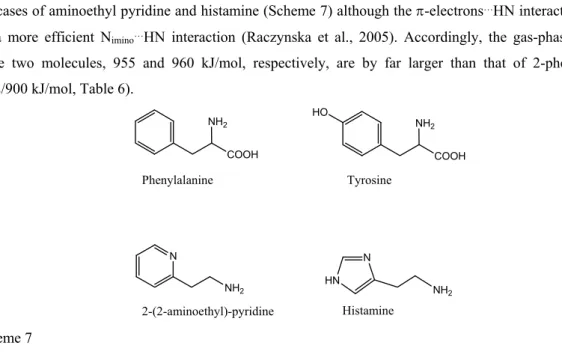
Similar increase in the basicity of a NH2 group induced by an aromatic moiety has been demonstrated for the aminoacids phenylalanine and tyrosine (Bouchoux et al., 2009) (Scheme 7). One may also note in passing the cases of aminoethyl pyridine and histamine (Scheme 7) although the -electrons…HN interaction is replaced by a more efficient Nimino…HN interaction (Raczynska et al., 2005). Accordingly, the gas-phase basicities of these two molecules, 955 and 960 kJ/mol, respectively, are by far larger than that of 2-phenylethylamine (902/900 kJ/mol, Table 6). N NH2 COOH NH2 COOH NH2 HO HN N NH2 Phenylalanine Tyrosine 2-(2-aminoethyl)-pyridine Histamine Scheme 7
c. Aromatic diamines, proton sponges
The remarkable high basicity of 1,8-bis(dimethylamino)-naphtalene 1 (Table 7) in aqueous solution has been reported more than forty years ago (Alder et al., 1968). The determination of its gas-phase basicity has been done ten years later by the equilibrium method using high pressure mass spectrometry (Lau et al., 1978). In the same study, the authors also reported the gas-phase basicity of the unsubstituted 1,8-bis-amino-naphtalene 2. Using their data, GB values of 907 and 983 are obtained for 2 and 1, respectively (Table 7). If compared to aniline (GB = 850.6 kJ/mol), a clear basicity explosion is associated to these diamino-naphtalene derivatives.
Table 7. Basicity data of several diamino-naphtalenes.
M GB(M)a PA(M)a NH2 NH2 2 equilibrium theory 907.3b/(912.1) 939.7*/(944.5) 953d 942h N(CH3)2 N(CH3)2 1 equilibrium theory 983.0b (930.9) 1015.4* (960.3) 1042d 1028e,f 1027g 1030c,h 1025i
N(CH3)2 N(CH3)2 OCH3 H3CO 3 theory 1095d 1097f N(CH3)2 N(CH3)2 CH3 H3C theory 1055f
a) kJ.mol-1; b) From (Lau et al., 1978), addition of the experimental free energy change associated to the proton transfer reaction NH 4+ + M NH3 + MH+ to the presently accepted value GB(NH3) = 819.0 kJ.mol-1. No protonation entropy has been assumed when estimating PA from GB. Into parentheses (Hunter & Lias, 1998); c) HF/6-31G calculation, (Platts et al., 1994), d) MP2/6-31G(d) //HF/6-31G(d) calculations, (Perakyla, 1996); e) B3LYP/6-31+G(d,p) calculation, (Howard, 2000); f) BP/DZVP calculation, (Guo & Salahub, 2001); g) MP2/6-311+G(d,p)//HF/6-31G(d) calculations, (Kovacevic & Maksic, 2002); h) B3LYP/6-31+G(d,p)//B3LYP/6-31G(d) calculation, (Ganguly et al., 2007); i) B3LYP/6-31+G(d,p)//B3LYP/6-31G(d) calculation, (Singh & Ganguly, 2007).
Explanations of this strong basicity enhancement provided by theoretical computations combine hydrogen bond energies, lone pair-lone pair repulsion energies, relief of strain energies and resonance stabilization energies (Platts et al., 1994; Perakyla, 1996; Howard, 2000; Guo & Salahub, 2001; Kovacevic & Maksic, 2002; Singh & Ganguly, 2007; Ganguly et al., 2007). Optimized geometry of neutral 1,8-bis(dimethylamino)-naphtalene possesses a C2 symmetry with non planar arrangement of the dimethylamino
moieties. Protonation results in an asymmetric NH…N bridged arrangement with the two methyl groups nearly perpendicular to the aromatic ring. A general consensus arises for a theoretical proton affinity around 1030 kJ/mol, the agreement with experimental determination is satisfactory in view of the modest level of theory generally used (Table 7). It is also noteworthy that theory reproduces nicely the 90 kJ/mol of difference in proton affinity between 1 and 2. A large increase of basicity (~60kJ/mol) is observed between 1 and 3 thus revealing a considerable impact of the 2,7-methoxy substitution (Guo & Salahub, 2001). It is concluded from theoretical results that this increase comes from the relief of steric repulsions of the methoxy groups with their neighbouring amino group as a result of protonation.
Proton sponges continue to attract considerable attention and many other molecule with exceptionally high basicity have been described recently (see for example (Raab et al., 2005)). Some of them, containing amidine or guanidine functionalities, i.e. unsaturated basic center, will be described latter on (in a dedicated part of this review).
C. Aminoalcohols
a. Hydroxylamine and derivatives
It has been observed from quantum chemistry calculations that protonation on the most electronegative center of a X-Y bond results in a X-Y bond elongation (Alcami et al., 1990). This is so because, after the X-H bond formation, the X atom is able to recover its electroneutrality by lowering the electron density along bonds with less electronegative atoms. Conversely, when protonation is occurring on the less electronegative atom a shortening of the X-Y bond is observed. In that case, there is no tendency for Y to recover its neutrality but the
positive charge on the YH+ moiety induces a polarization of the X-YH+ bond and thus reinforces it. Hydroxylamine, HONH2, offers a clear illustration of these general tendencies. Accordingly, the N-O bond is elongated when protonation occurs on O and shortened when protonation occurs on N (by ~ 0.04Å in both cases (Alcami et al., 1990; Boulet et al., 1999)).
Hydroxylamine is not stable enough to allow determination of its gas-phase basicity by the equilibrium method (Angelelli et al., 1995). Protonated hydroxylamine ions may be, in contrast, handled easily in a mass spectrometer thus allowing application of the bracketing technique. This has been done in a FT-ICR mass spectrometer cell after formation of the desired ions in an external chemical ionization source and in a B-E tandem mass spectrometer (Angelelli et al., 1995). A qualitative use of their data allow Cacace and co-workers (Angelelli et al., 1995) to propose PA(hydroxylamine) = 810±8 kJ/mol.
Figure 4
As recalled in the introduction, the bracketing technique may be seriously improved by using the thermokinetic method (Bouchoux, 2007). Fortunately, Angelelli et al (Angelelli et al., 1995) presented measurements of proton transfer rate constants from protonated hydroxylamine to four reference bases. Using their data we obtain the thermokinetic plot presented in Figure 4 from which the following thermochemical parameters may be deduced: PA = 818±4 and GB = 788±4 kJ/mol.
Proton affinities corresponding to N and O protonations have been theoretically computed (Angelelli et al., 1995; Boulet et al., 1999) demonstrating, as expected, a favoured protonation on the nitrogen atom. At the G1 level Angelelli et al (Angelelli et al., 1995) obtain PAN=811 and PAO=700 kJ/mol whereas Boulet et al (Boulet et al., 1999) obtained PAN=814 and PAO=711 kJ/mol at the CCSD(T)/6-311++G(d,p)//B3LYP/6-311++G(d,p) level. Clearly, these theoretical results are in excellent agreement with experiment as summarized in Scheme 8.
H2N OH
811/814 700/711
Theoretical PA (kJ/mol)
Experimental PA: 810± 8 / 818± 4 kJ/mol
HN OH
853 733
Theoretical PA (kJ/mol)
Experimental PA: 858kJ/mol
H2N O
841 752
Theoretical PA (kJ/mol)
Experimental PA: 848 kJ/mol
H3C CH3
The two methyl-hydroxylamines CH3NOH and NH2OCH3 were also examined both experimentally and theoretically from the point of view of their gas-phase basicities (Angelelli et al., 1995). Protonation is still favoured on the nitrogen atom and proton affinities appear to increase significantly when compared to hydroxylamine itself. Scheme 8 summarizes the Angelelli et al. results. A proton affinity of 844.8 kJ/mol, is given in Hunter and Lias compilation (Hunter & Lias, 1998) with reference to a personal communication by Taft, this figure is very close to the value of 848.1 kJ/mol reported by Angelelli et al. (Angelelli et al., 1995).
Formation of [CH3NHOH]+ by methylation of hydroxylamine under chemical ionization conditions is attested by collisional activation experiments. This result is fully in line with the fact that this ion is more stable than [NH2OHCH3]+ by 120 kJ/mol (G1 calculation (Angelelli et al., 1995)).
It is noteworthy that the increases in proton affinity observed between hydroxylamine and its methylated homologues are larger than expected if compared with alkyl monoamines. For example, an increase in PA of 30 kJ/mol is observed between methylamine and dimethylamine (Table 2) while the difference PA(CH3NHOH)-PA(NH2OH) amount for 48 kJ/mol. This observation is confirmed by the proton affinity of Et2NOH which may be deduced from ICR measurements (Bartmess et al., 1983). Using standard techniques for measuring equilibrium gas-phase basicities the authors find that Et2NOH is 1.7 kJ/mol less basic than propylamine or 50.2 kJ/mol less basic than its carbon analogue Et2NCH3. Neglecting any entropic effect, these data lead to an Et2NOH proton affinity of ~ 918 kJ/mol. It represents an increase of 118 kJ/mol with respect to hydroxylamine. By comparison, the difference PA((C2H5)2NCH3) – PA(CH3NH2) represents only 72 kJ/mol.
It may be finally recalled that results concerning amino substituted hydroxylamine analogues NH2NHOH and NH2ONH2 (Maziarz & Ball, 2002) have been presented above (see "diamines").
b. aliphatic aminoalcohols
Aminohydroxymethane, HOCH2NH2, has not been isolated, this molecule is however interesting from several points of view. It is for example expected to be formed by addition of ammonia to formaldehyde and thus the first intermediate in the synthesis of glycine or hexamethylenetetramine, the potential precursors of interstellar aminoacids (Feldmann et al., 2005). HOCH2NH2, has been theoretically predicted to be a stable isolated species since it is protected against dissociation by energy barriers higher than 230 kJ/mol (Feldmann et al., 2005). A G3B3 computation gives a proton affinity, PA(HOCH2NH2), of 880.4 kJ/mol for the N-protonation and of 869.7 kJ/mol for the O-protonation (Table 8).
Higher aliphatic aminoalcohols were investigated experimentally (Meot-Ner et al., 1980; Houriet et al., 1983; Sunner et al., 1986; Bouchoux et al., 2003a; Bouchoux & Buisson, 2006) and theoretically (Bouchoux et al., 2002a; da Silva, 2005). A summary of the protonation thermochemistry presented in these various studies is given in Table 8. Comparison between experiments can be done only for 1,3- and 1,4-aminoalcohols. As observed for diamines, the agreement is excellent when gas-phase basicities are compared. However, considerable differences are evident when considering PA and pS°.
Table 8 Protonation thermochemistry of -aminoalcohols M Method GB(M)a PA(M)a pS°(M)b 1,1-aminohydroxymethane theoretical 880.4j 1,2-aminohydroxyethane equilibrium theoretical 896.8 887.0g 930.3c 921.8 g 929.4i -3.3c -8g 1,3-aminohydroxypropane equilibrium extended kinetic thermokinetic average theoretical 917.3c 914.5d 913.9±0.4f 914.6e 916.6±1.3f 915.41.5 914.8g 962.5c 953.5e 958.06.4 950.6 g 952.3i -43c -22e -3315 -19g 1,4-aminohydroxybutane equilibrium extended kinetic average theoretical 932.1c 931.7e 931.90.3 925.1g 984.5c 971.9e 978.28.9 962.5g -67c -26 e -4729 -23g diethanolamine equilibrium 820.0h 874.8h 0h triethanolamine equilibrium 841.0h 903.7h 0h
a) kJ.mol-1; b) J.K-1.mol-1; c) (Meot-Ner et al., 1980); d) (Aue & Bowers, 1979); e) (Bouchoux et al., 2003a); f) (Bouchoux & Buisson, 2006); g) G2MP2 calculations,(Bouchoux et al., 2002a); h)(Sunner et al., 1986); i) B3LYP/6-311++G(d,p) calculations, (da Silva, 2005); j) G3B3 calculation, this work.
Examination of Table 8 reveals nevertheless an increase in PA of ~100 kJ/mol from 1,1- to 1,4-aminoalcohols. A parallel decrease in pS is also corroborated for 1,2- to 1,4-aminoalcohols. These evolutions are reproduced by theoretical calculation although with moderate agreement. The structural properties of neutral and protonated 1,2-aminoethanol, 1,3-aminopropanol and 1,4-aminobutanol has been detailed in the first part of this review (Bouchoux, 2007). The most stable conformers of neutral and protonated 1,2-aminoethanol, 1,3-aminopropanol and 1,4-aminobutanol are characterized by an internal hydrogen bond. The global stabilization of the protonated forms being larger, an increase in proton affinity results. This effect is amplified in the series when increasing the size of the cycle because of the more efficient NH...O alignment.
Stereochemical effects on the intrinsic basicity and on the reactivity of the protonated forms have been demonstrated for 1,2-aminoalcohols (Longevialle et al., 1973; Houriet et al., 1983; Bouchoux et al., 2002a). In the 1970's it has been first observed that the loss of water from protonated steroidal aminoalcohols was intense only if the distance between the oxygen and the nitrogen atoms is too large to allow the formation of an internal