Publisher’s version / Version de l'éditeur:
Construction Technology Update, 1998-12-01
READ THESE TERMS AND CONDITIONS CAREFULLY BEFORE USING THIS WEBSITE.
https://nrc-publications.canada.ca/eng/copyright
Vous avez des questions? Nous pouvons vous aider. Pour communiquer directement avec un auteur, consultez la première page de la revue dans laquelle son article a été publié afin de trouver ses coordonnées. Si vous n’arrivez pas à les repérer, communiquez avec nous à [email protected].
Questions? Contact the NRC Publications Archive team at
[email protected]. If you wish to email the authors directly, please see the first page of the publication for their contact information.
NRC Publications Archive
Archives des publications du CNRC
Access and use of this website and the material on it are subject to the Terms and Conditions set forth at
Water-shedding details improve masonry performance
Maurenbrecher, A. H. P.
https://publications-cnrc.canada.ca/fra/droits
L’accès à ce site Web et l’utilisation de son contenu sont assujettis aux conditions présentées dans le site LISEZ CES CONDITIONS ATTENTIVEMENT AVANT D’UTILISER CE SITE WEB.
NRC Publications Record / Notice d'Archives des publications de CNRC:
https://nrc-publications.canada.ca/eng/view/object/?id=972efc54-a60b-413a-877e-862f6fb55499 https://publications-cnrc.canada.ca/fra/voir/objet/?id=972efc54-a60b-413a-877e-862f6fb55499
b y A .H.P. Ma ure nb re che r
This Update show s how the lack of effective w ater-shedding details can
affect the appearance and performance of the exterior surface of masonry
w alls. Practical recommendations for avoiding problems are presented.
C o n s t r u c t i o n T e c h n o l o g y U p d a t e N o . 2 3
Masonry is known for its long-term durability an d low m ain ten an ce. Bu t in ord er for th ese stren gth s to be realized , bu ild in g facad es m u st be d esign ed to p reven t con cen trated sou rces of w ater from reach in g th e w all. Th e m ost im p ortan t exterior d esign d etails are p rojection s an d d rip s — roof overh an gs, cop in gs, w in d ow sills an d gu tters — w h ich p rotect vertical su rfaces.
Water can cau se p roblem s th at m ay be p rim arily aesth etic su ch as stain in g,
efflor-escen ce an d biological grow th , or th at m ay lead to m aterial d am age su ch as sp allin g of m ason ry u n its cau sed by freezin g an d corrosion of m etal com ponents in the wall. Th e p oten tial for p roblem s d ep en d s on the properties of the materials in th e w all an d on th e am ou n t of w ater reach in g th e w all. Th e latter d ep en d s on th e clim ate, th e location of th e w all on the building, design, workmanship an d m ain ten an ce. Precip itation w ets w alls eith er d irectly or indirectly. Direct wetting is most severe on h orizon tal su rfaces (most of the rain, and melting ice an d sn ow ) an d least on vertical su rfaces (w in d -d riven rain , w ith h igh er p arts of th e bu ild in g an d th e corn ers w etted m ost). In d irect w ettin g resu lts from ru n -off from h igh er location s on th e bu ild in g an d its exten t d ep en d s on
su rface textu re, w ater-absorp tion ch aracter-istics of th e su rface m aterial, an d d esign featu res th at collect an d d ivert w ater flow.
Effe c t of Building De t a ils on M a sonry Wa lls
Good design lessons can be learned by closely observin g th e exterior su rfaces of bu ild in gs, in p articu lar, lookin g at bu ild in g d etails to see h ow th ey affect th e flow of w ater on th e su rface an d h ow w ater can in flu en ce su rface ap p earan ce an d d eterioration . Th e d esign objective sh ou ld be to avoid con cen trated flow s of w ater an d red u ce th e tim e of w et-n ess. Coet-n ceet-n trated flow s caet-n cau se staiet-n iet-n g an d satu ration of th e m ason ry. Th e lon ger an area rem ain s w et th e greater th e ch an ce of biological grow th , corrosion of m etal com p on en ts an d in creased satu ration . Th e areas w etted m ost are h orizon tal an d slop in g su rfaces, an d vertical su rfaces th at receive ru n -off from low -absorp tion su rfaces su ch as m etal, glass an d vin yl (e.g., w in d ow s an d sid in g). Th ese areas sh ou ld be p rotected w ith w aterp roof cap s an d flash in gs, w h ich d ivert w ater from th e m ason ry.
Copings
Overh an gin g cop in gs (cap s) at th e top of w alls, p arap ets an d ch im n eys can effectively red u ce th e p oten tial for w ater d am -age. In region s w ith freezin g tem p eratu res, d am age can be seriou s: h igh m oistu re con -ten t togeth er w ith freeze-th aw cycles can lead to sp allin g. Th e staircase w all sh ow n in Figu re 1 h as a con crete cop in g bu t
Water-Shedding Details
Improve Masonry
Performance
Figure 1.Frost damage (coping allows water to drain onto the wall)
2
becau se it w as bu ilt flu sh w ith th e face of th e w all, w ater can still ru n on to th e m ason ry below. Th e p roblem is m ost severe w h en sn ow on th e cop in g m elts d u rin g th e d ay an d th e w ater freezes at n igh t; th is cycle m ay be
rep eated over several d ays. An oth er p roblem w ith th is w all is th at th e bricks go all th e w ay d ow n to grou n d level (n ot recom m en d ed p ractice). At grou n d level, rain and melting snow have also caused frost d am age (d e-icin g salts u sed on th e w alkw ay m ake m atters w orse). Th e sam e brick on th e m ore sh eltered w all of th e ap artm en t bu ild in g h as su ffered n o d am age.
Figu re 2 sh ow s a bu ild -in g w ith a step p ed back p arap et. Th e low er sec-tion h as a con crete cop in g w ith a m etal cap w h ich slop es tow ard s th e fron t of th e w all an d allow s w ater to d rain straigh t on to th e w all (in su fficien t overh an g). On e sm all section of p arap et w ith ou t a setback on th e left of th e p h otograp h d oes n ot h ave th is p roblem ; th e top of th e m etal cop in g slop es tow ard s th e roof an d at th e face of th e w all th e bottom en d p rojects ou tw ard to sh ed w ater. At th e balcon ies, a con crete
cop in g overh an gs th e brick bu t water can still run back underneath the coping (n o d rip groove) an d th rou gh ju n ction s in th e cop -in g. Exten sive efflorescen ce d u r-in g th e cold er m on th s of th e year is th e resu lt.
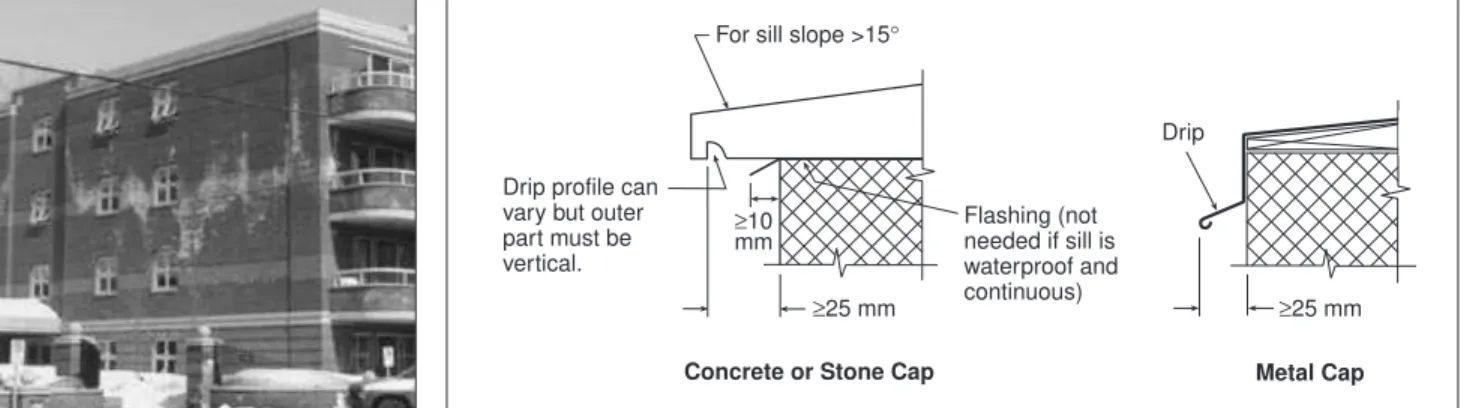
Dam age can be avoid ed by u sin g cop in gs th at exten d beyon d th e face of th e w all, by u sin g a p rojectin g m etal flash in g betw een th e cop in g an d th e w all, or by u sin g m ason ry w ith a kn ow n h igh frost resistan ce (bu t th en stain in g m ay still occu r). Field observation s in d icate th at d rip s that project at least 25 m m beyon d th e face of th e w all are effective. Con crete or ston e cop in gs m u st h ave a d rip groove to stop water from running back under th e overh an g, w h ile m etal cop in gs m u st be sh ap ed to form a d rip (see d iagram ). Junctions in copings should be carefu lly d esign ed to avoid w ater gettin g th rou gh , or altern atively th ere sh ou ld be a p rojectin g flash in g u n d erneath to intercept the water. Stain in g below ju n ction s is a com m on d efect observed in p ractice.
Window Sills
Brick w in d ow sills are gen erally n ot recom -m en d ed u n less care is taken to ch oose d u rable brick an d m ortar (esp ecially in areas w h ere freezin g occu rs). Th ey m ay be accep table in d rier p arts of th e cou n try an d in low -rise h ou sin g w ith a p rotective roof overh an g. If a brick sill is u sed , a con tin u ou s w aterp roof flash in g m aterial m u st be bed d ed im m ed iately u n d er it. Th e flash in g sh ou ld also p roject beyon d th e face of th e w all; th is w ill in tercep t w ater com in g th rou gh th e sill, u su ally th rou gh fin e cracks at th e brick/ m ortar in terface. Figu re 3 sh ow s a brick sill th at allow s w ater to d rain th rou gh , cau sin g efflorescen ce below. Figu re 4 sh ow s ven tilation ven ts in a p arkin g garage w ith a brick sill flu sh w ith th e face of th e w all, resu ltin g in stain in g an d ice form ation . A p rojectin g m etal flash in g on th e sill w ou ld h ave avoid ed th is p roblem .
Figure 2.Efflorescence (coping allows water to drain onto the wall)
Figure 4.Staining and icing below garage vents (sills flush with the wall)
Figure 3.Efflorescence (water migrates through brick sill)
Drip profile can vary but outer part must be vertical.
For sill slope >15°
Flashing (not needed if sill is waterproof and continuous)
Concrete or Stone Cap Metal Cap
Drip
≥10 mm
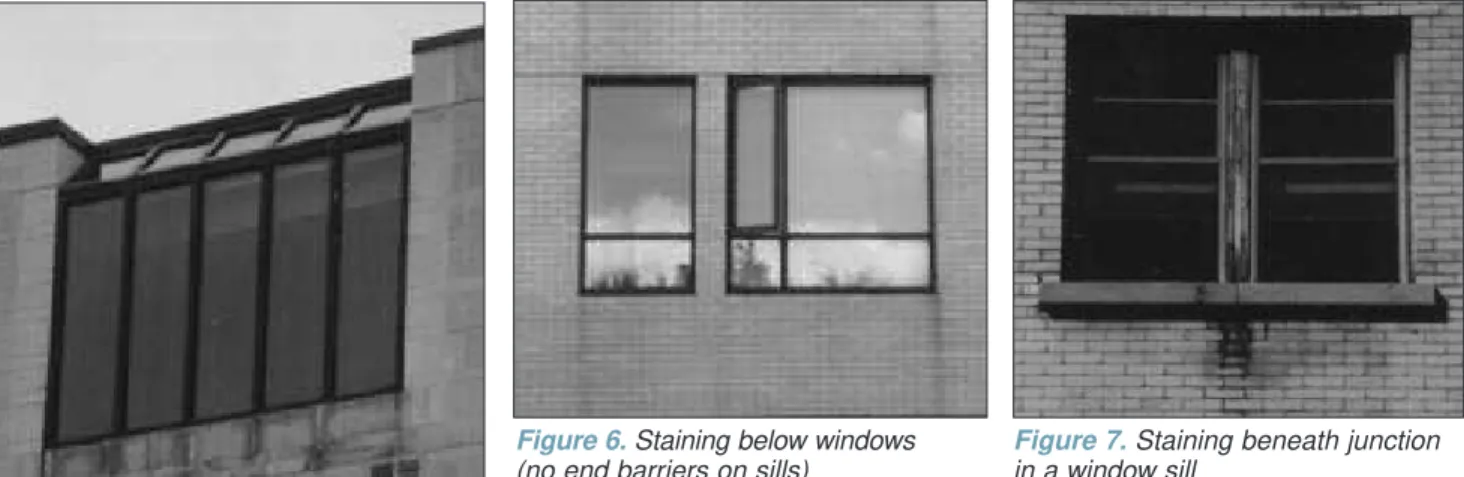
Large w in d ow areas an d slop in g section s in crease th e w ater ru n -off con sid erably (Figu re 5). Th e lack of a p rojectin g sill ben eath th e w in d ow h as resu lted in severe stain in g, all th e m ore obviou s w ith th e ligh t-colou red m ason ry. With large areas of slop ed glazin g, th e m in im u m p rojection for th e sill m ay n eed to be in creased to 50 m m ; altern atively a gu tter cou ld be in stalled to collect th e w ater. Each en d of a sill sh ou ld h ave a barrier to stop w ater from ru n n in g off th e en d s on to th e w all (often a raised section to d eflect th e w ater forw ard ). Figu re 6 sh ow s th e typ ical stain in g p attern w h en barriers are n ot p rovid ed . Wh ere p ossible, sills sh ou ld be m ad e in on e p iece
to avoid ju n ction s (Figu re 7). Wh en
ju n ction s are u n avoid able, th ey sh ou ld be d etailed to en su re w ater w ill n ot get th rou gh , or a p rojectin g flash in g sh ou ld be bed d ed u n d ern eath to d ivert an y w ater. Mortar an d sealan ts in ju n ction s m ay be ad equ ate in th e sh ort term bu t n ot th e lon g term .
Roof Details
Water ru n off from p itch ed roofs is su bstan -tial an d th erefore m u st be sh ed w ell aw ay from th e w all or be collected by gu tters. With com p licated roof form s th is m ay n ot alw ays be su ccessfu l. Th e h ou se sh ow n in Figu re 8 h as som e of its roof ru n -off bein g fu n n elled to on e location th at d oes n ot effectively sh ed w ater. Ad d ition al w ater com in g from th e flat roof (beyon d th e rid ge) exacerbates th e p roblem . Th e w ater is w et-tin g th e brick n ear th e top of th e w all an d at grou n d level, th e latter m ain ly by sp lash -in g. It is im p ortan t to correct su ch p rob-lem s p rom p tly. Th e best solu tion in th is case w ou ld be to in stall a gu tter an d d ow n -sp ou t.
Other Details
Concrete and aluminum or vinyl siding above m ason ry m u st h ave a flash in g at th e in ter-section to sh ed w ater aw ay from th e m ason ry. Figu re 9 sh ow s an ap artm en t bu ild in g w ith alu m in u m sid in g. Th e sid in g h as d rip s at every storey to break th e flow of w ater d ow n th e w all. Bu t above th e grou n d storey m ason ry th e flash in g d oes n ot p roject beyon d th e m ason ry. Here m u ch of th e w ater ru n s alon g th e flash in g u n til it h its a ju n ction an d th en d rain s d ow n , lead in g to stain in g.
Water ru n n in g off fittin gs an d d ecorative item s (e.g., ligh ts, sign s an d flagp ole su p -p orts) -p rojectin g beyon d th e su rface of th e w all m u st also be d iverted to avoid stain in g. Stain in g m ay be cau sed by d irt, lim e from con crete or lim eston e p rod u cts, or corrosion p rod u cts from iron or cop p er. Th e stain in g
3
Figure 6.Staining below windows (no end barriers on sills)
Figure 7.Staining beneath junction in a window sill
Figure 8.Wetting of wall from roof run-off
Figure 9.Staining below junction in flashing set back from the wall
Figure 5.Staining below window (no sill projecting beyond wall)
sh ow n in Figu re 10 can be avoid ed by p lacin g a flash in g betw een th e lam p fixtu re an d th e w all w ith a p rojection ben eath , or a gap betw een th e fixtu re an d th e w all.
Kitch en an d lau n d ry exh au st ven ts sh ou ld be d esign ed to d irect th e air aw ay from th e w all, in clu d in g ad jacen t w alls (Figu re 11).
M a int e na nc e
Th e p rom p t rep air of w ater-sh ed d in g ele-m en ts is iele-m p ortan t esp ecially in th e case of gu tters an d d ow n sp ou ts (gu tters sh ou ld be regu larly cleared of d ebris su ch as leaves from overh an gin g trees). Figu re 12 sh ow s w h at can h ap p en if rep airs are p ostp on ed . Th e brick in th is bu ild in g h as good frost resistan ce an d on ly su ffered m in or d am age. Th e d am age to th e con crete w in d ow sill is cau sed by corrod in g rein forcem en t (n ot d irectly related to th e d ow n sp ou t break).
Sum m a ry
On e of th e best w ays to im p rove th e lon g-term d u rability of m ason ry is to p ay p artic-u lar atten tion to bartic-u ild in g d etails th at red u ce th e am ou n t of w ater reach in g exte-rior w alls, esp ecially con cen trated w ater flow s. Follow th e p ath of th e w ater all th e w ay from th e top of th e bu ild in g to grou n d level. Wh ere p ossible, w ater com in g off w atersh ed d in g elem en ts m u st n ot u n in ten -tion ally w et low er p arts of th e bu ild in g.
Furt he r Re a ding
1. Win d -d riven Rain an d Bu ild in gs. G. Robin son an d M.C. Baker. Nation al Research Cou n cil, Division of Bu ild in g Research , Tech n ical Pap er 445, 1975. 2. Th e In teraction of Design an d
Weath erin g on Mason ry Con stru ction s. T.L. Kn igh t an d M. Ham m ett. Mason ry In tern ation al, Vol. 7, No. 1. 1993, p p . 9-13. 3. Perform an ce of Materials in Bu ild in gs.
L. Ad d leson an d C. Rice. Bu tterw orth -Hein em an n , 1991, 588 p .
4. Brick Mason ry Details. Brick In d u stry Association (U.S.), Tech n ical Notes 36 an d 36A, 1988.
Dr. A .H.P. Ma ure nb re che ris a research officer in th e Bu ild in g En velop e an d S tru ctu re Program of th e N ation al Research Cou n cil’s In stitu te for Research in Con stru ction .
“Construction Te chnology Up d a te s” is a se rie s of te chnica l a rticle s conta ining p ra ctica l inform a tion d istille d from re ce nt construction re se a rch.
For more information, contact Institute for Research in Construction, National Research Council of Canada, Ottaw a K1A 0R6
Telephone: (613) 993-2607; Facsimile: (613) 952-7673; Internet: http://irc.nrc-cnrc.gc.ca
© 1998
Nation al Research Cou n cil of Can ad a Decem ber 1998
ISSN 1206-1220
Figure 11.Frost on wall at a laundry exhaust vent
Figure 12.
Severe icing below break in downspout
Figure 10.Staining below light fixture (water run-off)