Publisher’s version / Version de l'éditeur:
Concrete Engineering International, 8, Winter 4, pp. 50-53, 2004-12-01
READ THESE TERMS AND CONDITIONS CAREFULLY BEFORE USING THIS WEBSITE. https://nrc-publications.canada.ca/eng/copyright
Vous avez des questions? Nous pouvons vous aider. Pour communiquer directement avec un auteur, consultez la
première page de la revue dans laquelle son article a été publié afin de trouver ses coordonnées. Si vous n’arrivez pas à les repérer, communiquez avec nous à [email protected].
Questions? Contact the NRC Publications Archive team at
[email protected]. If you wish to email the authors directly, please see the first page of the publication for their contact information.
NRC Publications Archive
Archives des publications du CNRC
This publication could be one of several versions: author’s original, accepted manuscript or the publisher’s version. / La version de cette publication peut être l’une des suivantes : la version prépublication de l’auteur, la version acceptée du manuscrit ou la version de l’éditeur.
Access and use of this website and the material on it are subject to the Terms and Conditions set forth at
Achieving fire resistance in steel columns through concrete filling
Kodur, V. K. R.
https://publications-cnrc.canada.ca/fra/droits
L’accès à ce site Web et l’utilisation de son contenu sont assujettis aux conditions présentées dans le site LISEZ CES CONDITIONS ATTENTIVEMENT AVANT D’UTILISER CE SITE WEB.
NRC Publications Record / Notice d'Archives des publications de CNRC:
https://nrc-publications.canada.ca/eng/view/object/?id=320931a9-a421-480d-a66b-83fb9596407c https://publications-cnrc.canada.ca/fra/voir/objet/?id=320931a9-a421-480d-a66b-83fb9596407c
Achieving fire resistance in steel columns through
concrete filling
Kodur, V.
NRCC-47620
A version of this document is published in / Une version de ce document se trouve dans: Concrete Engineering International, v. 8, no. 4, Winter 2004, pp. 50-53
Achieving Fire Resistance in Steel Columns Through Concrete Filling
by V.K.R. Kodur
Senior Research Officer, Institute for Research in Construction, National Research Council of Canada, Ottawa, Canada
ABSTRACT
Results from experimental and theoretical studies indicate that required fire resistance, in the practical region, can be obtained for hollow structural steel columns filled with three types of concrete-filling: plain concrete, bar reinforced concrete and steel fibre reinforced concrete. Case studies illustrating the use of concrete-filling, as a means of providing fire protection, to hollow steel columns are presented for the Museum of Flight in Seattle, Washington and a school building in Hamilton, Ontario.
INTRODUCTION
Steel hollow structural section (HSS) columns are very efficient structurally in resisting compression loads and are widely used in the construction of framed structures in industrial buildings. By filling these sections with concrete, the load-bearing capacity of such columns can be increased substantially. The two components of the composite column complement each other ideally, in that the steel casing confines the concrete laterally allowing it to develop its optimum compressive strength, while the concrete, in turn, enhances resistance to elastic local buckling of the steel wall.
In addition, a higher fire resistance can be obtained without using external fire protection for the steel, thus increasing the usable space in the building. Further, the steel sections dispense with the need for formwork and can be prefabricated, thus enabling their erection in all types of weather. Properly designed concrete-filled hollow steel columns can also lead, in an economic way, to the realization of architectural and structural design with visible steel without any restrictions on fire safety.
The National Research Council of Canada, supported by the North American steel industry, has developed innovative practical solutions for obtaining the required fire resistance for HSS columns, without any external protection, through concrete-filling. Both experimental and theoretical studies, using numerical techniques, were carried out at the NRC to investigate the influence of three types of concrete-filling; namely, plain concrete (PC), bar-reinforced concrete (RC), and fibre-reinforced concrete (FC), on the fire resistance of HSS columns. The results of these studies were used to develop simple design equations for calculating the fire resistance of concrete-filled HSS columns. The calculation procedures were used to provide data on the necessary fire protection measures for the concrete-filled HSS columns used in the Museum of Flight building in Seattle, WA, and a school building in Hamilton, Ontario.
EXPERIEMNTAL STUDIES
The experimental program consisted of fire tests on full-scale concrete-filled HSS columns. Both square and circular HSS columns were tested and the influence of factors, including type of filling (PC, RC, FC), concrete strength, type and intensity of loading, and column dimensions was investigated. During a test, the column was exposed, under a load, to heating controlled in such a way that the average temperature in the furnace followed, as closely as possible, the North American standard temperature-time curve. The furnace,
concrete and steel temperatures, as well as the axial deformations and rotations, were recorded until failure of the column occurred. Figure 1 shows a typical concrete-filled HSS column
immediately after a fire resistance test.
Results from the tests showed that, at room temperature, the load on a concrete-filled
HSS column is carried by both the concrete and the steel1. When the column is exposed to fire,
however, the steel carries most of the load during the early stages since the steel section expands more rapidly than the concrete core. At increased temperatures, the steel section gradually yields as its strength decreases, and the column rapidly contracts sometime between 20 and 30 minutes after initial fire exposure. At this stage, the concrete filling starts to take over and carries a progressively increasing portion of the load as the temperature rises. The
strength of the concrete decreases with time and ultimately, when the column can no longer support the load, failure occurs. The elapsed time that it takes for the column to fail is the measure of its fire resistance.
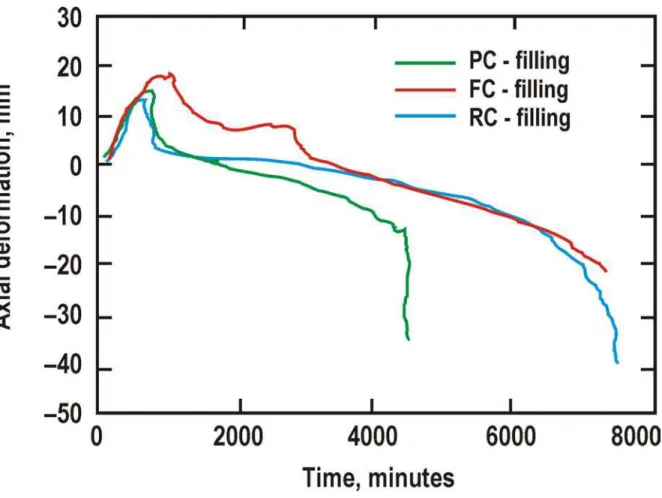
The behaviour of concrete-filled HSS columns under fire conditions is illustrated in Figure 2 which shows the variation of the axial deformation with time for the three types of concrete-filling. The columns had similar dimensions and loading conditions and the results can be used to illustrate the comparative fire behaviour of the three types of concrete filling.
As expected, the three columns expand in the initial stages and then contract leading to failure. The deformation in these column results from several factors such as load, thermal expansion and creep. While the effect of load and thermal expansion is significant in the early stages, the effect of creep becomes pronounced in the later stages. It can be seen from the figure that the deformation behaviour of the FC-filled steel column is similar, during the later stages of the test, to that of the RC-filled steel column. The initial higher deformations in the fibre reinforced concrete-filled column might be due to higher thermal expansion of fibre-reinforced concrete. The fire resistance of RC-filled column is higher than that of FC-filled column, which in turn is higher than PC-filled HSS column.
EFFECT OF CONCRETE-FILLING ON FIRE RESISTANCE
Results from the tests show that filling the column with plain concrete, without any steel reinforcement, offers the most economical arrangement from the point of view of fire resistance. However, in some cases, especially when the dimensions of the columns are large (323 mm or more), PC-filled steel columns fail at relatively low loads when exposed to fire. These failures can be attributed to early cracking initiated by strength loss in the steel casing at elevated
temperatures1,2 and excessive local stresses in the concrete due to the reduction in
compressive strength of the concrete at elevated temperatures.
In the bar-reinforced concrete-filled HSS column, the presence of rebars not only decreases the propagation of cracks and sudden loss of strength, but also contributes to the
load-carrying capacity of the concrete core1. The fire resistances of these columns were
improved significantly. However, there is the additional cost of steel, and installation of the rebars in the column.
The use of fibre-reinforced concrete-filling in HSS columns provided better fire behaviour and resulted in fire resistance values which are comparable to those of RC-filled HSS columns. The load-carrying capacity of the column is also increased to a certain degree. This can be attributed to the fact that the compressive strength of fibre-reinforced concrete increases with
temperature up to about 400°C. The additional cost in the case of FC-filled columns, over the cost of concrete, is the cost of the steel fibres.
NUMERICAL STUDIES
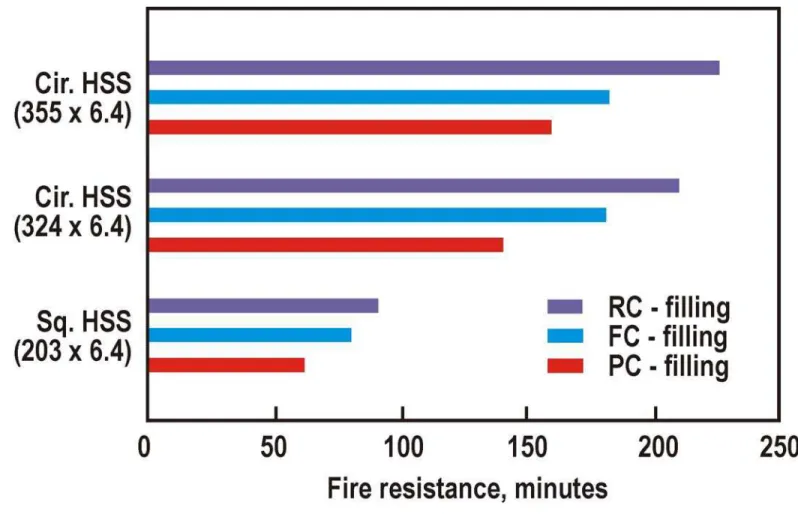
The experimental data were used to validate the computer programs that were developed for predicting the fire behaviour of concrete-filled steel columns. These programs can take into account the influence of the various parameters that determine the fire resistance performance of concrete-filled HSS columns. Using the computer programs, data can generated for
obtaining alternate, but cost-effective designs (Figure 3)1,3. The computer programs were used
to conduct detailed parametric studies to establish the influence of various parameters on the fire resistance of HSS columns filled with concrete; it was found that the most important parameters are:
• type of concrete filling (plain, bar-reinforced, fibre-reinforced)
• outside diameter, or the outside width, of the column
• load on the column
• effective length of the column
• strength of the concrete
• type of aggregate
• eccentricity of load
DESIGN EQUATION
Data from the tests and the computer-simulated parametric studies were used to
develop a simple equation for calculating the fire resistance of circular and square HSS columns filled with any of the three types of concrete. It was possible to express the fire resistance of these columns, as a function of the parameters that determine it, by an unified equation:
R
f
(f
20)
(KL 1000)
D
D
C
c ' 2=
+
−
(1) where:• R = fire resistance in minutes
•
f
c' = specified 28-day concrete strength in MPa• D = outside diameter or width of the column in mm
• C = applied load in kN
• K = effective length factor as per CAN/CSA-S16.1-M89 Standard
• L = unsupported length of the column in mm
• f = a parameter to account for the type of concrete filling (PC, RC, and FC), the type of
aggregate used (carbonate or siliceous), the percentage of reinforcement, the thickness of concrete cover, and the cross-sectional shape of the HSS column (circular or square). The values of parameter f can be found in References 1 and 2, as can the limits of applicability for the various parameters for the above equation.
The above design formula, which is based on the results of a large number of computer runs and was verified using the results of full-scale tests, can now be used for calculating the fire resistance of concrete-filled hollow steel columns. Further, the formula calculates fire resistance as a function of such parameters as the sectional dimensions, load and material properties. Using such formulas, engineers can design the most economical structural members, with the
required fire resistance, simply by varying the parameters. The fire resistance design can also be conveniently integrated with structural design since the fire resistance is expressed in terms of structural design parameters.
This type of design formula can be used as a tool to verify fire resistance for various structural members under the upcoming objective-based codes in Canada. Using this approach, the fire resistance design can be carried out entirely on a rational basis and
cost-effective measures can be derived in a consistent manner3.
The fire resistance equations evolving from these studies have been incorporated into the National Building Code of Canada and other standards such as ASCE-29 ACI 216 and AISC fire standards.
PRACTICAL APPLICATIONS
The research described above was used to calculate the fire resistance of HSS columns used in actual buildings. The practical applications included:
Museum of Flight, Seattle, Washington
The Museum of Flight at King County Airport is the largest air and space museum on the west coast of the United States and is home to one of the most extensive aircraft collections in the world. The 13,300 m2 (143,200 ft.2) museum is dominated by a six-storey-high Great Gallery, constructed as part of a three-part extension, and is composed of a main steel-and-glass exhibit hall, a library, a 268-seat auditorium, and office and conference space. The irregularly shaped building is 148 m (185 ft.) long, 76 m (250 ft.) wide, and 23 m (75 ft.) high.
The architectural concept adopted for the building was shaped by the need to naturally light the exhibits and visibility needs; the ability to see exhibits from outside (from the street and from the air), as well as to see the sky from inside to provide a natural background for aircraft suspended from the ceiling (Figure 4). Further, the framing members (specially columns) had to be thin so as not to distract from the exhibits, and not to generate any visible noise. Steel tubes were recommended by the structural engineers for the columns. The Authority Having Jusisdiction had adopted the Uniform Building Code which required a 60 minute fire resistance rating for the columns supporting the roof. To avoid the bulk and appearance of sprayed on fire protection, it was decided to try concrete-filling. In addition, four reinforcing bars were added to the concrete to help maintain as small a profile as possible while providing the necessary loading carrying capacity at the specified fire endure period.
Although the UBC did not specifically recognize the concept of concrete-filled HSS, the local Building Official accepted the test data and analytical work done by the National Fire
Laboratory. Using the same mathemetical model developed to conduct the simplified design equations above, the NRC staff showed that the bar-reinforced concrete-filled HSS columns could provide a fire resistance rating of 60 minutes or higher under full design loads. Thus the above research was instrumental in increasing the architectural beauty of Museum of Flight without compromising on fire resistance.
St. Thomas Elementary School, Hamilton, Ontario
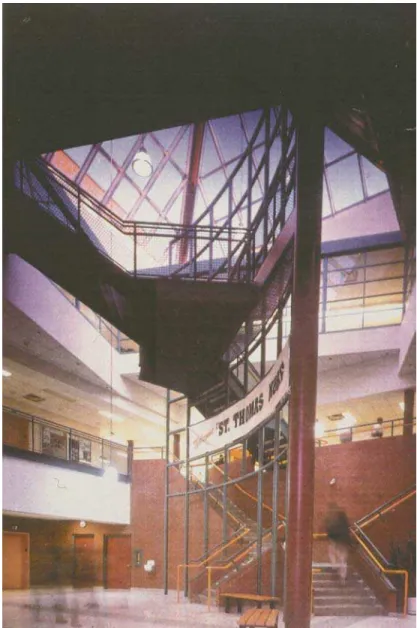
Owned by the Hamilton-Wentworth Roman Catholic Separate School Board, St. Thomas Elementry School is a typical two storey building with an interconnected floor. The open area
contains two stair cases and is covered with a glass dome. The natural light and slender
members give the space an airy look. To conform with the Ontario Building Code, the designers required the columns to have a one hour fire resistance rating. The National Fire Laboratory was called upon to use their analytical techniques, and provided solutions using both square and round HSS with different concrete strengths. The designers selected the more elegant round HSS columns and adopted bar-reinforcing for the ground level columns, in order to carry higher loads, and plain concrete-filling for second storey supporting the roof. Figure 8 shows a typical two-storey school building, with concrete-filled steel columns, in Hamilton, Ontario.
SUMMARY
Concrete-filling offers an attractive practical solution for providing fire protection to hollow structural steel columns without any external protection. Results from the experimental and numerical studies indicate that fire resistance, in the practical region, can be obtained for HSS columns through three types of concrete-filling. Fire protection of hollow steel columns, through concrete-filling, has increased the architectural beauty of the Museum of Flight and has provided an efficient design option for a school building.
REFERENCES
1. Kodur, V.K.R., and Lie, T.T. 1995,. Fire Performance of Concrete-filled Hollow Steel Columns. Journal of Fire Protection Engineering, 7(3): 89-98.
2. Kodur, V.R.; MacKinnon, D.H. "Fire endurance of concrete-filled hollow structural steel columns" AISC Steel Construction Journal, 37(1), 13-24, 2000.
3. Kodur, V.R. "Performance based fire resistance design of concrete-filled steel columns" Journal
List of Figures
Figure 1 Concrete-filled HSS column immediately after a fire resistance test.
Figure 2. Axial Deformation in Concrete-filled HSS Columns as a Function of Fire Exposure Time
Figure 3. Effect of Concrete-filling on Calculated Fire Resistance of HSS Columns
Figure 4. Display of Aircraft in the Museum of Flight Building
Figure 2. Axial Deformation in Concrete-filled HSS Columns as a Function of Fire Exposure Time