People’s Democratic Republic of Algeria
Ministry of Higher Education and Scientific Research
University of Mostaganem
Faculty of Foreign Languages
Department of English
MASTER DEGREE IN
Applied Linguistics and ICT’s
Presented by: HABOUCHI Halima
The Board of Examiners:
Chairwoman:
Dr. SARNOU HanenExaminer:
Dr. SARNOU DallelSupervisor:
Mrs. KHAROUBI MouniraAcademic Year 2016/2017
Pupils’ Difficulties in Learning Vocabulary
: A Case Study of First Year Pupils at
Dedication
This thesis is dedicated to my wonderful parents, who have raised me to be the person i am today. Thank you for all the unconditional love, guidance and support that you have always
given me.
The light of my life and the dearest person to my husband: thank you for all your encouragement, and above all your love.
The flowers of my family: my brothers and my sisters.
My relatives and my friends whom I am sharing my life with its lights and shadows. My classmates and all people who helped me in many ways.
Acknowledgements
In the name of Allah, the most compassionate, the most merciful.
I owe my deepest gratitude to my supervisor, Mrs. KHAROUBI Mounira for her available experience and guidance as well as her permanent availability and encouragements. My gratefulness also goes to the honorable members of the jury who have kindly accepted to
read and evaluate my work.
Abstract
Vocabulary is the most important and the most difficult skill in any language. This research work deals with the students’ difficulties in learning English as a Foreign Language especially beginners (first year middle school pupils). Because vocabulary is an important part in any language, learners face many obstacles in learning vocabulary. It aims to improve EFL middle school students’ vocabulary knowledge, and to ameliorate their English language levels. Learners suggest some difficulties as a hypothesis of the research that they find in learning English language as, pronunciation, spelling, length of the word, the teacher’s method. It is based on the analysis of data gathered from the questionnaire devoted to learners in order to validate the hypothesis and achieve the objectives. The results show many solutions behind this problem for learners. It shows that using some techniques can help learners to facilitate learning vocabulary. Accordingly, it is recommended that these techniques should be used in learning vocabulary for learners.
List of abbreviations
EFL: English as a Foreign Language CBA: Competency Based Approach CLT: Communicative Language Teaching TV: Television
Table of Contents
Dedication………..I Acknowledgements………II Abstract………III List of Abbreviations………IV Table of Contents………..V List of Tables……….VIII List of Figures………..IX General Introduction………...11. Chapter One: Theoretical Background 1.1. Introduction.………4
1.2. The History of Vocabulary………..4
1.4.1. The Importance of Vocabulary……….5
1.4.2.The Importance of Vocabulary Learning Goals………...7
1.5. The Description of Vocabulary………...8
1.5.1. The Definition of Vocabulary………..8
1.5.2. Types of Vocabulary………..10
a. Receptive Vocabulary………...10
b. Productive Vocabulary ………10
1.6. Meanings and Functions of Vocabulary………10
1.7. Vocabulary in EFL Classes………...12
1.8. Steps of Learning Vocabulary………...15
1.9. Vocabulary Learning Approaches……….15
2. Chapter Two: Data Analysis and Interpretation
2.1. Introduction………...19
2.2. Research Methodology………..19
2.3. Participants and Setting……….19
2.4. Learners Profile……….19
2.5. Data Gathering Tools………....19
2.6. The Construction of the Instrument………..20
2.7. Description of Learner’s Questionnaire………21
2.8. Data Collection Analysis………...21
2.9. Analysis of the Questionnaire………...21
2-10- Conclusion………..33
3. Chapter Three: Discussion of the Findings and Recommendations 3.1. Introduction………...35
3.2. Findings……….35
3.3. Discussion of the Findings………35
3.4. Recommendation and Suggestions………37
3.4.1. Learner’s Suggestions………37
3.4.2. Parents and Family’s Suggestions………..38
3.5. Limitation of the Study………..39
3.6. Conclusion……….40
General Conclusion………..41
List of Tables
Table 1
: What is needed in Knowing a Word?Table 2:
Distribution of Learner’s GenderTable 3:
Distribution of Learners’ AgeTable 4:
Learners’ LevelsTable 5:
The preference of Learning English LanguageTable 6:
Learners’ Point Of View about English LanguageTable 7:
Learners’ Opinion about Acquiring New WordsTable 8:
The importance of Vocabulary in Learning English LanguageTable 9:
The rates of the Importance Learners give to VocabularyTable 10:
Learners Difficulties in Acquiring New English TermsTable 11:
Training Learners to get the Word MeaningList of Figures
Figure 1:
Vocabulary FormsFigure 2:
The preference of Learning English LanguageFigure 3:
Learners’ Point Of View about English LanguageFigure 4:
Learners’ Opinion about Acquiring New WordsFigure 5:
The importance of Vocabulary in Learning English LanguageFigure 6:
The rate of the Importance Learners give to VocabularyFigure 7:
Learners Difficulties in Acquiring New English TermsFigure 8:
Training Learners to get the Word MeaningGeneral Introduction
EFL students in Algeria receive seven years of formal English language instruction; four years in middle schools and three years in the secondary schools. However, they usually feel bored and tired from passing hours and hours trying to learn new vocabulary without changing their passive learning habits such as using dictionaries, or learning by heart lists of words and their meanings in Arabic without even knowing what they really mean. As a result, they face serious problems in terms of remembering and using the words.
Learning vocabulary is viewed as being very important to language learning; however, many people have unpleasant memories of learning vocabulary. For example, EFL learners face difficulties to learn and to remember new words.
In fact, the importance of vocabulary in English language imposes greater urgency to the need of more effective means by which language proficiency can be enhanced.
To learn new language is not learn its vocabulary, grammar, phonetic and even its culture. The researcher will deal with the student’s difficulties in learning vocabulary (first year pupils). Since vocabulary has a great importance in the language class without it no language can exist and the wide range of words in any language refer to the ability of communicating with that language. Furthermore, the EFL is the dominant language in the world it controls the means of technology, economic and even politics. So as much learners acquire new terms in English they will be efficient in communicating with. But having a different vocabulary background in EFL is not easy where pupils should go beyond the difficulties that limit their learning of vocabulary. It is necessary to identify the problems and look for effective solution. As a result, the 1st year middle school classes are the sample of the researcher. The research study will analyze the pupils’ difficulties in acquiring new vocabulary. It attempts also to explore their points of view about English and their abilities to acquire new terms. The study was founded on one main question:
What are the beginner’s difficulties in acquiring the EFL vocabulary? Beside this question many hypotheses were grounded:
The difficulties that learners face in learning English language as follows: pronunciation, spelling, the length of the word, the length of syllabus, lack of practice and visual aids, absence reinforcement.
This study is divided into three main chapters; the first chapter is devoted to theoretical background. The second chapter is concerned with data analysis and interpretation
of learners’ questionnaire, where the third one is based on discussion of the findings and recommendations.
The first chapter deals with the history of vocabulary, the importance of vocabulary, the definition of vocabulary in addition to its types, meaning, and function of vocabulary in EFL classes.
The second chapter is about the research methodology, it explains the main parts of it (the tool used in the study the participants and its aim).
This chapter mainly discusses the data analysis and interpretation of the learner’s questionnaire that will help the researcher in focusing on the learners needs to acquire vocabulary easily.
The last chapter includes the findings of the questionnaire, discussion of these findings and limitation of the study. Then, the researcher will suggest some solutions and recommendations to solve their problems where these recommendations will be to the learners and the family members.
1.1. Introduction:
Vocabulary is considered as an important element in language learning. In fact many students feel that vocabulary learning is boring since they have to memorize unfamiliar words and spelling without changing their learning habits, such as writing words on paper, learning by heart or learning passively through the teacher’s explanations. This chapter looks at learning vocabulary within the Algerian middle school. In this chapter the researchers attempt to give an over view about the status of vocabulary in English (Mazouna case study).
We will enumerate some data about our topic (vocabulary) we may refer to: the history of vocabulary, the importance of vocabulary, the definition of vocabulary, types of vocabulary, meanings and functions of vocabulary, vocabulary in EFL classes, steps for learning vocabulary and vocabulary learning approaches.
1.2. The History of Vocabulary:
Through ages people have attempted to learn second language and there have been many approaches to learn from language, but through time vocabulary had balanced between an important or negligible place. In the second century B C, Romans were very interesting in the Greek art, “Rhetoric art“ which was based on a developed vocabulary, the Roman children were taught the Greek alphabet. Then, they moved to syllables, words and connected discourse. (some of the text gave students lexical help by providing vocabulary that was either alphabetized or grouped under various topic areas). Brown, Madsen and Hilferty (1985) said that vocabulary was very important in that time. But in the medieval period, the study of grammar became more important because this era witnessed the teaching of the Latin language and the same thing happened during the Renaissances period where grammar was highly focused but there were some reforming educators whom protested against this way of teaching “the emphasis on syntax“. In 1611, William of Bath wrote a text book about vocabulary acquisition, he present on it 1.2000 proverb from the common Latin vocabulary. He showed also homonyms in the context of sentence, latter Johns Amos Comenius created a text book with same area of context utilizing vocabulary. He defined a new approach (inductive approach) by restricting vocabulary on eight thousand common Latin words. Then, grouped it according to the topics and illustrated with label pictures. His limited vocabulary will become an important part of “vocabulary movement“in the early twentieth century. Even through those scholars tried to emphasize more on vocabulary “inductive approach“ the way of teaching still emphasis on “detective approach“ grammar.
In the eight twentieth and ninetieth centuries “the age of raison“, grammar was written in English based on Latin models. It was writing by the important man in the world which means that they give the write form them to decide what the proper from is and the improper grammar even through that they have no qualification to do so. The most effective prescriptive grammars was the Robert lowth’s short introduction to English grammar (1762), he broke the common used rules. As using the double negative (I do not want to study no more grammar rules) ; these grammar were highly received and show the over control of grammar over vocabulary.
But the attempts to raise the place of vocabulary lead to the appearance of the first dictionary by Robert Cawdry.
“A table Alphabetical”. Kelly (1669, 24) notes that the first bilingual lexicology dates from around 2500 b.c. Then, the English language dictionary by Samuel Johnson in 1975 which became the reference of the English language, he focused in his dictionary on spelling and lexical usage; it was an unchallenged dictionary until publication of the American version by Noah Webster.
1.3. The Importance of Vocabulary:
Of all the language skills, it is widely acknowledged that vocabulary is a very important part in English language learning, no one can communicate in any meaningful way without vocabulary.
Bowen et al. (1985, p. 322) and McCarthy (1990, p. iix) indicate that the single, biggest 20 component of any language course is vocabulary. This is consistent with Nation (1990, p. 2) who affirms that learners also see vocabulary as being a very, if not the most, important element in language learning. Learners feel that many of their difficulties, in both receptive and productive language use, result from the lack of vocabulary knowledge. However, many scholars in the fields of vocabulary learning and teaching (e.g. Allen, 1983; Carter and McCarthy, 1988; Hedge, 2000; Long and Richards, 1997; Malay, 1986; Richards, 1985; Zimmerman, 1997) indicate that vocabulary has long been neglected in the language classroom.
Words are the tools learners use to think, to express ideas and feelings, as well as to explore and analyze the world around them. A limited vocabulary keeps them from expressing their thoughts and feelings. On the other hand, a large, rich vocabulary gives them the right words to use at the right time. Kitajima (2001, p. 470) affirms that without words that label objects, actions, and concepts, one cannot express intended meanings. “The more
words one is able to use correctly, the better one will be able to express oneself easily and with self-confidence and to understand the world one lives in” (Nandy 1994, p. 1).
There is no question that in a good language learning classroom, both vocabulary and grammar are essential, but when compared vocabulary with grammar, vocabulary is much more important and should receive more attention than grammar. Allen (1983, p. 5) indicates that in the best classes, neither grammar nor vocabulary is neglected, but vocabulary is more essential and should be taught before grammar. Likewise, Flower (2000, p. 5) states, “Words are the most important things students must learn. Grammar is important, but vocabulary is much more important“. This is consistent with Lewis (1993, p. 115) who also views the importance of vocabulary as the centre of language teaching and learning since language consists of grammatalised lexis, not lexicalized grammar’ and ‘grammar, as structure, is subordinate to lexis’. That is to say, these scholars see that the words are preceded by the grammar. This confirms what we know from our own experience that one can understand others even if they pronounce words badly, and make grammatical mistakes, but without the mediation of words, any meaningful way of communication is rather impossible. To be precise, vocabulary seems to be the key to language learning, and thus, is accepted to be more important than grammar.
Wilkins (1972, p. 111) said that “Without grammar, very little can be conveyed; without vocabulary, nothing can be conveyed”. This is consistent with Ellis (1994) who affirms that lexical errors tend to obstruct comprehension more than grammatical errors. Besides, Harmer (1991, p. 153) asserts that choosing words carefully in certain situations is more important than choosing grammatical structures because language learners cannot use structures correctly if they do not have enough vocabulary knowledge. This means that vocabulary is more important than grammar, and it is vital for comprehension in language skill in any situation.
Regarding vocabulary in communication, it is apparent that vocabulary is basic in learning to communicate effectively while listening, speaking, reading, and writing. This is asserted by many scholars. For example, Lewis (1993, p. iii) views the importance of vocabulary as being a basic for daily communication. He indicates that if language learners do not recognize the meanings of the key words used by those who address them, they will be unable to participate in the conversation, even if they know the morphology and syntax. Krashen and Terrell (2000, p. 155) indicate that if language learners wish to express some
idea or ask for information, they must be able to produce lexical items to convey their meaning. Besides, Richards’ preface in Schmitt’s (2000, p. xi) “Vocabulary in Language Teaching” indicates that vocabulary is central to communicative competence and to the acquisition of a second language. Vocabulary and lexical items are at the core of learning and communication. No amount of grammatical or other type of linguistic knowledge can be employed in communication or discourse without the mediation of vocabulary because vocabulary is shown to focus much more than knowledge of single words.
To summarize, we can see the importance of vocabulary in that language learners with vocabulary knowledge can achieve a great deal of success in their classroom, their social life, and in their continuing acquisition of the target language. A large, rich vocabulary gives language learners the right words to use at the right time, and also enables them to express their real thoughts, ideas, and feelings. From the scholars’ statements mentioned, we can see that vocabulary plays a dominant role in learning and understanding a language as well as in communication situations. Vocabulary is shown to focus much more than knowledge of single words.
1.4. The Importance of Vocabulary Learning Goals:
Vocabulary plays an important part in learning, understanding, and communicating in a language. It is useful if language learners understand the importance of vocabulary in successful communication and comprehension. This section specifically deals with the importance of vocabulary learning goals.
In a language classroom, language learning goals are very important since they are objectives or intended learning for particular learners working on particular tasks, made specific from the general learning aims of book or syllabus. Learning goals help language teachers in planning lessons and adapting tasks for their students. Goals will result in learning achievement in the target language (Cameron 2001, pp. 28-29). Therefore, in a language classroom, language learning goals and sub-goals must be set that are clear and appropriate because they help ensure success and achievement at each learning step, and of the task as a whole.
Similarly, in vocabulary learning, the main goals should be focused on why language learners particularly learn vocabulary both in isolation and in context. For example, students need to hear a new word in isolation as well as in context, so that they can notice the sounds at
the beginning and end, the stress pattern of the word, and the syllables that make up the word. They will need to hear the word spoken in isolation several times to catch all this information. Additionally, the method of vocabulary instruction, both in isolation and in context, is normally based on learners’ educational level: beginner, intermediate or advanced. To begin with, teachers must clarify their main goals of what they want their students to obtain for learning vocabulary items. However, possible objectives of vocabulary teaching and learning have been proposed by different scholars:
•Nandy (1994, p. 1) states, “an extensive vocabulary is most desirable, not in order that the possessor may display his sophistication by the use of a very large number of unfamiliar words, but in order that he may have at his stock exactly of the right word for every occasion”.
•Ooi and Lee (1996, p. 7) propose that “the main focuses in teaching vocabulary should be to make the learner more discriminating of word form, word meaning, and word use”.
•Aebersold and Field (1997, p. 139) affirm that the three main goals of vocabulary teaching and learning are to help students 1) to know the vocabulary in the text, 2) to recognize vocabulary to make sense of the text, and 3) to consider vocabulary students need to know to function in the L2/FL in the future.
1.5. The Description of Vocabulary:
1.5.1. The Definition of Vocabulary:
Since vocabulary is one element that links the four skills of speaking, listening, reading and writing all together, its definition relates to various views about its nature and its use.
Vocabulary is the total number of words in a language (Hornby, 1995). The Oxford dictionary defines vocabulary as the body of words used in a particular sphere and as the total number of words that make up a language (2007). In Longman Dictionary (1995), vocabulary is defined as all the words that someone knows, learns or uses.
Todd (1987) argues that there are four aspects of the word; the orthographic word has a space on both sides of it. A morphological word considers the form only. A lexical word considers all the forms a word can take and which are clearly related by meaning. A semantic
word considers the distinction between items that may be morphologically identical but differ in meaning.
Vocabulary comes into oral and print forms; the former refers to words used and recognized in speaking and listening, and the latter denotes all words recognized in reading and writing. Also, knowing a word comes into two kinds: receptive (listening and reading) and productive (speaking and writing).
ooral
Vocabulary
Figure 1:
Vocabulary Forms1.5.2. Types of Vocabulary:
Some experts divide vocabulary into two types: active and passive vocabulary. Harmer (1991) distinguishes between these two types of vocabulary. The first type of vocabulary
Receptive
Oral
productive
Listening
Reading
Speaking
Writing
writingrff
writing
refers to the one that the students have been taught and that they are expected to be able to use. Meanwhile, the second one refers to the words which the students will recognize when they meet them, but which they will probably not be able to pronounce. Haycraft, quoted by Hatch and Brown (1995) indicate two kinds of vocabulary, namely receptive vocabulary and productive vocabulary.
a. Receptive Vocabulary:
Receptive vocabulary is words that learners recognize and understand when they are used in context, but which they cannot produce. It is vocabulary that learners recognize when they see or meet in reading text but do not use it in speaking and writing (Stuart Webb, 2009).
b. Productive Vocabulary:
Productive vocabulary is the words that the learners understand and can pronounce correctly and use constructively in speaking and writing. It involves what is needed for receptive vocabulary plus the ability to speak or write at the appropriate time. Therefore, productive vocabulary can be addressed as an active process, because the learners can produce the words to express their thoughts to others (Stuart Webb, 2005).
1.6. Meanings and Functions of Vocabulary:
Regarding meanings and functions of each vocabulary, let us now discuss meanings and functions of each vocabulary type concerned with the four language skills in details:
1) Meaning/ Oral vocabulary refers to words language learners use in order to understand what they hear in speech, and words they use when they speak. This involves both receptive and productive vocabulary. For listening, if they lack meaning/oral vocabulary knowledge, they would have difficulties in what they are hearing in authentic situations or from authentic texts. That is, they probably miss the points of what they are listening to. For speaking, Nation (1990, p. 93) suggests that in order to speak English, it is necessary to have a large vocabulary. In developing learners’ spoken English vocabulary, it is best to give learners practice in being able to say a lot, using a small number of words. Pikulski and Templeton (2004, p. 3) affirm that language learners who have large speaking vocabulary generally tend to have large listening, reading, and writing vocabulary, and vice versa.
2) Literate/ Written vocabulary refers to words language learners use in order to understand what they read, and words they use in writing. This, again, includes both receptive and productive vocabulary. Receptive vocabulary involves being able to recognize it when it
is seen. When one reads, he or she needs a number of vocabulary items to understand texts he or she is reading. Likewise, when one writes, he or she needs a number of vocabulary items to produce his or her ideas in the writing texts.
3) Receptive vocabulary concerns words language learners use in order to understand what they hear in speech, and words used to understand what they read. It is generally acknowledged that language learners need receptive vocabulary for their listening and reading. The better one’s vocabulary knowledge, the easier one would find it to understand the conversation or a large amount of reading. However, when compared vocabulary learning from listening with vocabulary learning from reading, Read (2000, p. 47) points out that vocabulary learning from listening has received much less attention than learning vocabulary items through reading. Based on vocabulary and reading, Nation and Coady (1988, p. 98) point out that vocabulary is likely to be a predominant causal factor for reading comprehension. Laufer (1997, p. 20) emphasizes that no text comprehension is possible, either in one’s native language or in a foreign language, without understanding the text’s vocabulary. Besides, Rubin (1993, p.1) stresses, “A good vocabulary and good reading go hand in hand. Unless language learners know the meaning of words, they will have difficulties in understanding what is read. And the more one reads, the more words one will add to one’s vocabulary”. That is to say, a rich vocabulary is essential to successful listening and reading comprehension.
Similarly, Pikulski and Templeton (2004, p. 1) indicate in their study that a large vocabulary is more specifically predictive and reflective of high levels of reading achievement.
4) Productive vocabulary involves words language learners use to express their thoughts and ideas in speaking and writing. Since both speaking and writing are productive skills, Nandy (1994, p. i) highlights the relationship between vocabulary and expression of speech and writing that “An extensive vocabulary, besides empowering us to give expression to a wide range of thoughts, also enables us to vary our forms of expression, and so make our speech or our writing more pleasing to hear or more interesting to read. No one can ever become an effective speaker or a ready writer if he does not have at his command a wide vocabulary to which he is continually adding.” In terms of vocabulary and the written text, Schmitt (2000, p. 155) indicates that vocabulary knowledge is indispensable since the text involves the use of difficult words to convey more complicated ideas than the spoken one. All in all, vocabulary items can be generally categorized into four main groups as ‘receptive (or passive)’, ‘productive (or active)’, ‘meaning/oral’ and ‘literal/written’ vocabulary based on
their meanings and functions. It is apparent that vocabulary is vital for the improvement of the four language skills. To improve language skills, language learners need to involve receptive and productive, meaning/oral, and literal/written vocabulary.
1.7. Vocabulary in EFL Classes:
In traditional methods, vocabulary was not considered as a major subject to be separately and officially taught. Instead of being a particular subject of students to learn, it was included at the margin within lessons of speaking, listening, reading and writing. As a result, few learners realized the importance of vocabulary. Recently, vocabulary teaching and learning process has been developed and gets such an importance in EFL classes especially with the emergence of methods such as CBA and CLT.
There have been an awareness that learning a foreign language requires a strong knowledge of its vocabulary rather than its grammar “you can say very little with grammar, but you can say almost anything with vocabulary”(Wilkins, 1972). Beginners often manage to communicate using single words; they can most of the time convey meaning without necessarily having acquired grammar. This is evident that in learning a language, much importance should be given to vocabulary. The student should be highly aware that it is the greatest tool he may have in hand to function in his education and his life as well “without vocabulary nothing can be conveyed” (Wilkins, 1972). It is an essential element of communication as Christopher Fowers (2000) argues that a large vocabulary can help language learners communicate clearly and effectively. So, it is obvious that the more words a student knows, the more he can say and understand the others.
However, infinite number of unfamiliar and literally changed items that he meets during his language learning process can cause problems for his comprehension and knowledge. Knowing a word is more than just knowing its meaning. It is:
-Having the ability to recognize it in its spoken and written forms. -Knowing its different meanings.
-Knowing its part of speech (V, N). -Being able to pronounce it properly.
-Being able to use it correctly within a sentence. Nation (2000, p. 40-41) summarized a number of factors needed in knowing a word in the following table:
Form
Spoken
R: what does the word sound like?
P: how is the word pronounced?
Writing R: what does the word look like?
P: how is the word written?
Word parts
R: what patterns are recognizable in the word?
P: what word parts are needed to express the
meaning?
meaning
Form and meaning
R: what meaning does this word from signal?
P: what word can be used to express this
meaning?
Concepts and referents R: what is included in the concept?
P: what items can the item refer to?
Associations
R: what other words does this make us think
of?
P: what other words could we use instead of
this one? Use Grammatical functions
R: in what patterns does the word occur?
P: what other words could we use instead of
this one?
Collocations
R: what words or types of words occur with
this one?
P: what words or types of words must we use
with this one? Constraints
on use
(register, frequency...)
R: where, when and how often would we
expect to meet this word? P: where, when and how would we use this word?
Table 1:
What is needed in Knowing a Word?1.8. Steps for Learning Vocabulary:
1. Encountering new words:
Finding sources forward such as reading books and stories, practicing language games-of interest in the present research-and listening to radio and songs. Learners‟ interests (such as
vehicles for boys and jewelers for girls), motivation and their needs lead them to focus on learning some words rather than others.
2. Getting the word form:
Getting a clear image about the words ‟form-spelling and pronunciation”. It is considered very important especially when learners are asked to define words.
3. Getting the word meaning:
Based mostly on relating new words with already made pictures in mind, using dictionaries, relying on someone’s clarification or putting words in situation.
4. Consolidating word form and meaning in memory:
Learning words through their appropriate context in which learners can acquire the word meaning and form at the same time.
5. Using the word:
It is essential to test the learner’s productive knowledge of collocations, syntactic restriction and register appropriateness.
The learners need all these five steps in order to enrich their vocabulary and have full knowledge of the words they want to learn.
1.9. Vocabulary Learning Approaches:
Since vocabulary is the heart of mastering a foreign language, it is necessary to discuss vocabulary learning approaches. Before starting this section, however, it should be made clear that there is no ‘right’ or ‘best’ approach for vocabulary learning
(Schmitt 2000, p. 142). The best practice in any situation will depend on the type of student, the words that are targeted, the school system and curriculum, and many other factors. According to Nation (1990, p. 2); Rubin and Thompson (1994, p.79); Richek et al. (1996, p. 203), there are two general ways in which learners learn vocabulary: the direct vocabulary learning approach, and the indirect vocabulary learning approach. This section concentrates on learning approaches which language learners can make use of to decode for themselves the meanings of words, using both direct and indirect learning approaches.
“Direct or ‘explicit’ vocabulary learning is concerned with conscious learning processes when language learners learn vocabulary explicitly, either in context or in isolation, through direct instruction in both the meanings of individual words and word-learning strategies” (Laufer and Hulstijn 2001, p. 1). In direct learning, learners are systematically taught specific words and language structures (Richek et al. 1996,p. 203).
This approach of vocabulary learning is necessary for learning the core vocabulary - basic and important vocabulary that is used and serves in most situations. This is particularly true for the learning of basic lexical and semantic knowledge, particularly for beginner-level or less successful language learners (Nation, 1990). The learning of single words explicitly should be emphasized at an early stage of second language
learning. After the language ability is developed, indirect vocabulary learning through contexts is essential to be emphasized to language learners (Coady and Huckin, 1997).
Indirect or ‘implicit’ vocabulary learning, on the other hand, involves learning the meaning of new words implicitly when language learners hear or see the words used in many different contexts, for example, through daily opportunities, through conversations with others and through reading extensively on their own (Read 2000,p. 39; Laufer and Hulstijn 2001, p.1). Indirect vocabulary learning is concerned with unconscious processes of learning through reading or listening without language learners necessarily being aware of the goals of learning. In this type of learning, new words are learned incidentally while reading or learning from listening to stories, films, television or the radio (Anderson and Nagy, 1991; Nation, 1982; 2001; Sternberg, 1987). Moreover, learners absorb meaning vocabulary, grammatical structures, and concepts simply from being exposed to rich language (Richek et al. 1996, p. 203). Learning vocabulary indirectly via guessing from context is widely accepted as the most important of all sources of learning vocabulary (Nation 2001, p. 232). This approach should be emphasized for further lexical and semantic development of the words learned through explicit learning and for learning additional vocabulary.
Since, there are too many words to learn, so it is impossible to teach language learners all words. Many researchers (e.g. Carter, 1998; Gu, 2002; 2003; Hulstijn, 1992; Nation, 1990; Schmitt, 2000; Sökmen, 1997; Sternberg, 1987) have maintained that guessing the meaning of words presented in context is an effective strategy for vocabulary learning, and most vocabulary can be learned from context by means of strategies of inferences. When language learners become advanced or independent learners, they acquire the meanings of new words by using more ‘inferential’ or ‘implicit’ vocabulary learning strategies. Regarding the role of teachers at this stage, they may help learners with vocabulary directly or ‘explicitly’ by means of word lists, paired translation equivalents, and in related semantic sets. They may also help learners by more indirect or ‘implicit’ means, such as exposure to words in the context of reading authentic texts. That is to say, learners may learn vocabulary incidentally through explicit or/and implicit learning.
We can see that language learners may learn vocabulary incidentally through direct or/ and indirect vocabulary learning; however, it is impossible to teach everything learners may face. Since learners not only learn vocabulary intentionally as part of the course requirements but also gain knowledge of words incidentally through their reading and listening; therefore both direct and indirect vocabulary learning approaches are very useful and essential for them to learn and acquire vocabulary items. Learners also learn vocabulary items when vocabulary items are explicitly taught, not only individual words but also vocabulary learning strategies. Some vocabulary should be taught directly even though a great deal of vocabulary is learned indirectly.
1.10. Conclusion:
In the former chapter, the researchers attempt to give an over view about their topic. They enlarged it through giving much detail. They started these data by mentioning the status of learning English in the Algerian school followed by the importance of vocabulary, the history of vocabulary.
The researchers go beyond this to state the definition of vocabulary, types of vocabulary, meanings and functions of vocabulary, vocabulary in EFL classes, steps for learning vocabulary and vocabulary learning approaches.
Chapter Two: Data Analysis and
Interpretation
2.1. Introduction
This chapter will mainly deal with the analysis of the practical part; the researchers follow to achieve this work. It deals with presenting and analyzing the gathered data. The results of the questions included in the questionnaire (learner’s questionnaire) are discussed and interpreted into graphs. The researchers based their interpretations on comments and suggestions proposed by the participants. Firstly, we are going to state the research design used (population, setting and the research tools) and then to interpret and analyze the data obtained.
2.2. Research Methodology:
This section concerns the participants and setting, the instruments used in the study and data collection tools.
2.3. Participants and Setting:
The participants chosen for this study were composed of first year learners at (Gharnout Brother middle school) who were studying English as foreign language during the academic year (2016/2017). The sample was composed of thirty seven pupils in the class.
2.4. Learner’s Profile:
The subject of the study were 1st year learners who aimed at getting a level in English language and acquire the basic skills. These pupils were studying English as a foreign language and the majority of them did not have any background in English.
2.5. Data Gathering Tools:
A huge variety of research projects and dissertations involve gathering of primary data from the respondents. This study involves the collection of quantitative data which is defined by Nunan (1992; 26) as the data” which are recorded in numerical form”. i.e., they are the form of information that can be “counted and measured in some form or another”. Verma and Mallick (1999; 26).
The only instrument used by the researchers in data collection was the questionnaire. It was preferred over other means because it is most easily administered and can be used to
gather data from a large and unlimited number of participants. Another reason for choosing the questionnaire was the large number of pupils who participated in this investigation thus another tool such as the interview could not be valid because of the high sensitivity of the subject matter. Furthermore, to guarantee a positive successful participant which depends on the pupil’s sincerity in showing their real attitudes, the questionnaire was used to protect the anonymity of the participants which encouraged them to respond frankly and honesty.
In an attempt to collect as much useful data as possible from the respondents, the researchers used both open ended and closed questions; in closed questions, the respondents were given some kind of questions and providing them with many options from which they would select.
As noted by Nunan (1992; 143), “the range of possible responses is determined by the researcher”. However, in open questions, the participant is free to “decide what to say and how to it”. (Nunan, 1992; 144). The aim of closed questions is “to provide the research with specific answers because there are easy to be analyzed and reduced to statistical data”. (Zidane, 2010; 16). While, the aim of open ended questions is to “give the participants an opportunity to respond using their own knowledge such as giving criticism, suggestions or solutions”. (Zidane, 2012; 16).
2.6. The Construction of the Instrument:
The researcher has attempted to collect enough information before organizing those questions. Since, the status of vocabulary is not well improved in Algerian middle school; the researcher tried to find solutions to this phenomenon through this study.
The whole questions had created by the researchers based on personal experience. The questionnaire had written in English with extra explanations and illustrations only for learners (due to their level).
2.7. Descriptions of Learner’s Questionnaire:
The researcher divided the learner’s questionnaire into two sections, where section one includes the personal information in order to know years of studying English (first time or repetitive). The second section contains the English courses aiming at place lighting on: learner’s preference, their point of view about English. In addition, the questions include the
importance of vocabulary in learning English language, the difficulties that they face in acquiring new English terms in vocabulary and what are the reasons behind these difficulties without neglecting the techniques that learners use it in learning vocabulary. Where at last the researcher asked about the suggestions that the teacher may give to him that facilitate teacher’s tasks of explaining.
2.8. Data Collection Analysis:
This section is mainly concerned with the quantitatively and qualitatively analysis of the data obtained through the research instruments.
After collecting data from learner’s answers we will analyze the results. The analysis could help to obtain information concerning students’ difficulties in learning vocabulary; it could also help us to understand what the reasons are and what the solutions behind this problem are in order to develop learners’ skill.
2.9. Analysis of the Questionnaire:
Part One: Personal Information
Item 1:
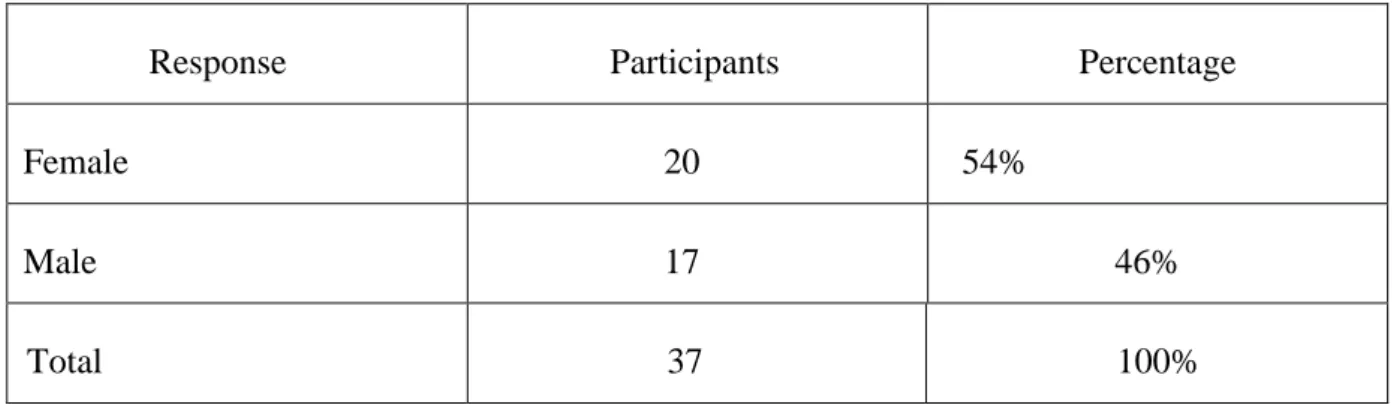
learners’ genderResponse Participants Percentage Female 20 54%
Male 17 46% Total 37 100%
Table 2:
Distribution of Learner’s GenderThe table shows that the learners are from different gender. We notice that the number of all learners is thirty seven pupils; the number of female (twenty) is higher than the number of male (seventeen).
Item 2:
Learners’ ageResponse Participants Percentage 11-12 years old 30 81%
More than 11 7 19%
Total 37 100%
Table 3:
Distribution of Learners’ AgeThe results show that the age of 81% learners is between 11and 12 years old, they learn English for the first time. 19% are more than 11 years old, they studied English before (repetitive). The majority of them are beginners in learning English; this is their first experience in studying English.
Item 3:
Levels of learning EnglishLevels 1st year 2nd year 3rd year 4th year
Learners
Table 4:
Learners’ LevelsThe results indicate that there is a single important level of all learners which is the first year middle school; it shows that they are from the same level.
Part Two: English Courses
Item 4:
The preference of learning EnglishResponse Learners Percentage
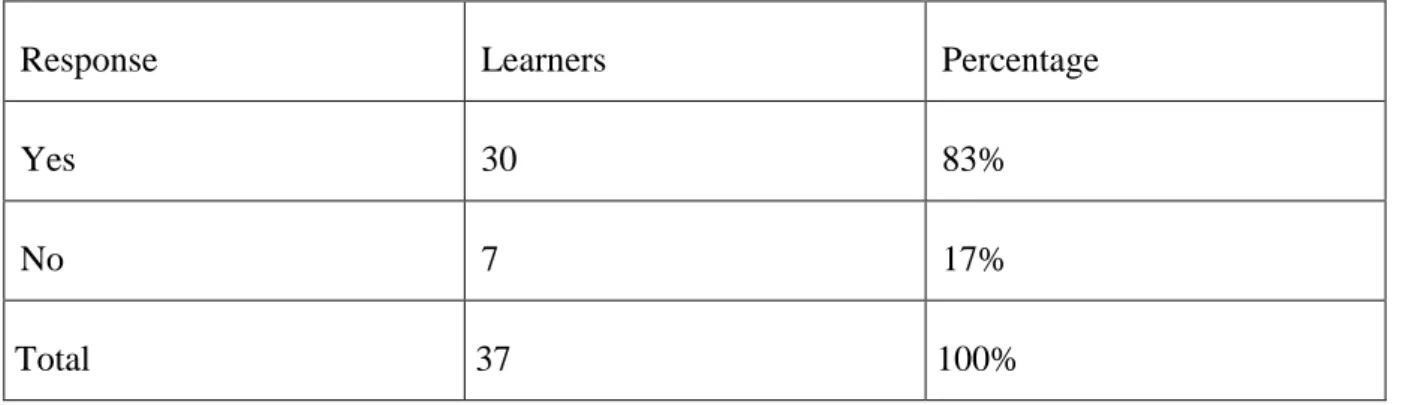
Yes 30 83%
No 7 17%
Total 37 100%
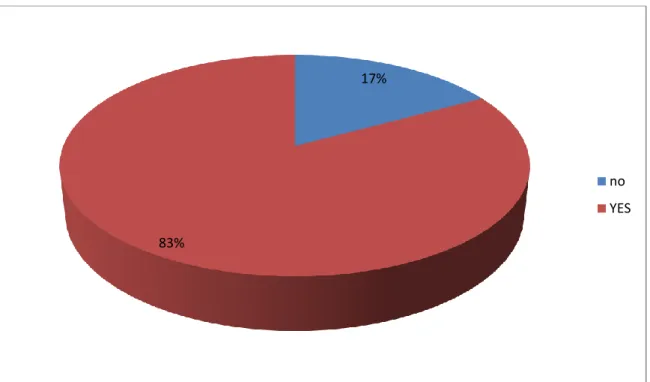
Figure 2:
The preference of Learning English LanguageThe results show the learner’s pleasantness of learning English, 83% of them acquire it with pleasant, whereas 17% of them do not like it. Although, the large number of sample prefers learning English language, the unpleasant of this language for the rest learners may affect their competency.
Item 5:
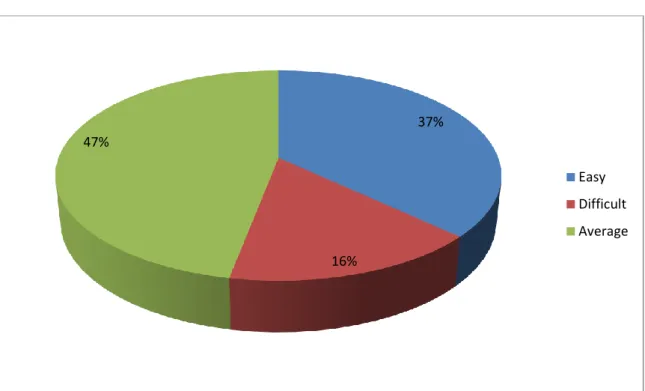
Learners’ point of view about English languageResponse Participants Percentage
Easy 14 37%
Difficult 6 16%
Average 17 47%
Total 37 100%
Table 6:
Learners’ Point Of View about English Language17%
83%
no YES
Figure 3:
Learners’ Point Of View about English LanguageThe figure above describes the point of view of learners about English language. Most of pupils 47% find that English is average, where 37% claimed that is easy and just 16% said that English is difficult. Thus, English language is balanced between average and easy for most learners but there are numerated learners who find difficulties in learning English language.
Item 6:
Acquiring of new words each lessonResponse Learners Percentage
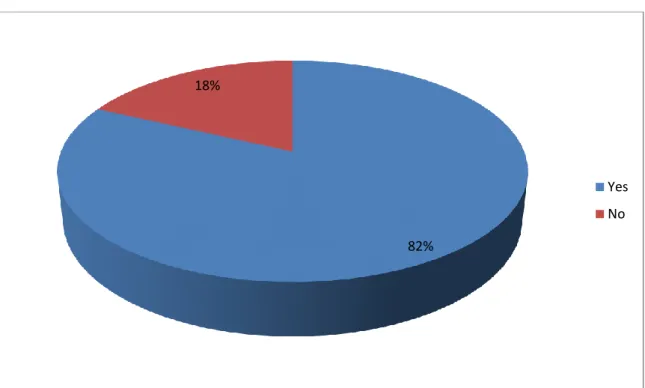
Yes 30 82%
No 7 18%
Total 37 100%
Table 7:
Learners’ Opinion about Acquiring New Words37% 16% 47% Easy Difficult Average
Figure 4:
Learners’ Opinion about Acquiring New WordsThe table shows that most of pupils 82% say that they are acquiring new words each lesson. However, there are some pupils 18% do not acquire new words each lesson. Acquiring new terms canenrich learners’ lexical storage, they can go back to their copy book where they write every new words with its equivalence in native language and use it as own dictionary. As a result, they create their personal dictionaries that they find it easy to access.
Item 7:
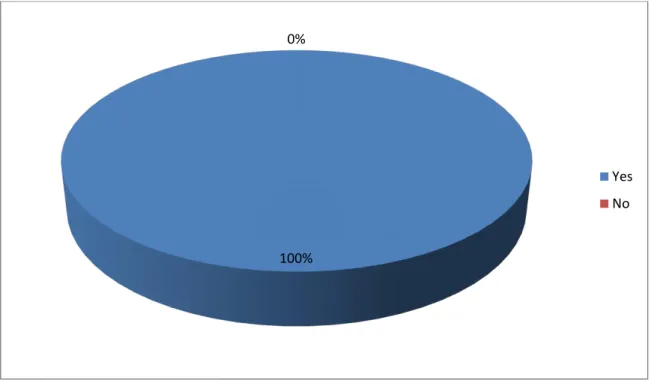
The importance of vocabulary in learning English language Response Learners PercentageYes 37 100%
No 00 00%
Total 37 100%
Table 8:
The importance of Vocabulary in Learning English Language82% 18%
Yes No
Figure 5:
The importance of Vocabulary in Learning English LanguageThe table indicates that all the learners say “yes” and they gave some reasons as follows: - Vocabulary allows me to communicate with my friends via the net.
- It allows me to convey my thoughts even if I make grammar mistakes. - I can translate to my parents some words in Arabic.
- I understand what I read in English magazines or TV programs and films. - It allows me to write good expressions.
Their reasons differ according to their interests, but they are all evidence that vocabulary is an important tool to have in hand.
100% 0%
Yes No
Item 8:
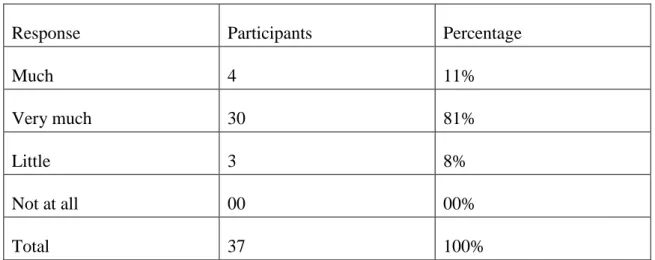
The rate of the importance learners give to vocabularyResponse Participants Percentage
Much 4 11%
Very much 30 81%
Little 3 8%
Not at all 00 00%
Total 37 100%
Table 9:
The rates of the Importance Learners give to VocabularyFigure 6:
The rate of the Importance Learners give to VocabularyThe results show that most of learners 81% see that are aware of the importance of vocabulary in language learning, it is “very much”. Whereas, the others 11% show that learners give a” much” importance to vocabulary, the last 8% shows that they give a “little” importance of vocabulary. Most of learners believe that language learning requires learning its vocabulary. As a result, learners who are interested to learn the language will give very much importance to its vocabulary learning. However, the little importance that some learners give to vocabulary comes as a result of the small concern they give to the language. 11% 81% 8% 0% Much Very much Little Not at all
Item 9:
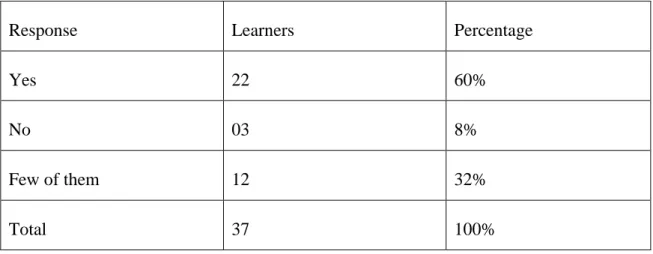
The difficulties in learning vocabularyResponse Learners Percentage
Yes 22 60%
No 03 8%
Few of them 12 32%
Total 37 100%
Table 10:
Learners Difficulties in Acquiring New English TermsFigure 7:
Learners difficulties in Acquiring New English TermsThe results show that there are 60% of learners who have difficulties in acquiring new terms, the other learners 32% said that “few of them”, it means that there are 12 learners who have some difficulties in acquiring new terms. There are 8% of learners who said “no”, they do not have any difficulties in acquiring new English terms.
60% 8% 32% Yes No Few of them
All learners have problems especially in comprehending the word, when the teacher explains to them the meaning of each word what does mean, they do not have any problem, all is OK after explaining.
We interpret their difficulties in memorizing and using words by their needs to practice the word in its real situation.
Item 10:
The reasons of learning vocabulary difficulties - No practice in or outside the class- The absence of interest to study foreign languages, like English and French
Item 11:
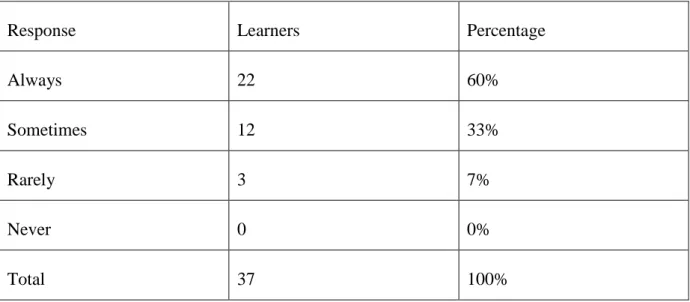
Training learners to get the word meaningResponse Learners Percentage
Always 22 60%
Sometimes 12 33%
Rarely 3 7%
Never 0 0%
Total 37 100%
Figure 8:
Training Learners to get the Word MeaningThe aim of this question is to know how teachers train their learners to get the word meaning. 60% the majority of learners said that “always” the teacher trained them, while 33% said “sometimes”. Whereas, the 7% said “rarely”. More importantly, there are no one who said “never”.
Learners can use many sources in the class to enhance their skills, for example using dictionaries, asking the teacher.
Item 12:
The main problems that face learners in learning vocabulary All the learners have common problems:- They do not pronounce it in the correct way
- Lot of words are similar so that they do not distinguish between them - They forget the synonyms
- They remember its meaning in Arabic but they do not remember how to write it - They do not know how to use it in the correct manner
- They feel tired and bored from trying to learn unknown word
60% 33% 7% 0% Always Sometimes Rarely Never
Item 13:
The techniques used to learn vocabularyTechniques Learners Percentage Checking the dictionary 23 63%
Translation to Arabic 4 12% Repetition 10 25%
Total 37 100%
Table 12:
Techniques Used by Learners in Learning VocabularyFigure 9:
Techniques Used by Learners in Learning VocabularyThe results indicate that 63% of learners used to check in the dictionary, the easy way known and used by the majority of learners. 25% of them added that they repeat the words. Whereas, 12% of them used to translate the words to Arabic, in addition to dictionary and to repetition.
These techniques may construe the problems seen in the previous question. Dictionary gives them a lot of resembling words that makes them unsure about what are they searching.
63% 12%
25%
Checking the dictionary Translation to Arabic Repitition
Repetition is tiring and boring. Translation weakens them to make efforts in the target language; they stay remembering words just in their mother tongue.
Item 14:
SuggestionsLearners suggest many things to ameliorate their acquiring of English language where they see that; visual aids, stories, sessions of reading, practice (exercises) and the use of reinforcement may help them to learn English better, i.e. pupils state that the use of visual aids will help them to understand the meaning that need further explanation. They prefer to learn to see in order to write. Furthermore, they want to read stories and short texts. Where they claimed that it helps to memorize the items and flourish their imagination, in addition they claimed also that practice helps them to put the new words in the right place. Moreover, pupils say that reinforcement may reduce their hesitation and make them participate more; it is suggested for both teachers and parents for them. As a result, learners claimed multiple things that may help them in learning English language.
2.10. Conclusion:
This chapter is concerned with getting real data about learners’ opinions concerning learners’ difficulties in learning vocabulary in addition to the information that was gathered through the analysis of the tool used in this work that is learners’ questionnaire. Where the researchers selected different graphs by comments and suggestions which are related to the sample’s point of view.
Chapter Three: Discussion of the Findings
and Recommendations
3.1.
Introduction:
As long as I have dealt with several data collection in the previous chapter concerning students’ difficulties in learning vocabulary, here comes the part of discussing the data obtained from the questionnaire of learners.
After all this, the researchers arrived at proving their hypothesis. This chapter is concerned with the possible solutions transmitted to parents, family and for learners themselves as well, these solutions call for resolving the issue of learners’ difficulties in learning vocabulary at middle school.
3.2.
Findings:
The questionnaire’s results show the students’ difficulties in learning EFL vocabulary. Consequently, learners do their best to acquire new terms in English. Moreover, due to this problem, most of the time pupils acquire new words as they can acquire it in order to develop their mind. Because, they believe that having a small number of words with knowing a lot about their use is better than learning a great amount of vocabulary without any use. In other words, it is not important for learners to learn a great number of words, but it is effective to acquire and use the words they already have.
The analysis of the data shows a difference between the theories and the reality of the difficulties of students in learning EFL vocabulary. Although, most theories emphasize the difficulties that face learners in learning and acquiring new vocabulary. Students suggest many techniques and they use them in order to increase their skills, cooperative learning and improving vocabulary storage, they use them because there are many reasons.
As a result, learners said that there are many problems that face them in learning vocabulary, this also means that if they use the techniques to learn vocabulary with the passage of time, good results will be attained.
3.3.
Discussion of the Findings:
This study has aimed to find out the difficulties of EFL learners in learning vocabulary. For the purpose of fulfilling our objectives, we have submitted the learners’ questionnaire. After the analysis of the questionnaire, the most significant results of our research work can be summarized in the following:
The majority of learners are female; the number of them is more than the number of male. Most of them have 11-12 years old, they learn English for the first time and the others are more than 11 years old, they studied English before, it means that they are repetitive. The results show that all learners are in the same level of learning English that is the first year middle school.
In the second part, the majority of the pupils preferred learning English language. 83% of them like this language. The response of the majority of the learners think that English language is average but there are some learners who find difficulties in learning English language. As in answer six, the majority of the learners said that they acquire new words each lesson, they can use some sources in order to facilitate and acquire new words each session. Here, it is the role of the teacher to give them as much as possible of new terms each lesson. As in the following answer, learners give all the importance to vocabulary in learning English language, all of them said yes it means that vocabulary is an important tool. They give some reasons which mentioned that vocabulary is an important tool in any language, one of them is that vocabulary allows learners to read, write and translate every word in any language. Learners in answer eight classified the rate of the importance learners give to vocabulary. The majority of them choose the answer very much, it means that most of learners are interested in vocabulary, they give very much importance to its vocabulary learning. According to the following answer, most of learners 60% have difficulties in acquiring new English terms. Moreover, the majority of learners have problems in learning vocabulary especially in comprehending the word. On the other hand, learners give some reasons behind these difficulties in answer ten in order to enhance their ability to acquire new words.
As the following answer, it shows that they always train to get the word meaning, they can use dictionaries to enhance their skills.
There are many obstacles that face learners in learning vocabulary, all of them have the same problems, and the most faceable ones are the pronunciation and the meaning of words. As the following answer, learners used some techniques to learn vocabulary, the majority of them used the dictionary as an easy way and the known one that used by the majority of learners. These techniques can facilitate to them the ability to learn vocabulary.
As a final answer, learners suggest many things to ameliorate their acquiring of English language, the most ones are practice, stories, and games, these can help them in learning English language.
3.4. Recommendations and Suggestions:
Because of the difficulties that face learners in learning and acquiring vocabulary, we suggest some recommendations for learners:
3.4.1. Learner’s Suggestions:
Practice the language: since the majority of the researchers sample agreed that “practice makes perfect”. But the lack of time and the length of the syllabus limit practice inside classroom, pupils are supported to participate with their teachers and do their home works if they want to ameliorate their English language. They can practice it with their friends where their exchanges of words may help them a lot in acquiring the new terms. Moreover, talking with their families in English language by using simple words may also help them to memorize and use the language explicitly.
Use of the note book: one of the important elements in acquiring new terms is the note- book where pupils could write all the new words and define it into their mother tongue. It is a very helpful way to remember words where the pupil can check it the time he need it.
Use the lists: the use of lists may also effect the acquiring of new language for a beginner. Where listing words in particular order helps a lot in memorizing the words explicitly special if this list includes the word in English language and its equivalent in the mother tongue. It works a lot with beginners.
Picture dictionary: pupils most of the time prefers to learn with pictures, this picture includes the name of things in English language.
Reading: reading will improve beginner’s ability to pronounce words and it add new word to his glossary.
Use your free time to learn (games): pupils can play brainstorming games. For instance, create small groups of (5-6) pupils, and then choose a word such as (sport, travelling, classroom…). After a while each group gives his related words to the previous and the group who gathered may words will be the winner.
Built a good relationship with your teacher: one of the means that helps in learning new language is the relationship between the pupils and his teacher, so pupils build strong relation with their teacher, by helping him in doing his lesson. In addition, pupils should tell their teacher if they find his method of teaching inappropriate
because he is there to help them acquiring English language and he should follow the method that they prefer.
Written expression: pupils learn a lot from the paragraph with the blank spaces. Whereas beginners you can use these paragraphs in acquiring the vocabulary. Where the blank spaces could be complete with nouns, adjectives, adverbs. So learners can learn many kinds of words in just one paragraph.
Learn through poems and songs: as beginners you can use the short poems or songs to learn new vocabulary items.
Use short dialogue: As a pupil you can speak with your friend or your family in term of WH questions. Where this technique may help you a lot to memorize words and discover new ones.
Use puzzles: play with your friend’s games of puzzles where it can built and increase your range of words.
The use of flash cards: this method may improve learner’s level in learning. As much as possible vocabulary. Using flash cards facilitate the task of acquiring working with new items. It gives the learner the opportunity to learn as much as possible new terms and their definitions, synonyms, antonyms. Also to put those new terms in sentences. Electronic dictionary: using this method can help learners in their learning of
vocabulary. Where this dictionary will give learners the right pronunciation and learners can repeat the words after it and memorize it correctly.
Matching: matching synonyms with their opposites or the words with its definitions as well as a word to a picture may also be an effective way in learning vocabulary.
3.4.2. Parents and Family’s Suggestions:
What can parents do to promote vocabulary development at home?
Provide for him words in Arabic language or French then ask him to look for the equivalents in English. This technique may work effectively with beginners but you cannot use it with advanced learners.
Teach him through technology: make your child watch appropriate English programmers according to his age with Arabic or French translation such as; English cartoons or children films. Where he can learn morals and improve his English language.
Books: Teach your child through buying to him books of English language for beginners. Such as the books that consist the name of colors, animals, fruit and include also short dialogue, short stories and songs.
Uses games: due to the fact that Algerian parents are not very familiar with English language, the other members of the family (brothers, sisters) can help the beginners in learning English language, through playing games with them. The role of parents became here where they will reinforce the winner by giving him presents, sweets or through encouraging him.
3.5. Limitation of the Study:
In any kind of research, there are several limitations inherent in this study before being submitted. The limitations that face us in doing our research are that there were some learners who did not answer some questions in the questionnaire; also there were some learners who did not answer the questionnaire at all. They did not bring us even all the papers. When, we gave the questionnaire’s paper to all learners, that let us do not know why, it means the reasons behind this problem.
There is another obstacle that face the researcher is the time limit, because time is so important in this research, it was distributed with time constraints.
According to our research study and because we dealt the beginner learners, some pupils have difficulties in understanding the questionnaire’s questions. Most of learners studied English in the first time. Another obstacle that is the shortage of answers.
Another limitation is the lack of information as all the available information includes the student’s difficulties in learning vocabulary, in which the data obtained from learner’s questionnaire was insufficient. For this problem, the researcher change some answers and sometimes refuse it.
3.6. Conclusion:
This final chapter is considered as the fruitful part of this research, it concluded of the findings that confirm what is mentioned in the first one.
It concluded also various solutions and suggestions that may help learners to learn and acquire new English terms. These suggestions were divided into two main parts, parents and
family suggestions and learners’ suggestions as well to be more aware about their difficulties in learning vocabulary. Finally, it is proved that it is a good technique to use these of solutions.