HAL Id: insu-01206203
https://hal-insu.archives-ouvertes.fr/insu-01206203
Submitted on 7 Mar 2021HAL is a multi-disciplinary open access
archive for the deposit and dissemination of sci-entific research documents, whether they are pub-lished or not. The documents may come from teaching and research institutions in France or abroad, or from public or private research centers.
L’archive ouverte pluridisciplinaire HAL, est destinée au dépôt et à la diffusion de documents scientifiques de niveau recherche, publiés ou non, émanant des établissements d’enseignement et de recherche français ou étrangers, des laboratoires publics ou privés.
Multiplication of microbes below 0.690 water activity:
implications for terrestrial and extraterrestrial life
Andrew Stevenson, Jürgen Burkhardt, Charles S. Cockell, Jonathan A. Cray,
Jan Dijksterhuis, Mark Fox-Powell, Terence P. Kee, Gerhard Kminek, Terry J.
Mcgenity, Kenneth N. Timmis, et al.
To cite this version:
Andrew Stevenson, Jürgen Burkhardt, Charles S. Cockell, Jonathan A. Cray, Jan Dijksterhuis, et al.. Multiplication of microbes below 0.690 water activity: implications for terrestrial and extraterrestrial life. Applied and Environmental Microbiology, American Society for Microbiology, 2015, 17 (2), pp.257-277. �10.1111/1462-2920.12598�. �insu-01206203�
This is a repository copy of Multiplication of microbes below 0.690 water activity:
implications for terrestrial and extraterrestrial life.
White Rose Research Online URL for this paper: http://eprints.whiterose.ac.uk/121554/
Version: Accepted Version
Article:
Stevenson, A, Burkhardt, J, Cockell, CS et al. (12 more authors) (2015) Multiplication of microbes below 0.690 water activity: implications for terrestrial and extraterrestrial life. Environmental Microbiology, 17 (2). pp. 257-277. ISSN 1462-2912
https://doi.org/10.1111/1462-2920.12598
© 2014 Society for Applied Microbiology and John Wiley & Sons Ltd. This is the peer reviewed version of the following article: Stevenson, A., Burkhardt, J., Cockell, C. S., Cray, J. A., Dijksterhuis, J., Fox-Powell, M., Kee, T. P., Kminek, G., McGenity, T. J., Timmis, K. N., Timson, D. J., Voytek, M. A., Westall, F., Yakimov, M. M. and Hallsworth, J. E. (2015), Multiplication of microbes below 0.690 water activity: implications for terrestrial and extraterrestrial life. Environ Microbiol, 17: 257–277. doi:10.1111/1462-2920.12598, which has been published in final form at https://doi.org/10.1111/1462-2920.12598. This article may be used for non-commercial purposes in accordance with Wiley Terms and
Conditions for Self-Archiving. Uploaded in accordance with the publisher's self-archiving policy.
[email protected] https://eprints.whiterose.ac.uk/
Reuse
Unless indicated otherwise, fulltext items are protected by copyright with all rights reserved. The copyright exception in section 29 of the Copyright, Designs and Patents Act 1988 allows the making of a single copy solely for the purpose of non-commercial research or private study within the limits of fair dealing. The publisher or other rights-holder may allow further reproduction and re-use of this version - refer to the White Rose Research Online record for this item. Where records identify the publisher as the copyright holder, users can verify any specific terms of use on the publisher’s website.
Takedown
If you consider content in White Rose Research Online to be in breach of UK law, please notify us by
Multiplication of microbes below 0.690 water activity: implications for terrestrial and 1 extraterrestrial life 2 3 4
Andrew Stevenson1, Jürgen Burkhardt2, Charles S. Cockell3, Jonathan A. Cray1, Jan
5
Dijksterhuis4, Mark Fox-Powell3, Terence P. Kee5, Gerhard Kminek6, Terry J. McGenity7,
6
Kenneth N. Timmis8, David J. Timson1, Mary A. Voytek9, Frances Westall10, Michail
7
M.Yakimov11, John E. Hallsworth1
8 9
1Institute for Global Food Security, School of Biological Sciences, MBC, Queen’s University
10
Belfast, Belfast, BT9 7BL, Northern Ireland. 2Plant Nutrition Group, Institute of Crop Science
11
and Resource Conservation, University of Bonn, Karlrobert-Kreiten-Str. 13, D-53115 Bonn, 12
Germany. 3UK Centre for Astrobiology, School of Physics and Astronomy, University of
13
Edinburgh, Edinburgh EH9 3JZ, UK. 4CBS Fungal Biodiversity Centre, Uppsalalaan 8,
NL-14
3584, CT Utrecht, Netherlands. 5University of Leeds, School of Chemistry, Leeds, LS2 9JT,
15
West Yorkshire, UK. 6ESA-ESTEC, Keplerlaan 1, 2200 Noordwijk, The Netherlands.
16
7University of Essex, School of Biological Sciences, Colchester, CO4 3SQ, Essex, UK.
17
8Institute of Microbiology, Technical University Braunschweig, Spielmannstrasse 7, D-38106
18
Braunschweig, Germany. 9NASA Headquarters, Washington, DC 20546-0001, USA.
19
10Centre de Biophysique Moléculaire, CNRS, Rue Charles Sadron, and Centre de
20
Recherches sur les Matériaux à Haute Température, 1D, avenue de la recherché 21
scientifique, 45071 Orléans Cedex 2, France. 11Istituto per l'Ambiente Marino Costiero, CNR,
22
98122 Messina, Italy. 23
24
*For correspondence. E-mail [email protected]; Tel: (+44) 289097 2314; Fax: (+44) 25
289097 5877. 26
27
Running title: Multiplication of microbes at low water-activity 28
29
Keywords: Aspergillus, habitability, halophilic Archaea and Bacteria, limits for life, Mars, 30
xerophilic fungi, water activity 31
Summary
33 34
Since a key requirement of known life-forms is available water (water-activity; aw), searches
35
for signatures of past life in terrestrial and extraterrestrial environments have recently 36
targeted places known to have contained significant quantities of biologically available water. 37
The lower limit of water activity that enables cell division is 0.605 which, until now, was only 38
known to be exhibited by a single eukaryote; the sugar-tolerant, fungal xerophile Xeromyces 39
bisporus. The first forms of life on Earth were, however, prokaryotic. Furthermore, early life 40
on Earth inhabited high-salt environments, suggesting an ability to withstand low water-41
activity. Recent evidence indicates that some halophilic Archaea and Bacteria have water-42
activity limits more or less equal to those of X. bisporus. Regardless of species, cellular 43
systems are sensitive to minute differences in water activity (of <0.005 aw-units) so there is a
44
need to determine water-activity values to three decimal places
.
We discuss water activity in 45relation to the limits of Earth’s present-day biosphere; the possibility of microbial 46
multiplication by utilizing water from thin, aqueous films or non-liquid sources; whether 47
prokaryotes were the first organisms able to multiply at the 0.605-aw limit; and whether
48
extraterrestrial aqueous milieu of ≥0.605 aw can resemble fertile microbial habitats found on
49 Earth. 50 51 52 53 Introduction 54
Given the fact that water is one of the principal ingredients of cellular life (Daniel et al., 55
2004), insights into the minimum water requirements of cells are imperative to understanding 56
the functionality of living-systems at every level (from biomacromolecule to biosphere), as 57
well as the origins of life, in an environmental context. The generally held opinion is that life 58
appeared independently on Earth and, possibly, elsewhere in the Solar System (Clancy et 59
al., 2005); though one other explanation for the presence of life on Earth is that it appeared 60
on another planet and was transported here in the form of prokaryotes or their ancestors (an 61
idea known as panspermia; Thomson, 1871). Until recently, eukaryotic microbes have held 62
the record for life under water-constrained conditions, as some species are capable of cell 63
division down to a water activity (aw)1 of 0.605 at high sugar concentrations (Pitt and
64
Christian, 1968; Williams and Hallsworth, 2009). Whereas such data have formed the basis 65
of international policy for planetary protection in relation to space-exploration missions (see 66
1Water activity, the mole fraction of water, is defined by an equation (water activity = vapour pressure of the
solution/vapour pressure of the water) which is derived from Raoult’s Law; this parameter and its derivation are discussed in detail by Brown (1990) and Grant (2004).
below), sugar-rich substrates have very limited applicability to those extraterrestrial habitats 67
with which we are familiar. Historically, the accepted limit for cell division of prokaryotic 68
microbes has been 0.755 aw; this applied to a small fraction of halophilic species at high salt
69
concentrations (for references, see Grant, 2004). However, both based and culture-70
independent studies provide evidence for multiplication and metabolic activity of halophilic 71
Archaea and Bacteria in the range 0.680 to 0.605 aw, both in their natural habitats in situ,
72
and in vitro (Javor, 1984; Yakimov et al., 2014; A. Stevenson et al., submitted). Other studies 73
have shown that, whereas the vast majority of yeasts and fungi are active somewhere within 74
the range 1 to 0.720 aw (Pitt, 1975; Brown, 1976), only 12 species have been observed to
75
grow and/or germinate at < 0.700 aw (Williams and Hallsworth, 2009; A. Stevenson et al.,
76
submitted). Here, we discuss the evidence for microbial activity below at or below 0.690, 77
which represents the very edge of the functional biosphere on Earth. Low water activity is 78
also discussed in relation to early life on Earth, the plausibility of cell division in habitable 79
extraterrestrial environments in which biologically available water is present, and a series of 80
unanswered scientific questions. 81
82
Water-activity at the outer edges of the microbial biosphere 83
84
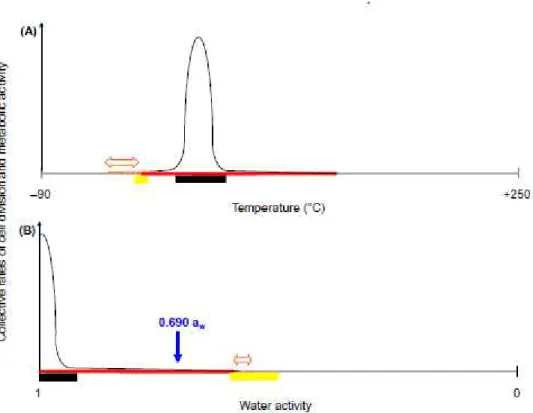
The primary physical determinants of the habitable space on Earth are temperature and 85
water activity; these parameters are also used to designate the ‘Special Regions’ of Mars in 86
which microbial cell-division might feasibly take place (Beaty et al., 2006; Kminek et al., 87
2010; J. D. Rummel et al., unpublished)2. The temperature window over which microbes are,
88
collectively, capable of cell division (i.e. from -18 to +122°C; Takai et al., 2008; Chin et al., 89
2010) spans ≤ 40% of the entire range of temperatures to which life-systems on Earth can 90
be exposed; i.e. from approximately -90°C to ≥ 250°C (for some hydrothermal vents; Fig. 91
1a). By contrast, environmental water-activity values range from 1 to 0 and most cellular 92
systems of known life-forms on Earth are only active in the range, or a segment of the range, 93
1 to 0.900 aw (Fig. 1b; Brown, 1976; Grant, 2004). For example, there is a drop-off in
94
measurable metabolic activity in many soils at ≤ 0.890 aw (Moyano et al., 2012; 2013;
95
Stevenson and Hallsworth, 2014). However, metabolic activity and cell-division has been 96
2 Planetary protection in relation to space missions aims to protect those planets where spacecraft are landed,
as well as Earth, from accidental contamination with non-native life-forms (Kminek et al., 2010; 2014). Mars Special Regions have been defined according to the activities of the NASA Mars Exploration Program Analysis Group (MEPAG), Special Regions-Scientific Analysis Group 1 (SR-SAG1) and the Committee on Space Research (COSPAR), which is part of the International Council for Science. Both these committees
conservatively recommended 0.500 aw as the limit beyond which no known terrestrial microorganism is capable
of multiplication; implying that any environment of Mars with a water activity of > 0.500 may potentially enable proliferation of xerophilic microbes if they happened to arrive as accidental passengers on spacecraft sent from Earth (Fig. 1; Beaty et al., 2006; Kminek et al., 2010). A revised analysis of Mars Special Regions is currently underway by the MEPAG SR-SAG2 (J. D. Rummel et al., unpublished).
reported below 0.900 aw for a great number of xerotolerant/philic and halotolerant/philic
97
microbes (Brown, 1976; Grant, 2004), and even below 0.755 aw for both eukayotic and
98
prokaryotic species (Javor, 1984; Williams and Hallsworth, 2009; Yakimov et al., 2014; A. 99
Stevenson et al., submitted). Of the microbes known to multiply below 0.720, the majority 100
(unlike X. bisporus) are not obligate osmophiles that must inhabit sugar-rich substrates; 101
these include halophilic prokaryotes and xerophilic fungi such as Aspergillus penicilliodes 102
and Eurotium herbarorium (Samson and Lustgraaf, 1978; Williams and Hallsworth, 2009; 103
Yakimov et al., 2014; A. Stevenson et al., submitted)3. Even for the most xerophilic microbes
104
thus far characterized (see Pitt, 1975; Javor, 1984; Williams and Hallsworth, 2009; A. 105
Stevenson et al., submitted), rates of cell division typically decrease by an order of 106
magnitude between 0.870 and 0.770 aw, and by a further order of magnitude between 0.770
107
and 0.670 aw (Stevenson and Hallsworth, 2014; A. Stevenson et al., submitted). There are
108
only reports of cell division for between 20 and 30 microbial species or communities at ≤ 109
0.690 aw (see Javor, 1984; Yakimov et al., 2014; A. Stevenson et al., submitted). Whereas
110
all of these species are extreme, obligately xerophilic eukaryotes or extreme, obligately 111
halophilic prokaryotes which have low rates of cell division - or are incapable of growth - 112
close to 1 aw, the ultimate limit for multiplication of even the most resilient strains appears to
113
be 0.61 aw (Pitt and Christian, 1968; A. Stevenson et al., submitted). For microbes on
114
Earth, therefore, biotic activity spans approximately 40% of the available water-activity 115
range, thus emphasizing the potency of water as a determinant of the functional biosphere. 116
The overwhelming majority of microbial systems are metabolically active somewhere within 117
the ranges 5 to 40°C, and 1 to 0.900 aw, which represent even smaller portions of the
118
environmentally pertinent temperature and water-activity ranges; i.e. only 10% in each case 119
(Fig. 1). Of the microbial systems characterized thus far, the 20 to 30 known to be active at ≤ 120
0.690 aw (Fig. 1; Javor, 1984; Yakimov et al., 2014; A. Stevenson et al., submitted) represent
121
the most extreme forms of life to have penetrated these kinds of hostile environment4.
122
Some reports have alluded to the possibility of microbial growth and metabolism at 123
the otherwise unprecedented water-activity values of 0.382 (for deep-sea halophiles in 124
MgCl2-saturated brine; van der Wielen et al., 2005), < 0.450 (for halophiles in the CaCl2-rich,
125
Antarctic Don Juan Pond; Siegel, 1979), 0.500 (Actinobacteria isolated from algal mats and 126
cultured in soil-based substrates; Doroshenko et al., 2005; 2006; Zvyagintsev et al., 2009; 127
3This has implications for preventing contamination of other planetary bodies (see above) which, as far as we
know, lack sugar-ruch environments, during space exploration missions.
4Habitats which have sufficiently low water-activity to exclude almost all forms of life on Earth and, therefore,
have a characteristically low biodiversity (especially those of < 0.690 aw) are fertile habitats for those
extremophiles which thrive there due to minimal competition and, frequently, a lack of grazers and predators (for references, see Cray et al., 2013b). Such low-water activity habitats are, however, typically too biologically hostile and insufficiently biodiverse to act as open habitats for microorganisms (Cray et al., 2013b; Lievens et al., 2014; Oren and Hallsworth, 2014).
2012), 0.570 (for halophiles in acidic saline lakes; Mormile et al., 2009), 0.600 (for 128
germination of Wallemia sebi [a xerophilic basidiomycete] on high-sugar substrates; Frank 129
and Hess, 1941) and 0.600 (reported value for optimum growth of halophiles (Jaenicke and 130
Bohm, 1998), and biotic activity in salt lakes; Cobucci-Ponzano et al., 2006). Some of these 131
values were hypothetical (see below), and the other claims have not been accepted or have 132
been refuted by authors of a number of subsequent studies (Pitt and Christian, 1968; Wynn-133
Williams, 1996; Beaty et al., 2006; Hallsworth et al., 2007; Kminek et al., 2010; Oren, 2011; 134
Stevenson and Hallsworth, 2014; A. Stevenson et al., submitted; J. D. Rummel et al., 135
unpublished). The Don Juan Pond (located within the McMurdo Dry Valleys, Antarctica) is a 136
CaCl2-saturated brine-pool situated in a closed basin and fed by seasonal melt-water
137
streams and deliquescent seepages, both of which are thought to deliver CaCl2 to the lake
138
(Dickson, 2013). Its volume fluctuates but is typically 3000 m3 (slightly larger than an
139
Olympic swimming pool), and it is amongst the most saline large-scale bodies of water 140
known on Earth. This pond rarely, if ever, freezes despite winter temperatures of ≤ -51oC
141
(Siegel 1979; Marion 1997; Grant, 2004). While annual temperatures of the pond’s water and 142
the surrounding sediments are occasionally above 0°C, they remain below -20°C for the 143
majority of the year (Samarkin et al., 2010) so it is highly unlikely that microbial life could 144
multiply there (for references, see Chin et al., 2010; Kminek et al., 2010; J. D. Rummel et al., 145
unpublished). Saturated solutions of CaCl2, as found in the Don Juan Pond, are highly
146
chaotropic and are therefore likely to prevent microbial growth (and may even be sterile 147
environments; Duda et al., 2004; 2005; Hallsworth et al., 2007; Cray et al., 2013a; 2013b; 148
Oren, 2013; Yakimov et al., 2014). Nitrous oxide emissions recorded from the surrounding 149
sediments, frequently attributed to the biological transformation of nitrogenous compounds, 150
are apparently the result of abiotic reactions between brine nitrates and FeII-bearing minerals
151
(Samarkin et al., 2010). The water activity of the MgCl2-dominated, deep-sea hypersaline
152
brine studied by van der Wielen et al. (2005) is ~0.382 at the in situ temperature of 14.5°C 153
(Winston and Bates, 1960; Hallsworth et al., 2007). Culture-dependent and culture-154
independent studies of this brine, and investigations into the biophysics of macromolecular 155
interactions, indicate that both its potent chaotropicity (even at water-activity values which 156
would otherwise be permissive for cell division) and exceptionally low water-activity prohibit 157
life processes (Hallsworth et al., 2007; Yakimov et al., 2014), as these parameters do for 158
solutions of comparable salts (Winston and Bates, 1960; Duda et al., 2004; Hallsworth et al., 159
2003a; Kminek et al., 2010; Oren, 2011; Cray et al., 2013a; 2013b). Speculations that 160
microbial metabolism and cell division occur at 5 M MgCl2 are inconsistent with the virtual
161
sterility of the Dead Sea when MgCl2 concentrations become elevated (Oren, 1999; 2010;
162
Oren, 2013) or the CaCl2-dominated Don Juan Pond (Siegel et al., 1983; Samarkin et al.,
2010; Oren, 2013) where concentrations of divalent chloride salts reach critical 164
concentrations which are prohibitive for all life processes (Hallsworth et al., 2007; Cray et al., 165
2013a; Oren, 2013; Yakimov et al., 2014). Although there is a theoretical possibility that 166
some microbes have evolved specialised structures which isolate cells from such hostile 167
habitats whilst permitting biotic activity, to our knowledge no such structures have yet been 168
reported for any microbial species in any type of extremely chaotropic (e.g. Hallsworth et al., 169
2007; Yakimov et al., 2014) or low water-activity (≤ 0.600) environment. 170
Reports of germination and subsequent cell division during germ-tube formation of 171
several Actinobacteria (i.e. Streptomyces albidoflavus [syn. Streptomyces odorifer], 172
Streptomyces rectiviolaceus, and a Micromonospora strain) at 0.500 aw (which were carried
173
out by one group: Doroshenko et al., 2005; 2006; Zvyagintsev et al., 2009; 2012) are 174
apparently erroneous (see Stevenson and Hallsworth, 2014). Independent studies have 175
demonstrated that none of these species was capable of growth below 0.895 aw, and the
176
theoretical water-activity minimum for the most xerotolerant (a strain of Streptomyces 177
albidoflavus) was 0.870 (Stevenson and Hallsworth, 2014). Proposed limits of 0.570 or 178
0.600 aw for biotic activity of halophiles were speculative (i.e. not derived from
179
determinations of water-activity; Jaenicke and Bohm, 1998; Mormile et al., 2009; Cobucci-180
Ponzano et al., 2006), and sources of experimental error in studies of W. sebi germination 181
have been discussed previously (Pitt and Christian, 1968). Furthermore, apparent microbial 182
growth within terrestrial brine lakes which can reach values of ≤ 0.600 aw may have actually
183
occurred at higher water-activity values given the seasonal and other temporal fluctuations of 184
the in situ salt concentrations (Oren, 1988; 1993; Cobucci-Ponzano et al., 2006; Mormile et 185
al., 2009). 186
Although the established temperature minima for multiplication of the most 187
psychrophilic microbes are in the region of -15 to -18°C (for r eferences, see Chin et al., 188
2010; Kminek et al., 2010), there are numerous sources of evidence for metabolic activity 189
considerably below this range (Kminek et al., 2010; J. D. Rummel et al., unpublished). By 190
contrast, there is a paucity of data to demonstrate metabolic activity below the accepted 191
water-activity minimum for microbial cell division (i.e. 0.605; Kminek et al., 2010; Yakimov et 192
al., 2014; A. Stevenson et al., unpublished; J. D. Rummel et al., unpublished). In relation to 193
the water-activity limit for life, it is noteworthy that trehalose, a hygroscopic substance which 194
accumulates in desiccated microbial cells and may facilitate the acquisition and retention of 195
water, cannot efficiently absorb water from the vapour phase at equilibrium relative 196
humidities of less than 50%, equivalent to 0.500 aw (Fakes et al., 2000). Whereas some
197
enzymes can remain catalytic at water activities of < 0.500 (Kurkal et al., 2005; Lopez et al., 198
2010), there is evidence that DNA becomes disordered, and is therefore no longer 199
transcribable, below a water activity of 0.550 (Falk et al., 1963). Furthermore, strand breaks 200
have been recorded at 0.530 aw in bacterial cells (Asada et al., 1979). It has, therefore,
long-201
been considered unlikely that cellular systems could function at water activities substantially 202
lower than 0.600 (e.g. Pitt, 1975; Brown, 1976; 1990; Sutton and Hildebrand, 1985; J. D. 203
Rummel et al., unpublished). However, interactions between the various factors which 204
determine the biophysical limits for cellular integrity and biotic activity at low water-activity 205
are complex and have yet to be fully elucidated. Macromolecular integrity and functionality 206
can depend on the net effect of prevailing conditions such as temperature, chao-207
/kosmotropicity, pressure and water activity (Hallsworth, 1998; Hallsworth et al., 2007; 208
Williams and Hallsworth, 2009; Bhaganna et al., 2010; Chin et al., 2010; Yakimov et al., 209
2014) and it may be possible that, in some as-yet-undiscovered environments, cells are 210
capable of metabolism at < 0.600 aw.
211 212
Microbial cell division via utilization of water which is not in the bulk liquid-phase 213
214
Water is more or less ubiquitous on Earth and in other parts of the Solar System (Bradley et 215
al., 2014; Küppers et al., 2014); it may be present within the atmospheres, subsurface, rocks 216
and regolith, polar ice-sheets, glaciers, and/or subsurface oceans of planetary bodies, in 217
vapour plumes extruded into space, and – indeed – within space itself5. Whereas here on
218
Earth, we tend to be most familiar with water in its bulk-liquid phase, in both terrestrial and 219
extraterrestrial environments, it can also be present in a variety of forms. In addition to ice 220
and vapour, these include thin aqueous films on/at various types of surfaces and interfaces, 221
or as molecules hydrating mineral, organic, and other substances (Kminek et al., 2010; 222
Toner et al., 2014; J. D. Rummel et al., unpublished). Liquidity of water is determined by 223
temperature, pressure, the presence of solutes and/or gases, and molecular interactions 224
between other materials or substances and water molecules - as well as processes such as 225
salt deliquescence, sublimation of ice, frost formation, condensation or dew-formation on 226
surfaces or within the gaseous phase, aerosol formation, and precipitation (Watanabe and 227
Mizoguchi, 2002; Jepsen et al., 2007; Möhlmann; 2008; 2009; 2012; Argyris et al., 2008; 228
Chin et al., 2010; Pavlov et al., 2010; Bing and Ma, 2011). 229
Thin aqueous films can exist on various surfaces including those of ice and biological 230
and mineral structures, and the water within these films can remain in the liquid phase under 231
a wide range of conditions (Pearson and Derbyshire, 1974; Raviv et al., 2001; Wolfe et al., 232
2002; Jepsen et al., 2007; Möhlmann; 2004; 2008; 2009; 2011; 2012; J. D. Rummel et al., 233
5 See Waite et al. (2006); Nimmo et al. (2007); Tosca et al. (2008); Campins et al. (2010); Sohl et al. (2010);
unpublished). The depth of thin films can range from > 1 mm to a monolayer of water 234
molecules (~0.3 nm; Möhlmann, 2004; 2005), and they can be stable (Möhlmann, 2012) or 235
highly ephemeral (Burkhardt and Hunsche, 2013). At the temperatures and pressures which 236
typically prevail in Earth’s biosphere, aqueous films of ~1 mm are primarily made up of water 237
which is biologically available (e.g. Qvit-Raz et al., 2008, Burch et al., 2013). Whereas we 238
speculate that single-monolayer films do not provide water that can be accessed by cellular 239
systems. It has, however, been suggested that microbes can utilize fluid films with a mean 240
thickness equivalent to that of three water molecules (Harris, 1981; Beaty et al., 2006); a 241
hypothesis that may be inconsistent with the lack of solute diffusion in very thin films 242
(Derjaguin and Churaev, 1986; Hu and Wang, 2003) which indicate that the water in films as 243
thin as this is not in the liquid phase6. Despite the circumstantial evidence (see also Rivkina
244
et al., 2000), there is a paucity of data thus far available which convincingly demonstrate that 245
water in thin films that are equivalent to between one and three water molecules in depth is 246
biologically available. 247
There are three possible sources of liquid water in otherwise desiccated and cold 248
areas such as those which are characteristic of Mars: (1) interfacial water as a thin film 249
(several water-molecular in depth) forming on mineral surfaces by adsorption or, on ice, as 250
pre-melted ice (Dash et al. 2006, Möhlmann, 2011); (2) brines forming on salt crystals via 251
deliquescence; and (3) subsurface melt-water below an ice covering due to a solid-state 252
‘greenhouse’ effect (Möhlmann, 2011). Process (2) is a particularly effective mechanism by 253
which liquid water can be generated on Earth and, almost certainly, in extraterrestrial 254
locations (Möhlmann, 2011). The condensing water vapour can potentially reach the dry 255
weight of the deliquescent salt, and will exceed it if the humidity exceeds the deliquescence 256
relative humidity. Deliquescence of NaCl, as equilibrium relative humidity increases from 65 257
to 80%, can be observed in Movie S1. Most salts (and, indeed, many organic substances) 258
are hygroscopic and will attract water to their surface at equilibrium relative humidities of ≤
259
100%. Each salt becomes deliquescent at a specific relative humidity, thereby dissolving as 260
the water vapour condenses. The deliquescence relative humidity for a given salt and its 261
(usually slight) temperature-dependence quantitatively correspond to both the water activity 262
values of, and equilibrium relative humidity values for, saturated solutions of a given salt 263
(Winston and Bates, 1960). If the equilibrium relative humidity is higher than a salt’s 264
deliquescence relative humidity, the water activity of the salt solution will equilibrate with the 265
relative humidity of the atmosphere, so the salt solution will become more dilute. Mixtures of 266
substances (e.g. mixtures of different salts or salts plus sugars) will have a deliquescence 267
6This inconsistency also raises the possibility that the high water-activity values associated with very thin films
relative humidity below that of each individual component (Mauer and Taylor, 2010). In 268
addition to the reduced water activity, salts also reduce the freezing point, and cryobrines 269
may be stable far below the melting point of water, e.g. under Martian conditions (Möhlmann, 270
2011, Martínez and Renno, 2013). 271
Within the Earth’s biosphere, brine formation may play a role for diverse microbial
272
species – especially those that are halotolerant or halophilic – which are located within 273
bioaerosols, or on mineral or biological surfaces (e.g. leaf surfaces) and are exposed to 274
humid air (Potts, 1994). For example, adapted species can reproduce within the 275
phyllosphere of salt-exuding desert plants (Qvit-Raz et al., 2008, Burch et al., 2013) and, at 276
subzero temperatures, in supercooled water in the atmosphere (Sattler et al., 2001). 277
Pseudomonas syringae, which is not haliophilic, is a species widely transported within 278
bioaerosols and its cells are highly effective as ice nuclei because they have protein coatings 279
that cause water to freeze at relatively warm temperatures (Christner et al., 2008; Morris et 280
al., 2014). Being surrounded by ice, they may benefit from the solid-state greenhouse effect 281
which involves the internal formation of thin films due to the penetration and retention of 282
shortwave radiation within the ice. 283
Microbes can obtain water from the vapour-phase, a process which has been 284
observed in lichens (Lange et al., 2006; Pintado and Sancho, 2002) as well as the 285
propagules of various species (Waldham and Halvorson, 1954; Pasanen et al., 1991; 286
Reponen et al., 1996). Other studies have demonstrated that microbial cells also generate 287
considerable quantities of water via their metabolic activity (Oriol et al., 1988; Nagel et al., 288
2001; Marcano et al., 2002; Kreuzer-Martin et al., 2005; 2006; de Goffau et al., 2011), up to 289
70% of the cell’s water according to radio-labelled gas uptake experiments (Kreuzer-Martin 290
et al. 2005; 2006). Spore germination of powdery mildews, such as by the Erysiphe and 291
Uncinula species, has been observed at low equilibrium relative humidities (0 to 10%) 292
without a visible extracellular source of liquid water (Brodie and Neufield, 1942; Manners and 293
Hossain, 1963; Carroll and Wilcox, 2003); although it is not clear whether condensation 294
processes and/or thin films might act to shuttle water to the cell. Desiccated lichens are able 295
to absorb water at an equilibrium relative humidity of ≥ 82% and thereby commence 296
photosynthesis (Pintado and Sancho, 2002; Lange et al. 2006). Various lines of evidence 297
suggest that microorganisms may be capable of cell division without an extracellular supply 298
of liquid water (see also Miller and Chibnall, 1932; Yarwood, 1950; Peterson and Cowling, 299
1972; Lange et al., 1986; 1994). However, there is a paucity of convincing data to irrefutably 300
affirm this hypothesis. Furthermore, systematic studies of water-activity limits for cell division 301
of phylogenetically diverse extremotolerant and extremophilic microbes suggest that cell 302
division would be implausible at values much below 0.600 aw (i.e. 60% equilibrium relative
humidity) (Pitt and Christian, 1968; Brown, 1976; Williams and Hallsworth, 2009; A. 304
Stevenson et al., unpublished). This question is equally pertinent to life on Earth, and the 305
aqueous milieu found elsewhere in the Solar System (not least in relation to planetary 306
protection; see above). 307
308
Implications for the evolution of microbial life on Earth 309
310
The most solute-tolerant Bacteria and Archaea (i.e. extreme, obligate halophiles) are only 311
able to grow at their water-activity minima under hypersaline conditions. Some of these 312
organisms thrive under conditions which resemble those that would have been available on 313
the early Earth; indeed, many of the extreme halophiles thus far studied exhibit their water-314
activity minimum for cell division at elevated temperatures (Robinson et al., 2005). There is 315
some debate regarding the temperature of the early seas; earlier estimates of 70-80°C 316
(Knauth and Lowe, 2003) are now considered to be too high (the 18O values on which the
317
calculations were based were skewed due to increased seawater temperatures which 318
resulted from inputs of hydrothermal fluids from the crust). More recent estimates based on 319
analysis of oxygen and hydrogen isotopes (i.e. 18O and D, respectively) are about 40°C
320
(Blake et al., 2010). However, the high mantle heat flow on the early Earth drove a highly 321
active hydrothermal circulatory system that contributed hot, salty (de Ronde et al., 1997), 322
silica-rich fluids to the local environment (Westall, 2012). It has been proposed that 323
primordial life may have first occurred within saline environments on early Earth (Dundas, 324
1998), and recent evidence suggests that the abiotic formation of primitive proteins can 325
indeed occur under saline conditions (Longo et al., 2013; Longo and Blaber, 2014). 326
Understanding the way in which water-condensing chemical reactions could have led to the 327
emergence of key biomolecules (eg: peptides and nucleic acids) is essential to 328
understanding the origins of life (da Silva and Holm 2014 and references therein). 329
Prokaryote life (anaerobic) was relatively abundant in these early environments and left 330
behind numerous signatures of its presence (Westall, 2012). There are stratified salt 331
deposits of various ages across large regions of the Earth, indicating that concentrated salt-332
waters/brines have existed across the planet’s geologic history (Warren, 2010). Direct 333
association of an early photosynthetic microbial community with evaporitic conditions is 334
documented in 3.33 billion-year-old volcanic sands from the Barberton greenstone belt, 335
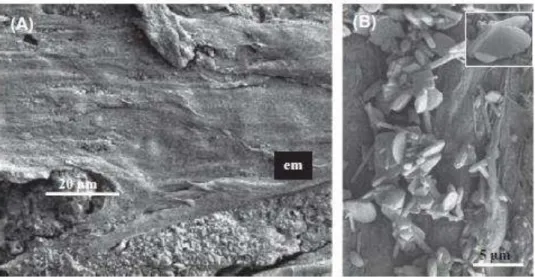
South Africa (Figure 2; Westall et al., 2006, 2011). The uppermost layers of a desiccated 336
biofilm, formed on sediments deposited in shallow waters that were partially exposed to air, 337
are interlayered with tiny evaporate crystals (microns in size and including aragonite, 338
gypsum, halite and magnesium calcite; Figure 2). Evaporitic precipitates have been 339
described from other formations on the early Earth, including the 3.42 billion-year-old Buck 340
Reef Chert in Barberton (Lowe and Fisher-Worrell, 1999) and the 3.43 billion-year-old 341
Strelley Pool Chert of the Pilbara in Australia (Allwood et al., 2007). The early terrestrial 342
phototrophs were quite advanced on the evolutionary scale compared to chemotrophs. 343
Although, to date, no direct association of chemotrophic biosignatures with the early 344
evaporitic deposits has been identified, these more primitive organisms were nevertheless 345
also common (Westall, 2012; Westall et al., 2013). If primitive cells did reach the early Earth 346
through panspermia, experiments simulating the entry of meteorites containing 347
microorganisms into the Earth’s atmosphere have shown (1) that phototrophs could not have
348
been transported to Earth by these means (Cockell et al., 2007) and (2) that, if resilient forms 349
of life were hidden in meteorites, they would need to be buried at depths of at least 5 cm in 350
cracks within the meteorite in order to withstand the heat of entry (Foucher et al., 2010). 351
Regardless of how (and where) life originated, it seems most likely that it was 352
prokaryotes (known to have preceded eukaryotes by 2 billions years), in saline 353
environments, which first reached the 0.605-aw limit. Some of the oldest known fossils are
354
those of prokaryotic cells (dating from ~3.5 billion years ago [Frances, is this the same 355
environment as the 3.33 billion above? And if so, do we need to use the same 356
number?....also is there any repetition between these sentences concerning the Barberton 357
work here and those in the paragraph above? If not then that’s fine.]) which apparently lived 358
in salt-rich environments, as evaporite minerals such as magnesium calcite and halite were 359
found embedded in the biofilm of an extant [Frances, was this mat fossilized or alive?] 360
microbial mat, discovered in the Barberton greenstone belt, South Africa [Frances, given that 361
the Barberton greenstone belt and it’s location were mentioned above does this need 362
repeating here?] (Westall et al., 2001; 2006), and similarly within ancient stromatolite 363
columns from the Pilbara Craton, Western Australia (Allwood et al., 2007). Intriguingly, 364
molecular analysis of modern stromatolite communities revealed that 74% of archaeal clones 365
were closely related to the Halobacteria (Burns et al., 2004), which frequently dominate 366
hypersaline environments (Oren, 2002). These prokaryotic halophiles were exposed to, and 367
presumably inhabited [Frances should there be a comma here…] evaporitic environments 368
containing […or a comma here?] elevated concentrations of magnesium and characterized 369
by water activities of considerably less than 0.755 (and can, indeed, be considerably below 370
0.600 aw, depending on salt concentrations; Winston and Bates, 1960; Hallsworth et al.,
371
2007; Yakimov et al., 2014; A. Stevenson et al., submitted). Indeed, the signatures of past 372
life forms, including stromatolites, can be common in evaporitic deposits (Rothschild and 373
Mancinelli, 2001). 374
Much later, and presumably in terrestrial locations, the Eukarya must have developed 375
a similar resilience during growth at high concentrations of solutes which are produced via 376
biogenic activity; namely sugars and polyols. Indeed, extremophilic Eukarya are considerably 377
less salt-tolerant than their bacterial and archaeal counterparts, and it may be that the 378
prokaryotes are yet to evolve an ability to grow at low water-activity in non-saline substrates 379
(their current record is in the range 0.850 to 0.800; Lievens et al., 2014; R. Santos et al., 380
submitted; A. Stevenson et al., submitted). Microbial, and indeed all biological, cells are not 381
pure-water reactors with water activity of 1 (Trevors and Pollack, 2005), but consist of gels 382
within which modulation of water activity along with speciation as a result of the solute-383
exclusion principle are central to effective cellular function. Indeed, a metabolic ability to 384
maintain the cellular system at his level is one of the fundamental, defining characteritstics of 385
life itself. 386
387
Extraterrestrial, aqueous milieu which resemble fertile habitats on Earth 388
389
Liquid water was, and may still be, present in numerous locations in the Solar System. On 390
Mars, for example, there is abundant geomorphological evidence for the presence of liquid 391
water on the planet in the past (Carr, 2006) and possibly even, ephemerally, in the present 392
(Möhlmann, 2011; McEwan et al., 2014; J. D. Rummel et al., unpublished). Such evidence 393
includes the formation of secondary minerals through the aqueous alteration of the basaltic 394
rocks that cover the surface of the planet (e.g. Carter et al., 2013; Martínez and Renno, 395
2013). It has been calculated that the water activities of evaporite deposits and bodies of 396
saline water on early Mars were as high as 0.780 to 0.860 (Tosca et al., 2008), which is well 397
within the ranges for microbial species from each Domain-of-life (Javor, 1984; Grant, 2004; 398
Williams and Hallsworth, 2009; Stevenson et al., submitted). 399
The various brines on Jupiter’s moon Europa are composed primarily of water and 400
salts such as MgSO4, Na2SO4, and/or Na2CO3 (and, in some cases also contain sulfuric
401
acid; Muñoz-Iglesias et al., 2013). Saturated solutions of these salts have water-activity 402
values of 0.900, 0.930 and 0.920 respectively (at 20°C, 1 atm; Winsto n and Bates, 1960), 403
although it is currently unclear what the values would be under the prevailing conditions on 404
Europa. At the lower temperatures, and the in situ pressures, on Europa the solubility of ions 405
and, conversely, the precipitation of salts can also vary leading to increases in water activity 406
(Marion et al., 2003; 2005), the water activity of a saturated Na2CO3 solution at 10°C, for
407
example, is 0.990 (Winston and Bates, 1960). Whereas water-activity values for individual 408
brines will vary according to their ionic composition (and pH, which also influences 409
solubilities of some salts), it seems likely that the in-situ water activities are sufficiently high 410
to span the entire range for known life (Javor, 1984; Williams and Hallsworth, 2009; 411
Stevenson et al., submitted). 412
Water has also been identified in asteroidal materials, for example the Monahans 413
(1998) H5 chondrite which contained hypersaline fluid inclusions composed predominantly of 414
saturated NaCl (Zolensky et al., 1999) having a water activity of 0.760 at 20°C and 0.750 at 415
2°C at 1 atm (Winston and Bates, 1960), although these values will vary with pressure. Fluid 416
inclusions have been identified in an increasing number of asteroidal specimens including 417
the Zag (1998) meteorite (Rubin et al., 2002). Furthermore, organic molecules have been 418
detected in the fluid inclusions of some of these asteroidal bodies (e.g. Fries et al., 2012), so 419
the composition of these asteroidal fluids can be close to those of the media and substrates 420
in which halophiles occur. For instance, halophiles in hypersaline fluid inclusions of salt 421
crystals from evaporite deposits contain Archaea, Bacteria, and algae (Dunaliella species)7.
422
Many NaCl-saturated habitats contain a remarkably high microbial biomass and are 423
characterised by intense competition (Antón et al., 2002; Daffonchio et al., 2006; Baati et al., 424
2008; Elevi Bardavid et al., 2008; Khemakhem et al., 2010) during which some species - 425
which are known as “microbial weeds” (Cray et al., 2013b; Oren and Hallsworth, 2014) - 426
achieve dominance of the communities including Archaea, Bacteria and Eukarya (e.g. 427
Haloquadratum walsbyi, Salinibacter ruber, and Dunaliella salina; for references see Cray et 428
al., 2013b; Oren and Hallsworth, 2014). The microbes that dominate and/or are most 429
frequently isolated from the fluid inclusions of salt crystals found in evaporite deposits 430
include a number of species known to be capable of cell division in the range 0.710 to 0.605 431
(or their close relations, such as Dunaliella, Halocarcula, Halobacterium, Halococcus, 432
Halorubrum and Natrinema spp.: Stan-Lotter et al., 2000; Schubert et al., 2009b; Lowenstein 433
et al., 2011; Gramain et al., 2011; A. Stevenson et al., submitted). In relation to water 434
activity, the biotic activity of microorganisms - including halophiles – is plausible for some of 435
the aqueous milieu found in extraterrestrial environments. Indeed, some of these locations 436
resemble highly fertile habitats for known halophiles (see also A. Stevenson et al., 437
submitted). 438
Planets which are neither too close to nor too far from a star and could, theoretically 439
at least, accommodate active biological systems are said to be in the Circumstellar Habitable 440
Zone or Goldilocks Zone of their respective solar system (Strughold, 1953). This designation 441
is based on criteria, such as size of the planet and its absolute distance from the star it 442
orbits, whether illuminosity could permit photosynthesis, having surface temperatures which 443
7See McGenity et al. (2000); D’Hondt et al. (2002); Schubert et al. (2009a); Gramain et al. (2011); Lowenstein
et al. (2011); Lomstein et al. (2012); Valentine (2013). Cyanobacteria are know to be metabollically active in evaporite deposits (the in situ water-activity limit for this activity has yet to be determined; Rothschild et al., 1994).
are biologically permissive for at least some of the time (variously defined as 0 to 100°C, or -444
25 to +122°C; Franck et al. 2007; Takai et al., 2008; Kmine k et al., 2010; Harrison et al., 445
2013), and/or whether they have liquid water (Rampino and Caldeira, 1994; von Bloh et al., 446
2011). However, these criteria (and indeed the habitable-zone concept) have limited 447
applicability or validity for a variety of reasons. Ecosystems exist on Earth which do not 448
depend on photosynthetic activity (Chivian et al., 2008; Teixeira et al., 2013) and, indeed, the 449
earliest forms of life were not photosynthetic (Westall, 2012); furthermore, there is 450
circumstantial evidence that an extracellular source of liquid water is not obligatory for 451
microbial life (see above). What is more, biologically permissive conditions may prevail in 452
specific environments or substrates on otherwise hostile planetary bodies (for examples in 453
relation to moons of Saturn, see Raulin, 2006; Nimmo et al., 2007; Parkinson et al., 2008). 454
And finally, various activities of solutes can both prevent freezing of water and expand biotic 455
windows of microbes and may do so to a degree yet to be determined (see below; Chin et 456
al., 2010; J. D. Rummel et al., unpublished). 457
Water can remain liquid at temperatures far lower than those known to permit 458
microbial cell-division (i.e. approximately -18°C; see references in Chin et al., 2010). Liquid
459
water (in various forms, from thin films to underground oceans) may be found in many 460
environments on Mars as well as planetary moons (Europa, Ganymede, Enceladus, etc). 461
Diverse lines of evidence suggest that both photosynthetic and non-photosynthetic microbes 462
may be capable of metabolism and cell division by hygroscopic absorption of water vapour 463
and/or acquiring water from their substratum (as a sole extracellular source of water) both in 464
vitro and in their natural habitats on Earth8, and utilize a variety of mechanisms for the
465
acquisition and retention of water (e.g. production and accumulation of trehalose and other 466
hygroscopic substances which optimize the acquisition and retention of water, morphological 467
changes which minimize water loss, hydrotactic responses, inhabiting high-humidity niches, 468
and construction of soil features to enhance water capture and retention; Garcia-Pichel and 469
Pringault, 2001; Garvie et al., 2008; de Goffau et al. 2011; Williams et al., 2012; Rajeev et 470
al., 2013; Zakharova et al., 2013). Furthermore, as noted above, some microbial cells can 471
generate vast quantities of water via their metabolic activities (Miller, 1932; Peterson and 472
Cowling, 1973; Oriol et al., 1988; Nagel et al., 2001; Marcano et al., 2002; Hocking, 2003; 473
Kreuzer-Martin et al., 2005; 2006). Indeed, studies of bacterial cells demonstrate that up to 474
70% of intracellular water can be derived in this way (Kreuzer-Martin et al., 2005; 2006) and 475
other studies demonstrate that cells can maintain higher intracellular water-activity than that 476
of the environment; de Goffau et al. (2011). 477
8E.g. fungi, lichens and cyanobacteria (Snow, 1949; Armolick and Dickson, 1956; Pitt and Christian, 1968;
Ayerst, 1969; Bootsma et al., 1973; Drewello and Weissmann, 1997; Shomari and Kennedy, 1999; Lange et al., 2006; Wierzchos et al., 2011; Zakharova et al., 2013).
The atmosphere of Saturn’s moon Enceladus can contain ≥ 90% water vapour (Waite 478
et al., 2006) and, whereas its terrestrial surface is approximately -200°C (Brown et al., 2006), 479
plumes of water vapour and ice which are released into space are thought to originate in 480
subsurface oceans that have temperatures in the range -23 to -3°C ( Nimmo et al., 2007; 481
Parkinson et al., 2008); i.e. temperatures which are permissive for the metabolic activity of 482
psychrotolerant and psychrophilic microbes (Collins and Buick, 1989; Chin et al., 2010, 483
Kminek et al., 2010, Mykytczuk et al., 2013). Various salts, nitrogenous compounds, and 484
organic substances have been identified in the atmosphere of Enceladus and E-ring ice 485
grains of Saturn (which may originate from Enceladus) including NaCl, NaHCO3, NaCO3, N2,
486
ammonia, hydrogen cyanide, CO and CO2, methane, acetylene, and propane (Matson et al.,
487
2007; Postberg et al., 2009; 2011). Under conditions prevalent on Earth, bioaerosols can be 488
fertile habitats characterized by high levels of microbial diversity, biomass, and metabolic 489
activity (Fahlgren et al., 2010; Womack et al., 2010; 2012). In relation to the atmosphere of 490
Enceladus and/or the watery plumes which it emits into space, it is intriguing to speculate 491
what the water activity of liquid droplets in, or the humidity of, the gaseous phase might be 492
(presumably close to 100%) and whether the temperatures within these plumes can ever be 493
considerably higher than -200°C. It should be noted that, wher eas definitive evidence from 494
culture-based studies of microbial systems on Earth indicate limits for cell division of 495
approximately +122°C or -18°C (Collins and Buick, 1989; Takai e t al., 2008; Chin et al., 496
2010; Harrison et al., 2013), circumstantial evidence from other biochemical or geochemical 497
data suggest biotic activity under more extreme conditions (down to about -40°C, and up to 498
approximately +140°C; Parkes et al., 2000; Kminek et al., 201 0; J. D. Rummel et al., 499
unpublished). 500
Although the Earth is located within the region allocated as the Goldilocks Zone of our 501
own Solar System, it hosts many environments which do not permit life process and are 502
therefore essentially sterile due to, for example, low water activity, high chaotropicity, 503
excessively high or low temperatures, pH of > 12, plus combinations of conditions such as 504
high salt and low pH or high temperature and high pH (e.g. Brown, 1990; Hallsworth, 1998; 505
Parkes et al., 2000; Grant, 2004; Hallsworth et al., 2007; Harrison et al., 2013; Yakimov et 506
al., 2014). Under all these conditions cells also need adequate energy sources and nutrients 507
for maintenance and growth which may require electron donors and acceptors for 508
respiration etc. Some combinations of conditions can slightly extend extremes for growth, 509
such as high pressure and temperatures; furthermore survival can occur under conditions 510
where growth cannot9. Conversely, planetary bodies which are basically hostile to life may
511
nevertheless harbour small-scale, biologically permissive domains (Kminek et al., 2010; J. D. 512
Rummel et al., unpublished). Solute activities represent one of the determinants for potential 513
habitability on Earth; for example, chaotropicity can enable cellular function at low 514
temperatures and kosmotropicity may enable cellular function in high-temperature 515
environments or those dominated by chaotropic substances10. The ways in which water
516
activity and other solute activities can interact to determine the physicochemical limits for life 517
(e.g. Williams and Hallsworth, 2009; Chin et al., 2010) have yet to be fully characterized. 518
Furthermore, there is little information on the way in which availability of nutrients and other 519
resources can determine tolerance limits to physicochemical stress parameters (e.g. 520
Daffonchio et al., 2006; J. P. Harrison et al., submitted). Once the interactions between such 521
factors are better understood, the currently accepted criteria for habitability will require 522
revision (Beaty et al., 2006; Marion et al., 2003; Marion and Kargel, 2008; Tosca et al., 2008; 523
Kminek et al., 2010; Harrison et al., 2013; J. D. Rummel et al., unpublished). 524
525
How sensitive are cells to minute changes in water activity? And other unanswered 526
questions 527
528
In their environmental context, microbes are exposed to complexity at multiple levels; in 529
relation to (i) the dynamics of physical and chemical parameters, (ii) the antimicrobials and 530
other substances produced by other cells in the vicinity, (iii) varying availability of resources, 531
and countless other factors. Water activity, in particular, can oscillate (Cray et al., 2013b; 532
Lievens et al., 2014), and may do so across a range of timescales from a fraction of a 533
second, for example to days or longer. The majority of stress-biology studies which quantify 534
water activity do so to either one or two decimal places. We propose here that water activity 535
ought to be determined to an accuracy of three decimal places (Winston and Bates, 1960; 536
Williams and Hallsworth, 2009; A. Stevenson et al., submitted) as this is more closely 537
aligned with the sensitivity of cellular systems. All technologies used to quantify the water 538
activity of undefined substrates are associated with some degree of error (see Winston and 539
Bates, 1960, Greenspan, 1977, Hallsworth and Nomura, 1999, Yu et al., 2009). 540
Commercially available apparatus for water-activity determination are associated with a net 541
9The propagules/cells of many microbes are highly resilient to exposure to extremes of temperature, uv, pH,
chaotropicity, desiccation and other stresses (e.g. Wyatt et al., 2014; R. Santos et al., submitted), even over long timescales, and so are capable of surviving conditions found in extraterrestrial locations (see above).
10See Hallsworth (1998a); Hallsworth et al. (1998b; 2003a; 2003b; 2007); Williams and Hallsworth (2009)
Bhaganna et al. (2010); Chin et al. (2010); McCammick et al. (2010); Bell et al. (2013); Cray et al. (2013a; 2013b); Lievens et al. (2014); Yakimov et al. (2014). Whereas chaotropic substances are typically less polar than water and disorder biomacromoelcules, kosmotropic substances are usually more polar than water and thereby structure or rigidify macromolecular systems (see Cray et al., 2013a, and references therein).
variation (accounting for both accuracy and repeatability) of 0.010 to 0.020 water-activity 542
units (A. Stevenson et al., submitted). At 0.600 water activity, this is equivalent to variations 543
of water potential between -2.3 and -4.5 MPa respectively). For the purposes of biological 544
and food-related research it has been suggested, that levels of accuracy of ±0.010 (Labuza 545
et al., 1976; Roa and Tapia, 1998), ±0.020 (Troller and Christian, 1978; Sereno et al., 2001), 546
±0.005 (Ferro Fontán and Chirife, 1981; Hallsworth and Nomura, 1999), or ±0.001 aw are
547
appropriate (Winston and Bates, 1960). Our earlier studies (Williams and Hallsworth, 2009; 548
A. Stevenson et al., submitted) suggest that microbial cells can be sensitive to 549
differences/changes of < 0.010 water activity. For example, water-activity differences of < 550
0.005 units have impacted growth rates for diverse strains of xerophilic fungi by between 40 551
and 80% (A. Stevenson et al., submitted) which, in turn, implies fundamental differences at 552
every level of the cellular system, from gene expression to physiological and developmental 553
processes. On glycerol-supplemented media at water activities of 0.799 and 0.795 growth-554
rates for A. penicillioides varied between 1.13 and 0.642 mm d-1 for strain JH06THH and
555
between 1.20 and 0.732 mm d-1 for strain JH06THJ; and on MgCl
2-supplemented media at
556
water activities of 0.915 and 0.907 rates for X. bisporus varied between 3.96 and 1.43 mm d
-557
1 for strain FRR 0025, 2.55 and 0.533 mm d-1 for strain FRR 2347, and 2.13 and 0.800 mm
558
d-1 for strain FRR 3443 (A. Stevenson et al., submitted). These data raise the tantalizing
559
question of whether microbial cells are sensitive to water-activity differences down to the 560
fourth, or even fifth, decimal place11. It is noteworthy that, for a hypothetical microbial species
561
which has a temperature window for cell division spanning from 5 to 40°C (i.e. a 35°C 562
range), a temperature change of 10, 1 or 0.1°C would repre sent a 1/3.5, 1/35 and 1/350 563
fraction of this window, respectively. If the water-activity window for this microbe spanned 564
from 1 to 0.900 aw (i.e. 0.100 aw-units in total), 1/3.5, 1/35- and 1/350-portions of this window
565
would correspond to 0.02857, 0.00286 and 0.00029 aw units, respectively. This underlines
566
the fact that water-activity determinations to one decimal place (equivalent, in this example, 567
to 29°C) can lack biological meaning, and those made to two decima l places (equivalent to 568
an accuracy level of up to 2.9°C) are far less accurate than we w ould accept for biological 569
studies of temperature or other environmental parameters. In relation to microbial 570
multiplication on Earth, the water-activity and temperature windows for life span 0.400 aw
-571
units and 140°C, respectively (Fig. 1). In the context of stress b iology, and at the scale of the 572
11Based on the use of Novasina technnology (Axair Ltd., Pfäffikon, Switzerland) and a protocol incorporating a
range of precautionary measures we achieve an accuracy of ±0.001 water-activity units (A. Stevenson et al., submitted). Whereas calculations can be carried out to enable the expression of water-activity values to the fourth decimal place, these have been based on a number of assumptions which, collectively, result in
unacceptable levels of uncertainty (Greenspan, 1977; Yu et al., 2009). Such a level of accuracy would be highly desirable in many spheres of biological research but empirical determinations of water activity to the fourth decimal place are currently unattainable.
biosphere, the expression of water activity to decimal place leads to an unacceptable level of 573
accuracy, as 0.100 aw units equates to a temperature of 35°C. Even water-activity
574
determinations to three decimal places (equivalent to an accuracy level of 0.3°C) are 575
imposed by technological limitations rather than being dictated by the sensitivity level of the 576
cell. 577
It remains unclear whether microorganisms are capable of subsistence without an 578
extracellular supply of liquid water, and the biological availability of water in various types of 579
aqueous film has also yet to be quantified. Cells may be able to acquire and retain water (de 580
Goffau et al., 2011) which can be utilized when water activity falls below biologically 581
permissive levels (for instance, see the studies of powdery mildew cited above) but there is 582
no definitive evidence that this does indeed occur (and, if so, what mechanisms are involved) 583
at present (J. D. Rummel et al., unpublished). Culture-independent studies are needed for 584
high-solute, and other low-water activity, habitats to establish whether metabolic activity 585
below the threshold for cell division (0.605 aw) is commonplace at different locations within
586
the microbial biosphere. In contrast with the increasing understanding of molecular-level 587
adaptations in many other forms of extremophile, there is a paucity of information in relation 588
to physiological, biochemical, and genetic mechanisms which facilitate halophile/xerophile 589
function at < 0.690 aw12. Further work is also needed to elucidate the roles that low
water-590
activity substrates have played, and continue to play, in the evolution of both prokaryotic and 591
eukaryotic systems. In the context of habitability, work is also needed to elucidate the 592
interactions between type and concentration of ions, chao-/kosmotropicity, and water activity 593
in relation to complex brines such as current those found in various locations on Earth 594
(Siegel et al., 1983; Oren, 1988; Hallsworth et al., 2007; Yakimov et al., 2014) and those 595
likely to have existed on early Earth or ancient Mars (Tosca et al., 2008). For ecosystems 596
located in extremely hostile habitats, some reports hint that microbial life can be 597
discontinuous and fragmented (Hopkins et al., 2005). In some low water-activity habitats, it 598
may be that active cells can be located in otherwise biologically non-permissive zones, and 599
pockets of sterility exist within otherwise inhabited zones. Furthermore, in some locations 600
microbes may be inactive for most of the time and yet functional for short periods. It has yet 601
to be determined, for example, whether slow cell divisions (over 100s or 1000s years) can 602
occur in microbial communities which may subsist in nature at water activities below the 603
known 0.605 aw limit. In relation the water-activity limits for microbial life, we know much
604
about the outer edges of Earth’s biosphere yet, in the relation to the in situ conditions of 605
microbial habitats, we still know relatively little. 606
607
12This also acts as a barrier to the biotechnological exploitation of these extremophiles and the macromolecular
Acknowledgements
608
We are grateful to Dave W. Beaty (Jet Propulsion Laboratory, California Institute of 609
Technology, USA), Kathleen C. Benison (West Virginia University, USA), Ben Clark (Space 610
Science Institute, USA), Peter N. Golyshin (Bangor University, Wales), Jesse P. Harrison 611
(UK Centre for Astrobiology, The University of Edinburgh, UK), Ailsa D. Hocking (CSIRO 612
Division of Food and Nutritional Sciences, Australia), Barbara J. Javor (Southwest Fisheries 613
Science Center, USA), Tom L. Kieft (New Mexico Tech., USA), Chris R. Omelon (University 614
of Texas at Austin, USA), Aharon Oren (The Hebrew University of Jerusalem, Israel), 615
R. John Parkes (Cardiff University, Wales), John D. Rummel (East Carolina University, 616
USA), and Andrew Steele (Carnegie Institution of Washington, USA) for fruitful 617
discussions. Invaluable technical and logistical assistance was provided by Kalpa J. 618
Hallsworth (Bangor, UK) and Knut Wichterich (University of Bonn, Germany). 619
620
Funding Information Funding was received from the Department of Agriculture and Rural
621
Development and the Research (Northern Ireland) and Enterprise Directorate of Queen’s 622 University Belfast. 623 624 625 626 627