HAL Id: hal-03092099
https://hal.archives-ouvertes.fr/hal-03092099
Submitted on 1 Jan 2021
HAL is a multi-disciplinary open access
archive for the deposit and dissemination of
sci-entific research documents, whether they are
pub-lished or not. The documents may come from
teaching and research institutions in France or
abroad, or from public or private research centers.
L’archive ouverte pluridisciplinaire HAL, est
destinée au dépôt et à la diffusion de documents
scientifiques de niveau recherche, publiés ou non,
émanant des établissements d’enseignement et de
recherche français ou étrangers, des laboratoires
publics ou privés.
Kinship ties across the lifespan in human communities
Jeremy Koster, Dieter Lukas, David Nolin, Eleanor Power, Alexandra
Alvergne, Ruth Mace, Cody Ross, Karen Kramer, Russell Greaves, Mark
Caudell, et al.
To cite this version:
Jeremy Koster, Dieter Lukas, David Nolin, Eleanor Power, Alexandra Alvergne, et al.. Kinship
ties across the lifespan in human communities. Philosophical Transactions of the Royal Society B:
Biological Sciences, Royal Society, The, 2019, 374 (1780), pp.20180069. �10.1098/rstb.2018.0069�.
�hal-03092099�
royalsocietypublishing.org/journal/rstb
Research
Cite this article: Koster J et al. 2019 Kinship
ties across the lifespan in human communities.
Phil. Trans. R. Soc. B 374: 20180069.
http://dx.doi.org/10.1098/rstb.2018.0069
Accepted: 12 May 2019
One contribution of 17 to a theme issue ‘The
evolution of female-biased kinship in humans
and other mammals’.
Subject Areas:
behaviour, ecology, evolution
Keywords:
kinship, descent, residence, dispersal,
reproductive conflict, life-history theory
Author for correspondence:
Jeremy Koster
e-mail: [email protected]
Electronic supplementary material is available
online at https://doi.org/10.6084/m9.figshare.
c.4526240.
Kinship ties across the lifespan in
human communities
Jeremy Koster
1,2, Dieter Lukas
2, David Nolin
3, Eleanor Power
4,
Alexandra Alvergne
5, Ruth Mace
6,7, Cody T. Ross
2, Karen Kramer
8,
Russell Greaves
8, Mark Caudell
9, Shane MacFarlan
8, Eric Schniter
10,
Robert Quinlan
11, Siobhan Mattison
12, Adam Reynolds
12, Chun Yi-Sum
12,13and Eric Massengill
121Department of Anthropology, University of Cincinnati, Cincinnati, OH 45221-0380, USA
2Department of Human Behavior, Ecology, and Culture, Max Planck Institute of Evolutionary Anthropology, Deutscher Platz 6, 04103 Leipzig, Germany
3Department of Anthropology and Population Research Institute, Penn State University, University Park, PA 16802, USA
4Department of Methodology, The London School of Economics and Political Science, Houghton Street, London WC2A 2AE, UK
5School of Anthropology and Museum Ethnography, University of Oxford, 51 Banbury Road, Oxford OX2 6PE, UK 6Department of Anthropology, University College London, 14 Taviton St, London WC1H 0BW, UK
7School of Life Sciences, Lanzhou University, 222 Tianshui NanLu, Lanzhou, Gansu 73000, People’s Republic of China
8Department of Anthropology, University of Utah, Salt Lake City, UT 84112, USA
9Paul G. Allen School for Global Animal Health, Washington State University, Pullman, WA 99164, USA 10Economic Sciences Institute, Chapman University, Orange, CA 92866, USA
11Department of Anthropology, Washington State University, Pullman, WA 99164, USA 12Department of Anthropology, University of New Mexico, Albuquerque, NM 87131, USA
13Harvard-Yenching Institute, Vanserg Hall, Suite 20, 25 Francis Avenue, Cambridge, MA 02138, USA
JK, 0000-0002-7291-6478; DL, 0000-0002-7141-3545; EP, 0000-0002-3064-2050; AA, 0000-0002-3151-9919; RM, 0000-0002-6137-7739; CTR, 0000-0002-0067-4799; KK, 0000-0002-9157-7758;
MC, 0000-0003-4456-3318; SM, 0000-0002-6332-9829; SM, 0000-0002-9537-5459
A hypothesis for the evolution of long post-reproductive lifespans in the human lineage involves asymmetries in relatedness between young immi-grant females and the older females in their new groups. In these circumstances, inter-generational reproductive conflicts between younger and older females are predicted to resolve in favour of the younger females, who realize fewer inclusive fitness benefits from ceding reproduction to others. This conceptual model anticipates that immigrants to a community initially have few kin ties to others in the group, gradually showing greater relatedness to group members as they have descendants who remain with them in the group. We examine this prediction in a cross-cultural sample of communities, which vary in their sex-biased dispersal patterns and other aspects of social organization. Drawing on genealogical and demo-graphic data, the analysis provides general but not comprehensive support for the prediction that average relatedness of immigrants to other group members increases as they age. In rare cases, natal members of the commu-nity also exhibit age-related increases in relatedness. We also find large variation in the proportion of female group members who are immigrants, beyond simple traditional considerations of patrilocality or matrilocality, which raises questions about the circumstances under which this hypothesis of female competition are met. We consider possible explanations for these heterogenous results, and we address methodological considerations that merit increased attention for research on kinship and reproductive conflict in human societies.
This article is part of the theme issue ‘The evolution of female-biased kinship in humans and other mammals’.
1. Introduction
Humans are among the minority of mammalian species in which females exhibit prolonged post-reproductive lifespans [1]. Among anthropologists, adaptive explanations for this life-history strategy have focused on the inclusive fitness benefits of parental and grandparental investment [2,3]. Expanding on these perspectives, Cant & Johnstone [4] observe that in addition to the fitness effects of altruism, con-ceptual models also need to account for the inclusive fitness consequences of reproductive conflicts. That is, reproductive conflict occurs in social groups, including cooperative groups, when there are limited resources to support repro-duction by females in the group. In humans, for instance, increased offspring mortality has been documented when a woman reproduces concurrently with her mother-in-law [5]. Females who are surrounded by fewer genetic kin are predictably more indifferent to the reproductive costs that competition inflicts than females living among many kin [4]. For example, whereas women are typically unrelated to their mother-in-law’s offspring, their own offspring will be the genetic grandoffspring of the mother-in-law, who there-fore has less to lose by ceding reproductive opportunities. To understand whether the resolution of reproductive conflicts might have shaped the evolution of life-history strat-egies, we need a better understanding of the kinship structure among interacting females and how this is influenced by demography.
The main factor that influences whether adult females are interacting with close kin is whether and where they move relative to their parents’ location [6,7]. In most populations of mammals and birds, there appears to be a strong sex bias in dispersal [8]. Accordingly, populations are generally classi-fied into those where females are philopatric and remain with their kin and those where females disperse and join other, unrelated females. Empirical studies of kinship generally sup-port that in a given population females either remain with kin or not, but also highlight important fluidity in these patterns where only subsets of females remain philopatric [9] or disper-sing females end up with kin [10]. Such fluidity in settlement patterns appears to characterize many human populations [11], leading to potential differences between females in their relatedness to other group members depending on their movement history, with corresponding implications for the resolution of reproductive conflicts.
Arguments related to kinship structure among females are further complicated since it is not a static aspect of a female’s environment, but changes dynamically across the lifespan [12]. For instance, in human societies that are charac-terized by male philopatry and female-biased dispersal, younger females are predicted to be surrounded by fewer genetic kin than older females. In this scenario, females leave their kin and join a new group, where they mate with males who are typically related to the older females in the group. Therefore, usually the resulting offspring of these young females exhibit high genetic similarity to the older females (with allowances for paternity uncertainty) such that older females are related to the majority of individuals in their local group. This asymmetry favours younger females in reproductive conflicts with older females because the latter have relatively more to gain via alloparental investment. According to theory, these could be the conditions favouring the evolution of post-reproductive lifespans in females [4].
The conceptual arguments linking kinship structure to residence patterns and age were formalized quantitatively by Johnstone & Cant [1], who derive individuals’ related-ness to group members as a function of mating patterns and the dispersal and demography of males and females, respectively. The model provides confirmatory evidence that when females disperse and mating occurs within the local group, the relatedness of females to other group mem-bers increases with age as they have sons who remain as breeding members of the group. Given the extent to which female-biased dispersal characterizes hominoid species, this pattern is dubbed the ‘ape case’ [1]. The model is also flexible enough to accommodate the kinship dynamics of cetaceans, another species with prolonged post-reproduc-tive lifespans. Among killer whales, neither males nor females disperse from their natal group, but because mating occurs with individuals outside the group, females exhibit relatively low relatedness to males other than their sons [13]. As they age and have more sons in the group, female killer whales, therefore, display overall increases in average relatedness to other group members that parallel the aforementioned increases in the ape case [13].
When applied to the evolution of human life-history traits, the female-biased dispersal that typifies African apes has often been assumed to characterize the social organization of human ancestors [4]. By dispersing, young adult females may reside primarily among their mates’ female kin, not their own. In that hypothesized scenario, the resulting reproductive conflicts among the females potentially help to explain distinctive human traits, such as prolonged post-reproductive lifespans. However, it is currently difficult to make strong empirical inferences about the social organization of prehistoric hominins, par-ticularly given the flexible residence and dispersal that distinguish contemporary human societies [11]. Hetero-geneous residence rules across human societies include patrilocality and matrilocality, which purportedly corre-spond to the typical dispersal patterns of the ape case and the typical mammalian case, respectively. In addition to cross-cultural variability [14], adherence to normative resi-dence rules within societies is likewise variable. Human couples maintain affiliative bonds with both the husband’s and wife’s kin, and the ability to move between these groups throughout an individual’s life permits flexible resi-dence arrangements that can confound even seasoned ethnographers [15].
Given this diversity and flexibility, empirical research on kinship in human societies is needed to inform our under-standing of the potential for reproductive conflict and cooperation among women. In this study, our aim is to inves-tigate the extent to which movement influences kinship patterns across human communities and whether this is associated with predictable variation in individual levels of kinship across female lifespans. Given the expected flexibility in human settlement patterns, and the extent to which indi-viduals adhere to these rules, we consider variation in group kinship across the lifespan for immigrants (of both sexes) in each community, drawing contrasts to natal resi-dents to contextualize these changes. To assess these patterns, we compile genealogical and demographic data from 19 communities to examine age-related variation in relatedness to group members. The study communities vary in terms of settlement history, subsistence strategies,
ro
yalsocietypublishing.org/journal/rs
tb
Phil.
Trans.
R.
Soc.
B
374
:
20180069
2population, fertility rates, descent rules and sex biases in dispersal. Given that we also observe flexibility in the disper-sal data of the communities in our sample, we are not classifying these along traditional binary lines of matrilocal versus patrilocal. Instead, we explicitly consider the ratio of immigrants in each sex.
Our analysis is framed around the predictions of Johnstone & Cant [1], specifically that individuals who disperse to new communities initially have few kinship ties but progressively exhibit greater relatedness as they have offspring who become members of the group. In this analysis, the outcome variable is the individuals’ average relatedness to other community members [13]. Arguably, because sharing and competition over resources may be par-ticularly acute within residential clusters of close kin (i.e. sub-units of the larger community), the measure of commu-nity relatedness in this study could be too broad [16]. However, the present compilation of datasets do not permit the identification of relevant subclusters within the commu-nities, a methodological consideration that we address in the discussion. Nevertheless, the numerator in the calcu-lations of average relatedness for a given individual largely reflects the number of close, co-resident kin in the population. Therefore, in larger communities, although most individuals may be distantly related to the individual, variability in aver-age relatedness frequently reflects the presence of close kin and the concomitant opportunities for reproductive conflict and cooperation.1
2. Methods
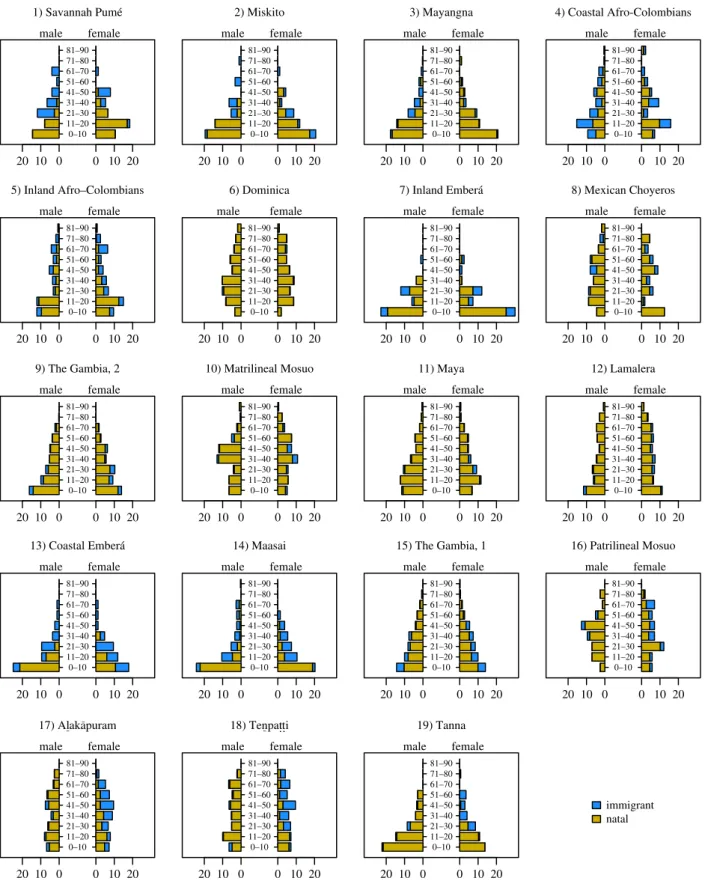
The data for this study were obtained by the authors via censuses and genealogical interviews at their respective field sites (table 1). As noted, the sites exhibit diverse social organization, demography and subsistence strategies (see the electronic sup-plementary material for brief descriptions of each site). For all living residents in the respective study communities, the authors compiled data on age, sex and whether or not individuals are natal members of the community (figure 1). This latter variable is subject to interpretation, given the diversity of move-ment patterns in human communities. When groupings are geographically and temporally ephemeral, for example, then it can be challenging to distinguish between natal and non-natal members of the community. In this sample of sites, the Savannah Pume´ of Venezuela exhibit such fluidity, and few older residents are therefore considered natal members of the community. Ana-logously, the Maasai community in this sample is a relatively new settlement that attracted a diverse set of immigrants, result-ing in few older residents who are considered natal members of the community. More generally, the co-authors had to categorize individuals such as temporary migrants, children who had relo-cated with their parents, and foster children. The co-authors attempted to standardize norms about the categorization of such individuals, generally tending toward conservatism in the categorization of natal residents. For instance, children of divorced women who subsequently marry into a new commu-nity are generally not considered natal members of the new community. Therefore, relative to immigrants, the comparability of predictions for natal residents is less impacted by the fluidity of residence that characterizes several of the study sites.
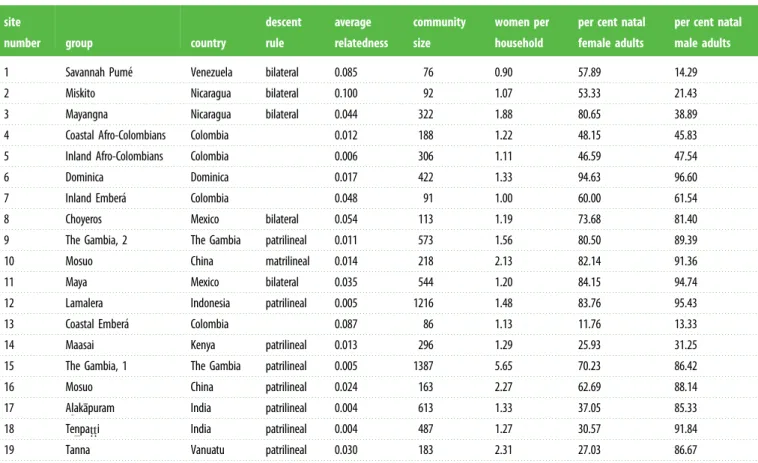
Table 1. Descriptive statistics for the study sites. Descent rules are reported when known. Sample size corresponds to the number of residents in the
communities. Natality status was calculated only among adults (males older than 21 and females older than 18). For each respective sex, the percentages in the
table reflect the proportion of adults who are natal members of the study community. For the data on average women per household, the household is
considered to be the most relevant resource-sharing units at that locale. For the Gambian study sites, these correspond to multi-family compounds. Blank cells
for the descent rules indicate a lack of information.
site
number group country
descent rule average relatedness community size women per household
per cent natal female adults
per cent natal male adults
1 Savannah Pume´ Venezuela bilateral 0.085 76 0.90 57.89 14.29
2 Miskito Nicaragua bilateral 0.100 92 1.07 53.33 21.43
3 Mayangna Nicaragua bilateral 0.044 322 1.88 80.65 38.89
4 Coastal Afro-Colombians Colombia 0.012 188 1.22 48.15 45.83
5 Inland Afro-Colombians Colombia 0.006 306 1.11 46.59 47.54
6 Dominica Dominica 0.017 422 1.33 94.63 96.60
7 Inland Embera´ Colombia 0.048 91 1.00 60.00 61.54
8 Choyeros Mexico bilateral 0.054 113 1.19 73.68 81.40
9 The Gambia, 2 The Gambia patrilineal 0.011 573 1.56 80.50 89.39
10 Mosuo China matrilineal 0.014 218 2.13 82.14 91.36
11 Maya Mexico bilateral 0.035 544 1.20 84.15 94.74
12 Lamalera Indonesia patrilineal 0.005 1216 1.48 83.76 95.43
13 Coastal Embera´ Colombia 0.087 86 1.13 11.76 13.33
14 Maasai Kenya patrilineal 0.013 296 1.29 25.93 31.25
15 The Gambia, 1 The Gambia patrilineal 0.005 1387 5.65 70.23 86.42
16 Mosuo China patrilineal 0.024 163 2.27 62.69 88.14
17 Alaka¯puram India patrilineal 0.004 613 1.33 37.05 85.33
18 Tenpat.t.i India patrilineal 0.004 487 1.27 30.57 91.84
19 Tanna Vanuatu patrilineal 0.030 183 2.31 27.03 86.67
ro
yalsocietypublishing.org/journal/rs
tb
Phil.
Trans.
R.
Soc.
B
374
:
20180069
3For each site, the data also includes genealogical relation-ships that were elicited via interviews with informants. These genealogies permit the calculation of relatedness among indi-vidual residents of the communities. These calculations employ standard methods for estimating the coefficient of relat-edness from genealogies [17]. For any given dyad, the coefficient is therefore constrained to lie between 0 and 1, which we anticipate to provide a useful approximation of genetic similarity. The genealogies from our study sites include
at least three generations of depth for residents, typically per-mitting us to distinguish cousins and closer genealogical relationships. As shown by Pemberton [18], pedigrees of three generations capture much of the variation in genetic relatedness among individuals. Some datasets provide even greater depth, and this varying thoroughness introduces between-site vari-ation into the sample. In some communities, most notably the matrilineal Mosuo community, women were often unable to reliably indicate the father of their children. The data are 20 10 0 0 10 20 0–10 11–20 21–30 31–40 41–50 51–60 61–70 71–80 81–90 male female 2) Miskito 1) Savannah Pumé 20 10 0 0 10 20 0–10 11–20 21–30 31–40 41–50 51–60 61–70 71–80 81–90 male female 3) Mayangna 20 10 0 0 10 20 0–10 11–20 21–30 31–40 41–50 51–60 61–70 71–80 81–90 male female 4) Coastal Afro-Colombians 20 10 0 0 10 20 0–10 11–20 21–30 31–40 41–50 51–60 61–70 71–80 81–90 male female 5) Inland Afro–Colombians 20 10 0 0 10 20 0–10 11–20 21–30 31–40 41–50 51–60 61–70 71–80 81–90 male female 6) Dominica 20 10 0 0 10 20 0–10 11–20 21–30 31–40 41–50 51–60 61–70 71–80 81–90 male female 20 10 0 0 10 20 0–10 11–20 21–30 31–40 41–50 51–60 61–70 71–80 81–90 male female 8) Mexican Choyeros 20 10 0 0 10 20 0–10 11–20 21–30 31–40 41–50 51–60 61–70 71–80 81–90 male female 9) The Gambia, 2 20 10 0 0 10 20 0–10 11–20 21–30 31–40 41–50 51–60 61–70 71–80 81–90 male female 10) Matrilineal Mosuo 20 10 0 0 10 20 0–10 11–20 21–30 31–40 41–50 51–60 61–70 71–80 81–90 male female 11) Maya 20 10 0 0 10 20 0–10 11–20 21–30 31–40 41–50 51–60 61–70 71–80 81–90 male female 12) Lamalera 20 10 0 0 10 20 0–10 11–20 21–30 31–40 41–50 51–60 61–70 71–80 81–90 male female 20 10 0 0 10 20 0–10 11–20 21–30 31–40 41–50 51–60 61–70 71–80 81–90 male female 14) Maasai 20 10 0 0 10 20 0–10 11–20 21–30 31–40 41–50 51–60 61–70 71–80 81–90 male female 15) The Gambia, 1 20 10 0 0 10 20 0–10 11–20 21–30 31–40 41–50 51–60 61–70 71–80 81–90 male female 16) Patrilineal Mosuo 20 10 0 0 10 20 0–10 11–20 21–30 31–40 41–50 51–60 61–70 71–80 81–90 male female 17) Al ¯aka ¯puram 20 10 0 0 10 20 0–10 11–20 21–30 31–40 41–50 51–60 61–70 71–80 81–90 male female 18) Ten ¯pat.t.i 20 10 0 0 10 20 0–10 11–20 21–30 31–40 41–50 51–60 61–70 71–80 81–90 male female 19) Tanna 20 10 0 0 10 20 0–10 11–20 21–30 31–40 41–50 51–60 61–70 71–80 81–90 male female immigrant natal 13) Coastal Emberá 7) Inland Emberá
Figure 1. Population pyramids for the study communities. In the plot, sites are ordered in row-wise fashion according to the ratio of adult female natality to adult
male natality (the quotient of the respective quantities in table 1). The numbers on the horizontal axes represent the percentage of the total represented by the
respective age-sex categories.
ro
yalsocietypublishing.org/journal/rs
tb
Phil.
Trans.
R.
Soc.
B
374
:
20180069
4cross-sectional and represent the composition of the community at a single point in time.
In our primary analysis, we examine the average relatedness of adults to other adult residents in the community. A focus on adults has parallels to the ethological literature and its attention to inbreeding avoidance among reproductively mature individ-uals [19]. Accordingly, we consider females to be adults when they are 18 years or older and males to be adults when they are 21 years or older. These ages align with evidence that Ache´ women typically give birth the first time at 19 years old and that men in natural fertility populations are commonly 3 years older than women when their first child is born [20,21].
The analysis is oriented primarily toward illuminating demographic patterns within the respective study sites. We therefore model average relatedness at each site separately using regression models with the main effects and interaction terms of the three predictor variables: age, sex and natality. In some datasets, there were missing values for individuals’ age and natality. Typically, these individuals were not permanent residents of the respective communities, so although their genea-logical connections were included in the calculations of dyadic relatedness, the average relatedness of these individuals were not included in the statistical models. Because the outcome vari-able, average relatedness, is bounded to lie between 0 and 1, we use beta regression models [22]. Since average relatedness for some individuals is zero, we add a constant (0.0001) to all values for identifiability of model parameters.2We interpret the
models graphically, plotting their predictions as a function of age interacted with the categorical predictors, sex and natality. As a supplemental analysis, we model average relatedness among all individuals in the study communities, including chil-dren. We also consider a multilevel analysis of the aggregated cross-cultural dataset, and we evaluate simpler site-specific models that omit sex as a predictor.
Models are fit with Markov chain Monte Carlo estimation using functions from the Rstan package [23] and auxiliary func-tions from the rethinking package [24]. Weak regularizing priors are implemented for all model parameters. We do not adopt any particular threshold for statistical significance, but we make sure to note the effects for which the models consistently predict age-related increases or decreases in the posterior samples. Data and coding scripts are available as supplemental files on the Open Science Framework (https://osf.io/h8cqr/).
3. Results
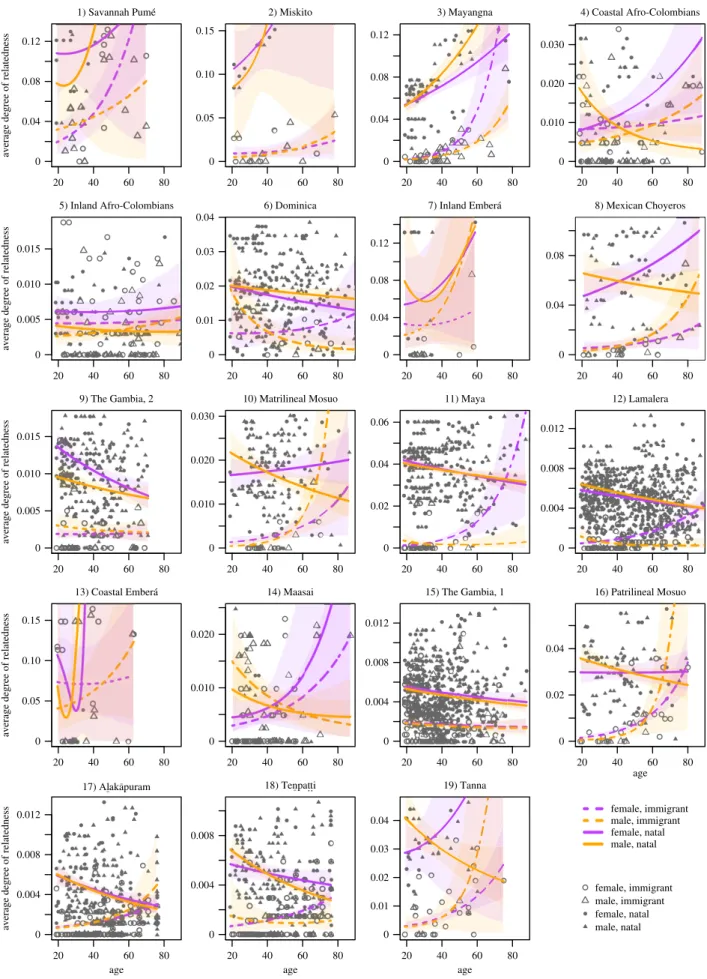
Our models examine the average relatedness of individual adults to all other adults in the community. Model predic-tions for each site are plotted in figure 2 (see also electronic supplementary material, table S1). Before interpreting predic-tions for specific sites, it is important to acknowledge that the confidence in predictions is a reflection of varying sample sizes, both across sites and across demographic subclasses within sites. In smaller communities, such as the Embera´ sites, the predicted slopes may exhibit high heterogeneity, but there is little confidence that the slopes are conclusively positive or negative, nor are the slopes for demographic sub-classes distinguishable from each other. The uncertainty relates in part to the small size of these communities, though another consideration is the high mobility and disper-sal rates that characterize these sites. That is not to say that age-related variation in relatedness cannot be discerned in small communities. The Savannah Pume´ community is also small, but for immigrant females, the model confidently pre-dicts an increase in relatedness with age. Similarly, low sample sizes within demographic subclasses can also
reduce confidence in the corresponding model predictions. At the patrilineal Mosuo site, for example, the predicted effects of age are roughly comparable for male and female immigrants. However, there are substantially more female immigrants than male immigrants. Consequently, there is relatively more confidence in predictions for the average female immigrant.
In larger communities, individuals exhibit minimal relatedness to most of the other residents. This lowers the average relatedness among residents, and slopes in these communities typically seem relatively flat. Because of the larger sample size in communities, however, there is higher confidence in the predicted means (e.g. the downward trends in Lamalera). On the other hand, a comparison of the predicted values to the empirical data shows that age and the moderating effects of sex and natality typically explain only a modicum of the variation in average relatedness in large communities.
With those caveats in mind, we assess model predictions. Initially, we focus on age-related increases in average related-ness given the importance of such increases in recent theorizing of reproductive conflict [1]. For natal residents, increases with age are rare and evident primarily among males and females in the Mayangna community (site 3) and the female residents of the Coastal Afro-Colombian commu-nity (site 4) and the Mexican choyero commucommu-nity (site 8). For immigrants, increases are relatively more common and apparent among female immigrants in the patrilineal com-munities of Lamalera (site 12), the patrilineal Mosuo (site 16), Alaka¯puram (site 17), Tenpat.t.i (site 18) and Tanna (site 19). Similar age-related increases for female immigrants are evident in two communities characterized by bilateral descent and female philopatry, the Savannah Pume´ (site 1) and Mayangna (site 3). For male immigrants, conclusive age-related increases are evident primarily in the Mayangna community.3 Collectively, these results accord with expec-tations from Johnstone & Cant [1] that adult immigrants initially have few kin in the community, but then their relat-edness increases over time as they have descendants who join them as residents in the group.
Although prevailing theories focus on age-related increases in relatedness over time, declines are also interest-ing because they imply a different set of tradeoffs that merit theoretical attention. In this sample, declines in average relatedness are evident in several communities. For instance, the statistical models predict decreases for both natal females and males in Lamalera (site 12) and Alaka¯puram (site 17). There is a decrease with age for natal males in Tenpat.t.i and a decrease for natal females in the smaller Gambian commu-nity (site 9). There is also moderate evidence for a decline in relatedness with age among natal residents of both sexes in the larger Gambian community (site 15). For natal females in Dominica (site 6), the predicted relationship with age also trends negative. Among immigrants, however, there is little evidence for decreases in relatedness with age at any of the sites.
(a) Supplemental analyses
For a supplementary analysis of age-related variation in relatedness, we also calculated and modelled average related-ness among all individuals in the community, including both adults and children (electronic supplementary material,
ro
yalsocietypublishing.org/journal/rs
tb
Phil.
Trans.
R.
Soc.
B
374
:
20180069
5figure S1 and table S2). In general, the predictions from these models resemble the models for relatedness among adults. Noteworthy differences include the flattening of slopes for
female immigrants in Lamalera (site 12), the Maasai (site 14), Alaka¯puram (site 17) and Tenpat.t.i (site 18). This preliminarily suggests that juvenile female immigrants to 0 0.04 0.08 0.12 20 40 60 80 0 0.05 0.10 0.15 2) Miskito 20 40 60 80 0 0.04 0.08 0.12 3) Mayangna 20 40 60 80 0 0.010 0.020 0.030 4) Coastal Afro-Colombians 20 40 60 80 0 0.005 0.010 0.015 5) Inland Afro-Colombians 20 40 60 80 0 0.01 0.02 0.03 0.04 6) Dominica 20 40 60 80 0 0.04 0.08 0.12 20 40 60 80 0 0.04 0.08 8) Mexican Choyeros 20 40 60 80 0 0.005 0.010 0.015 9) The Gambia, 2 20 40 60 80 0 0.010 0.020 0.030 10) Matrilineal Mosuo 20 40 60 80 0 0.02 0.04 0.06 11) Maya 20 40 60 80 0 0.004 0.008 0.012 12) Lamalera 20 40 60 80 0 0.05 0.10 0.15 20 40 60 80 0 0.010 0.020 14) Maasai 20 40 60 80 0 0.004 0.008 0.012 15) The Gambia, 1 20 40 60 80 0 0.02 0.04 16) Patrilineal Mosuo 20 40 60 80 0 0.004 0.008 0.012 20 40 60 80 0 0.004 0.008 20 40 60 80 0 0.01 0.02 0.03 0.04 19) Tanna 20 40 60 80 female, immigrant male, immigrant female, natal male, natal female, immigrant male, immigrant female, natal male, natal
age age age
age
average degree of relatedness
average degree of relatedness
average degree of relatedness
average degree of relatedness
average degree of relatedness
7) Inland Emberá 1) Savannah Pumé 13) Coastal Emberá 17) Al ¯aka ¯puram 18) Ten ¯pat.t.i
Figure 2. Model predictions for adults’ relatedness to all other adults in the study communities, which is expected to vary as a function of individuals’ age, sex and
natality status. All predictions are based on beta regression models with three-way interaction terms (and the corresponding two-way interactions) between these
variables. Shaded intervals depict 89% confidence intervals around model predictions. Note that the scale of the vertical axis changes for each community. Sites are
ordered in row-wise fashion according to the ratio of adult female natality to adult male natality (the quotient of the respective quantities in table 1).
ro
yalsocietypublishing.org/journal/rs
tb
Phil.
Trans.
R.
Soc.
B
374
:
20180069
6these communities have more kin ties ( potentially including siblings) than women who arrive as adults. There is also clearer evidence for age-related increases in relatedness among natal males and females in the Miskito community (site 2).
As an additional supplementary analysis, we aggregated and analysed the cross-cultural dataset using a multilevel beta regression model. For this analysis, we calculated the proportion of adult males and females in each community who are natal residents to reflect patrilocal or matrilocal biases (these quantities are reported in table 1). These ‘contex-tual effects’ are then separately interacted with the individual-level effects, age, sex and natality. The purpose of these models is to assess whether matrilocal and patrilocal biases in the communities moderate the age-related variation that is evident among individuals. Perhaps because they are overparametrized, these statistical models largely recapitulate our prior findings, revealing few noteworthy differences that vary as a function of the residence biases that characterize the study communities (electronic supplementary material, figure S3). Overall, in these aggregated models, the most con-sistent difference is between the average relatedness of natal residents and immigrants. As in the model of Johnstone & Cant [1], the philopatric sex consistently exhibits higher relatedness to group members.
Finally, we view these analyses primarily as descriptive and exploratory, which initially led us to consider the full three-way interactions between age, sex and natality. However, visual inspection of the predictions in figure 2 reveals that, con-ditional on age and natality, there are few differences between males and females. In the supplemental file, we consider sim-pler models that omit sex as a predictor and moderator. These models often receive greater Watanabe–Akaike information criterion weight than the models presented here. In other words, in models that include age and natality as predictors, sex typically explains little variation in average relatedness (electronic supplementary material, table S4).
4. Discussion
Our analyses show age-related increases in relatedness among immigrants in several of the study communities that conform to predictions [1]. That is, immigrants of the more commonly dispersing sex initially have low relatedness, but they accrue more kinship ties as they age and reproduce. These increases are evident both among immigrant females to societies in which most males remain in their natal locality ( patrilocal communities) and among migrating males in societies in which most females do not move (matrilocal com-munities). Not all communities show this pattern, however, and exceptions occur especially among the Gambian commu-nities and the small commucommu-nities with fluid residence patterns and unstable settlement histories. This fluidity also suggests that traditional labels of matrilocality versus patrilo-cality do not fully capture the diversity of migration patterns across human communities. Nevertheless, our results provide partial support for the prediction that average relatedness of immigrants to other group members increases as they age. That is, in societies where immigrants exhibit changes in relatedness that vary as a function of age, the effects are positive, not negative. However, the predicted positive effects are not evident at all study sites. In the
following, we discuss additional factors that were not mod-elled in this analysis, but that potentially shape the observed variation in kinship ties across the lifespan.
In this analysis of community relatedness, age is seldom associated with increases in average relatedness among natal members of the community. A notable exception is the Mayangna site in Nicaragua. The increase for females in this community is noteworthy because there are biases toward matrilocality and dispersal by males. This result therefore departs from the conceptual model advanced by Johnstone & Cant [1], which anticipates that females in such circumstances would start to show gradual declines in average relatedness as they age. To explain this departure, a factor to consider is the high fertility rate and population growth in this indigenous Nicaraguan community. As a matriline expands, older women are increasingly surrounded by daughters (r ¼ 0.5) and nieces (r ¼ 0.25).4By contrast, for younger females in an expanding population, a high pro-portion of their peers are cousins (r ¼ 0.125). To some extent, therefore, the effects of age on relatedness at this site may be a by-product of the population growth rate, which is considerably higher than the long-term growth rates that characterized Paleolithic and Neolithic human popula-tions [25].5 Conversely, decreases in age-related relatedness were observed for natal residents of several communities that have a lower ratio of younger to older individuals (e.g. Alaka¯puram), which suggests a potential need to account for demographic non-stationarity in populations when conducting comparative research on kinship (see [26] for a similar argument).
To explain cross-cultural heterogeneity in relatedness across the lifespan, we argue that there are likely to be recur-sions between relatedness and demographic outcomes. In other words, the fertility, mortality and dispersal of individ-uals plausibly vary in response to the presence of kin in the group. Over time, variation in these outcomes can conse-quently amplify or reduce relatedness to other group members. For instance, high average relatedness among older individuals could indicate greater longevity or fertility due to support from kin, possibly augmented by the disper-sal of individuals with few local kinship ties. Effects of kin on fertility and mortality have received substantial attention from human behavioural ecologists [27,28]. By comparison, dispersal in human populations has received less attention [29,30]. Studies of non-human mammals provide evidence of facultative dispersal strategies as a function of the presence and rank of local kin [31 –34]. Comparable anthropological research is empirically challenging, but ethnographers who conduct longitudinal studies can potentially examine decisions about residence and dispersal as kin availability fluctuates. In addition, there is an opportunity for theoretical models and simulations that allow demographic outcomes to vary non-randomly and dynamically in response to local kinship ties. In particular, whereas the theoretical model of Johnstone & Cant [1] assumes that all individuals have equiv-alent probabilities for reproduction, dispersal and mortality, it is beneficial to consider models in which these probabilities depend in part on an individual’s relatedness to others in the group.
Whereas adult immigrants frequently show increases over time in average relatedness, these effects were not apparent in the Gambian communities, which were previously analysed by Mace & Alvergne [16]. Polygyny is the norm in this
ro
yalsocietypublishing.org/journal/rs
tb
Phil.
Trans.
R.
Soc.
B
374
:
20180069
7setting, and men and their wives live in extended family com-pounds. For females at this study site, although there were minimal changes in average relatedness with age when exam-ining kinship among all members of the community, their relatedness to other adults in the compound increased as their offspring reached adulthood.6In other words, whereas the predicted effects were not evident in our community-level analysis, age-related variation in relatedness to other compound members accords with expectations from the Johnstone & Cant [1] model.
The discrepancy from the Gambia between relatedness in compounds and communities provides a cautionary note regarding the interpretation of the results of this study. That is, reproductive conflict is expected to be acute when individuals are drawing on the same resources. For example, the killer whales studied by Croft et al. [13] live in pods com-posed of closely related individuals who share access to harvested food resources. Ethnographically, there are
analo-gous examples of human communities that share
food resources communally, including indigenous South Americans who collectively prepare and consume meals as a community [35]. More commonly, however, residents of human communities share preferentially with subsets of co-residents, including close kin [36–39]. Whereas our analysis helps to substantiate the asymmetries of relatedness that dis-tinguish young immigrants from older affinal kin, this does not necessarily imply that these respective individuals are drawing on the same resources. In some settings, it is plaus-ible that humans facultatively employ behavioural strategies to minimize such reproductive competition.
In communities that are characterized by discriminative sharing, research would ideally be directed at the dynamics of kinship within resource-sharing subgroups [40,41]. In most ethnographic settings, however, there are methodological chal-lenges that hinder such analyses, particularly the task of distinguishing the boundaries of the subgroups. At most of our study sites, individuals are organized in small households, usually occupied by a single adult woman (table 1). As a result, there are minimal opportunities for reproductive competition within females in the same household. Yet, households often maintain strong cooperative ties to other households in the community. The pooling of resources among households pro-duces the conditions in which reproduction competition could be pronounced [1]. A key challenge is that these inter-household ties are rarely evident when using standard demographic and census methods. As a possible alternative, a combination of social network surveys [17] and community detection algorithms [42,43] could potentially provide opportu-nities to identify the subgroups in which reproductive competition is especially relevant for life-history strategies.7
5. Conclusion
In this study, we have considered a cross-cultural sample of sites with heterogeneous patterns of residence and dispersal. The sample includes sites at which dispersal is biased toward females (e.g. Tenpat.t.i) or males (e.g. Mayangna). At other sites, including several of the larger communities, the majority of residents of both sexes are natal members of the community. There are also sites, including those affected by political disruptions (e.g. Colombia), at which most adults of both sexes are immigrants. Amid this variability, several study sites feature increases in relatedness that support
prevailing conceptual models [1]. That is, immigrants of the more commonly dispersing sex tend to show increases in local relatedness as they get older. There are noteworthy excep-tions to this generalization, and given the limitaexcep-tions of the sample, it is premature to assume that this pattern typifies the majority of human communities. Furthermore, the demo-graphic variables in this analysis usually explain only a minority of the observed variation in relatedness, which implies opportunities for additional variables to explain heterogeneity in kin ties. Nevertheless, evidence of the pre-dicted asymmetries in relatedness are apparent in multiple settings, reinforcing the potential value of additional empirical research on inter-generational reproductive conflict [5,46–48].
More generally, this cross-cultural study reveals
surprisingly diverse relationships between age and kinship in human communities. These results reinforce perspectives on the flexible kinship that distinguishes humans from other hominoids [11]. There are pitfalls to reasoning from ethnographic analogy, but this flexibility motivates a reconsi-deration of human kinship and life-history strategies. Currently, research is directed toward discerning the social structure of prehistoric hominins with the assumption that distinctive life-history traits evolved partly as a consequence of this social organization [1]. From this perspective, the emergence of flexible kinship arrangements in human societies is largely an epilogue that postdates the evolution of more remarkable human traits. However, the malleability of human kinship enables diverse adaptive responses to socio-ecological challenges. It is worthwhile to consider scen-arios in which life-history traits evolved concurrently with the ability to reside and cooperate with different classes of kin throughout one’s lifetime.
In terms of female-biased kinship, the theme of this special issue of Philosophical Transactions, this cross-cultural study underscores the importance of dispersal as a determi-nant of kin availability. In most cases, young adult immigrants to new communities have fewer co-resident kin than their same-aged natal counterparts. Although female immigrants can maintain intermittent affiliative ties to family members from their natal communities [49], women who do not disperse can expect to be surrounded by kin more consistently during their reproductive years. Therefore, in combination with broader debates about descent rules and daughter-biased inheritance [50], heterogeneity in female philopatry has a key role to play in evolutionary accounts of human social organization. A contribution of this study is that dispersal tendencies vary not only across societies, but also within populations. Dispersal is seldom obligatory, and a mixture of natal male and female adults is observable in nearly all study communities (see also [51]). Decisions about dispersal impose trade-offs on individuals, and society-level variation in residence rules may be explained in part by unidentified individual-level predictors that cap-ture heterogeneous effects both across and within the sexes.
Data accessibility.Data are available as supplemental files on the Open
Science Framework (https://osf.io/h8cqr/).
Authors’ contributions.J.K. and D.L. conceived of the study, conducted the
analysis and drafted the manuscript. The data were contributed by authors: Savannah Pume´ and Maya (K.K. and R.G.), Miskito and Mayangna (J.K.), Coastal Afro-Colombians, Inland Afro-Colombians, Inland Embera´ and Coastal Embera´ (C.T.R.), Mexican Choyeros (S.M.), The Gambia 1 and The Gambia 2 (R.M. and A.A.), Matrilineal Mosuo and Patrilineal Mosuo (S.M., A.R. and C.Y.), Lamalera (D.N.),
ro
yalsocietypublishing.org/journal/rs
tb
Phil.
Trans.
R.
Soc.
B
374
:
20180069
8Maasai (M.C.), Alaka¯puram and Tenpat.t.i (E.P.) and Tanna (E.M., A.R. and S.M.). All authors read and commented on the manuscript.
Competing interests.The authors declare that they have no competing
interests.
Funding.No funding has been received for this article.
Acknowledgements.We are grateful to colleagues at the Max Planck
Insti-tute for Evolutionary Anthropology and the University of Utah who provided preliminary feedback on the conceptualization and an early draft of this paper.
Endnotes
1Whereas we follow Croft et al. [13] by focusing on average
related-ness as our outcome variable, we include a supplemental analysis in which we model the number of close kin in the community as the outcome variable.
2Alternatively, fitting the models as zero-augmented (hurdle) beta
regression models provides qualitatively similar predictions.
3There is also moderate evidence for a positive slope for male
immi-grants in several additional communities, including the Mexican choyero community (site 8), the two Mosuo communities (sites 10 and 16) and Alaka¯puram (site 17). However, the low number of male immigrants in these communities precludes strong conclusions about this demographic subgroup.
4These coefficients of relatedness assume monogamous mating. 5
Bottom-heavy population pyramids are evident at other study sites (e.g. Maasai) without accompanying age-related increases in average relatedness, which suggests that other factors can potentially counter-act the age-related accumulation of close kinship ties in expanding populations.
6The dataset for that paper is the same used for the Gambian sites
in this paper. Unlike the 2012 paper, however, the present study depicts results separately for each community rather than modelling individuals in an aggregated dataset.
7In addition to the Social Relations Model that has been used by
evol-utionary anthropologists (e.g. [44]), there are related statistical models that permit the identification of block structures in social network data, including models that permit the inclusion of covariates (e.g. [45]).
References
1. Johnstone RA, Cant MA. 2010 The evolution of menopause in cetaceans and humans: the role of demography. Proc. R. Soc. B 277, 3765 – 3771. (doi:10.1098/rspb.2010.0988)
2. Williams GC. 1957 Pleiotropy, natural section, and the evolution of senescence. Evolution 11, 398 – 411. (doi:10.1111/evo.1957.11.issue-4) 3. Hawkes K. 2003 Grandmothers and the evolution of
human longevity. Am. J. Hum. Biol. 15, 380 – 400. (doi:10.1002/(ISSN)1520-6300)
4. Cant MA, Johnstone RA. 2008 Reproductive conflict and the separation of reproductive generations in humans. Proc. Natl Acad. Sci. USA 105, 5332 – 5336. (doi:10.1073/pnas.0711911105)
5. Lahdenpera¨ M, Gillespie DOS, Lummaa V, Russell AF. 2012 Severe intergenerational reproductive conflict and the evolution of menopause. Ecol. Lett. 15, 1283 – 1290. (doi:10.1111/j.1461-0248.2012. 01851.x)
6. Hamilton WD. 1972 Altruism and related phenomena, mainly in social insects. Annu. Rev. Ecol. Syst. 3, 193 – 232. (doi:10.1146/annurev.es.03. 110172.001205)
7. Clutton-Brock TH, Lukas D. 2012 The evolution of social philopatry and dispersal in female mammals. Mol. Ecol. 21, 472 – 492. (doi:10.1111/j.1365-294X. 2011.05232.x)
8. Greenwood PJ. 1980 Mating systems, philopatry and dispersal in birds and mammals. Anim. Behav. 28, 1140 – 1162. (doi:10.1016/S0003-3472(80)80103-5) 9. Kirkpatrick RC. 2007 Asian colobines: diversity
among leaf-eating monkeys. In Primates in perspective (eds CJ Campbell, A Fuentes, KC MacKinnon, N Panger, SK Bearder), pp. 186 – 200. New York, NY: Oxford University Press. 10. Bradley BJ, Doran-Sheehy DM, Vigilant L. 2007
Potential for female kin associations in wild western gorillas despite female dispersal. Proc. R. Soc. B 274, 2179 – 2185. (doi:10.1098/rspb.2007.0407) 11. Chapais B. 2013 Monogamy, strongly bonded
groups, and the evolution of human social structure.
Evol. Anthropol. 22, 52 – 65. (doi:10.1002/evan. 21345)
12. Silk JB, Altmann J, Alberts SC. 2006 Social relationships among adult female baboons (Papio cynocephalus) I. Variation in the strength of social bonds. Behav. Ecol. Sociobiol. 61, 183 – 195. (doi:10. 1007/s00265-006-0249-2)
13. Croft DP et al. 2017 Reproductive conflict and the evolution of menopause in killer whales. Curr. Biol. 27, 298 – 304. (doi:10.1016/j.cub.2016.12.015) 14. Marlowe FW. 2004 Marital residence among
foragers. Curr. Anthropol. 45, 277 – 284. (doi:10. 1086/382256)
15. Goodenough WH. 1956 Residence rules. Southwestern J. Anthropol. 12, 22 – 37. (doi:10. 1086/soutjanth.12.1.3628856)
16. Mace R, Alvergne A. 2012 Female reproductive competition within families in rural Gambia. Proc. R. Soc. B 279, 2219 – 2227. (doi:10.1098/rspb. 2011.2424)
17. Koster JM. 2018 Family ties: the multilevel effects of households and kinship on the networks of individuals. R. Soc. Open Sci. 5, 172159. (doi:10. 1098/rsos.172159)
18. Pemberton JM. 2008 Wild pedigrees: the way forward. Proc. R. Soc. B 275, 613 – 621. (doi:10. 1098/rspb.2007.1531)
19. Clutton-Brock TH. 1989 Female transfer and inbreeding avoidance in social mammals. Nature 337, 70 – 72. (doi:10.1038/337070a0) 20. Hill K, Hurtado AM 1996 Ache life history: the
ecology and demography of a foraging people. London, UK: Routledge.
21. Fenner JN. 2005 Cross-cultural estimation of the human generation interval for use in genetics-based population divergence studies. Am. J. Phys. Anthropol. 128, 415 – 423. (doi:10.1002/ajpa.20188) 22. Ferrari S, Cribari-Neto F. 2004 Beta regression for modelling rates and proportions. J. Appl. Stat. 31, 799 – 815. (doi:10.1080/0266476042000 214501)
23. Stan Development Team. 2018 RStan: the R interface to Stan. R package version 2.17.3. See http://mc-stan.org.
24. McElreath R 2015 Statistical rethinking: a Bayesian course with examples in R and stan. Boca Raton, FL: CRC Press.
25. Wells JCK, Stock JT. 2007 The biology of the colonizing ape. Am. J. Phys. Anthropol. 134, 191 – 222. (doi:10.1002/(ISSN)1096-8644) 26. Beckerman AP, Sharp SP, Hatchwell BJ. 2011
Predation and kin-structured populations: an empirical perspective on the evolution of cooperation. Behav. Ecol. 22, 1294 – 1303. (doi:10.1093/beheco/arr131)
27. Sear R, Mace R. 2008 Who keeps children alive? A review of the effects of kin on child survival. Evol. Hum. Behav. 29, 1 – 18. (doi:10.1016/j.evol humbehav.2007.10.001)
28. Kramer KL. 2010 Cooperative breeding and its significance to the demographic success of humans. Annu. Rev. Anthropol. 39, 417 – 436. (doi:10.1146/ annurev.anthro.012809.105054)
29. Towner MC. 2001 Linking dispersal and resources in humans. Hum. Nat. 12, 321 – 349. (doi:10.1007/ s12110-001-1002-1)
30. Kramer KL, Schacht R, Bell A. 2017 Adult sex ratios and partner scarcity among hunter-gatherers: implications for dispersal patterns and the evolution of human sociality. Phil. Trans. R. Soc. B 372, 20160316. (doi:10.1098/rstb. 2016.0316)
31. Chapais B. 1983 Matriline membership and male rhesus reaching high ranks in natal troops. In Primate social relationships: an integrated approach (ed. RA Hinde), pp. 171 – 175. Sunderland, MA: Sinauer Associates.
32. Moore J. 1993 Inbreeding and outbreeding in primates: what’s wrong with ‘the dispersing sex’. In The natural history of inbreeding and outbreeding (ed. N Wilmsen Thornhill), pp. 392 –426. Chicago, IL: University of Chicago Press.
ro
yalsocietypublishing.org/journal/rs
tb
Phil.
Trans.
R.
Soc.
B
374
:
20180069
933. Armitage KB, Van Vuren DH, Ozgul A, Oli MK. 2011 Proximate causes of natal dispersal in female yellow-bellied marmots, Marmota flaviventris. Ecology 92, 218 – 227. (doi:10.1890/10-0109.1) 34. Hoogland JL. 2013 Prairie dogs disperse when all
close kin have disappeared. Science 339, 1205 – 1207. (doi:10.1126/science.1231689) 35. Beckerman S, Valentine P, Eller E. 2002 Conservation
and native Amazonians: why some do and some don’t. Antropologica 96, 31 – 51.
36. Gurven M. 2004 To give and to give not: the behavioral ecology of human food transfers. Behav. Brain Sci. 27, 543 – 559. (doi:10.1017/
S0140525X04000123)
37. Allen-Arave W, Gurven M, Hill K. 2008 Reciprocal altruism, rather than kin selection, maintains nepotistic food transfers on an Ache reservation. Evol. Hum. Behav. 29, 305 – 318. (doi:10.1016/j. evolhumbehav.2008.03.002)
38. Nolin D. 2011 Kin preference and partner choice. Hum. Nat. 22, 156 – 176. (doi:10.1007/s12110-011-9113-9)
39. Koster J, Leckie G. 2014 Food sharing networks in lowland Nicaragua: an application of the social
relations model to count data. Soc. Netw. 38, 100 – 110. (doi:10.1016/j.socnet.2014.02.002) 40. Frank SA 1998 Foundations of social evolution.
Princeton, NJ: Princeton University Press. 41. West SA, Pen I, Griffin AS. 2002 Cooperation and
competition between relatives. Science 296, 72 – 75. (doi:10.1126/science.1065507)
42. Girven M, Newman MEJ. 2002 Community structure in social and biological networks. Proc. Natl Acad. Sci. USA 99, 7821 – 7826. (doi:10.1073/pnas. 122653799)
43. Aven BL. 2015 The paradox of corrupt networks: an analysis of organizational crime at Enron. Organiz. Sci. 26, 980 – 996. (doi:10.1287/orsc.2015.0983) 44. Koster J, Aven B. 2018 The effects of individual status and group performance on network ties among teammates in the National Basketball Association. PLoS ONE 13, e0196013. (doi:10.1371/ journal.pone.0196013)
45. Sweet TM. 2015 Incorporating covariates into stochastic blockmodels. J. Educat. Behav. Statist. 40, 635 – 664. (doi:10.3102/1076998615606110) 46. Ji T, Wu J, He Q, Xu J, Mace R, Tao Y. 2013
Reproductive competition between females in the
matrilineal Mosuo of southwestern China. Phil. Trans. R. Soc. B 368, 20130081. (doi:10.1098/rstb. 2013.0081)
47. Snopkowski K, Moya C, Sear R. 2014 A test of the intergenerational conflict model in Indonesia shows no evidence of earlier menopause in female-dispersing groups. Proc. R. Soc. B 281, 20140580. (doi:10.1098/rspb.2014.0580)
48. Pettay JE, Lahdenpera¨ M, Rotkirch A, Lummaa V. 2016 Costly reproductive competition
between co-resident females in humans. Behav. Ecol. 27, 1601 – 1608. (doi:10.1093/beheco/ arw088)
49. Scelza BA. 2011 Female mobility and postmarital kin access in a patrilocal society. Hum. Nat. 22, 377 – 393. (doi:10.1007/s12110-011-9125-5)
50. Mattison SM. 2011 Evolutionary contributions to solving the ‘Matrilineal Puzzle’. Hum. Nat. 22, 64 – 88. (doi:10.1007/s12110-011-9107-7)
51. Walker RS et al. 2012 Living with kin in lowland horticultural societies. Curr. Anthropol. 54, 96 – 103. (doi:10.1086/668867)