The MIT Faculty has made this article openly available. Please share how this access benefits you. Your story matters.
Citation Patzold, M., T. P. Andert, S. W. Asmar, J. D. Anderson, J.- P. Barriot, M. K. Bird, B. Hausler, et al. “Asteroid 21 Lutetia: Low Mass, High Density.” Science 334, no. 6055 (October 27, 2011): 491–492.
As Published http://dx.doi.org/10.1126/science.1209389
Publisher American Association for the Advancement of Science (AAAS)
Version Author's final manuscript
Citable link http://hdl.handle.net/1721.1/103947
Terms of Use Creative Commons Attribution-Noncommercial-Share Alike
lutetia_paper_2011_v15_brevia.doc, 10.08.201108.08.2011
1
Asteroid (21) Lutetia – low mass, high density
2
3
M. Pätzold (1), T. P. Andert (2), S.W. Asmar (3), J.D. Anderson (3), J.-4
P. Barriot (4), M.K. Bird (5), B. Häusler (2), M. Hahn (1), S. Tellmann 5
(1), H. Sierks (6), P. Lamy (7), B.P. Weiss (8) 6
(1) Rheinisches Institut für Umweltforschung, Abt. Planetenforschung, 7
an der Universität zu Köln, Cologne, Germany 8
(2) Institut für Raumfahrttechnik, Universität der Bundeswehr München, 9
Neubiberg, Germany 10
(3) Jet Propulsion Laboratory, Caltech, Pasadena, California, USA 11
(4) Géosciences du Pacifique Sud, Université de la Polynésie 12
Française, BP 6570, 98702 FAA'A, Tahiti, Polynésie Francaise 13
(5) Argelander Institut für Astronomie, Universität Bonn, Bonn, Germany 14
(6) Max-Planck-Institut für Sonnensystemforschung, Katlenburg-Lindau, 15
Germany 16
(7) Laboratoire d'Astrophysique de Marseille, Marseille, France 17
(8) Dept. of Earth, Atmospheric and Planetary Sciences, Massachusetts 18
Institute of Technology, Cambridge, MA, USA 19
20
lutetia_paper_2011_v15_brevia.doc, 10.08.201108.08.2011
signals imposed by Lutetia's gravitational perturbation on the flyby trajectory are used to determine the mass of the asteroid. 24
Calibrating and correcting for all Doppler contributions not 25
associated with Lutetia, a least-squares fit to the residual 26
frequency observations from four hours before to six hours after 27
closest approach yields a mass of (1.700 +/- 0.017)·1018 kg (error: 28
1.0%). Using the volume model of Lutetia determined by the 29
Rosetta OSIRIS camera, the bulk density, an important parameter 30
for clues to its composition and interior, is (3.4 +/- 0.3)·103 kg/m3. 31
Asteroid (21) Lutetia, discovered in 1852, is one of the larger main belt 32
asteroids. In 2004, it became the flyby target asteroid for the Rosetta 33
mission. An important characteristic of an asteroid is its bulk density, 34
derived from its mass and its volume. Although there are a number of 35
asteroid mass determination techniques, by far the most accurate is 36
spacecraft tracking during a close flyby. 37
The velocity of a spacecraft flying by a body of sufficient size and at a 38
sufficiently close distance is perturbed by the attracting force of that 39
body. The perturbed velocity is estimated from the additional Doppler 40
shift of the transmitted radio signal in comparison with the expected 41
Doppler shift of an unperturbed trajectory (1). 42
The Rosetta flyby geometry at Lutetia on 10 July 2010 was suboptimal 43
because of the large flyby distance d=3168 +/- 7.5 km, the high relative 44
flyby velocity v0=14.99 km/s and the projection angle between the 45
lutetia_paper_2011_v15_brevia.doc, 10.08.201108.08.2011
relative velocity and the direction to Earth of
α
=171.2°, all of which 46reduced the post-encounter amplitude of the expected Doppler shift. 47
The final Doppler frequency shift six hours after the closest approach 48
after correcting for contributions not associated with Lutetia (see 49
Supporting Online Material SOM) is
∆
f=36.2±0.2 mHz (Figure 1). The 50value of GM from a least-squares fitting procedure and considering 51
further error sources is determined to be GM=(11.34±0.11)⋅10-2 km3s-2, 52
corresponding to a mass of (1.700±0.017)⋅1018 kg (error: 1.0%). The 53
uncertainty in GM considers the error from the least squares fit mainly 54
driven by the frequency noise (0.55%), the uncertainty in the Lutetia 55
ephemeris introduced by the uncertainty in the flyby distance of ±7.5 km 56
(0.24%) and the considered uncertainty in the tropospheric correction 57
introduced by the zenith delay model and the mapping function of the 58
ground station elevation (0.8%). These contributions yield a total 59
uncertainty of 1.0%. The values for GM and
∆
f agree within the error 60with the analytical solution (2). The derived mass is lower than other 61
mass determinations of Lutetia from astrometry (see SOM). 62
One of the most important global geophysical parameters, which 63
provide clues to the origin, internal structure and composition of Lutetia, 64
is the mean (bulk) density, derived from the mass and the volume. 65
Observations of the OSIRIS camera and ground observations using 66
adaptive optics were combined to model the global shape.. The derived 67
volume is (5.0±0.4)·1014 m3 (4). The volume leads to a bulk density of 68
(3.4 ± 0.3)·103 kg/m3. This high bulk density is unexpected in view of the 69
low value of the measured mass. It is one of the highest bulk densities 70
lutetia_paper_2011_v15_brevia.doc, 10.08.201108.08.2011
macroporosity of 12%, it would imply that the bulk density of its material constituents would exceed that of stony meteorites. Unless Lutetia has 73
anomalously low porosity compared to other asteroids in its size range, 74
its high density likely indicates a nonchondritic bulk composition 75
enriched in high atomic number like iron. It may also be evidence for a 76
partial differentiation of the asteroid body as proposed by Weiss et al. 77 (6). 78 79 Notes: 80
(1) Andert, T.P., P. Rosenblatt, M. Pätzold, B. Häusler, V. Dehant, G. L. Tyler, 81
and J. C. Marty, Precise mass determination and the nature of Phobos, 82
Geophysical Research Letters, Volume 37, Issue 9, CiteID L09202, 2010. 83
(2) As shown in (3), the expected final post-encounter Doppler shift of a two-84
way radio carrier signal is (α´=172.18° is the direction to Earth projected into 85
the flyby plane, β=3° is the direction angle to Earth above the flyby plane) 86
(
)
0 4fX GM sin ´cos f t c d vα
β
∆ → ∞ = ⋅ ⋅ 87Using the fit solution for Lutetia of GM = (11.34±0.11)⋅10-2 km3/s2 the 88
analytical result of the relation above is (36.4±0.4) mHz. 89
(3) Pätzold, M., T. P. Andert, B. Häusler, S. Tellmann, J. D. Anderson, S. W. 90
Asmar, J.-P. Barriot, and M. K. Bird, Pre-flyby estimates of the precision of the 91
mass determination of asteroid (21) Lutetia from Rosetta radio tracking, 92
Astronomy and Astrophysics, Volume 518, id.L156, 2010. (4) Sierks et al., this 93
issue, 2011. 94
lutetia_paper_2011_v15_brevia.doc, 10.08.201108.08.2011
(5) Similar high bulk densities are known for the asteroids (4) Vesta, (16) 95
Psyche, (20) Massalia, (22) Kalliope, all larger than Lutetia. Bulk densities of 96
more primitive C-type asteroids are in the range 1200 kg/m3 to 2700 kg/m3. 97
(6) Weiss, B.P., L.T. Elkins-Tanton, M.A. Barucci, H. Sierks, M. Pätzold, C. 98
Snodgrass, S. Marchi, I. Richter, P.R. Weissman, M. Fulchignoni and R.P. 99
Binzel, Evidence for thermal metamorphism or partial differentiation of asteroid 100
21 Lutetia from Rosetta, 42nd Lunar and Planetary Science Conference, 2077, 101
(2011).. 102
The Rosetta Radio Science Investigation (RSI) experiment is funded by DLR 103
Bonn under grants 50QM1002 (TA, BH) and 50QM1004 (MP, MH, ST, MKB) 104
and under a contract with NASA (SWA, JDA). We thank T. Morley for valuable 105
comments and all persons involved in Rosetta at ESTEC, ESOC, ESAC, JPL 106
and the ESTRACK and DSN ground stations for their continuous support. 107
lutetia_paper_2011_v15_brevia.doc, 10.08.201108.08.2011
Figure Captions: 110
Figure 1: Filtered and adjusted frequency residuals at X-band from 4 111
hours before closest approach to 6 hours after closest approach. Two 112
tracking gaps (light red shaded zones) are indicated from 5 minutes 113
before closest approach to 45 minutes after closest approach as 114
planned and from 192 minutes to 218 minutes after closest approach 115
when DSS 63 accidentally dropped the uplink. The red solid line is a 116
least-squares fit to the data from which GM is determined. 117
118
119
120
lutetia_paper_2011_v15_som.doc, 09.08.2011 1
Asteroid (21) Lutetia – low mass, high density
2
Supporting Online Material
3
M. Pätzold (1), T. P. Andert (2), S.W. Asmar (3), J.D. Anderson (3), J.-4
P. Barriot (4), M.K. Bird (5), B. Häusler (2), M. Hahn (1), S. Tellmann 5
(1), H. Sierks (6), P. Lamy (7), B.P. Weiss (8) 6
(1) Rheinisches Institut für Umweltforschung, Abt. Planetenforschung, 7
an der Universität zu Köln, Cologne, Germany 8
(2) Institut für Raumfahrttechnik, Universität der Bundeswehr München, 9
Neubiberg, Germany 10
(3) Jet Propulsion Laboratory, Caltech, Pasadena, California, USA 11
(4) Géosciences du Pacifique Sud, Université de la Polynésie française, 12
BP 6570, 98702 FAA'A, Tahiti, Polynésie Francaise 13
(5) Argelander Institut für Astronomie, Universität Bonn, Bonn, Germany 14
(6) Max-Planck-Institut für Sonnensystemforschung, Katlenburg-Lindau, 15
Germany 16
(7) Laboratoire d'Astrophysique de Marseille, Marseille, France 17
(8) Dept. of Earth, Atmospheric and Planetary Sciences, Massachusetts 18
Institute of Technology, Cambridge, MA, USA 19
20
lutetia_paper_2011_v15_som.doc, 09.08.2011
The additional Doppler shift of the Rosetta spacecraft radio 23
signals imposed by Lutetia's gravitational perturbation on the 24
flyby trajectory are used to determine the mass of the asteroid. 25
Calibrating and correcting for all Doppler contributions not 26
associated with Lutetia, a least-squares fit to the residual 27
frequency observations from four hours before to six hours after 28
closest approach yields a mass of (1.700 +/- 0.017)·1018 kg (error: 29
1.0%). Using the volume model of Lutetia determined by the 30
Rosetta OSIRIS camera, the bulk density, an important parameter 31
for clues to its composition and interior, is (3.4 +/- 0.3)·103 kg/m3. 32
33
1.
Flyby and Observation
34
The Rosetta spacecraft was tracked during the flyby at asteroid 21 35
Lutetia on 10 July 2010 with NASA´s Deep Space Network (DSN) 70-m 36
antenna (DSS 63) near Madrid, Spain. Strong carrier signals at X-band 37
(fX=8.4 GHz) and S-band (fS=2.3 GHz) were received throughout the 38
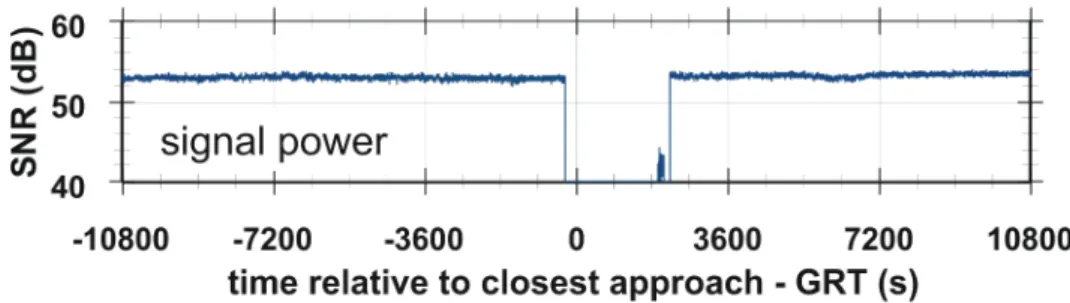
flyby (Figure 1) except for a planned tracking gap from 5 minutes before 39
closest approach (t0) to 40 minutes after t0 and a short gap of 26 40
minutes starting at 192 minutes after t0, when the uplink was 41
accidentally dropped at DSS 63. The sampling time during the 10 hours 42
of recording was one sample per second. 43
lutetia_paper_2011_v15_som.doc, 09.08.2011 44
Figure 1: Received signal power at X-band from Rosetta +/- 3 hours around closest 45
approach.
46
2.
Frequency Prediction
47
The received carrier frequency from the actual flyby is compared with a 48
carrier frequency prediction of a spacecraft motion unperturbed by the 49
asteroid. This frequency prediction is based on a complex force model 50
taking into account gravitational forces (Folkner et al., 2008) from the 51
Sun and planets, and the largest asteroids Ceres, Pallas and Vesta, but 52
not the target asteroid, and non-gravitational forces acting on the 53
spacecraft (e.g. solar radiation pressure relative to a spacecraft macro-54
model with known optical parameters of each plane and the solar 55
panels and their orientation at each time step). Also required are 56
precise knowledge of the location of the ground station antenna phase 57
center, and its behavior under forces like solid Earth tides and plate 58
tectonic and a function of Earth rotation, precession and nutation 59
(McCarthy & Petit, 2003),. Relativistic propagation effects are 60
considered up to second order (Häusler et al., 2007). 61
The frequency prediction is routinely computed for radio science data 62
processing on the Mars Express and Venus Express missions (Pätzold 63
et al., 2002). 64
lutetia_paper_2011_v15_som.doc, 09.08.2011
3.
Frequency residuals
66
The frequency shift from the perturbed spacecraft motion caused by the 67
attracting force of the asteroid is extracted from the frequency recorded 68
in the ground station on Earth by subtracting the predicted unperturbed 69
frequency. The difference between the observed perturbed and the 70
predicted unperturbed Doppler shift is the raw frequency residual 71
(Figure 2a). 72
Figure 2 (next page): Frequency residuals at X-band from t0-4 hours to t0+6 hours. 73
Two tracking gaps are indicated (light red shaded zones) from t0-5 minutes to t0+45 74
minutes as planned and from t0+192 minutes to t0+218 minutes when DSS 63 75
accidentally dropped the uplink. a) raw uncalibrated frequency residuals (observed
76
frequency minus predicted frequency). These raw residuals must be corrected for
77
tropospheric propagation (solid line). b) Frequency residuals after tropospheric
78
correction. The feature between t0+95 minutes and t0+165 minutes was caused by an 79
HGA slew in elevation and azimuth, thereby producing an additional velocity
80
component along the line-of-sight. c) HGA slew rates in azimuth (red) and elevation
81
(blue). It is evident that the HGA generated an additional Doppler shift at the highest
82
slew rates, in particular starting at t0-15 minutes. These contributions 83
overcompensated the Doppler shift from the gravitational attraction of the asteroid. d)
84
Frequency residuals corrected for the HGA slew rates. The large positive frequency
85
residuals just before the first tracking gap are caused by the abrupt stop of the HGA
86
slew. e) Filtered frequency residuals to reduce noise. The red solid line is a least-
87
square fit to the data from which GM is determined.
88 89
lutetia_paper_2011_v15_som.doc, 09.08.2011 90
Figure 2 91
lutetia_paper_2011_v15_som.doc, 09.08.2011
caused by the propagation of the radio signal through the Earth’s 94
troposphere. The propagation is mainly affected by the temperature, the 95
atmospheric pressure and the partial pressure of water vapor. These 96
meteorological parameters are recorded at the ground station site and 97
used for calibration. 98
The tropospheric refraction of the radio ray path in the Earth 99
atmosphere consists of two components: i) the dry component, the 100
non-water-vapor component of the atmosphere, and ii) the contribution 101
of the highly variable water vapor content of the atmosphere( the so-102
called wet component). The correction for refraction in the Earth’s 103
atmosphere is calculated with models for the path delay and mapping 104
functions which project the path delay onto the direction of the signal 105
path for the wet and dry components. 106
The models from Saastamoinen et al. (1972) for the dry component, 107
from Ifadis (1986) for the wet component, and the straightforward 108
mapping functions from (Chao, 1972) were used to compute the 109
tropospheric correction. The uncertainty in the wet component is much 110
larger than that of the dry component. 111
The tropospheric correction is subtracted from the raw frequency 112
residual (Figure 2a) to obtain the tropospherically corrected residual 113
(Figure 2b). The difference between three correction models (Schüler, 114
2001, Boehm et al., 2006, Petit and Luzum, 2010) for the zenith delay 115
lutetia_paper_2011_v15_som.doc, 09.08.2011
and mapping functions was used to derive an systematic error estimate 116
of the GM derivation. 117
118
5.
High Gain Antenna motion
119
The steerable High Gain Antenna (HGA) of the spacecraft maintained 120
Earth pointing until five minutes before closest approach, at which time 121
the end position of the HGA motion was reached. The readjustment of 122
the HGA resulted in a tracking gap of 45 minutes, including the time of 123
closest approach. Pre-encounter flyby simulations, however, showed 124
that stable and precise solutions for the mass can be achieved even 125
with tracking gaps of several hours (Pätzold et al., 2010). While the 126
Rosetta on-board instruments continued to track the asteroid, the HGA 127
was articulated to reacquire Earth pointing. The varying HGA slew rates 128
in azimuth and elevation (Figure 2c) induced an extra Doppler shift 129
along the line-of-sight (LOS), which began to become significant at 15 130
minutes before closest approach. 131
The rotation of the steerable HGA during the flyby induced an additional 132
frequency shift on the observed radio signal which needs to be 133
removed. This is done by applying the LOS component of ∆v =
ω
ω
ω
ω
x r, 134where r is the vector from the center of mass (COM) to the phase 135
center of the antenna and
ω
ω
ω
ω
the rotation rate of the antenna. Because 136the COM changed during the motion of the HGA, the location of the 137
COM was adjusted during the fitting process. 138
lutetia_paper_2011_v15_som.doc, 09.08.2011
motion maneuver performed in 2004. The HGA was rotated from -95° to -23° in elevation with a maximum elevation rotation rate of 0.1°/sec 141
and from -34° to 34° in azimuth with a maximum azimuth rotation rate of 142
0.03°/sec (Figure 3). The maximum resulting frequency shift caused by 143
the antenna rotation is about 300 mHz (Figure 4). The frequency shift 144
caused by the antenna motion was corrected by using the above model 145
and the resulting residuals are shown in Figure 5. It is seen that the 146
frequency noise increased during the rotational motion caused by short 147
term variations in the rotation rate. The additional frequency shift 148
induced by the rotation of the HGA, however, is essentially removed 149
from the frequency residuals, which are distributed about a mean value 150
of zero. 151
The Doppler contributions from the HGA slew are evident in Figure 2b. 152
The increase in frequency shortly before closest approach contrasts 153
with the expected (Pätzold et al., 2010) Doppler shift signature of the 154
asteroid. The post-encounter feature between 95 min and 165 min is a 155
specially designed spacecraft slew for Philae observations. The 156
contributions from the HGA slewing motion are removed to obtain the 157
frequency residuals in Figure 2d, the calibrated and corrected Doppler 158
shift caused by the asteroid between four hours before and six hours 159
after closest approach. 160
lutetia_paper_2011_v15_som.doc, 09.08.2011 162
Figure 3: Angular rates of the antenna motors in elevation and azimuth during a pre-163
planned maneuver in 2004. These values have been provided via the spacecraft
164
housekeeping telemetry data. 165
lutetia_paper_2011_v15_som.doc, 09.08.2011 167
Figure 4: Residual Doppler shift at X-band after subtracting the predicted frequency 168
during the pre-planned maneuver in 2004. The large additional Doppel frequency shift
169
is caused by the HGA motion in azimuth and elevation..
170
lutetia_paper_2011_v15_som.doc, 09.08.2011 172
Figure 5: Residual Doppler shift from the pre-planned maneuver in 2004 after 173
correcting with the rotation rates of the HGA antenna motors in azimuth and elevation.
174
The rotation rates and angles were provided via the spacecraft housekeeping
175
telemetry data.
176
177
6.
Filtering and adjustment
178
The frequency residuals in Figure 2d were filtered at an integration time 179
of 18 seconds for noise reduction. 180
Two different types of filters are used for data noise reduction: a Kaiser 181
window filter and a moving average filter (Buttkus, 2000). Both filters 182
are applied consecutively in forward and reverse direction ensuring a 183
zero phase. The cut-off frequency fc = 0.028 Hz Kaiser window filters 184
and the integration time ∆t = 18 seconds of the moving average filter 185
lutetia_paper_2011_v15_som.doc, 09.08.2011
approach avoids elimination of information in the data about the mass of the body and ensures that only noise is removed. The noise of the 188
Lutetia flyby data was reduced in this step by more than a factor of two 189
from 5.7 mHz to 2.6 mHz. 190
It is known from our experience with Mars Express and Venus Express 191
radio science data processing that the frequency residuals can show a 192
constant pre-event bias on the order of 10…50 mHz caused by 193
contributions not considered in the prediction. In the Lutetia case, these 194
contributions are not connected with the attracting force of the asteroid. 195
The pre-encounter frequency residual bias of -32 mHz has been 196
removed. This adjustment assumes a zero mean for the pre-encounter 197
frequency residuals from t0-4 hours to t0-3 hours. The Hill sphere of 198
influence of Lutetia (radius: 25,000 km) was entered at t0-0.5h. 199
200
7.
Fit and uncertainty
201
A least squares fit to the filtered curve (Figure 2e) yields a solution for 202
GM, an adjusted pre-encounter state vector, an adjusted solar radiation 203
pressure constant and the scale factor for the motion of the HGA phase 204
center with respect to the spacecraft center-of-mass. 205
The final Doppler frequency shift six hours after the closest approach is 206
∆
f = (36.2 +/- 0.2) mHz (Figure 2e). 207The mass and the other parameters were estimated with a weighted 208
least-squares method. The initial velocity vector, the scale factor for the 209
lutetia_paper_2011_v15_som.doc, 09.08.2011
solar radiation pressure, the center of mass adjustment factor and the 210
mass of Lutetia were fit using the frequency residuals. An initial state 211
vector of the Rosetta spacecraft at t0-4 hours is taken from the most 212
actual SPICE-kernel1 provided by the ESOC Flight Dynamics team as a 213
first guess for the fitting procedure. 214
The change
δ
x of the initial parameter set x iteratively aligning the 215measurement and the model is obtained from 216
δ
x = (JTWJ+ Iα
)-1 JTWεεεε
, 217where J is the Jacobi matrix, containing the partial derivatives of 218
parameter set x, W the weighting matrix containing the standard 219
deviation of the measurement,
εεεε
the difference between model and220
measurement, I the identity matrix and α is a damping factor. The 221
damping factor serves as a numerical stabilization of the solution 222
against ill-posed parameters (Aster et al., 2005). The iterative process 223
is applied until the solution converges, i.e. measurement and models 224
are aligned. The inverse of the term in parenthesis is computed using 225
singular value decomposition (Press et al., 1986). 226
The error of each parameter is derived from the diagonal terms of the 227
covariance matrix 228
P = (JTWJ)-1. 229
The value of GM from the above described fitting procedure and 230
considering further error sources is determined to be GM = (11.34 ± 231
1
The SPICE Kernel ORHR_______________00109.BSP is available from
ssols01.esac.esa.int for all Rosetta experiment teams and is considered as a long term planning orbit file for experimental purposes.
lutetia_paper_2011_v15_som.doc, 09.08.2011
(error: 1.3%). The uncertainty in GM considers the error from the least 233
squares fit mainly driven by the frequency noise (0.55%), the 234
uncertainty in the Lutetia closest approach time introduced by the 235
uncertainty in the flyby distance of +/-7.5 km (0.24%) and the 236
considered uncertainty in the tropospheric correction introduced by the 237
mapping function of the ground station elevation (0.8%) yielding a total 238
uncertainty of 1.0%. 239
The post-fit Doppler residuals, the difference observation minus the fit 240
are shown in Figure 6. 241
-4 -3 -2 -1 0 1 2 3 4 5 6
time relative to closest approach (hours)
-0.03 -0.02 -0.01 0.00 0.01 0.02 0.03 X -b a n d f re q u e n c y r e s id u a ls : o b s e rv a ti o n m in u s f it ( H z ) mean value: 0.00 mHz standard dev.: 2.57 mHz 242
Figure 6: Post-fit residuals after subtracting the least-squares fit from the filtered 243
observation (Figure 2e).
244
lutetia_paper_2011_v15_som.doc, 09.08.2011
8.
Comparison and discussion
246
The values for GM and
∆
f agree within the error with the analytical 247solution. As shown in (Pätzold et al., 2010), the expected final post-248
encounter Doppler shift of a two-way radio carrier signal is 249
(
)
0 4fX GM sin ´cos f t c d vα
β
∆ → ∞ = ⋅ ⋅ 250α
´=172.18° is the direction to Earth projected into the flyby plane,β
=3° 251is the direction angle to Earth above the flyby plane. 252
Using the fit solution for Lutetia of GM = (11.34±0.11)⋅10-2 km3/s2 the 253
analytical result of the relation above is (36.4±0.4) mHz. 254
The mass estimate from the Rosetta flyby is compared in Figure 7 with 255
the asteroid masses derived from astrometry or perturbation 256
calculations. The derived mass is lower than other mass determinations 257
of Lutetia from astrometry (Baer et al., 2011; Fienga et al., 2008; Fienga 258
et al., 2010; Folkner et al., 2009). A systematic bias is apparent: Baer 259
et al. (2010) derived a mass value of (2.59 ± 0.24)⋅1018 kg for Lutetia 260
from asteroid/asteroid perturbations, which is 70% larger and has an 261
error of 15%. A more recent derivation (Baer et al., 2011) yields 262
(2.6±0.87)⋅1018 kg where the error increased by a factor of 3. Fienga et 263
al. (2008) derived a mass value of (2.06 ± 0.6)⋅1018 kg from the 264
influence of Lutetia on the motion of the planet Mars, which is 20% 265
larger than Baer et al. (2010) and has an uncertainty of 30%. Again, a 266
more recent derivation (Fienga et al., 2010) of (2.55 ± 2.34)⋅1018 kg is 267
closer to Baer et al. (2008, 2011) but has an error of 92%. The Jet 268
lutetia_paper_2011_v15_som.doc, 09.08.2011
lists the mass of Lutetia as (2.094 ± 0.21)⋅10 kg with an error of 10%. 270
Each precise direct mass determination of a large asteroid is therefore 271
a valuable contribution to solar system dynamics. 272 Baer et al., 2008 Baer et al., 2011 Fienga et al., 2009 Fienga et al., 2010 JPL DE421 Rosetta flyby C1 1.0 1.5 2.0 2.5 3.0 3.5 m a s s ( 1 0 1 8 k g ) 273
Figure 7: Comparison between mass determinations of (21) Lutetia by astrometry and 274
the Rosetta direct mass determination. The Rosetta error bar is smaller than the
275
measurement point. The earlier derived values are systematically higher.
276 277
The most important global geophysical parameter, which provides 278
clues for the origin, internal structure and composition of Lutetia, is the 279
mean (bulk) density, derived from the mass and the volume. The 280
different pre-encounter values for the volume, as discussed earlier, vary 281
over large ranges of the order of 20%. The precise mass value from 282
Doppler observations during the Rosetta flyby leaves the volume as the 283
only significant error source for the bulk density. Observations of the 284
lutetia_paper_2011_v15_som.doc, 09.08.2011
OSIRIS camera and ground observations using adaptive optics were 285
combined to model the global shape. The derived volume is (5.0 ± 0.4) 286
1014 m3 (Sierks et al., 2011). A large part of the asteroid could not be 287
observed during the flyby itself but the combination with adaptive optics 288
images from other viewing directions than from the flyby, the 289
requirement of principal axis rotation and the agreement with the 290
KOALA (Carry et al., 2010) model with the imaged part of the asteroid 291
constrain the error in the volume to 8%. Although the absolute value of 292
the volume determined by Lamy et al. (2010) is confirmed, the error 293
decreased by little more than a factor of 2. 294
The volume leads to a bulk density of (3.4 ± 0.3)·103 kg/m3. The high 295
bulk density is unexpected in view of the low value of the measured 296
mass. It is one of the highest bulk densities known for asteroids. 297
Assuming that Lutetia has a modest macroporosity of 12%, it would 298
imply that the bulk density of its material constituents would exceed that 299
of stony meteorites. Unless Lutetia has anomalously low porosity 300
compared to other asteroids in its size range, its high density likely 301
indicates a nonchondritic bulk composition enriched in high atomic 302
number like iron. It may also be evidence for a partial differentiation of 303
the asteroid body as proposed by Weiss et al. (2011) 304
305
Acknowledgements 306
The Rosetta Radio Science Investigation (RSI) experiment is funded by DLR 307
Bonn under grants 50QM1002 (TPA, BH) and 50QM1004 (MP, MH, ST, MKB) 308
and under a contract with NASA (SWA, JDA). We thank T. Morley (ESOC) for 309
lutetia_paper_2011_v15_som.doc, 09.08.2011 support.
312
References 313
Aster, R. C.; Borchers, B. & Thurber, C., Parameter Estimation and 314
Inverse Problems, Elsevier Academic Press, 2005 315
Baer, J., S. Chesley and D. Britt, Eds., Asteroid masses V1.0 EAR-A-316
COMPIL-5-ASTMASS-V1.0, Nasa Planetary Data System, 2009. 317
Baer, J., S.R. Chesley, R.D. Matson, Astrometric masses of 26 318
asteroids and observations on asteroid porosity, Astron. J. 141:143, 319
(12pp), 2011. 320
Boehm, J., Werl, B., and Schuh, H., 2006a, “Troposphere 321
mapping functions for GPS and very long baseline interferometry from 322
European Centre for Medium-Range Weather Forecasts operational 323
analysis data,” J. Geophys. Res., 324
Buttkus, B., Spectral analysis and filter theory in applied geophysics, 325
Springer Verlag, Berlin, Heidelberg, 2000 326
Carry, B. et al. (24 Co-authors), Physical properties oft he ESA Rosetta 327
target asteroid (21) Lutetia, Astron. Astrophys. 523, A94, 2010. 328
Chao, C. C., A Model for Tropospheric Calibration from Daily Surface 329
and Radiosonde Balloon Measurements,Technical Memorandum 391-330
350, Jet Propulsion Laboratory, Pasadena, California, USA, 1972 331
Fienga, A., H. Manche, J. Laskar, and M. Gastineau, INPOP06: a new 332
numerical planetary ephemeris, Astronomy and Astrophysics, Volume 333
477, pp.315-327, 2008. 334
Fienga, A., H. Manche, P. Kuchynka, J. Laskar, M. Gastineau, 335
Planetary and Lunar ephemerides, INPOP10A, arXiv.org > astro-ph > 336
arXiv:1011.4419, 2010. 337
Folkner, W. M.; Williams, J. G. & Boggs, D. H., The planetary and Lunar 338
Ephemeris DE 421, JPL IOM, 343R-08-003, 2008. 339
Folkner, W.M., J.G. Williams and D.H. Boggs, The Planetary and Lunar 340
Ephemeris DE421, IPN Progress Report 42-178, August 15, 2009. 341
lutetia_paper_2011_v15_som.doc, 09.08.2011
Häusler, B., W. Eidel, R. Mattei, S. Remus, M. Pätzold & s. Tellmann, 342
The Planetary Atmospheric Doppler Effect in a Relativistic Treatment, 343
FORSCHUNGSBERICHT, , LRT 9-FB-5, 36, 2007. 344
Ifadis, I., The Atmospheric Delay of Radio Waves: Modeling the 345
Elevation Dependence on a Global Scale, Technical Report no. 38L, 346
School of Electrical and Computer Engineering, Chalmers University of 347
Technology, Göteborg, Sweden, 1986. 348
Lamy P., G. Faury, L. Jorda, M. Kaasalainen, and S. F. Hviid., Multi-349
color, rotationally resolved photometry of asteroid 21 Lutetia from 350
OSIRIS/Rosetta observations, 2010. 351
McCarthy, D. D. & Petit, G., IERS Conventions (2003), International 352
Earth Rotation and Reference System Service (IERS), IERS Technical 353
Note; N0. 32 , 203. 354
Pätzold, M. et al., MaRS : Mars Express Radio Science Experiment, 355
ESA-SP 1291, 217-248, 2009. Häusler, B. et al., Radio science 356
investigations by VeRa onboard the Venus Express spacecraft, 357
Planetary and Space Science 54, 1315–1335, 2006. 358
Pätzold, M., T. P. Andert, B. Häusler, S. Tellmann, J. D. Anderson, S. 359
W. Asmar, J.-P. Barriot, and M. K. Bird, Pre-flyby estimates of the 360
precision of the mass determination of asteroid (21) Lutetia from 361
Rosetta radio tracking, Astronomy and Astrophysics, Volume 518, 362
id.L156, 2010. 363
Petit, G. & Luzum, B. IERS Conventions (2010) International Earth 364
Rotation and Reference Systems Service (IERS), 2010 365
Press, W. H.; Teukolsky, S. A.; Vetterling, W. T. & Flannery, B. P., 366
Numerical Recipes in Fortran, Cambridge Univ. Press, Cambridge, 367
1986 368
Saastamoinen, J. et al., Atmospheric Correction for the Troposphere 369
and Stratosphere in Radio Ranging Satellites, The Use of Artificial 370
Satellites for Geodesy, American Geophysical Union, Washington D. 371
C., 1972, 247-252 372
Schüler, T., On Ground Based GPS Tropospheric Delay Estimation, 373
PhD-Thesis, Universität der Bundeswehr, München, 2001 374
Sierks et al., Science this volume, 2011. 375
Weiss, B.P., L.T. Elkins-Tanton, M.A. Barucci, H. Sierks, M. Pätzold, C. 376
Snodgrass, S. Marchi, I. Richter, P.R. Weissman, M. Fulchignoni and 377
R.P. Binzel, Evidence for thermal metamorphism or partial 378
lutetia_paper_2011_v15_som.doc, 09.08.2011 381