HAL Id: hal-03004381
https://hal-univ-rennes1.archives-ouvertes.fr/hal-03004381
Submitted on 13 Nov 2020
HAL is a multi-disciplinary open access
archive for the deposit and dissemination of
sci-entific research documents, whether they are
pub-lished or not. The documents may come from
teaching and research institutions in France or
abroad, or from public or private research centers.
L’archive ouverte pluridisciplinaire HAL, est
destinée au dépôt et à la diffusion de documents
scientifiques de niveau recherche, publiés ou non,
émanant des établissements d’enseignement et de
recherche français ou étrangers, des laboratoires
publics ou privés.
Applications
Jiasong Wu, Fuzhi Wu, Qihan Yang, Yan Zhang, Xilin Liu, Youyong Kong,
Lotfi Senhadji, Huazhong Shu
To cite this version:
Jiasong Wu, Fuzhi Wu, Qihan Yang, Yan Zhang, Xilin Liu, et al.. Fractional Spectral Graph Wavelets
and Their Applications. Mathematical Problems in Engineering, Hindawi Publishing Corporation,
2020, 2020, pp.1 - 18. �10.1155/2020/2568179�. �hal-03004381�
Research Article
Fractional Spectral Graph Wavelets and Their Applications
Jiasong Wu ,
1,2,3,4Fuzhi Wu,
1Qihan Yang,
1Yan Zhang,
1Xilin Liu,
5Youyong Kong ,
1,3,4Lotfi Senhadji ,
2,3,4and Huazhong Shu
1,3,41Laboratory of Image Science and Technology (LIST), Key Laboratory of Computer Network and Information Integration,
Southeast University, Ministry of Education, Nanjing 210096, China
2Univ Rennes, INSERM, LTSI-UMR 1099, 35042 Rennes, France
3Centre de Recherche en Information Biom´edicale Sino-Français (CRIBs), Univ Rennes, INSERM, Rennes, France 4Southeast University, Nanjing, China
5College of Data Science, Taiyuan University of Technology, Taiyuan 030024, China
Correspondence should be addressed to Jiasong Wu; [email protected]
Received 14 June 2020; Revised 18 September 2020; Accepted 15 October 2020; Published 6 November 2020 Academic Editor: Bogdan Smolka
Copyright © 2020 Jiasong Wu et al. This is an open access article distributed under the Creative Commons Attribution License, which permits unrestricted use, distribution, and reproduction in any medium, provided the original work is properly cited. One of the key challenges in the area of signal processing on graphs is to design transforms and dictionary methods to identify and exploit structure in signals on weighted graphs. In this paper, we first generalize graph Fourier transform (GFT) to spectral graph fractional Fourier transform (SGFRFT), which is then used to define a novel transform named spectral graph fractional wavelet transform (SGFRWT), which is a generalized and extended version of spectral graph wavelet transform (SGWT). A fast algorithm for SGFRWT is also derived and implemented based on Fourier series approximation. Some potential applications of SGFRWTare also presented.
1. Introduction
In traditional signal processing, the most commonly used tools are transforms, among which Fourier transform and wavelet transform play key roles [1]. Fourier transform and wavelet transform were generalized and extended in many contexts in recent years.
On the one hand, Fourier transform and wavelet transform were extended to fractional domain, obtaining fractional Fourier transform (FRFT) [2–23] and fractional wavelet transform (FRWT) [24–30]. From a mathematical viewpoint, the FRFT can be seen as a parametric Fourier transform [7], whose fractional order θ is a free parameter which offers more flexibility and generalization properties compared to the classical Fourier transform. From a signal processing point of view, the FRFT can be interpreted as a rotation in the frequency plane, i.e., the unified time-frequency transform. With the order θ increasing from 0 to 1, the FRFT can show the characteristics of the signal changing from the time domain to the frequency domain
[8]. There are roughly three main research directions for investigating FRFT: firstly, the application of FRFT to deal with many signal processing problems [9], for example, filtering, compression, image encryption, digital water-marking, pattern recognition, edge detection, antennas, radar and sonar, and communication; secondly, the dis-cretization algorithms of the FRFT [10–17]; and lastly, the extension of the fractional idea of FRFT to other transforms, for example, fractional cosine, sine and Hartley transforms [18–21], fractional Krawtchouk transform [22], and short-time FRFT [23]. By cascading of the FRFT and the ordinary wavelet transform, Mendlovic et al. [24] first proposed FRWT. Recently, by introducing a new structure of the fractional convolution [25] associated with the FRFT, Shi et al. [26] proposed a simplified definition of the FRWT which analyzes the signal in time-frequency-FRFD domain, where FRFD denotes fractional Fourier domain. The defi-nition of FRWT in [26] was further improved by Prasad et al. [27], who analyzed the signal only in time-FRFD domain. More recently, Dai et al. [28] presented a new FRWT which Volume 2020, Article ID 2568179, 18 pages
displays the time and FRFD-frequency information jointly in the time-FRFD-frequency plane. Srivastava et al. [29] proposed a certain family of fractional wavelet transfor-mations and Shi et al. [30] proposed a novel fractional wavelet packet transform. In general, compared to tradi-tional transforms, fractradi-tional transforms may lead to (1) better signal filtering results due to the rotation of the time–frequency plane [9]; (2) better image compression ratios [31], image recognition results [32], and image seg-mentation results [33] due to the flexible choices of the fractional orders; and (3) better image encryption [34] and image watermarking [35] performances since the fractional order can be used as an additional secret key.
On the other hand, Fourier transform and wavelet transform were extended to graph domain, obtaining graph Fourier transform (GFT) [36–43] and graph wavelet transform (GWT) [44–49] to handle signal defined on the vertices of weighted graphs. Two basic approaches to signal processing on graphs have been considered: the first is rooted in the spectral graph theory [50] and builds upon the graph Laplacian matrix [36]. Although spectral de-composition of generalized graph Laplacian with negative edges has been considered for the construction of graph frequency domain [51, 52], in this paper, we limit this approach to undirected graphs with real and nonnegative edge weights for the sake of clarity. The second approach, discrete signal processing on graphs [40, 41], is rooted in the algebraic signal processing theory [53, 54] and builds on the graph shift operator. The latter works as the ele-mentary operator that generates all linear shift-invariant filters for signals with a given structure. In particular, the graph Fourier transform in this framework expands a graph signal into a basis of eigenvectors of the adjacency matrix, and the corresponding spectrum is then given by the associated eigenvalues. Besides graph-based trans-forms [36–49], recent research works on graph also in-clude, among others, sampling and interpolation on graphs [55, 56], graph signal recovery [57–60], semi-supervised classification on graphs [61, 62], graph dic-tionary learning [63, 64], and graph convolutional neural networks [65–72]. Please refer to [73] for more references on graph signal processing.
To the authors’ knowledge, there are only few research works done for discrete signal processing on fractional graph domain, which is a combination of fractional transform domain and graph transform domain. Wang et al. [74, 75] proposed a definition of fractional Fourier transform on graphs named graph fractional Fourier transform (GFRFT), which is based on algebraic signal processing theory [53, 54]. However, similar to Fourier transform, GFRFT is a global transform and does not provide useful localization prop-erties in fractional graph domain. Furthermore, GFRFT does not allow multiresolution analysis of graph signals. In this paper, based on spectral graph theory, we first propose a new spectral graph fractional Fourier transform (SGFRFT), which is then used to define a new spectral graph fractional wavelet transform (SGFRWT), which can be seen as an extended version of spectral graph wavelet transform (SGWT) [44].
The remainder of the paper is organized as follows. Section 2 recalls the main foundations of fractional wavelet transform, spectral graph theory, and spectral graph wavelet transform (SGWT). The spectral graph fractional Fourier transform (SGFRFT) and the spectral graph fractional wavelet transform (SGFRWT) are defined in Section 3. Section 4 is dedicated to the Fourier series approximation-based fast algorithm for forward and inverse SGFRWT. Several applications of SGFRWT for addressing different problems are shown in Section 5. Section 6 concludes the paper.
2. Preliminary
In the following, we first recall the forward and inverse fractional Fourier transform (FRFT) [2–5] and then the forward and inverse fractional wavelet transform (FRWT) [24, 26–28] and also show how scaling operator may be expressed in the FRFT domain. Table 1 summarizes the definitions of various transforms for classical signal pro-cessing and also those for graph signal propro-cessing.
2.1. Fractional Fourier Transform (FRFT). The θ-order
for-ward FRFT [2–5] is the decomposition of a function f according to the fractional Fourier kernel, i.e.,
fθ(u) �〈f, K∗θ〉 � +∞ −∞ f(x)Kθ(x, u)dx, (1) where Kθ(x, u) �
Aθexp (j/2) x 2+ u2cot θ − jxu csc θ, θ ≠ nπ, δ(x − u), θ � 2nπ, δ(x + u), θ � (2n + 1)π, ⎧ ⎪ ⎪ ⎪ ⎪ ⎪ ⎨ ⎪ ⎪ ⎪ ⎪ ⎪ ⎩ (2) Aθ� �������� 1 − j cot θ 2π , (3)
where θ indicates the rotation angle of the transform and
δ(x) represents the Dirac distribution.
The inverse FRFT is given by [2–5]
f(x) �〈fθ, Kθ〉 �
+∞ −∞
fθ(u)K∗θ(x, u)du. (4)
The kernel in equation (2) can be obtained by its spectral expansion [5]:
Kθ(x, u) �
∞
k�0
exp(− jθk)ξk(u)ξk(x). (5)
ξk(x) in equation (5) is the kth-order normalized
Hermite function [11, 12], which is the eigenfunction of the Fourier transform. From (5), we can see that FRFT is a generalized version of the Fourier transform, since they
share the same eigenfunction ξk(x)and the eigenvalues of
T able 1: The definitions of various transforms for classical signal processing and for graph signal processing. Classical signal processing Fourier transform Fractional Fourier transform Wavelet transform Fractional wavelet transform f( u ) � 〈 f, e 2π iux 〉 � + ∞ − ∞ f ( x )e − 2π iux d x Discrete form of Fourier matrix: FN � VN DN V T N � VN diag ([ 1 ,e − j ,. .. ,e − j( N − 1 ) ]) V T N where diag(.) denotes a diagonal matrix formed from its vector argument. fθ ( u ) � 〈 f, K ∗ θ〉 � + ∞ − ∞ f ( x )K θ ( x, u )d x Kθ ( x, u ) � ∞ k� 0 exp (− jθ k )ξk ( u )ξk ( k ) where ξk ( k ) is the kth-order normalized Hermite function. Discrete form of fractional Fourier matrix: F θ N � VN D θ VN T N � VN diag ([ 1 , e − jθ , .. ., e − j( N − 1 )θ ]) V T .N W f ( s, a ) � 〈 f, ψs,a 〉 � ∞ −∞ f ( x )ψ ∗ s,a ( x )d x with ψs,a ( x ) � (1/ s) ψ ( x − a/ s) W θ f( s, a ) � 〈 f, ψθ ,s,a 〉 � ∞ −∞ f ( x )ψ ∗ θ,s,a ( x )d x ψθ ,s,a ( x ) � e − j/2 ( x 2− a 2( x − a/ s) 2)cot θψ s,a ( x ) with ψs,a ( x ) � 1/ sψ ( x − a/ s) And `e is the fractional order. Graph signal processing Algebraic signal processing (ASP) [40, 41] Spectral graph theory [53, 54] Graph Fourier transform Graph fractional Fourier transform Spectral graph Fourier transform Spectral graph fractional Fourier transform Spectral graph wavelet transform Spectral graph fractional wavelet transform f(ℓ ′ ) � 〈 f, χℓ ′〉 � N n� 1 f ( n )( χℓ ′(n )) ∗ , ℓ � 0 ,1 ,. .. ,N − 1 , where χ� ′ v − 1� χ0 ′(1 ) .. . χN − 1 ′(1 ) ⋮ ⋱ ⋮ χ0 ′(N ) .. . χN − 1 ′(N ) ⎡⎢⎢ ⎢ ⎢ ⎢ ⎢ ⎣ ⎤⎥⎥ ⎥ ⎥ ⎥ ⎥ ⎦is obtained by the Jordan decomposition of the adjacency matrix W as follows: W � VJ A V − 1. f′(ℓθ ) � 〈 f, cℓ ′〉 � N n� 1 f ( n ) ( cℓ ′(n )) ∗ , ℓ � 0 ,1 ,. .. ,N − 1 , where c ′ � (χ ′ ) θ� c0 ′(1 ) .. . cN − 1 ′(1 ) ⋮ ⋱ ⋮ c0 ′(N ) .. .cN − 1 ′(N ) ⎡⎢⎢ ⎢ ⎢ ⎢ ⎢ ⎣ ⎤⎥⎥ ⎥ ⎥ ⎥ ⎥ ⎦ where `e is the fractional order. f ′ (ℓ ) � 〈 f, χℓ 〉 � N n� 1 f ( n )χ ∗ ℓ ( n ), ℓ � 0 ,1 ,. .. ,N − 1 , where χ � χ0 (1 ) ·· · χN − 1 (1 ) ⋮ ⋱ ⋮ χ0 ( N ) ·· · χN − 1 ( N ) ⎡⎢⎢ ⎢ ⎢ ⎢ ⎣ ⎤⎥⎥ ⎥ ⎥ ⎥ ⎦is obtained by the eigenvalue decomposition of the graph Laplacian matrix L as follows: L � D − W � χΛ χ H, where D is the diagonal degree matrix and W is the adjacency matrix. f(ℓθ ) � 〈 f, cℓ 〉 � N n� 1 f ( n ) c ∗ (ℓ n ), ℓ � 0 ,1 ,. .. ,N − 1 where c � χ θ� c0 (1 ) .. . cN − 1 (1 ) ⋮ ⋱ ⋮ c0 ( N ) .. . cN − 1 ( N ) ⎡⎢⎢ ⎢ ⎢ ⎢ ⎣ ⎤⎥⎥ ⎥ ⎥ ⎥ ⎦ where `e is the fractional order. W f ( s, n ) � ( T sfg )( n ) � N − 1 ℓ g ( sλℓ )f (ℓ )χℓ ( n ), n � 1 ,. .. ,N, where T s�g g ( sL ) and L is the graph Laplacian matrix. W f (θ ,s, n ) � ( T sfg )( n ) � 〈 f, ψθ ,s,n 〉 � N − 1 m � 1 f ( m )ψ ∗ θ,s,n ( m ), n � 1 ,. .. ,N, where ψθ ,s,n ( m ) � N − 1 ℓ g ( sλ θ )cℓ ℓ ( m )c ∗ ℓ( n ), m � 1 ,. .. ,N, T s gθ � g ( sLθ ), and L`e is the graph fractional Laplacian matrix Lθ � cΛ θc H
transform [2]. When the rotation angle θ � π/2, the FRFT defaults to Fourier transform.
The discrete form of equation (5) can be expressed as follows [11, 12]: FθN�VND θ NV T N�VNdiag 1, e − jθ, . . . , e− j(N−1)θ VTN, (6) where diag(.) denotes a diagonal matrix formed from its
vector argument. FθN denotes the θ-order forward FRFT
matrix of size N × N. VN�v0 v1 · · · vN−1, vkis the
kth-order DFT Hermite eigenvector. Note that Fθ
N becomes
identity matrix when θ � 0 and Fourier matrix when θ � π/2.
2.2. Fractional Wavelet Transform (FRWT). There are several
definitions for fractional wavelet transform (FRWT)
[24, 26–28]. In this part, we choose the definition in [28] since it displays the signal in the joint time-FRFD-frequency plane.
The θ-order forward FRWT is defined as [28]
Wθf(s, a) �〈f, ψθ,s,a〉 � ∞ −∞ f(x)ψ∗θ,s,a(x)dx , (7) where ψθ,s,a(x) � e − j/2 x( 2− a2− (x− a/s)2)cot θ ψs,a(x), (8)
with ψs,a(x) � (1/s)ψ(x − a/s).
The unitarity property of the FRFT applied to (7) leads to an equivalent form of FRWT: Wθf(s, a) � Tsθf(a) � �������� 2π 1 − j cot θ ∞ −∞
ej/2s2u2cot θfθ(u)ψ∗θ(su)K
∗
θ(u, a)du, (9)
where fθstands for the θ-order FRFT of f. Here also, as for
the classical CWT [1], the scaling is operated in the trans-formed domain “u” and not directly in the time domain.
The inverse of the FRWT is given by [28]
f(x) � 1 2π sin θCθ,ψ ∞ −∞ ∞ −∞ Wθf(s, a)ψθ,s,a(x) dsda s , (10)
when the following admissibility condition is satisfied [28]: ∞ 0 ψθ(s) 2 s ds � Cθ,ψ< ∞. (11)
2.3. Spectral Graph Theory and Spectral Graph Wavelet Transform. In this section, we briefly review the spectral
graph theory and also the spectral graph wavelet transform [44].
2.3.1. Spectral Graph Theory. We consider an undirected,
connected, weighted graph G � V, E, W{ }, composed of a
finite set of vertices V (with Card(V) � N), a set of edges E, and an adjacency symmetric and positive-valued matrix W. A real-valued signal f defined on the vertices V of the graph G is an N × 1 vector where each entry is the value f(n) assigned to the vertex n. The (nonnormalized) graph
Lap-lacian operator is the matrix defined by L � D − W ∈ RN×N,
where D is the diagonal degree matrix defined by
dm,m� nwm,n. dm,mis the degree of vertex m.
As the matrix L is real and symmetric, then it is
diag-onalizable and its eigenvectors χ 0,χ1, . . . ,χN−1, sorted
according to the ascending order of the corresponding
ei-genvalues 0 � λ0< λ1≤ λ2≤ · · · ≤ λN−1, form an
orthonor-mal basis. Therefore, with the unitary column matrix:
χ � χ 0,χ1, . . . ,χN−1, (12)
and the diagonal matrix Λ � diag([λ0,λ1, . . . ,λN−1]), we
have
L � χΛχH, (13)
where the superscript H denotes the Hermitian transpose operation. The graph Fourier transform (GFT) of the signal f is then the sequence provided by the scalar products [36]:
f(ℓ) � 〈f, χℓ〉 � N n�1 f(n)χ∗ℓ(n), ℓ � 0, 1, . . . , N − 1, (14) and f can be recovered (inverse GFT) by means of the re-construction formula: f(n) �〈f,χ∗ℓ〉 � N−1 ℓ�0 f(ℓ)χℓ(n), n �1, . . . , N. (15)
Using vectors and matrices notations, equations (14) and (15) become
f � f(0) f(1) · · · f(N − 1)T�χHf,
f � f( 1) f(2) · · · f(N)T�χ f.
(16) The graph Fourier transform obeys the Parseval theo-rem; that is, for any signals f and h defined on the graph G, we have
〈f, h〉 � 〈f, h〉. (17)
2.3.2. Spectral Graph Wavelet Transform (SGWT). The
spectral graph wavelet transform (SGWT) of the signal f with the kernel g is defined by [44]
Wf(s, n) � T s gf (n) � N−1 ℓ�0 g sλℓ f(ℓ)χℓ(n), n �1, . . . , N, (18) where Tsg� g(sL), (19)
and the kernel g is continuous positive-valued function
defined on R+ satisfying g(0) � lim x⟶+∞g(x) �0 +∞ 0 g(x) x2 dx � Cg∈ R + . (20)
Using equation (14), the SGWT becomes Wf(s, n) � T s gf (n) � N m�1 f(m)ψ∗s,n(m) �〈f, ψs,n〉, n �1, . . . , N, (21) with ψs,n(m) � N−1 ℓ�0 g sλℓχℓ(m)χ ∗ ℓ(n), m �1, . . . , N. (22)
The signal f can be recovered up to its mean value using the inverse formula [44]:
f(m) −〈f, χ0〉χ0(m) � 1 Cg N n�1 ∞ 0 Wf(s, n)ψs,n(m) ds s, m �1, . . . , N. (23)
3. Spectral Graph Fractional Transforms
We first propose a novel spectral graph fractional Fourier transform (SGFRFT) in Section 3.1 and then give the def-inition of spectral graph fractional wavelet transform (SGFRWT) in Section 3.2.
3.1. Spectral Graph Fractional Fourier Transform. Similar to
(13), we define the graph fractional Laplacian operator Lθas
follows:
Lθ�γRγ
H
, (24)
where 0 < θ ≤ 1 and γ is the power matrix given by
γ � γ 0,γ1, . . . ,γN−1 �χ
θ, (25)
with χ being the unitary (i.e., inverse graph Fourier trans-form matrix) shown in (12). Note that as χ is unitary, then
c �χθ is also unitary. And
R � diag r 0, r1, . . . , rN−1 �Λ
θ, (26)
that is,
rℓ�λθℓ, ℓ � 0, 1, . . . , N − 1. (27)
Considering λℓ ∈ [0, λN−1], and from (27), we can easily
get rℓ ∈ [0, rN−1]. The reason why we choose Lθ as the
definition of graph fractional Laplacian operator will be discussed in Section 3.2.
The forward spectral graph fractional Fourier transform (SGFRFT) of any signal f defined on the vertices V of the graph G is defined by fθ(ℓ) ≔ 〈f, χℓ〉 � N n�1 f(n)c∗ℓ(n), ℓ � 0, 1, . . . , N − 1, (28)
or by the following matrix form:
fθ� fθ(0) fθ(1) · · · fθ(N − 1)T�γHf. (29)
For θ � 1, the proposed SGFRFT in (29) is no more than the GFT in (18) defined by Shuman et al. [36]. For other
values of θ, we can compute c � χθ by using Schur–Pad´e
algorithm [76, 77] which is found to be superior in accuracy and stability to several alternatives, including eigende-composition method and also the approaches based on the
formula χθ� eθ log(χ).
The inverse SGFRFT is given by
f(n) �〈fθ, c∗ℓ〉 �
N−1
ℓ�0
fθ(ℓ)cℓ(n), n �1, . . . , N, (30)
or by the following matrix form:
f � f(1) f(2) · · · f(N) T�γfθ. (31)
The graph fractional Fourier transform obeys the Par-seval theorem; that is, for any signals f and h defined on the graph G, we have
〈f, h〉 �〈fθ, hθ〉. (32)
Note that the forward and inverse SGFRFTs defined here are different from the forward and inverse graph fractional Fourier transforms (GFRFTs) [74, 75], which are, respec-tively, given by fθ′� fθ′(0) fθ′(1) · · · fθ′(N − 1)T�γ
′
f, (33) f � f(1) f(2) · · · f(N) T� (γ′
)−1fθ′, (34) where σ′� χ′θ, (35)and χ′�V−1is obtained by the Jordan decomposition of the
adjacency matrix W as follows [74, 75]:
W � VJWV
−1, (
36)
where V is a matrix composed of eigenvector and JWis a
block-diagonal matrix. For more details, please refer to Appendix A of [74].
From (13), (29), (31), and (33)–(36), we can see that the differences are that the proposed SGFRFTs are based on the decomposition of the graph Laplacian matrix L, while the GFRFTs are based on the decomposition of the adjacency matrix W.
3.2. Spectral Graph Fractional Wavelet Transform (SGFRWT). Similar to (21), we can define the spectral graph fractional
wavelet transform (SGFRWT) operator Ts
gθ as follows: Wf(θ, s, n) � T sgθf(n) � N m�1 f(m)ψ∗θ,s,n(m) �〈f, ψθ,s,n〉, n �1, . . . , N, (37) where Tsg θ� g sLθ, (38) ψθ,s,n(m) � N−1 l�0 g sλθℓcℓ(m)c∗ℓ(n), m �1, . . . N. (39)
Why we choose Lθ in (24) as the definition of graph
fractional Laplacian operator and choose ψθ,s,n(m)in (39) as
the basis of SGFRWT? There are two reasons. (1) We want to
define the basis of SGFRWT ψθ,s,n(m) based on a new
function cℓ(n)instead of the same function χℓ(n)as basis of
SGWT ψs,n(m)in (23). The SGFRWT and SGWT will have
different characteristics since they are based on different
functions cℓ(n) and χℓ(n), respectively. (2) We want to
define the basis of SGFRWT ψθ,s,n(m) which changes
di-rectly with λθℓ. Since the parameter θ acts on the eigenvalues
of the Fourier matrix in the form of exponents in the spectral expansion of FRFT in (5), similarly, we also want to obtain
the form that the parameter θ can directly affect λℓ in the
proposed definition of SGFRWT. Two other possible defi-nitions of SGFRWT are also discussed in Appendices A and B, respectively.
From (37), we can see that the proposed SGFRWT is a generalization of SGWT in (21) defined by Hammond et al. [44]; that is, when θ � 1, the proposed SGFRWT defaults to the SGWT. The proposed SGFRWT can be seen as a parametric generalization of SGWT [7]. Furthermore, the proposed SGFRWT converts a graph signal into an inter-mediate domain between vertex and spectral graph wavelet. With the order θ increasing from 0 to 1, the SGFRWT can provide much more domain choices of expressions for a graph signal.
The scaling functions are then obtained by
ϕθ(n) � Thθδn� h Lθδn, (40)
and the coefficients by
Sθ,f(n) �〈ϕθ,n, f〉. (41)
Stable recovery of the original signal f from the SGFRWT
coefficients will be assured if the quantity
G(r) � h2(r) + J
j�1g2(sjr), where sj denotes jth scale, is
bounded away from zero on the fractional Laplacian Lθ.
Moreover, under the same conditions, Lemmas 5.1, 5.2, 5.3, and 5.4 and Theorems 5.5 and 5.6 in [44] are verified by the SGFRWT, whose properties are shown in Appendix C.
4. Fourier Series Approximation and
Fast SGFRWT
If we compute the SGFRWT by using equation (37) directly, we have to compute the entire set of eigenvectors and
ei-genvalues of Lθ shown in (24). Both the computational
complexity and the memory consumption become unac-ceptable when the data is larger than hundreds of thousands or millions of dimensions. Therefore, in this section, we propose a fast algorithm for computing the SGFRWT based
on approximating the scaled generating kernels gθ by
low-order Fourier series. It should be noted that the proposed fast SGFRWT algorithm is an extension of the fast SGWT algorithm from real domain to complex domain. The pro-posed fast SGFRWT algorithm is different from the fast graph Fourier transform proposed by Magoarou et al. [39], who use the modified Jacobi eigenvalue algorithm for ap-proximating the graph Laplacian matrix. Note that the proposed SGFRWT algorithm can approximate an arbitrary matrix while the algorithm in [39] is only practicable for approximating symmetric matrix.
The following lemma shows that the polynomial ap-proximation of g(sx) may be taken over a finite range
containing the spectrum of Lθ.
Lemma 1. Let rmax≥ rN− 1 be any upper bound on the
fractional spectrum of Lθ. For fixed s > 0, let p(x) be a
polynomial approximant of g(sx) with L∞ error
B �supx∈[0,rmax]|g(sx) − p(x)|. Then the approximate
SGFRWT coefficients Wf(θ, s, n) � (p(Lθ)f)n satisfy
|Wf(θ, s, n) − Wf(θ, s, n)| ≤ B‖f‖.
The proof of Lemma 1 is similar to Lemma 6.1 in [44]. In [44], Hammond et al. approximated g(sL) shown in (19) by truncated Chebyshev expansions. The reason is that
g(sL) is real as the original L shown in (13) is a real matrix.
However, the Chebyshev polynomial approximation
method is not suitable for our problem of approximating
g(sLθ)shown in (33) may be a complex matrix. Therefore, in this part, we will use the truncated Fourier series expansion
instead of Chebyshev expansions to approximate g(sLθ)
shown in (38).
The Fourier series of a general function f(x) is given by [78] f(y) � ∞ k�−∞ ckexp(iky), (42) where ck� 1 2π 2π 0
f(y)exp(− iky)dy �
a0, k �0, ak− ikb 2 , k> 0, ak− ikb 2 , k< 0, ⎧ ⎪ ⎪ ⎪ ⎪ ⎪ ⎪ ⎪ ⎪ ⎪ ⎪ ⎨ ⎪ ⎪ ⎪ ⎪ ⎪ ⎪ ⎪ ⎪ ⎪ ⎪ ⎩ a0� 1 2π 2π 0 f(y), ak�1 π 2π 0 f(y)cos(ky)dy, bk�1 π 2π 0 f(y)sin(ky)dy. (43)
We now assume a fixed set of wavelet scales sn. For each
n, approximating g(snx) for x ∈ [0, rmax] can be done by
scaling the domain of exp(− iky), y ∈ [0, 2π], using the
transformation x � yrmax/(2π). Then, g(snx)can be written
by g snx � ∞ k�−∞ cn,kFk(x), x∈ 0, r max, (44) with cn,k� 1 2πrmax rmax 0 g snxF− k(x)dx, (45) Fk(x) �exp i2πkx rmax . (46) Note that Fk(x) � F− k(x)∗. (47)
The above equation is due to the fact that rmax 0 Fk(x)F− l(x) 1 rmaxdx � δkl. (48)
For each scale sj, g(sjx) can be approximated by the
truncated Fourier expansion (42) to 2Mj+1 terms; that is,
pj(x) �
Mj
k�− Mj
cn,kFk(x), x∈ 0, r max. (49)
We may choose an appropriate Mjin practice to achieve
a balance between accuracy and computational complexity. We can also use exactly the same scheme to approximate the
scaling function kernel hθ shown in (40) by p0. Then, the
approximated SGFRWT wavelet and scaling function co-efficients are, respectively, given by
Wfθ, sj, n � Mj k�− Mj cj,kFk Lθf ⎛ ⎜ ⎜ ⎝ ⎞⎟⎟⎠ n , (50) Sf(θ, n) � M0 k�− M0 c0,kFk Lθf ⎛ ⎝ ⎞⎠ n , (51) where Fk Lθ �exp i2πkLθ rmax . (52)
Note that (52) is easily obtained by applying the function
Fk(.) in (46) to the matrix Lθ, and we have
Fk Lθ � F− k Lθ
∗. (
53) The efficiency of this algorithm depends on the following recursive formula:
Fk Lθf � F1 Lθ Fk−1 Lθf, k∈ − M j, Mj. (54)
As the signal f ∈ RN, taking equation (53) into
con-sideration, equation (54) can only be computed for
k∈ [1, Mj], and the other k ∈ [− Mj, −1] can be obtained by
conjugate operation.
The computational complexity of the proposed fast SGFRWT algorithm is analyzed as follows:
(1) The computation of c from χ in (25) by using
Schur–Pad´e algorithm [76, 77] needs O(N3)
operations.
(2) The computation cost of each Fk(Lθ)f in (54) is O(6|
E|), where |E| is the number of nonzero edges in the
graph, and 6|E| because F1(Lθ)is a complex matrix
and a complex multiplication requires 4 real mul-tiplications and 2 real additions (6 operations).
Therefore, the computation of all
Fk(Lθ)f, k � 1, 2, . . . , Mj needs O(6Mj|E|)
operations.
(3) It requires O(6N) operations at scale j for each k ≤ Mj
in (50) and (51). Therefore, the computation of (50)
and (51) needs O(6N Jj�0Mj)operations.
Therefore, the total computational complexity of the fast
SGFRWT algorithm is O(N3+6M
j|E| +6N
J
Implementation of (54) requires memory of size 2N. The total memory requirement for the proposed fast SGFRWT is 2N(J + 1) + 2N.
4.1. Fast Computation of Adjoint. Given a fixed set of wavelet
scales s j
J
j�1, and including the scaling functions ϕn, the
SGFRWT Wθf � ((Thθf) T , (Ts1 gθf) T , . . . , (TsJ gθf) T )T can be
seen as a linear map Wθ:R
N
⟶ CN(J+1), where C denotes
the complex domain. Let Wθf � (((p0(Lθ))f)
T,
(p1(Lθ)f)
T, . . . , (p
J(Lθ)f)
T)T
denote the approximated fractional wavelet transform by using the fast SGFRWT algorithm. In this section, we show that both the adjoint
W∗θ:C
N(J+1)⟶ RN
and the composition
W∗θWθ:R
N
⟶ RN can be computed efficiently by using
the Fourier series approximation.
For any η ∈ CN(J+1), we consider η as the concatenation
η � (ηT 0,η T 1, . . . ,η T J) T
with each ηj ∈ CNfor 0 ≤ j ≤ J; we have
〈η, Wθf〉N(J+1)�〈η0, Thθf〉 + J j�1 〈ηj, T sj gθf〉N �〈T∗hθη0,f〉 + 〈 J j�1 Tsj gθ ∗ηj,f〉N �〈T∗hθη0+ J j�1 Tsj gθ ∗ηj,f〉N. (55) Considering 〈η, Wθf〉N(J+1)� 〈W∗θη, f〉N, we have W∗θη � T ∗ hθη0+ J j�1 Tsj gθ ∗ηj. (56)
Similar to (50) and (51), the adjoint operator W∗θin (56)
can be approximated by W∗θη � J j�0 p∗j Lθηj. (57)
In the following, we derive a fast algorithm for the
computation of W∗θWθ, which is an approximation of the
composition W∗W. In general, when computing W∗
θWθ, we
first apply Wθ and then apply W∗θ by the fast SGFRWT,
which needs 2J Fourier series expansions. However, the
computational complexity of W∗θWθcan further be reduced.
Note that W∗θWθf � J j�0 p∗j Lθ p j Lθf � J j�0 p∗j Lθpj Lθ f. (58)
In the following, we derive a fast algorithm for the
computation of W∗θWθf.
Lemma 2. Set P(x) � Jj�0p∗j(x)pj(x), which has degree
M∗�2 max M j. Then, P(x) can be computed by
P(x) � M∗ k�− M∗ dkFk(x), (59) where dk� Jj�0dj,k, and dj,k� Mj i�− Mj− i c∗j,icj,k+i, −2Mj≤ k ≤ − 1 Mj− k i�− Mj c∗j,icj,k+i, 0 < k ≤ 2Mj ⎧ ⎪ ⎪ ⎪ ⎪ ⎪ ⎪ ⎪ ⎨ ⎪ ⎪ ⎪ ⎪ ⎪ ⎪ ⎪ ⎩ . Proof p∗j(x)pj(x) � Mj k�− Mj cj,kFk(x) ⎛ ⎜ ⎜ ⎝ ⎞⎟⎟⎠ ∗ Mj l�− Mj cj,lFl(x) ⎛ ⎜ ⎜ ⎝ ⎞⎟⎟⎠ � Mj k�− Mj Mj l�− Mj c∗j,kcj,lF∗k(x)Fl(x) � Mj k�− Mj Mj l�− Mj c∗j,kcj,lFl− k(x), � Mj k�− Mj Mj k′+k�− Mj c∗j,kcj,k′+kFk′(x) � Mj i�− Mj Mj k+i�− Mj c∗j,icj,k+iFk(x) � Mj i�− Mj Mj− i k�− Mj− i c∗j,icj,k+iFk(x), � −1 k�−2Mj Mj i�− Mj− i c∗j,icj,k+iFk(x) + 2Mj k�0 Mj− k i�− Mj c∗j,icj,k+iFk(x) � M∗ k�− M∗ dj,kFk(x). (60) Note that F∗
k(x)Fl(x) � Fl− k(x) is used in the above
derivation. Therefore, P(x) � J j�0 p∗j(x)pj(x) � J j�0 M∗ k�− M∗ dj,kFk(x) � M∗ k�− M∗ J j�0 dj,kFk(x) � M∗ k�− M∗ dkFk(x). (61)
The proof of Lemma 2 is now completed. Combining (58) and (59), we have
W∗θWθf � P Lθf �
M∗
k�− M∗
dkFk Lθf. (62)
From (62), we can see that W∗θWθf can be computed by a
single Fourier series expansion with twice the length, which reduces the computational cost by a factor J comparing to
4.2. Reconstruction by Using the Fast Adjoint Algorithm.
In this part, we show the reconstruction of proposed SGFRWT by using the fast adjoint algorithm in Section 4.1. The SGFRWT is an overcomplete transform since it maps an input signal f of size N to the N(J + 1) factional wavelets coefficients
c � Wθf. (63)
The pseudoinverse of the above equation can be obtained by solving the following square matrix equation:
W∗θWθf � W∗c. (64)
Equation (64) can be solved by the conjugate gradients method [79], whose computation in each step is dominated
by applying W∗
θWθto a single vector. What is more, W∗θWθf
can be fast approximated by W∗θWθf shown in (62).
Therefore, we can reconstruct input signal f from c.
5. Application Examples
Similar to [44], in this section, we will show several appli-cation examples of the SGFRWT on different real and synthetic datasets by modifying the GSPBOX toolbox [80]. The first and the third experiments are implemented in MATLAB programming language on a PC machine, which sets up Microsoft Windows 7 operating system and has an
Intel
®
Core™
i7-2600 CPU with speed of 3.40 GHz and16 GB RAM. The second experiment is implemented using PyTorch on a PC machine, which sets up Ubuntu 16.04
operating system and has an Intel
®
Core™
i7-4790 CPU withspeed of 4.00 GHz and 32 GB RAM and has also two NVIDIA GTX1080-Ti GPUs.
5.1. SGFRWT Design Details. We should design two kernels
in SGFRWT. One is the wavelet kernel g(x), and the other is the scaling function h(x).
For the wavelet kernel g(x), we choose the same cubic spline in [44] as follows: g(x) � x−1αxα, for x < x1, s(x), for x1≤ x ≤ x2, xβ2x−β, for x > x2, ⎧ ⎪ ⎪ ⎪ ⎨ ⎪ ⎪ ⎪ ⎩ (65)
where α and β are integers and they are used to determine
the decay rate of spline. x1and x2are boundary of transitions
region. Note that g is normalized such that
g(x1) � g(x2) �1. The coefficients of the cubic polynomial
s(x) are determined by s(x1) � s(x2) � 1, s′(x1) �α/x1, and
s′(x2) � −β/x2. All of the examples in this paper were
produced using α � β � 2, x1�1, and x2�2; in this case,
s(x) � − 5 + 11x − 6x2+ x3. For the SGFRWT, we can easily
substitute x in (65) by Lθ shown in (24) to get g(Lθ).
For the scaling function kernel h(x), we take h(x) �
ρ exp(− (x/0.6λmin)4)with ρ � h(0).
5.2. SGFRWT Application Examples
5.2.1. SGFRWT on Synthetic Graph Data. In the first
ex-ample, we perform the proposed SGFRWT on “Swiss roll,” which is a dataset whose points are sampled randomly from a two-dimensional (2D) manifold as follows:
x → t1, t2 � t1cos t2 4π , t1, t2 sin t2 4π , −1 ≤ t1≤ 1, π ≤ t2≤ 4π. (66)
Figure 1 shows the Swiss roll data cloud. We take 500 points sampled uniformly on the manifold and then build a weighted graph, whose edge weight is defined as follows:
ai,j�exp − xi− xj �� �� � ����� 2 2σ2 ⎛ ⎜ ⎜ ⎝ ⎞⎟⎟⎠. (67)
Note that the definition of the edge weight is a critical issue in graph construction. The most direct way to compute the edge weight is based on a given (dis)similarity measure. In practice, the edge weight is generally defined using dif-ferent measures for better interpretability. As discussed in [81], Gaussian kernel and its variants (i.e., heat kernel or RBF kernel) are one of the most popular schemes to assign edge weights for a graph. Therefore, we take the Gaussian kernel in (67) to calculate the edge weight to simplify our discussion in this paper. We perform SGFRWT with fractional order
θ ∈ [0.1, 1.0] on Swiss roll data cloud with J � 5 wavelet scales,
and the results of some fractional orders θ ∈ {0.1, 0.5, 0.8, 1.0} are shown in Figure 2. The last column of Figure 2 shows the results of performing SGWT [44] on Swiss roll, from which we can see that SGWT [44] searches for the optimal ex-pression domain only along the dimension of scale. How-ever, the proposed SGFRWT searches for the optimal expression domain not only along the dimension of scale but also along the dimension of fractional order. That is, compared with SGWT, the proposed SGFRWT can express Swiss roll in higher dimensions, which makes the expression space larger and is therefore more likely to obtain a better expressive domain for the original problem. Just like [31–33], the fractional order θ is a hyperparameter depending on the original problem and you should search for a suitable value of θ. For example, the fractional order
θ � 0.4 is an appropriate value for gland segmentation when
using fractional wavelet scattering network [33].
As a comparison, we also give the results of the proposed spectral graph fractional Fourier transform (SGFRFT) and graph fractional Fourier transform (GFRFT) proposed in [74, 75] on the “Swiss roll” in Figure 3, respectively. As we can see from Figure 3, the results of the proposed SGFRFT are different from those of GFRFT in [74, 75]. Furthermore, both SGFRFT and GFRFT are global transform and are not easily to be used for local analysis. However, let us see the third column of Figure 2, that is, the results of SGFRWT with
J � 5 and fractional order θ � 0.8; the localization is more and
more obvious along scale dimension. Comparing the third column of Figure 2 with the third column of Figure 3, we can
see that, compared with SGFRFT and GFRFT, the proposed SGFRWT allows localization in fractional graph domain, which may lead to better local analysis in spectral graph domain. The experiment results of Figure 3 verify the local properties of SGFRWT shown in Appendix C (i.e., Lemmas C2–C4 and Theorem C5) to a certain extent.
5.2.2. SGFRWT on MNIST Database. In the second
exam-ple, we will see that the proposed SGFRWT can be used as a data augmentation method in the preprocessing of con-volutional neural networks, which require as many input images as possible. Because, as shown in the first example, the proposed SGFRWT allows deriving many images from the original image by considering several fractional orders. In the following, a series of experiments are performed on the MNIST dataset to verify the effectiveness of the proposed SGFRWT as a method of data augmentation.
We construct the graph for each image in MNIST dataset. The vertices of the graph are made up of pixels in the image and each pixel is connected with its vertical and horizontal neighbor pixel. The edge weight is calculated by a Gauss kernel weighting function [36] as follows:
wi,j� exp −[dist(i, j)] 2 2τ2 , if dist(i, j) ≤ k, 0, otherwise, ⎧ ⎪ ⎪ ⎪ ⎪ ⎨ ⎪ ⎪ ⎪ ⎪ ⎩ (68)
where wi,jis the weight on the edge connection of the vertex
viand vj, and dist (i, j) represents the distance between pixel i
and pixel j.
In order to prove the effectiveness of SGWT and SGFRWT, we augment MNIST dataset by the following strategies: (i) The original MNIST database has a training set of 60,000 images and a testing set of 10,000 images, which are used as a control group. (ii) For each image of the MNIST training set, we perform SGWT [44] with J � 5 wavelet scales
and generate a total of 360,000 images. The original 10,000 test images are still used as the testing set. (iii) For each image of the MNIST training set, we apply the proposed SGFRWT with J � 5 wavelet scales and fractional order
θ ∈ {0.2, 0.4, 0.6, 0.8, 1.0}, generating a total of 1,800,000
training images. The details of the generated four datasets are shown in Table 1. Figure 4 shows all sample images by processing an image of the digit “zero” by SGFRWT with
J � 5 wavelet scales and fractional order θ ∈ {0.2, 0.4, 0.6, 0.8,
1.0}.
To evaluate the data augmentation performance of the proposed approach, we train and test a simple convolutional neural network, which is shown in Figure 5, using the three datasets mentioned above. The CNN model consists of 2 convolutional layers, 2 pooling layers, and a fully connected layer with a 10-way Softmax classifier. The inputs of the CNN are images of size 28 × 28. The first convolutional layer has 32 kernels with size 5 × 5, while the other layer has 64 kernels with size 3 × 3. The Rectified Linear Units (ReLUs) are chosen as the activation function. Every convolutional layer is followed by a nonoverlapping max-pooling with filter of size 2 × 2. Stochastic gradient descent algorithm is employed to optimize the network with a learning rate of 0.001. When the network converges, we evaluate the clas-sification accuracy on the testing set with an average value of 10 times. The last column of Table 2 shows the classification performance comparison of the three different datasets. As we can see from Table 2, if we use traditional data aug-mentation methods (flipping, rotating, and adding noise), then the recognition rate can achieve 98.41%. When the training dataset of MNIST is augmented by SGWT without traditional data augmentation, the recognition rate can increase to 98.71%. From the last row of Table 2, we can see that our proposed SGFRWT can further improve the accuracy.
5.2.3. Face Recognition by Fusing SGFRWT Features. In the
third example, the application of SGFRWT to provide features for face recognition is investigated. We use four classical face databases, whose MATLAB formats are provided in [82, 83]. (1) Yale Database [84]. It contains 165 grayscale images (15 individuals, 11 images per in-dividual). (2) AR Database [85]. We use a nonoccluded subset of AR database containing 700 images (50 male subjects and 50 female subjects, 7 images per subject). (3)
CMU PIE Face Database [86]. We also use a nonoccluded
subset of CMU PIE database which contains 11560 images (68 persons, 170 images per person). (4) ORL Database [87]. It contains 400 grayscale images (40 individuals, 10 images per individual). Note that all the images are resized to 32 × 32 pixels.
The experiment is carried out by the following three steps:
(1) For each image of the four face databases, we apply
the propoJ � tr(Sb)/tr(Sw),sed SGFRWT with
1 0 –1 1 0 –1 –1 0 1 Vertex 32
Figure 1: Spectral fractional graph wavelets on Swiss roll data cloud. The figure shows vertex at which SGFRWT is centered; that is, we will apply SGFRWT on the signal value of centered vertex.
Fractional order θ θ = 1.0 Sc al e 1 0 –1 1 0 –1 1 0 –1 –1 0 1 –1 0 1 Scaling function –1 0 1 Scaling function –0.05 0 0.05 Scaling function 1 0 –1 –1 0 1 1 0 –1 1 0 –1 –1 0 1 –0.05 0 0.05 Scaling function 1 0 –1 1 0 –1–1 0 1 –0.05 0 0.05 Wavelet at scale j = 1, θ = 1.0 1 0 –1 1 0 –1 –1 0 1 –0.05 0 0.05 Wavelet at scale j = 2, θ = 1.0 1 0 –1 1 0 –1–1 0 1
Wavelet at scale j = 1, θ = 0.1 Wavelet at scale j = 1, θ = 0.5
–0.2 0 0.2 1 0 –1 1 0 –1 –1 0 1 1 0 –1 1 0 –1 –1 0 1 –0.1 0 0.1 Wavelet at scale j = 1, θ = 0.8 1 0 –1 1 0 –1 –1 0 1 –0.05 0 0.05
Wavelet at scale j = 2, θ = 0.1 Wavelet at scale j = 2, θ = 0.5
–0.04 0 0.04 1 0 –1 1 0 –1–1 0 1 1 0 –1 1 0 –1–1 0 1 –0.05 0 0.05 Wavelet at scale j = 2, θ = 0.8 1 0 –1 1 0 –1–1 0 1 –0.05 0 0.05 (a) Sc al e Fractional order θ θ = 1.0
Wavelet at scale j = 3, θ = 0.1 Wavelet at scale j = 3, θ = 0.5 Wavelet at scale j = 3, θ = 0.8 Wavelet at scale j = 3, θ = 1.0
Wavelet at scale j = 4, θ = 0.1 1 0 –1 1 0 –1 –1 0 1 1 0 –1 1 0 –1 –1 0 1 Wavelet at scale j = 4, θ = 0.5 1 0 –1 1 0 –1 –1 0 1 Wavelet at scale j = 4, θ = 0.8 1 0 –1 1 0 –1 –1 0 1 Wavelet at scale j = 4, θ = 1.0 1 0 –1 1 0 –1 –1 0 1 1 0 –1 1 0 –1 –1 0 1 1 0 –1 1 0 –1 –1 0 1 1 0 –1 1 0 –1 –1 0 1 0.5 0 –0.5 0.5 0 –0.5 0.5 0 –0.5 0.05 0 –0.05 0.01 0 –0.01 –0.1 0 0.1 –0.2 0 0.2 –0.2 0 0.2 (b)
Figure 2: Spectral fractional graph wavelets on Swiss roll data cloud, with wavelet scale J � 5 and fractional order θ ∈ {0.1, 0.5, 0.8, 1.0}. (a) Wavelet scale j � 0, 1, 2 and fractional order θ ∈ {0.1, 0.5, 0.8, 1.0}. Note that j � 0 denotes the scaling function (b) wavelet scale j � 3, 4 and fractional order θ ∈ {0.1, 0.5, 0.8, 1.0}.
wavelet scale J � 10 and fractional order θ ∈ {0.1, 0.2, 0.3, 0.4, 0.5, 0.6, 0.7, 0.8, 0.9, 1.0}, obtaining 100 times the images of original datasets.
(2) We then extract the SGFRWT features of three fractional orders which have the highest trace ration [88] as follows:
J �tr Sb
tr Sw
, (69)
where tr(.) denotes the trace. Sband Sw are
between-class scatter matrix and the within-between-class scatter matrix, respectively, Sb� c i�1 Ni A − Ai T , Sw � c i�1 NiAi− xθ,jAi− xθ,j T , (70) θ = 0.1 Fractional order θ θ = 1.0 1 0 –1 1 0 –1–1 0 1 SGFRFT, θ = 0.1 –0.5 0 0.5 SGFRFT, θ = 0.4 –0.5 0 0.5 SGFRFT, θ = 0.7 SGFRFT, θ = 1 SGFRFT –0.5 0 0.5 –0.5 0 0.5 1 0 –1 1 0 –1–1 0 1 1 0 –1 1 0 –1–1 0 1 1 0 –1 1 0 –1–1 0 1 (a) GFRFT GFRFT, θ = 0.1 –0.5 0 0.5 GFRFT, θ = 0.4 –0.5 0 0.5 GFRFT, θ = 0.7 –0.5 0 0.5 GFRFT, θ = 1 –0.5 0 0.5 1 0 –1 1 0 –1 –1 0 1 1 0 –1 1 0 –1 –1 0 1 1 0 –1 1 0 –1 –1 0 1 1 0 –1 1 0 –1 –1 0 1 (b)
Figure 3: Spectral graph fractional Fourier transform (SGFRFT) and graph fractional Fourier transform (GFRFT) [74, 75] on Swiss roll data with fractional order θ ∈ {0.1, 0.4, 0.7, 1.0}.
(0.2 0) (0.4, 0) (0.6, 0) (0.8, 0) (1.0, 0) (0.2 1) (0.4, 1) (0.6, 1) (0.8, 1) (1.0, 1) (0.2 2) (0.4, 2) (0.6, 2) (0.8, 2) (1.0, 2) (0.2 3) (0.4, 3) (0.6, 3) (0.8, 3) (1.0, 3) (0.2 4) (0.4, 4) (0.6, 4) (0.8, 4) (1.0, 4) (0.2 5) (0.4, 5) (0.6, 5) (0.8, 5) (1.0, 5)
Figure 4: Spectral graph fractional wavelets on an image “zero,” with J � 5 wavelet scales and fractional order θ ∈ {0.2, 0.4, 0.6, 0.8, 1.0}. (θ, j, θ denotes the fractional order; j denotes the scale.
Table 2: Dataset generation implementation details. Comparison of classification performance of three different datasets with three different augmentation methods on the same CNN network.
Dataset Augmentation details of training set Validation set Accuracy (%)
(i) MNIST training set augmented with flipping, rotating, and adding noise. Original MNIST testing set 98.41
(ii) MNIST training set augmented with SGWT Original MNIST testing set 98.71
(iii) MNIST training set augmented with SGFRWT Original MNIST testing set 98.86
Input 28 × 28
Convolutions Max pooling Convolutions Max pooling Full connection Flatten C1: 32 @ 28 × 28
S1: 32 @ 14 × 14
S1: 64 @ 7 × 7 FC: 1024
Output: 10 C2: 64 @ 14 × 14
Figure 5: The convolutional neural network used in our experiment.
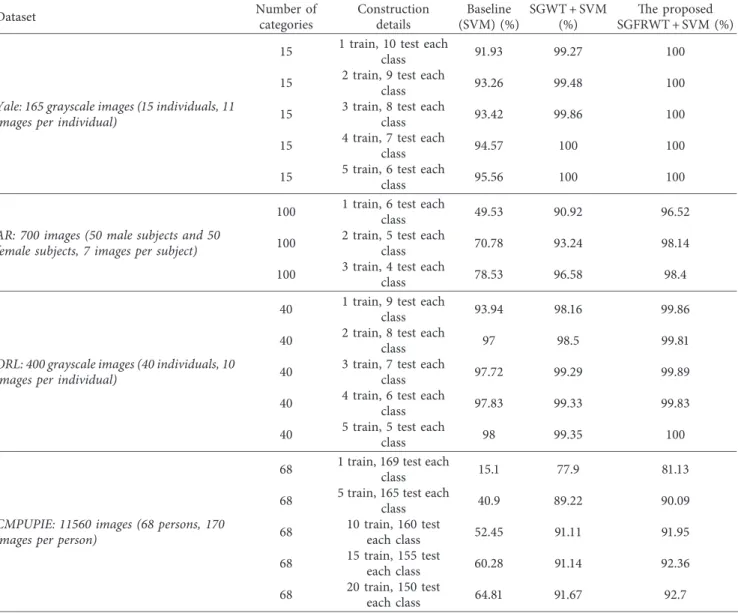
Table 3: The recognition results of the proposed SGFRWT feature, the SGWT feature, and the baseline on four face databases (Yale, AR, ORL, and CMU PIE). We randomly selected several images per individual as training set and the remaining images as testing set. “i train” means that we randomly choose i images in each class for training. The accuracy is the average results of ten random testing experiments.
Dataset Number of categories Construction details Baseline (SVM) (%) SGWT + SVM (%) The proposed SGFRWT + SVM (%)
Yale: 165 grayscale images (15 individuals, 11 images per individual)
15 1 train, 10 test each
class 91.93 99.27 100
15 2 train, 9 test each
class 93.26 99.48 100
15 3 train, 8 test each
class 93.42 99.86 100
15 4 train, 7 test each
class 94.57 100 100
15 5 train, 6 test each
class 95.56 100 100
AR: 700 images (50 male subjects and 50 female subjects, 7 images per subject)
100 1 train, 6 test each
class 49.53 90.92 96.52
100 2 train, 5 test eachclass 70.78 93.24 98.14
100 3 train, 4 test each
class 78.53 96.58 98.4
ORL: 400 grayscale images (40 individuals, 10 images per individual)
40 1 train, 9 test each
class 93.94 98.16 99.86
40 2 train, 8 test each
class 97 98.5 99.81
40 3 train, 7 test eachclass 97.72 99.29 99.89
40 4 train, 6 test each
class 97.83 99.33 99.83
40 5 train, 5 test each
class 98 99.35 100
CMPUPIE: 11560 images (68 persons, 170 images per person)
68 1 train, 169 test each
class 15.1 77.9 81.13
68 5 train, 165 test each
class 40.9 89.22 90.09
68 10 train, 160 test
each class 52.45 91.11 91.95
68 15 train, 155 test
each class 60.28 91.14 92.36
where the superscript T denotes transposition. C
denotes the number of classes. A is the mean of Ai
and Ai is the mean image of class Xiand Ni is the
number of images in class Xi.| X(θ, j)| denotes the
modulus of SGFRWT coefficient with the fractional order θ and the wavelet scale j.
(3) The SGFRWT features of three fractional orders are fused by canonical correlation analysis (CCA) [89] to obtain the feature vector, whose dimension is then reduced by principal component analysis (PCA) and Linear Discriminant Analysis (LDA). Finally, we feed the feature vector to the support vector machine (SVM). We conduct experiments on 18 different datasets which are constructed by four classical face databases mentioned above. Each set of datasets is compared with three different methods (baseline, SGWT, and SGFRWT), and we evaluate the classification accuracy on the testing set with an average value of 10 times. The recognition comparison results of the proposed SGFRWT feature building, the SGWT feature, and the baseline (only PCA + LDA + SVM used) on four face databases are shown in Table 3, from which we can see that the proposed SGFRWT feature building approach can achieve promising results and perform better than SGWT feature and also the SVM baseline.
6. Conclusion
This paper investigates the issue of extension of spectral graph wavelet transform (SGWT) to fractional domain. The main contributions of this paper can be summarized as follows. (1) A novel transform named spectral graph fractional wavelet transform (SGFRWT) is defined. (2) A Fourier series ap-proximation-based fast algorithm for SGFRWT is derived and implemented since the SGFRWT includes complex domain computations compared to SGWT. (3) Applications of SGFRWT to synthetic and real datasets are also given to highlight its potential usefulness. In summary, the proposed fractional spectral graph wavelets provide a new choice for the graph signal processing. Further research may include the extension of the proposed SGFRWT for dealing with the di-rected graphs [40, 41] and the extension of the idea of SGFRWT to critically sampled graph wavelets like GraphBio [46].
Appendix
A. Definition of SGFRWT by Using the Idea of
Traditional FRWT
According to (8), we can define the SGFRWT in (37) in another form by using the idea of traditional FRWT as follows: Wf(θ, s, n) � T sgθf(n) � N m�1 f(m)ψ∗θ,s,n(m) �〈f, ψθ,s,n〉, n �1, . . . , N, (A.1) where Tsg θ� e − j/2 m( 2− n2− (m− n/s)2)cot θ g(sL), (A.2) ψθ,s,n(m) � e − j/2 m( 2− n2− (m− n/s)2) cot θ N−1 ℓ�0 g sλℓχℓ(m)χ ∗ ℓ(n). (A.3)
From (A.3), we can see that this definition has two defects:
(1) The basis of SGFRWT ψθ,s,n(m) is still based on
χℓ(n); however, we want to define the basis of
SGFRWT ψθ,s,n(m) based on a new function, for
example, cℓ(n). If we use the definition of (A.3), then
the characteristic of ψθ,s,n(m)will be very similar to
ψs,n(m) in (22) since they are based on the same
function χℓ(n).
(2) We want to define the basis of SGFRWT ψθ,s,n(m)
which changes directly with λθℓ; that is, the parameter
θ should have an effect on λℓ directly.
Therefore, we do not use (A.1)–(A.3) to define the SGFRWT.
B. Definition of SGFRWT by Using Another
Graph Fractional Laplacian Operator L
θDifferent from the definition in (24), the graph fractional Laplacian operator can also be defined as follows:
Lθ�χΛχHθ�χΛθχH. (B.1)
Comparing (B.1) and (13), we can see that the
decom-position of L and Lθshares the same χ. That is, if we define Lθ
as the graph fractional Laplacian operator, then, similar to (21), we can define the spectral graph fractional wavelet
transform (SGFRWT) operator Ts gθ as follows: Wf(θ, s, n) � T T sgθ, f(n) � N m�1 f(m)ψ∗θ,s,n(m)〈f, ψθ,s,n〉, n �1, . . . , N, (B.2) where Tsg θ� g sL θ , (B.3) ψθ,s,n(m) � N−1 ℓ�0 g sλθℓχℓ(m)χ ∗ ℓ(n), m �1, 2, . . . , N. (B.4) From (B.4), we can see that this definition has one defect:
the basis of SGFRWT ψθ,s,n(m)is based on χℓ(n); however,
we want to define the basis of SGFRWT ψθ,s,n(m)based on a
new function, for example, cℓ(n). If we use the definition of
to ψs,n(m)in (21) since they are based on the same function
χℓ(n).
Therefore, we do not use (B.1)–(B.4) to define the SGFRWT.
C. Some Properties of SGFRWT
In this appendix, we give some properties of proposed SGFRWT without proof, since the proof of these properties is very similar to that of those properties of SGWT in [44].
Lemma C.1. If the SGFRWT kernel gθsatisfies the following
admissibility condition: ∞ 0 g2(x) x dx � Cg< ∞, (C.1) and g(0) � 0, then 1 Cg N n�1 ∞ 0 Wf(θ, s, n)ψθ,s,n(m) ds s � f#(m), (C.2)
where f# � f − 〈c0,f〉c0. In particular, the complete
recon-struction is given by f � f# + f(0)c0.
Lemma c.1 shows that the mean of f may not be re-covered from the zero-mean fractional graph wavelets. Lemma c.1 is a generalization of Lemma 5.1 in [44].
Lemma C.2. Let G be a weighted graph, Lθ the graph
fractional Laplacian operator, and t > 0 an integer. For any
two vertices m and n, if dG(m, n)> t then ((Lθ)
t)
m,n�0.
Note that dG(m, n)is the shortest-path distance, i.e., the
minimum number of edges for any paths connecting m and
n. Lemma c.2 shows the localization result for integer powers
of the fractional Laplacian Lθ. Lemma c.2 is a generalization
of Lemma 5.2 in [44].
Lemma C.3. Let ψθ,s,n� Tsgθδn and ψθ,s,n� Tsg
θδn be the
fractional wavelets at scale s generated by the fractional
kernels gθ and gθ. If |g(sr) − g(sr)|≤ M(s) for all
r∈ [0, rN−1], then |ψθ,s,n(m) − ψθ,s,n(m)|≤ M(s) for each
vertex m. Additionally, ‖ψθ,s,n− ψθ,s,n‖2≤
��
N
√
M(s).
Lemma c.3 shows that if two fractional kernels gθand gθ
are close to each other in some sense, then the resulting graph fractional wavelets should be close to each other. Lemma 3.3 is a generalization of Lemma c.3 in [44].
Lemma C.4. Let gθ be K + 1 times continuously
differen-tiable, satisfying g(0) � 0, g(i)(0) � 0 for all i < K, and
g(K)(0) � C ≠ 0. Assume that there is some s
′
> 0 such that |g(K+1)(r)|≤ B for all r∈ [0, s′
rN−1]. Then, for g(sr) � (C/K!)(sr)K, we have M(s) � sup r∈[0,rN−1] |g(sr) − g (sr)|≤ sK+1rK+1 N−1/(K + 1)! for all s < s′.Lemma c.4 shows that if a fractional kernel gθhas a zero
of integer multiplicity at the origin, then gθ can be
approximated by a single monomial for small scales. Lemma c.4 is a generalization of Lemma 5.4 in [44].
Theorem C.1. Let G be a weighted graph with fractional
Laplacian Lθ. Let gθ be a kernel satisfying the hypothesis of
Lemma 3.4, with constants s′and B. Let m and n be vertices of
G such that dG(m, n)> K. Then, there exist constants D and
s″, such that ψθ,s,n(m)/‖ψθ,s,n‖≤ Ds for all s < min(s
′
, s″
).Theorem c.1 shows that the localization of the fractional
wavelet ψθ,s,nmust include a renormalization factor in the limit
of small scales. In general, ψθ,s,n(m)⟶ 0 as s ⟶ 0 for all m
and n, due to the normalization chosen for the graph fractional wavelets. Theorem c.1 is a generalization of Theorem 5.5 in [44].
Theorem C.2. Given a set of scales sj Jj�
1, the set F �ϕθ,n N n�1∪ ψ θ,sj,n J j�1 N
n�1forms a frame with bounds A,
B given by A � minr∈[0,rN−1]G(r) and B � maxr∈[0,rN−1]G(r),
where G(r) � |h(r)|2+ j|g(sjr)|2.
Note that the basic definition of a frame is as follows:
Given a Hilbert space H, a set of vectors Γk ∈ H form a
frame with frame bounds A and B if the inequality
A‖f‖2≤
k
|〈f,Γk〉|2≤ B‖f‖2holds for all f ∈ H. Theorem
C.6 shows that the numerical stability of recovering the
vector f from the inner product 〈f, Fk〉 depends on the
frame bounds A and B. Theorem c.2 is a generalization of Theorem 5.6 in [44].
Data Availability
The data used in Section 5.2.1 are synthetic graph data. The data used in Section 5.2.2 are MNIST dataset, which are downloaded from the homepage of Yann LeCun (http:// yann.lecun.com/exdb/mnist/). The data used in Section 5.2.3 are supported in [82, 83].
Conflicts of Interest
The authors declare that they have no conflicts of interest regarding the publication of this paper.
Acknowledgments
This work was supported in part by the National Natural Science Foundation of China under Grants 61876037, 31800825, 61871117, 61871124, and 61773117, in part by the National Science and Technology Major Project of the Ministry of Science and Technology of China under Grant 2018ZX10201002-003, in part by the Short-Term Recruitment Program of Foreign Experts under Grant WQ20163200398, and in part by INSERM under the Grant IAL.
References
[1] S. Mallat, A Wavelet Tour of Signal Processing: The Sparse Way, Academic Press, Cambridge, MA, USA, 3rd edition, 2008.


![Figure 3: Spectral graph fractional Fourier transform (SGFRFT) and graph fractional Fourier transform (GFRFT) [74, 75] on Swiss roll data with fractional order θ ∈ {0.1, 0.4, 0.7, 1.0}.](https://thumb-eu.123doks.com/thumbv2/123doknet/14628717.547836/13.900.116.785.130.548/spectral-fractional-fourier-transform-fractional-fourier-transform-fractional.webp)