HAL Id: hal-00336149
https://hal.archives-ouvertes.fr/hal-00336149v3
Submitted on 26 Jun 2009
HAL is a multi-disciplinary open access
archive for the deposit and dissemination of sci-entific research documents, whether they are pub-lished or not. The documents may come from teaching and research institutions in France or abroad, or from public or private research centers.
L’archive ouverte pluridisciplinaire HAL, est destinée au dépôt et à la diffusion de documents scientifiques de niveau recherche, publiés ou non, émanant des établissements d’enseignement et de recherche français ou étrangers, des laboratoires publics ou privés.
Approaching the prosodic system of Shǐxīng
Ekaterina Chirkova, Alexis Michaud
To cite this version:
Ekaterina Chirkova, Alexis Michaud. Approaching the prosodic system of Shǐxīng. Language and Linguistics, Sage publishing, Association with Academia Sinica, Taiwan, 2009, 10 (3), pp.539-568. �hal-00336149v3�
Approaching the prosodic system of Shǐxīng∗
Katia Chirkova (CNRS, CRLAO) Alexis Michaud (CNRS, LACITO)
Abstract: This article focuses on the prosodic organization of Shǐxīng, a tonal Sino-Tibetan
language spoken in the South-West of China. It is essentially based on an experiment that explores the derivational relationship between the three contrastive tones on monosyllables, /H/, /L/ and /HL/, and the three contrastive tones on phonological words of two syllables or more, likewise /H/, /L/ and /HL/. The process of tone derivation in phonological words of two syllables or more is determined by the presence or absence of lexical tone on the initial element of the phonological word (a morpheme or a word) as well as by the length and composition of the phonological word. The observed phenomena of tone derivation are here explained under the assumption that a prosodic domain in Shǐxīng is characterized by metrical stress, which is the location for the insertion of either of the three lexical tones. The default location of stress is domain-initial. The lexical tone of a stressed syllable in initial position spreads onto the remaining syllables, followed, in the case of the lexical /L/ tone, by the addition of a postlexical [H] tone. In tonal domains that begin with a toneless syllable (e.g. prefix or proclitic), stress is shifted to the first stressable syllable to its right; the contrast between /L/ and /HL/ neutralizes to /L/, while /H/ remains unchanged. When the first stressable syllable is two syllables apart from the domain-initial position, all three tones are neutralized to /L/.
Keywords: Shǐxīng, prosody, tone, metrical stress, boundary tone
史兴语韵律系统初探 摘要:本文用实验方法研究史兴语单音节词的三个声调(/H/、/L/、/HL/)与多音节 词的三个声调(同样/H/、/L/、/HL/)间的变换关系。结果表明多音节词的声调取决 于其长度、内部结构及其第一个组成词素或单词有无声调。史兴语韵律域的重音,即 词汇声调的插入点,默认位置在首音节上,首音节声调延伸至后面其它音节,全/L/调 域的末尾音节采用边界调[H]。以无调音节起头的韵律域,其重音移到右边第一个有调 音节。重音位置离默认位置越远,词汇调中立化越大。 关键词:史兴语,韵律,声调,韵律重音,边界调 1. Introduction
This article focuses on the prosodic organization of Shǐxīng(史兴语), a tonal Sino-Tibetan language spoken in the South-West of China. It is essentially based on an experiment that explores the derivational relationship between the three contrastive tones on monosyllables, /H/, /L/ and /HL/, and the three contrastive tones on phonological words of two syllables or
∗ Earlier versions of this paper were presented at the Workshop on Tibeto-Burman Languages of Sichuan, held at
the Institute of Linguistics, Academia Sinica (Taipei, Taiwan, November 21-22, 2008), at a talk at the National Tsing Hua University (Hsinchu, Taiwan, November 26, 2008), and at a talk at LACITO (Langues et civilisations à tradition orale), CNRS (Villejuif, France, January 26, 2009). We are grateful to Jonathan Evans, Larry Hyman, Martine Mazaudon, Wāng Fēng 汪锋 and the anonymous reviewers of Language and Linguistics for useful comments on earlier drafts of the paper. The work reported in this study has been supported by the Agence Nationale de la Recherche (France) as part of the research project “What defines Qiang-ness? Towards a phylogenetic assessment of the Southern Qiangic languages of Muli” (ANR-07-JCJC-0063). We are indebted to our language consultant, Mr. Lǔróng Duōdīng 鲁绒多丁 [Ldʑi-Hʂɛ̃ Hlu-Hzũ Hto-Hdɪ̃], for most of the linguistic
data provided here as well as for his efficient and enthusiastic help in facilitating and assisting this study. We are also grateful to Sūn Hóngkāi 孙宏开 and Huáng Xíng 黄行 of the Institute of Ethnology and Anthropology of the Chinese Academy of Social Sciences and to the local authorities of Mùlǐ Tibetan Autonomous County for their support in helping us to prepare and execute our fieldwork.
2 more, likewise /H/, /L/ and /HL/. The experimental observations are supported and supplemented by non-experimental data derived from a corpus of Shǐxīng narrative texts, of which one is appended to the article to facilitate the assessment of the validity of our analysis and conclusions based on natural speech data.
1.1. Shǐxīng: location and linguistic affiliation
Shǐxīng is spoken by approximately 1,800 people who reside along the banks of the Shuǐluò River 水洛河 in Shuǐluò Township 水洛乡 of Mùlǐ Tibetan Autonomous County 木里藏族 自治县 (WT smi li rang skyong rdzong) in the South-West of Sìchuān Province 四川省 in the People’s Republic of China (PRC).
Map 1. Location of Shuǐluò Township, Mùlǐ Tibetan Autonomous County1
Shǐxīng is currently classified as belonging to the Qiangic subgroup of the Sino-Tibetan language family (Bradley 1997:36-37; Sūn 2001; Thurgood 2003:17).
Shǐxīng is one of the lesser-known Sino-Tibetan languages spoken in the PRC. Only two brief outlines in Chinese exist. They focus on two distinct sub-varieties of this language: that of the Lower Reaches of the Shuǐluò river (Sūn 1983), and that of its Upper Reaches (Huáng and Rénzēng 1991). In addition to these two brief outlines, two comparative vocabulary handbooks on Tibeto-Burman languages, Sūn et al. (1991:240-244) and Huáng et al. (1992:646-647), present the phonological system of Shǐxīng as well as approximately
1 We are grateful to Franz Huber and Caroline Weckerle from the Institute of Systematic Botany, University of
3 1,000 and 1,800 Shǐxīng words, respectively.2 This article builds on these studies as well as on the first author’s fieldwork on the Upper Reaches variety of Shǐxīng (Chirkova 2007, 2009).
1.2. Shǐxīng tones and tone domain
Shǐxīng is a phonologically monosyllabic, tonal language with a strong tendency towards disyllabicity in the lexicon through affixation, compounding and reduplication. Most Shǐxīng monosyllables are lexically specified for tone (roots), whereas affixes are toneless. The domain of the contrastive tones is the phonological word.
A phonological word in Shǐxīng is a unit equal to or larger than one syllable, which, when larger than one syllable, is subject to the processes of consonant lenition and vowel harmony (Chirkova 2009). For example:3
(1) [Htɕyi] ‘tea’ + [LHbiæ] ‘leaf’ > [Htɕyi-Hwæ] ‘tea leaf’ (2) [Htɕyi] ‘tea’ + [LHtɕʰĩ] ‘drink’ > [Htɕyi-Hɕĩ] ‘drink tea’
A phonological word in Shǐxīng may be equivalent to a lexical word (defined here as representing one unit of meaning), e.g. [Htɕyi-Hwæ] ‘tea leaf’, or to a syntactic phrase (defined here as a relatively independent group of words), e.g. [Htɕyi-Hɕĩ] ‘drink tea’. The average Shǐxīng phonological word is two syllables long. The longest phonological words do not exceed five syllables in length, e.g. [Lba-Lru-Ldiæ-Lqʰɜ-Hʂɿ] ‘spider web’.
In isolation, the three contrastive tones on monosyllabic phonological words are realized as one level tone, [H], and two contour tones, [LH] and [HL], as in the minimal tonal triplet in Table 1:4
tone example meaning
[H] [Htsʰi] to measure [LH] [LHtsʰi] ploughshare [HL] [HLtsʰi] section, joint
2 The phonological analysis of Shǐxīng in Sūn et al. (1991) is identical to that in Sūn (1983); that in Huáng et al.
(1992) differs slightly from the analysis in Huáng and Rénzēng (1991). See Chirkova (2009) for a discussion.
3The phonemic transcription adopted in this study essentially follows the conventions proposed for the Upper
Reaches sub-variety in Huáng and Rénzēng (1991), with some minor adjustments based on the first author’s fieldwork (Chirkova 2009). Shǐxīng has a simple syllabic structure: (C)(G)V, where initial consonant and glide are optional. Since glides have a very restricted distribution, most syllables are simply (C)V.
Superscript letters, /Ha/, /LHa/ and /HLa/, are here adopted for tone notation instead of more current and
visually preferable diacritics over the vowels, because currently available IPA fonts do not allow a combination of tone diacritics with the diacritic for nasality (Shǐxīng has nasal vowels). Bound morphemes (affixes and clitics) are not marked for tone, if quoted in isolation. Square brackets are used for phonetic transcriptions (surface phonological representations) and slashes for phonemic material (the product of our analysis). The hyphen separates syllables in a word. The dot separates syllables within a monomorphemic polysyllabic word. The pound sign indicates a juncture between two tone domains. The equals sign separates an enclitic from its host word.
4 In terms of Chao Yuen Ren’s tone letters, the three contrastive tones on monosyllabic words are represented as
follows: (i) H is ‘55’; (ii) LH is ‘35’ on syllables with voiceless initials (both plain and aspirated) and ‘14’ on syllables with voiced initials; (iii) HL is ‘53’ on syllables with voiceless initials (both plain and aspirated) and ‘341’ on syllables with voiced initials (Huáng and Rénzēng 1991:179-180; Sūn et al. 1991:244). In addition to the three tones that are contrastive on monosyllables, previous studies posit a fourth tone, i.e. ‘33’, said to occur only in polysyllabic words. This tone corresponds to our ‘L’ in phonological words of two syllables or more. For example, Huáng and Rénzēng’s (1991:180) [ma33-rõ55] ‘high, tall’ is [Lma-Hrõ] in our notation.
4
Table 1. The three-way tonal contrast on monosyllabic phonological words
The three contrastive tones on phonological words of two syllables or more are realized as sequences of level tones, one on each syllable, namely:
• a sequence of H tones, i.e. [H-H-…-H], e.g. [Hmiæ-Htsʰi] ‘bamboo joint’ (< [Hmiæ] ‘bamboo’, [HLtsʰi] ‘section, joint’)
• a sequence of L tones on all syllables up to the penultimate and H on the last syllable, i.e. [L-L-…-H], e.g. [Lʁɛ̃-Htsʰi] ‘back of the neck’ (< [LHʁɛ] ‘neck’, [HLtsʰi] ‘section, joint’)
• a sequence of H tone on the first syllable and L on all following syllables, i.e. [H-L-…-L], e.g. [Hʁɑo-Ltsʰi =Lgɜ] ‘want to measure swords’ (< [HLʁɑo] ‘strength’, [Htsʰi] ‘measure’, the volitional marker /gɜ/), see sentence (5) of the appended text
We analyze the three contrastive tone patterns on phonological words of two syllables or more as the phonetic implementation of the same three contrastive tones as on monosyllabic phonological words. We treat the mode of association of tones to syllables as one-to-one mapping of tones to available syllables, followed by the spreading of the last tone. We note that the [L-L-…-H] tone pattern is distinct from the remaining two tone patterns in that its final [H] level does not spread. The [L-L-…-H] tone pattern is therefore taken to combine a lexical tone, L, which can spread, and a boundary H tone, which cannot spread and which is added to the final syllable of the domain post-lexically. The addition of this boundary tone stems from the prohibition of all-L tonal domains in this language. Cross-linguistically, addition of a final H tone in domains having /L/ tone is common. It is attested in languages as genetically diverse as Tibetan (Sun 1997:499), Japanese (Haraguchi 1999:19), Matengo and Kimatuumbi (Bantu) (Odden 2005:415) and Mùkǎ Qiāng (Evans 2009). This boundary H tone, while dissimilar in origin from a lexical H tone, is inserted on the same level in the final tonal string (surface phonological representation of the utterance). On monosyllabic phonological words with /L/ tone, both the lexical L tone and the boundary H tone crowd on the only syllable there is, e.g. [LHrõ] ‘horse’. On phonological words of two syllables or more, the boundary tone is assigned to the final syllable of the word, e.g. [Lrõ =Hji] ‘of a horse’. In sum, the three contrastive tones is Shǐxīng are here analyzed as /H/, /L/ and /HL/.
The relationship between the two types of contrastive tones, those on monosyllables versus those on phonological words of two syllables or more, is not straightforward and has hitherto not been systematically investigated. The logical assumption would be that tones on phonological words of two syllables or more derive from the tones of the constituting monosyllables (hereafter we refer to this derivational relationship as “word tone derivation”). The present study uses an experimental approach to explore this assumption.
2. Experiment: Method, speaker, language materials
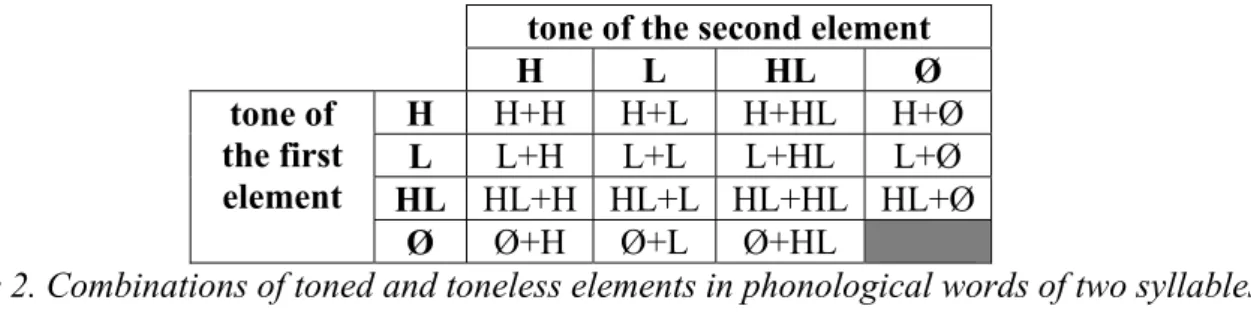
The experiment that underlies this study sets out to form phonological words by combining two elements (morphemes or words), of which both are lexically specified for tone, or only one is lexically specified for tone whereas the other one is toneless. The aims of the experiment are (i) to examine all possible combinations of toned and toneless elements, and (ii) to compare the tone of each resulting combination with the citation tones of the constituting elements. The range of possible combinations of toned and toneless elements is summarized in Table 2. The symbol ‘Ø’ stands for toneless elements (affixes). Rows represent the first element in a combination, which may be an affix, a root or a word. Columns represent the second element in a combination, which may likewise be an affix, a root or a word. The intersection of a row and a column contains the resulting combination. The combination of two toneless elements within a word is non-existent (the shaded gray cell).
5
tone of the second element
H L HL Ø tone of the first element H H+H H+L H+HL H+Ø L L+H L+L L+HL L+Ø HL HL+H HL+L HL+HL HL+Ø Ø Ø+H Ø+L Ø+HL
Table 2. Combinations of toned and toneless elements in phonological words of two syllables or more
While we aimed at a complete coverage of all possible combinations as summarized in Table 2, not all combinations involving toneless elements (affixes) could have been experimentally tested. More precisely, while the synchronically productive process of word formation through prefixation offered us a chance to study combinations of a toneless element with a toned element (i.e. Ø+H, Ø+L, and Ø+HL), comparable combinations of a toned element with a toneless element (i.e. H+Ø, L+Ø, and HL+Ø) could not have been systematically examined, because word formation by suffixation is of restricted productivity in Shǐxīng. Nevertheless, regularities of word tone derivation revealed through the tested combinations shed some light on tone derivation in words formed through processes with restricted productivity, as detailed in §3.2.1.
The experiment was conducted in March-April 2008 in the town of Qiáowǎ 乔瓦, the administrative seat of Mùlǐ Tibetan Autonomous County. The reported data were collected in four elicitation sessions from one adult male speaker, Lǔróng Duōdīng, the principal language consultant of the first author since 2005.5 Examples with monosyllabic /HL/ words were checked for accuracy and supplemented by additional examples with the same language consultant in March 2009.
The materials for this study are mono- and disyllabic words (both nouns and verbs), taken from the Shǐxīng vocabulary list compiled by the first author during her fieldwork in 2005 and 2006. We used 3-4 words for each tone in each of the studied categories (monosyllabic nouns, disyllabic nouns, monosyllabic verbs, disyllabic verbs). Both native Shǐxīng words, e.g. [LHrõ], /Lrõ/ ‘horse’, [Hpu-Lmi], /HLpu-mi/, and loanwords (from Tibetan), e.g. [Hsɛ̃.Htɕɛ̃], /Hsɛ̃.tɕɛ̃/ ‘domestic animals’ (WT sems can), were used.
The first stage of the experiment consisted in recording the target items, first in isolation and then inside carrier sentences. The Chinese equivalent of the target elements were provided orally as a prompt. Our language consultant was instructed to repeat each item twice. We used a total of three carrier sentences for nouns and nine carrier sentences for verbs. Here are some examples:6
5 Lǔróng Duōdīng is a native speaker of the Upper Reaches sub-variety of Shǐxīng, originally from Lánmǎn [H lã-Hmã] village in Shuǐluò Township. In addition to Shǐxīng, he is proficient in South-West Mandarin Chinese (a
dialectal variety of Mandarin Chinese spoken in Yúnnán and Sìchuān), in Kami Tibetan (the local Mùlǐ variety of Tibetan), and in Prinmi (a Qiangic language spoken in Lánpíng and Nínglàng counties in northwestern Yúnnán, and in Mùlǐ and Jiǔlóng counties in southwestern Sìchuān). He has lived and worked in Qiáowǎ for several decades, but he visits his home township regularly and speaks his native language at home with his wife, also a native of Shuǐluò, thereby maintaining a good proficiency in Shǐxīng.
6 The following symbols and abbreviations and are used in the glosses: 1=first person; 2=second person; 3=third
person; <=derived from; >=shows the outcome of a derivation; ?=indicates a morpheme or word whose meaning is unclear; AGT=agent; ANM=animate; CMPR=standard of comparison; COM=comitative; COP=copula; DUR=durative; GEN=genitive; IPFV=imperfective; LOC=locative; NEG=negation; NM=nominal; NMLZ=nominalizer; PL=plural; PFV=perfective; PNT=patient; PRF=perfect; PST=past; PROG=progressive; RES=resultative; SG=singular; TERM=terminative; TOP=topic; VOC=vocative; VOL=volition; WT=Written Tibetan.
6 (3) Lha =Hʐɿ# NP Lɲõ.
this =TOP COP
‘This is NP.’, e.g. [Lha =Hʐɿ# Hʔɛ̃ Lɲõ.] ‘This is a sheep.’ (4) Hŋɜ# V =Ltsʰa =Lwu =Lsɿ.
1SG =TERM =RES =PRF
‘I finished V.’, e.g. [Hŋɜ# LHtɕʰĩ =Ltsʰa =Lwu =Lsɿ.] ‘I finished drinking.’ (< [LHtɕʰĩ], /Ltɕʰĩ/ ‘drink’)
The second stage of the experiment consisted in systematic combinations of two elements into di-, tri-, tetra- and pentasyllabic phonological words. The target items were recorded again first in isolation and then in the appropriate carrier sentence.
The use of carrier sentences led to the following observations. First, fully articulated phonological words may be followed by extrametrical syllables, as the copula /ɲõ/ in example (3) (< [LHɲõ], /Lɲõ/ in isolation), and the verbal clitics /tsʰa/, /wu/ and /sɿ/ in example (4).7
These syllables do not acquire any tone from their host word, nor do they surface their inherent tones. Instead, they are realized, phonetically, on a low pitch and are here analyzed as supplied with a phonological L tone before the phonetics. Extrametrical syllables attach to fully articulated phonological words and may influence their tone pattern. Tonal domains combining phonological words and enclitics consequently exhibit a number of additional tone patterns distinct from those on phonological words.
The second observation prompted by the use of carrier sentences is that the realization of tones may change depending on surrounding tones (§3.1).
The experiment reveals that word tone derivation in Shǐxīng is essentially constrained by the presence or absence of tone on the initial element of the phonological word in question. The presentation of experimental results is therefore organized in three parts, including phonological words in which the initial element is toned (§3.2.1), phonological words in which the initial element is toneless (§3.2.2), and domains containing enclitics (§3.2.3).
3. Results
3.1. Tonal alternations in running speech
A comparison of the realization of target elements in isolation and in carrier sentences revealed the following two differences in the realization of tones (conditioned by the surrounding tones).
First, contour tone simplification. Monosyllabic [HL] words are realized as [H] when followed by a [L] tone (a phonological word with the lexical /L/ tone or an extrametrical syllable).8 The endpoint of the [HL] contour is delayed into the following [L] syllable, where
7 Verbal clitics comprise auxiliaries, negators, and interjections. Nominal clitics include case and discourse
markers. In terms of their positioning in relation to other sentence elements, all Shǐxīng verbal and nominal markers are enclitics, with the only exception of negators (the negative marker /mV/, subject to vowel harmony, and the prohibitive marker /tha/) that are proclitics instead. A nominal or a verbal clitic cannot appear in isolation, whereas combinations of a nominal clitic with another nominal clitic, or of one verbal clitic with another verbal clitic may form phonological words in their own right (see example 57). In view of the assumption that tones on phonological words of two syllables or more derive from the tones of the constituting monosyllables, nominal and verbal clitics appear to be underlyingly specified for tone.
8 This generalization is not without exceptions. In the corpus of narrative texts, some monosyllabic /HL/ words
may also be simplified to /H/ when followed by a /H/ tone, as the word [HLʁɑo] ‘strength’, followed by the word
[Hka-Hpɑo] ‘very’ in sentence (14) of the appended text. The precise conditioning for this simplification as well
7 it is absorbed into a like [L] tone (cf. “prohibition of contours in like neighbor contexts” among the most recurrent tonal processes cross-linguistically, Hyman 2007b:13). Consider examples (5) and (6), presenting a nominal and a verbal contrastive [H]-[HL] pair, respectively: [Hʂɿ] ‘fishing net’ vs. [HLʂɿ] ‘tongue’, and [Hpũ] ‘move’ vs. [HLpũ] ‘pile’. The contour tone [HL], followed by a syllable with an [L] tone in these carrier sentences, simplifies to [H], so that the tonal contrast in each pair is neutralized.
(5) Lha =Hʐɿ# Hʂɿ Lɲõ. this =TOP fishing.net
tongue
COP
‘This is a fishing net.’ / ‘This is a tongue.’ (6) Htʰi =Hrɛ̃# Hpũ# Ltɕi-Htɕi# Lbɜ =Hjĩ.
that =PL move
pile
do-do make =PROG ‘They are about to move.’ / ‘They are about to pile.’
This contour simplification may be nullified and the citation [HL] tone “restored” as a strategy to avoid surface homophony of underlyingly distinct forms. For instance, in the absence of a larger context to disambiguate the two homophonous pairs in examples (5-6), our language consultant finally chose to pronounce the members of each pair with their respective citation tones, so that his rendering of the sentence ‘This is a tongue.’ was consequently corrected to [Lha =Hʐɿ# HLʂɿ Lɲõ.] and that of the sentence ‘They are about to pile.’ to [Htʰi =Hrɛ̃# HLpũ# Ltɕi-Htɕi# Lbɜ =Hjĩ].
Second, late realization of tone. A tone may be realized on a neighboring tone-bearing unit, when this unit is followed by a [L] tone (cf. “horizontal assimilation”, realization of tone on a neighboring tone-bearing unit among the most recurrent tonal processes cross-linguistically, Hyman 2007b:4-8). In disyllabic words, [L-H] sequences may be realized as [L-LH] by left-to-right L tone spreading. In a similar fashion, L] may be realized as [H-HL] by left-to-right H tone spreading. Both patterns, [L-H] vs. [L-LH] and [H-L] vs. [H-[H-HL], are in free variation. For example:
(7) Lha =Hʐɿ# Lpʰa-LHza Lɲõ. this =TOP shoes COP
‘These are shoes.’ (< [Lpʰa-Hza], /Lpʰa-za/ ‘shoes’ in isolation) (8) Lha =Hʐɿ# Hta-HLpi Lɲõ.
this =TOP mane COP
‘This is mane.’ (< [Hta-Lpi], /HLta-pi/ ‘mane’ in isolation)
3.2. Word tone derivation
3.2.1. Word tone derivation in phonological words in which the initial element is toned
Acceptability of modifying noun-noun combinations as one phonological word, subject to word tone derivation, in the course of the experiment was constrained by the acceptability of the combination as one unit of meaning (a compound or a high frequency combination), e.g. [Lba-Lru Hrɘ], /Lba-ru rɘ/ ‘snake skin’ (< [Lba-Hru], /Lba-ru/ ‘snake’, [Hrɘ] ‘skin’). Combinations not satisfying this condition were treated by our language consultant as those of
8 two (phonological and lexical) words (with or without the intervening genitive marker /ji/), each with its own tone, e.g. [Lba-Hru# LHʁɛ̃] ‘the neck of a snake’.
In phonological words of two syllables or more, in which the initial element is lexically specified for tone, the tone of the initial element decides the tone of the resulting combination. Consider these examples, grouped by the tone of the initial element:
/H/
(9) [Hʔɛ̃] ‘sheep’+ [Hrɘ] ‘skin’ > [Hʔɛ̃ Hrɘ], /Hʔɛ̃ rɘ/ ‘sheep skin’
(10) [Hʔɛ̃] ‘sheep’+ [LHʁɛ̃], /Lʁɛ̃/ ‘neck’ > [Hʔɛ̃ Hʁɛ̃], /Hʔɛ̃ ʁɛ̃/ ‘sheep neck’
(11) [Hʔɛ̃] ‘sheep’+ [HLqʰɘ] ‘excrement’ > [Hʔɛ̃ Hqʰɘ], /Hʔɛ̃ qʰɘ/ ‘sheep excrement’
(12) [Hʔɛ̃] ‘sheep’+ [Hkʰa-Hmiæ], /Hkʰa-miæ/ ‘footprint’ > [Hʔɛ̃ Hkʰa-Hmiæ], /Hʔɛ̃ kʰa-miæ/ ‘sheep hoofprints’
(13) [Hʔɛ̃] ‘sheep’+ [Lm̥iæ-Htsũ], /Lm̥iæ-tsũ/ ‘tail’ > [Hʔɛ̃ Hm̥iæ-Htsũ], /Hʔɛ̃ m̥iæ-tsũ/ ‘sheep tail’ (14) [Hʔɛ̃] ‘sheep’+ [Hɲɜ-Lmi], /HLɲɜ-mi/ ‘heart’ > [Hʔɛ̃ Hɲɜ-Hmi], /Hʔɛ̃ ɲɜ-mi/ ‘sheep heart’ /L/
(15) [LHrõ], /Lrõ/ ‘horse’+ [Hrɘ] ‘skin’ > [Lrõ Hrɘ], /Lrõ rɘ/ ‘horse skin’
(16) [LHrõ], /Lrõ/ ‘horse’+ [LHʁɛ̃], /Lʁɛ̃/ ‘neck’ > [Lrõ Hʁɛ̃], /Lrõ ʁɛ̃/ ‘horse neck’
(17) [LHrõ], /Lrõ/ ‘horse’+ [HLqʰɘ] ‘excrement’ > [Lrõ Hqʰɘ], /Lrõ qʰɘ/ ‘horse excrement’ (18) [LHrõ], /Lrõ/ ‘horse’+ [Hkʰa-Hmiæ], /Hkʰa-miæ/ ‘footprint’ > [Lrõ Lkʰa-Hmiæ], /Lrõ kʰa-miæ/ ‘horse hoofprints’
(19) [LHrõ], /Lrõ/ ‘horse’+ [Lm̥iæ-Htsũ], /Lm̥iæ-tsũ/ ‘tail’ > [Lrõ Lm̥iæ-Htsũ], /Lrõ m̥iæ-tsũ/ ‘horse tail’
(20) [LHrõ], /Lrõ/ ‘horse’+ [Hɲɜ-Lmi], /HLɲɜ-mi/ ‘heart’ > [Lrõ Lɲɜ-Hmi], /Lrõ ɲɜ-mi/ ‘horse heart’
/HL/
(21) [HLtsʰɿ] ‘goat’+ [Hrɘ] ‘skin’ > [Htsʰɿ Lrɘ], /HLtsʰɿ rɘ/ ‘goat skin’
(22) [HLtsʰɿ] ‘goat’+ [LHʁɛ̃], /Lʁɛ̃/ ‘neck’ > [Htsʰɿ Lʁɛ̃], /HLtsʰɿ ʁɛ̃/ ‘goat neck’
(23) [HLtsʰɿ] ‘goat’+ [HLqʰɘ] ‘excrement’ > [Htsʰɿ Lqʰɘ], /HLtsʰɿ qʰɘ/ ‘goat excrement’
(24) [HLtsʰɿ] ‘goat’+ [Hkʰa-Hmiæ], /Hkʰa-miæ/ ‘footprint’ > [Htsʰɿ Lkʰa-Lmiæ], /HLtsʰɿ kʰa-miæ/ ‘goat hoofprints’
(25) [HLtsʰɿ] ‘goat’+ [Lm̥iæ-Htsũ], /Lm̥iæ-tsũ/ ‘tail’ > [Htsʰɿ Lm̥iæ-Ltsũ], /HLtsʰɿ m̥iæ-tsũ/ ‘goat tail’
(26) [HLtsʰɿ] ‘goat’+ [Hɲɜ-Lmi], /HLɲɜ-mi/ ‘heart’ > [Htsʰɿ Lɲɜ-Lmi], /HLtsʰɿ ɲɜ-mi/ ‘goat heart’ The process of word tone derivation in phonological words in which the initial element is toned is hence a left-to-right expansion of the tone of the initial element. Tones of non-initial elements are deleted, whereas the tone of the initial element adjusts to the new number of syllables in the resulting combination. This word tone derivation process is schematically presented in Table 3.
tone of the second element
9 H L HL tone of the first element H H L L HL HL
Table 3. Word tone derivation in phonological words in which the initial element is toned
One noted exception to this otherwise regular process in our experimental data is the monosyllabic /HL/ word [HLbõ] ‘yak’. In contrast to the other four tested /HL/ words, [HLbõ] ‘yak’ behaves in combinations as a /L/ tone word, as in the following examples:
(27) [HLbõ] ‘yak’+ [Hrɘ] ‘skin’ > [Lbõ Hrɘ], /Lbõ rɘ/ ‘yak skin’
(28) [HLbõ] ‘yak’+ [LHʁɛ̃], /Lʁɛ̃/ ‘neck’ > [Lbõ Hʁɛ̃], /Lbõ ʁɛ̃/ ‘yak neck’
(29) [HLbõ] ‘yak’+ [HLqʰɘ] ‘excrement’ > [Lbõ Hqʰɘ], /Lbõ qʰɘ/ ‘yak excrement’
(30) [HLbõ] ‘yak’+ [Hkʰa-Hmiæ], /Hkʰa-miæ/ ‘footprint’ > [Lbõ Lkʰa-Hmiæ], /Lbõ kʰa-miæ/ ‘yak hoofprints’
(31) [HLbõ] ‘yak’+ [Lm̥iæ-Htsũ], /Lm̥iæ-tsũ/ ‘tail’ > [Lbõ Lm̥iæ-Htsũ], /Lbõ m̥iæ-tsũ/ ‘yak tail’ (32) [HLbõ] ‘yak’+ [Hɲɜ-Lmi], /HLɲɜ-mi/ ‘heart’ > [Lbõ Lɲɜ-Hmi], /Lbõ ɲɜ-mi/ ‘yak heart’
Aside from this one exception, in phonological words in which the initial element is toned, the tone of this initial element determines the tone of the resulting combination.
This regularity appears to account also for word tone derivation in words formed through processes with a synchronically restricted productivity, such as the formation of nouns by suffixation. This is suggested by a comparison of nouns that exist in doublets: one form as monosyllable (free root) and another suffixed (root+suffix) (Chirkova 2007).
(33) [Hʔɛ̃] ‘sheep’ and [Hʔɛ̃-Hmi], /Hʔɛ̃-mi/ ‘ewe’ (34) [HLtsʰɿ] ‘goat’ and [Htsʰɿ-Lmi], /HLtsʰɿ-mi/ ‘doe’ Table 4 summarizes this derivation process:
suffix (Ø)
root H H
L L
HL HL
Table 4. Word tone derivation in words formed through suffixation
Notably, the “irregular” /HL/ word [HLbõ] behaves phonologically as a /L/ word also when followed by a suffix, i.e. similar to its behavior in noun-noun combinations, i.e. [Lbõ-Hmi], /Lbõ-mi/ ‘dri, female yak’.
3.2.2. Word tone derivation in phonological words in which the initial element is toneless
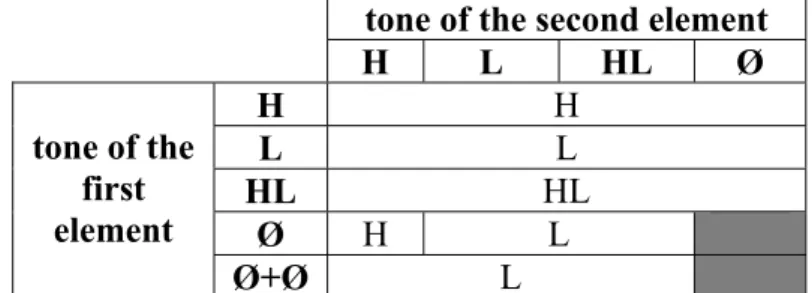
The examined phonological words in which the initial element is toneless include verbs formed through prefixation. We examined combinations of monosyllabic verb roots with one or two prefixes, and disyllabic verb roots with one prefix (the remaining option of disyllabic verb roots with two prefixes is non-occurring in this language). Combinations of verb roots with one prefix yielded the following tone derivation patterns:
10 If the tone of the verbal root is /H/, the prefix assimilates to it, resulting in a /H/ word tone. /H/ is hence anticipated onto the penult and realized on its original syllable. For example: (35) /miæ-/ ‘downward’ + [Hɕĩ] ‘look’ > [Hmiæ-Hɕĩ], /Hmiæ-ɕĩ/ ‘look down’
(36) /bɘ-/ ‘outward’ + [Hɕĩ] ‘look’ > [Hbɘ-Hɕĩ], /Hbɘ-ɕĩ/ ‘look out’ (37) /kʰu-/ ‘inward’ + [Hɕĩ] ‘look’ > [Hkʰu-Hɕĩ], /Hkʰu-ɕĩ/ ‘look inside’
(38) /dʑi-/ ‘upward’ + [Hɕĩ] ‘look’ > [Hdʑi-Hɕĩ], /Hdʑi-ɕĩ/ ‘look up’
If the tone of the verbal root is /L/ or /HL/, the resulting word tone is /L/, i.e. neutralizing the contrast between /L/ and /HL/ over the root. For example:
(39) /dʑi-/ ‘upward’ + [LHpiæ], /Lpiæ/ ‘climb’ > [Ldʑi-Hpiæ], /Ldʑi-piæ/ ‘climb up’
(40) /kʰu-/ ‘inward’ + [Ldzõ-Hdzõ], /Ldzõ-dzõ/ ‘run’ > [Lkʰu-Ldzõ-Hdzõ], /Lkʰu-dzõ-dzõ/ ‘run inside’
(41) /miæ-/ ‘downward’ + [HLkʰɪ] ‘throw’ > [Lmiæ-Hxɪ], /Lmiæ-xɪ/ ‘throw down’ (42) /miæ-/ ‘downward’ + [HLpũ] ‘pile’ > [Lmiæ-Hpũ], /Lmiæ-pũ/ ‘pile down, put down’ Combinations of a monosyllabic verbal root with two prefixes, on the other hand, invariably yielded one single tone pattern, namely /L/, irrespective of the citation tone of the verbal root. For example:
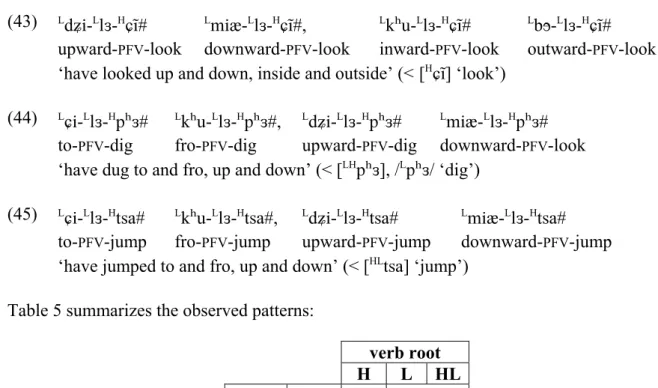
(43) Ldʑi-Llɜ-Hɕĩ# Lmiæ-Llɜ-Hɕĩ#, Lkʰu-Llɜ-Hɕĩ# Lbɘ-Llɜ-Hɕĩ# upward-PFV-look downward-PFV-look inward-PFV-look outward-PFV-look
‘have looked up and down, inside and outside’ (< [Hɕĩ] ‘look’) (44) Lɕi-Llɜ-Hpʰɜ# Lkʰu-Llɜ-Hpʰɜ#, Ldʑi-Llɜ-Hpʰɜ# Lmiæ-Llɜ-Hpʰɜ# to-PFV-dig fro-PFV-dig upward-PFV-dig downward-PFV-look
‘have dug to and fro, up and down’ (< [LHpʰɜ], /Lpʰɜ/ ‘dig’)
(45) Lɕi-Llɜ-Htsa# Lkʰu-Llɜ-Htsa#, Ldʑi-Llɜ-Htsa# Lmiæ-Llɜ-Htsa# to-PFV-jump fro-PFV-jump upward-PFV-jump downward-PFV-jump
‘have jumped to and fro, up and down’ (< [HLtsa] ‘jump’) Table 5 summarizes the observed patterns:
verb root
H L HL
prefix Ø H L
Ø+Ø L
Table 5. Word tone derivation in phonological words in which the initial element is toneless
Notably, the phonetic realization of /L/ tone pattern on verbs formed through prefixation is distinct from that of /L/ tone pattern on nominal compounds (§3.2.1). In verbs formed through prefixation, the syllables carrying /L/ tone (prefixes) are different from that carrying /H/ tone (verbal root) in duration and articulatory precision, whereas no similar difference is observed on /L/ nominal compounds. In verbs, the syllables carrying /L/ tone have more reduced
11 vowels, which may moreover be subject to regressive vowel harmony, e.g. [Lbɘ-Hgi] ‘pull out, lengthen’, [Lbɜ-Hpʰɜ] ‘pull out’, [Lbu-Htʂʰu] ‘spit out’. The distinction in prominence is here taken as indication of the stressed status of the syllable carrying the boundary [H] tone and the unstressed status of the toneless prefixes carrying the phonological [L] tone. This issue is further taken up in §4.1.9
3.2.3. Tonal domains containing enclitics
Examined combinations of words with nominal and verbal enclitics yielded two distinct types of tone patterns, depending on the overall length of the resulting combination and the number of its constituting elements (the number of attached enclitics).
(i) Word-enclitic combinations may be treated as one phonological word. The tone of the resulting combination is the expansion of the tone of its initial element. For example:
(46) [Hʔɛ̃] ‘sheep’+ the genitive marker /ji/ > [Hʔɛ̃ =Hji], /Hʔɛ̃ =ji/ ‘of a sheep’ (47) [LHrõ], /Lrõ/ ‘horse’+ the genitive marker /ji/ > [Lrõ =Hji], /Lrõ =ji/ ‘of a horse’ (48) [HLtsʰɿ] ‘goat’+ the genitive marker /ji/ > [Htsʰɿ =Lji], /HLtsʰɿ =ji/ ‘of a goat’
(49) [Hʂu-Hhĩ], /Hʂu-hĩ/ ‘a Shǐxīng person’ + the genitive marker /ji/ > [Hʂu-Hhĩ =Hhĩ], /Hʂu-hĩ =hĩ/ ‘of a Shǐxīng person’ (in this combination, the genitive marker /ji/ assimilates to the preceding syllable, /hĩ/)
(50) [Ltʂa.Hwɜ], /Ltʂa.wɜ/ ‘monk’ (WT grwa pa) + the genitive marker /ji/ > [Ltʂa.Lwɜ =Hji], /Ltʂa.wɜ =ji/ ‘of a monk’
(51) [Hsĩ-Lzu], /HLsĩ-zu/ ‘carpenter’ + the genitive marker /ji/ > [Hsĩ-Lzu =Lji], /HLsĩ-zu =ji/ ‘of a carpenter’
The “irregular” /HL/ word /HLbõ/ ‘yak’ behaves as a regular /HL/ word in this type of combinations, as in the following example:
(52) [HLbõ] ‘yak’+ the genitive marker /ji/ > [Hbõ =Lji], /HLbõ =ji/ ‘of a yak’
9 Vowel harmony taken as diagnostic of the unstressed status of the syllables on which it operates helps to
identify in Shǐxīng a set of pronominal proclitics. Overall, vowel harmony has very restricted productivity in Shǐxīng and affects, in addition to directional verbal prefixes, only the negator [mV] and the first and third person pronouns in combinations with the plural suffix [-rɛ̃] and nominal clitics, e.g. [Ltʰi =Hji] ‘his’, [Ltʰɜ =Hsɿ]
‘him’, [Htʰu-Hwu] ‘his family, they as a family’. If assumed to be derived from the tone of the third person
pronoun [HLtʰi] (§3.2.1), the resulting tone of these combinations is expected to be /HL/, i.e. *[Htʰi =Lji], *[Htʰɜ
=Lsɿ] and *[Htʰu-Lwu], hence yielding the incorrect tone. If, on the other hand, the initial syllable in these
combinations is regarded as unstressed and toneless, as suggested by the assimilation of the vowel of this syllable to the vowel of the following syllable, its tone can be explained as depending on the tone of the adjacent stressed syllable (§3.2.2). The assimilation of both the vowel of the initial syllable and its tone to the vowel and tone of the second syllable of the word [Htʰu-Hwu] ‘his family, they as a family’, derived from the root [Hwu]
‘family’, supports this assumption. The same analysis, positing a set of unstressed and toneless pronominal proclitics, can be extended to those pronominal forms that, while not subject to vowel harmony, exhibit tonal behavior inconsistent with the tones of the corresponding free pronominal forms, e.g. [Hɲi-Hwu] ‘you (as a
family)’ (< [HLɲi] ‘thou’, [Hwu] ‘family’), [Lɲi =Hwu] ‘with you’ (< the comitative marker /wu/). The same
12 (ii) Alternatively, only the host word or, variously, the first two syllables of the combination of a word with enclitics may carry tone, deriving this tone from the tone of the initial element of the combination (the host word). The remaining syllables are toneless and surface with a phonological [L] tone. For example:
(53) Hŋɜ# Hqua =Ltsʰa =Lwu =Lsɿ. 1SG weep =TERM =RES =PRF
‘I finished weeping.’ (< [Hqua] ‘cry, weep’) (54) Hŋɜ# LHdzɜ =Ltsʰa =Lwu =Lsɿ.
1SG eat =TERM =RES =PRF
‘I finished eating.’ (< [LHdzɜ], /Ldzɜ/ ‘eat’)
The corresponding /HL/ monosyllabic verb in the same carrier sentence is realized as /H/, i.e. the citation /HL/ tone is simplified due to the adjacent [L] tone:10
(55) Hŋɜ# Htsa =Ltsʰa =Lwu =Lsɿ. 1SG weep =TERM =RES =PRF
‘I finished jumping.’ (< [HLtsa] ‘jump’)
The following example illustrates the alternative situation, in which the first two syllables of a combination of a word with enclitics are treated as one fully articulated phonological word, carrying one of the three contrastive tone patterns, /H/, /L/ or /HL/, whereas the remaining syllables are toneless and surface as [L]. Note that in this type of situation, the domain for the contrastive tone pattern may not be coextensive with the constituents into which this domain is analysed morphologically and syntactically, as in example (56):
(56) [Htsõ] ‘things’ + the disyllabic optional plural marker /mɘ-ʑi/ > [Htsõ=Hmɘ-Lʑi] ‘things’ Finally, an even number of enclitics attached to a disyllabic host word may form disyllabic phonological words in their own right. Consider, for instance, the phonological word [Lrɛ̃ =Hʐɿ], composed of the agentive marker /rɛ̃/ and the topic marker /ʐɿ/, in sentence (20) of the appended text, reproduced here for convenience:
(57) Ltʰi =Hji# Ltsʰɿ-Hdʑyɜ# Lrɛ̃ =Hʐɿ# HLpɜ =Lli =Lɲõ. Ltʰi =Hji Ltsʰɿ-Hdʑyɜ Lrɛ̃ =Hʐɿ HLpɜ =Lli =Lɲõ 3SG =GEN life-friend AGT =TOP speak =NMLZ.PST =COP ‘His wife answered.’
Overall, the shorter the word-enclitics combination (one monosyllabic host word followed by one single enclitic), the likelier it is that the enclitic will be integrated into one phonological word with its host; the longer the combination, the likelier it is that the enclitic(s) will be treated as extrametrical syllables, as if they did not count as part of the tonal domain.
10 In the corpus of narrative texts, monosyllabic /HL/ words followed by several enclitics are also attested with
their citation /HL/ tone, as in sentence (14) of the appended text, [HLɕyɜ =Lli =Lɲõ] ‘[he] thought’ (< [HLɕyɜ]
13
4. Discussion
The following tables summarize the observed patterns in word tone derivation: (i) tone patterns in phonological words of two syllables or more (which are equivalent to lexical words, compounds and word-enclitic combinations), and (ii) tone patterns in domains containing enclitics, treated as one phonological word followed by extrametrical syllables. Sequences enclosed in square brackets in Table 7 are fully articulated phonological words, whereas those outside are extrametrical. “PW” stands for phonological words formed out of enclitics.
tone of the second element H L HL Ø tone of the first element H H L L HL HL Ø H L Ø+Ø L
Table 6. Word tone derivation in phonological words of two syllables or more
one enclitic two enclitics three enclitics
monosyllabic host word H [H]-L [H]-L-L or [H-H]-L [H]-L-L-L or [H-H]-L-L L [LH]-L [LH]-L-L or [L-H]-L [LH]-L-L-L or [L-H]-L-L HL [HL]-L [HL]-L-L or [H-L]-L [HL]-L-L-L or [H-L]-L-L disyllabic host word H [H-H]-L [H-H]-L-L or [H-H]-[PW] [H-H]-L-L-L or [H-H]-[PW]-L L [L-H]-L [L-H]-L-L or [L-H]-[PW] [L-H]-L-L-L or [H-H]-[PW]-L HL [H-L]-L [H-L]-L-L or [H-L]-[PW] [H-L]-L-L-L or [H-H]-[PW]-L
Table 7. Tone patterns in tonal domains containing one to three enclitics (treated as a combination of a phonological word and extrametrical syllables)
The following observations can be made:
(i) Tones. The observed patterns of tone derivation suggest that of the three contrastive tones, /HL/ has a special status, dissimilar to that of /H/ and /L/. /H/ and /L/ are not subject to modifications in tonal context and remain stable in derivations, with the only exception of verbs formed by adding two prefixes. /HL/ tone, on the other hand, is subject to simplification to /H/ in running speech and also neutralizes with /L/ to /L/ in most derivations, except for those where the initial element of the word carries /HL/ tone.
(ii) Tonal processes. Shǐxīng displays a wide range of tonal processes, including (a) contour tone simplification, (b) left-to-right tone spreading on nouns, (c) anticipatory (right-to-left) tone spreading on verbs formed with one prefix, and (d) tone neutralization to tone /H/ on verbal roots in verbs formed with two prefixes. A notable by-product of word tone derivation in Shǐxīng is tone deletion, e.g. the deletion of tone on non-initial elements in phonological words in which the initial element is toned.
(iii) Word tone derivation. The experiment reveals the following major factors that constrain word tone derivation in phonological words of two syllables or more in Shǐxīng:
(a) presence or absence of tone on the initial element of the phonological word, triggering two distinct tonal processes: anticipatory tone spreading and tone neutralization in the case of verbs formed through prefixation vs. perseverative tone spread in the case of nominal compounds and phrases containing enclitics.
(b) length of the phonological word: the prototypical tone domain in Shǐxīng is two syllables long. Even sequences exceeding this length may be divided into two or more disyllabic phonological words; alternatively, only the first two syllables of the domain
14 may be treated as one phonological word, whereas the remaining syllables are extrametrical (§3.2.3). The process of tone anticipation in verbs is also restricted to the first two syllables of the domain (§3.2.2). Altogether, this suggests that Shǐxīng has a strong preference towards disyllabicity in its prosodic organization, with the disyllabic foot being the building block for the prosodic structure of Shǐxīng. At the same time, monosyllabic (minimal) feet are allowed in Shǐxīng (free roots that can stand alone as monosyllabic lexical words).
(c) composition of the phonological word: the more elements a phonological word contains, the likelier it is that only the first element (or the first disyllabic foot) will be treated as a fully articulated phonological word, whereas the remaining elements will be treated as extrametrical.
4.1. Word tone derivation and the prosodic organization of Shǐxīng
A unified account of the observed phenomena is possible, if a prosodic domain in Shǐxīng is taken to be characterized, in addition to tone, also by metrical stress.
We argue that Shǐxīng is a language with culminative word prominence (stress): a phonological word in Shǐxīng has a single syllable bearing stress, which is the location for the insertion of lexical tones. The default location of stress is the initial syllable of the domain. A prosodic domain in Shǐxīng is hence divided into one stressed syllable and the remaining unstressed syllables, the tones of which are deleted. The tone of the stressed syllable determines the tone pattern of the domain. All in all, a prosodic domain is first and foremost defined by stress.
When appearing on the initial stressed syllable of the domain, the three contrastive tones, /H/, /L/ and /HL/, extend their respective tones onto the remaining unstressed syllables, followed by the addition of a postlexical boundary [H] tone in the case of the lexical /L/ tone (§3.2.1). If the domain exceeds two syllables in length, the expansion of the tone of the initial syllable is correlated with the morphosyntactic constituency of the domain. If the prosodic domain in question is equivalent to a lexical word, the tone of the initial stressed syllable will expand onto all remaining syllables. If the domain is equivalent to a syntactic phrase, the expansion can also take place, but the expansion of tone may be restricted to the initial disyllabic foot, whereas the remaining syllables are extrametrical and receive a phonological [L] tone (§3.2.3). Altogether, lexical words are characterized by stable tone patterns, which are lexically encoded, whereas the tone pattern of a group of words making up one prosodic domain is characterized by a certain degree of variability. To reflect this difference, we propose to distinguish within a prosodic stress domain a distinct level of tonal domain, which is characterized by the three contrastive tones, /H/, /L/ and /HL/. While a tonal domain may be restricted to the first disyllabic foot, a stress domain may be larger, including also extrametrical syllables. Both domains (stress domain and tonal domain) coincide in the case of lexical words; the stress domain may be larger than the tonal domain for syntactic phrases.
Tone placement rules on domains that begin with a toneless syllable deviate from the default rule above. The relevant set of facts is here explained under the assumption that toneless syllables (affixes as well as proclitics, see footnote 9) cannot receive stress. In domains that begin with toneless syllables, stress shifts to the first toned (and thus stressable) syllable to the right. The precise process of tone derivation appears to be further constrained by the distance of the first stressable syllable from the default domain-initial stress location: the further from the default stress location, the greater the neutralization between the three lexical tones (§3.2.2). In domains beginning with a toneless syllable, the lexical tone of the first stressable syllable can determine the derivation of the output tone pattern only if this stressable syllable is located within the initial disyllabic foot. In this case, if the first stressable syllable carries /H/ tone, this tone can be anticipated on the preceding toneless syllable. If, on the other hand, the first stressable syllable carries /L/ or /HL/ tone, the contrast between these
15 two tones is neutralized to /L/, all syllables within the domain up to the final syllable receive /L/ tone, whereas the final syllable receives a boundary [H] tone.11 If a prosodic domain begins with two unstressed syllables, so that the initial foot consists entirely of unstressed toneless syllables and the first stressable syllable is not within its scope (as in verbs formed with two prefixes), the contrast between the three lexical tones appears to be disregarded altogether. All syllables within the domain receive /L/ tone, and the domain-final syllable receives a boundary [H] tone.
To conclude this overview of experimental results, we would like to tentatively suggest one option for phonological modeling that, in the present state of knowledge, may shed further light on the link between stress and tone (§3.2.2) and the related pattern of stress placement, as well as on the tonal behavior of nominal and verbal clitics, which, while cannot occur in isolation, may combine to form phonological words. This option for phonological modeling consists in considering L as an underspecified tone. In this analysis, Shǐxīng would have only two active tones, /H/ that can spread (/H/ in current notation), and /H/ that cannot spread and that appears only in domain-initial position (/HL/ in current notation). The category of toneless syllables would include, in addition to affixes, free and bound monosyllables previously analyzed as having /L/ tone (e.g. /rõ/ ‘horse’).12 A further distinction would then be drawn between free toneless monosyllables (free roots) that can stand alone as monosyllabic phonological words, thus constituting minimal monosyllabic feet, and bound toneless monosyllables (e.g. clitics) that cannot stand alone as monosyllabic phonological words. Notably, toneless monosyllables of the latter type can form phonological words if combined by two (i.e. constituting disyllabic feet, the building block of the prosodic organization of Shǐxīng), as the phonological word [Lrɛ̃ =Hʐɿ] formed out of two enclitics in example (57) above or disyllabic combinations of pronominal proclitics with case clitics mentioned in footnote 9. In a domain that begins with a monosyllabic or disyllabic foot formed out of one or two toneless syllables, respectively, stress shifts to the final syllable, tentatively due to the phonetic cue of duration, commonly shared between stressed syllables and final syllables cross-linguistically. Hence, in phonological words that consist of toneless syllables, stress is realized as a boundary [H] tone. In sum, in this analysis, stress in Shǐxīng is linked to lexical tone and uniformly targets the initial foot of the domain (either minimal, monosyllabic, or prototypical, disyllabic). If the domain-initial foot does not contain syllables that are lexically specified for tone, stress shifts to the final syllable of the domain.
11 While we did not test combinations of an unstressed toneless elements followed by a stressable toned element,
which is, in turn, followed by one or several unstressed, toneless elements, the textual corpus allows us to see word tone derivation in this type of situation. If the root carries /H/ tone, this tone is anticipated on the preceding syllable, realized on the original syllable and spread onto the following syllable, as in [Hha Hhĩ Hha] ‘this man’ (<
[Hhĩ] ‘man’, the pronominal clitic /ha/ ‘this’, which frames the modified noun) in sentence (2) of the appended text. If the root carries /L/ or /HL/ tone, this tonal contrast is neutralized to /L/. All syllables up to the final receive /L/ tone and the final syllable receives a boundary [H] tone, e.g. [Lbu-Lʐõ =Lsɿ =Hʐɿ] ‘there existed’
(</bu-/ ‘outward’, [Ldʑõ] ‘exist’ (NB: the initial of this root is lenited in the intervocalic position), the perfect
marker /sɿ/, the topic marker /ʐɿ/).
12 For a discussion of two-level tone systems in which a marked tone (frequently H) is contrasted with its
16
4.2. Prospects for further research
This pilot study is inevitably limited in its exploratory nature. The following steps are envisaged to obtain a comprehensive understanding of the prosodic organization of Shǐxīng:
(a) The proffered generalizations and hypotheses need to be carefully scrutinized, by testing against a broader range of experimental and non-experimental data. The most pressing task is to understand the nature and the distribution of /HL/ tone, as well as its relationship to /H/ tone. The already collected data and hypotheses are to be verified with more speakers.
(b) The investigation is to be extended to the Lower Reaches dialect of Shǐxīng, that reportedly has a distinct prosodic structure.
(c) The present study, focused on synchronic Shǐxīng phonology, is to include a diachronic perspective in an attempt to account for the noted exceptions in tone derivation (e.g. the word for ‘yak’, [HLbõ]), as well as in order to explore the paths along which tone arose in Shǐxīng.
Appendix. Daly Kuku and Gutsen Padzhe13
(1)Hji-Lɲɪ# Hji-Lɲɪ# Hhĩ# Lda-Hlɘ-Lku-Lku# Hma-Hhĩ# LHdʑĩ# LHjĩ =Ldʑõ.
Hji-Lɲɪ Hji-Lɲɪ Hhĩ Lda-Hlɘ-Lku-Lku Hma-Hhĩ previous-? previous-? person personal.name name-person LHdʑĩ LHjĩ =Ldʑõ.
one exist.ANM=DUR
‘A long time ago, there was a man by the name of Daly Kuku.’ (2)Hha Hhĩ Hha# Hʁɑo-Lduɜ.
Hha Hhĩ Hha Hʁɑo-Lduɜ this person this strength-big ‘This man was very strong.’
(3)Ltʰɜ-Llæ =Hʐɿ# Hgu-Htsɛ̃-Hpa-Htɕɜ# Hpɜ-Lhĩ# Ldʑĩ =Hlɜ# LHjĩ =Ldʑõ. Ltʰɜ-Llæ =Hʐɿ Hgu-Htsɛ̃-Hpa-Htɕɜ Hpɜ-Lhĩ that-become=TOP personal.name speak-person Ldʑĩ =Hlɜ LHjĩ =Ldʑõ
one =also exist.ANM =DUR
‘Then, there was also a man called Gutsen Padzhe.’ (4)Ltʰi =Hlɜ# Hʁɑo-Lduɜ-Lhĩ Lɲõ.
Ltʰi =Hlɜ Hʁɑo-Lduɜ-Lhĩ Lɲõ 3SG =also strength-big-person COP ‘He, too, was very strong.’
13 Personal names in Shǐxīng normally carry /H/ tone, e.g. /Hgu-tsɛ̃-pa-tɕɜ/. The tone pattern of the name of the
main protagonist, [Lda-Hlɘ-Lku-Lku] ‘Daly Kuku’, is therefore unusual. At present, we do not know what this
17
(5) Ldʑi-Hma# Hgu-Htsɛ̃-Hpa-Htɕɜ =Lrɛ̃# Lbi =Hsɿ# Lda-Hlɘ-Lku-Lku =Lkɜ# Hʁɑo-Ltsʰi =Lgɜ# HLɕyɜ =Lli =Lɲõ.
Ldʑi-Hma Hgu-Htsɛ̃-Hpa-Htɕɜ =Lrɛ̃ Lbi =Hsɿ Lda-Hlɘ-Lku-Lku =Lkɜ one-day personal.name =AGT walk =PRF personal.name =at
Hʁɑo-Ltsʰi =Lgɜ HLɕyɜ =Lli =Lɲõ strength-measure =VOL think =NMLZ.PST =COP
‘One day, Gutsen Padzhe wanted to measure swords with Daly Kuku.’
(6)Ltʰɜ =Lma =Hli# Hgu-Htsɛ̃-Hpa-Htɕɜ# Lda-Hlɘ-Lku-Lku =Lji# Ldʑo-Lhõ=Hno# Hpɑo =Ltɕʰu =Lli =Lɲõ.
Ltʰɜ =Lma =Hli Hgu-Htsɛ̃-Hpa-Htɕɜ Lda-Hlɘ-Lku-Lku =Lji that = day= NMLZ.PST personal.name personal.name=GEN Ldʑo-Lhõ =Hno Hpɑo =Ltɕʰu =Lli =Lɲõ
house =inside arrive =come =NMLZ.PST =COP ‘That day he arrived at Daly Kuku’s house.’
(7)Lda-Hlɘ-Lku-Lku# Lmi =LHjĩ =Lli =Lɲõ.
Lda-Hlɘ-Lku-Lku Lmi =LHjĩ =Lli =Lɲõ
personal.name NEG =exist.ANM =NMLZ.PST =COP ‘Daly Kuku was not at home.’
(8)Lda-Hlɘ#-Lku-Lku =Hji# Ltsʰɿ-Ldʑyɜ =Hʐɿ# Ldʑõ-Hhõ# LHjĩ =Ldʑõ.
Lda-Hlɘ#-Lku-Lku =Hji Ltsʰɿ-Ldʑyɜ =Hʐɿ Ldʑõ-Hhõ LHjĩ =Ldʑõ
personal.name =GEN life-friend =TOP house exist.ANM =DUR ‘Daly Kuku’s wife was at home.’
(9)Hgu-Htsɛ̃-Hpa-Htɕɜ# Ltʰu-Hwu# Ldʑõ-Hhõ# Hkʰu-Hpɑo =Ltɕʰu =Lli =Lɲõ. Hgu-Htsɛ̃-Hpa-Htɕɜ Ltʰu-Hwu Ldʑõ-Hhõ
personal.name 3SG-family house Hkʰu-Hpɑo =Ltɕʰu =Lli =Lɲõ
inward-arrive =come =NMLZ.PST =COP ‘Gutsen Padzhe entered their house.’
(10) “Hŋɜ# Ltʰɜ =Hwu# Hʁɑo-Hdɜ=Hgɜ#,”HLpɜ =Lli =Lɲõ.
“Hŋɜ Ltʰɜ =Hwu Hʁɑo-Hdɜ =Hgɜ,” HLpɜ =Lli =Lɲõ
1SG 3SG =COM strength-perform =VOL speak =NMLZ.PST =COP ‘“I was to fight with him!”, he said.’
(11)Ltʰɜ =Hlæ# Lda-Hlɘ-Lku-Lku =Lji# Ltsʰɿ-Hdʑyɜ =Lrɛ̃# Lʑu =Hsɿ# Htsʰɜ# Ldʑɜ-Hbu =Lʁõ# Lkʰu-Ltʂʰa =Hsɿ# Ldʑyɜ-Hlɜ =Ltɕi =Lli =Lɲõ.
Ltʰɜ=Hlæ Lda-Hlɘ-Lku-Lku =Lji Ltsʰɿ-Hdʑyɜ =Lrɛ̃ Lʑu =Hsɿ Htsʰɜ that=become personal.name =GEN life-friend =AGT be.afraid =PRF salt
18 Ldʑɜ-Hbu =Lʁõ Lkʰu-Ltʂʰa =Hsɿ Ldʑyɜ-Hlɜ =Ltɕi =Lli =Lɲõ chest =on inward-seize =PRF lift =do =NMLZ.PST =COP ‘Then, scared out of her wits, the wife of Daly Kuku grabbed the salt cupboard and lifted it.’ (12)Hgu-Htsɛ̃-Hpa-Htɕɜ# Ldõ =Hlæ# HLtʰi# Hɕyɜ =Lli =Lɲõ.
Hgu-Htsɛ̃-Hpa-Htɕɜ Ldõ =Hlæ HLtʰi Hɕyɜ =Lli =Lɲõ
personal.name see =become that think =NMLZ.PST =COP ‘Upon seeing that, Gutsen Padzhe thought the following.’
(13) “Hha Ha-Hme# Hhĩ Hha =Hrɛ̃ =Llɜ# Ldʑɜ-Hbu =Llɜ# Ldʑyɜ-Hlɜ# Ldõ =Hjĩ.”
“Hha Ha-Hme Hhĩ Hha =Hrɛ̃ =Llɜ Ldʑɜ-Hbu =Llɜ this VOC-mother person this =AGT =also chest =also Ldʑyɜ-Hlɜ Ldõ =Hjĩ.”
lift be.able =PROG
‘“This woman can lift a whole cupboard!”’
(14) “Lda-Hlɘ-Lku-Lku =Lli# Lsɜ-Lʁɑ =Hlɜ# Hʁɑo# Hka-Hpɑo# Lkʰuɜ =Hso-Lti#,” HLɕyɜ =Lli =Lɲõ.
“Lda-Hlɘ-Lku-Lku =Lli Lsɜ-Lʁɑ =Hlɜ Hʁɑo Hka-Hpɑo
personal.name =?NMLZ.PST CMPR =also strength very Lkʰuɜ =Hso-Lti,” HLɕyɜ =Lli =Lɲõ
big =probably think =NMLZ.PST =COP
‘“Daly Kuku is probably even stronger than she is,” he thought.’
(15)Lsɪ-Lji =Hʐɿ# LHda# Ltʰɜ =Lmu =Htʂɿ# Lbɜ =Hsɿ# Lʑu =Hsɿ# Lbɘ-Htsɑ =Lxa =Lli =Lɲõ. Lsɪ-Lji =Hʐɿ LHda Ltʰɜ =Lmu =Htʂɿ Lbɜ =Hsɿ Lʑu =Hsɿ
then-? =TOP nothing ?= NEG =delay make =PRF be.afraid =PRF Lbɘ-Htsɑ =Lxa =Lli =Lɲõ
outward-go =go.PST =NMLZ.PST =COP
‘Then, without saying a word, he ran away in fear.’
(16)Lma-Llɜ-Hʁua# Lda-Hlɘ-Lku-Lku# Ldʑõ-Hhõ# Hlɜ-Hpɑo =Ltɕʰũ =Lli =Lɲõ. Lma-Llɜ-Hʁua Lda-Hlɘ-Lku-Lku Ldʑõ-Hhõ Hlɜ-Hpɑo =Ltɕʰũ =Lli =Lɲõ day-?LOC-back personal.name house PFV-arrive =come =NMLZ.PST =COP ‘Then Daly Kuku returned home later that afternoon.’
(17)Ltʰɜ =Hlæ# Ltʰi =Hji# Ltsʰɿ-Hdʑyɜ =Lrɛ̃# Lda-Hlɘ-Lku-Lku =Lno# Hpɜ =Lli =Lɲõ. Ltʰɜ =Hlæ Ltʰi =Hji Ltsʰɿ-Hdʑyɜ =Lrɛ̃ Lda-Hlɘ-Lku-Lku =Lno that =become 3SG=GEN life-friend =AGT personal.name =inside
19 Hpɜ =Lli =Lɲõ
speak =NMLZ.PST =COP ‘His wife told Daly Kuku.’
(18) “Hma# Hgu-Htsɛ̃-Hpa-Htɕɜ# La =Hlɜ# Ltɕʰũ =Hsɿ#, Lɲi =Hwu# Hʁɑo-Hdɜ =Hgɜ# Hpɜ =Ljĩ.”
“Hma Hgu-Htsɛ̃-Hpa-Htɕɜ La =Hlɜ Ltɕʰũ =Hsɿ#, Lɲi =Hwu today personal.name here =LOC come =PRF 2SG =COM Hʁɑo-Hdɜ =Hgɜ Hpɜ =Ljĩ.”
strength-perform =VOL speak =PROG
‘“Gutsen Padzhe came over today, saying he wanted to fight with you.”’ (19)Ltʰɜ =Hlæ# Lda-Hlɘ-Lku-Lku# Lrɛ̃ =Hʐɿ:# “LHza# LHjĩ,”# HLpɜ =Lli =Lɲõ. Ltʰɜ =Hlæ Lda-Hlɘ-Lku-Lku Lrɛ̃ =Hʐɿ: “LHza LHjĩ,” that =become personal.name AGT =TOP where exist.ANM HLpɜ =Lli =Lɲõ
speak =NMLZ.PST =COP
‘Daly Kuku asked: “Where is he?”’
(20)Ltʰi =Hji# Ltsʰɿ-Hdʑyɜ# Lrɛ̃ =Hʐɿ# HLpɜ =Lli =Lɲõ.
Ltʰi =Hji Ltsʰɿ-Hdʑyɜ Lrɛ̃ =Hʐɿ HLpɜ =Lli =Lɲõ 3SG =GEN life-friend AGT =TOP speak =NMLZ.PST =COP ‘His wife answered.’
(21) “Hgu-Htsɛ̃-Hpa-Htɕɜ# Hʔõ-Hwu =Lkɜ# Hpɑo =Hlæ#, Hŋɜ# Lʑu =Hsɿ# Htsʰɜ# Ldʑɜ-Hbu# Ldʑyɜ-Ldʑi-Hlɜ# Ldɜ =Hsɿ#, Ltʰɜ =Llæ =Hʐɿ# LHda# Ltʰɜ =Lmu =Htʂɿ# Lbɜ =Hsɿ# Htsɑ =Lwu =Lsɿ.”
“Hgu-Htsɛ̃-Hpa-Htɕɜ Hʔõ-Hwu =Lkɜ Hpɑo =Hlæ Hŋɜ
personal.name self-family =at arrive =become 1SG Lʑu =Hsɿ, Htsʰɜ Ldʑɜ-Hbu Ldʑyɜ-Ldʑi-Hlɜ Ldɜ =Hsɿ be.afraid =PRF salt chest lift-one-lift perform =PRF Ltʰɜ =Llæ =Hʐɿ LHda# Ltʰɜ =Lmu =Htʂɿ# Lbɜ =Hsɿ
that =become =top nothing ? =NEG =delay make =PRF Htsɑ =Lwu =Lsɿ.”
go =RES =PRF
‘“When Gutsen Padzhe came to our place, I was so afraid that I lifted the cupboard in the air, and seeing this, he went away without saying a word.”’
20 (22)Lma-Hsɿ-Lma-Lli# Lda-Hlɘ-Lku-Lku# LHlu# Lbi =Hsɿ# Hgu-Htsɛ̃-Hpa-Htɕɜ# Hlɜ-Hɕæ# Hxa =Lli =Lɲõ.
Lma-Hsɿ-Lma-Lli Lda-Hlɘ-Lku-Lku LHlu Lbi =Hsɿ the.second.day personal.name again walk =PRF Hgu-Htsɛ̃-Hpa-Htɕɜ Hlɜ-Hɕæ Hxa =Lli =Lɲõ
personal.name PFV-search go.PST =NMLZ.PST =COP ‘The following day, Daly Kuku went to look for Gutsen Padzhe.’
(23)Ltʰɜ =Hlæ# Hgu-Htsɛ̃-Hpa-Htɕɜ# Htʂʰu-Lbu-Lza-Lhĩ# Hjĩ =Hno# LHjĩ =Lli =Lɲõ. Lthɜ =Hlæ Hgu-Htsɛ̃-Hpa-Htɕɜ Htʂʰu-Lbu-Lza-Lhĩ Hjĩ =Hno
that =become personal.name other.side field =inside LHjĩ =Lli =Lɲõ
exist.ANM =NMLZ.PST =COP
‘He found Gutsen Padzhe in a field on the other side of the river.’
(24)Ltʰɜ =Hlæ# Lda-Hlɘ-Lku-Lku# Htɜ# Hpɑo =Ltɕʰũ =Lli =Lɲõ#, Hgu-Htsɛ̃-Hpa-Htɕɜ# Lda-H lɘ-Lku-Lku# Hdõ =Ltɕi =Lli =Lɲõ#, Lʑu-Hwu# =Lpu =Lwu =Hsɿ# Lʐɿ-Hbɜ# Ldʑi-Lwu Hɲi# L wɜ-Lsuɜ-Hhĩ# Ldʑyɜ-Llɜ =Hsɿ# Htʰa.Hpɑo# Lʁu-Hla# Hsũ =Lku.Lri# Lto-Hwu =Ltɕi =Lli =Lɲõ. Ltʰɜ =Hlæ Lda-Hlɘ-Lku-Lku Htɜ Hpɑo =Ltɕʰũ =Lli =Lɲõ, that =become personal.name there arrive =come =NMLZ.PST =COP Hgu-Htsɛ̃-Hpa-Htɕɜ Lda-Hlɘ-Lku-Lku Hdõ =Ltɕi =Lli =Lɲõ,
personal.name personal.name see =do =NMLZ.PST =COP Lʑu-Hwu =Lpu =Lwu =Hsɿ Lʐɿ-Hbɜ Ldʑi-Lwu Hɲi be.afraid =IPFV =RES =PRF plough.ox one-pair and
Lwɜ-Lsuɜ-Hhĩ Ldʑyɜ-Llɜ =Hsɿ Htʰa.Hpɑo Lʁu-Hla Hsũ =Lku.Lri cow-lead-person lift =PRF head ?around three=circle Lto-Hwu =Ltɕi =Lli =Lɲõ
circle =do =NMLZ.PST =COP
‘When Daly Kuku arrived there, Gutsen Padzhe saw him and, scared out of his wits, grabbed the pair of oxen together with the boy leading the oxen, lifted all of them and swung them three times around his head.’
(25)Hgu-Htsɛ̃-Hpa-Htɕɜ# HLtʰi# HLpɜ =Lli =Lɲõ.
Hgu-Htsɛ̃-Hpa-Htɕɜ HLtʰi HLpɜ =Lli =Lɲõ
personal.name that speak =NMLZ.PST =COP ‘Gutsen Padzhe then [pretended he was not himself, and] said.’
(26) “Lɲi =Hwu# Hʁɑo-Hdɜ =Hgɜ# Hpɜ-Lhĩ# Hŋɜ# Hmõ =Lɦõ#, Hgu-Htsɛ̃-Hpa-Htɕɜ# Hŋɜ# Hmõ =Lɦõ#,” Htʰi Lpɜ =Llæ#, Lda-Hlɘ-Lku-Lku# Htsɑ =Lxa =Lli =Lɲõ.
![Table 3. Word tone derivation in phonological words in which the initial element is toned One noted exception to this otherwise regular process in our experimental data is the monosyllabic /HL/ word [ HL bõ ] ‘yak’](https://thumb-eu.123doks.com/thumbv2/123doknet/14480147.523936/10.892.295.629.82.173/derivation-phonological-initial-element-exception-regular-experimental-monosyllabic.webp)