HAL Id: hal-01603815
https://hal.archives-ouvertes.fr/hal-01603815
Submitted on 26 May 2020
HAL is a multi-disciplinary open access
archive for the deposit and dissemination of sci-entific research documents, whether they are pub-lished or not. The documents may come from teaching and research institutions in France or abroad, or from public or private research centers.
L’archive ouverte pluridisciplinaire HAL, est destinée au dépôt et à la diffusion de documents scientifiques de niveau recherche, publiés ou non, émanant des établissements d’enseignement et de recherche français ou étrangers, des laboratoires publics ou privés.
Microbial Partnerships of Pathogenic Oomycetes
Marie Larousse, Eric Galiana
To cite this version:
Marie Larousse, Eric Galiana. Microbial Partnerships of Pathogenic Oomycetes. PLoS Pathogens, Public Library of Science, 2017, 13 (1), �10.1371/journal.ppat.1006028�. �hal-01603815�
PEARLS
Microbial Partnerships of Pathogenic
Oomycetes
Marie Larousse, Eric Galiana*
Universite´ Coˆte d’Azur, INRA, CNRS, ISA, Sophia Antipolis, France
Introduction
Oomycetes are filamentous eukaryotic microorganisms among which several species are plant and animal pathogens [1,2]. Those that cause plant diseases have had great impacts on human activities such as (i) the 19th century Irish famine triggered by the potato late blight ( Phy-tophthora infestans), (ii) the associated massive North American immigration [3], and (iii) the formulation of the Bordeaux mixture, which was the first fungicide to be used worldwide [4]. Because of their ability to develop resistant against chemical treatments and to bypass plant resistance genes, they still have severe economic repercussions on modern crops. To circum-vent these problems, most studies of the last ten years have reported on the coevolutionary mechanisms between the plant host immune system and the oomycete effector repertoire that promotes successful infection [5,6,7,8].
As for all other groups of plant pathogens, one of the current challenges is now to under-stand what is happening beyond the well-understood plant–oomycete interaction. To accomplish this, it is required to get a much broader picture of how the traits of the host and the pathogenic oomycete interact with the biotic environment to shape the evolution of plant resistance or oomycete pathogenicity. Concerning the host plant, the maintenance of a stable disease-resistance gene polymorphism appears to involve coevolution between the
R gene and effector pairs but also complex and diffuse community-wide interactions [9]. The plant-associated microbiota contributes to maximize host adaptation to deal with path-ogenic infection [10,11,12,13]. Concerning the pathogen, there is less understanding regard-ing how the pathogen–microbiota interaction accommodates the emergence of a
pathogenic population, how it interferes with the expression of the effector repertoire on the plant surface, and,in fine, how it promotes or suppresses the disease. At the same time, an
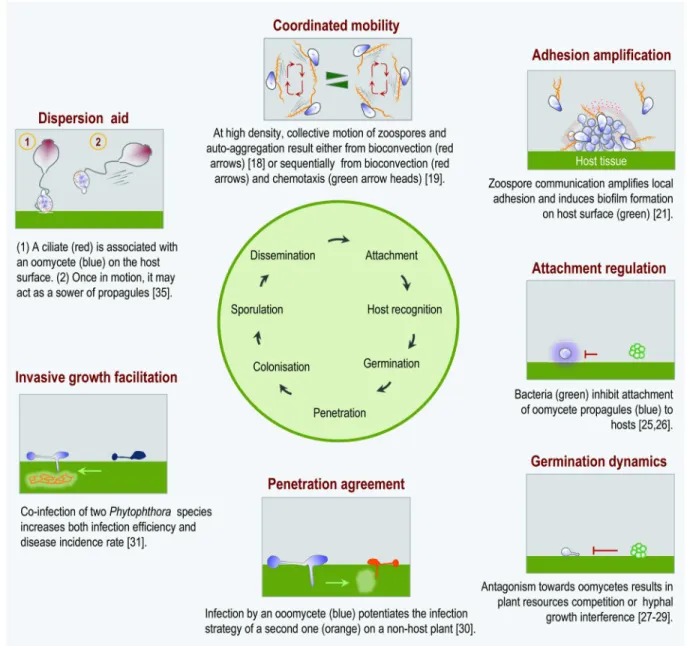
infectious entity is no longer only considered at the species level but also at the level of a res-ident microbiota or part thereof [14]. This paradigmatic inflexion helps (i) to unravel the molecular basis of interactions between plants and their pathogens in natural systems and (ii) to delineate the complex network of interactions that determine the spatial and temporal distribution of inocula and the genetic structure of the pathogen population as well as the communal virulence-associated mechanisms. This report highlights studies that establish how different aspects of the infectious process can be regulated by interactions between oomycetes or between oomycetes and other microbial species (Fig 1).
How Do Zoospores Coordinate Their Motion?
The plant infection initially depends on the ability of biflagellate zoospores to reach host tis-sues, except for cases in which oomycete species have lost the ability to produce swimming cells. Plants emit concentration gradients of attractants, which help a zoospore in targeting
a1111111111 a1111111111 a1111111111 a1111111111 a1111111111 OPEN ACCESS
Citation: Larousse M, Galiana E (2017) Microbial Partnerships of Pathogenic Oomycetes. PLoS Pathog 13(1): e1006028. doi:10.1371/journal. ppat.1006028
Editor: Cyril Zipfel, The Sainsbury Laboratory, UNITED KINGDOM
Published: January 26, 2017
Copyright:© 2017 Larousse, Galiana. This is an open access article distributed under the terms of theCreative Commons Attribution License, which permits unrestricted use, distribution, and reproduction in any medium, provided the original author and source are credited.
Funding: ML was supported by a three-year PhD fellowship funded by INRA and the PACA region (France), and by a one-year ATER position (Temporarily Assistant to Education and Research) funded by the University of Nice-Sophia Antipolis. The funders had no role in study design, data collection and analysis, decision to publish, or preparation of the manuscript.
Competing Interests: The authors have declared that no competing interests exist.
optimal sites for infection [15,16]. Within thePhytophthora genus, zoospores may also adopt
collective motion. In Petri dishes and in the absence of chemical or electrical signals, they form plumes with cell concentrations increasing over time, a phenomenon named pattern swim-ming or auto-aggregation. An analysis ofP. citricola zoospore behavior—taking into account
the effects of surface tension, initial cell concentration, and suspension depth—suggests that the pattern swimming is an example of bioconvection, an overturning instability induced when the upper regions of a fluid become denser than the lower regions [17]. For zoospores, bioconvection involves (i) density instability because of the upward-swimming tendency of
Fig 1. A schematic representation of phenomenological interfaces between a disease cycle and an interfering microbiota. For different steps of a disease generic cycle (central green circle), the facets of cooperation and interaction (red subtitles) are illustrated by an inset provided with a legend below it. The reference numbers of reported cases of oomycete–oomycete and microbiota–oomycete interactions cited in the text are indicated.
the zoospores and (ii) gyrotaxis, which is the directed motion resulting from the orientation of cells by balancing gravitational and viscous torques [18]. Another series of experiments com-bined with mathematical modelling were conducted to investigate the auto-aggregation behav-ior inP. infestans zoospores. This work supports the hypothesis of a combination of
bioconvection and chemotaxis operating sequentially to achieve auto-aggregation. First, bio-convection causes the rapid formation of plumes. Then, chemotaxis between plumes is required to form larger auto-aggregates over a longer timescale [19]. A better understanding of the driving forces generated by bioconvection and of molecular mechanisms governing zoo-spore chemotaxis should help to define the conditions required for collective recruitment in the early phases of host infection.
What Are the Known Modes for Amplification or Inhibition of
Adhesion to the Host?
After the motile period and the attraction process, a transition from motile zoospore to non-motile cyst occurs on the host cell surface. It is characterized by the loss of flagella, the elabo-ration of a primary cell wall, and the secretion of adhesive molecules [20]. The polyphagous speciesPhytophthora parasitica may use zoospore communication to amplify and increase
local adhesion by means of biofilm formation. A cluster of founder cells adheres at the same site of infection and emits an unknown signal. Then, the oriented migration of additional waves of zoospores leads to biofilm formation by local and massive encystment. The struc-ture is embedded within an extracellular mucilage and is speckled with channels in which swimming zoospores circulate [21]. The biofilm transcriptome is characterized by the coor-dinated up-regulation of a set of genes encoding mucin-like proteins, exporters and/or importers of substrates, and RXLR effectors [22,23] suggesting that the biofilm contributes to the dynamics of recruitment of effector functions to optimize infection effectiveness. Diverse lines of further research need exploration with respect to addressing structural and functional aspects of the biofilm, especially in natural habitats of oomycetes. For instance, how do zoospores deal with biosurfactants produced in the soil by bacteria such as Pseudo-monas [24] to succeed in aggregation at the host surface? Does the biofilm increase the sur-vival and resistance of oomycetes to environmental variations (temperature, hydric
potential, and salinity) and/or to (bio)chemical stresses (microbial antibiosis activities, plant defense responses, or anthropogenic treatments against crop diseases)? Is it a structure favor-ing exchanges of signals and/or nutrients between sessile, biofilm-associated cells and plank-tonic zoospores or other circulating microorganisms? Is it involved in mediating
competition or cooperation occurring at the surface of host cells between oomycetes and other pathogens or opportunistic microorganisms?
The first investigations of the metainteraction between an oomycete and a resident micro-biota have explored fish micromicro-biota andSaprolegnia-associated egg disease [25,26]. These stud-ies show that attachment ofSaprolegnia species on fish eggs is regulated by interkingdom
interactions between the oomycete and bacterial microbiota. A metataxonomic analysis indi-cated a correlation between a low incidence of saprolegniosis on salmon eggs having an imma-ture adaptive immune system and a high richness and abundance of specific commensal Actinobacteria. Bacteria from the genusFrondihabitans effectively inhibit attachment of Sapro-legnia to eggs [25]. Another study established that within Gammaproteobacteria, Pseudomo-nadaceae represents one of the largest bacterial families associated with salmon eggs from a hatchery.Pseudomonas isolates from the microbiota associated with salmon eggs reduced egg
mortality caused bySaprolegnia diclina [26]. Thus, the prokaryotic microbiota appears as one of the determining factors in establishing infection.
How Do Members of a Resident Microbiota Regulate Cyst
Germination and Hyphal Elongation?
Following encystment, a germination tube emerges that becomes firmly attached to the host surface. Different case studies report that microorganisms growing in the rhizosphere may exhibit antigerminative properties against plant pathogens. The oomycetePythium oligandrum,
licensed as a biocontrol agent, is a parasite ofPhytophthora and Pythium species. The
mecha-nism of inhibition consists of a nutrient and/or space competition towardPythium ultimum in
the cotton or sugar beet rhizosphere [27]. It involves the production of hydrolytic enzymes (e.g., cellulases) and the deposition onto the inner cell surface ofPhytophthora parasitica, the
causal agent of the black shank disease [28]. The bacteriaEnterobacter cloacae suppresses Pythium ultimum seed rot by competition with the oomycete for plant-derived unsaturated
long-chain fatty acids. A genetic approach pointed out the role of two bacterial genes in nutri-ent competition:fadB, encoding a subunit of β-oxidation enzymes, and fadL, encoding an
outer membrane protein involved in the binding and transport of fatty acids into the cell. This competition leads to inhibition of oomycete germination and disease suppression [29].
Do Microbial Partners Contribute to Penetration and Invasive
Growth into the Host?
Pathogenicity of oomycetes also depends on their ability to enter into host tissues. A coinfec-tion by two oomycetes can potentiate infeccoinfec-tion strategies among which there is gene expres-sion for secreted effector proteins that manipulate structure, signaling, and metabolism of the host.Albugo laibachii infection enables colonization of the nonhost plant Arabidopsis thaliana
byPhytophthora infestans. The set of P. infestans effector genes induced during the tripartite
interaction overlaps with the genes induced in the host plantSolanum tuberosum. The
penetra-tion ofP. infestans into A. thaliana tissues does not induce cell death associated with the
hyper-sensitive response, a mechanism used by plants to prevent the spread of infection. The authors of this study also report observation ofA. laibachii and P. infestans haustoria in the same plant
cell [30]. Analysis of different multipartite interactions could help to understand how coinfec-tion of host cells allows some oomycetes to act as opportunistic pathogens.
After successful penetration, the ability for invasive hyphal growth by elongation and rami-fication through the host tissue determines disease incidence. Different interspecific activities of extracellular products increase both infection efficiency and disease incidence rate. Superna-tants conditioned by zoopsores of four species (Phytophthora capsici, P. hydropathica, P. sojae,
andP. nicotianae [P. parasitica]) stimulate infection of each pathogenic species in three
patho-systems (Catharanthus roseus cv. Little Bright Eye × P. nicotianae; Lupinus polyphyllus × P. sojae; Glycine max cv. Williams × P. sojae). The molecular basis of this cross signal remains to
be determined [31]. Homoserine lactones such as AI-2 involved in interspecies communica-tion between bacteria species [32] or involved in the quorum sensing in many bacterial species [33] could not be identified in the zoospore-conditioned supernatants [31]. Supernatants con-ditioned by the telluric bacteriumBacillus megaterium Sb5 stimulate both plant infection by
thePhytophthora species and up-regulation of effector gene expression in P. sojae [34].
Is There a Contribution of Microbiota to Oomycete Propagule
Dissemination in the Soil?
Rapid spreading of epidemics involves zoospore motility as the main dispersal mode for move-ment in soil. Other microbial species may contribute to a secondary mode of propagule disper-sion through transitory physical association with pathogenic oomycetes. A motile unicellular
Vorticella acts as a sower of propagules through a mutualistic interaction. The ciliate is able to
colonize aP. parasitica biofilm, at which point it becomes sedentary, presumably to initiate a
bacterial nutrition phase. When it again explores new habitats, it disseminatesP. parasitica
propagules of large size, which may include a sporangium. They are disseminated at high velocity, reaching up to 100μm/s. They lead to the propagation of tobacco black shank disease, at least under laboratory conditions in a Boyden chamber system [35].
Until now, most of these studies have been performed under experimental conditions designed to mimic some of the more propitious aspects of natural habitats for the establish-ment of the host–oomycete interaction. An important challenge will be to now design sam-pling plans enabling the analysis of the functional capacity of microbiota and the evolutionary trajectories within microbiomes in natural habitats of oomycetes [36,37]. It is required to gen-erate metagenomics and metatranscriptomics data in these conditions, in particular to explore the effector gene repertoire [38] in order to determine the contribution not only of the coevo-lution betweenR gene and effector pairs but also of the pleiotropic aspects of the microbiota–
oomycete coevolution [13] to the maintenance of effector gene polymorphisms in oomycete populations [39]. On the other hand, a greater understanding of the microbial partnerships of oomycetes constitutes a vector for innovations in protection against diseases. The physics and biology of collective zoospore motion should help to elaborate biomimic materials for early monitoring of pathogenic populations in agrosystems [40,41]. Phylogenetic, ecological, and functional characterization of the oomycete–microbiota network, in combination with analy-ses of shifts in plant microbiota composition in disease and healthy states, will contribute to get new insights in epidemiology. They should lead to the definition of biotic factors favorable to environmental distribution of inocula and to disease circulation. They will also be condu-cive to the development of microbiota-based strategies after setting the composition for new biocontrol products and the conditions of application [42,43].
Acknowledgments
We are extremely grateful to the reviewers who provided very constructive and beneficial feed-back for the shaping of this manuscript. We also extend our thanks to Odile Berge, Aurèlie Deveau, and Florence Val for helpful discussion and to William Rhamey for editing of the paper.
References
1. Kamoun S, Furzer O, Jones JD, Judelson HS, Ali GS, Dalio RJ, et al. The Top 10 oomycete pathogens in molecular plant pathology. Mol Plant Pathol. 2014; 16(4):413–34. doi:10.1111/mpp.12190PMID:
25178392
2. van West P, Beakes GW. Animal pathogenic Oomycetes. Fungal Biol. 2014; 118(7):525–6. doi:10. 1016/j.funbio.2014.05.004PMID:25088068
3. O´ Grada C. Black ’47 and Beyond: The Great Irish Famine in History, Economy, and Memory. Prince-ton University Press, 2000. p. 216.
4. Dixon B. Pushing Bordeaux mixture. Lancet Infect Dis. 2004; 4(9):594. doi:10.1016/S1473-3099(04) 01136-3PMID:15336227
5. Jones JD, Dangl JL. The plant immune system. Nature. 2006; 444(7117):323–9. doi:10.1038/ nature05286PMID:17108957
6. Birch PR, Armstrong M, Bos J, Boevink P, Gilroy EM, Taylor RM, et al. Towards understanding the viru-lence functions of RXLR effectors of the oomycete plant pathogen Phytophthora infestans. J Exp Bot. 2009; 60(4):1133–40. doi:10.1093/jxb/ern353PMID:19204033
7. Hein I, Gilroy EM, Armstrong MR, Birch PR. The zig-zag-zig in oomycete-plant interactions. Mol Plant Pathol. 2009; 10(4):547–62. doi:10.1111/j.1364-3703.2009.00547.xPMID:19523107
8. Dong S, Raffaele S, Kamoun S. The two-speed genomes of filamentous pathogens: waltz with plants. Curr Opin Genet Dev. 2015; 35:57–65. doi:10.1016/j.gde.2015.09.001PMID:26451981
9. Karasov TL, Kniskern JM, Gao L, DeYoung BJ, Ding J, Dubiella U, et al. The long-term maintenance of a resistance polymorphism through diffuse interactions. Nature. 2014; 512(7515):436–40. doi:10.1038/ nature13439PMID:25043057
10. Bulgarelli D, Garrido-Oter R, Munch PC, Weiman A, Droge J, Pan Y, et al. Structure and function of the bacterial root microbiota in wild and domesticated barley. Cell Host Microbe. 2015; 17(3):392–403. doi:
10.1016/j.chom.2015.01.011PMID:25732064
11. Bulgarelli D, Schlaeppi K, Spaepen S, Ver Loren van Themaat E, Schulze-Lefert P. Structure and func-tions of the bacterial microbiota of plants. Annu Rev Plant Biol. 2013; 64:807–38. doi: 10.1146/annurev-arplant-050312-120106PMID:23373698
12. Berg G, Rybakova D, Grube M, Koberl M. The plant microbiome explored: implications for experimental botany. J Exp Bot. 2016; 67(4):995–1002. doi:10.1093/jxb/erv466PMID:26547794
13. Agler MT, Ruhe J, Kroll S, Morhenn C, Kim ST, Weigel D, et al. Microbial Hub Taxa Link Host and Abi-otic Factors to Plant Microbiome Variation. PLoS Biol. 2016; 14(1):e1002352. doi:10.1371/journal.pbio. 1002352PMID:26788878
14. Kemen E. Microbe-microbe interactions determine oomycete and fungal host colonization. Curr Opin Plant Biol. 2014; 20:75–81. doi:10.1016/j.pbi.2014.04.005PMID:24845577
15. Tyler BM. Molecular basis of recognition between phytophthora pathogens and their hosts. Annu Rev Phytopathol. 2002; 40:137–67. doi:10.1146/annurev.phyto.40.120601.125310PMID:12147757
16. Judelson HS, Blanco FA. The spores of Phytophthora: weapons of the plant destroyer. Nat Rev Micro-biol. 2005; 3(1):47–58. doi:10.1038/nrmicro1064PMID:15608699
17. Pedley TJ, Hill NA, Kessler JO. The growth of bioconvection patterns in a uniform suspension of gyro-tactic micro-organisms. J Fluid Mech. 1988; 195:223–37. PMID:11543357
18. Ochiai N, Dragiila MI, Parke JL. Pattern swimming of Phytophthora citricola zoospores: an example of microbial bioconvection. Fungal Biol. 2011; 115(3):228–35. doi:10.1016/j.funbio.2010.12.006PMID:
21354529
19. Savory AI, Grenville-Briggs LJ, Wawra S, van West P, Davidson FA. Auto-aggregation in zoospores of Phytophthora infestans: the cooperative roles of bioconvection and chemotaxis. J R Soc Interface. 2014; 11(94):20140017. doi:10.1098/rsif.2014.0017PMID:24598206
20. Hardham AR. Cell biology of plant-oomycete interactions. Cell Microbiol. 2007; 9:31–9. doi:10.1111/j. 1462-5822.2006.00833.xPMID:17081190
21. Galiana E, Fourre S, Engler G. Phytophthora parasitica biofilm formation: installation and organization of microcolonies on the surface of a host plant. Environ Microbiol. 2008; 10(8):2164–71. doi:10.1111/j. 1462-2920.2008.01619.xPMID:18430009
22. Theodorakopoulos N, Govetto B, Industri B, Mass L, Gaysinski M, Deleury E, et al. Biology and Ecology of Biofilms formed by a plant pathogen Phytophthora parasitica: from biochemical Ecology to Ecological Engineering. Procedia Environmental Sciences 2011; 9:178–82.
23. Larousse M, Govetto B, Seassau A, Etienne C, Industri B, Theodorakopoulos N, et al. Characterization of PPMUCL1/2/3, three members of a new oomycete-specific mucin-like protein family residing in Phy-tophthora parasitica biofilm. Protist. 2014; 165(3):275–92. doi:10.1016/j.protis.2014.03.003PMID:
24739437
24. Kruijt M, Tran H, Raaijmakers JM. Functional, genetic and chemical characterization of biosurfactants produced by plant growth-promoting Pseudomonas putida 267. J Appl Microbiol. 2009; 107(2):546–56. doi:10.1111/j.1365-2672.2009.04244.xPMID:19302489
25. Liu Y, de Bruijn I, Jack AL, Drynan K, van den Berg AH, Thoen E, et al. Deciphering microbial land-scapes of fish eggs to mitigate emerging diseases. Isme J. 2014; 8(10):2002–14. doi:10.1038/ismej. 2014.44PMID:24671087
26. Liu Y, Rzeszutek E, van der Voort M, Wu CH, Thoen E, Skaar I, et al. Diversity of Aquatic Pseudomonas Species and Their Activity against the Fish Pathogenic Oomycete Saprolegnia. PLoS ONE. 2015; 10 (8):e0136241. doi:10.1371/journal.pone.0136241PMID:26317985
27. Gerbore J, Benhamou N, Vallance J, Le Floch G, Grizard D, Regnault-Roger C, et al. Biological control of plant pathogens: advantages and limitations seen through the case study of Pythium oligandrum. Environ Sci Pollut Res Int. 2014; 21(7):4847–60. doi:10.1007/s11356-013-1807-6PMID:23695856
28. Picard K, Tirilly Y, Benhamou N. Cytological effects of cellulases in the parasitism of Phytophthora para-sitica by Pythium oligandrum. Appl Environ Microbiol. 2000; 66(10):4305–14. PMID:11010874
29. van Dijk K, Nelson EB. Fatty acid competition as a mechanism by which Enterobacter cloacae sup-presses Pythium ultimum sporangium germination and damping-off. Appl Environ Microbiol. 2000; 66 (12):5340–7. PMID:11097912
30. Belhaj K, Cano LM, Prince DC, Kemen A, Yoshida K, Dagdas YF, et al. Arabidopsis late blight: Infection of a nonhost plant by Albugo laibachii enables full colonization by Phytophthora infestans. Cell Micro-biol. 2016; 19(1):e12628.
31. Kong P, Tyler BM, Richardson PA, Lee BW, Zhou ZS, Hong C. Zoospore interspecific signaling pro-motes plant infection by Phytophthora. BMC Microbiol. 2010; 10:313. doi:10.1186/1471-2180-10-313
PMID:21138563
32. Xavier KB, Bassler BL. Interference with AI-2-mediated bacterial cell-cell communication. Nature. 2005; 437(7059):750–3. doi:10.1038/nature03960PMID:16193054
33. McDougald D, Rice SA, Kjelleberg S. Bacterial quorum sensing and interference by naturally occurring biomimics. Anal Bioanal Chem. 2007; 387(2):445–53. doi:10.1007/s00216-006-0761-2PMID:
17019574
34. Kong P, Hong C. Soil bacteria as sources of virulence signal providers promoting plant infection by Phy-tophthora pathogens. Sci Rep. 2016; 6:33239. doi:10.1038/srep33239PMID:27616267
35. Galiana E, Marais A, Mura C, Industri B, Arbiol G, Ponchet M. Ecosystem screening approach for path-ogen-associated microorganisms affecting host disease. Appl Environ Microbiol. 2011; 77(17):6069– 75. doi:10.1128/AEM.05371-11PMID:21742919
36. Nelson EB, Karp MA. Soil pathogen communities associated with native and non-native Phragmites australis populations in freshwater wetlands. Ecol Evol. 2013; 3(16):5254–67. doi:10.1002/ece3.900
PMID:24455153
37. Crocker EV, Karp MA, Nelson EB. Virulence of oomycete pathogens from Phragmites australis-invaded and noninvaded soils to seedlings of wetland plant species. Ecol Evol. 2015; 5(11):2127–39. doi:10. 1002/ece3.1468PMID:26078850
38. Goss EM, Press CM, Grunwald NJ. Evolution of RXLR-class effectors in the oomycete plant pathogen Phytophthora ramorum. PLoS ONE. 2013; 8(11):e79347. doi:10.1371/journal.pone.0079347PMID:
24244484
39. Kemen AC, Agler MT, Kemen E. Host-microbe and microbe-microbe interactions in the evolution of obli-gate plant parasitism. New Phytol. 2015; 206(4):1207–28. doi:10.1111/nph.13284PMID:25622918
40. Pettitt TR, Wakeham AJ, McPherson GM. A desk study to review global knowledge on best practice for oomycete root-rot detection and control. Final Report on AHDB Project CP 126, Stoneleigh, Agriculture & Horticulture Development Board, 176 pp. 2015.
41. Rivière M-P, Ponchet M, Galiana E. The Millardetian Conjunction in the Modern World. Chapter 18 in "Pesticides in the Modern World—Pesticides Use and Management", book edited by Stoytcheva Marga-rita, ISBN 978-953-307-459-7, Published: October 21, 2011 under CC BY 3.0 license.©The Author(s). 42. Berg G, Krause R, Mendes R. Cross-Kingdom Similarities in Microbiome Ecology and Biocontrol of
Pathogens. Front Microbiol. 2015; 6:1311. doi:10.3389/fmicb.2015.01311PMID:26635772
43. Massart S, Martinez-Medina M, Jijakli MH. Biological control in the microbiome era: Challenges and opportunities. Biological control. 2015; 89 98–108.