HAL Id: hal-01379202
https://hal.archives-ouvertes.fr/hal-01379202v2
Submitted on 30 Jan 2017
HAL is a multi-disciplinary open access
archive for the deposit and dissemination of
sci-entific research documents, whether they are
pub-lished or not. The documents may come from
teaching and research institutions in France or
abroad, or from public or private research centers.
L’archive ouverte pluridisciplinaire HAL, est
destinée au dépôt et à la diffusion de documents
scientifiques de niveau recherche, publiés ou non,
émanant des établissements d’enseignement et de
recherche français ou étrangers, des laboratoires
publics ou privés.
Distributed under a Creative Commons Attribution - NonCommercial - NoDerivatives| 4.0
International License
Theoretical principles for biology: Variation
Maël Montévil, Matteo Mossio, Arnaud Pocheville, Giuseppe Longo
To cite this version:
Maël Montévil, Matteo Mossio, Arnaud Pocheville, Giuseppe Longo. Theoretical principles for
biol-ogy: Variation. Progress in Biophysics and Molecular Biology, Elsevier, 2016, 122 (1), pp.36 - 50.
�10.1016/j.pbiomolbio.2016.08.005�. �hal-01379202v2�
Theoretical principles for biology: Variation
Ma¨el Mont´evila,b,∗, Matteo Mossiob, Arnaud Pochevillec, Giuseppe Longod,e
aLaboratoire ”Mati`ere et Syst`emes Complexes” (MSC), UMR 7057 CNRS, Universit´e Paris 7 Diderot, Paris, France bInstitut d’Histoire et de Philosophie des Sciences et des Techniques (IHPST) - UMR 8590, 13, rue du Four, 75006 Paris, France
cDepartment of Philosophy and Charles Perkins Centre, The University of Sydney, Sydney, Australia
dCentre Cavaill`es, R´epublique des Savoirs, CNRS USR3608, Coll`ege de France et ´Ecole Normale Sup´erieure, Paris, France eDepartment of Integrative Physiology and Pathobiology, Tufts University School of Medicine, Boston, MA USA
Abstract
Darwin introduced the concept that random variation generates new living forms. In this paper, we elaborate on Darwin’s notion of random variation to propose that biological variation should be given the status of a fundamental theoretical principle in biology. We state that biological objects such as organisms are specific objects. Specific objects are special in that they are qualitatively different from each other. They can undergo unpredictable qualitative changes, some of which are not defined before they happen. We express the principle of variation in terms of symmetry changes, where symmetries underlie the theoretical determination of the object. We contrast the biological situation with the physical situation, where objects are generic (that is, different objects can be assumed to be identical) and evolve in well-defined state spaces. We derive several implications of the principle of variation, in particular, biological objects show randomness, historicity and contextuality. We elaborate on the articulation between this principle and the two other principles proposed in this special issue: the principle of default state and the principle of organization.
Keywords:
Variability, Historicity, Genericity, Biological randomness, Organization, Theory of organisms
Since the beginning of physics, symmetry
considerations have provided us with an extremely powerful and useful tool in our effort to understand nature. Gradually they have become the backbone of our theoretical formulation of physical laws.
Tsung-Dao Lee The artificial products do not have any molecular dissymmetry; and I could not indicate the existence of a more profound separation between the
products born under the influence of life and all the others.
L. Pasteur
Contents
1 Introduction 2
∗Corresponding author
Email addresses: [email protected] (Ma¨el Mont´evil), [email protected] (Matteo Mossio),
[email protected] (Arnaud Pocheville), [email protected] (Giuseppe Longo)
URL: http://montevil.theobio.org (Ma¨el Mont´evil), http://www.di.ens.fr/users/longo/ (Giuseppe Longo)
• Published as: Ma¨el Mont´evil, Matteo Mossio, Arnaud Pocheville, Giuseppe Longo, Theoretical principles for biology: Vari-ation, Progress in Biophysics and Molecular Biology, Available on-line 13 August 2016, ISSN 0079-6107, http://dx.doi.org/10.1016/ j.pbiomolbio.2016.08.005.
2 Invariance and symmetries: physics as the domain of generic objects 3
3 Variation and symmetry changes: biology as the domain of specific objects 5
3.1 Randomness proper to specific objects . . . 6
3.2 Constraints and specific objects . . . 7
3.3 Constraints and randomness . . . 7
3.4 Historicity . . . 9
3.5 Contextuality . . . 10
3.6 Variability . . . 11
3.7 Modelization and specific objects . . . 12
3.8 Conclusive remarks on the principle of vari-ation . . . 13
4 Bringing organization into the picture 13 4.1 Organization grounds constraints in specific objects . . . 13
4.2 The epistemological status of closure under variation . . . 14
4.3 Relevant variation with respect to closure . 14 4.4 Closure remains closure under variation . . 15 5 Non-identical iteration of morphogenetic
pro-cesses 16
1. Introduction
A striking feature of living beings is their ability to change. All naturalists know that two individuals of the same species usually display important qualitative differ-ences. All experimentalists know that two replicate ex-periments can give quite unexpectedly different results – even in the absence of any abnormality in the experimental setup.
Variation took a central role in biological reasoning in Darwin’s book The Origin of the Species (1859) in which it served as a means to explain the current diversity of life, by virtue of the concept of “descent with modifica-tion” (Darwin, 1859, pp.119-124): organisms might show some differences from their parents, these differences might be heritable and, under some proper conditions, accumu-late to form new lineages. Importantly, to Darwin, some of these variations would be “chance” variations, that is, changes that would be unrelated to the conditions of exis-tence of the organisms, and even unpredictable (Darwin, 1859, p.p 131, 314)1. In so doing, Darwin introduced con-tingency and historicity into biological thinking: accidents would happen along life’s trajectory, which would at the same time be unpredictable, unrepeatable, and have long lasting effects (Gould, 2002, p. 1334).
In this paper, we elaborate on the Darwinian idea of “chance” variation. We argue that variation should be given the status of a principle in biology, and in particu-lar organismal biology. Informally, the principle of varia-tion states that biological objects (such as organisms) con-tinually undergo modifications. Some of these variations have functional repercussions, which we discuss with pre-cise concepts in section 3). Moreover, whatever the math-ematical frame used to describe an object, unpredictable variations are nevertheless possible: the principle of varia-tion thus implies that the existence of excepvaria-tions is the rule in biology. However, a proper biological theory cannot be a mere catalog of exceptions. Accommodating the changes biological organisms undergo during their lives (ontogene-sis), as well as during evolution (phylogene(ontogene-sis), in a general theory is a specific challenge raised by biological systems, in particular in contrast to physical theorizing.
In physics, theoretical definitions enable us to discuss abstractly and adequately the behavior of objects (such as the trajectory in space of a punctual object of mass m in classical mechanics, or the behavior of quantum objects as a vector in a Hilbert space in Quantum Mechanics).
1This concept of chance variation contrasts sharply with, for
in-stance, the concept of variation of Lamarck (1809) another father of theoretical biology. To Lamarck, variations would be directed by the conditions of existence. This directedness entails that if the condi-tions of existence re-occur in time, evolution is repeatable and thus, ahistorical (Gould, 2002, p. 191). Other 19thcentury writers would
advocate that variation would be so canalized (by the properties of the organisms) as to direct evolution (when evolution was acknowl-edged). See e.g. Bowler (2005; Pocheville & Danchin (2016) for more details.
Such a theoretical framework does not (yet) exist for the biology of organisms and our proposal aims at contributing to the elaboration of the “biological counterpart” of the theoretical frameworks and abstract objects at work in physics.
It is worth emphasizing that, although we will elab-orate on the concept of variation by analogy with and in contrast to the physico-mathematical perspective, we by no means advocate a physico-mathematical treatment of biological phenomena. Rather, we think that biology in general, and the biology of organisms in particular, requires a significant change of perspective with respect to the physical viewpoints and methodologies. Typically, physics provide an ahistorical understanding of the phe-nomena studied2. In contrast to physics and in line with the theory of evolution, we argue that historicity is an es-sential feature of biological phenomena and that biological historicity stem from the principle of variation.
The principle of variation is related to the other princi-ples put forward in this special issue: the biological default state (proliferation with variation and motility), and the principle of organization. The default state is described as a primary generator of variation; when a cell divides, it generates two non-identical cells (Soto et al., 2016). The principle of variation specifies the nature of the difference between these cells. The principle of organization is a way to interpret biological functions as a property stemming from the role that parts play in the maintaining of a sys-tem (Mossio et al., 2016, 2009; Mont´evil & Mossio, 2015). According to this principle, a biologically relevant part (constraint) both depends on and maintains other parts of the organism, thus forming a mutual dependence (labeled “closure” for historical reasons). In Mossio et al. (2016), variation and organization are discussed as two intertwined principles: organization is a condition for variation and fa-vors its propagation, whereas variation is a condition for the maintenance and adaptation of biological organization and for the generation of functional innovations. In sec-tion 4 of this text, we argue that any relevant variasec-tion is a variation of an organization.
Biological variation occurs at all levels of organization, from the molecular level to large scale structures and func-tions (West-Eberhard, 2003; Dueck et al., 2016). Single cell observations on one side and high throughput tech-nologies on the other enable biologists to observe both inter-cellular and inter-individual variations, which have received an increasing amount of attention (Elowitz et al., 2002; Collective, 2005; Rivenbark et al., 2013). There
2As a matter of fact, physical approaches and methodologies are
not confined to the physical and biophysical domain and have, in part, percolated in biology and even social sciences. Such was the case, for instance, of the proposal of vital forces by some vitalists. These vital forces were conceived by analogy with Newtonian grav-itation and would entail spontaneous generation as a result of this force acting on the right objects (De Klerk, 1979). Vital forces are an example of how the physico-mathematical approach typically implies an ahistorical understanding of the living, as we stress below.
are many generators of variation among which are ran-dom gene expression, instability in morphogenetic pro-cesses and randomness in biological rhythms. In partic-ular, cellular proliferation generates variation (Soto et al., 2016). As for temporal scales, living systems undergo vari-ation during their lives (ontogenesis), as well as during evolution (phylogenesis), and these two aspects cannot be analyzed independently (Danchin & Pocheville, 2014). In this paper, we focus on variation as a general feature of biological systems without a privileged level of analysis. This enables us to discuss general features that are proper to biology and to stress key differences with respect to physics.
The central implication of this paper is the distinc-tion between the objects as conceived in physical theories (generic objects) and the objects as conceived in biology on the basis of biological variation (specific objects)3. In what follows, we discuss first shortly what generic objects are, what kind of manipulation they enable, and how their analysis grounds physical theories (section 2). Then, we contrast generic objects with the variation that biological objects exhibit. We propose that biological objects should be understood as specific (in section 3). Specific objects are, in particular, fundamentally historical, variable and contextual. Thus, the specificity of organisms encompasses biological individuation and diversity. We also discuss the interplay between specific objects and physical morpho-genesis. Then, in section 4 we elaborate on the integration between the principle of variation and the principle of or-ganization, between the notion of biological specificity for biological objects and the notion of organization and “con-tingent genericity” (Moreno & Mossio, 2015; Mont´evil & Mossio, 2015; Mossio et al., 2016). Finally, we develop the idea that biological systems are characterized by the non-identical iterations of morphogenetic processes (section 5). 2. Invariance and symmetries: physics as the
do-main of generic objects
The principle of variation poses novel challenges with respect to how mathematics enables us to describe the world. To better identify these challenges, we first make a detour by physics and show the role mathematics play in physical theories.
Physics is based on mathematized theories. Histori-cally, the development of physical theories has been inter-twined with the development of appropriate mathematics to frame and define their objects: they have “co-evolved”. We submit that mathematized physical theories rely on the manipulation of generic objects (Bailly & Longo, 2011; Longo & Mont´evil, 2014a). The notion of generic objects is abstract, as it lies at the core of physicomathematical rea-soning. However, the intuitive idea is quite simple: generic
3An introduction to this distinction is given by Soto & Longo
(2016).
objects are objects which are all of the same kind from the point of view of the theory (they typically obey the same equations). An apple, the Earth, an anvil, for example, are all objects with a given mass and center of gravity and, from the point of view of classical mechanics, they all obey the same equations in the vacuum. Moreover, they continue to obey the same equation during their dynamics even though they undergo some changes: this is because, in physical language, their changes are restricted to changes of state. Equations are not about specific values of the parameters or states; instead they jointly describe generic relations between parameters, states and the changes of states4. This is why changes of state of an object do not affect the validity of the equation which describe its behav-ior. For example, the mass is an element of the description of some generic objects, formalized by a generic variable m representing jointly and synthetically all the possible masses.
Physical objects, hence, are generic objects. More gen-erally physical ‘laws’ are about generic objects. Consider for example the fundamental principle of dynamics: mass times acceleration equals the sum of external forces applies to the object. Here, the “external forces” are understood in a completely generic manner and any kind of forces may be involved.
Typically, a physical object is described in a mathe-matical space which is generated by the various quantities required to describe this object. This mathematical space is called the ‘phase space’5. In classical mechanics, the phase space is the space of positions and momenta. This mathematical space is given in advance; it pre-exists the description of the object. The behavior of the physical object is defined as the way in which the object changes in its phase space. The space is also assumed to provide all the causes of the changes of the object, and thus it specifies the quantities that should be measured experi-mentally. In classical mechanics, positions and momenta, in combination with properties such as the mass, are the quantities required to understand the changes of positions and momenta over time.
A phase space, however, is not sufficient to understand the behavior of an object because the quantities it pro-vides need to be articulated together to understand the changes of the object6. In physics, a theoretical framework requires equations that depend on the variables
symboliz-4Simulations suffer from a shortcoming in this respect. While a
program does describe generic relationships between the variables, a simulation run only provides one trajectory for specific values of its input. Whether this trajectory is representative of the behavior of the system for other values of the input, that is to say whether the behavior obtained is generic or not, is a very difficult mathematical issue (Stoer & Bulirsch, 2013).
5Some physicists restrict the notion of ‘phase space’ to positions
and momenta. Here, phase space means in general the space of mathematical description of the object.
6The a priori diversity of possible trajectories in such a space is
unfathomable in the sense that no axiomatic is sufficient to describe all their possible mathematical features.
ing the quantities describing the objects. The behavior of an object, that is to say its changes, is determined as a specific trajectory by equations that single it out in the phase space. Equations are valid for the phase space (or, at least, some regions of it) and depend on its quantities. The behavior of the object is completely determined by the quantities that define its phase space and the corre-sponding equations. Predicting a trajectory corresponds to making this trajectory mathematically remarkable. To this end, equations typically correspond to optimization principles (for energy, entropy, entropy production, etc.), which enable physicists to single out a trajectory, the op-timal trajectory that the system follows according to the theory. Optimization principles and the ability to derive equations are essential for fundamental physical theories and special models to make predictions.
For the purposes of this paper, the key question to be asked at this point is what justifies the use of the spaces and equations in the theoretical constructions of physics. In part, these mathematical structures stem from axioms and are justified by their consequences. However, there is more to say on the nature of fundamental hypotheses of physics and the way in which they justify the use of mathematics.
Because whole classes of concrete objects are described in the same mathematical frame, they are studied as the same generic object, and all have the same behavior. As we evoked above, a piece of lead, an apple, or a planet are all the same objects from the viewpoint of classical grav-itation: they all are point-wise objects with a position, a momentum, a mass, and they all are subject to the prin-ciple of inertia and gravitational forces, described by the same equations. In this respect, there is no relevant dif-ference between them and they are described jointly and synthetically as the same generic object. At the core of this approach to natural phenomena lies the identifica-tion of identical objects. This identificaidentifica-tion of non-identical objects is made explicit by transformations that leave these objects invariants (i.e. symetries). Putting an emphasis on transformations is a modern approach in mathematics and physics that we build upon in this paper. In particular, invariants are best described by the trans-formations that preserve them and which make explicit a mathematical structure.
Generic objects are, for the most part, defined by the transformations that preserve them, and that enable us to define stable mathematical structures. We call such trans-formations ‘symmetries’. The notion of symmetry we use is more general than the concept of geometrical symme-try in a three-dimensional space. Yet, the underlying idea is the same: geometrical symmetries are transformations which leave a geometrical figure invariant. Rotating a cle around its center, for instance, does not modify the cir-cle: it verifies a central symmetry7. Similarly, symmetries (in general) are transformations which leave the relevant
7Another example comes from topology, a notion very useful in
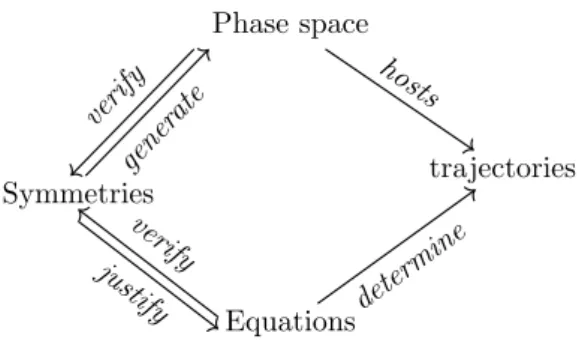
Phase space Equations trajectories Symmetries determine hosts verify gener ate verify justify
Figure 1: Articulation of the different components defining a generic object in physics. Equations determine the trajectory of a system, and this trajectory takes place in a mathematical space. Both the equations and the space have a structure that is described by the the-oretical symmetries that frame the object and that are valid by hy-pothesis. There is a fundamental feedback that we do not represent here: trajectories are the endpoint which fundamentally justifies the whole theoretical construction of the generic object as experimenter can observe them.
aspects of an object invariant. For example, cutting an apple into two halves does not change the way it falls in the vacuum. Hence, an apple and its two halves are sym-metric (they are the same) from the point of view of free fall in classical mechanics. Allometric relationships pro-vide a biological example of symmetry (Longo & Mont´evil, 2014b). In mammals, the average period of rhythms such as heart rate or respiratory rate is found experimentally to depend on mass with the relation τ ∝ M1/4. Measur-ing such relationships amounts to assumMeasur-ing that the basic properties of metabolism are preserved under the trans-formations consisting of changing sizes and species, and thus that mammals of different masses are symmetric as for their internal rhythms (West & Brown, 2005; Longo & Mont´evil, 2014b). Lastly, the assumption that different replicates of an experiment enable us to access the same situation also corresponds to an assumption of symmetry between the replicates: they are all supposed to behave in fundamentally the same way8.
Symmetries are the basis of the mathematical struc-tures in physics; that is the phase space and the relevant
biology. For instance, it is possible to deform a balloon into a sphere or a rod shape without tearing and/or stitching, but it is impossible to transform it into a donut. Similarly, it is impossible to transform a cell into two cells without tearing and/or stitching the membrane, where stitching corresponds here to the fusion of the membrane by pinching, and tearing corresponds to the final separation of the cells. In all these cases, continuous deformations are considered as symme-tries, insofar as they preserve topological invariants and, reciprocally, the topological invariants are the ones preserved by continuous de-formations. As a result, one can define different categories of shapes on the basis of their inter-transformability. Continuous deformations fall under our concept of symmetry and are characteristic to the field of topology.
8Notice that such an assumption is required in order to perform
statistical analyses. The most common statistical assumption is that two variables are identically distributed, that is to say that the two considered situations are symmetric as far as their probability dis-tributions are concerned.
equations. Accordingly, they constitute fundamental phys-ical assumptions which are less anthropomorphic than the notion of law and more meaningful than conservation prin-ciples (see for example Van Fraassen, 1989; Bailly & Longo, 2011; Longo & Mont´evil, 2014a).
For instance, the choice of an origin, three axes and a metric are mandatory in order to write equations and per-form measurement of positions and velocities (in Galilean, special, or general relativity). Although different choices are possible, the consistency of the theory depends on the fact that the trajectories obtained in different reference systems are, in a fundamental sense, the same: in par-ticular, they are invariant under suitable classical or rel-ativistic transformations of the reference system. Thus, the equations of physics are symmetric under these trans-formations9. In general, the same trajectory should be obtained before and after transformations which are fun-damental symmetries in the theory10, and these symme-tries enable us at the same time to formulate and justify the equations and the phase space11.
In short, physical objects are understood as generic objects that follow specific trajectories. Theoretical sym-metries ground this approach to natural phenomena. The epistemological structure of generic objects is summarized in figure 1. In the next section, we discuss the princi-ple of variation and the major challenges that biological variation raises when one tries to frame biological objects theoretically.
3. Variation and symmetry changes: biology as the domain of specific objects
A central and pervasive property of biological systems is their ability to change their organization over time12. These changes are not just quantitative changes, they are also qualitative. From a physico-mathematical point of
9Similarly, in electromagnetism the choice of assigning negative
or positive charges to electrons is arbitrary; therefore, permuting the sign of charges has to leave the equations invariants (the derived trajectories remain the same).
10In a mathematical model, some symmetries are theoretical
sym-metries which cannot be violated while others are more pragmatic symmetries that correspond to a particular situation. The two things should not be conflated. For example, a theoretical symmetry is the assumption that all directions of the empty space are equivalent. However, in a particular setting, all directions may not be equiva-lent, for example because of the position and the gravitational field of some planets. Another theoretical symmetry is the symmetry be-tween positive and negative charges in classical electromagnetism.
11Such justification of equations by symmetries is, in particular,
the core of Noether’s theorem, which justifies the conservation of energy (resp. momenta) on the basis of a symmetry by time (resp. space) translation of fundamental equations, among many other con-served quantities (Byers, 1999; Longo & Mont´evil, 2014c).
12While we mean here ‘organization’ in the technical sense
dis-cussed in Mossio et al. (2016), the reader can also interpret the notion in a more informal manner. The different parts of an or-ganism depends on each other and form a coherent whole. This interdependence of the parts and their relation to the whole form the organization of organisms.
view, qualitative changes typically imply changes of the relevant mathematical structures and, accordingly, changes of symmetries. For example, changes of states of matter in phase transitions typically correspond to changes of sym-metries: a liquid is symmetric by rotation while a crystal is not, because of its microscopic structure (see figure 3).
In the biological domain, the organization of any cur-rent organism has been shaped by permanent qualitative changes, that is, through changes of symmetries. A given biological organization is determined by an accumulation of changes of symmetries both on the evolutionary and the ontogenetic times13. These changes correspond to changes in the manner in which functions are performed, or even to the appearance or loss of functions.
Acknowledging that organisms can vary in this strong, functional sense, is not trivial: historically, the preforma-tionists (as for development), and the fixists (as for evolu-tion) have held just the opposite view. If the homunculus is already in the egg, or, in modern terms, if dna already contains a blueprint of the organism, then development is just the unfolding of an already existing organism (with all its relevant properties and functions). Similarly, if species do not change over geological time, then obviously organ-isms conserve the same functions.
The idea that biological objects genuinely develop and evolve over time corresponds to the idea that the mathe-matical structures required to describe them also change over time. Thus, stating that development and evolution involve symmetry changes constitutes nothing more than a mathematical interpretation of the departure from the preformationist or fixist stances of development and evo-lution. Evolution is rarely considered as entirely deter-mined as the unfolding of historical necessities. Similarly, development should not be seen as the unfolding of a pre-constituted organization but instead as a cascade of folding leading to the setting up of an organization (figure 2 and 4).
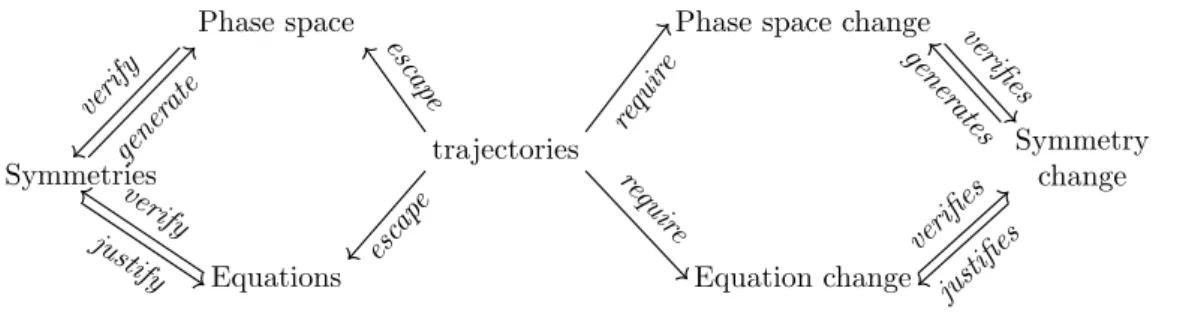
The crucial consequence of this view is that, because of their permanent symmetry changes, biological objects should not be considered as generic objects. Organisms are not well defined as invariant under transformations. When an organism is transformed, and in particular when the flow of time operates on it, the organism may undergo unpredictable qualitative changes. As a result, biologi-cal objects are not well described by the virtuous cycle described in figure 1. Accordingly, trajectories are not en-tirely framed by a mathematical framework: they may es-cape such frameworks and require a change in the symme-tries, space of description, and equations used to describe the object (figure 2).
We propose then to understand biological objects (and organisms in particular) as specific objects14. Specific ob-jects are constituted by a particular history of relevant and
13A more detailed presentation of most of these ideas can be found
in Longo & Mont´evil (2014a) and Longo & Mont´evil (2011, 2013).
Phase space Equations trajectories Symmetries escap e esc ap e verify gener ate verify justify
Phase space change
Equation change Symmetry change requir e requir e verifies gener ates verifies justifies
Figure 2: Scheme of an elementary symmetry change in biology. An initial situation, on the left, is described by analogy with physics (see figure 1). However in biology, variation can escape such a frame. Understanding the object then requires a change of symmetry and of the whole mathematical structure framing the object. Trajectories are at the center of this change, they escape the initial frame and thus require a change of the symmetries describing the object.
unpredictable symmetry changes over time, at all time-scales. Specific objects can be understood as the opposite of generic objects: two instantiations of a specific object may always differ by at least one of their relevant qual-itative aspects (in a given theoretical frame), while two instantiations of a generic object do not. For example, two organisms, be they clones, may always differ in one of their relevant qualitative properties, for instance because they may have undergone differences in their morphogen-esis, i.e., they have been constituted by different develop-mental histories.
On the basis of the concept of specific objects, we can now state the principle of variation:
Principle of variation:
Biological organisms are specific objects.
The principle implies that biological organisms undergo changes of symmetry over time and that, as we discuss be-low, some of these changes cannot be stated in advance15. In other words, the mathematical structure required to describe organisms is not stable with respect to the flow of time. Qualitative changes of structures and functions occur over time and some of them are unpredictable.
We now expand on several aspects and implications of the principle of variation.
3.1. Randomness proper to specific objects
A fundamental feature of the principle of variation is that it includes an original notion of randomness: the very fact that biological objects undergo unpredictable symme-try changes. Generally speaking, the notion of randomness is often conflated with the idea that events have some prob-ability of occurrence. However, scientific approaches to randomness are richer than the notion of (classical) prob-abilities (see for example Longo et al., 2011, for a discus-sion at the crossroads of different fields). Randomness may
concepts of ‘biological’ specificity, such as chemical specificity of en-zymes, or causal and informational specificity (see Griffiths et al., 2015).
15We would argue that even the rate of possible symmetry changes
cannot be stated in advance.
be defined generally as unpredictability with respect to a theory. The notion of randomness which stems from the principle of variation is not endowed with a probability measure.
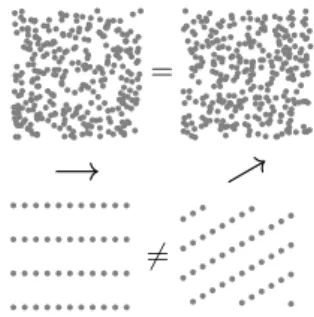
Let us first characterize randomness in the case of a ba-sic symmetry breaking, typically encountered in phyba-sical models. Let us start with a situation which is symmetric, for example a gas (figure 3, top). All directions are equiv-alent for this object: all macroscopic quantities (density of the gas, pressure, etc.) stay the same after rotation. When the symmetry is broken, directions are no longer equivalent; for example, there are privileged directions cor-responding to a crystal structure after a phase transition (figure 3, bottom). The symmetry of the initial situation means that all directions are initially equivalent and then that it is not possible to deduce the subsequent privileged directions in the crystal. As a result, the directions of the crystal are random in this theoretical account. Moreover, since all directions are symmetric in the initial conditions, all directions have the same probability to become one of the crystal’s privileged directions.
This physical situation exemplifies how symmetry break-ing and randomness are associated and how the initial symmetries define and justify probabilities (see Longo & Mont´evil, to appear, for a general analysis of this associa-tion).
Symmetry breaking and the associated randomness are relevant for biology but we submit that they are not suf-ficient. Biological randomness includes a fundamentally different notion. In the above case, the possible outcomes (all the possible directions in three dimensions) are defined before the symmetry breaking, as it is the mathematical space on which symmetries act. Saying that the gas is symmetric by rotation requires us to define rotations and therefore the set of all possible directions on which rota-tions act. In biology, in contrast, the principle of variation poses that the list of possible outcomes and therefore the relevant symmetry changes are not pre-defined. For exam-ple, it is not possible to embed all the spaces of description of current and future organisms within the space of de-scription of the last universal common ancestor (LUCA).
=
6=
Figure 3: Example of a symmetry breaking. The left pictures corre-spond to an initial situation and the right ones to the same situations after a rotation (represented by the arrows). The above diagrams show a disordered situation such as a gas or a liquid. This situa-tion is statistically symmetric by rotasitua-tion, there are no privileged directions. By contrast, the situation below corresponds to a crys-tal such as graphite. It is not symmetric by rotation (except with an angle of 180◦) and it thus has directions which have an intrinsic
physical meaning. The transition from the situation above to the situation below implies the introduction of new relevant elements: the directions of the crystals, which are random.
A part of the relevant symmetry and symmetry changes can only be listed a posteriori, that is, after their real-ization. These changes only make sense as a result of a previous history. Not only lineages, but also individual organisms, are subject to biological randomness, as their development can sometimes take new routes which were not expected in advance (e.g. West-Eberhard, 2003).
Note that we consider symmetry changes in general and not just symmetry breaking. Symmetry breaking cor-responds to symmetry changes which start from a situation that respects a given symmetry to a situation where this symmetry is no longer valid, as discussed above. Other symmetry changes are possible, for example one can go from an asymmetric situation to a symmetric one. In bi-ology, symmetry changes include the appearance of new and unpredictable symmetries corresponding to new rele-vant parts and their functioning. For example, the appear-ance of sexual reproduction in evolution corresponds to a separation of individuals in two genders in many species, where new symmetries (or equivalence) between males on one side and females on the other become fundamental as for their role in reproduction. New associated variables become relevant, for example the sex ratio of a population. Because of symmetry changes, the phase spaces of bi-ological objects also change in unpredictable ways over time. Symmetry and phase space changes constitute a specific form of randomness, proper to biological systems (Longo & Mont´evil, 2012; Longo et al., 2012a; Kauffman, 2013; Longo & Mont´evil, 2013). Biological randomness typically manifests itself through the appearance of new relevant quantities, parts, functions, and behaviors over time (for example limbs, toes, toenails, all the quantities required to describe them and the various functions that they can have).
3.2. Constraints and specific objects
The principle of variation does not preclude the pres-ence of elements of stability in biological systems. On the contrary, in order to show experimentally and describe the-oretically a change of symmetry, the preceding and follow-ing situations have to be stable enough to be described. In other words, a set of symmetries has to be at least approx-imately valid long enough before it changes for an observer to discuss it and after the change the new set has to be met for some time too. For example a given geometry of bones is conserved during movements of the organism at short time-scales, which corresponds to the conserved symmetry of a solid (the relative positions of points in a solid do not change). However, this geometry is plastic at longer time scales and very important changes can oc-cur especially during development (West-Eberhard, 2003). The change of two bones geometry at different times thus corresponds to a symmetry change, but the symmetries of these bones are met at short time-scales.
We call constraints the relevant stable elements at work in biological systems and their associated symmetries. Con-straints are local stable elements, in the sense that they only concern a particular aspect of a given organism. In addition, constraints are contingent insofar as they, and their associated symmetries, may change over biological time (which is implied by the principle of variation).
In short, we define constraints as symmetries (i.e. sta-ble mathematical structure) witch have a restricted range of validity and are used to describe a part of a specific object.
3.3. Constraints and randomness
In this section, we discuss the articulation between two kinds of randomness in specific objects. This discussion is more technical and may be skipped in a first reading.
A constraint (or a combination of constraints) exerted on biological dynamics may lead to a situation in which symmetry changes (if any) occur in a generic manner, typically as symmetry breaking. In the case of generic symmetry changes, these ‘random’ changes can be stated in advance, even though their specific outcome cannot. This randomness can be derived from constraints, and it is weaker than the randomness proper to specific objects. Let us start with morphogenesis as an example. Most (if not all) mathematical models of morphogenesis involve a symmetry change, which usually is a symmetry break-ing. Consider for instance Turing’s model of morphogene-sis (Turing, 1952)16. In this model, the equations describ-ing reactions and diffusion of chemicals remain invariant, so that their properties (rate of reactions, coefficient of diffusion, etc.) are stable constraints. In turn, these con-straints lead together to a symmetry breaking, because of
16Turing’s model is based on a basic symmetry breaking, where a
situation that is initially symmetric by rotation forms a pattern of alternation of concentrations of chemicals (and new quantities are needed to describe where this pattern is located).
the sensitivity of the non-linear dynamics to initial con-ditions (an instability, says Turing): minor fluctuations trigger different outcomes.
Another very different example of biological symmetry breaking is the dna recombinations in the maturation of lymphocytes (Thomas-Vaslin et al., 2013). The random process of recombination in a cell can be seen as a symme-try breaking from a situation where all the recombinations to come are equivalently possible to a situation where only one recombination is actually realized in each cell. After recombinations, the description of the system has to in-clude which possibility each cell has “chosen”. This sym-metry breaking makes the diversification of the immune repertoire possible under the constraint of enzymes.
Both cases (morphogenesis and dna recombinations) involve stable constraints, in an extremely sensitive pro-cess, which leads to a change of symmetry. These con-straints are stable parts of the organization of the consid-ered organisms. As a result, the associated changes are robust in the sense that they will occur as a consequence of these constraints. In such situations, a generic change of symmetry is established, which generates “new” relevant quantities but in a generic manner, i.e. the change belongs to a set of predefined possibilities. These new quantities are new in a weaker sense than the unpredictable new di-mensions of description that specific objects can generate. For example, the recombinations in the immune system can be seen as generic, as a set of possible physico-chemical recombinations of molecules. The outcome of such recom-binations is probably unique because the odds of perform-ing the same recombinations twice are vanishperform-ingly small, but this outcome is still generic. The situation is anal-ogous to the physical case of the positions of individual molecules in a gas which are basically unique, whereas the gas is still in a generic configuration because the gas is in a configuration of maximum entropy. However the actual immune repertoire in an adult mammal is not fully deter-mined by the generic properties of recombinations because the recombinations are just a part of the process estab-lishing this repertoire. The immune repertoire strongly depends on the specific history of the given organism, its environment, non-genetic inheritance (through milk and the microbiome), etc. (Thomas-Vaslin et al., 2013). The immune repertoire has a causal structure that is not deter-mined by pre-existing regularities. The dependency on the organism’s history is functional, it determines the immune response to specific pathogens and contributes to the dy-namic relationship with the microbiome. The biologically relevant properties of the immune repertoire are not the generic properties of recombinations, instead they are the specific properties which stem from a history. Hence, the actual repertoire of the adult contains more meaningful novel structures than the initial probabilistic recombina-tions.
Now, every time we describe a symmetry change ac-cording to current physico-mathematical methodology, it takes a generic form, that is, a possible change in a
pre-given space of possibilities which may be pre-given a priori probabilities. Biological objects are — by hypothesis — specific, but when we describe a particular change of sym-metry, it is studied a posteriori as a generic aspect of the object, and can be added to the past possibilities of a sys-tem. Randomness is then not correctly framed by a priori probabilities. Probabilities, if any, are defined a posteri-ori. A specific possibility is accommodated by the space of possibilities, but this space is obtained a posteriori and obviously does not include all future possibilities.
Let us unpack this idea. A physical symmetry breaking is a simple elementary process: a symmetry is met by the system, and after the symmetry breaking event, the sym-metry is no longer met. The possible breakings are given by the initial set of symmetries and make mathematical sense when they can be described in a given mathematical space where the symmetry operates. However, if a situ-ation is and always has been completely symmetric, the symmetries do not change anything and thus, cannot be properly evidenced as transformations (because the object is not changed at all). Thus the logic required to describe a new symmetry breaking has two steps. First the sym-metry that will be broken has to be added to the initial definition of the system and accordingly the states that are initially symmetric have to be added to the phase space of the object. They are added because they are required to accommodate their future breaking. Then, and only then, may the symmetry be broken. Such a modeling is retrodictive: the mathematical space, needed for an equa-tional model, can be given only after the change has been observed. In general, then, a biological dynamic must be understood as a possible path, out of many established along the biological dynamics, which consists in the com-position of stepwise symmetry changes.
In a given situation, some symmetry changes can be spelled out and analyzed in a generic framework because they are stabilized by (local) constraints. Let us consider such an elementary biological symmetry change, for exam-ple in a morphogenesis model. We can describe it explicitly with generic constraints but it is also possible to leave it implicit and consider that this single symmetry change is taken into account by the specificity of the object, among many other changes. The choice depends on the perspec-tive adopted to understand a given situation, including the scale of description and the phenomena of interest. For ex-ample, the intestine folding are usually kept implicit when studying brain morphogenesis.
Even though the boundaries of specific and generic as-pects of an organism are relative and may change after a new possibility is acknowledged or as a result of a change of perspective, the accurate description of any biological organism will always involve a component of specificity. In a given representation of an organism, all changes of sym-metry are then either accommodated by the specificity of the object or by generic symmetry changes. The concept of the specificity of biological objects aims to enable us to take into account theoretically all symmetry changes
without spelling out all of them explicitly. 3.4. Historicity
Historical objects are objects whose properties are ac-quired or lost over time, and cannot all be described ahead of time. The fact that biological organisms are specific objects straightforwardly implies that they are historical objects and, in particular, contingent objects in Gould’s sense (Beatty, 1995; Gould, 1989). Historicity thus goes hand in hand with biological randomness, which corre-sponds to the fact that a situation after a random event cannot be stated with certainty before the event. Thus, a system showing biological randomness shows historicity: the object takes a particular path among several possible paths through time. Reciprocally, historical objects nec-essarily show some randomness.
Let us first consider an analogy with dynamic systems. We can see a trajectory defined by a differential equation as the sum of infinitesimal changes from the initial condi-tions to any time point. By analogy, it is conceivable to see biological historicity as a sum or a sequence of variations since the origin of life. However, this idea does not have a well-defined mathematical and theoretical sense, insofar as such a history is not entirely accessible. Nevertheless, it is still possible to clarify the present in the light of the past — and, as a matter of fact, this is precisley one of the aims of evolutionary theories.
As discussed in Longo et al. (2015), although histor-ical objects exist also in physics, they are historhistor-ical in a weaker sense. Self-organized physical objects, for instance, are sometimes described as historical, mostly because they depend on a symmetry breaking. For example, the appear-ance of convection cells in a fluid corresponds to a qualita-tive change in the macroscopic dynamics of the fluid. Nev-ertheless, self-organized objects are spontaneous: they can be obtained de novo. Theoretically, they can be described as the spontaneous self-organization of flows of energy and matter. Even the physical situation of the early history of the universe can be obtained experimentally “just” by tun-ing a parameter (by obtaintun-ing very high local densities of energy with particles accelerators)17.
Despite these analogies though, physical self-organizing processes have no historical or evolutionary time in a strong theoretical sense; they may just have the time of a process. They entirely obey optimality principles from physics and past events have not shaped their properties, insofar as the symmetry breakings that self-organizing processes may en-counter are all pre-defined within the theory. A hurricane does have, so to speak, a “birth”, a “life”, and it does even-tually “die out”; yet, hurricanes have been the “same” kind of object for the past four billion years on Earth. Again,
17Incidentally, the idea of spontaneous generation in biology
stemmed from the same kind of reasoning: (generic) biological ob-jects would appear spontaneously by self-organization in the appro-priate milieu (De Klerk, 1979).
their time is that of a process. Their historicity is embed-ded within a pre-defined phase space.
The fact that we can understand such spontaneous ob-jects on the basis of a stable generic mathematical struc-ture is not fortuitous. Indeed, their spontaneous charac-ter corresponds to the fact that these objects can emerge from homogeneous initial conditions in the mathematical framework used to describe them. By contrast, specific objects are not framed by stable mathematical structures: they cannot be derived from homogeneous initial condi-tions and cannot be obtained spontaneously in practice. Even in the “origin of life” field, the aim is to produce a cell which can evolve and not a cell that is similar to all current cells as they have evolved for billions of years. Moreover the aim is certainly not to obtain a cell similar to any specific species (Pross & Pascal, 2013).
According to the principle of variation, biological ob-jects are the result of a cascade of unpredictable symmetry changes, which implies that they do not follow optimiza-tion principles and that they are not spontaneous. To be sure, biological objects did appear spontaneously in the history of life, but should one re-run the history of the Earth, one could not expect to obtain the same biological objects. It is not even possible to state in advance the mathematical space of possible forms that could be ob-tained. The historicity of biological objects is not embed-ded within the phase space anymore (as it was in physics): rather, the principle of variation means that the phase space itself is historical (figure 4).
At first sight, though, the claim that the phase spaces in biology are historical seems too strong: aren’t there some aspects of biological objects which are ahistorical? Evolutionary convergences, for instance, seem to be an ex-ample of an ahistorical aspect of the living: convergent features seem to be obtained independently of (some as-pects of) the past history of the organism. Let us first point out that evolutionary convergences are not about invariant properties of a given object over time, they are about mathematical structures that are similar in differ-ent historical paths. Let us consider the case of the cam-era eye of the vertebrates and of the cephalopods as an example. These eyes have different evolutionary origins but they are nevertheless similar and one could argue that they would be instances of the same generic object from a physicomathematical viewpoint, when described in terms of optical geometry for example.
The principle of variation, however, implies that the convergence is very unlikely to be qualitatively exact. There would always be a relevant biological description which would distinguish them sharply by pointing to differences in their organization and in their articulation with the rest of the organism. For instance, the retina is inverted in ver-tebrates: the axons of photoreceptors and their connection to ganglion cells and the optic nerve are located between the receptors and the light source, creating a blind spot at the level of the optic nerve. In cephalopods, axons are be-hind the photoreceptor which does not create such a blind
spot. A close analysis of both the phylogenetic and the on-togenetic paths makes the difference understandable: the high modularity of the cephalopods’ brain derives from an early separation of the brain’s modules by an invagination of the ectoderm, in contrast to the evagination of the dien-cephalon, due to the late separation of the eye component of vertebrates’ brains.
In short, the principle of variation implies that strict evolutionary (or developmental) convergence never occurs: symmetry changes are such that biological objects drift in a burgeoning phase space, and partial convergences always embed hidden differences which may be of importance with regard to the considered behavior of the biological object in that phase space. Reciprocally, the similarity between the organizations of different organisms stems from com-mon descent, that is to say from a shared history.
3.5. Contextuality
Organisms are contextual objects. In our theoretical framework, the symmetries of organisms depend on its en-vironment — both on its immediate enen-vironment and the environments encountered in its past history.
The fact that the symmetries of an organism depend on its immediate environment constitutes another similarity with self-organizing physical systems mentioned above, as the latter strongly depend on their boundary conditions. However, the principle of variation makes the contextuality of biological objects more fundamental than that of phys-ical systems. Contrary to physics, the possible changes of symmetry due to a change of the context are not all pre-defined. This means that an organism in a new environ-ment may undergo unpredictable reorganizations, which correspond to different relations between its internal con-straints and the environment, as well as different relations between its internal constraints, tout court. For example, we do not know a priori the many changes that can occur when bacteria that used to live with many other species in their natural and historical environment are grown as an isolated strain in laboratory conditions. Similarly, it is always difficult to assess whether the behavior of cells cul-tured in vitro is an artifact of in vitro culture, or whether it is biologically relevant (meaning that it corresponds to a behavior that happens in the context of the multicellular organism from which they were taken, see Mont´evil et al., 2016).
The contextuality of biological objects is coupled with their historicity (Miquel & Hwang, 2016): biological or-ganizations tend to maintain the effects of former envi-ronments and may even internalize their relationship with the environment over time. This holds at the develop-mental scale (think of how early plastic responses to the environment might be ’frozen’ later in development, see also Gilbert & Epel (2009)), at the scale of several gen-erations (for example through epigenetics), and at longer evolutionary scales (think, for instance, of the presence of lungs and lack of gills in marine mammals, which reflects a past terrestrial life).
Let us discuss two examples of internalization of the context on the developmental and on the evolutionary time scales, to show how it can lead to unexpected behaviors of biological objects.
On the developmental time-scale, an example of inter-nalization of past contexts is provided by the response of cells to hormones (Soto & Sonnenschein, 2005). Basically, the response of a cell to hormones does not depend only on the specific receptor and corresponding hormone in-volved but, rather, on the developmental history of this cell. More precisely, precursor erythroid cells are expected to differentiate into red blood cells when their erythropoi-etin receptors bind with erythropoierythropoi-etin. However, precur-sor erythroid cells which have been engineered to lack ery-thropoietin receptors and instead have receptors for pro-lactin do differentiate into red blood cells when they are exposed to prolactin, a hormone associated with lactation (Socolovsky et al., 1997). Conversely, mammary epithelial cells can be engineered to have a hybrid receptor with an extracellular part of a prolactin receptor and an intracel-lular part of an erythropoietin receptor. These engineered cells respond like normal mammary epithelial cells to pro-lactin (Brisken et al., 2002). These examples show that it is not the molecular specificity of a signal binding to a re-ceptor that determines the response of a cell to a hormone. In contact with a hormone for which it has a receptor, a cell rather responds according to the context of its cellular lineage during development, that is its trajectory in time and space (Soto & Sonnenschein, 2005).
On the evolutionary time-scale, a component of an or-ganism, as a result of a history, may be used for differ-ent purposes in differdiffer-ent contexts. The phenomenon of a character (be it the result of past natural selection or not) which is coopted for a current use has been named ‘ex-aptation’ by Gould & Vrba (1982). They provide many key examples, for instance: “the jaw arises from the first gill arch, while an element of the second arch becomes, in jawed fishes, the hyomandibula (suspending the upper jaw to the braincase) and later, in tetrapods, the stapes, or hearing bone” (Gould, 2002, p.1108). An ex-aptation is a re-interpretation, or re-use, of a trace of the past in a new context and, therefore, cannot be derived from the initial function of the parts involved. As a consequence, the detailed structure of the internal ear can be better understood by looking into the cumulative history of ex-aptations.
In light of the principle of variation, the internalization of current and past contexts provides one way (although not the only one) in which symmetry changes can occur throughout the history of an organism. As an illustration, the internalization of the context contributes to explaining the difficulty of replicating biological experiments, insofar as aspects of an experimental situation which can be rel-evant to the studied behavior may not be measured and can be traces of an (unknown) past (Begley & Ellis, 2012).
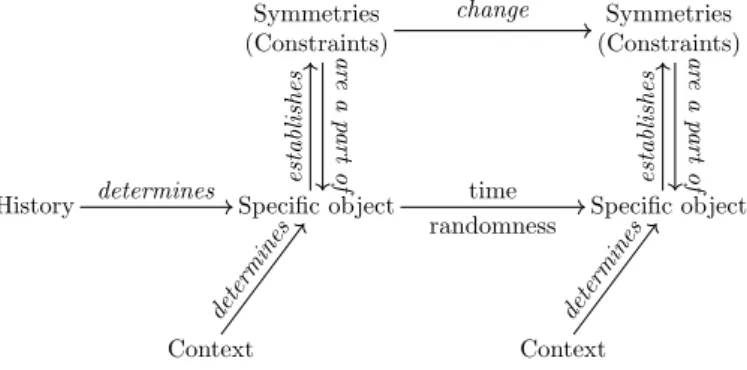
History Context Symmetries (Constraints) Specific object determines establishes ar e a part of determines Context Symmetries (Constraints) Specific object time randomness change determines establishes ar e a part of
Figure 4: Biological objects and their theoretical structure. Spe-cific objects are not defined by invariants and invariant preserving transformations. Instead, specific objects such as organisms undergo random variation over biological time. Their behaviors are not given by a synchronic description. Instead, they depend on a history and a context. Constraints are restricted invariants and symmetries, which may change over time and frame a part of the behavior of specific objects. Experiments and mathematical models usually investigate constraints and their changes.
3.6. Variability
The principle of variation underlies biological variabil-ity: the fact that multiple organisms or the same organism or lineage at different times exhibit differences when com-pared to each other.
The flow of time is the most fundamental transforma-tion acting on biological objects: as we argued, biological symmetries and accordingly biological organizations are not preserved as time passes.
Variability tends to be stronger when considering large evolutionary time scales than for shorter time scales. When one follows the succeeding generations from the LUCA to a randomly chosen current organism, for example a rat, many relevant aspects of the description needed to under-stand these organisms appear and disappear through time. Variability is also significant at physiological time scales, even at those that are much shorter than the lifespan of the considered organism. Heart rate, for example, does not obey homeostasis stricto sensu: the beat to beat interval is not invariant (in a healthy situation), and it does not even display fluctuations around a stable average value. In-stead, the beat to beat interval fluctuates in a multiscale manner (West, 2006; Longo & Mont´evil, 2014b). Typi-cally, the heart rate of a healthy subject displays patterns of accelerations and deceleration at all time scales during wake hours. Note, however, that the typical symmetries of multiscale fluctuations (scale symmetries) are not met either. Rather, many factors impact the multiscale feature of these variations of rhythms. For example, the current activity of the subject, her age, her life habits (smoking, exercising, etc.) and diseases change these multiscale fea-tures (Longo & Mont´evil, 2014b). These differences in the patterns of the variability of the beat to beat interval can even be used for diagnostic purposes (West, 2006; Bailly et al., 2011).
Besides the flow of time, the second set of transforma-tions relevant to variability are the permutatransforma-tions of dif-ferent organisms or difdif-ferent populations. Permutations correspond to the interchanging of different objects. They are fundamental symmetries in many physical frames: for example, it is axiomatic that all electrons follow the same equations (but they can be in many different states). In experimental biology, permutations of different animals or cells are often assumed to be symmetries: when one con-siders different animals of a control group, a common as-sumption is that they behave in the same way and that the quantitative variation observed stems from a proba-bility distribution that would apply to all of them. This assumption, in one form or another, is required to apply theorems of statistical analysis.
According to the principle of variation, however, the permutation between these organisms cannot be taken as a symmetry. Of course, organisms are related by a shared history, which enables us to determine that they are mice, rats, etc., of a given strain. Yet, the transformation which replaces one organism by another in the same group cor-responds to a comparison between the results of divergent paths stemming from a shared history. Here, divergence is taken in a strong sense and implies symmetry changes and not mere quantitative changes conserving the same sym-metries. For example, qualitative behaviors differ between different strains of the same species, even in unicellular oganisms (Vogel et al., 2015). Now, we illustrate this idea with a historical example.
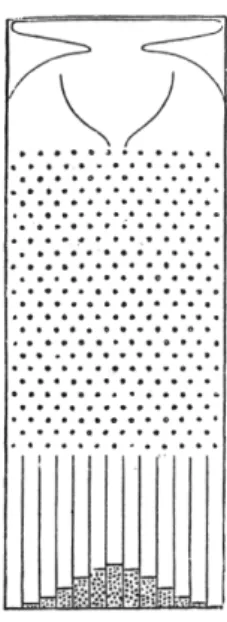
At the end of the 19th century, Sir Francis Galton, one of the founders of the notion of heredity, came up with a device, known as the bean box or the quincunx (see figure 5). The quincunx facilitated the simulation of a binomial distribution (the device would be used to simulate “normal variability”, Galton (1894, pp.63f)). The device consisted in a vertical frame with three parts: a funnel in its upper part, rows of horizontal pins stuck squarely in its middle part, and a series of vertical compartments in its lower part. A charge of small items (say, beans or balls) would be thrown through the funnel, travel through the pins, possibly bouncing in any direction, and would be gathered by the vertical compartments at the bottom (where they would not move anymore). In the end, the distribution of the items in the bottom compartment would approximate a binomial distribution.
In our terms, the bean box works the following way. The items share a common history when they get into the funnel, and this common history leaves a trace in the re-sult: depending on where the funnel is placed into the device (e.g. in the middle or not), the distribution of the items in the end varies. When the items exit the funnel, they take divergent paths (by bouncing on the pins) until they reach a vertical compartment. This is, however, di-vergence in a weak sense. For the bean box to work, all the items have to be supposed to be symmetrical, and all the realized paths have to be supposedly taken from the same underlying distribution. As a matter of fact, this
Figure 5: Galton’s quincux (Galton, 1894, pp.63). A ball falls but obstacles lead it to move randomly to the right or to the left. The outcome is variability in the position of the balls at the bottom of the device. This device illustrates variation in a pre-defined set of possibilities. Biological variation, by contrast, sometimes involves the constitution of new possibilities, which would amount for the ball to jump outside of the quincunx.
assumption is necessary for the use of statistics in biol-ogy: when performing an experiment on — say — rats, one supposes that all rats are independent realizations of a random variable taken from the same underlying distri-bution and that this distridistri-bution is stemming from their most recent common ancestor. The most recent common ancestor plays the role of the funnel; and subsequent muta-tions, effects of the environment, spontaneous variamuta-tions, etc., play the role of the pins. Variation can occur, but it will be merely quantitative and measured by the position on the horizontal axis in the bean box.
By contrast, the principle of variation posits that unex-pected (and unknown) qualitative variation permanently occurs. This means that different organisms are not differ-ent realizations of a random variable taken from an under-lying single distribution, as this distribution cannot even be defined. In terms of the bean box, this means that the pins unexpectedly open new dimensions (i.e. new relevant features arise), which would not be defined before the re-alization, and would not be reproducible after either. This is what we mean by divergence in a strong sense. Galton used his device to illustrate normal variability where vari-ability would be quantitative, in a pre-defined space. By contrast, the principle of variation implies that variation can be qualitative (i.e. symmetry changes) and that the space of variation is not pre-defined. This, to reiterate, applies both at ontogenetic and phylogenetic scales18.
18In experimental biology, organisms are often kept as historically
close as possible, they may be siblings for example. The aim is then to keep the divergence in their organization limited. We call
3.7. Modelization and specific objects
Current mathematical modeling practices in biology borrow mostly the epistemology of physics and are based on generic objects following specific trajectories. So far, we have argued that the theorizing of physical phenomena is based on stable mathematical structures and on the corre-sponding analysis of generic objects. We advocate, by con-trast, that biological organisms are specific objects moving along possible phylo-ontogenetic trajectories. Organisms have a historical and contextual nature and change their organization and functions over time.
This physicomathematical modeling practice in biology leads to many technical and epistemological problems. For example Boolean networks (see Kauffman, 1993) are used to model gene networks and are defined as random net-works where the existence of an edge between two nodes follows a given probability distribution. Such an assump-tion is a way to model protein or gene networks in an ahis-torical manner (and for example to generate them de novo in simulations). This disregards the fact that the actual phenomena are the result of evolution, and thus that ac-tual biological networks depend on the historical interplay between living beings and their environment, even at the molecular level (Yamada & Bork, 2009). Hence, they are not a sample of a random network following a given proba-bility distribution. This is also true for cell networks: in a tissue, cell to cell interactions or the production of proteins are largely a context- and history-dependent phenomenon. For instance, the “normalization” of a cell transferred from a cancer tissue to a healthy one can be understood as the effect of tissue context (and its history) controlling indi-vidual cellular activities (Soto et al., 2008; Sonnenschein & Soto, 2016). These examples show that the standard modeling strategies of a biological system struggle against the historicity and contextuality of biological organisms.
We interpret the “big data” approach, that aims at taking into account a massive amount of data in a model, as an attempt to address the consequences of the histori-cal nature of biologihistori-cal objects while keeping the physihistori-cal methodology of establishing intelligibility on the basis of generic objects. Such an approach, however, raises the question of the intelligibility of their object, because the complicated mathematical structures of models based on big data make only computer simulations possible. Other more physical approaches focus on generic features that even these historical systems would meet. For example, scaling laws in networks have been extensively investi-gated, but their validity is criticized (Fox Keller, 2005). Globally speaking, however, the methodological emphasis on generic features implies that the biological meaning of specific variations, and their role in a given organism, is lost. The issue is that without stable generic features, the
this experimental methodology, which aims at selecting biological objects in such a way as to reduce variability “symmetrization”. A more detailed analysis of biological experiments will be the object of a specific paper.